Zero conditional
First conditional
Second conditional
Third conditional
CONDITIONAL
SENTENCES
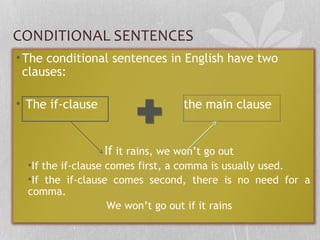
CONDITIONAL SENTENCES
•The conditional sentences in English have two
clauses:
• The if-clause the main clause
If it rains, we won’t go out
•If the if-clause comes first, a comma is usually used.
•If the if-clause comes second, there is no need for a
comma.
We won’t go out if it rains
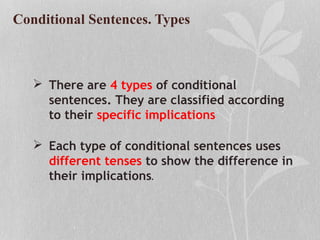
Conditional Sentences. Types
 There are 4 types of conditional
sentences. They are classified according
to their specific implications
 Each type of conditional sentences uses
different tenses to show the difference in
their implications.
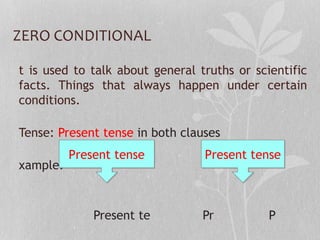
ZERO CONDITIONAL
t is used to talk about general truths or scientific
facts. Things that always happen under certain
conditions.
Tense: Present tense in both clauses
xample:
Present te Pr P
Present tensePresent tense Present tensePresent tense
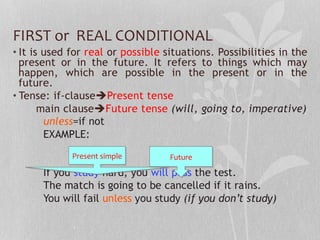
FIRST or REAL CONDITIONAL
Present simplePresent simple FutureFuture
2nd or UNREAL CONDITIONAL
t is used for unreal or improbable situations. It refers to things
which are unreal (not true or not possible) to happen in the
present or in the future- things which don’t or won’t happen. A
case that is unlikely to happen.
enses: if-clauseSimple Past
main clauseWould+infinitive (could, might)
★were≈Past of the verb to be
xamples:
Simple pastSimple past would+infinitiv
e
would+infinitiv
e
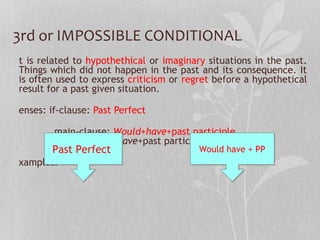
3rd or IMPOSSIBLE CONDITIONAL
t is related to hypothethical or imaginary situations in the past.
Things which did not happen in the past and its consequence. It
is often used to express criticism or regret before a hypothetical
result for a past given situation.
enses: if-clause: Past Perfect
main-clause: Would+have+past participle
(could/might +have+past participle)
xamples:
Past PerfectPast Perfect Would have + PPWould have + PP
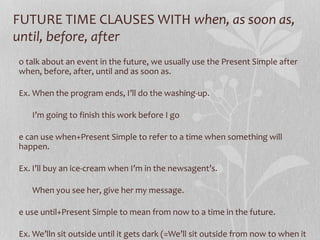
FUTURE TIME CLAUSES WITH when, as soon as,
until, before, after
o talk about an event in the future, we usually use the Present Simple after
when, before, after, until and as soon as.
Ex. When the program ends, I’ll do the washing-up.
I’m going to finish this work before I go
e can use when+Present Simple to refer to a time when something will
happen.
Ex. I’ll buy an ice-cream when I’m in the newsagent’s.
When you see her, give her my message.
e use until+Present Simple to mean from now to a time in the future.
Ex. We’lln sit outside until it gets dark (=We’ll sit outside from now to when it

Conditional sentences

  • 1.
    Zero conditional First conditional Secondconditional Third conditional CONDITIONAL SENTENCES
  • 2.
    CONDITIONAL SENTENCES •The conditionalsentences in English have two clauses: • The if-clause the main clause If it rains, we won’t go out •If the if-clause comes first, a comma is usually used. •If the if-clause comes second, there is no need for a comma. We won’t go out if it rains
  • 3.
    Conditional Sentences. Types There are 4 types of conditional sentences. They are classified according to their specific implications  Each type of conditional sentences uses different tenses to show the difference in their implications.
  • 4.
    ZERO CONDITIONAL t isused to talk about general truths or scientific facts. Things that always happen under certain conditions. Tense: Present tense in both clauses xample: Present te Pr P Present tensePresent tense Present tensePresent tense
  • 5.
    FIRST or REALCONDITIONAL Present simplePresent simple FutureFuture
  • 6.
    2nd or UNREALCONDITIONAL t is used for unreal or improbable situations. It refers to things which are unreal (not true or not possible) to happen in the present or in the future- things which don’t or won’t happen. A case that is unlikely to happen. enses: if-clauseSimple Past main clauseWould+infinitive (could, might) ★were≈Past of the verb to be xamples: Simple pastSimple past would+infinitiv e would+infinitiv e
  • 7.
    3rd or IMPOSSIBLECONDITIONAL t is related to hypothethical or imaginary situations in the past. Things which did not happen in the past and its consequence. It is often used to express criticism or regret before a hypothetical result for a past given situation. enses: if-clause: Past Perfect main-clause: Would+have+past participle (could/might +have+past participle) xamples: Past PerfectPast Perfect Would have + PPWould have + PP
  • 8.
    FUTURE TIME CLAUSESWITH when, as soon as, until, before, after o talk about an event in the future, we usually use the Present Simple after when, before, after, until and as soon as. Ex. When the program ends, I’ll do the washing-up. I’m going to finish this work before I go e can use when+Present Simple to refer to a time when something will happen. Ex. I’ll buy an ice-cream when I’m in the newsagent’s. When you see her, give her my message. e use until+Present Simple to mean from now to a time in the future. Ex. We’lln sit outside until it gets dark (=We’ll sit outside from now to when it