REACTIVE DYES
DYEING OF CELLULOSIC MATERIAL
Properties of Reactive Dyes
• Readily soluble in water
– Presence of sulphonic group ( - SO3H)
– Unlike direct dye, reactive dye molecule tends to be much less
substantive to cotton
• Requires large quantities of salt for exhaustion
– React and combine chemically with cellulose with co-valent bond
– Reactivity of the dyestuff can reduced by blocking one of the two
reactive chlorine atoms
2
Properties of Reactive Dyes
• Reactive dyes are not so long as that of direct dyes
– Easy penetration
– Good levelling
• Good washing fastness
– Due to Covalent bonds
• Formation of covalent bond between dye and fibre occurs in
alkaline condition
– Presence of acid reverse this process
– Perspiration is acidic, hence this fades the colour
3
Classification of Reactive Dyes
• Alkaline controllable dyes
• Salt controllable dyes
• Temperature controllable dyes
4
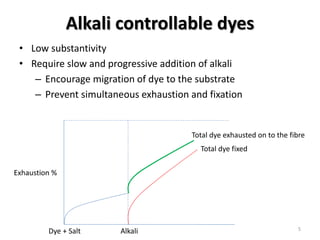
Alkali controllable dyes
• Low substantivity
• Require slow and progressive addition of alkali
– Encourage migration of dye to the substrate
– Prevent simultaneous exhaustion and fixation
5
Dye + Salt Alkali
Total dye exhausted on to the fibre
Total dye fixed
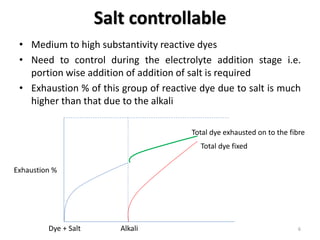
Salt controllable
• Medium to high substantivity reactive dyes
• Need to control during the electrolyte addition stage i.e.
portion wise addition of addition of salt is required
• Exhaustion % of this group of reactive dye due to salt is much
higher than that due to the alkali
6Dye + Salt Alkali
Total dye exhausted on to the fibre
Total dye fixed
Temperature controllable dyes
• This dye react with cellulose above the boil in the absence of
alkali
• They can be used as “Salt controllable dyes” with alkali
fixation being done at 80 – 1000 C
• These dyes are self levelling
• Control of rate of temperature gives good results
7
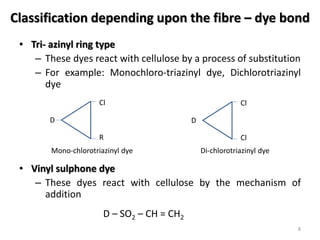
Classification depending upon the fibre – dye bond
• Tri- azinyl ring type
– These dyes react with cellulose by a process of substitution
– For example: Monochloro-triazinyl dye, Dichlorotriazinyl
dye
• Vinyl sulphone dye
– These dyes react with cellulose by the mechanism of
addition
8
D
Cl
R
Mono-chlorotriazinyl dye
D
Cl
Cl
Di-chlorotriazinyl dye
D – SO2 – CH = CH2
Classification based on Reactive system
• Monofunctional reactive dyes
• Bi-functional reactive dye
– Homo-bifunctional
– Hetero-bifunctional
• Multifunctional reactive dye
9
• Mono functional reactive dyes
– Characterized by the presence of reactive groups (one or two
reactive species) at individual locations in the dye molecule
– All reactive dyes developed during the early stages of
development were monofunctional reactive dyes
• Ex: Dyes having either monochloro or di-chloro triazine or
vinyl sulphone reactive groups
• Although di-chlorotriazine contains two reactive Cl atoms,
located at the same triazine ring they are considered as
mono functional reactive dyes
10
• Bi-functional reactive dyes
– These dyes are induced recently to the reactive dye range
– Characterized by the presence of two reactive groups of
same type or two different type at two different locations
in the dye molecule
• Homo functional – Dye molecule contain two reactive
systems of same type
• Hetero functional – Dye molecule contain two reactive
systems of mixed type
11
Examples
• MCT / MCT
– Monocholorotriazine / Monocholorotriazine
• VS / VS
– Vinyl sulphone / Vinyl sulphone
• MCT / VS
– Monochlorotriazine / Vinyl sulphone
• FT / VS
– Fluro triazine / vinyl sulphone
12
Speciality of Bifunctional reactive dyes
• These dyes have high exhaustion leading to high fixation and
better colour yield
• Due to high exhaustion the quantity of dye in the dye bath
and that removed during washing is small
• High fixation is due to
– Presence of two reactive groups
13
Dyeing of Cotton with Reactive Dyes
• Involves the following steps
– Dyeing in the presence of NaCl for better exhaustion
– Chemically reacting the dye and the fibre in the presence of alkali
– After treatment of the reactive cotton material (Soaping, washing etc.)
– Dyeing with COLD Brand Reactive dye
• Start at 300C and maintain the temperature through out
• Add dye solution and add salt gradually for 30 minutes
• About 15 minutes after final salt addition add 1/10 th soda ash
gradually
• After further 10 mintues add the remaining soda ash and continue
dyeing for 30 – 45 minutes followed by drain, rinse and soap rinse
14
Dyeing of Cotton with Reactive Dyes
• Dyeing with HOT Brand Reactive dye
– Start at 500C and add dye solution
– During next 40 minutes add salt gradually
– Start raising temperature while adding the 2nd portion of the salt
– Raise the temperature to 800C in 30 minutes
– About 15 minutes after the salt addition, add soda ash gradually for 15
minutes and continue dyeing for 30 – 60 minutes
– Followed by draining, rinsing and soap rinse
15

Reactive dyes

  • 1.
    REACTIVE DYES DYEING OFCELLULOSIC MATERIAL
  • 2.
    Properties of ReactiveDyes • Readily soluble in water – Presence of sulphonic group ( - SO3H) – Unlike direct dye, reactive dye molecule tends to be much less substantive to cotton • Requires large quantities of salt for exhaustion – React and combine chemically with cellulose with co-valent bond – Reactivity of the dyestuff can reduced by blocking one of the two reactive chlorine atoms 2
  • 3.
    Properties of ReactiveDyes • Reactive dyes are not so long as that of direct dyes – Easy penetration – Good levelling • Good washing fastness – Due to Covalent bonds • Formation of covalent bond between dye and fibre occurs in alkaline condition – Presence of acid reverse this process – Perspiration is acidic, hence this fades the colour 3
  • 4.
    Classification of ReactiveDyes • Alkaline controllable dyes • Salt controllable dyes • Temperature controllable dyes 4
  • 5.
    Alkali controllable dyes •Low substantivity • Require slow and progressive addition of alkali – Encourage migration of dye to the substrate – Prevent simultaneous exhaustion and fixation 5 Dye + Salt Alkali Total dye exhausted on to the fibre Total dye fixed
  • 6.
    Salt controllable • Mediumto high substantivity reactive dyes • Need to control during the electrolyte addition stage i.e. portion wise addition of addition of salt is required • Exhaustion % of this group of reactive dye due to salt is much higher than that due to the alkali 6Dye + Salt Alkali Total dye exhausted on to the fibre Total dye fixed
  • 7.
    Temperature controllable dyes •This dye react with cellulose above the boil in the absence of alkali • They can be used as “Salt controllable dyes” with alkali fixation being done at 80 – 1000 C • These dyes are self levelling • Control of rate of temperature gives good results 7
  • 8.
    Classification depending uponthe fibre – dye bond • Tri- azinyl ring type – These dyes react with cellulose by a process of substitution – For example: Monochloro-triazinyl dye, Dichlorotriazinyl dye • Vinyl sulphone dye – These dyes react with cellulose by the mechanism of addition 8 D Cl R Mono-chlorotriazinyl dye D Cl Cl Di-chlorotriazinyl dye D – SO2 – CH = CH2
  • 9.
    Classification based onReactive system • Monofunctional reactive dyes • Bi-functional reactive dye – Homo-bifunctional – Hetero-bifunctional • Multifunctional reactive dye 9
  • 10.
    • Mono functionalreactive dyes – Characterized by the presence of reactive groups (one or two reactive species) at individual locations in the dye molecule – All reactive dyes developed during the early stages of development were monofunctional reactive dyes • Ex: Dyes having either monochloro or di-chloro triazine or vinyl sulphone reactive groups • Although di-chlorotriazine contains two reactive Cl atoms, located at the same triazine ring they are considered as mono functional reactive dyes 10
  • 11.
    • Bi-functional reactivedyes – These dyes are induced recently to the reactive dye range – Characterized by the presence of two reactive groups of same type or two different type at two different locations in the dye molecule • Homo functional – Dye molecule contain two reactive systems of same type • Hetero functional – Dye molecule contain two reactive systems of mixed type 11
  • 12.
    Examples • MCT /MCT – Monocholorotriazine / Monocholorotriazine • VS / VS – Vinyl sulphone / Vinyl sulphone • MCT / VS – Monochlorotriazine / Vinyl sulphone • FT / VS – Fluro triazine / vinyl sulphone 12
  • 13.
    Speciality of Bifunctionalreactive dyes • These dyes have high exhaustion leading to high fixation and better colour yield • Due to high exhaustion the quantity of dye in the dye bath and that removed during washing is small • High fixation is due to – Presence of two reactive groups 13
  • 14.
    Dyeing of Cottonwith Reactive Dyes • Involves the following steps – Dyeing in the presence of NaCl for better exhaustion – Chemically reacting the dye and the fibre in the presence of alkali – After treatment of the reactive cotton material (Soaping, washing etc.) – Dyeing with COLD Brand Reactive dye • Start at 300C and maintain the temperature through out • Add dye solution and add salt gradually for 30 minutes • About 15 minutes after final salt addition add 1/10 th soda ash gradually • After further 10 mintues add the remaining soda ash and continue dyeing for 30 – 45 minutes followed by drain, rinse and soap rinse 14
  • 15.
    Dyeing of Cottonwith Reactive Dyes • Dyeing with HOT Brand Reactive dye – Start at 500C and add dye solution – During next 40 minutes add salt gradually – Start raising temperature while adding the 2nd portion of the salt – Raise the temperature to 800C in 30 minutes – About 15 minutes after the salt addition, add soda ash gradually for 15 minutes and continue dyeing for 30 – 60 minutes – Followed by draining, rinsing and soap rinse 15