12DE 
1004 Saiesh 
1005 Brembley 
1006 Russell 
1007 Mukesh
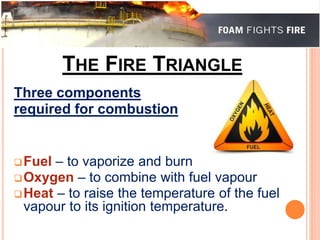
THE FIRE TRIANGLE 
Three components 
required for combustion 
Fuel – to vaporize and burn 
Oxygen – to combine with fuel vapour 
Heat – to raise the temperature of the fuel 
vapour to its ignition temperature.
 Two important factors to remember in 
preventing and extinguishing a fire: 
i) If any of the three components are missing, then a fire 
cannot start. 
ii) If any of the three components are removed, then the 
fire will go out.
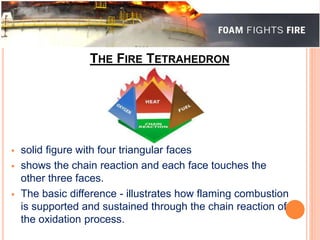
THE FIRE TETRAHEDRON 
 solid figure with four triangular faces 
 shows the chain reaction and each face touches the 
other three faces. 
 The basic difference - illustrates how flaming combustion 
is supported and sustained through the chain reaction of 
the oxidation process.
VARIOUS SYSTEMS USED ONBOARD FOR 
FIGHTING FIRE 
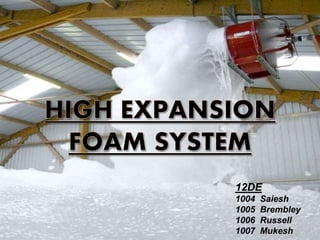
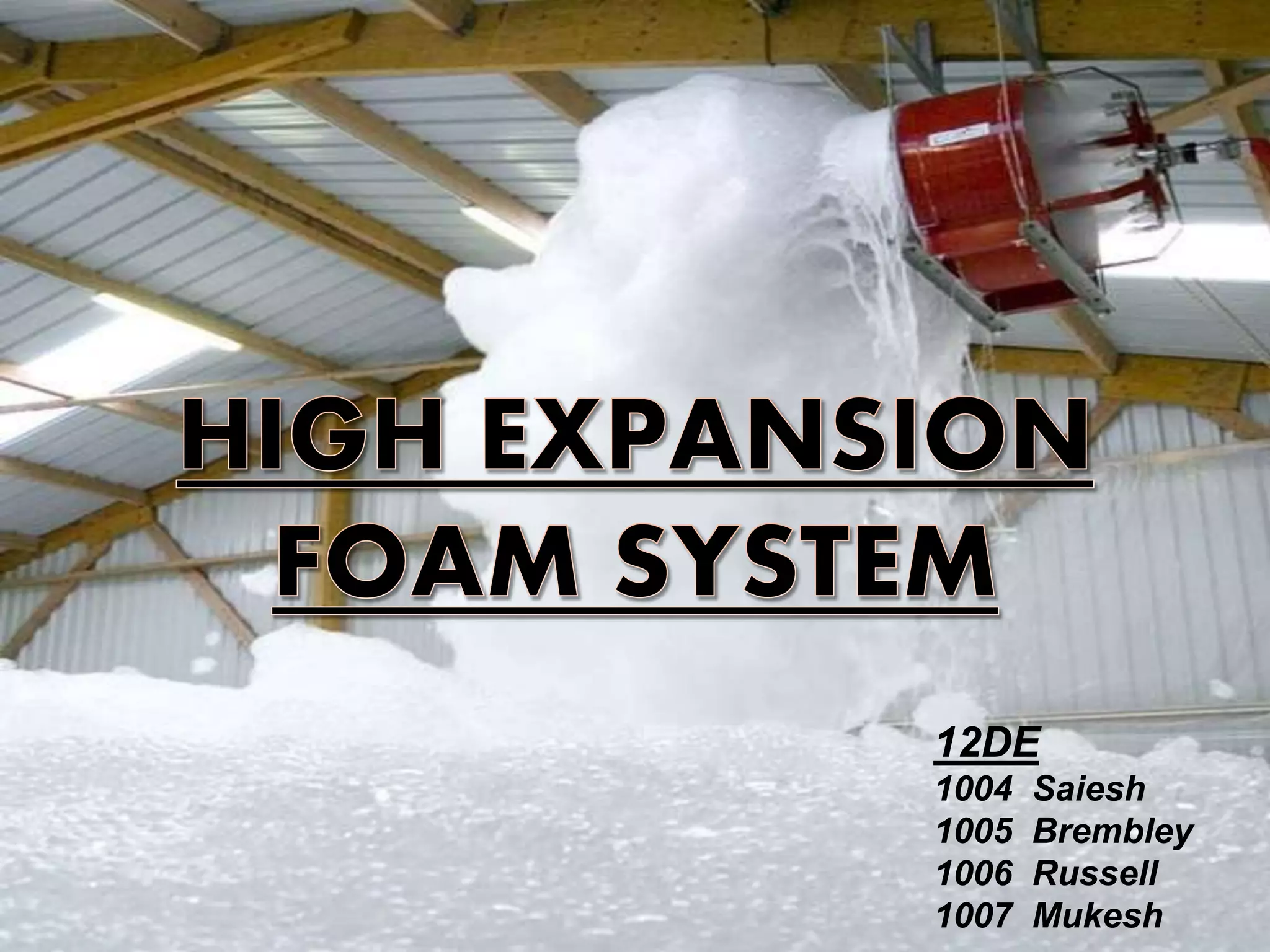
 HIGH EXPANSION FOAM SYSTEM 
 CO2 SYSTEM 
 SPRINKLER & SPRAYER SYSTEM 
 HALON SYSTEM
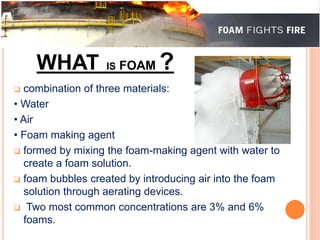
WHAT IS FOAM ? 
 combination of three materials: 
• Water 
• Air 
• Foam making agent 
 formed by mixing the foam-making agent with water to 
create a foam solution. 
 foam bubbles created by introducing air into the foam 
solution through aerating devices. 
 Two most common concentrations are 3% and 6% 
foams.
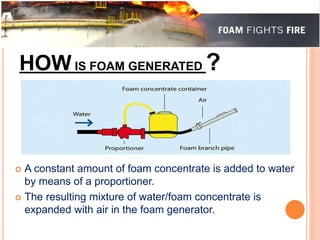
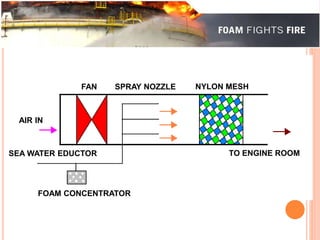
HOWIS FOAM GENERATED ? 
 A constant amount of foam concentrate is added to water 
by means of a proportioner. 
 The resulting mixture of water/foam concentrate is 
expanded with air in the foam generator.
AIR IN 
FAN SPRAY NOZZLE 
SEA WATER EDUCTOR 
FOAM CONCENTRATOR 
NYLON MESH 
TO ENGINE ROOM
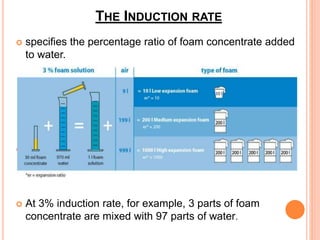
THE INDUCTION RATE 
 specifies the percentage ratio of foam concentrate added 
to water. 
 
 At 3% induction rate, for example, 3 parts of foam 
concentrate are mixed with 97 parts of water.
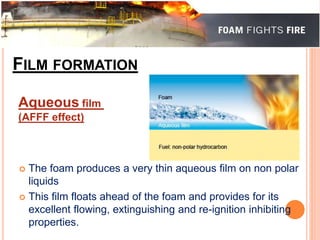
FILM FORMATION 
Aqueous film 
(AFFF effect) 
 The foam produces a very thin aqueous film on non polar 
liquids 
 This film floats ahead of the foam and provides for its 
excellent flowing, extinguishing and re-ignition inhibiting 
properties.
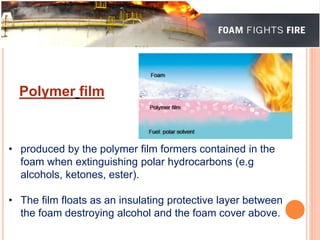
Polymer film 
• produced by the polymer film formers contained in the 
foam when extinguishing polar hydrocarbons (e.g 
alcohols, ketones, ester). 
• The film floats as an insulating protective layer between 
the foam destroying alcohol and the foam cover above.
HOWFOAM EXTINGUISHES FIRE ? 
o Separating effect 
The closed foam cover separates the combustion zone 
from the ambient air. 
o Cooling effect 
The flammable material is cooled down by the water/ 
foam solution discharged by the foam.
o Cover effect 
The closed foam cover stops any further gas evaporation 
from burning materials, i.e. flammable gases 
foam forms a blanket on the surface of flaming liquids 
o Repression effect 
Flooding spaces, channels, plant parts, etc. with high or 
medium expansion foam represses the atmospheric oxygen 
and flammable gases necessary for the combustion 
process. 
o Insulation effect 
foam insulates flammable material which has not yet caught 
fire
FOAM CHARACTERISTICS 
 Knockdown Speed and Flow- ability to spread across a 
fuel surface or around obstacles 
 
 Heat Resistance-able to resist the destructive effects of 
heat radiated from any remaining fire 
 Vapour Suppression. capable of suppressing the 
flammable vapours to break the fire triangle.
Alcohol Resistance-foam blankets that are not 
alcohol-resistant will be destroyed if used on 
alcohol-based cargoes. 
cohesive properties- to stick together 
sufficiently to establish and maintain a vapour 
tight blanket 
light enough-to float on flammable liquids, yet 
heavy enough to resist winds
TYPES OF FOAMS 
Chemical foam 
• formed by mixing together a solution of an alkali, an acid, 
water and a stabilizer. 
• forms a foam or froth of bubbles filled with carbon dioxide 
gas. 
• 7 to 16 volumes of foam are produced for each volume of 
water. 
• Needs a device called a foam hopper or separate tanks
 Mechanical (Air) Foam 
• produced by mixing a foam concentrate 
with water to produce a foam solution. 
• The bubbles are formed by the turbulent 
mixing of air and the foam solution.
TYPES OF MECHANICAL FOAMS 
 Protein Foam 
produced by the hydrolysis of waste protein material, such as 
protein-rich animal waste and vegetable waste that is 
hydrolyzed 
 Fluoroprotein Foam (FP). 
formed by the addition of special fluorochemical surfactants 
with protein foam 
 Film Forming Fluoroprotein Foam (FFFP) 
combination of fluorochemical surfactants with protein foam 
release a film on the surface of the hydrocarbon.
 Aqueous Film Forming Foam (AFFF) 
• combination of fluorochemical surfactants and synthetic foaming 
agents 
• film spreads rapidly causing dramatic fire knockdown. 
 Alcohol Resistant-Aqueous Film Forming Foam (AR-AFFF) 
• combination of synthetic stabilizers, foaming agents, fluorochemicals 
and alcohol resistant additives 
• offers good burnback resistance, knockdown and high fuel tolerance 
on both hydrocarbon and alcohol fuel fires. 
 Synthetic Foam 
• made up of alkyl sulfonates. 
• It foams more readily than the proteins and requires less water 
important where the water supply is limited
CATEGORIES OF FOAM SYTEMS 
 Low Expansion Foams 
• expansion ratio of 12:1 when mixed with air 
• effective in controlling and extinguishing most flammable liquid 
(Class “B”) fires 
• typically used on tanker deck foam systems 
 Mid Expansion Foams 
• expansion ratio of between about 20:1 to 100:1 
• truly three dimensional; it is measured in length, width, height, and 
cubic feet 
 High-expansion foam 
• designed for fires in confined spaces 
• Heavier than air but lighter than oil or water
LIMITATIONS ON THE USE OF FOAM 
 Because they are aqueous (water) solutions, foams are 
electrically conductive 
 Like water, foams should not be used on combustible-metal 
fires. 
 not suitable for fires involving gases and extremely low 
temperature liquids. 
 If placed on burning liquids whose temperatures exceed 
100°C (212°F), the water content of the foam may cause 
frothing, spattering or slopover. 
 Sufficient foam must be available.
ADVANTAGES OF FOAM 
 effective smothering agent and provides cooling effect. 
 sets up a vapor barrier that prevents flammable vapors 
from rising 
 Can be used on Class “A” fires because of its water 
content. 
 effective in blanketing oil spills 
 uses water economically
 most effective extinguishing agent for fires involving large 
tanks of flammable liquids. 
 can be made with fresh water or seawater, and hard or 
soft water 
 does not break down readily and extinguishes fire 
progressively 
 Foam stays in place, covers and absorbs heat from 
materials that could cause re-ignition 
 Foam concentrates are not heavy, and foam systems do 
not take up much space.
PRACTICAL ISSUES 
 Water Temperature and Contaminants 
more stable when generated with lower temperature 
water. 
temperature range 1.7°C to 26.7°C 
 Combustible Products in Air 
It is desirable to take clean air into the foam nozzle at all 
times 
 Water Pressures 
Nozzle pressures should be held between 3.4 bar and 
13.8 bar (50 and 200 psi)
 Non-ignited Spills 
Where flammable liquids have spilled, fires can be 
prevented by prompt coverage of the spill with a foam 
blanket 
 Electrical Fires 
not generally recommended for use on electrical fires 
 Vaporized Liquids 
not recommended for use on materials that react with 
water, such as magnesium, titanium, potassium etc.
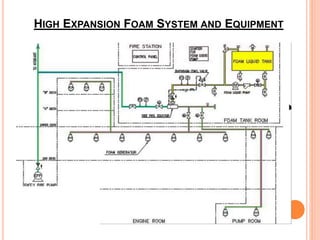
HIGH EXPANSION FOAM SYSTEM AND EQUIPMENT
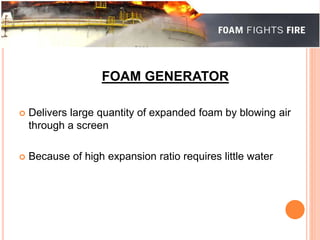
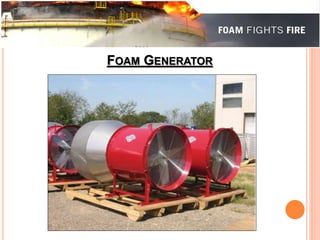
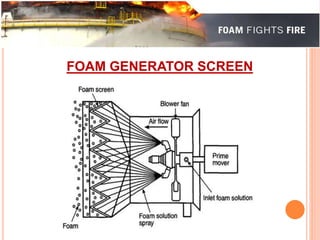
FOAM GENERATOR 
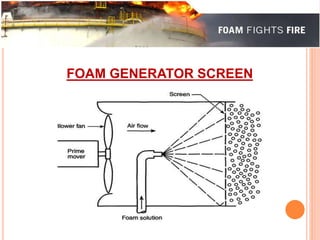
 Delivers large quantity of expanded foam by blowing air 
through a screen 
 Because of high expansion ratio requires little water
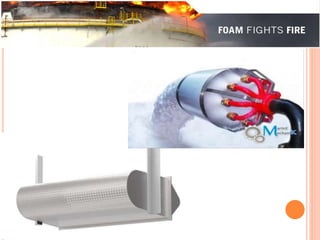
FOAM GENERATOR
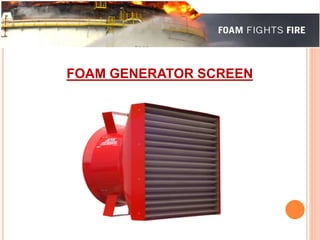
FOAM GENERATOR SCREEN
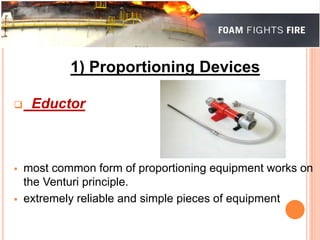
1) Proportioning Devices 
 Eductor 
 most common form of proportioning equipment works on 
the Venturi principle. 
 extremely reliable and simple pieces of equipment
Around-the-Pump Systems 
 an eductor is installed on the discharge side of the water 
pump 
 water flow causes a vacuum that picks up and introduces 
the foam concentrate into the water
 Balanced Pressure Foam Proportioners 
 extremely versatile and accurate 
 The principle of operation based on the use of a 
modified venturi proportioner commonly called a 
ratio controller.
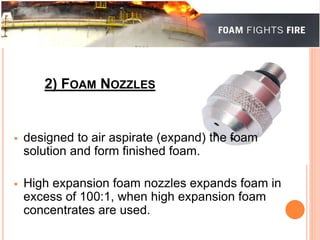
2) FOAM NOZZLES 
 designed to air aspirate (expand) the foam 
solution and form finished foam. 
 High expansion foam nozzles expands foam in 
excess of 100:1, when high expansion foam 
concentrates are used.
3) FOAM MONITORS 
 are permanently-installed foam discharge units 
 capable of being aimed and projecting large 
quantities of foam substantial distances. 
 normally mounted on a rotating base (360- 
degree circle)
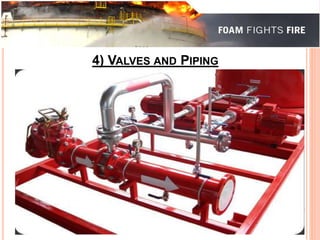
4) VALVES AND PIPING 
must be adequately designed to match the flow 
rates of the equipment, and a thorough 
understanding of the system 
 control valves is critical for quick and effective 
operation of the system 
 Color coding of the valves
4) VALVES AND PIPING
5) FOAM CONCENTRATE STORAGE 
 stored in tanks ready to supply the proportioning 
system 
 The concentrate tank should be kept filled with 
liquid halfway 
 The tank should be kept closed to the atmosphere
SOLAS REQUIREMENTS 
 FOAM CONCENTRATE 
 Foam concentrates to be of the type approved by 
administration 
 Capable of rapidly discharging foam @ at least 1 m 
in depth per minute 
 Volume of foam = 5 x volume of largest space 
 Expansion ratio not to exceed 1000:1
 INSTALLATION REQUIREMENTS 
• System should provide effective foam production and 
distribution 
• Foam generator delivery ducting to be protected 
against fire risk, withstand 925 deg C. 
• Foam delivery ducts to be constructed of steel 
having thickness > 5 mm 
• Dampers to be automatically operated by remote 
control 
• All system equipment to be readily accessible and 
simple to operate
ABS REQUIREMENTS FOR FOAM EXTINGUISHING SYSTEMS 
 Design and Certification of Piping Components 
• All valves, fittings and piping to comply with the 
applicable requirements 
• be suitable for the intended pressures 
 Pipe and Pipe Joints 
the wall thickness, type and design of the pipe joints to 
comply with the requirements
 Materials 
• materials used in the system should not to be 
rendered ineffective by heat. 
• material to have a melting temperature higher 
than the test temperature specified in an 
acceptable fire test. 
Pumps 
• should be tested in the presence of a Surveyor
 Pressure Vessels 
 the tank is to be considered a pressure vessel and is to 
comply with the requirements as applicable. 
System Component Certification 
 fixed fire-extinguishing system components are to be 
certified. 
 Accordingly, components such as foam system eductors, 
proportioners, monitors, nozzles, etc., are to comply with 
the certification requirements
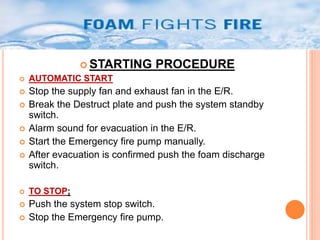
STARTING PROCEDURE 
 AUTOMATIC START 
 Stop the supply fan and exhaust fan in the E/R. 
 Break the Destruct plate and push the system standby 
switch. 
 Alarm sound for evacuation in the E/R. 
 Start the Emergency fire pump manually. 
 After evacuation is confirmed push the foam discharge 
switch. 
 TO STOP; 
 Push the system stop switch. 
 Stop the Emergency fire pump.
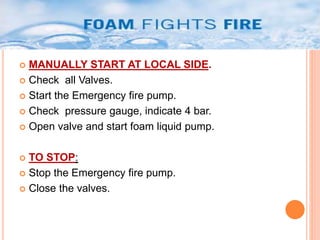
 MANUALLY START AT LOCAL SIDE. 
 Check all Valves. 
 Start the Emergency fire pump. 
 Check pressure gauge, indicate 4 bar. 
 Open valve and start foam liquid pump. 
 TO STOP: 
 Stop the Emergency fire pump. 
 Close the valves.
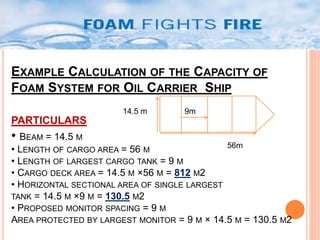
EXAMPLE CALCULATION OF THE CAPACITY OF 
FOAM SYSTEM FOR OIL CARRIER SHIP 
14.5 m 9m 
PARTICULARS 
• BEAM = 14.5 M 
• LENGTH = 56 56m 
OF CARGO AREA M 
• LENGTH OF LARGEST CARGO TANK = 9 M 
• CARGO DECK AREA = 14.5 M ×56 M = 812 M2 
• HORIZONTAL SECTIONAL AREA OF SINGLE LARGEST 
TANK = 14.5 M ×9 M = 130.5 M2 
• PROPOSED MONITOR SPACING = 9 M 
AREA PROTECTED BY LARGEST MONITOR = 9 M × 14.5 M = 130.5 M2
A CASE STUDY
LESSONS LEARNT 
 Proper maintenance should be done including putting 
back the cover 
 Blowing/purging the line after hydraulic pressure testing 
 Inspection of the foam nozzle after test 
 Foam line on board to be pressure tested regularly 
 Draining the line to prevent accumulation of water
WHERE IS HIGH EXPANSION FOAM SYSTEM 
USED ? 
 ENGINE ROOM 
 PURIFIER ROOM 
 INCINERATOR ROOM 
 PUMP ROOM
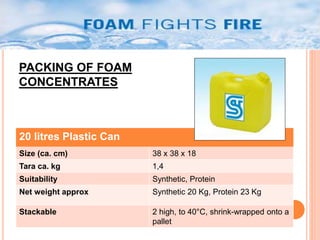
PACKING OF FOAM 
CONCENTRATES 
20 litres Plastic Can 
Size (ca. cm) 38 x 38 x 18 
Tara ca. kg 1,4 
Suitability Synthetic, Protein 
Net weight approx Synthetic 20 Kg, Protein 23 Kg 
Stackable 2 high, to 40°C, shrink-wrapped onto a 
pallet
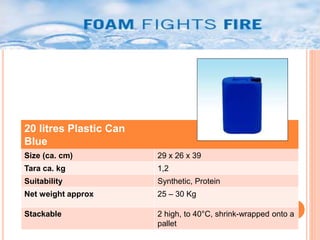
20 litres Plastic Can 
Blue 
Size (ca. cm) 29 x 26 x 39 
Tara ca. kg 1,2 
Suitability Synthetic, Protein 
Net weight approx 25 – 30 Kg 
Stackable 2 high, to 40°C, shrink-wrapped onto a 
pallet
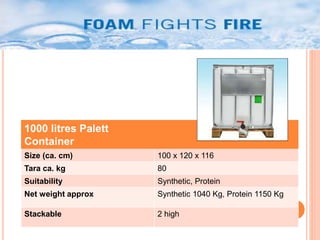
200 litresValenthene 
Barrel 
Size (ca. cm) 60 x 90 
Tara ca. kg 21 
Suitability Synthetic, Protein 
Net weight approx 200 – 225 Kg 
Stackable 2 high
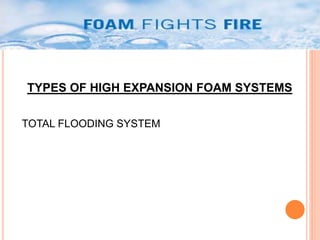
1000 litres Palett 
Container 
Size (ca. cm) 100 x 120 x 116 
Tara ca. kg 80 
Suitability Synthetic, Protein 
Net weight approx Synthetic 1040 Kg, Protein 1150 Kg 
Stackable 2 high
TYPES OF HIGH EXPANSION FOAM SYSTEMS 
TOTAL FLOODING SYSTEM
MAINTENANCE AND INSPECTION OF SYSTEM AND 
APPLIANCES. 
 Operational readiness 
• To be in good order and readily available for immediate 
use while the ship is in service. 
 Maintenance and Testing 
• should be carried out in accordance with the ship's 
maintenance plan. 
• Inspections should be carried out by the crew in 
accordance with manufacturer's maintenance and 
inspection guidelines
 MONTHLY TESTING AND INSPECTIONS 
• Verify all control and section valves are in the 
proper open or closed position, and all pressure 
gauges are in the proper range.
 QUARTERLY TESTING AND INSPECTIONS 
• Verify the proper quantity of foam 
concentrate is provided in the foam 
system
ANNUAL TESTING AND INSPECTIONS. 
o visually inspect all accessible components 
o functionally test all fixed system audible alarms 
o flow test all water supply and foam pumps for 
proper pressure and capacity 
o Ensure all piping is thoroughly flushed with fresh 
water after service
o test all system cross connections to other sources of 
water supply for proper operation; 
o verify all pump relief valves, if provided, are properly set 
o examine all filters/strainers to verify they are free of 
debris and contamination 
o verify all control/section valves are in the correct 
position
 blow dry compressed air or nitrogen through the 
discharge piping 
 confirm the pipework and nozzles of high expansion foam 
systems are clear of any obstructions, debris and 
contamination 
 take samples from all foam concentrates carried on 
board and subject them to the periodical control tests 
 test all fuel shut-off controls connected to fire-protection 
systems for proper operation.
 FIVE-YEAR SERVICE 
 perform internal inspection of all control valves 
 flush piping with fresh water, drain and purge with air 
 check all nozzles to prove they are clear of debris 
 test all foam proportioners to confirm that the mixing 
ratio tolerance is within +30 to -10% of the nominal 
mixing ratio
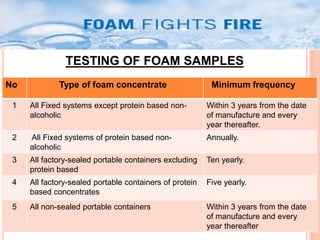
TESTING OF FOAM SAMPLES 
No Type of foam concentrate Minimum frequency 
1 All Fixed systems except protein based non-alcoholic 
Within 3 years from the date 
of manufacture and every 
year thereafter. 
2 All Fixed systems of protein based non-alcoholic 
Annually. 
3 All factory-sealed portable containers excluding 
protein based 
Ten yearly. 
4 All factory-sealed portable containers of protein 
based concentrates 
Five yearly. 
5 All non-sealed portable containers Within 3 years from the date 
of manufacture and every 
year thereafter
High Expansion Foam System

High Expansion Foam System

  • 1.
    12DE 1004 Saiesh 1005 Brembley 1006 Russell 1007 Mukesh
  • 2.
    THE FIRE TRIANGLE Three components required for combustion Fuel – to vaporize and burn Oxygen – to combine with fuel vapour Heat – to raise the temperature of the fuel vapour to its ignition temperature.
  • 3.
     Two importantfactors to remember in preventing and extinguishing a fire: i) If any of the three components are missing, then a fire cannot start. ii) If any of the three components are removed, then the fire will go out.
  • 4.
    THE FIRE TETRAHEDRON  solid figure with four triangular faces  shows the chain reaction and each face touches the other three faces.  The basic difference - illustrates how flaming combustion is supported and sustained through the chain reaction of the oxidation process.
  • 5.
    VARIOUS SYSTEMS USEDONBOARD FOR FIGHTING FIRE  HIGH EXPANSION FOAM SYSTEM  CO2 SYSTEM  SPRINKLER & SPRAYER SYSTEM  HALON SYSTEM
  • 6.
    WHAT IS FOAM?  combination of three materials: • Water • Air • Foam making agent  formed by mixing the foam-making agent with water to create a foam solution.  foam bubbles created by introducing air into the foam solution through aerating devices.  Two most common concentrations are 3% and 6% foams.
  • 7.
    HOWIS FOAM GENERATED?  A constant amount of foam concentrate is added to water by means of a proportioner.  The resulting mixture of water/foam concentrate is expanded with air in the foam generator.
  • 8.
    AIR IN FANSPRAY NOZZLE SEA WATER EDUCTOR FOAM CONCENTRATOR NYLON MESH TO ENGINE ROOM
  • 9.
    THE INDUCTION RATE  specifies the percentage ratio of foam concentrate added to water.   At 3% induction rate, for example, 3 parts of foam concentrate are mixed with 97 parts of water.
  • 10.
    FILM FORMATION Aqueousfilm (AFFF effect)  The foam produces a very thin aqueous film on non polar liquids  This film floats ahead of the foam and provides for its excellent flowing, extinguishing and re-ignition inhibiting properties.
  • 11.
    Polymer film •produced by the polymer film formers contained in the foam when extinguishing polar hydrocarbons (e.g alcohols, ketones, ester). • The film floats as an insulating protective layer between the foam destroying alcohol and the foam cover above.
  • 12.
    HOWFOAM EXTINGUISHES FIRE? o Separating effect The closed foam cover separates the combustion zone from the ambient air. o Cooling effect The flammable material is cooled down by the water/ foam solution discharged by the foam.
  • 13.
    o Cover effect The closed foam cover stops any further gas evaporation from burning materials, i.e. flammable gases foam forms a blanket on the surface of flaming liquids o Repression effect Flooding spaces, channels, plant parts, etc. with high or medium expansion foam represses the atmospheric oxygen and flammable gases necessary for the combustion process. o Insulation effect foam insulates flammable material which has not yet caught fire
  • 14.
    FOAM CHARACTERISTICS Knockdown Speed and Flow- ability to spread across a fuel surface or around obstacles   Heat Resistance-able to resist the destructive effects of heat radiated from any remaining fire  Vapour Suppression. capable of suppressing the flammable vapours to break the fire triangle.
  • 15.
    Alcohol Resistance-foam blanketsthat are not alcohol-resistant will be destroyed if used on alcohol-based cargoes. cohesive properties- to stick together sufficiently to establish and maintain a vapour tight blanket light enough-to float on flammable liquids, yet heavy enough to resist winds
  • 16.
    TYPES OF FOAMS Chemical foam • formed by mixing together a solution of an alkali, an acid, water and a stabilizer. • forms a foam or froth of bubbles filled with carbon dioxide gas. • 7 to 16 volumes of foam are produced for each volume of water. • Needs a device called a foam hopper or separate tanks
  • 17.
     Mechanical (Air)Foam • produced by mixing a foam concentrate with water to produce a foam solution. • The bubbles are formed by the turbulent mixing of air and the foam solution.
  • 18.
    TYPES OF MECHANICALFOAMS  Protein Foam produced by the hydrolysis of waste protein material, such as protein-rich animal waste and vegetable waste that is hydrolyzed  Fluoroprotein Foam (FP). formed by the addition of special fluorochemical surfactants with protein foam  Film Forming Fluoroprotein Foam (FFFP) combination of fluorochemical surfactants with protein foam release a film on the surface of the hydrocarbon.
  • 19.
     Aqueous FilmForming Foam (AFFF) • combination of fluorochemical surfactants and synthetic foaming agents • film spreads rapidly causing dramatic fire knockdown.  Alcohol Resistant-Aqueous Film Forming Foam (AR-AFFF) • combination of synthetic stabilizers, foaming agents, fluorochemicals and alcohol resistant additives • offers good burnback resistance, knockdown and high fuel tolerance on both hydrocarbon and alcohol fuel fires.  Synthetic Foam • made up of alkyl sulfonates. • It foams more readily than the proteins and requires less water important where the water supply is limited
  • 20.
    CATEGORIES OF FOAMSYTEMS  Low Expansion Foams • expansion ratio of 12:1 when mixed with air • effective in controlling and extinguishing most flammable liquid (Class “B”) fires • typically used on tanker deck foam systems  Mid Expansion Foams • expansion ratio of between about 20:1 to 100:1 • truly three dimensional; it is measured in length, width, height, and cubic feet  High-expansion foam • designed for fires in confined spaces • Heavier than air but lighter than oil or water
  • 21.
    LIMITATIONS ON THEUSE OF FOAM  Because they are aqueous (water) solutions, foams are electrically conductive  Like water, foams should not be used on combustible-metal fires.  not suitable for fires involving gases and extremely low temperature liquids.  If placed on burning liquids whose temperatures exceed 100°C (212°F), the water content of the foam may cause frothing, spattering or slopover.  Sufficient foam must be available.
  • 22.
    ADVANTAGES OF FOAM  effective smothering agent and provides cooling effect.  sets up a vapor barrier that prevents flammable vapors from rising  Can be used on Class “A” fires because of its water content.  effective in blanketing oil spills  uses water economically
  • 23.
     most effectiveextinguishing agent for fires involving large tanks of flammable liquids.  can be made with fresh water or seawater, and hard or soft water  does not break down readily and extinguishes fire progressively  Foam stays in place, covers and absorbs heat from materials that could cause re-ignition  Foam concentrates are not heavy, and foam systems do not take up much space.
  • 24.
    PRACTICAL ISSUES Water Temperature and Contaminants more stable when generated with lower temperature water. temperature range 1.7°C to 26.7°C  Combustible Products in Air It is desirable to take clean air into the foam nozzle at all times  Water Pressures Nozzle pressures should be held between 3.4 bar and 13.8 bar (50 and 200 psi)
  • 25.
     Non-ignited Spills Where flammable liquids have spilled, fires can be prevented by prompt coverage of the spill with a foam blanket  Electrical Fires not generally recommended for use on electrical fires  Vaporized Liquids not recommended for use on materials that react with water, such as magnesium, titanium, potassium etc.
  • 26.
    HIGH EXPANSION FOAMSYSTEM AND EQUIPMENT
  • 27.
    FOAM GENERATOR Delivers large quantity of expanded foam by blowing air through a screen  Because of high expansion ratio requires little water
  • 28.
  • 30.
  • 31.
  • 32.
  • 33.
    1) Proportioning Devices  Eductor  most common form of proportioning equipment works on the Venturi principle.  extremely reliable and simple pieces of equipment
  • 34.
    Around-the-Pump Systems an eductor is installed on the discharge side of the water pump  water flow causes a vacuum that picks up and introduces the foam concentrate into the water
  • 35.
     Balanced PressureFoam Proportioners  extremely versatile and accurate  The principle of operation based on the use of a modified venturi proportioner commonly called a ratio controller.
  • 36.
    2) FOAM NOZZLES  designed to air aspirate (expand) the foam solution and form finished foam.  High expansion foam nozzles expands foam in excess of 100:1, when high expansion foam concentrates are used.
  • 37.
    3) FOAM MONITORS  are permanently-installed foam discharge units  capable of being aimed and projecting large quantities of foam substantial distances.  normally mounted on a rotating base (360- degree circle)
  • 38.
    4) VALVES ANDPIPING must be adequately designed to match the flow rates of the equipment, and a thorough understanding of the system  control valves is critical for quick and effective operation of the system  Color coding of the valves
  • 39.
  • 40.
    5) FOAM CONCENTRATESTORAGE  stored in tanks ready to supply the proportioning system  The concentrate tank should be kept filled with liquid halfway  The tank should be kept closed to the atmosphere
  • 41.
    SOLAS REQUIREMENTS FOAM CONCENTRATE  Foam concentrates to be of the type approved by administration  Capable of rapidly discharging foam @ at least 1 m in depth per minute  Volume of foam = 5 x volume of largest space  Expansion ratio not to exceed 1000:1
  • 42.
     INSTALLATION REQUIREMENTS • System should provide effective foam production and distribution • Foam generator delivery ducting to be protected against fire risk, withstand 925 deg C. • Foam delivery ducts to be constructed of steel having thickness > 5 mm • Dampers to be automatically operated by remote control • All system equipment to be readily accessible and simple to operate
  • 43.
    ABS REQUIREMENTS FORFOAM EXTINGUISHING SYSTEMS  Design and Certification of Piping Components • All valves, fittings and piping to comply with the applicable requirements • be suitable for the intended pressures  Pipe and Pipe Joints the wall thickness, type and design of the pipe joints to comply with the requirements
  • 44.
     Materials •materials used in the system should not to be rendered ineffective by heat. • material to have a melting temperature higher than the test temperature specified in an acceptable fire test. Pumps • should be tested in the presence of a Surveyor
  • 45.
     Pressure Vessels  the tank is to be considered a pressure vessel and is to comply with the requirements as applicable. System Component Certification  fixed fire-extinguishing system components are to be certified.  Accordingly, components such as foam system eductors, proportioners, monitors, nozzles, etc., are to comply with the certification requirements
  • 46.
    STARTING PROCEDURE AUTOMATIC START  Stop the supply fan and exhaust fan in the E/R.  Break the Destruct plate and push the system standby switch.  Alarm sound for evacuation in the E/R.  Start the Emergency fire pump manually.  After evacuation is confirmed push the foam discharge switch.  TO STOP;  Push the system stop switch.  Stop the Emergency fire pump.
  • 47.
     MANUALLY STARTAT LOCAL SIDE.  Check all Valves.  Start the Emergency fire pump.  Check pressure gauge, indicate 4 bar.  Open valve and start foam liquid pump.  TO STOP:  Stop the Emergency fire pump.  Close the valves.
  • 48.
    EXAMPLE CALCULATION OFTHE CAPACITY OF FOAM SYSTEM FOR OIL CARRIER SHIP 14.5 m 9m PARTICULARS • BEAM = 14.5 M • LENGTH = 56 56m OF CARGO AREA M • LENGTH OF LARGEST CARGO TANK = 9 M • CARGO DECK AREA = 14.5 M ×56 M = 812 M2 • HORIZONTAL SECTIONAL AREA OF SINGLE LARGEST TANK = 14.5 M ×9 M = 130.5 M2 • PROPOSED MONITOR SPACING = 9 M AREA PROTECTED BY LARGEST MONITOR = 9 M × 14.5 M = 130.5 M2
  • 49.
  • 50.
    LESSONS LEARNT Proper maintenance should be done including putting back the cover  Blowing/purging the line after hydraulic pressure testing  Inspection of the foam nozzle after test  Foam line on board to be pressure tested regularly  Draining the line to prevent accumulation of water
  • 51.
    WHERE IS HIGHEXPANSION FOAM SYSTEM USED ?  ENGINE ROOM  PURIFIER ROOM  INCINERATOR ROOM  PUMP ROOM
  • 52.
    PACKING OF FOAM CONCENTRATES 20 litres Plastic Can Size (ca. cm) 38 x 38 x 18 Tara ca. kg 1,4 Suitability Synthetic, Protein Net weight approx Synthetic 20 Kg, Protein 23 Kg Stackable 2 high, to 40°C, shrink-wrapped onto a pallet
  • 53.
    20 litres PlasticCan Blue Size (ca. cm) 29 x 26 x 39 Tara ca. kg 1,2 Suitability Synthetic, Protein Net weight approx 25 – 30 Kg Stackable 2 high, to 40°C, shrink-wrapped onto a pallet
  • 54.
    200 litresValenthene Barrel Size (ca. cm) 60 x 90 Tara ca. kg 21 Suitability Synthetic, Protein Net weight approx 200 – 225 Kg Stackable 2 high
  • 55.
    1000 litres Palett Container Size (ca. cm) 100 x 120 x 116 Tara ca. kg 80 Suitability Synthetic, Protein Net weight approx Synthetic 1040 Kg, Protein 1150 Kg Stackable 2 high
  • 56.
    TYPES OF HIGHEXPANSION FOAM SYSTEMS TOTAL FLOODING SYSTEM
  • 57.
    MAINTENANCE AND INSPECTIONOF SYSTEM AND APPLIANCES.  Operational readiness • To be in good order and readily available for immediate use while the ship is in service.  Maintenance and Testing • should be carried out in accordance with the ship's maintenance plan. • Inspections should be carried out by the crew in accordance with manufacturer's maintenance and inspection guidelines
  • 58.
     MONTHLY TESTINGAND INSPECTIONS • Verify all control and section valves are in the proper open or closed position, and all pressure gauges are in the proper range.
  • 59.
     QUARTERLY TESTINGAND INSPECTIONS • Verify the proper quantity of foam concentrate is provided in the foam system
  • 60.
    ANNUAL TESTING ANDINSPECTIONS. o visually inspect all accessible components o functionally test all fixed system audible alarms o flow test all water supply and foam pumps for proper pressure and capacity o Ensure all piping is thoroughly flushed with fresh water after service
  • 61.
    o test allsystem cross connections to other sources of water supply for proper operation; o verify all pump relief valves, if provided, are properly set o examine all filters/strainers to verify they are free of debris and contamination o verify all control/section valves are in the correct position
  • 62.
     blow drycompressed air or nitrogen through the discharge piping  confirm the pipework and nozzles of high expansion foam systems are clear of any obstructions, debris and contamination  take samples from all foam concentrates carried on board and subject them to the periodical control tests  test all fuel shut-off controls connected to fire-protection systems for proper operation.
  • 63.
     FIVE-YEAR SERVICE  perform internal inspection of all control valves  flush piping with fresh water, drain and purge with air  check all nozzles to prove they are clear of debris  test all foam proportioners to confirm that the mixing ratio tolerance is within +30 to -10% of the nominal mixing ratio
  • 64.
    TESTING OF FOAMSAMPLES No Type of foam concentrate Minimum frequency 1 All Fixed systems except protein based non-alcoholic Within 3 years from the date of manufacture and every year thereafter. 2 All Fixed systems of protein based non-alcoholic Annually. 3 All factory-sealed portable containers excluding protein based Ten yearly. 4 All factory-sealed portable containers of protein based concentrates Five yearly. 5 All non-sealed portable containers Within 3 years from the date of manufacture and every year thereafter