Essentials of Fire Fighting,
5th Edition
Chapter 14 — Fire Streams
Firefighter II
Firefighter II
14–1
Chapter 14 Lesson Goal
• After completing this lesson, the
student shall be able to effectively apply
fire fighting foam using various foam
types, concentrates, and delivery
devices following the policies and
procedures set forth by the authority
having jurisdiction (AHJ).
Firefighter II
14–2
Specific Objectives
1. Describe the suppression
characteristics of fire fighting foam.
2. Define terms associated with types of
foam and the foam-making process.
3. Discuss how foam is generated.
(Continued)
Firefighter II
14–3
Specific Objectives
4. Discuss foam concentrates.
5. Describe methods by which foam may
be proportioned.
6. Discuss foam proportioners.
7. Discuss foam delivery devices.
(Continued)
Firefighter II
14–4
Specific Objectives
8. List reasons for failure to generate
foam or for generating poor-quality
foam.
9. Describe foam application techniques.
(Continued)
Firefighter II
14–5
Specific Objectives
10. Discuss hazards associated with foam
concentrates.
11. Place a foam line in service — In-line
eductor. (Skill Sheet 14-II-1)
Firefighter II
14–6
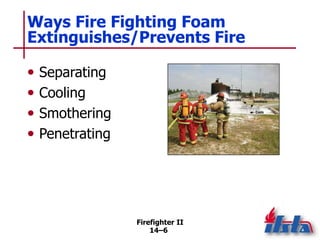
Ways Fire Fighting Foam
Extinguishes/Prevents Fire
• Separating
• Cooling
• Smothering
• Penetrating
Firefighter II
14–7
Terms Associated With Foam
• Foam concentrate
• Foam proportioner
• Foam solution
• Foam (finished foam)
Firefighter II
14–8
How Foam is Generated
• Foams used today are of mechanical
type and before use must be
– Proportioned
– Aerated
(Continued)
Firefighter II
14–9
How Foam is Generated
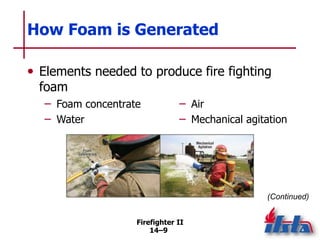
• Elements needed to produce fire fighting
foam
(Continued)
– Foam concentrate
– Water
– Air
– Mechanical agitation
Firefighter II
14–10
How Foam is Generated
• All elements must be present and
blended in correct ratios
• Aeration produces foam bubbles to form
effective foam blanket
Firefighter II
14–11
Foam Expansion
• The increase in volume of foam when
aerated
• Method of aerating results in varying
degrees of expansion
• Types of foam
Firefighter II
14–12
Foam Concentrates — General
Considerations
• Foam concentrates must match fuel to
which applied
• Class A foams not designed to
extinguish Class B fires
• Class B foams designed solely for
hydrocarbon fires will not extinguish
polar solvent fires
Firefighter II
14–13
Class A Foam
• Increasingly used in both wildland and
structural fire fighting
• Special formulation of hydrocarbon
surfactants
(Continued)
Firefighter II
14–14
Class A Foam
• Aerated Class A foam coats, insulates
fuels, preventing pyrolysis and ignition
• May be used with variety of nozzles
Firefighter II
14–15
Class B Foam
• Used to prevent ignition of or extinguish
fires involving flammable and
combustible liquids
• Used to suppress vapors from unignited
spills of these liquids
• Several types of Class B foam
concentrates available
(Continued)
Firefighter II
14–16
Class B Foam
• Manufactured from synthetic or protein
base
• May be proportioned into the fire stream
through fixed system, apparatus-
mounted system, or by portable foam
proportioning equipment
(Continued)
Firefighter II
14–17
Class B Foam
• Foams such as AFFF and FFFP foam
may be applied with standard fog
nozzles or air-aspirating foam nozzles
• Rate of application depends on several
factors
(Continued)
Firefighter II
14–18
Class B Foam
• Unignited spills do not require same
application rates as ignited spills
• To be most effective, blanket of foam 4
inches (100 mm) thick should be
applied to fuel surface
Firefighter II
14–19
Specific Application Foams
• Numerous types of foam available for
specific applications
• Properties of foams vary
Firefighter II
14–20
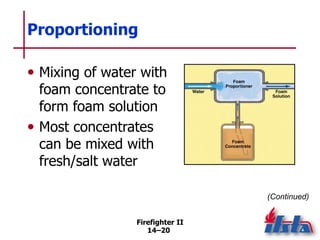
Proportioning
• Mixing of water with
foam concentrate to
form foam solution
• Most concentrates
can be mixed with
fresh/salt water
(Continued)
Firefighter II
14–21
Proportioning
• For maximum effectiveness, foam
concentrates must be proportioned at
designated percentage
• Most fire fighting foams intended to be
mixed with 94 to 99.9 percent water
Firefighter II
14–22
Proportioning Methods
• Induction
• Injection
• Batch-mixing
• Premixing
Firefighter II
14–23
Foam Proportioners — General
Considerations
• May be portable or apparatus-mounted
• Operate by one of two basic principles
Firefighter II
14–24
Portable Foam Proportioners
• Simplest, most common form of
proportioning devices
• In-line foam eductors
• Foam nozzle eductors
Firefighter II
14–25
Apparatus-Mounted
Proportioners
• Mounted on structural, industrial,
wildland, and aircraft rescue and fire
fighting apparatus, as well as on fire
boats
• Three types
Firefighter II
14–26
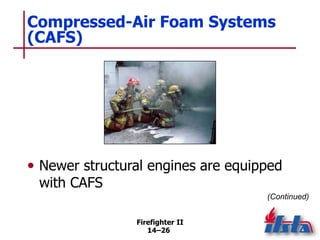
Compressed-Air Foam Systems
(CAFS)
• Newer structural engines are equipped
with CAFS
(Continued)
Firefighter II
14–27
Compressed-Air Foam Systems
(CAFS)
• Standard centrifugal pump supplies
water, direct-injection foam-
proportioning system mixes foam
solution with water on discharge side of
pump, onboard air compressor adds air
to mix before discharging from engine
(Continued)
Firefighter II
14–28
Compressed-Air Foam Systems
(CAFS)
• Unlike other systems, hoseline contains
finished foam
• Advantages
• Disadvantages
Firefighter II
14–29
Handline Nozzles
• Solid-bore nozzles
• Fog nozzles
• Air-aspirating foam nozzles
Firefighter II
14–30
Medium- and High-Expansion
Foam Generating Devices
• Produce foam that is semistable with
high air content
• Medium-expansion foam
• High-expansion foam
• Water-aspirating type nozzle
• Mechanical blower generator
Firefighter II
14–31
Reasons for Poor-Quality Foam/
Failure to Generate Foam
• Eductor, nozzle flow ratings do not
match so foam concentrate cannot
induct into fire stream
• Air leaks at fittings cause loss of suction
• Improper cleaning of proportioning
equipment causes clogged foam
passages
(Continued)
Firefighter II
14–32
Reasons for Poor-Quality Foam/
Failure to Generate Foam
• Nozzle not fully open, restricting water
flow
• Hose lay on discharge side of eductor is
too long
• Hose is kinked and stops flow
(Continued)
Firefighter II
14–33
Reasons for Poor-Quality Foam/
Failure to Generate Foam
• Nozzle is too far above eductor
• Mixing different types of foam
concentrate in same tank results in
mixture too viscous to pass through
eductor
Firefighter II
14–34
Roll-On Foam Application
Method
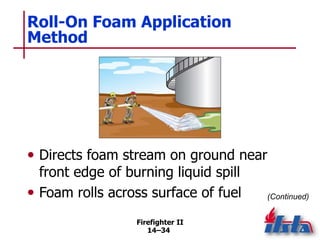
• Directs foam stream on ground near
front edge of burning liquid spill
• Foam rolls across surface of fuel (Continued)
Firefighter II
14–35
Roll-On Foam Application
Method
• Firefighters continue to apply foam until
spreads across entire surface of fuel
and fire extinguished
• Used only on pool of liquid fuel on open
ground
Firefighter II
14–36
Bank-Down Foam Application
Method
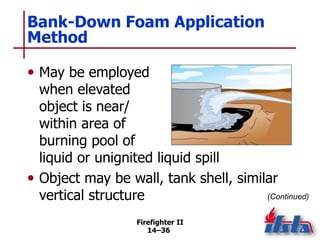
• May be employed
when elevated
object is near/
within area of
burning pool of
liquid or unignited liquid spill
• Object may be wall, tank shell, similar
vertical structure (Continued)
Firefighter II
14–37
Bank-Down Foam Application
Method
• Foam stream directed onto object,
allowing foam to run down onto surface
of fuel
• Used primarily in dike fires, fires
involving spills around damaged/
overturned transport vehicles
Firefighter II
14–38
Rain-Down Foam Application
Method
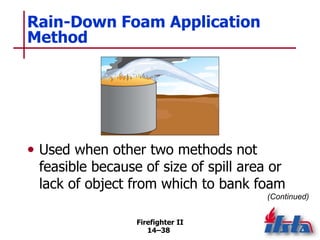
• Used when other two methods not
feasible because of size of spill area or
lack of object from which to bank foam
(Continued)
Firefighter II
14–39
Rain-Down Foam Application
Method
• Primary manual application technique
on aboveground storage tank fires
• Directs stream into air above fire/spill,
allows foam to float gently down onto
surface of fuel
Firefighter II
14–40
Foam Hazards to Humans
• Foam concentrates pose minimal health
risks to humans
• May be mildly irritating to skin, eyes
(Continued)
Firefighter II
14–41
Foam Hazards to Humans
• Affected areas should be flushed with
water
• Some concentrates, vapors may be
harmful if ingested/inhaled
• Consult MSDS for specific information
Firefighter II
14–42
Foam Hazards to Equipment
• Most Class A, Class B foam concentrates
are mildly corrosive
• Follow proper flushing procedures to
prevent damage
Firefighter II
14–43
Foam Hazards to Environment
• Primary impact is effect of finished
foam after application to fire/liquid spill
• Biodegradability of foam determined by
rate at which environmental bacteria
cause decomposition
(Continued)
Firefighter II
14–44
Foam Hazards to Environment
• Environmental impact of foam
concentrates varies
• In the U.S., Class A foams should be
approved by USDA Forest Service
(Continued)
Firefighter II
14–45
Foam Hazards to Environment
• Chemical properties of Class B foams
and environmental impact vary on type
and manufacturer
• Protein-based foams safer for
environment
(Continued)
Firefighter II
14–46
Summary
• Firefighters must know the differences
between the classes of foam, how to
generate foam, and how to apply foam
most effectively
Firefighter II
14–47
Review Questions
1. What are the ways that fire fighting
foam extinguishes and/or prevents
fire?
2. Describe types of foam concentrates.
3. What are the methods by which foam
may be proportioned?
(Continued)
Firefighter II
14–48
Review Questions
4. What are the types of portable foam
proportioners and how do they work?
5. Describe the techniques used to apply
foam.

Essentials of Firefighting - Chapter # 14

  • 1.
    Essentials of FireFighting, 5th Edition Chapter 14 — Fire Streams Firefighter II
  • 2.
    Firefighter II 14–1 Chapter 14Lesson Goal • After completing this lesson, the student shall be able to effectively apply fire fighting foam using various foam types, concentrates, and delivery devices following the policies and procedures set forth by the authority having jurisdiction (AHJ).
  • 3.
    Firefighter II 14–2 Specific Objectives 1.Describe the suppression characteristics of fire fighting foam. 2. Define terms associated with types of foam and the foam-making process. 3. Discuss how foam is generated. (Continued)
  • 4.
    Firefighter II 14–3 Specific Objectives 4.Discuss foam concentrates. 5. Describe methods by which foam may be proportioned. 6. Discuss foam proportioners. 7. Discuss foam delivery devices. (Continued)
  • 5.
    Firefighter II 14–4 Specific Objectives 8.List reasons for failure to generate foam or for generating poor-quality foam. 9. Describe foam application techniques. (Continued)
  • 6.
    Firefighter II 14–5 Specific Objectives 10.Discuss hazards associated with foam concentrates. 11. Place a foam line in service — In-line eductor. (Skill Sheet 14-II-1)
  • 7.
    Firefighter II 14–6 Ways FireFighting Foam Extinguishes/Prevents Fire • Separating • Cooling • Smothering • Penetrating
  • 8.
    Firefighter II 14–7 Terms AssociatedWith Foam • Foam concentrate • Foam proportioner • Foam solution • Foam (finished foam)
  • 9.
    Firefighter II 14–8 How Foamis Generated • Foams used today are of mechanical type and before use must be – Proportioned – Aerated (Continued)
  • 10.
    Firefighter II 14–9 How Foamis Generated • Elements needed to produce fire fighting foam (Continued) – Foam concentrate – Water – Air – Mechanical agitation
  • 11.
    Firefighter II 14–10 How Foamis Generated • All elements must be present and blended in correct ratios • Aeration produces foam bubbles to form effective foam blanket
  • 12.
    Firefighter II 14–11 Foam Expansion •The increase in volume of foam when aerated • Method of aerating results in varying degrees of expansion • Types of foam
  • 13.
    Firefighter II 14–12 Foam Concentrates— General Considerations • Foam concentrates must match fuel to which applied • Class A foams not designed to extinguish Class B fires • Class B foams designed solely for hydrocarbon fires will not extinguish polar solvent fires
  • 14.
    Firefighter II 14–13 Class AFoam • Increasingly used in both wildland and structural fire fighting • Special formulation of hydrocarbon surfactants (Continued)
  • 15.
    Firefighter II 14–14 Class AFoam • Aerated Class A foam coats, insulates fuels, preventing pyrolysis and ignition • May be used with variety of nozzles
  • 16.
    Firefighter II 14–15 Class BFoam • Used to prevent ignition of or extinguish fires involving flammable and combustible liquids • Used to suppress vapors from unignited spills of these liquids • Several types of Class B foam concentrates available (Continued)
  • 17.
    Firefighter II 14–16 Class BFoam • Manufactured from synthetic or protein base • May be proportioned into the fire stream through fixed system, apparatus- mounted system, or by portable foam proportioning equipment (Continued)
  • 18.
    Firefighter II 14–17 Class BFoam • Foams such as AFFF and FFFP foam may be applied with standard fog nozzles or air-aspirating foam nozzles • Rate of application depends on several factors (Continued)
  • 19.
    Firefighter II 14–18 Class BFoam • Unignited spills do not require same application rates as ignited spills • To be most effective, blanket of foam 4 inches (100 mm) thick should be applied to fuel surface
  • 20.
    Firefighter II 14–19 Specific ApplicationFoams • Numerous types of foam available for specific applications • Properties of foams vary
  • 21.
    Firefighter II 14–20 Proportioning • Mixingof water with foam concentrate to form foam solution • Most concentrates can be mixed with fresh/salt water (Continued)
  • 22.
    Firefighter II 14–21 Proportioning • Formaximum effectiveness, foam concentrates must be proportioned at designated percentage • Most fire fighting foams intended to be mixed with 94 to 99.9 percent water
  • 23.
    Firefighter II 14–22 Proportioning Methods •Induction • Injection • Batch-mixing • Premixing
  • 24.
    Firefighter II 14–23 Foam Proportioners— General Considerations • May be portable or apparatus-mounted • Operate by one of two basic principles
  • 25.
    Firefighter II 14–24 Portable FoamProportioners • Simplest, most common form of proportioning devices • In-line foam eductors • Foam nozzle eductors
  • 26.
    Firefighter II 14–25 Apparatus-Mounted Proportioners • Mountedon structural, industrial, wildland, and aircraft rescue and fire fighting apparatus, as well as on fire boats • Three types
  • 27.
    Firefighter II 14–26 Compressed-Air FoamSystems (CAFS) • Newer structural engines are equipped with CAFS (Continued)
  • 28.
    Firefighter II 14–27 Compressed-Air FoamSystems (CAFS) • Standard centrifugal pump supplies water, direct-injection foam- proportioning system mixes foam solution with water on discharge side of pump, onboard air compressor adds air to mix before discharging from engine (Continued)
  • 29.
    Firefighter II 14–28 Compressed-Air FoamSystems (CAFS) • Unlike other systems, hoseline contains finished foam • Advantages • Disadvantages
  • 30.
    Firefighter II 14–29 Handline Nozzles •Solid-bore nozzles • Fog nozzles • Air-aspirating foam nozzles
  • 31.
    Firefighter II 14–30 Medium- andHigh-Expansion Foam Generating Devices • Produce foam that is semistable with high air content • Medium-expansion foam • High-expansion foam • Water-aspirating type nozzle • Mechanical blower generator
  • 32.
    Firefighter II 14–31 Reasons forPoor-Quality Foam/ Failure to Generate Foam • Eductor, nozzle flow ratings do not match so foam concentrate cannot induct into fire stream • Air leaks at fittings cause loss of suction • Improper cleaning of proportioning equipment causes clogged foam passages (Continued)
  • 33.
    Firefighter II 14–32 Reasons forPoor-Quality Foam/ Failure to Generate Foam • Nozzle not fully open, restricting water flow • Hose lay on discharge side of eductor is too long • Hose is kinked and stops flow (Continued)
  • 34.
    Firefighter II 14–33 Reasons forPoor-Quality Foam/ Failure to Generate Foam • Nozzle is too far above eductor • Mixing different types of foam concentrate in same tank results in mixture too viscous to pass through eductor
  • 35.
    Firefighter II 14–34 Roll-On FoamApplication Method • Directs foam stream on ground near front edge of burning liquid spill • Foam rolls across surface of fuel (Continued)
  • 36.
    Firefighter II 14–35 Roll-On FoamApplication Method • Firefighters continue to apply foam until spreads across entire surface of fuel and fire extinguished • Used only on pool of liquid fuel on open ground
  • 37.
    Firefighter II 14–36 Bank-Down FoamApplication Method • May be employed when elevated object is near/ within area of burning pool of liquid or unignited liquid spill • Object may be wall, tank shell, similar vertical structure (Continued)
  • 38.
    Firefighter II 14–37 Bank-Down FoamApplication Method • Foam stream directed onto object, allowing foam to run down onto surface of fuel • Used primarily in dike fires, fires involving spills around damaged/ overturned transport vehicles
  • 39.
    Firefighter II 14–38 Rain-Down FoamApplication Method • Used when other two methods not feasible because of size of spill area or lack of object from which to bank foam (Continued)
  • 40.
    Firefighter II 14–39 Rain-Down FoamApplication Method • Primary manual application technique on aboveground storage tank fires • Directs stream into air above fire/spill, allows foam to float gently down onto surface of fuel
  • 41.
    Firefighter II 14–40 Foam Hazardsto Humans • Foam concentrates pose minimal health risks to humans • May be mildly irritating to skin, eyes (Continued)
  • 42.
    Firefighter II 14–41 Foam Hazardsto Humans • Affected areas should be flushed with water • Some concentrates, vapors may be harmful if ingested/inhaled • Consult MSDS for specific information
  • 43.
    Firefighter II 14–42 Foam Hazardsto Equipment • Most Class A, Class B foam concentrates are mildly corrosive • Follow proper flushing procedures to prevent damage
  • 44.
    Firefighter II 14–43 Foam Hazardsto Environment • Primary impact is effect of finished foam after application to fire/liquid spill • Biodegradability of foam determined by rate at which environmental bacteria cause decomposition (Continued)
  • 45.
    Firefighter II 14–44 Foam Hazardsto Environment • Environmental impact of foam concentrates varies • In the U.S., Class A foams should be approved by USDA Forest Service (Continued)
  • 46.
    Firefighter II 14–45 Foam Hazardsto Environment • Chemical properties of Class B foams and environmental impact vary on type and manufacturer • Protein-based foams safer for environment (Continued)
  • 47.
    Firefighter II 14–46 Summary • Firefightersmust know the differences between the classes of foam, how to generate foam, and how to apply foam most effectively
  • 48.
    Firefighter II 14–47 Review Questions 1.What are the ways that fire fighting foam extinguishes and/or prevents fire? 2. Describe types of foam concentrates. 3. What are the methods by which foam may be proportioned? (Continued)
  • 49.
    Firefighter II 14–48 Review Questions 4.What are the types of portable foam proportioners and how do they work? 5. Describe the techniques used to apply foam.