ESTIMATION OF SERUM
AMYLASE
Dr. RAJESH KUMAR
INTRODUCTION
.
 Amylase is the main enzyme for carbohydrate digestion produced mainly
by salivary glands and pancreas.
 It is an endoglycosidase that acts randomly on internal α,1-4 glycosidic
linkages of complex carbohydrates, like starch and glycogen, made up of
D-glucose units.
 Maltose, maltotriose and few glucose units are main products of amylase
digestion.
 It is a small enzyme of molecular weight 55,000-60,000Da
normally filtered by the kidney and excreted in urine.
 It is a calcium metallo-enzyme requiring anions like Cl or Br for
its activity.
 The optimal pH required is 7.0.
 Serum amylase is routinely estimated in biochemistry
laboratory for the diagnosis and follow up of pancreatitis patients.
 There are 3 types of amylases –α,β,.
 Most human amylases are α amylase, which catalyse random
cleavage of α -1,4 glycosidic linkage throughout the starch molecule.
 β amylases attack only α1-4 glycosidic linkage of starch molecule to
yield maltose.
 γ amylase attack α 1-4 glycosidic and α 1-6 glycosidic linkage at the
non reducing end of amylose and amylopectin , yielding glucose.
METHODS OF ESTIMATION
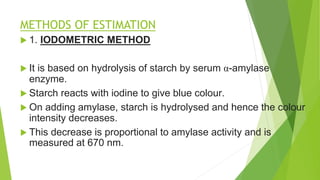
 1. IODOMETRIC METHOD
 It is based on hydrolysis of starch by serum α-amylase
enzyme.
 Starch reacts with iodine to give blue colour.
 On adding amylase, starch is hydrolysed and hence the colour
intensity decreases.
 This decrease is proportional to amylase activity and is
measured at 670 nm.
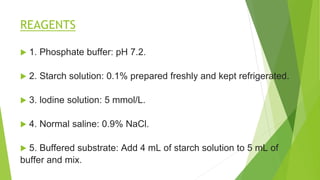
REAGENTS
 1. Phosphate buffer: pH 7.2.
 2. Starch solution: 0.1% prepared freshly and kept refrigerated.
 3. lodine solution: 5 mmol/L.
 4. Normal saline: 0.9% NaCl.
 5. Buffered substrate: Add 4 mL of starch solution to 5 mL of
buffer and mix.
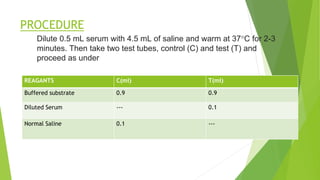
PROCEDURE
REAGANTS C(ml) T(ml)
Buffered substrate 0.9 0.9
Diluted Serum --- 0.1
Normal Saline 0.1 ---
Dilute 0.5 mL serum with 4.5 mL of saline and warm at 37°C for 2-3
minutes. Then take two test tubes, control (C) and test (T) and
proceed as under
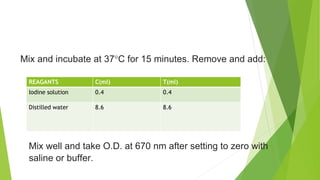
REAGANTS C(ml) T(ml)
Iodine solution 0.4 0.4
Distilled water 8.6 8.6
Mix and incubate at 37°C for 15 minutes. Remove and add:
Mix well and take O.D. at 670 nm after setting to zero with
saline or buffer.
OBSERVATION AND CALCULATION
 C-T/C x 800 -> is serum amylase in Somogyi units.
 Amylase unit is the amount of enzyme digesting 5mg of
starch under specified conditions of 37*C for 15 minutes.
INTERPRETATION
 Expected value is 25-125 U/L.
 The main clinical value of estimation of serum amylase
is the diagnosis and treatment of pancreatitis.
 2- SACCHAROGENIC METHOD[CNPG3 METHOD]
This method is based on the use of a chromogenic substrate,
2-chloro-p-nitrophenol linked with maltotriose.
The reaction of amylase with substrate results in the formation of
2-chloro-p-nitrophenol ,that can be measured spectrophotometically at
405 nm and is proportional to the alpha amylase activity in the specimen
INCREASE SERUM AMYLASE
 1. Acute Pancreatitis
Serum amylase level start rising from 12-24 hours from onset of disease,
then start falling within 2-3 days.
Persistent evaluated values higher than this suggests continuous necrosis.
Acute pancreatitis is caused by gall stones, alcoholism, trauma, infection,
Renal transplantation etc.
2.Chronic Pancreatitis
There is variable degree of fibrosis and atrophy of pancreas.
 3.Carcinoma of pancreas
Amylase in serum may be elevated but is of little diagnostic value
4. Macroamylasemia
An uncommon disorder with increased activity due to presence of abnormal
sized amylase with no or very little clearance in urine .
This arises by binding of either pancreatic or salivary amylase to a circulatory
protein
The differentiation of macroamylasemia and increased serum amylase eg
acute pancreatitis – is made by determination of urinary amylase, which will
be increased if amylase is of usual molecular weight
DECREASED AMYLASE
1. Necrotic pancreatitis
2.Hepatitis
3.Severe burns
THANK YOU

SERUM AMYLASE.pptx

  • 1.
  • 2.
    INTRODUCTION .  Amylase isthe main enzyme for carbohydrate digestion produced mainly by salivary glands and pancreas.  It is an endoglycosidase that acts randomly on internal α,1-4 glycosidic linkages of complex carbohydrates, like starch and glycogen, made up of D-glucose units.  Maltose, maltotriose and few glucose units are main products of amylase digestion.
  • 3.
     It isa small enzyme of molecular weight 55,000-60,000Da normally filtered by the kidney and excreted in urine.  It is a calcium metallo-enzyme requiring anions like Cl or Br for its activity.  The optimal pH required is 7.0.  Serum amylase is routinely estimated in biochemistry laboratory for the diagnosis and follow up of pancreatitis patients.
  • 4.
     There are3 types of amylases –α,β,.  Most human amylases are α amylase, which catalyse random cleavage of α -1,4 glycosidic linkage throughout the starch molecule.  β amylases attack only α1-4 glycosidic linkage of starch molecule to yield maltose.  γ amylase attack α 1-4 glycosidic and α 1-6 glycosidic linkage at the non reducing end of amylose and amylopectin , yielding glucose.
  • 5.
    METHODS OF ESTIMATION 1. IODOMETRIC METHOD  It is based on hydrolysis of starch by serum α-amylase enzyme.  Starch reacts with iodine to give blue colour.  On adding amylase, starch is hydrolysed and hence the colour intensity decreases.  This decrease is proportional to amylase activity and is measured at 670 nm.
  • 6.
    REAGENTS  1. Phosphatebuffer: pH 7.2.  2. Starch solution: 0.1% prepared freshly and kept refrigerated.  3. lodine solution: 5 mmol/L.  4. Normal saline: 0.9% NaCl.  5. Buffered substrate: Add 4 mL of starch solution to 5 mL of buffer and mix.
  • 7.
    PROCEDURE REAGANTS C(ml) T(ml) Bufferedsubstrate 0.9 0.9 Diluted Serum --- 0.1 Normal Saline 0.1 --- Dilute 0.5 mL serum with 4.5 mL of saline and warm at 37°C for 2-3 minutes. Then take two test tubes, control (C) and test (T) and proceed as under
  • 8.
    REAGANTS C(ml) T(ml) Iodinesolution 0.4 0.4 Distilled water 8.6 8.6 Mix and incubate at 37°C for 15 minutes. Remove and add: Mix well and take O.D. at 670 nm after setting to zero with saline or buffer.
  • 9.
    OBSERVATION AND CALCULATION C-T/C x 800 -> is serum amylase in Somogyi units.  Amylase unit is the amount of enzyme digesting 5mg of starch under specified conditions of 37*C for 15 minutes.
  • 10.
    INTERPRETATION  Expected valueis 25-125 U/L.  The main clinical value of estimation of serum amylase is the diagnosis and treatment of pancreatitis.
  • 11.
     2- SACCHAROGENICMETHOD[CNPG3 METHOD] This method is based on the use of a chromogenic substrate, 2-chloro-p-nitrophenol linked with maltotriose. The reaction of amylase with substrate results in the formation of 2-chloro-p-nitrophenol ,that can be measured spectrophotometically at 405 nm and is proportional to the alpha amylase activity in the specimen
  • 12.
    INCREASE SERUM AMYLASE 1. Acute Pancreatitis Serum amylase level start rising from 12-24 hours from onset of disease, then start falling within 2-3 days. Persistent evaluated values higher than this suggests continuous necrosis. Acute pancreatitis is caused by gall stones, alcoholism, trauma, infection, Renal transplantation etc. 2.Chronic Pancreatitis There is variable degree of fibrosis and atrophy of pancreas.
  • 13.
     3.Carcinoma ofpancreas Amylase in serum may be elevated but is of little diagnostic value 4. Macroamylasemia An uncommon disorder with increased activity due to presence of abnormal sized amylase with no or very little clearance in urine . This arises by binding of either pancreatic or salivary amylase to a circulatory protein The differentiation of macroamylasemia and increased serum amylase eg acute pancreatitis – is made by determination of urinary amylase, which will be increased if amylase is of usual molecular weight
  • 14.
    DECREASED AMYLASE 1. Necroticpancreatitis 2.Hepatitis 3.Severe burns
  • 15.