Developmental Language Disorder (DLD):
The consensus explained
Slides by Professor Dorothy Bishop
For the RADLD campaign
July 2017
• Most children learn to talk without difficulty, but some have problems using speech
and language to communicate.
• In some cases, these problems have a clear cause, but in others there is no known
cause, or risk factors of uncertain significance
• The difficulties can affect children of all ages; in some cases they are mild and
improve over time, in others they are more serious and persistent.
• Various professionals work with these children: Speech-language therapists (SLTs*),
teachers, psychologists and medical doctors, but it is difficult to work together
because the words we use to talk about types of language problems have been
variable and confusing.
*We use SLT here, but note that SLP (speech-language pathologist) and SALT (speech and language
therapist) are also used
Background
• The term Specific Language Impairment (SLI) was originally introduced by
researchers in the USA to refer to children with selective language problems of
unknown cause.
• SLI has been adopted in the UK in many clinical settings.
• However, there have been growing concerns that the term SLI has been used in a
way that excludes many children with clinically significant problems.
• A strict definition of SLI, coupled with a denial of speech-language therapy to
those who do not meet this definition, can lead to unfair provision of services,
with some children being denied help despite having serious language problems.
Specific language impairment (SLI)
• In 2012, Prof Dorothy Bishop, Prof Gina Conti-Ramsden, Prof Courtenay
Norbury, Prof Maggie Snowling and Ms Becky Clark started the RALLI (Raising
Awareness of Language Learning Impairments) campaign.
• One goal of RALLI was to provide information about children’s language
difficulties to other professionals and the public, mainly through a YouTube
channel.
• But it was difficult to raise awareness when different people used different
words to describe children’s language problems.
The RALLI campaign
• In 2016, we started the CATALISE project, to try to reach better agreement on
how to identify and talk about children’s language problems.
• We gathered together a group of 57 experts in children's language disorders
from a range of professional disciplines – mostly SLTs from the UK, but also
teachers, psychologists, doctors, and representatives from charities working
with families affected by language problems.
• Our focus was on how to decide which children would benefit from seeing a
SLT, and what words should be used to describe their problems
The CATALISE project
• The CATALISE consortium did two studies using the Delphi method.
• For each study, panel members rated and discussed statements about the
criteria and terminology for children's language difficulties.
• The ratings were done anonymously online, and people were encouraged also
to write down their thoughts on the points that were discussed.
• After this was done once, statements were revised to try to reduce
disagreement. Then everyone was shown the whole pattern of responses and
asked to rate the revised comments.
• Finally, all the statements were combined in a report and all the panel
members were asked to make further comments and revisions.
The Delphi method
• The second Delphi study made recommendations about how to talk about
children’s language problems, suggesting that the term
‘Developmental Language Disorder (DLD)’
should be used instead of SLI, and
‘Language Disorder associated with ….’
• E.g. ‘Language Disorder associated with Down syndrome’, or ‘Language Disorder
associated with Autism Spectrum Disorder’, be used for children who had
language problems in combination with a ‘differentiating condition’ such as brain
injury, neurodegenerative disorder, cerebral palsy, sensorineural hearing loss, a
genetic syndrome, autism spectrum disorder or intellectual disability.
Overview of findings from the CATALISE project
The CATALISE recommendation was that the term Developmental Language
Disorder (DLD) should be used for children where:
1. The child has language difficulties that create obstacles to communication or
learning in everyday life,
2. The child's language problems are unlikely to resolve (or have not resolved)
by five years of age, and
3. The problems are not associated with a known biomedical condition such as
brain injury, neurodegenerative conditions, genetic conditions or
chromosome disorders such as Down Syndrome, sensorineural hearing loss,
Autism Spectrum Disorder or Intellectual Disability.
Criteria for Developmental Language Disorder
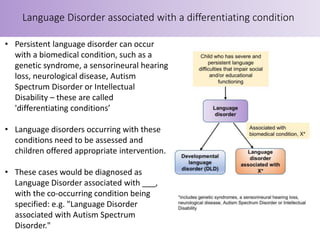
• Persistent language disorder can occur
with a biomedical condition, such as a
genetic syndrome, a sensorineural hearing
loss, neurological disease, Autism
Spectrum Disorder or Intellectual
Disability – these are called
'differentiating conditions’
• Language disorders occurring with these
conditions need to be assessed and
children offered appropriate intervention.
• These cases would be diagnosed as
Language Disorder associated with ___,
with the co-occurring condition being
specified: e.g. "Language Disorder
associated with Autism Spectrum
Disorder."
Language Disorder associated with a differentiating condition
• The CATALISE panel aimed as far as possible to recommend terminology that
was already adopted elsewhere.
• Developmental Language Disorder (DLD) has been in use for many years, and
is broadly consistent with international diagnostic systems: it will be used by
The World Health Organisation in the latest International Classification of
Diseases (ICD-11). The Diagnostic and Statistical Manual of the American
Psychiatric Association DSM-5 already uses "Language Disorder”.
• The term DLD has been endorsed by the Royal College of Speech and
Language Therapists (RCSLT), which has a mutual recognition agreement
between five countries (Australia, Canada, America, New Zealand and Republic
of Ireland).
Consistency with terminology used elsewhere
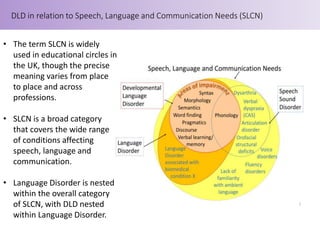
• The term SLCN is widely
used in educational circles in
the UK, though the precise
meaning varies from place
to place and across
professions.
• SLCN is a broad category
that covers the wide range
of conditions affecting
speech, language and
communication.
• Language Disorder is nested
within the overall category
of SLCN, with DLD nested
within Language Disorder.
DLD in relation to Speech, Language and Communication Needs (SLCN)
• Language Disorder is identified when language difficulties are serious enough to
impair functioning in everyday life and where problems are still present at 5 years
of age, or - for younger children - are likely to persist beyond this age.
• Multiple sources of information should be used in assessment, including
interview/questionnaires with parents/caregivers and teachers, direct observation
of the child, and standardized age-normed tests or criterion-based assessments.
• Note that the definition focuses on children whose problems are likely to persist.
It is not always easy to judge prognosis (i.e. likely outcome) in a young child.
However, we know from research studies that preschool children who have
noticeable problems with understanding (comprehension problems), or who have
problems affecting a wide range of language skills, are least likely to resolve.
How is language disorder diagnosed?
• Because many toddlers make good progress after a late start, the CATALISE
recommendation is that for 2-3 year olds, watchful waiting is adopted unless
specific risk factors are present, i.e., poor language comprehension, poor use of
gesture, and/or a family history of language impairment. Children with slow
language development who do not have these risk factors would not merit a
diagnosis of "disorder" unless the problems persist to 5 years of age.
Types of SLCN that don’t meet criteria for language disorder:
1. Late talkers
• Phonological problems in pre-schoolers that are not accompanied by other
language problems usually respond well to intervention.
• Thus they would not meet criteria for DLD because the problems are unlikely to
persist. The term 'speech sound disorder' (SSD) is recommended for such cases.
Types of SLCN that don’t meet criteria for language disorder:
2. Uncomplicated phonological problems in preschoolers
• Children with limited exposure to English at home may have restricted social and
educational opportunities. They would not, however, be regarded as having DLD
unless there was evidence that they had poor expressive and/or receptive
language in the home language, with indicators of poor prognosis.
Types of SLCN that don’t meet criteria for language disorder:
3. Language limitations due to lack of exposure to English
• One problem with the term SLI was the word ‘specific’. People varied in how
they interpreted this. Sometimes, the child could not get a diagnosis of SLI
unless they had no difficulties other than those affecting language.
• The CATALISE definition of DLD notes:
Impairments in cognitive, motor or behavioural domains can co-occur with
DLD, and should be noted, but are not used to exclude a diagnosis of DLD.
These co-occurring conditions include:
• Attention Deficit Hyperactivity Disorder (ADHD)
• Motor problems (including Developmental Co-ordination Disorder, or
'developmental dyspraxia').
• Developmental Dyslexia
• Speech difficulties
• Behavioural and emotional disorders
How ‘specific’ is developmental language disorder?
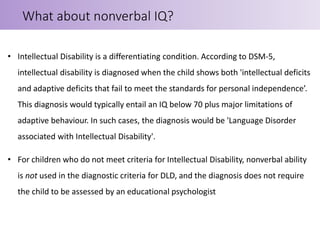
• Intellectual Disability is a differentiating condition. According to DSM-5,
intellectual disability is diagnosed when the child shows both 'intellectual deficits
and adaptive deficits that fail to meet the standards for personal independence’.
This diagnosis would typically entail an IQ below 70 plus major limitations of
adaptive behaviour. In such cases, the diagnosis would be 'Language Disorder
associated with Intellectual Disability'.
• For children who do not meet criteria for Intellectual Disability, nonverbal ability
is not used in the diagnostic criteria for DLD, and the diagnosis does not require
the child to be assessed by an educational psychologist
What about nonverbal IQ?
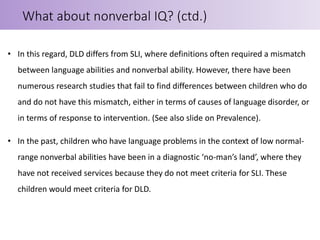
• In this regard, DLD differs from SLI, where definitions often required a mismatch
between language abilities and nonverbal ability. However, there have been
numerous research studies that fail to find differences between children who do
and do not have this mismatch, either in terms of causes of language disorder, or
in terms of response to intervention. (See also slide on Prevalence).
• In the past, children who have language problems in the context of low normal-
range nonverbal abilities have been in a diagnostic ‘no-man’s land’, where they
have not received services because they do not meet criteria for SLI. These
children would meet criteria for DLD.
What about nonverbal IQ? (ctd.)
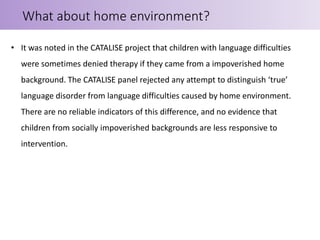
• It was noted in the CATALISE project that children with language difficulties
were sometimes denied therapy if they came from a impoverished home
background. The CATALISE panel rejected any attempt to distinguish ‘true’
language disorder from language difficulties caused by home environment.
There are no reliable indicators of this difference, and no evidence that
children from socially impoverished backgrounds are less responsive to
intervention.
What about home environment?
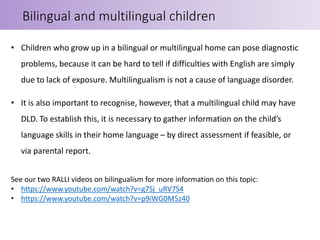
• Children who grow up in a bilingual or multilingual home can pose diagnostic
problems, because it can be hard to tell if difficulties with English are simply
due to lack of exposure. Multilingualism is not a cause of language disorder.
• It is also important to recognise, however, that a multilingual child may have
DLD. To establish this, it is necessary to gather information on the child’s
language skills in their home language – by direct assessment if feasible, or
via parental report.
See our two RALLI videos on bilingualism for more information on this topic:
• https://www.youtube.com/watch?v=g7Sj_uRV7S4
• https://www.youtube.com/watch?v=p9iWG0M5z40
Bilingual and multilingual children
• Attempts to identify reliable subtypes of DLD have not, on the whole, been
successful, because there is such a wide variety of ways in which language
problems can present and can evolve over time.
• It is recommended instead that diagnosis should be accompanied with
specification of the nature of the language impairment, (see next slide).
Are there subtypes of developmental language disorder?
Language disorder can affect any of the following:
• Phonology: problems producing and/or perceiving distinctions between speech sounds
• Grammar (Syntax and Morphology): problems combining words into grammatical
sentences, using endings such as past tense –ed etc., or in understanding meaning of
complex sentences
• Semantics: limited understanding of meanings expressed by words and word
combinations, restricted vocabulary
• Word finding: problems producing the right word even though it is known
• Pragmatics/language use: difficulty making communications appropriate to the context,
which can lead to miscommunication even if words and sentences are accurate; difficulty
understanding language in context, including overliteral interpretation; failure to
appreciate what other person needs to be told
• Verbal learning and memory: problems retaining spoken information
Aspects of language disorder
• It can be difficult to listen and work things out at the same time. At school,
children who can’t follow long and complex instructions may be mislabelled as
inattentive, naughty or stupid. The teacher may have moved on by the time a child
has processed information and is ready to answer.
• Children may find it hard to learn new words/ concepts that are then used in topic
work/ maths problems etc. They may not remember the words they want to use.
• Problems with expression and/or comprehension make it difficult to join in
activities with friends, and can be socially isolating in adolescence and adulthood.
• It may be difficult to recall information when telling stories or reporting events. In
children this could mean a bullying incident goes unreported, and in adolescents
and adults there may be problems in legal and other official contexts.
Impact of language disorder on everyday life
A recent British epidemiological study, the SCALES study, assessed language in
children entering reception class at state-maintained primary schools in
Surrey
Prevalence in children aged from 4;9 to 5;10 was as follows:
• Developmental language disorder (cause unknown): 7.58%
(Nonverbal IQ 85 or above = 4.80%, Nonverbal IQ 70-84 = 2.78%)
• Language disorder associated with a differentiating condition (e.g. ASD,
cerebral palsy, intellectual disability): 2.34%
• Total Prevalence of children with language disorder (any kind) = 9.92%
N.B. those with low-average nonverbal ability scores did not differ from those of average
nonverbal ability in severity of language deficit, or in rates of social, emotional and behavioural
problems. They also obtained similar levels of educational attainment. In contrast, where
language disorder was associated with known medical diagnosis and/or intellectual disability
children displayed more severe problems on all measures.
How common is (developmental) language disorder
• In contrast to some previous definitions of SLI, DLD does not require a mismatch
between verbal/ non-verbal ability. Provided the child does not meet criteria for
intellectual disability, low-range non-verbal ability is compatible with a diagnosis.
• The profile of language skills is not relevant for a diagnosis of DLD. Although it has
been common practice to regard an uneven, 'spiky' profile of skills as evidence of
disorder, there is no supporting evidence for this approach.
• The traditional distinction between language delay and language disorder is not
supported by research, and so the term 'language delay' is not recommended. Young
children who do not meet criteria for language disorder but who may benefit from
SLT input may be referred to as having 'language difficulties'.
• Children who have Language Disorder with an associated biomedical condition
should be assessed by a SLT, and offered intervention if appropriate.
Impact of terminology change on practice
Main References – freely available for download from the links
See the two CATALISE papers for full supporting references
Bishop, D. V. M., Clark, B., Conti-Ramsden, G., Norbury, C. F., & Snowling, M. J.
(2012). RALLI: An internet campaign for raising awareness of language learning
impairments. Child Language Teaching & Therapy, 28(3), 259-262.
doi:10.1177/0265659012459467. pdf here:
http://journals.sagepub.com/doi/pdf/10.1177/0265659012459467
Bishop, D. V. M., Snowling, M. J., Thompson, P. A., Greenhalgh, T., & The CATALISE
Consortium. (2016). CATALISE: a multinational and multidisciplinary Delphi
consensus study. Identifying language impairments in children. PLOS One, 11(7),
e0158753. doi:10.1371/journal.pone.0158753
Bishop, D. V. M., Snowling, M. J., Thompson, P. A., Greenhalgh, T., & The CATALISE
Consortium. (2017). Phase 2 of CATALISE: a multinational and multidisciplinary
Delphi consensus study of problems with language development: Terminology.
Journal of Child Psychology & Psychiatry. doi:10.1371/journal.pone.0158753

Developmental Language Disorder (DLD): The consensus explained

  • 1.
    Developmental Language Disorder(DLD): The consensus explained Slides by Professor Dorothy Bishop For the RADLD campaign July 2017
  • 2.
    • Most childrenlearn to talk without difficulty, but some have problems using speech and language to communicate. • In some cases, these problems have a clear cause, but in others there is no known cause, or risk factors of uncertain significance • The difficulties can affect children of all ages; in some cases they are mild and improve over time, in others they are more serious and persistent. • Various professionals work with these children: Speech-language therapists (SLTs*), teachers, psychologists and medical doctors, but it is difficult to work together because the words we use to talk about types of language problems have been variable and confusing. *We use SLT here, but note that SLP (speech-language pathologist) and SALT (speech and language therapist) are also used Background
  • 3.
    • The termSpecific Language Impairment (SLI) was originally introduced by researchers in the USA to refer to children with selective language problems of unknown cause. • SLI has been adopted in the UK in many clinical settings. • However, there have been growing concerns that the term SLI has been used in a way that excludes many children with clinically significant problems. • A strict definition of SLI, coupled with a denial of speech-language therapy to those who do not meet this definition, can lead to unfair provision of services, with some children being denied help despite having serious language problems. Specific language impairment (SLI)
  • 4.
    • In 2012,Prof Dorothy Bishop, Prof Gina Conti-Ramsden, Prof Courtenay Norbury, Prof Maggie Snowling and Ms Becky Clark started the RALLI (Raising Awareness of Language Learning Impairments) campaign. • One goal of RALLI was to provide information about children’s language difficulties to other professionals and the public, mainly through a YouTube channel. • But it was difficult to raise awareness when different people used different words to describe children’s language problems. The RALLI campaign
  • 5.
    • In 2016,we started the CATALISE project, to try to reach better agreement on how to identify and talk about children’s language problems. • We gathered together a group of 57 experts in children's language disorders from a range of professional disciplines – mostly SLTs from the UK, but also teachers, psychologists, doctors, and representatives from charities working with families affected by language problems. • Our focus was on how to decide which children would benefit from seeing a SLT, and what words should be used to describe their problems The CATALISE project
  • 6.
    • The CATALISEconsortium did two studies using the Delphi method. • For each study, panel members rated and discussed statements about the criteria and terminology for children's language difficulties. • The ratings were done anonymously online, and people were encouraged also to write down their thoughts on the points that were discussed. • After this was done once, statements were revised to try to reduce disagreement. Then everyone was shown the whole pattern of responses and asked to rate the revised comments. • Finally, all the statements were combined in a report and all the panel members were asked to make further comments and revisions. The Delphi method
  • 7.
    • The secondDelphi study made recommendations about how to talk about children’s language problems, suggesting that the term ‘Developmental Language Disorder (DLD)’ should be used instead of SLI, and ‘Language Disorder associated with ….’ • E.g. ‘Language Disorder associated with Down syndrome’, or ‘Language Disorder associated with Autism Spectrum Disorder’, be used for children who had language problems in combination with a ‘differentiating condition’ such as brain injury, neurodegenerative disorder, cerebral palsy, sensorineural hearing loss, a genetic syndrome, autism spectrum disorder or intellectual disability. Overview of findings from the CATALISE project
  • 8.
    The CATALISE recommendationwas that the term Developmental Language Disorder (DLD) should be used for children where: 1. The child has language difficulties that create obstacles to communication or learning in everyday life, 2. The child's language problems are unlikely to resolve (or have not resolved) by five years of age, and 3. The problems are not associated with a known biomedical condition such as brain injury, neurodegenerative conditions, genetic conditions or chromosome disorders such as Down Syndrome, sensorineural hearing loss, Autism Spectrum Disorder or Intellectual Disability. Criteria for Developmental Language Disorder
  • 9.
    • Persistent languagedisorder can occur with a biomedical condition, such as a genetic syndrome, a sensorineural hearing loss, neurological disease, Autism Spectrum Disorder or Intellectual Disability – these are called 'differentiating conditions’ • Language disorders occurring with these conditions need to be assessed and children offered appropriate intervention. • These cases would be diagnosed as Language Disorder associated with ___, with the co-occurring condition being specified: e.g. "Language Disorder associated with Autism Spectrum Disorder." Language Disorder associated with a differentiating condition
  • 10.
    • The CATALISEpanel aimed as far as possible to recommend terminology that was already adopted elsewhere. • Developmental Language Disorder (DLD) has been in use for many years, and is broadly consistent with international diagnostic systems: it will be used by The World Health Organisation in the latest International Classification of Diseases (ICD-11). The Diagnostic and Statistical Manual of the American Psychiatric Association DSM-5 already uses "Language Disorder”. • The term DLD has been endorsed by the Royal College of Speech and Language Therapists (RCSLT), which has a mutual recognition agreement between five countries (Australia, Canada, America, New Zealand and Republic of Ireland). Consistency with terminology used elsewhere
  • 11.
    • The termSLCN is widely used in educational circles in the UK, though the precise meaning varies from place to place and across professions. • SLCN is a broad category that covers the wide range of conditions affecting speech, language and communication. • Language Disorder is nested within the overall category of SLCN, with DLD nested within Language Disorder. DLD in relation to Speech, Language and Communication Needs (SLCN)
  • 12.
    • Language Disorderis identified when language difficulties are serious enough to impair functioning in everyday life and where problems are still present at 5 years of age, or - for younger children - are likely to persist beyond this age. • Multiple sources of information should be used in assessment, including interview/questionnaires with parents/caregivers and teachers, direct observation of the child, and standardized age-normed tests or criterion-based assessments. • Note that the definition focuses on children whose problems are likely to persist. It is not always easy to judge prognosis (i.e. likely outcome) in a young child. However, we know from research studies that preschool children who have noticeable problems with understanding (comprehension problems), or who have problems affecting a wide range of language skills, are least likely to resolve. How is language disorder diagnosed?
  • 13.
    • Because manytoddlers make good progress after a late start, the CATALISE recommendation is that for 2-3 year olds, watchful waiting is adopted unless specific risk factors are present, i.e., poor language comprehension, poor use of gesture, and/or a family history of language impairment. Children with slow language development who do not have these risk factors would not merit a diagnosis of "disorder" unless the problems persist to 5 years of age. Types of SLCN that don’t meet criteria for language disorder: 1. Late talkers
  • 14.
    • Phonological problemsin pre-schoolers that are not accompanied by other language problems usually respond well to intervention. • Thus they would not meet criteria for DLD because the problems are unlikely to persist. The term 'speech sound disorder' (SSD) is recommended for such cases. Types of SLCN that don’t meet criteria for language disorder: 2. Uncomplicated phonological problems in preschoolers
  • 15.
    • Children withlimited exposure to English at home may have restricted social and educational opportunities. They would not, however, be regarded as having DLD unless there was evidence that they had poor expressive and/or receptive language in the home language, with indicators of poor prognosis. Types of SLCN that don’t meet criteria for language disorder: 3. Language limitations due to lack of exposure to English
  • 16.
    • One problemwith the term SLI was the word ‘specific’. People varied in how they interpreted this. Sometimes, the child could not get a diagnosis of SLI unless they had no difficulties other than those affecting language. • The CATALISE definition of DLD notes: Impairments in cognitive, motor or behavioural domains can co-occur with DLD, and should be noted, but are not used to exclude a diagnosis of DLD. These co-occurring conditions include: • Attention Deficit Hyperactivity Disorder (ADHD) • Motor problems (including Developmental Co-ordination Disorder, or 'developmental dyspraxia'). • Developmental Dyslexia • Speech difficulties • Behavioural and emotional disorders How ‘specific’ is developmental language disorder?
  • 17.
    • Intellectual Disabilityis a differentiating condition. According to DSM-5, intellectual disability is diagnosed when the child shows both 'intellectual deficits and adaptive deficits that fail to meet the standards for personal independence’. This diagnosis would typically entail an IQ below 70 plus major limitations of adaptive behaviour. In such cases, the diagnosis would be 'Language Disorder associated with Intellectual Disability'. • For children who do not meet criteria for Intellectual Disability, nonverbal ability is not used in the diagnostic criteria for DLD, and the diagnosis does not require the child to be assessed by an educational psychologist What about nonverbal IQ?
  • 18.
    • In thisregard, DLD differs from SLI, where definitions often required a mismatch between language abilities and nonverbal ability. However, there have been numerous research studies that fail to find differences between children who do and do not have this mismatch, either in terms of causes of language disorder, or in terms of response to intervention. (See also slide on Prevalence). • In the past, children who have language problems in the context of low normal- range nonverbal abilities have been in a diagnostic ‘no-man’s land’, where they have not received services because they do not meet criteria for SLI. These children would meet criteria for DLD. What about nonverbal IQ? (ctd.)
  • 19.
    • It wasnoted in the CATALISE project that children with language difficulties were sometimes denied therapy if they came from a impoverished home background. The CATALISE panel rejected any attempt to distinguish ‘true’ language disorder from language difficulties caused by home environment. There are no reliable indicators of this difference, and no evidence that children from socially impoverished backgrounds are less responsive to intervention. What about home environment?
  • 20.
    • Children whogrow up in a bilingual or multilingual home can pose diagnostic problems, because it can be hard to tell if difficulties with English are simply due to lack of exposure. Multilingualism is not a cause of language disorder. • It is also important to recognise, however, that a multilingual child may have DLD. To establish this, it is necessary to gather information on the child’s language skills in their home language – by direct assessment if feasible, or via parental report. See our two RALLI videos on bilingualism for more information on this topic: • https://www.youtube.com/watch?v=g7Sj_uRV7S4 • https://www.youtube.com/watch?v=p9iWG0M5z40 Bilingual and multilingual children
  • 21.
    • Attempts toidentify reliable subtypes of DLD have not, on the whole, been successful, because there is such a wide variety of ways in which language problems can present and can evolve over time. • It is recommended instead that diagnosis should be accompanied with specification of the nature of the language impairment, (see next slide). Are there subtypes of developmental language disorder?
  • 22.
    Language disorder canaffect any of the following: • Phonology: problems producing and/or perceiving distinctions between speech sounds • Grammar (Syntax and Morphology): problems combining words into grammatical sentences, using endings such as past tense –ed etc., or in understanding meaning of complex sentences • Semantics: limited understanding of meanings expressed by words and word combinations, restricted vocabulary • Word finding: problems producing the right word even though it is known • Pragmatics/language use: difficulty making communications appropriate to the context, which can lead to miscommunication even if words and sentences are accurate; difficulty understanding language in context, including overliteral interpretation; failure to appreciate what other person needs to be told • Verbal learning and memory: problems retaining spoken information Aspects of language disorder
  • 23.
    • It canbe difficult to listen and work things out at the same time. At school, children who can’t follow long and complex instructions may be mislabelled as inattentive, naughty or stupid. The teacher may have moved on by the time a child has processed information and is ready to answer. • Children may find it hard to learn new words/ concepts that are then used in topic work/ maths problems etc. They may not remember the words they want to use. • Problems with expression and/or comprehension make it difficult to join in activities with friends, and can be socially isolating in adolescence and adulthood. • It may be difficult to recall information when telling stories or reporting events. In children this could mean a bullying incident goes unreported, and in adolescents and adults there may be problems in legal and other official contexts. Impact of language disorder on everyday life
  • 24.
    A recent Britishepidemiological study, the SCALES study, assessed language in children entering reception class at state-maintained primary schools in Surrey Prevalence in children aged from 4;9 to 5;10 was as follows: • Developmental language disorder (cause unknown): 7.58% (Nonverbal IQ 85 or above = 4.80%, Nonverbal IQ 70-84 = 2.78%) • Language disorder associated with a differentiating condition (e.g. ASD, cerebral palsy, intellectual disability): 2.34% • Total Prevalence of children with language disorder (any kind) = 9.92% N.B. those with low-average nonverbal ability scores did not differ from those of average nonverbal ability in severity of language deficit, or in rates of social, emotional and behavioural problems. They also obtained similar levels of educational attainment. In contrast, where language disorder was associated with known medical diagnosis and/or intellectual disability children displayed more severe problems on all measures. How common is (developmental) language disorder
  • 25.
    • In contrastto some previous definitions of SLI, DLD does not require a mismatch between verbal/ non-verbal ability. Provided the child does not meet criteria for intellectual disability, low-range non-verbal ability is compatible with a diagnosis. • The profile of language skills is not relevant for a diagnosis of DLD. Although it has been common practice to regard an uneven, 'spiky' profile of skills as evidence of disorder, there is no supporting evidence for this approach. • The traditional distinction between language delay and language disorder is not supported by research, and so the term 'language delay' is not recommended. Young children who do not meet criteria for language disorder but who may benefit from SLT input may be referred to as having 'language difficulties'. • Children who have Language Disorder with an associated biomedical condition should be assessed by a SLT, and offered intervention if appropriate. Impact of terminology change on practice
  • 26.
    Main References –freely available for download from the links See the two CATALISE papers for full supporting references Bishop, D. V. M., Clark, B., Conti-Ramsden, G., Norbury, C. F., & Snowling, M. J. (2012). RALLI: An internet campaign for raising awareness of language learning impairments. Child Language Teaching & Therapy, 28(3), 259-262. doi:10.1177/0265659012459467. pdf here: http://journals.sagepub.com/doi/pdf/10.1177/0265659012459467 Bishop, D. V. M., Snowling, M. J., Thompson, P. A., Greenhalgh, T., & The CATALISE Consortium. (2016). CATALISE: a multinational and multidisciplinary Delphi consensus study. Identifying language impairments in children. PLOS One, 11(7), e0158753. doi:10.1371/journal.pone.0158753 Bishop, D. V. M., Snowling, M. J., Thompson, P. A., Greenhalgh, T., & The CATALISE Consortium. (2017). Phase 2 of CATALISE: a multinational and multidisciplinary Delphi consensus study of problems with language development: Terminology. Journal of Child Psychology & Psychiatry. doi:10.1371/journal.pone.0158753