SPECIFIC LANGUAGE
IMPAIRMENT
SPECIFIC LANGUAGE
IMPAIRMENT
• Children who show a significant limitation in
language ability, yet the factors usually
accompanying language learning problems - such
as hearing impairment, low non-verbal intelligence
test scores, and neurological damage – are not
evident
Leonard 1998
General definition:
When SLD is a primary disability—not
accompanied by an intellectual disability, global
developmental delay, hearing or other sensory
impairment, motor dysfunction, or other mental
disorder or medical condition—it is considered
as Specific Language Impairment (SLI).
ASHA
• Specific language impairment can be viewed as a
continuum of late talking, specific expressive language
delay and expressive language delay which all affects
the child's ability to talk or understand or both. There are
3 types of SLI as per DSM IV:
– 1. Expressive language disorder
– 2. Mixed receptive expressive language disorder
– 3. Developmental articulation disorder
• Even though the disorder significantly affects the child in
terms of expression and comprehension and many other
related domains, it is a relatively less severe disorder
which occurs in the childhood and if provided with
adequate stimulation and training, many children will be
able to overcome the condition as they grow.
Diagnostic and Statistical Manual of Mental Disorders, Fourth Edn.
American Psychiatric Association
PREVALENCE
Males are more affected by SLI than females. In clinical
samples, the sex ratio of affected males: females is around 3
or 4:1 (Robinson, 1991)
Tomblin et al. (1997) suggested that as many as 7.4% of
pre-school aged children could be specifically language
impaired.
McArthur et al. (2000) raised the possibility of an even higher
prevalence rate on the basis of the undetermined
relationship between SLI and dyslexia.
In 2003, Hartley et al. referred to the prevalence estimation
of 3% to 10% of children.
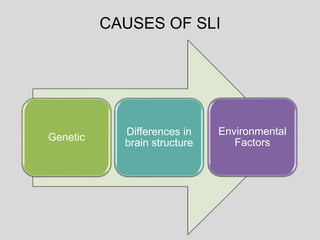
CAUSES OF SLI
Genetic
Differences in
brain structure
Environmental
Factors
• Familial studies
• Twin studies
• Pedigree studies
Genetics
DIFFERENCES IN BRAIN STRUCTURES
• One of the key finding in the study done by
Rosen et al (1985) was the asymmetry of the
planum temporale.
 In individuals with SLI a typically sized left
planum and an atypically large right planum.
 Individuals with SLI and their families
demonstrated larger perisylvian areas in the
right than compared to individual without SLI
and their families(Plante 1991)
• Social & linguistic
environment
• Demographic
variables
• (parental
education, birth
order, family&
socio-economic
status)
Environmental
factors
Characteristics of SLI
• According to ASHA, children with SLI will have
difficulty in two primary areas.
1.Linguistic skills
2.Processing skills
• They have difficulty in each language area
• Children with SLI have problem in morphology,
syntax, semantics and pragmatics(Bernstein
2002).
The early lexicon:
• Late in acquiring in their first words
• The types of words used by the children with SLI during the
early period of language development seem to match the
types observed in the speech of young normal children by
the time children with SLI begin to produce the multi word
utterances, their lexical abilities are not so easily
characterized as matching those of younger normally
developing children.
• Verbs, in particular, begin to show deficiencies that seem to
go beyond the general lag in these children’s lexical
abilities
Lexical abilities during preschool
• Poorer mapping ability on a comprehension task (Rice
et al 1990).
• The use of inappropriate extensions by the children
with SLI resembled that seen for younger normally
developing children (chapman et al 1983).
• The verb lexicon of children with SLI is characterized as
limited and less diverse , with a heavy reliance on general
all purpose (GAP) verbs , eg: go make , do, look. difficulty
with verb tensing was noted
Lexical abilities during the school years
Word finding problem.
• Long pauses in speech, frequent circumlocution,
frequent use of nonspecific words.
• Words are not represented in the memory in an
all-or-none fashion. Some words have richer
network of associations and a stronger set of
associations in memory than other words.
Naming difficulty
• Children with SLI were slower than age
controls in the number of pictures they could
name in a 60-second period ( Katz et al 1992)
• Slower response time.
• Slower in making judgments.
• Slow motor response.
• Poor word retrieval.
MORPHO SYNTAX
• Children with SLI use shorter simpler and less varied
sentences.
• Often use telegraphic speech.
• Uses content word in sentences, but omits functional
words
• Extended optional infinitive is seen where children
with SLI are thought to remain too long in a
developmental phase in which tense is treated as
optional(Wexler1994)
• Grammatical morphology related to verbs is affected
• Poor comprehension of grammatical morphemes
MORPHOLOGY
• Regular and irregular past tense
inflection
• Possessive morphemes
• Articles A, An, The.
• Third person singular forms
Children with SLI
frequently omit or
make error on
bound
morpheme.
PRAGMATIC DEFICITS
Reluctance to initiate conversation
Poor maintenance of topic
Inappropriate turn taking
Poor conversational repair strategy
Difficulty in describing events or pictures
All these pragmatic, behavioural difficulties were
secondary to problems of linguistic form or
content.
LITERACY SKILLS
• Children with SLI have difficulty in writing and reading.
• 50 to 70% of children have concurrent reading
disabilities.
• Many of these children have poor phonological
awareness
• Language impairment may be a basic deficit that affects
language function in both its oral and written forms.
Behavioral Characteristics
 Physically aggressive or
withdrawn
 Lower global self esteem
 Shyness
 Low sociability
Interview with the child’s caregiver,
Observation of the child in an
unstructured setting
Hearing test & standardized tests
of language and nonverbal ability
DIAGNOSIS OF SLI
Factor: Criterion
Language ability Language test score of 1.25 SD or lower
at risk for social devalue
Non verbal IQ Performance IQ: 85 or higher
Hearing Pass screening at conventional levels
Otitis media with effusion No recent episodes
Neurological dysfunction No evidence of seizure disorder, cerebral
palsy, brain lesions, not under medication
for control of seizures.
Oral structure No structural anomalies
Oral motor function Pass screening using developmentally
appropriate items
Physical & social interaction No symptoms of impaired reciprocal
social interaction or restriction of
activities. Leonard (1998)
The ICD-10 Research Diagnostic Criteria for
Developmental Language Disorders (World Health
Organization 1993) include following
• 1. Language skills, as assessed on standardized tests,
are below the 2 standard deviations limit for the child’s
age.
• 2. Language skills are at least 1 standard deviation below
nonverbal IQ as assessed on standardized tests.
• 3. There are no neurological, sensory, or physical
impairments that directly affect use of spoken language,
nor a pervasive developmental disorder.
• 4. A distinction is made between receptive language
disorder, where comprehension is more than 2 SD
below age level, and expressive language disorder,
where only expressive language is so severely
affected, and where understanding is within the 2
standard deviations limit for the child ́s age.
Standardized language tests that assess syntax,
morphosyntax, semantics, vocabulary, and phonology are
used. These can be supplemented by the tests of cognitive
abilities, including performance IQ and working memory.
Several computer programs are available to analyze language
samples. The programs that are widely used are
Systematic Analysis of Language Transcripts (SALT, Miller,
and Iglesias, 2008)
Computerized Language Analysis (CLAN, MacWhinney, 2000)
Computerized Profiling (Long, Fey, and Channell, 2004)
All permit calculation of mean length of utterance and provide
other syntactic, morphosyntactic, and lexical analyses.
TESTS AUTHOR & YEAR PURPOSE AGE RANGE
Clinical evaluation of
Language
Fundamentals-
Preschool (CELF-P2)
Wiig, Semel, &
Secord, 2004
It evaluates aspects of
language neccesary for
preschool children to make
transition to the classroom
 Its subtests includes
indepth language
assessment, preliteracy
scale ,Phonological
awareness & Pragmatic
profile
3- 6.11 years
Preschool Language
Scales (PLS)
Zimmerman, Steiner
& Pond, 2002
•Assess a child's ability to
meet the demands of
classroom discourse.
Birth – 6.11
years
TESTS AUTHOR & YEAR PURPOSE AGE RANGE
Expressive One word
Picture vocabulary
Test , Revised
(EOWPVT-R)
Gardner, 2000 To test a child’s verbal
expressive
vocabulary in a quick
and efficient manner.
The test can be used
as a screening tool or
to monitor progress.
2- 18.11 years
Peabody Picture
Vocabulary Test
(PPVT)
Dunn and Dunn, 1997 Measures verbal
ability in standard
American English
vocabulary.
2.6- 90+ years
TESTS AUTHOR & YEAR PURPOSE AGE- RANGE
Test of Language
Development
Primary ( TOLD-P)
Newcomer,
&Hammill, 1997
Assesses spoken
language in young
children. It is used
to (1) identify
children who are
significantly below
their peers in oral
language
proficiency,
(2) determine their
specific strengths
and weaknesses in
oral language
skills,
(3) document their
progress in
remedial programs,
(4) measure oral
language in
research studies.
It has 9 subtests.
4- 8.11 years
TESTS AUTHOR & YEAR PURPOSE AGE RANGE
Sequenced
Inventory of
Communication
Development
(SICD)
Hedrick, Prather, &
Tobin, 1984
•Assesses
communication
skills of delayed
and normally
developing
children.
•Receptive section
tests sound and
speech
discrimination,
awareness, and
understanding.
Expressive section
includes tests of
− three behaviors
(imitations,
initiation, and
response); and
4- 48 years
TESTS AUTHOR & YEAR PURPOSE AGE- RANGE
Test of Auditory
Comprehension
of Language
(TACL)
Carrow, Wool, &
Folk, 1999
Individually
administered
measure of
receptive spoken
vocabulary,
grammar, and
syntax. The test
consists of 142
items divided into
three subtests :-
•Vocabulary
•Grammatical
Morphemes
•Elaborated
Phrases and
Sentences
3- 9.11 years
TESTS AUTHOR & YEAR PURPOSE AGE RANGE
Preschool
language
Assessment
Instrument
(PLAI)
Blank, Rose, &
Berlin, 1978
Assesses how
effectively a child
integrates
cognitive,
linguistic and
pragmatic
components to
deal with
student-to-
teacher verbal
exchanges.
3- 6 years
TESTS AUTHOR & YEAR AREAS ASSESSED AGE RANGE
Bankson Language
Screening Test
Bankson, 1990 Receptive and
expressive;
semantics,
morphology, syntax;
auditory and visual
perception
3-7 years
Coston- Reindenbach
Articulation/
Language Quick
Screen
Coston &
Reidenbach, 1978
Expressive- receptive,
vocabulary syntax,
auditory
comprehension
------
Joliet 3 Minute
Speech and
Language Screen-
Preschool
Kinzler, 1992 Identifies children in
need of services-
phonology, grammar
and semantics
2.5- 4.5 years
Northwestern Syntax
Screening Test
Lee, 1971 Receptive and
expressive syntax,
morphology,
semantics
3- 7.11 years
33
Grammar and
Phonology
Screening
(GAPS) test
McClelland, A.
(2007).
GAPS test is a
quick and simple
screening test
used to assess
the grammatical
abilities and key
pre reading skills
of children
3.4 to 6.8 years
• ho need specialist help vs non-impaired
children.
Children’s
Communication
Checklist (CCC–2)
D.V.M. Bishop, 2006 70 items divided into
10 scales
Each scale has 7
items (5 address
difficulties, 2 focus on
strengths) Scales A,
B, C, & D assess
articulation and
phonology, language
structure, vocabulary
and discourse
Scales E, F, G & H
address pragmatic
aspects of
communication
Scales I & J assess
behaviors commonly
impaired in children
with ASD
4:0 to 16:11
Indian studies for assessment
• Screening Test of Syntax Acquisition in Kannada
(STASK )-Vijayalakshmi, 1981.
• Syntax Screening Test In Tamil-Sudha. K.Murthy,Thirumalai,1981
• 3DLAT-Geetha Herlekar,1986
• A Screening Picture Vocabulary Test in Kannada( Sreedevi.N, 1988)
• Linguistic Profile Test(Kannada-Prathiba karanth, 1980, Hindi - Monika
Sharma,1995., Malayalam – Asha.M.M ,1997 ., Telugu- Suhasini ,1997)
• Reading Acquisition Profile in Kannada – (Prema, K.S, 1997)
• Malayalam Language Test(Rukmini.A.P, 1994)
• Kannada Language Test (UNICEF funded project , 1990)
• Computerized Linguistic Protocol for Screening (CLIPS)-Anitha & Prema,
2004
• Cognitive Linguistic Assessment Protocol for Children (CLAP-C )-
Anuroopa, 2006
• Tests of articulation (as per language)
• DAPIC – Dsylexia assesment profile for Indian children (Kuppuraj and
Jayashree ,2012 ) etc.....
REFERENCES
• Leonard.(1999).Children with Specific Language
Impairment.
• Kaderavek.(2011). Language Disorders in Children.
• Vicki.A.Reed(2012).An introduction to children with
language disorders
• Rebecca.J.Mccauley(2001).Assessment of language
disorders in children
• www.dcidj.org
• Reed, V. (2012). An introduction to children with
language disorders. Pearson/Allyn and Bacon.

SLI.pptx

  • 1.
  • 2.
    SPECIFIC LANGUAGE IMPAIRMENT • Childrenwho show a significant limitation in language ability, yet the factors usually accompanying language learning problems - such as hearing impairment, low non-verbal intelligence test scores, and neurological damage – are not evident Leonard 1998
  • 3.
    General definition: When SLDis a primary disability—not accompanied by an intellectual disability, global developmental delay, hearing or other sensory impairment, motor dysfunction, or other mental disorder or medical condition—it is considered as Specific Language Impairment (SLI). ASHA
  • 4.
    • Specific languageimpairment can be viewed as a continuum of late talking, specific expressive language delay and expressive language delay which all affects the child's ability to talk or understand or both. There are 3 types of SLI as per DSM IV: – 1. Expressive language disorder – 2. Mixed receptive expressive language disorder – 3. Developmental articulation disorder • Even though the disorder significantly affects the child in terms of expression and comprehension and many other related domains, it is a relatively less severe disorder which occurs in the childhood and if provided with adequate stimulation and training, many children will be able to overcome the condition as they grow. Diagnostic and Statistical Manual of Mental Disorders, Fourth Edn. American Psychiatric Association
  • 5.
    PREVALENCE Males are moreaffected by SLI than females. In clinical samples, the sex ratio of affected males: females is around 3 or 4:1 (Robinson, 1991) Tomblin et al. (1997) suggested that as many as 7.4% of pre-school aged children could be specifically language impaired. McArthur et al. (2000) raised the possibility of an even higher prevalence rate on the basis of the undetermined relationship between SLI and dyslexia. In 2003, Hartley et al. referred to the prevalence estimation of 3% to 10% of children.
  • 6.
    CAUSES OF SLI Genetic Differencesin brain structure Environmental Factors
  • 7.
    • Familial studies •Twin studies • Pedigree studies Genetics
  • 8.
    DIFFERENCES IN BRAINSTRUCTURES • One of the key finding in the study done by Rosen et al (1985) was the asymmetry of the planum temporale.  In individuals with SLI a typically sized left planum and an atypically large right planum.  Individuals with SLI and their families demonstrated larger perisylvian areas in the right than compared to individual without SLI and their families(Plante 1991)
  • 9.
    • Social &linguistic environment • Demographic variables • (parental education, birth order, family& socio-economic status) Environmental factors
  • 10.
  • 11.
    • According toASHA, children with SLI will have difficulty in two primary areas. 1.Linguistic skills 2.Processing skills • They have difficulty in each language area • Children with SLI have problem in morphology, syntax, semantics and pragmatics(Bernstein 2002).
  • 12.
    The early lexicon: •Late in acquiring in their first words • The types of words used by the children with SLI during the early period of language development seem to match the types observed in the speech of young normal children by the time children with SLI begin to produce the multi word utterances, their lexical abilities are not so easily characterized as matching those of younger normally developing children. • Verbs, in particular, begin to show deficiencies that seem to go beyond the general lag in these children’s lexical abilities
  • 13.
    Lexical abilities duringpreschool • Poorer mapping ability on a comprehension task (Rice et al 1990). • The use of inappropriate extensions by the children with SLI resembled that seen for younger normally developing children (chapman et al 1983). • The verb lexicon of children with SLI is characterized as limited and less diverse , with a heavy reliance on general all purpose (GAP) verbs , eg: go make , do, look. difficulty with verb tensing was noted
  • 14.
    Lexical abilities duringthe school years Word finding problem. • Long pauses in speech, frequent circumlocution, frequent use of nonspecific words. • Words are not represented in the memory in an all-or-none fashion. Some words have richer network of associations and a stronger set of associations in memory than other words.
  • 15.
    Naming difficulty • Childrenwith SLI were slower than age controls in the number of pictures they could name in a 60-second period ( Katz et al 1992) • Slower response time. • Slower in making judgments. • Slow motor response. • Poor word retrieval.
  • 16.
    MORPHO SYNTAX • Childrenwith SLI use shorter simpler and less varied sentences. • Often use telegraphic speech. • Uses content word in sentences, but omits functional words • Extended optional infinitive is seen where children with SLI are thought to remain too long in a developmental phase in which tense is treated as optional(Wexler1994) • Grammatical morphology related to verbs is affected • Poor comprehension of grammatical morphemes
  • 17.
    MORPHOLOGY • Regular andirregular past tense inflection • Possessive morphemes • Articles A, An, The. • Third person singular forms Children with SLI frequently omit or make error on bound morpheme.
  • 18.
    PRAGMATIC DEFICITS Reluctance toinitiate conversation Poor maintenance of topic Inappropriate turn taking Poor conversational repair strategy Difficulty in describing events or pictures All these pragmatic, behavioural difficulties were secondary to problems of linguistic form or content.
  • 19.
    LITERACY SKILLS • Childrenwith SLI have difficulty in writing and reading. • 50 to 70% of children have concurrent reading disabilities. • Many of these children have poor phonological awareness • Language impairment may be a basic deficit that affects language function in both its oral and written forms.
  • 20.
    Behavioral Characteristics  Physicallyaggressive or withdrawn  Lower global self esteem  Shyness  Low sociability
  • 22.
    Interview with thechild’s caregiver, Observation of the child in an unstructured setting Hearing test & standardized tests of language and nonverbal ability
  • 23.
  • 24.
    Factor: Criterion Language abilityLanguage test score of 1.25 SD or lower at risk for social devalue Non verbal IQ Performance IQ: 85 or higher Hearing Pass screening at conventional levels Otitis media with effusion No recent episodes Neurological dysfunction No evidence of seizure disorder, cerebral palsy, brain lesions, not under medication for control of seizures. Oral structure No structural anomalies Oral motor function Pass screening using developmentally appropriate items Physical & social interaction No symptoms of impaired reciprocal social interaction or restriction of activities. Leonard (1998)
  • 25.
    The ICD-10 ResearchDiagnostic Criteria for Developmental Language Disorders (World Health Organization 1993) include following • 1. Language skills, as assessed on standardized tests, are below the 2 standard deviations limit for the child’s age. • 2. Language skills are at least 1 standard deviation below nonverbal IQ as assessed on standardized tests. • 3. There are no neurological, sensory, or physical impairments that directly affect use of spoken language, nor a pervasive developmental disorder. • 4. A distinction is made between receptive language disorder, where comprehension is more than 2 SD below age level, and expressive language disorder, where only expressive language is so severely affected, and where understanding is within the 2 standard deviations limit for the child ́s age.
  • 26.
    Standardized language teststhat assess syntax, morphosyntax, semantics, vocabulary, and phonology are used. These can be supplemented by the tests of cognitive abilities, including performance IQ and working memory. Several computer programs are available to analyze language samples. The programs that are widely used are Systematic Analysis of Language Transcripts (SALT, Miller, and Iglesias, 2008) Computerized Language Analysis (CLAN, MacWhinney, 2000) Computerized Profiling (Long, Fey, and Channell, 2004) All permit calculation of mean length of utterance and provide other syntactic, morphosyntactic, and lexical analyses.
  • 27.
    TESTS AUTHOR &YEAR PURPOSE AGE RANGE Clinical evaluation of Language Fundamentals- Preschool (CELF-P2) Wiig, Semel, & Secord, 2004 It evaluates aspects of language neccesary for preschool children to make transition to the classroom  Its subtests includes indepth language assessment, preliteracy scale ,Phonological awareness & Pragmatic profile 3- 6.11 years Preschool Language Scales (PLS) Zimmerman, Steiner & Pond, 2002 •Assess a child's ability to meet the demands of classroom discourse. Birth – 6.11 years
  • 28.
    TESTS AUTHOR &YEAR PURPOSE AGE RANGE Expressive One word Picture vocabulary Test , Revised (EOWPVT-R) Gardner, 2000 To test a child’s verbal expressive vocabulary in a quick and efficient manner. The test can be used as a screening tool or to monitor progress. 2- 18.11 years Peabody Picture Vocabulary Test (PPVT) Dunn and Dunn, 1997 Measures verbal ability in standard American English vocabulary. 2.6- 90+ years
  • 29.
    TESTS AUTHOR &YEAR PURPOSE AGE- RANGE Test of Language Development Primary ( TOLD-P) Newcomer, &Hammill, 1997 Assesses spoken language in young children. It is used to (1) identify children who are significantly below their peers in oral language proficiency, (2) determine their specific strengths and weaknesses in oral language skills, (3) document their progress in remedial programs, (4) measure oral language in research studies. It has 9 subtests. 4- 8.11 years
  • 30.
    TESTS AUTHOR &YEAR PURPOSE AGE RANGE Sequenced Inventory of Communication Development (SICD) Hedrick, Prather, & Tobin, 1984 •Assesses communication skills of delayed and normally developing children. •Receptive section tests sound and speech discrimination, awareness, and understanding. Expressive section includes tests of − three behaviors (imitations, initiation, and response); and 4- 48 years
  • 31.
    TESTS AUTHOR &YEAR PURPOSE AGE- RANGE Test of Auditory Comprehension of Language (TACL) Carrow, Wool, & Folk, 1999 Individually administered measure of receptive spoken vocabulary, grammar, and syntax. The test consists of 142 items divided into three subtests :- •Vocabulary •Grammatical Morphemes •Elaborated Phrases and Sentences 3- 9.11 years
  • 32.
    TESTS AUTHOR &YEAR PURPOSE AGE RANGE Preschool language Assessment Instrument (PLAI) Blank, Rose, & Berlin, 1978 Assesses how effectively a child integrates cognitive, linguistic and pragmatic components to deal with student-to- teacher verbal exchanges. 3- 6 years
  • 33.
    TESTS AUTHOR &YEAR AREAS ASSESSED AGE RANGE Bankson Language Screening Test Bankson, 1990 Receptive and expressive; semantics, morphology, syntax; auditory and visual perception 3-7 years Coston- Reindenbach Articulation/ Language Quick Screen Coston & Reidenbach, 1978 Expressive- receptive, vocabulary syntax, auditory comprehension ------ Joliet 3 Minute Speech and Language Screen- Preschool Kinzler, 1992 Identifies children in need of services- phonology, grammar and semantics 2.5- 4.5 years Northwestern Syntax Screening Test Lee, 1971 Receptive and expressive syntax, morphology, semantics 3- 7.11 years 33
  • 34.
    Grammar and Phonology Screening (GAPS) test McClelland,A. (2007). GAPS test is a quick and simple screening test used to assess the grammatical abilities and key pre reading skills of children 3.4 to 6.8 years
  • 35.
    • ho needspecialist help vs non-impaired children. Children’s Communication Checklist (CCC–2) D.V.M. Bishop, 2006 70 items divided into 10 scales Each scale has 7 items (5 address difficulties, 2 focus on strengths) Scales A, B, C, & D assess articulation and phonology, language structure, vocabulary and discourse Scales E, F, G & H address pragmatic aspects of communication Scales I & J assess behaviors commonly impaired in children with ASD 4:0 to 16:11
  • 36.
    Indian studies forassessment • Screening Test of Syntax Acquisition in Kannada (STASK )-Vijayalakshmi, 1981. • Syntax Screening Test In Tamil-Sudha. K.Murthy,Thirumalai,1981 • 3DLAT-Geetha Herlekar,1986 • A Screening Picture Vocabulary Test in Kannada( Sreedevi.N, 1988) • Linguistic Profile Test(Kannada-Prathiba karanth, 1980, Hindi - Monika Sharma,1995., Malayalam – Asha.M.M ,1997 ., Telugu- Suhasini ,1997) • Reading Acquisition Profile in Kannada – (Prema, K.S, 1997) • Malayalam Language Test(Rukmini.A.P, 1994) • Kannada Language Test (UNICEF funded project , 1990) • Computerized Linguistic Protocol for Screening (CLIPS)-Anitha & Prema, 2004 • Cognitive Linguistic Assessment Protocol for Children (CLAP-C )- Anuroopa, 2006 • Tests of articulation (as per language) • DAPIC – Dsylexia assesment profile for Indian children (Kuppuraj and Jayashree ,2012 ) etc.....
  • 37.
    REFERENCES • Leonard.(1999).Children withSpecific Language Impairment. • Kaderavek.(2011). Language Disorders in Children. • Vicki.A.Reed(2012).An introduction to children with language disorders • Rebecca.J.Mccauley(2001).Assessment of language disorders in children • www.dcidj.org • Reed, V. (2012). An introduction to children with language disorders. Pearson/Allyn and Bacon.