1Western Blotting
WESTERN BLOTTING
Technical Tips and Troubleshooting
www.ptglab.comwww.ptglab.com
2Western Blotting
CONTENTS
Principles Of Western Blotting
Antigen Optimization
Low Molecular Weight Proteins
Blocking
Transfer
Membrane Choice
Monoclonal Or Polyclonal Antibody?
Controls
Troubleshooting
Contact Us
3
4–5
6–8
9
10–11
12–13
14
15–16
17–20
21
2Western Blotting
www.ptglab.com
3Western Blotting
PRINCIPLES OF WESTERN BLOTTING
–– Western Blotting is an
	 Immunoblotting Technique.
–– Western Blotting is an analytical 		
	 technique to detect specific proteins
	 in a cell extract or tissue homogenate.
–– Western Blotting relies on the
	 specific binding between the protein-of-	
	 interest and an antibody raised against 	
	 this particular protein.
–– Main steps are:
Sample preparation
Gel electrophoresis
Transfer
Blocking
Detection
Analysis
3Western Blotting
www.ptglab.com
4Western Blotting
ANTIGEN OPTIMIZATION
–– Cell lysis is the breaking down of the
	 cell membrane and the separation of 	
	 proteins from the non-soluble parts of 	
	 the cell.
–– Dependent on the location of the
	 protein of interest, a different lysis 		
	 buffer is needed.
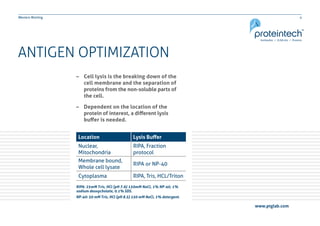
Location Lysis Buffer
Nuclear,
Mitochondria
RIPA, Fraction
protocol
Membrane bound,
Whole cell lysate
RIPA or NP-40
Cytoplasma RIPA, Tris, HCL/Triton
RIPA: 25mM Tris, HCl (pH 7.6) 150mM NaCl, 1% NP-40, 1%
sodium deoxycholate, 0.1% SDS.
NP-40: 50 mM Tris, HCl (pH 8.5) 150 mM NaCl, 1% detergent.
www.ptglab.com
5Western Blotting
ANTIGEN OPTIMIZATION
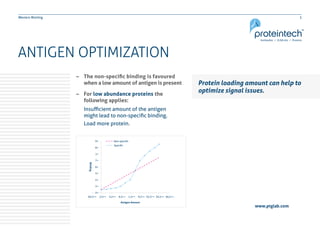
–– The non-specific binding is favoured 	
	 when a low amount of antigen is present
–– For low abundance proteins the 		
	 following applies:
Insufficient amount of the antigen
might lead to non-specific binding.
Load more protein.
Protein loading amount can help to
optimize signal issues.
www.ptglab.com
6Western Blotting
LOW MOLECULAR WEIGHT PROTEINS
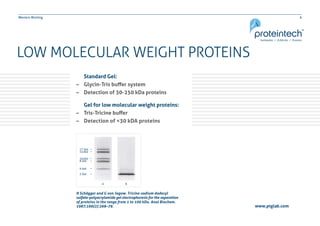
Standard Gel:
–– Glycin-Tris buffer system
–– Detection of 30-250 kDa proteins
Gel for low molecular weight proteins:
–– Tris-Tricine buffer
–– Detection of <30 kDA proteins
H Schägger and G von Jagow. Tricine-sodium dodecyl
sulfate-polyacrylamide gel electrophoresis for the separation
of proteins in the range from 1 to 100 kDa. Anal Biochem.
1987;166(2):368–79.
17.2kd
14.6kd
10.6kd
8.2kd
6.4kd
2.5kd
A B
www.ptglab.com
7Western Blotting
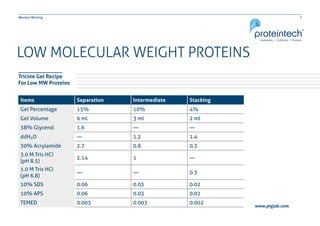
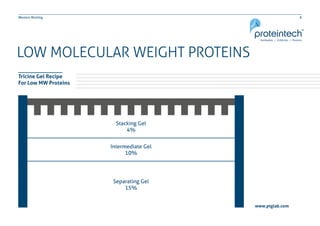
Tricine Gel Recipe
For Low MW Proteins
LOW MOLECULAR WEIGHT PROTEINS
Items Separation Intermediate Stacking
Gel Percentage 15% 10% 4%
Gel Volume 6 ml 3 ml 2 ml
38% Glycerol 1.6 — —
ddH2O — 1.2 1.4
30% Acrylamide 2.7 0.8 0.3
3.0 M Tris HCl
(pH 8.5)
2.14 1 —
1.0 M Tris HCl
(pH 6.8)
— — 0.3
10% SDS 0.06 0.03 0.02
10% APS 0.06 0.03 0.02
TEMED 0.003 0.003 0.002
www.ptglab.com
8Western Blotting
Tricine Gel Recipe
For Low MW Proteins
LOW MOLECULAR WEIGHT PROTEINS
Stacking Gel
4%
Intermediate Gel
10%
Separating Gel
15%
www.ptglab.com
9Western Blotting
BLOCKING
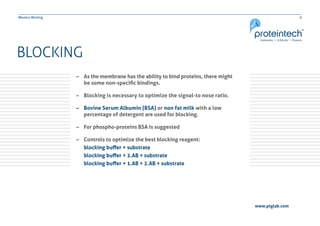
–– As the membrane has the ability to bind proteins, there might
	 be some non-specific bindings.
–– Blocking is necessary to optimize the signal-to nose ratio.
–– Bovine Serum Albumin (BSA) or non fat milk with a low 		
	 percentage of detergent are used for blocking.
–– For phospho-proteins BSA is suggested
–– Controls to optimize the best blocking reagent:
blocking buffer + substrate
blocking buffer + 2.AB + substrate
blocking buffer + 1.AB + 2.AB + substrate
www.ptglab.com
10Western Blotting
TRANSFER
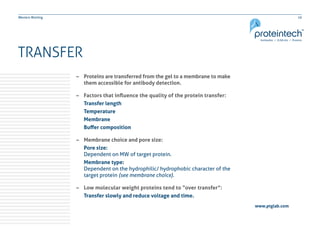
–– Proteins are transferred from the gel to a membrane to make 	
	 them accessible for antibody detection.
–– Factors that influence the quality of the protein transfer:
Transfer length
Temperature
Membrane
Buffer composition
–– Membrane choice and pore size:
Pore size:
Dependent on MW of target protein.
Membrane type:
Dependent on the hydrophilic/ hydrophobic character of the
target protein (see membrane choice).
–– Low molecular weight proteins tend to “over transfer”:
Transfer slowly and reduce voltage and time.
www.ptglab.com
11Western Blotting
TRANSFER
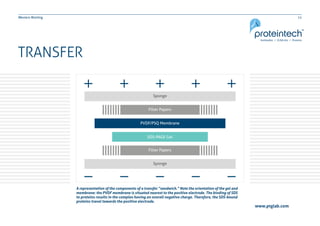
A representation of the components of a transfer “sandwich.” Note the orientation of the gel and
membrane: the PVDF membrane is situated nearest to the positive electrode. The binding of SDS
to proteins results in the complex having an overall negative charge. Therefore, the SDS-bound
proteins travel towards the positive electrode.
www.ptglab.com
12Western Blotting
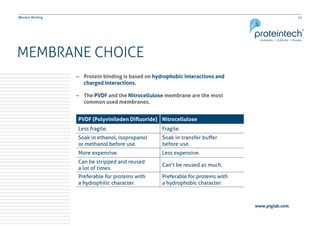
MEMBRANE CHOICE
–– Protein binding is based on hydrophobic interactions and
	 charged interactions.
–– The PVDF and the Nitrocellulose membrane are the most 		
	 common used membranes.
PVDF (Polyvinileden Difluoride) Nitrocellulose
Less fragile. Fragile.
Soak in ethanol, isopropanol
or methanol before use.
Soak in transfer buffer
before use.
More expensive. Less expensive.
Can be stripped and reused
a lot of times.
Can’t be reused as much.
Preferable for proteins with
a hydrophilic character.
Preferable for proteins with
a hydrophobic character.
www.ptglab.com
13Western Blotting
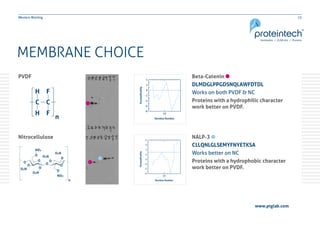
MEMBRANE CHOICE
Beta-Catenin
DLMDGLPPGDSNQLAWFDTDL
Works on both PVDF & NC
Proteins with a hydrophilic character
work better on PVDF.
PVDF
NALP-3
CLLQNLGLSEMYFNYETKSA
Works better on NC
Proteins with a hydrophobic character
work better on PVDF.
Nitrocellulose
Residue Number
www.ptglab.com
14Western Blotting
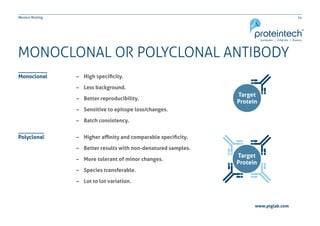
MONOCLONAL OR POLYCLONAL ANTIBODY
–– Higher affinity and comparable specificity.
–– Better results with non-denatured samples.
–– More tolerant of minor changes.
–– Species transferable.
–– Lot to lot variation.
–– High specificity.
–– Less background.
–– Better reproducibility.
–– Sensitive to epitope loss/changes.
–– Batch consistency.
Polyclonal
Monoclonal
www.ptglab.com
15Western Blotting
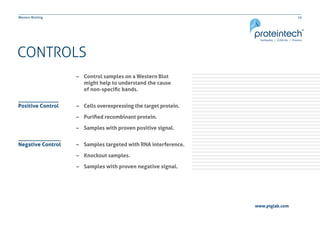
CONTROLS
–– Cells overexpressing the target protein.
–– Purified recombinant protein.
–– Samples with proven positive signal.
–– Control samples on a Western Blot
	 might help to understand the cause
	 of non-specific bands.
–– Samples targeted with RNA interference.
–– Knockout samples.
–– Samples with proven negative signal.
Positive Control
Negative Control
www.ptglab.com
16Western Blotting
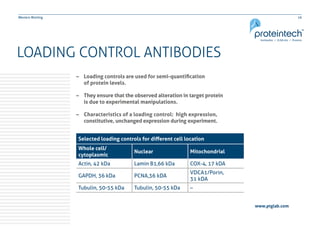
LOADING CONTROL ANTIBODIES
–– Loading controls are used for semi-quantification
	 of protein levels.
–– They ensure that the observed alteration in target protein
	 is due to experimental manipulations.
–– Characteristics of a loading control: high expression, 		
	 constitutive, unchanged expression during experiment.
Selected loading controls for different cell location
Whole cell/
cytoplasmic
Nuclear Mitochondrial
Actin, 42 kDa Lamin B1,66 kDa COX-4, 17 kDA
GAPDH, 36 kDa PCNA,36 kDA
VDCA1/Porin,
31 kDA
Tubulin, 50-55 kDa Tubulin, 50-55 kDa –
www.ptglab.com
17Western Blotting
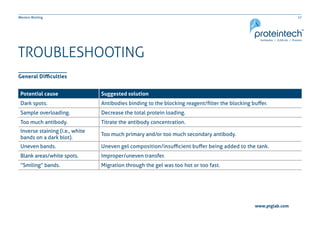
TROUBLESHOOTING
General Difficulties
Potential cause Suggested solution
Dark spots. Antibodies binding to the blocking reagent/filter the blocking buffer.
Sample overloading. Decrease the total protein loading.
Too much antibody. Titrate the antibody concentration.
Inverse staining (i.e., white
bands on a dark blot).
Too much primary and/or too much secondary antibody.
Uneven bands. Uneven gel composition/insufficient buffer being added to the tank.
Blank areas/white spots. Improper/uneven transfer.
“Smiling” bands. Migration through the gel was too hot or too fast.
www.ptglab.com
18Western Blotting
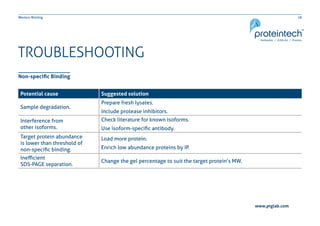
TROUBLESHOOTING
Non-specific Binding
Potential cause Suggested solution
Sample degradation.
Prepare fresh lysates.
Include protease inhibitors.
Interference from
other isoforms.
Check literature for known isoforms.
Use isoform-specific antibody.
Target protein abundance
is lower than threshold of
non-specific binding.
Load more protein.
Enrich low abundance proteins by IP.
Inefficient
SDS-PAGE separation.
Change the gel percentage to suit the target protein’s MW.
www.ptglab.com
19Western Blotting
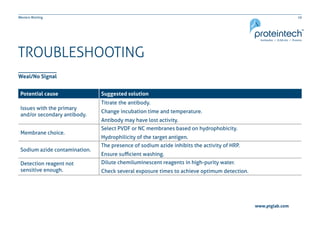
TROUBLESHOOTING
Weal/No Signal
Potential cause Suggested solution
Issues with the primary
and/or secondary antibody.
Titrate the antibody.
Change incubation time and temperature.
Antibody may have lost activity.
Membrane choice.
Select PVDF or NC membranes based on hydrophobicity.
Hydrophilicity of the target antigen.
Sodium azide contamination.
The presence of sodium azide inhibits the activity of HRP.
Ensure sufficient washing.
Detection reagent not
sensitive enough.
Dilute chemiluminescent reagents in high-purity water.
Check several exposure times to achieve optimum detection.
www.ptglab.com
20Western Blotting
TROUBLESHOOTING
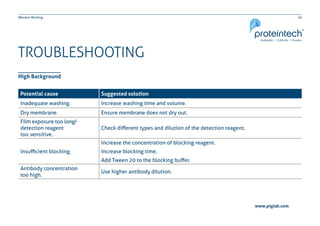
High Background
Potential cause Suggested solution
Inadequate washing. Increase washing time and volume.
Dry membrane. Ensure membrane does not dry out.
Film exposure too long/
detection reagent
too sensitive.
Check different types and dilution of the detection reagent.
Insufficient blocking.
Increase the concentration of blocking reagent.
Increase blocking time.
Add Tween 20 to the blocking buffer.
Antibody concentration
too high.
Use higher antibody dilution.
www.ptglab.com
21Western Blotting
CONTACT US
proteintech@ptglab.com
europe@ptglab.com
service@ptglab.com
Available 24 hours via Live Chat and 9–5
(CDT) via phone.
Proteintech Group
Proteintech Europe
Proteintech
Support
US Head Office
United Kingdom
China Office
Please visit us at www.ptglab.com for
more information about our antibodies
and technical tips.
www.ptglab.com

Western Blotting - Technical Tips and Troubleshooting

  • 1.
    1Western Blotting WESTERN BLOTTING TechnicalTips and Troubleshooting www.ptglab.comwww.ptglab.com
  • 2.
    2Western Blotting CONTENTS Principles OfWestern Blotting Antigen Optimization Low Molecular Weight Proteins Blocking Transfer Membrane Choice Monoclonal Or Polyclonal Antibody? Controls Troubleshooting Contact Us 3 4–5 6–8 9 10–11 12–13 14 15–16 17–20 21 2Western Blotting www.ptglab.com
  • 3.
    3Western Blotting PRINCIPLES OFWESTERN BLOTTING –– Western Blotting is an Immunoblotting Technique. –– Western Blotting is an analytical technique to detect specific proteins in a cell extract or tissue homogenate. –– Western Blotting relies on the specific binding between the protein-of- interest and an antibody raised against this particular protein. –– Main steps are: Sample preparation Gel electrophoresis Transfer Blocking Detection Analysis 3Western Blotting www.ptglab.com
  • 4.
    4Western Blotting ANTIGEN OPTIMIZATION ––Cell lysis is the breaking down of the cell membrane and the separation of proteins from the non-soluble parts of the cell. –– Dependent on the location of the protein of interest, a different lysis buffer is needed. Location Lysis Buffer Nuclear, Mitochondria RIPA, Fraction protocol Membrane bound, Whole cell lysate RIPA or NP-40 Cytoplasma RIPA, Tris, HCL/Triton RIPA: 25mM Tris, HCl (pH 7.6) 150mM NaCl, 1% NP-40, 1% sodium deoxycholate, 0.1% SDS. NP-40: 50 mM Tris, HCl (pH 8.5) 150 mM NaCl, 1% detergent. www.ptglab.com
  • 5.
    5Western Blotting ANTIGEN OPTIMIZATION ––The non-specific binding is favoured when a low amount of antigen is present –– For low abundance proteins the following applies: Insufficient amount of the antigen might lead to non-specific binding. Load more protein. Protein loading amount can help to optimize signal issues. www.ptglab.com
  • 6.
    6Western Blotting LOW MOLECULARWEIGHT PROTEINS Standard Gel: –– Glycin-Tris buffer system –– Detection of 30-250 kDa proteins Gel for low molecular weight proteins: –– Tris-Tricine buffer –– Detection of <30 kDA proteins H Schägger and G von Jagow. Tricine-sodium dodecyl sulfate-polyacrylamide gel electrophoresis for the separation of proteins in the range from 1 to 100 kDa. Anal Biochem. 1987;166(2):368–79. 17.2kd 14.6kd 10.6kd 8.2kd 6.4kd 2.5kd A B www.ptglab.com
  • 7.
    7Western Blotting Tricine GelRecipe For Low MW Proteins LOW MOLECULAR WEIGHT PROTEINS Items Separation Intermediate Stacking Gel Percentage 15% 10% 4% Gel Volume 6 ml 3 ml 2 ml 38% Glycerol 1.6 — — ddH2O — 1.2 1.4 30% Acrylamide 2.7 0.8 0.3 3.0 M Tris HCl (pH 8.5) 2.14 1 — 1.0 M Tris HCl (pH 6.8) — — 0.3 10% SDS 0.06 0.03 0.02 10% APS 0.06 0.03 0.02 TEMED 0.003 0.003 0.002 www.ptglab.com
  • 8.
    8Western Blotting Tricine GelRecipe For Low MW Proteins LOW MOLECULAR WEIGHT PROTEINS Stacking Gel 4% Intermediate Gel 10% Separating Gel 15% www.ptglab.com
  • 9.
    9Western Blotting BLOCKING –– Asthe membrane has the ability to bind proteins, there might be some non-specific bindings. –– Blocking is necessary to optimize the signal-to nose ratio. –– Bovine Serum Albumin (BSA) or non fat milk with a low percentage of detergent are used for blocking. –– For phospho-proteins BSA is suggested –– Controls to optimize the best blocking reagent: blocking buffer + substrate blocking buffer + 2.AB + substrate blocking buffer + 1.AB + 2.AB + substrate www.ptglab.com
  • 10.
    10Western Blotting TRANSFER –– Proteinsare transferred from the gel to a membrane to make them accessible for antibody detection. –– Factors that influence the quality of the protein transfer: Transfer length Temperature Membrane Buffer composition –– Membrane choice and pore size: Pore size: Dependent on MW of target protein. Membrane type: Dependent on the hydrophilic/ hydrophobic character of the target protein (see membrane choice). –– Low molecular weight proteins tend to “over transfer”: Transfer slowly and reduce voltage and time. www.ptglab.com
  • 11.
    11Western Blotting TRANSFER A representationof the components of a transfer “sandwich.” Note the orientation of the gel and membrane: the PVDF membrane is situated nearest to the positive electrode. The binding of SDS to proteins results in the complex having an overall negative charge. Therefore, the SDS-bound proteins travel towards the positive electrode. www.ptglab.com
  • 12.
    12Western Blotting MEMBRANE CHOICE ––Protein binding is based on hydrophobic interactions and charged interactions. –– The PVDF and the Nitrocellulose membrane are the most common used membranes. PVDF (Polyvinileden Difluoride) Nitrocellulose Less fragile. Fragile. Soak in ethanol, isopropanol or methanol before use. Soak in transfer buffer before use. More expensive. Less expensive. Can be stripped and reused a lot of times. Can’t be reused as much. Preferable for proteins with a hydrophilic character. Preferable for proteins with a hydrophobic character. www.ptglab.com
  • 13.
    13Western Blotting MEMBRANE CHOICE Beta-Catenin DLMDGLPPGDSNQLAWFDTDL Workson both PVDF & NC Proteins with a hydrophilic character work better on PVDF. PVDF NALP-3 CLLQNLGLSEMYFNYETKSA Works better on NC Proteins with a hydrophobic character work better on PVDF. Nitrocellulose Residue Number www.ptglab.com
  • 14.
    14Western Blotting MONOCLONAL ORPOLYCLONAL ANTIBODY –– Higher affinity and comparable specificity. –– Better results with non-denatured samples. –– More tolerant of minor changes. –– Species transferable. –– Lot to lot variation. –– High specificity. –– Less background. –– Better reproducibility. –– Sensitive to epitope loss/changes. –– Batch consistency. Polyclonal Monoclonal www.ptglab.com
  • 15.
    15Western Blotting CONTROLS –– Cellsoverexpressing the target protein. –– Purified recombinant protein. –– Samples with proven positive signal. –– Control samples on a Western Blot might help to understand the cause of non-specific bands. –– Samples targeted with RNA interference. –– Knockout samples. –– Samples with proven negative signal. Positive Control Negative Control www.ptglab.com
  • 16.
    16Western Blotting LOADING CONTROLANTIBODIES –– Loading controls are used for semi-quantification of protein levels. –– They ensure that the observed alteration in target protein is due to experimental manipulations. –– Characteristics of a loading control: high expression, constitutive, unchanged expression during experiment. Selected loading controls for different cell location Whole cell/ cytoplasmic Nuclear Mitochondrial Actin, 42 kDa Lamin B1,66 kDa COX-4, 17 kDA GAPDH, 36 kDa PCNA,36 kDA VDCA1/Porin, 31 kDA Tubulin, 50-55 kDa Tubulin, 50-55 kDa – www.ptglab.com
  • 17.
    17Western Blotting TROUBLESHOOTING General Difficulties Potentialcause Suggested solution Dark spots. Antibodies binding to the blocking reagent/filter the blocking buffer. Sample overloading. Decrease the total protein loading. Too much antibody. Titrate the antibody concentration. Inverse staining (i.e., white bands on a dark blot). Too much primary and/or too much secondary antibody. Uneven bands. Uneven gel composition/insufficient buffer being added to the tank. Blank areas/white spots. Improper/uneven transfer. “Smiling” bands. Migration through the gel was too hot or too fast. www.ptglab.com
  • 18.
    18Western Blotting TROUBLESHOOTING Non-specific Binding Potentialcause Suggested solution Sample degradation. Prepare fresh lysates. Include protease inhibitors. Interference from other isoforms. Check literature for known isoforms. Use isoform-specific antibody. Target protein abundance is lower than threshold of non-specific binding. Load more protein. Enrich low abundance proteins by IP. Inefficient SDS-PAGE separation. Change the gel percentage to suit the target protein’s MW. www.ptglab.com
  • 19.
    19Western Blotting TROUBLESHOOTING Weal/No Signal Potentialcause Suggested solution Issues with the primary and/or secondary antibody. Titrate the antibody. Change incubation time and temperature. Antibody may have lost activity. Membrane choice. Select PVDF or NC membranes based on hydrophobicity. Hydrophilicity of the target antigen. Sodium azide contamination. The presence of sodium azide inhibits the activity of HRP. Ensure sufficient washing. Detection reagent not sensitive enough. Dilute chemiluminescent reagents in high-purity water. Check several exposure times to achieve optimum detection. www.ptglab.com
  • 20.
    20Western Blotting TROUBLESHOOTING High Background Potentialcause Suggested solution Inadequate washing. Increase washing time and volume. Dry membrane. Ensure membrane does not dry out. Film exposure too long/ detection reagent too sensitive. Check different types and dilution of the detection reagent. Insufficient blocking. Increase the concentration of blocking reagent. Increase blocking time. Add Tween 20 to the blocking buffer. Antibody concentration too high. Use higher antibody dilution. www.ptglab.com
  • 21.
    21Western Blotting CONTACT US proteintech@ptglab.com europe@ptglab.com service@ptglab.com Available24 hours via Live Chat and 9–5 (CDT) via phone. Proteintech Group Proteintech Europe Proteintech Support US Head Office United Kingdom China Office Please visit us at www.ptglab.com for more information about our antibodies and technical tips. www.ptglab.com