CONTENTS
INTRODUCTION
HISTORY
MECHANISM
EXAMPLE
IMPORTANCE
APPLICATION
CONCLUSION
INTRODUCTION
ZEIGLER NATTA catalyst is an
important class of mixtures of
chemical compounds remarkable
for their ability to effect the
polymerisation of Olefins (
hydrocarbons containing a double
C-C bond ) to polymers of high
molecular weights and
stereoregular structures.
HISTORY
 Karl Zeigler of Germany in 1953 developed a
series of catalysts that polymerise ethylene at
low temperature and low pressures to give a
polyethylene with a high molecular weight and
very little branching. This polyethylene is
denser, tougher and has a higher melting point
than the polyethylene produced by the earlier
high temperature and pressure method.
 Recognizing that Zeigler’s catalysts were
capable of polymerising 1- alkenes to yield
stereoregular polymers, Guilio Natta of Itali in
1954 developed the edhodology to do it.
 In 1963, Zeigler and Natta jointly recieved the
Nobel Prize for the discovery and developement
of these catalyst systems.
 Karl Zeigler’s Discovery (1953)
 Guilio Natta’s Discovery (1954)
MECHANISM
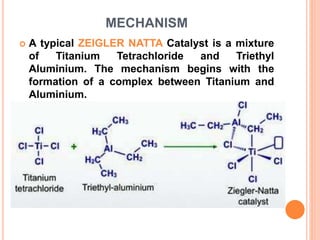
 A typical ZEIGLER NATTA Catalyst is a mixture
of Titanium Tetrachloride and Triethyl
Aluminium. The mechanism begins with the
formation of a complex between Titanium and
Aluminium.

 In the above complex, Titanium has an empty
orbital available for interaction with the pi
elections in the monomer, thus allowing for the
formation of a pi complex. The pi complex
orients the methyl group away from the
Titanium and towards the Aluminium. The pi
complex then rapidly rearranges to form a bond
between the CH2 group of propylene and the
Titanium and giving second carbon of the
propylene a positive charge.
 The alkyl group of the aluminium transfers to
the carbocation. This transfer happens so
rapidly that the carbocation formed in the
previous step doesnot have time to rearrange.
Thus, the titanium stereospecifically inserts the
propylene group between itself and the ethyl
group.
 The titanium complex continues to
stereospecifically insert additional propylene
monomers between itself and last ethyl group
added to the chain. This repeating reaction
forms the isotactic polymer.
 To end the reaction, chemists destroy the
complex by treating it with methanol.
EXAMPLE
Propene can polymerize in three ways:
IMPORTANCE
 High efficiency.
 High Stability.
 High stereoregularity (tacticity 99%)
 High concentration of polymer product.
 Easy regeneration.
 Lower cost in production.
 Controls growth and formation of polymer
product.
APPLICATION
 Production of high density polyethylene.
 Production of linear low density polyethylene.
 Production of thermoplastic polyolefins.
 Production of crystalline polypropylene.
 Production of carbon nanotube composites etc.
CONCLUSION
 Ziegler-Natta polymerization is a great way to
make polymers from hydrocarbon monomers
like ethylene and propylene. But it doesn't work
for some other kinds of monomers. For
example, we can't make PVC by Ziegler-Natta
polymerization. When the catalyst and co-
catalyst come together to form the initiating
complex, radicals are produced during
intermediate steps of the reaction. These can
initiate free radical polymerisation of the vinyl
chloride monomer.
REFERENCE
 Advanced Organic Chemistry-
Arun Bahl | B.S Bahl
 www.britannica.com
 www.youtube.com
THANK
YOU
PRESENTED BY:-
PRANJAL PROTIM
GOGOI
SIXTH SEMESTER
ROLL NO:- 183
DEPARTMENT OF
CHEMISTRY

Zeigler-Natta Catalyst

  • 2.
  • 3.
    INTRODUCTION ZEIGLER NATTA catalystis an important class of mixtures of chemical compounds remarkable for their ability to effect the polymerisation of Olefins ( hydrocarbons containing a double C-C bond ) to polymers of high molecular weights and stereoregular structures.
  • 4.
    HISTORY  Karl Zeiglerof Germany in 1953 developed a series of catalysts that polymerise ethylene at low temperature and low pressures to give a polyethylene with a high molecular weight and very little branching. This polyethylene is denser, tougher and has a higher melting point than the polyethylene produced by the earlier high temperature and pressure method.  Recognizing that Zeigler’s catalysts were capable of polymerising 1- alkenes to yield stereoregular polymers, Guilio Natta of Itali in 1954 developed the edhodology to do it.  In 1963, Zeigler and Natta jointly recieved the Nobel Prize for the discovery and developement of these catalyst systems.
  • 5.
     Karl Zeigler’sDiscovery (1953)  Guilio Natta’s Discovery (1954)
  • 6.
    MECHANISM  A typicalZEIGLER NATTA Catalyst is a mixture of Titanium Tetrachloride and Triethyl Aluminium. The mechanism begins with the formation of a complex between Titanium and Aluminium. 
  • 7.
     In theabove complex, Titanium has an empty orbital available for interaction with the pi elections in the monomer, thus allowing for the formation of a pi complex. The pi complex orients the methyl group away from the Titanium and towards the Aluminium. The pi complex then rapidly rearranges to form a bond between the CH2 group of propylene and the Titanium and giving second carbon of the propylene a positive charge.
  • 8.
     The alkylgroup of the aluminium transfers to the carbocation. This transfer happens so rapidly that the carbocation formed in the previous step doesnot have time to rearrange. Thus, the titanium stereospecifically inserts the propylene group between itself and the ethyl group.
  • 9.
     The titaniumcomplex continues to stereospecifically insert additional propylene monomers between itself and last ethyl group added to the chain. This repeating reaction forms the isotactic polymer.
  • 10.
     To endthe reaction, chemists destroy the complex by treating it with methanol.
  • 11.
  • 12.
    IMPORTANCE  High efficiency. High Stability.  High stereoregularity (tacticity 99%)  High concentration of polymer product.  Easy regeneration.  Lower cost in production.  Controls growth and formation of polymer product.
  • 13.
    APPLICATION  Production ofhigh density polyethylene.  Production of linear low density polyethylene.  Production of thermoplastic polyolefins.  Production of crystalline polypropylene.  Production of carbon nanotube composites etc.
  • 14.
    CONCLUSION  Ziegler-Natta polymerizationis a great way to make polymers from hydrocarbon monomers like ethylene and propylene. But it doesn't work for some other kinds of monomers. For example, we can't make PVC by Ziegler-Natta polymerization. When the catalyst and co- catalyst come together to form the initiating complex, radicals are produced during intermediate steps of the reaction. These can initiate free radical polymerisation of the vinyl chloride monomer.
  • 15.
    REFERENCE  Advanced OrganicChemistry- Arun Bahl | B.S Bahl  www.britannica.com  www.youtube.com
  • 16.
    THANK YOU PRESENTED BY:- PRANJAL PROTIM GOGOI SIXTHSEMESTER ROLL NO:- 183 DEPARTMENT OF CHEMISTRY