6th RDKit UGM, Berlin, Germany, Thursday 21st September 2017
Recent improvements
to the rdkit
Roger Sayle
NextMove Software, Cambridge, UK
6th RDKit UGM, Berlin, Germany, Thursday 21st September 2017
Motivation: compound acquisition
• Given a existing screening collection of X
compounds, and with Y vendor compounds
available for purchase, how should I select
the next Z diverse compounds to buy.
• Typically, X is about 2M and Y is about 100M.
6th RDKit UGM, Berlin, Germany, Thursday 21st September 2017
Rdkit’s maxminpicker
• Picking diverse compounds from large sets, 2014/08
• Optimizing Diversity Picking in the RDKit, 2014/08
• M. Ashton, J. Barnard, P. Willett et al., “Identification
of Diverse Database Subsets using Property-based
and Fragment-based Molecular Descriptors”, Quant.
Struct.-Act. Relat., Vol. 21, pp. 598-604, 2002.
• R. Kennard and L. Stone, “Computer aided design of
experiments”, Technometrics, Vol. 11, No. 1, pp. 137-
148, 1969.
6th RDKit UGM, Berlin, Germany, Thursday 21st September 2017
Conceptual algorithm
• If no compounds have been picked so far, choose the
first picked compound at random.
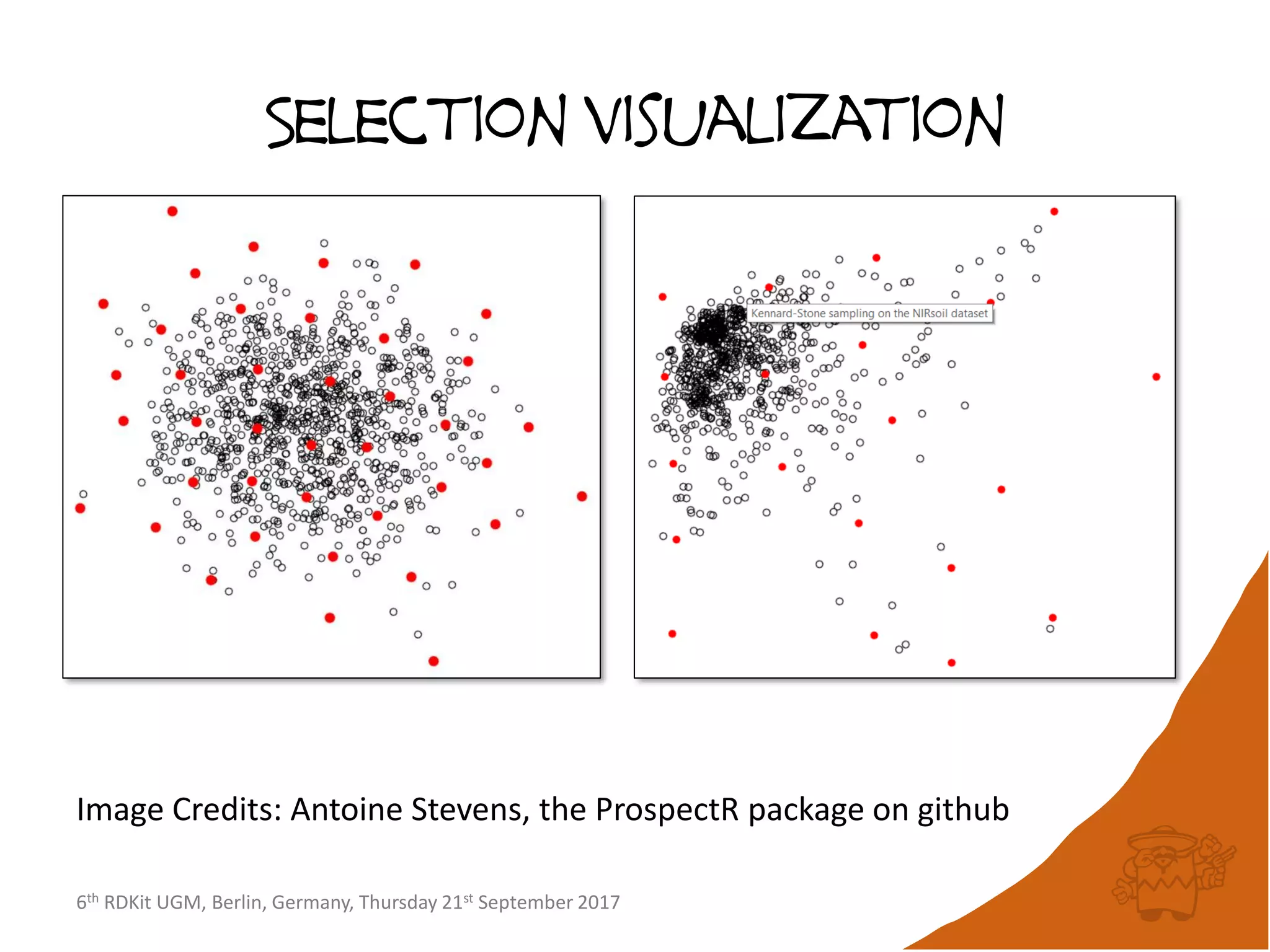
• Repeatedly select the compound furthest from it’s
nearest picked compound [hence the name
maximum-minimum distance].
• Continue until the desired number of picked
compounds has been selected (or the pool of
available compounds has been exhausted).
6th RDKit UGM, Berlin, Germany, Thursday 21st September 2017
Selection visualization
Image Credits: Antoine Stevens, the ProspectR package on github
6th RDKit UGM, Berlin, Germany, Thursday 21st September 2017
Pros vs. cons
• Optimal picking is (NP-)Hard.
• Density vs. Diversity
– With biased data sets, random sampling follows density,
where MaxMin optimizes coverage.
– Picking != Clustering.
• Worst-case NN-1 bounds
– It’s possible to (estimate a) bound on the worst case
distance to nearest neighbor.
• Fraction of Data Set to be Sampled
• Scaling Performance of Algorithm
6th RDKit UGM, Berlin, Germany, Thursday 21st September 2017
Distance matrices are a bad idea
• Naïvely, one approach is to provide a picking
algorithm with a full distance matrix.
• If X compounds are picked already, and Y is the initial
pool to pick, from this requires (X+Y-1)*(X+Y)/2 time
and space.
• One goal is to keep memory requirements O(X+Y).
• An intelligent algorithm should be able to avoid
calculating any given distance more than once.
6th RDKit UGM, Berlin, Germany, Thursday 21st September 2017
Taylor-butina vs. maxmin picking
• At a comparable distance threshold, MaxMin picks
are also a Leader (Tabu) clustering.
• As MaxMin picking doesn’t require a distance matrix
(NN list) it is significantly cheaper than Taylor-Butina.
• The distance bound for a given coverage is
discovered rather than specified (by trial and error).
– Taylor, JCICS, 1995, 35, pp. 59-67.
– Butina, JCICS, 1999, 39, pp. 747-750.
6th RDKit UGM, Berlin, Germany, Thursday 21st September 2017
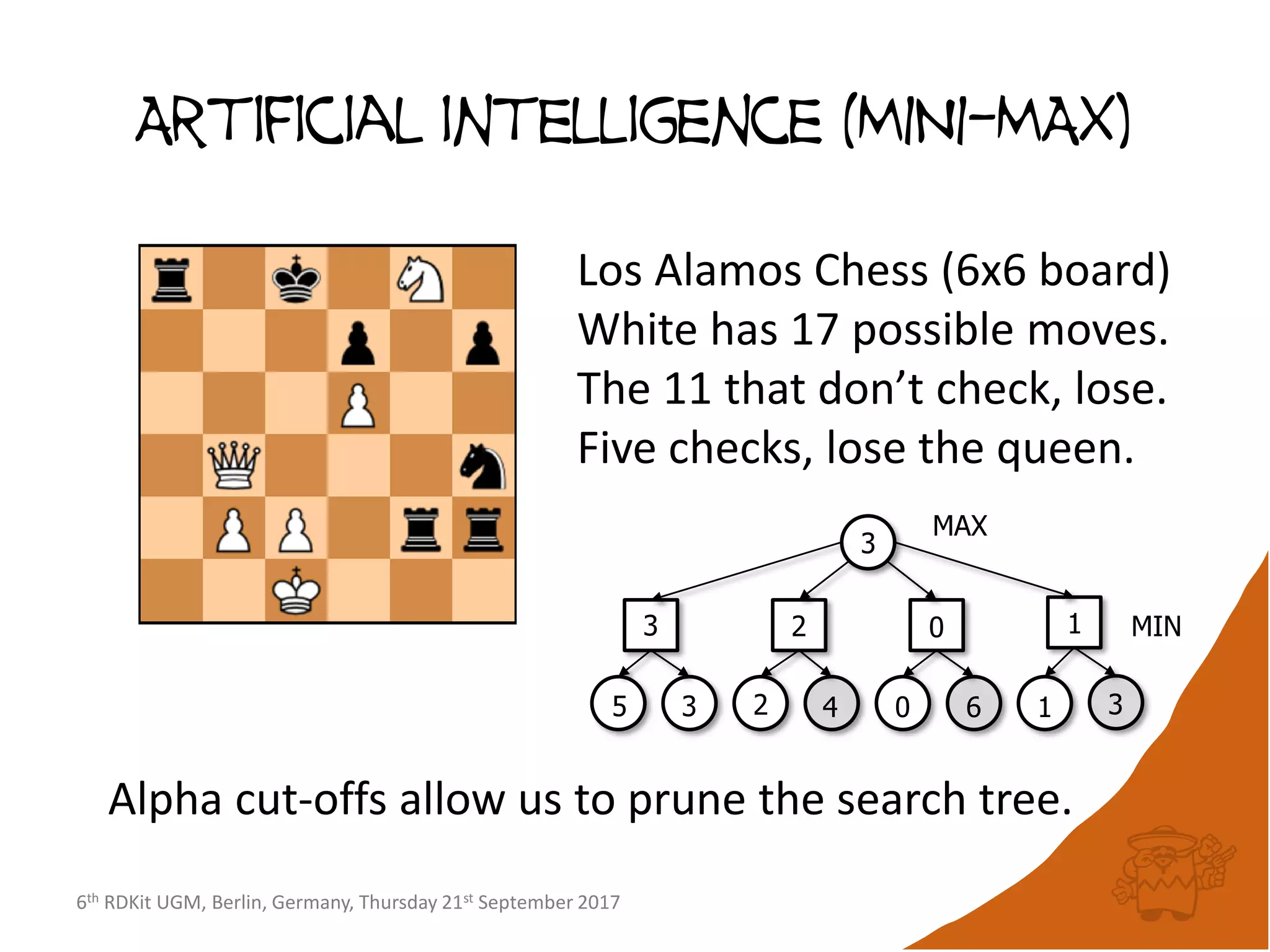
Artificial intelligence (MINI-MAX)
Los Alamos Chess (6x6 board)
White has 17 possible moves.
The 11 that don’t check, lose.
Five checks, lose the queen.
MAX
MIN
5 3 2 4 0 6 1 3
3
3
2 0 1
Alpha cut-offs allow us to prune the search tree.
6th RDKit UGM, Berlin, Germany, Thursday 21st September 2017
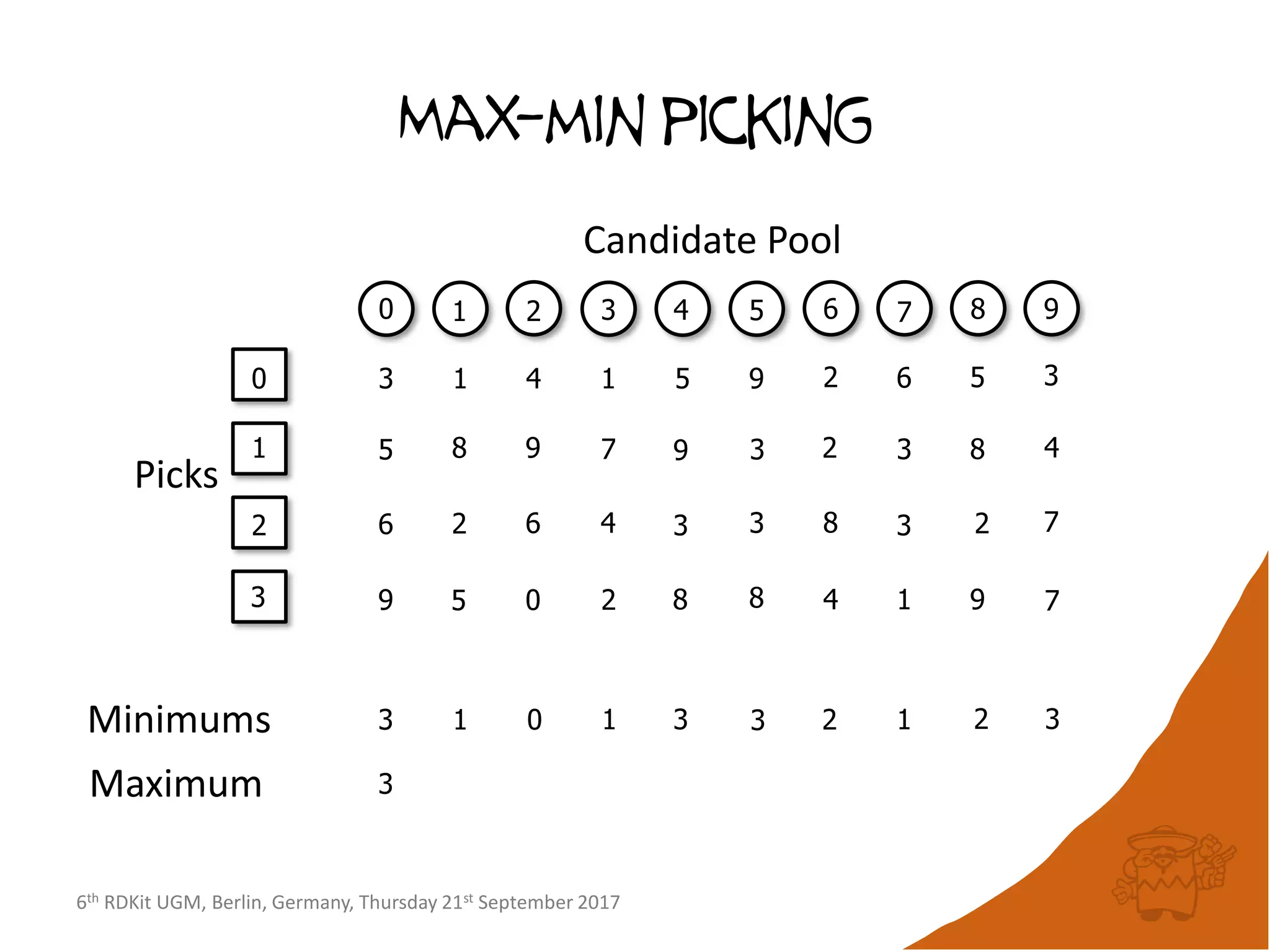
Max-min picking
1
2 3 4 5 6 7 8 9
1
0
2
Candidate Pool
Picks
3
1
4 1 5 9 2 6 5 3
5 8 9 7 9 3 2 3 8 4
6
Minimums
Maximum
2 26 4 3 3 8 3 7
9 5 0 2 8 8 4 1 9 7
3 1 0 1 3 3 2 1 2 3
3
3
0
6th RDKit UGM, Berlin, Germany, Thursday 21st September 2017
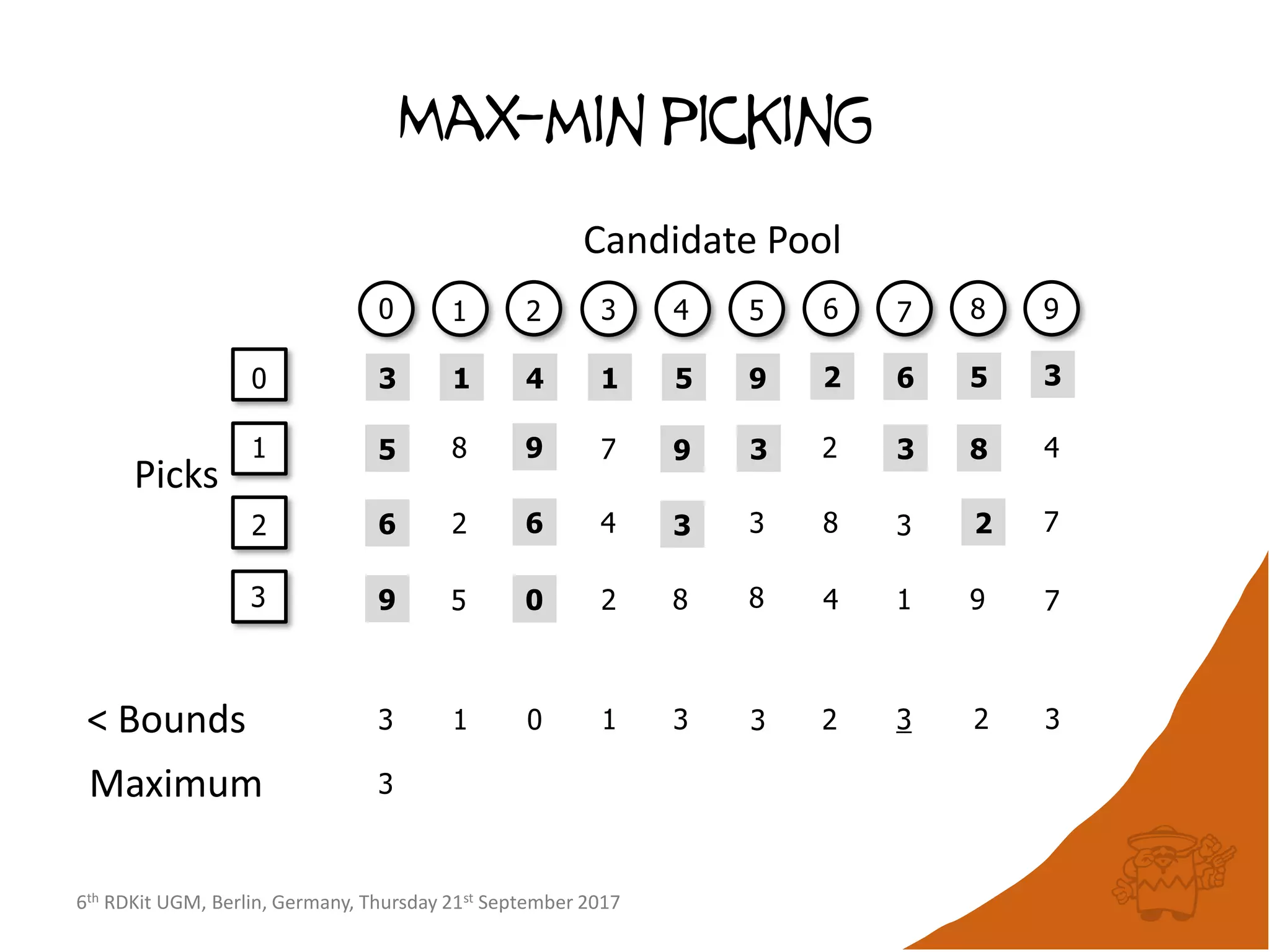
Max-min picking
0 1
2 3 4 5 6 7 8 9
1
0
2
Candidate Pool
Picks
3
1
4 1 5 9 2 6 5 3
5 8 9 7 9 3 2 3 8 4
6
< Bounds
Maximum
2 26 4 3 3 8 3 7
9 5 0 2 8 8 4 1 9 7
3 1 0 1 3 3 2 3 2 3
3
3
6th RDKit UGM, Berlin, Germany, Thursday 21st September 2017
Rdkit implementation
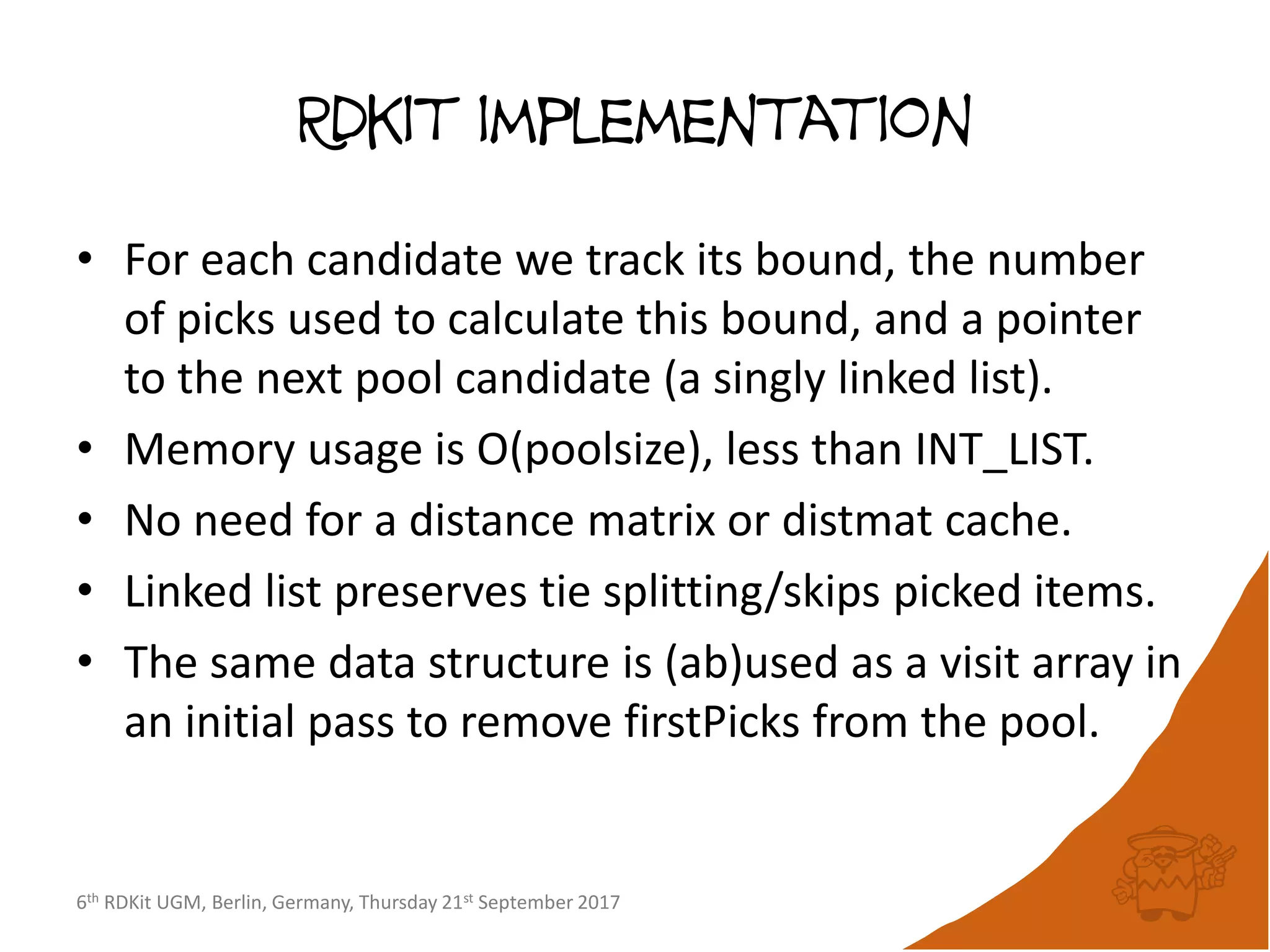
• For each candidate we track its bound, the number
of picks used to calculate this bound, and a pointer
to the next pool candidate (a singly linked list).
• Memory usage is O(poolsize), less than INT_LIST.
• No need for a distance matrix or distmat cache.
• Linked list preserves tie splitting/skips picked items.
• The same data structure is (ab)used as a visit array in
an initial pass to remove firstPicks from the pool.
6th RDKit UGM, Berlin, Germany, Thursday 21st September 2017
Performance improvement
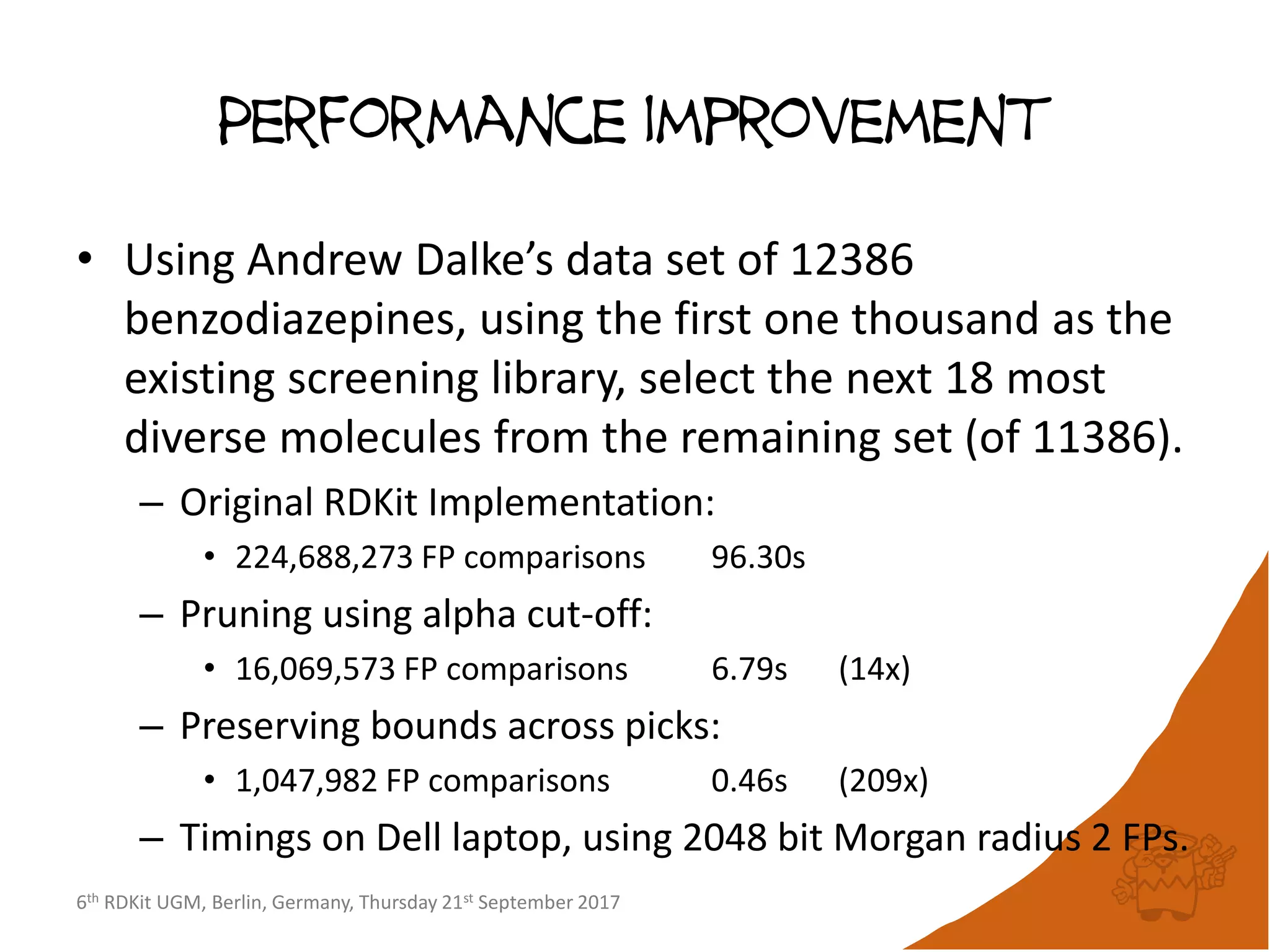
• Using Andrew Dalke’s data set of 12386
benzodiazepines, using the first one thousand as the
existing screening library, select the next 18 most
diverse molecules from the remaining set (of 11386).
– Original RDKit Implementation:
• 224,688,273 FP comparisons 96.30s
– Pruning using alpha cut-off:
• 16,069,573 FP comparisons 6.79s (14x)
– Preserving bounds across picks:
• 1,047,982 FP comparisons 0.46s (209x)
– Timings on Dell laptop, using 2048 bit Morgan radius 2 FPs.
6th RDKit UGM, Berlin, Germany, Thursday 21st September 2017
Significant similarity
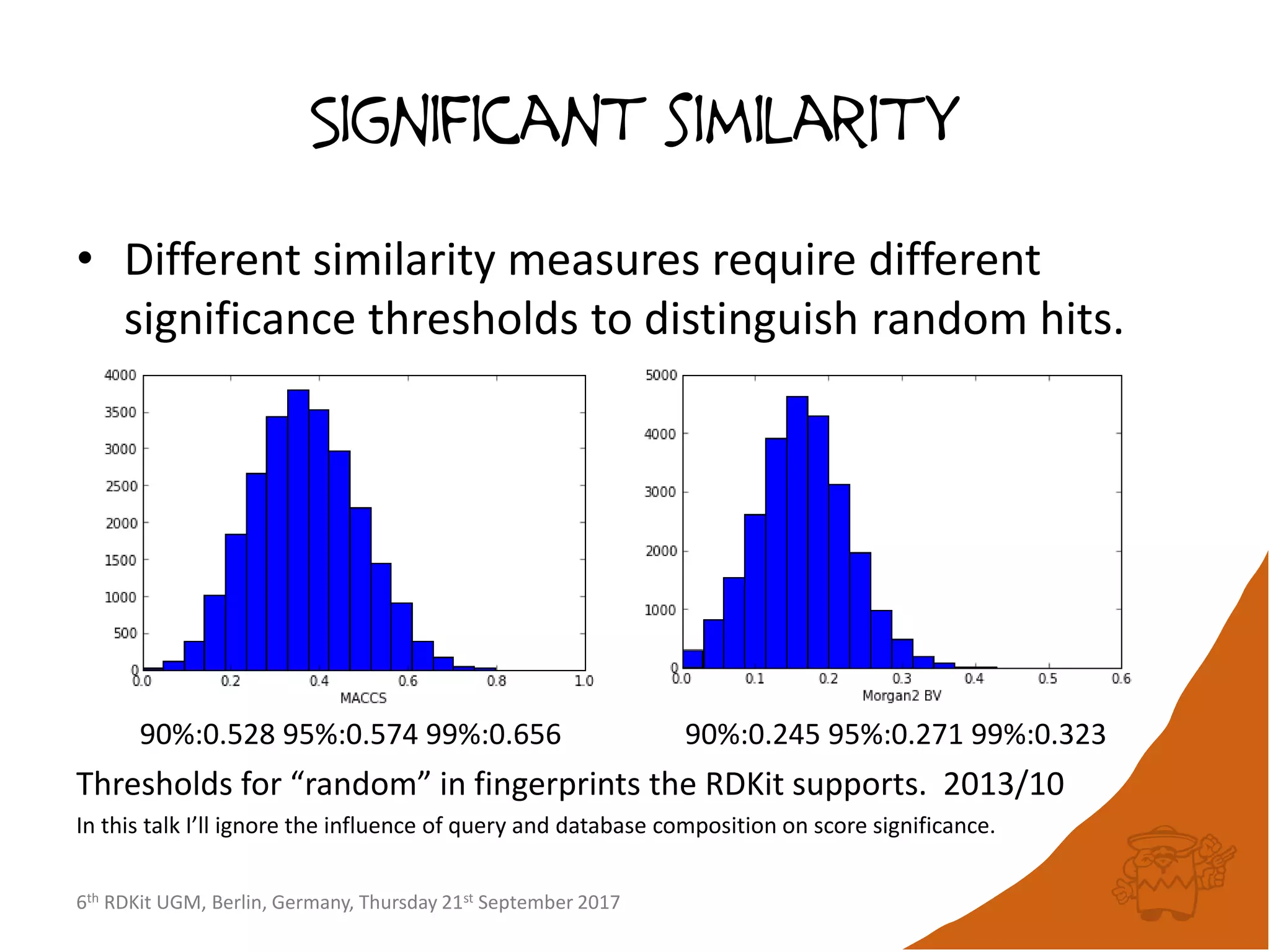
• Different similarity measures require different
significance thresholds to distinguish random hits.
90%:0.528 95%:0.574 99%:0.656 90%:0.245 95%:0.271 99%:0.323
Thresholds for “random” in fingerprints the RDKit supports. 2013/10
In this talk I’ll ignore the influence of query and database composition on score significance.
6th RDKit UGM, Berlin, Germany, Thursday 21st September 2017
Results: data set sampling
• ChEMBL 23 (1727053 compounds)
– 90%: 15107 compounds [5.45B FP cmps]
– 95%: 24430 compounds [9.82B FP cmps]
– 99%: 51463 compounds [23.9B FP cmps]
• eMolecules170601 (14328534 compounds)
– 90%: 19049 compounds [45.7B FP cmps]
– 95%: 32780 compounds [86.5B FP cmps]
– 99%: 80135 compounds [247B FP cmps]
6th RDKit UGM, Berlin, Germany, Thursday 21st September 2017
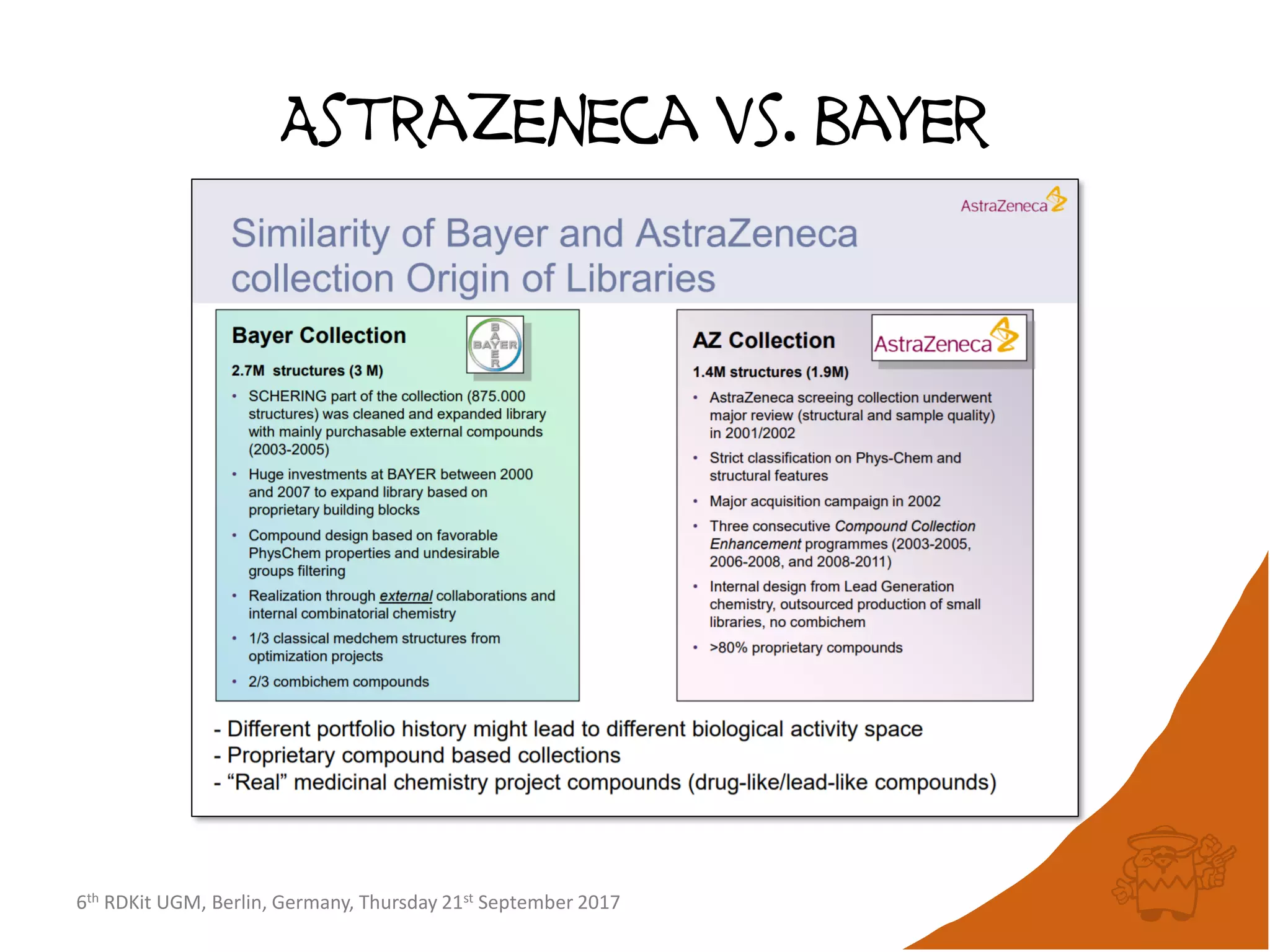
Astrazeneca vs. bayer
6th RDKit UGM, Berlin, Germany, Thursday 21st September 2017
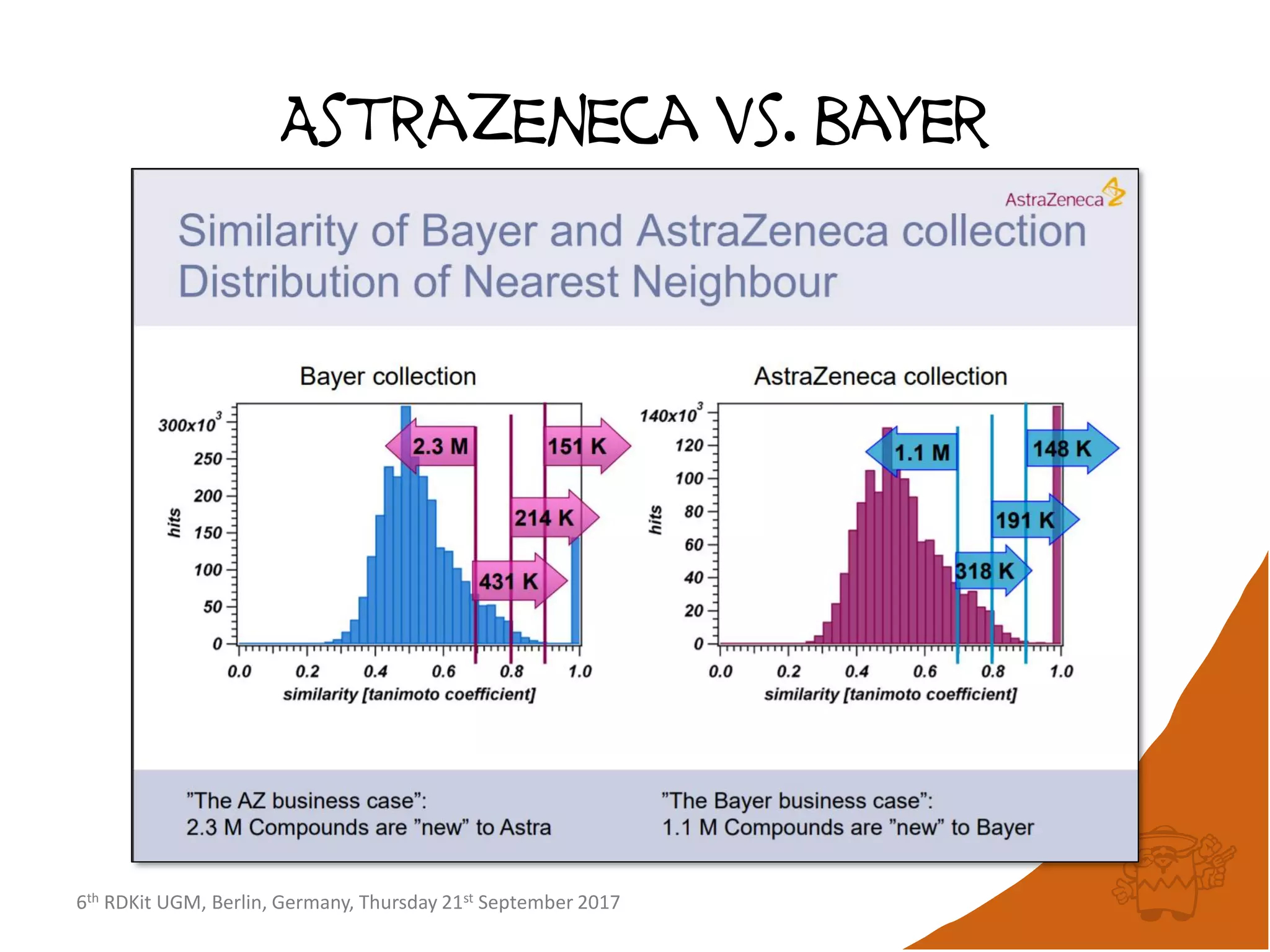
Astrazeneca vs. bayer
6th RDKit UGM, Berlin, Germany, Thursday 21st September 2017
Screening library enhancement
• Selecting 1K compounds for purchase from
eMolecules (14M) to enhance ChEMBL (1.7M).
– Reading eMolecules: 4780s
– Reading ChEMBL: 821s
– Generating FPs: 1456s
– MaxMinPicker: 42773s[80B FP cmps]
• Fazit: Large scale diversity selection can be run
overnight on a single CPU core.
• Selecting the first 18 compounds takes only 399s
[715M FP cmps].
6th RDKit UGM, Berlin, Germany, Thursday 21st September 2017
Additional considerations #1
• Rule 1: It’s better to filter compounds for desirability,
physical properties, Lipinski, price before picking.
– Filtering is O(N), Picking isn’t.
• With library screening, it’s often preferable to have
hits with neighbors rather than singletons, to confirm
true positives, or provide initial QSAR; either
– Picking should be performed on the pool of compounds
that have neighbors
– Each pick confirmed to have a neighbour as it is chosen.
6th RDKit UGM, Berlin, Germany, Thursday 21st September 2017
Additional considerations #2
• If required, it is possible to sample some areas of
chemical space (kinase inhibitors or fragments) with
higher density than others.
• For those that want to do fingerprint comparison
faster than RDKit, Andrew Dalke’s ChemFP is worth a
look.
• One possible refinement is to de-duplicate identical
fingerprints (efficiently done using a hash table).
• Finally, a better similarity measure should produce
better results (SmallWorld sales pitch goes here)
6th RDKit UGM, Berlin, Germany, Thursday 21st September 2017
Implementing full Kennard-stone
• The original Kennard-Stone algorithm requires the
first two picks to be the furthest apart in a data set.
• Traditionally, this has required O(N2) time.
• A break-through in theoretical computer science
since 2013 has changed this assumption:
– Pilu Crescenzi, Roberto Grossi, Michel Habib, Leonardo Lanzi, Andrea Marino, “On computing the
diameter of real-world undirected graphs”, Theoretical Computer Science, Vol. 514, pp. 84-95, 2013.
– Michele Borassi, Pierluigi Crescenzi, Michel Habib, Walter Kosters, Andrea Marino and Frank Takes,
“On the Solvability of the Six Degrees of Kevin Bacon Game: A Faster Graph Diameter and Radius
Computation Method”, 2014.
– Michele Borassi, Pierluigi Crescenzi, Michel Habib, Walter A. Kosters, Andrea Marino and Frank W.
Takes, “Fast diameter and radius BFS-based computation in (weakly connected) real-world graphs
with an application to the six degrees of separation games”, Theoretical Computer Science, Vol. 586,
pp. 59-80, 2015.
6th RDKit UGM, Berlin, Germany, Thursday 21st September 2017
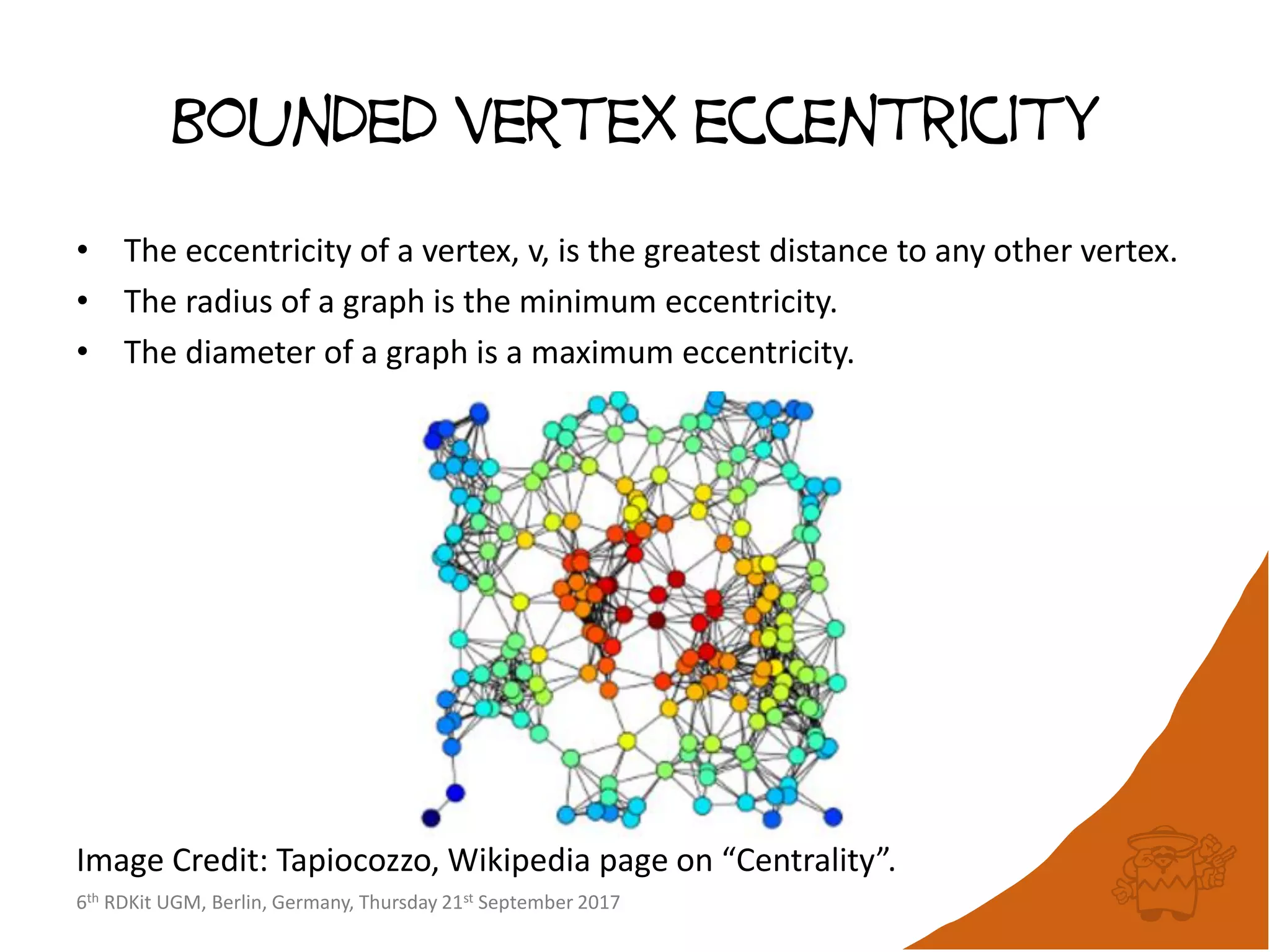
Bounded vertex eccentricity
• The eccentricity of a vertex, v, is the greatest distance to any other vertex.
• The radius of a graph is the minimum eccentricity.
• The diameter of a graph is a maximum eccentricity.
Image Credit: Tapiocozzo, Wikipedia page on “Centrality”.
6th RDKit UGM, Berlin, Germany, Thursday 21st September 2017
Sumsweep results
• Finding furthest two atoms of 327 heavy atoms in
the protein crambin (1CRN)
– Brute Force: 53301 comparisons
– SUMSWEEP: 6636 comparisons [k=21]
• Finding furthest apart (using Hamming distance on
2K MFP2 FPs) of 250251 compounds in NCI August
2000 data set.
– Brute Force: 31,312,656,375 comparisons
– SUMSWEEP: 43,278,372 comparisons [k=173]
6th RDKit UGM, Berlin, Germany, Thursday 21st September 2017
conclusions
• A little computer science can make compound
purchasing decisions a whole lot faster.
6th RDKit UGM, Berlin, Germany, Thursday 21st September 2017
acknowledgements
• The RDKit crew
– Greg Landrum and Brian Kelley
• The NextMove Software crew
– John Mayfield and Noel O’Boyle
• Industrial Inspiration
– Darren Green, GSK
– Roman Affentranger, Roche
– Pat Walters, Relay Therapeutics
– Andrew Dalke, Dalke Scientific.

Recent improvements to the RDKit

  • 1.
    6th RDKit UGM,Berlin, Germany, Thursday 21st September 2017 Recent improvements to the rdkit Roger Sayle NextMove Software, Cambridge, UK
  • 2.
    6th RDKit UGM,Berlin, Germany, Thursday 21st September 2017 Motivation: compound acquisition • Given a existing screening collection of X compounds, and with Y vendor compounds available for purchase, how should I select the next Z diverse compounds to buy. • Typically, X is about 2M and Y is about 100M.
  • 3.
    6th RDKit UGM,Berlin, Germany, Thursday 21st September 2017 Rdkit’s maxminpicker • Picking diverse compounds from large sets, 2014/08 • Optimizing Diversity Picking in the RDKit, 2014/08 • M. Ashton, J. Barnard, P. Willett et al., “Identification of Diverse Database Subsets using Property-based and Fragment-based Molecular Descriptors”, Quant. Struct.-Act. Relat., Vol. 21, pp. 598-604, 2002. • R. Kennard and L. Stone, “Computer aided design of experiments”, Technometrics, Vol. 11, No. 1, pp. 137- 148, 1969.
  • 4.
    6th RDKit UGM,Berlin, Germany, Thursday 21st September 2017 Conceptual algorithm • If no compounds have been picked so far, choose the first picked compound at random. • Repeatedly select the compound furthest from it’s nearest picked compound [hence the name maximum-minimum distance]. • Continue until the desired number of picked compounds has been selected (or the pool of available compounds has been exhausted).
  • 5.
    6th RDKit UGM,Berlin, Germany, Thursday 21st September 2017 Selection visualization Image Credits: Antoine Stevens, the ProspectR package on github
  • 6.
    6th RDKit UGM,Berlin, Germany, Thursday 21st September 2017 Pros vs. cons • Optimal picking is (NP-)Hard. • Density vs. Diversity – With biased data sets, random sampling follows density, where MaxMin optimizes coverage. – Picking != Clustering. • Worst-case NN-1 bounds – It’s possible to (estimate a) bound on the worst case distance to nearest neighbor. • Fraction of Data Set to be Sampled • Scaling Performance of Algorithm
  • 7.
    6th RDKit UGM,Berlin, Germany, Thursday 21st September 2017 Distance matrices are a bad idea • Naïvely, one approach is to provide a picking algorithm with a full distance matrix. • If X compounds are picked already, and Y is the initial pool to pick, from this requires (X+Y-1)*(X+Y)/2 time and space. • One goal is to keep memory requirements O(X+Y). • An intelligent algorithm should be able to avoid calculating any given distance more than once.
  • 8.
    6th RDKit UGM,Berlin, Germany, Thursday 21st September 2017 Taylor-butina vs. maxmin picking • At a comparable distance threshold, MaxMin picks are also a Leader (Tabu) clustering. • As MaxMin picking doesn’t require a distance matrix (NN list) it is significantly cheaper than Taylor-Butina. • The distance bound for a given coverage is discovered rather than specified (by trial and error). – Taylor, JCICS, 1995, 35, pp. 59-67. – Butina, JCICS, 1999, 39, pp. 747-750.
  • 9.
    6th RDKit UGM,Berlin, Germany, Thursday 21st September 2017 Artificial intelligence (MINI-MAX) Los Alamos Chess (6x6 board) White has 17 possible moves. The 11 that don’t check, lose. Five checks, lose the queen. MAX MIN 5 3 2 4 0 6 1 3 3 3 2 0 1 Alpha cut-offs allow us to prune the search tree.
  • 10.
    6th RDKit UGM,Berlin, Germany, Thursday 21st September 2017 Max-min picking 1 2 3 4 5 6 7 8 9 1 0 2 Candidate Pool Picks 3 1 4 1 5 9 2 6 5 3 5 8 9 7 9 3 2 3 8 4 6 Minimums Maximum 2 26 4 3 3 8 3 7 9 5 0 2 8 8 4 1 9 7 3 1 0 1 3 3 2 1 2 3 3 3 0
  • 11.
    6th RDKit UGM,Berlin, Germany, Thursday 21st September 2017 Max-min picking 0 1 2 3 4 5 6 7 8 9 1 0 2 Candidate Pool Picks 3 1 4 1 5 9 2 6 5 3 5 8 9 7 9 3 2 3 8 4 6 < Bounds Maximum 2 26 4 3 3 8 3 7 9 5 0 2 8 8 4 1 9 7 3 1 0 1 3 3 2 3 2 3 3 3
  • 12.
    6th RDKit UGM,Berlin, Germany, Thursday 21st September 2017 Rdkit implementation • For each candidate we track its bound, the number of picks used to calculate this bound, and a pointer to the next pool candidate (a singly linked list). • Memory usage is O(poolsize), less than INT_LIST. • No need for a distance matrix or distmat cache. • Linked list preserves tie splitting/skips picked items. • The same data structure is (ab)used as a visit array in an initial pass to remove firstPicks from the pool.
  • 13.
    6th RDKit UGM,Berlin, Germany, Thursday 21st September 2017 Performance improvement • Using Andrew Dalke’s data set of 12386 benzodiazepines, using the first one thousand as the existing screening library, select the next 18 most diverse molecules from the remaining set (of 11386). – Original RDKit Implementation: • 224,688,273 FP comparisons 96.30s – Pruning using alpha cut-off: • 16,069,573 FP comparisons 6.79s (14x) – Preserving bounds across picks: • 1,047,982 FP comparisons 0.46s (209x) – Timings on Dell laptop, using 2048 bit Morgan radius 2 FPs.
  • 14.
    6th RDKit UGM,Berlin, Germany, Thursday 21st September 2017 Significant similarity • Different similarity measures require different significance thresholds to distinguish random hits. 90%:0.528 95%:0.574 99%:0.656 90%:0.245 95%:0.271 99%:0.323 Thresholds for “random” in fingerprints the RDKit supports. 2013/10 In this talk I’ll ignore the influence of query and database composition on score significance.
  • 15.
    6th RDKit UGM,Berlin, Germany, Thursday 21st September 2017 Results: data set sampling • ChEMBL 23 (1727053 compounds) – 90%: 15107 compounds [5.45B FP cmps] – 95%: 24430 compounds [9.82B FP cmps] – 99%: 51463 compounds [23.9B FP cmps] • eMolecules170601 (14328534 compounds) – 90%: 19049 compounds [45.7B FP cmps] – 95%: 32780 compounds [86.5B FP cmps] – 99%: 80135 compounds [247B FP cmps]
  • 16.
    6th RDKit UGM,Berlin, Germany, Thursday 21st September 2017 Astrazeneca vs. bayer
  • 17.
    6th RDKit UGM,Berlin, Germany, Thursday 21st September 2017 Astrazeneca vs. bayer
  • 18.
    6th RDKit UGM,Berlin, Germany, Thursday 21st September 2017 Screening library enhancement • Selecting 1K compounds for purchase from eMolecules (14M) to enhance ChEMBL (1.7M). – Reading eMolecules: 4780s – Reading ChEMBL: 821s – Generating FPs: 1456s – MaxMinPicker: 42773s[80B FP cmps] • Fazit: Large scale diversity selection can be run overnight on a single CPU core. • Selecting the first 18 compounds takes only 399s [715M FP cmps].
  • 19.
    6th RDKit UGM,Berlin, Germany, Thursday 21st September 2017 Additional considerations #1 • Rule 1: It’s better to filter compounds for desirability, physical properties, Lipinski, price before picking. – Filtering is O(N), Picking isn’t. • With library screening, it’s often preferable to have hits with neighbors rather than singletons, to confirm true positives, or provide initial QSAR; either – Picking should be performed on the pool of compounds that have neighbors – Each pick confirmed to have a neighbour as it is chosen.
  • 20.
    6th RDKit UGM,Berlin, Germany, Thursday 21st September 2017 Additional considerations #2 • If required, it is possible to sample some areas of chemical space (kinase inhibitors or fragments) with higher density than others. • For those that want to do fingerprint comparison faster than RDKit, Andrew Dalke’s ChemFP is worth a look. • One possible refinement is to de-duplicate identical fingerprints (efficiently done using a hash table). • Finally, a better similarity measure should produce better results (SmallWorld sales pitch goes here)
  • 21.
    6th RDKit UGM,Berlin, Germany, Thursday 21st September 2017 Implementing full Kennard-stone • The original Kennard-Stone algorithm requires the first two picks to be the furthest apart in a data set. • Traditionally, this has required O(N2) time. • A break-through in theoretical computer science since 2013 has changed this assumption: – Pilu Crescenzi, Roberto Grossi, Michel Habib, Leonardo Lanzi, Andrea Marino, “On computing the diameter of real-world undirected graphs”, Theoretical Computer Science, Vol. 514, pp. 84-95, 2013. – Michele Borassi, Pierluigi Crescenzi, Michel Habib, Walter Kosters, Andrea Marino and Frank Takes, “On the Solvability of the Six Degrees of Kevin Bacon Game: A Faster Graph Diameter and Radius Computation Method”, 2014. – Michele Borassi, Pierluigi Crescenzi, Michel Habib, Walter A. Kosters, Andrea Marino and Frank W. Takes, “Fast diameter and radius BFS-based computation in (weakly connected) real-world graphs with an application to the six degrees of separation games”, Theoretical Computer Science, Vol. 586, pp. 59-80, 2015.
  • 22.
    6th RDKit UGM,Berlin, Germany, Thursday 21st September 2017 Bounded vertex eccentricity • The eccentricity of a vertex, v, is the greatest distance to any other vertex. • The radius of a graph is the minimum eccentricity. • The diameter of a graph is a maximum eccentricity. Image Credit: Tapiocozzo, Wikipedia page on “Centrality”.
  • 23.
    6th RDKit UGM,Berlin, Germany, Thursday 21st September 2017 Sumsweep results • Finding furthest two atoms of 327 heavy atoms in the protein crambin (1CRN) – Brute Force: 53301 comparisons – SUMSWEEP: 6636 comparisons [k=21] • Finding furthest apart (using Hamming distance on 2K MFP2 FPs) of 250251 compounds in NCI August 2000 data set. – Brute Force: 31,312,656,375 comparisons – SUMSWEEP: 43,278,372 comparisons [k=173]
  • 24.
    6th RDKit UGM,Berlin, Germany, Thursday 21st September 2017 conclusions • A little computer science can make compound purchasing decisions a whole lot faster.
  • 25.
    6th RDKit UGM,Berlin, Germany, Thursday 21st September 2017 acknowledgements • The RDKit crew – Greg Landrum and Brian Kelley • The NextMove Software crew – John Mayfield and Noel O’Boyle • Industrial Inspiration – Darren Green, GSK – Roman Affentranger, Roche – Pat Walters, Relay Therapeutics – Andrew Dalke, Dalke Scientific.