A de facto standard
or
a free-for-all?
A benchmark for reading SMILES
Noel O’Boyle, John Mayfield and Roger Sayle
NextMove Software
256th ACS National Meeting Washington Aug 2018
https://github.com/nextmovesoftware/smilesreading
Introduction
SMILES
• Simplified Molecular Identification and Line Entry
System
• 30 years since Dave Weininger published:
– SMILES, a chemical language and information system. 1.
Introduction to methodology and encoding rules, JCICS,
1988, 28, 31
• Cited 2389 times, 179 times in 2017 (Google Scholar)
• 31 years since an EPA report on SMILES
– SMILES: A line notation and computerized interpreter for
chemical structures, EPA/600/M-87/021, Aug 1987 (available
online)
A de Facto Standard…
• Since 1987, Daylight Chemical Information Systems
have been responsible for developing SMILES
– The documentation is freely available online
• Some aspects of the language were clarified by the
OpenSMILES specification (drafted 2007)
• One of the most widely-used file formats in
cheminformatics
– Compact, convenient, combineable, can be
canonicalized
…Or “Free-For-ALL” ?
• Toolkits can generally read their own SMILES strings
– But can they read SMILES strings from other programs?
• Typical problems
– Hydrogens appear and/or disappear when moving from X to Y
– SMILES written by X are rejected by Y
– One toolkit says a ring system is aromatic while another says
it’s not
• Why? Is it a problem? If so, can anything be done?
– Something fundamentally broken with SMILES?
MY GOAL
• Improve the interoperability of SMILES strings among
all tools that support SMILES
1. Identify the most common issues affecting
interoperability
– Differences in interpretation of spec? Errors? Unusual
aromaticity models? Counting hydrogens?
2. Work with developers to highlight and resolve issues
3. Provide a resource for future implementations to
use to avoid the pitfalls of the past
Scope of benchmark
• The benchmark is not a SMILES validation suite
– Does not replace a toolkit’s own testing
• Focuses on aspects of SMILES syntax that tend to be
incorrectly implemented
– Stereochemistry
– Implicit valence
– (Reading) Aromatic SMILES
• Focuses on SMILES reading
– Can toolkits agree on the meaning of a SMILES string?
Stereochemistry
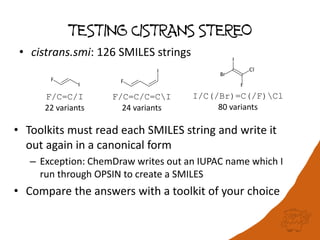
TESTING CISTRANS STEREO
• Toolkits must read each SMILES string and write it
out again in a canonical form
– Exception: ChemDraw writes out an IUPAC name which I
run through OPSIN to create a SMILES
• Compare the answers with a toolkit of your choice
• cistrans.smi: 126 SMILES strings
F/C=C/I
22 variants
F/C=C/C=CI
24 variants
I/C(/Br)=C(/F)Cl
80 variants
STEREO RESULTS
• Currently, the benchmark focuses on:
– Tetrahedral and cis-trans
• To come:
– Octahedral, extended tetrahedral, square-planar, trigonal
bipyramidal
• The main problem observed is handling of stereo at
bond closure digits:
– F/C=C/1.Br1 should be the same as
F/C=C1.Br1
– [C@@](O)(Cl)(F)Br should be the same as
[C@@](O)(Cl)(F)1.Br1 (if supported)
Implicit Valence
The SMILES IMPLICIT valence Model
• A SMILES string completely describes the molecular
formula of a molecule, including hydrogens
The SMILES IMPLICIT valence Model
• A SMILES string completely describes the molecular
formula of a molecule, including hydrogens
• The valence model tells you how to read/write SMILES
that leave out the explicit hydrogen count on certain
atoms (B, C, N, O, P, S, halogens)
– CO should be read as CH3OH, i.e. methanol
– Similarity, methanol, CH3OH may be written as CO
• Same rules must be used for reading as for writing
– This has consequences for interoperability
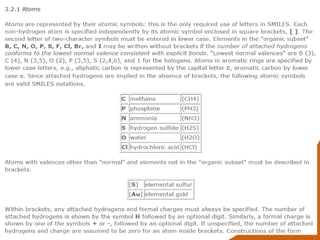
• The rules are in the docs…
The SMILES IMPLICIT valence Model
• Not the same as the MDL valence model
• Not the same as “how many hydrogens is an atom with this valence likely
to have?”
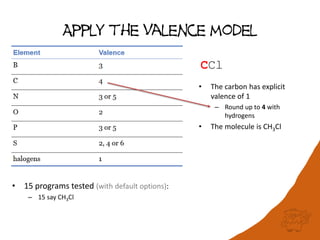
Apply the Valence model
CCl
• The carbon has explicit
valence of 1
– Round up to 4 with
hydrogens
• The molecule is CH3Cl
• 15 programs tested (with default options):
– 15 say CH3Cl
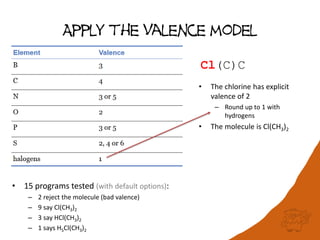
Apply the Valence model
Cl(C)C
• The chlorine has explicit
valence of 2
– Round up to 1 with
hydrogens
• The molecule is Cl(CH3)2
• 15 programs tested (with default options):
– 2 reject the molecule (bad valence)
– 9 say Cl(CH3)2
– 3 say HCl(CH3)2
– 1 says H5Cl(CH3)2
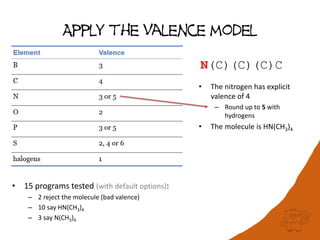
Apply the Valence model
N(C)(C)(C)C
• The nitrogen has explicit
valence of 4
– Round up to 5 with
hydrogens
• The molecule is HN(CH3)4
• 15 programs tested (with default options):
– 2 reject the molecule (bad valence)
– 10 say HN(CH3)4
– 3 say N(CH3)4
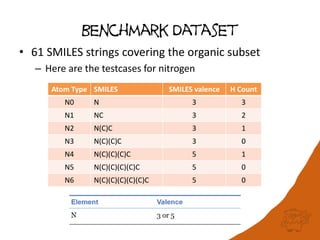
Benchmark Dataset
• 61 SMILES strings covering the organic subset
– Here are the testcases for nitrogen
Atom Type SMILES SMILES valence H Count
N0 N 3 3
N1 NC 3 2
N2 N(C)C 3 1
N3 N(C)(C)C 3 0
N4 N(C)(C)(C)C 5 1
N5 N(C)(C)(C)(C)C 5 0
N6 N(C)(C)(C)(C)(C)C 5 0
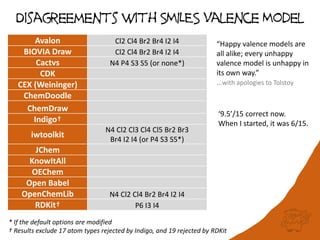
Avalon Cl2 Cl4 Br2 Br4 I2 I4
BIOVIA Draw Cl2 Cl4 Br2 Br4 I2 I4
Cactvs N4 P4 S3 S5 (or none*)
CDK
CEX (Weininger)
ChemDoodle
ChemDraw
Indigo†
iwtoolkit
N4 Cl2 Cl3 Cl4 Cl5 Br2 Br3
Br4 I2 I4 (or P4 S3 S5*)
JChem
KnowItAll
OEChem
Open Babel
OpenChemLib N4 Cl2 Cl4 Br2 Br4 I2 I4
RDKit† P6 I3 I4
Disagreements with SMILES Valence Model
* If the default options are modified
† Results exclude 17 atom types rejected by Indigo, and 19 rejected by RDKit
“Happy valence models are
all alike; every unhappy
valence model is unhappy in
its own way.”
…with apologies to Tolstoy
‘9.5’/15 correct now.
When I started, it was 6/15.
Reading Aromatic
SMILES
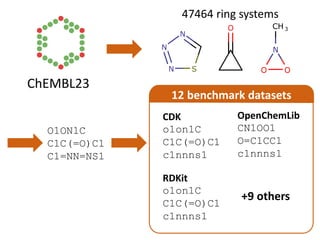
O1ON1C
C1C(=O)C1
C1=NN=NS1
CDK
o1on1C
C1C(=O)C1
c1nnns1
OpenChemLib
CN1OO1
O=C1CC1
c1nnns1
RDKit
o1on1C
C1C(=O)C1
c1nnns1
12 benchmark datasets
+9 others
ChEMBL23
47464 ring systems
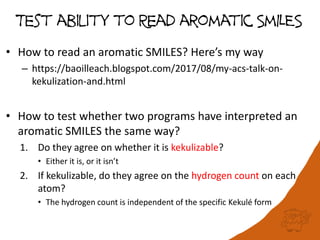
Test ability to Read aromatic SmILES
• How to read an aromatic SMILES? Here’s my way
– https://baoilleach.blogspot.com/2017/08/my-acs-talk-on-
kekulization-and.html
• How to test whether two programs have interpreted an
aromatic SMILES the same way?
1. Do they agree on whether it is kekulizable?
• Either it is, or it isn’t
2. If kekulizable, do they agree on the hydrogen count on each
atom?
• The hydrogen count is independent of the specific Kekulé form
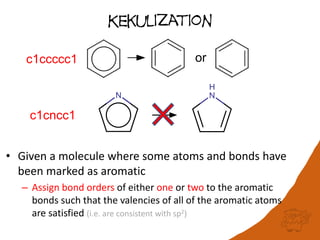
Kekulization
• Given a molecule where some atoms and bonds have
been marked as aromatic
– Assign bond orders of either one or two to the aromatic
bonds such that the valencies of all of the aromatic atoms
are satisfied (i.e. are consistent with sp2)
orc1ccccc1
c1cncc1
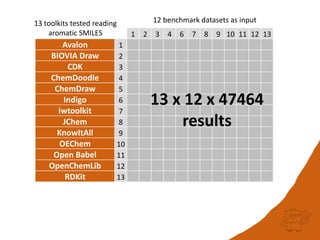
1 2 3 4 6 7 8 9 10 11 12 13
Avalon 1
BIOVIA Draw 2
CDK 3
ChemDoodle 4
ChemDraw 5
Indigo 6
iwtoolkit 7
JChem 8
KnowItAll 9
OEChem 10
Open Babel 11
OpenChemLib 12
RDKit 13
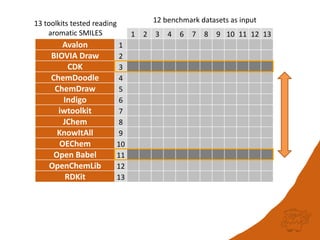
12 benchmark datasets as input
13 x 12 x 47464
results
13 toolkits tested reading
aromatic SMILES
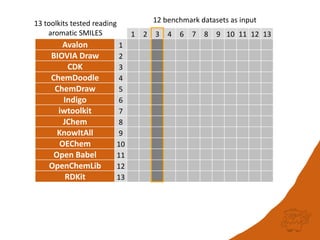
1 2 3 4 6 7 8 9 10 11 12 13
Avalon 1
BIOVIA Draw 2
CDK 3
ChemDoodle 4
ChemDraw 5
Indigo 6
iwtoolkit 7
JChem 8
KnowItAll 9
OEChem 10
Open Babel 11
OpenChemLib 12
RDKit 13
12 benchmark datasets as input13 toolkits tested reading
aromatic SMILES
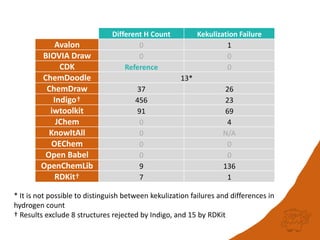
Different H Count Kekulization Failure
Avalon 0 1
BIOVIA Draw 0 0
CDK Reference 0
ChemDoodle 13*
ChemDraw 37 26
Indigo† 456 23
iwtoolkit 91 69
JChem 0 4
KnowItAll 0 N/A
OEChem 0 0
Open Babel 0 0
OpenChemLib 9 136
RDKit† 7 1
* It is not possible to distinguish between kekulization failures and differences in
hydrogen count
† Results exclude 8 structures rejected by Indigo, and 15 by RDKit
1 2 3 4 6 7 8 9 10 11 12 13
Avalon 1
BIOVIA Draw 2
CDK 3
ChemDoodle 4
ChemDraw 5
Indigo 6
iwtoolkit 7
JChem 8
KnowItAll 9
OEChem 10
Open Babel 11
OpenChemLib 12
RDKit 13
12 benchmark datasets as input13 toolkits tested reading
aromatic SMILES
Final THOUGHTS
Work in Progress
• These results represent a snapshot in time
– Much better than six months ago
– Expect more improvements within another six
• Software that has been changed in response to this
benchmark
• Encourage your favourite tools/toolkits to take part!
iwtoolkit
JChem
KnowItAll
CACTVS
CDK
ChemDoodle
Open Babel
OpenChemLib
RDKit
ConclusionS
• While stereochemistry is well-handled, adherence to the
SMILES valence model and ability to read aromatic
SMILES tend to be problem areas
– Checking for agreement in hydrogen count is a surprisingly
powerful way of identifying errors
• While disagreement exists, all is not lost
– On inspection, it has always been clear what the correct
answer is
• Developers are (mostly) open to addressing issues
– The only area of push-back from developers is implementing
the SMILES valence model
• Overall, much more successful than expected!
Acknowledgements
• The developers of many toolkits who have taken the
time to engage with this benchmark
• Matt Swain for providing JChem results
• Roger Sayle for indulging my interest in SMILES
reading
• John Mayfield for many discussions on the topic of
kekulization and SMILES aromaticity
Datasets, results and scripts are available at:
https://github.com/nextmovesoftware/smilesreading
noel@nextmovesoftware.com
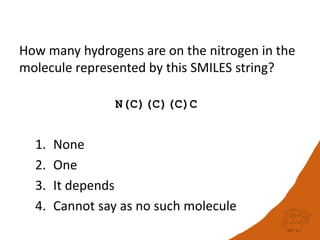
How many hydrogens are on the nitrogen in the
molecule represented by this SMILES string?
N(C)(C)(C)C
1. None
2. One
3. It depends
4. Cannot say as no such molecule
Daylight

A de facto standard or a free-for-all? A benchmark for reading SMILES

  • 1.
    A de factostandard or a free-for-all? A benchmark for reading SMILES Noel O’Boyle, John Mayfield and Roger Sayle NextMove Software 256th ACS National Meeting Washington Aug 2018 https://github.com/nextmovesoftware/smilesreading
  • 2.
  • 3.
    SMILES • Simplified MolecularIdentification and Line Entry System • 30 years since Dave Weininger published: – SMILES, a chemical language and information system. 1. Introduction to methodology and encoding rules, JCICS, 1988, 28, 31 • Cited 2389 times, 179 times in 2017 (Google Scholar) • 31 years since an EPA report on SMILES – SMILES: A line notation and computerized interpreter for chemical structures, EPA/600/M-87/021, Aug 1987 (available online)
  • 4.
    A de FactoStandard… • Since 1987, Daylight Chemical Information Systems have been responsible for developing SMILES – The documentation is freely available online • Some aspects of the language were clarified by the OpenSMILES specification (drafted 2007) • One of the most widely-used file formats in cheminformatics – Compact, convenient, combineable, can be canonicalized
  • 5.
    …Or “Free-For-ALL” ? •Toolkits can generally read their own SMILES strings – But can they read SMILES strings from other programs? • Typical problems – Hydrogens appear and/or disappear when moving from X to Y – SMILES written by X are rejected by Y – One toolkit says a ring system is aromatic while another says it’s not • Why? Is it a problem? If so, can anything be done? – Something fundamentally broken with SMILES?
  • 6.
    MY GOAL • Improvethe interoperability of SMILES strings among all tools that support SMILES 1. Identify the most common issues affecting interoperability – Differences in interpretation of spec? Errors? Unusual aromaticity models? Counting hydrogens? 2. Work with developers to highlight and resolve issues 3. Provide a resource for future implementations to use to avoid the pitfalls of the past
  • 7.
    Scope of benchmark •The benchmark is not a SMILES validation suite – Does not replace a toolkit’s own testing • Focuses on aspects of SMILES syntax that tend to be incorrectly implemented – Stereochemistry – Implicit valence – (Reading) Aromatic SMILES • Focuses on SMILES reading – Can toolkits agree on the meaning of a SMILES string?
  • 8.
  • 9.
    TESTING CISTRANS STEREO •Toolkits must read each SMILES string and write it out again in a canonical form – Exception: ChemDraw writes out an IUPAC name which I run through OPSIN to create a SMILES • Compare the answers with a toolkit of your choice • cistrans.smi: 126 SMILES strings F/C=C/I 22 variants F/C=C/C=CI 24 variants I/C(/Br)=C(/F)Cl 80 variants
  • 10.
    STEREO RESULTS • Currently,the benchmark focuses on: – Tetrahedral and cis-trans • To come: – Octahedral, extended tetrahedral, square-planar, trigonal bipyramidal • The main problem observed is handling of stereo at bond closure digits: – F/C=C/1.Br1 should be the same as F/C=C1.Br1 – [C@@](O)(Cl)(F)Br should be the same as [C@@](O)(Cl)(F)1.Br1 (if supported)
  • 11.
  • 12.
    The SMILES IMPLICITvalence Model • A SMILES string completely describes the molecular formula of a molecule, including hydrogens
  • 13.
    The SMILES IMPLICITvalence Model • A SMILES string completely describes the molecular formula of a molecule, including hydrogens • The valence model tells you how to read/write SMILES that leave out the explicit hydrogen count on certain atoms (B, C, N, O, P, S, halogens) – CO should be read as CH3OH, i.e. methanol – Similarity, methanol, CH3OH may be written as CO • Same rules must be used for reading as for writing – This has consequences for interoperability • The rules are in the docs…
  • 14.
    The SMILES IMPLICITvalence Model • Not the same as the MDL valence model • Not the same as “how many hydrogens is an atom with this valence likely to have?”
  • 15.
    Apply the Valencemodel CCl • The carbon has explicit valence of 1 – Round up to 4 with hydrogens • The molecule is CH3Cl • 15 programs tested (with default options): – 15 say CH3Cl
  • 16.
    Apply the Valencemodel Cl(C)C • The chlorine has explicit valence of 2 – Round up to 1 with hydrogens • The molecule is Cl(CH3)2 • 15 programs tested (with default options): – 2 reject the molecule (bad valence) – 9 say Cl(CH3)2 – 3 say HCl(CH3)2 – 1 says H5Cl(CH3)2
  • 17.
    Apply the Valencemodel N(C)(C)(C)C • The nitrogen has explicit valence of 4 – Round up to 5 with hydrogens • The molecule is HN(CH3)4 • 15 programs tested (with default options): – 2 reject the molecule (bad valence) – 10 say HN(CH3)4 – 3 say N(CH3)4
  • 18.
    Benchmark Dataset • 61SMILES strings covering the organic subset – Here are the testcases for nitrogen Atom Type SMILES SMILES valence H Count N0 N 3 3 N1 NC 3 2 N2 N(C)C 3 1 N3 N(C)(C)C 3 0 N4 N(C)(C)(C)C 5 1 N5 N(C)(C)(C)(C)C 5 0 N6 N(C)(C)(C)(C)(C)C 5 0
  • 19.
    Avalon Cl2 Cl4Br2 Br4 I2 I4 BIOVIA Draw Cl2 Cl4 Br2 Br4 I2 I4 Cactvs N4 P4 S3 S5 (or none*) CDK CEX (Weininger) ChemDoodle ChemDraw Indigo† iwtoolkit N4 Cl2 Cl3 Cl4 Cl5 Br2 Br3 Br4 I2 I4 (or P4 S3 S5*) JChem KnowItAll OEChem Open Babel OpenChemLib N4 Cl2 Cl4 Br2 Br4 I2 I4 RDKit† P6 I3 I4 Disagreements with SMILES Valence Model * If the default options are modified † Results exclude 17 atom types rejected by Indigo, and 19 rejected by RDKit “Happy valence models are all alike; every unhappy valence model is unhappy in its own way.” …with apologies to Tolstoy ‘9.5’/15 correct now. When I started, it was 6/15.
  • 20.
  • 21.
  • 22.
    Test ability toRead aromatic SmILES • How to read an aromatic SMILES? Here’s my way – https://baoilleach.blogspot.com/2017/08/my-acs-talk-on- kekulization-and.html • How to test whether two programs have interpreted an aromatic SMILES the same way? 1. Do they agree on whether it is kekulizable? • Either it is, or it isn’t 2. If kekulizable, do they agree on the hydrogen count on each atom? • The hydrogen count is independent of the specific Kekulé form
  • 23.
    Kekulization • Given amolecule where some atoms and bonds have been marked as aromatic – Assign bond orders of either one or two to the aromatic bonds such that the valencies of all of the aromatic atoms are satisfied (i.e. are consistent with sp2) orc1ccccc1 c1cncc1
  • 24.
    1 2 34 6 7 8 9 10 11 12 13 Avalon 1 BIOVIA Draw 2 CDK 3 ChemDoodle 4 ChemDraw 5 Indigo 6 iwtoolkit 7 JChem 8 KnowItAll 9 OEChem 10 Open Babel 11 OpenChemLib 12 RDKit 13 12 benchmark datasets as input 13 x 12 x 47464 results 13 toolkits tested reading aromatic SMILES
  • 25.
    1 2 34 6 7 8 9 10 11 12 13 Avalon 1 BIOVIA Draw 2 CDK 3 ChemDoodle 4 ChemDraw 5 Indigo 6 iwtoolkit 7 JChem 8 KnowItAll 9 OEChem 10 Open Babel 11 OpenChemLib 12 RDKit 13 12 benchmark datasets as input13 toolkits tested reading aromatic SMILES
  • 26.
    Different H CountKekulization Failure Avalon 0 1 BIOVIA Draw 0 0 CDK Reference 0 ChemDoodle 13* ChemDraw 37 26 Indigo† 456 23 iwtoolkit 91 69 JChem 0 4 KnowItAll 0 N/A OEChem 0 0 Open Babel 0 0 OpenChemLib 9 136 RDKit† 7 1 * It is not possible to distinguish between kekulization failures and differences in hydrogen count † Results exclude 8 structures rejected by Indigo, and 15 by RDKit
  • 27.
    1 2 34 6 7 8 9 10 11 12 13 Avalon 1 BIOVIA Draw 2 CDK 3 ChemDoodle 4 ChemDraw 5 Indigo 6 iwtoolkit 7 JChem 8 KnowItAll 9 OEChem 10 Open Babel 11 OpenChemLib 12 RDKit 13 12 benchmark datasets as input13 toolkits tested reading aromatic SMILES
  • 28.
  • 29.
    Work in Progress •These results represent a snapshot in time – Much better than six months ago – Expect more improvements within another six • Software that has been changed in response to this benchmark • Encourage your favourite tools/toolkits to take part! iwtoolkit JChem KnowItAll CACTVS CDK ChemDoodle Open Babel OpenChemLib RDKit
  • 30.
    ConclusionS • While stereochemistryis well-handled, adherence to the SMILES valence model and ability to read aromatic SMILES tend to be problem areas – Checking for agreement in hydrogen count is a surprisingly powerful way of identifying errors • While disagreement exists, all is not lost – On inspection, it has always been clear what the correct answer is • Developers are (mostly) open to addressing issues – The only area of push-back from developers is implementing the SMILES valence model • Overall, much more successful than expected!
  • 31.
    Acknowledgements • The developersof many toolkits who have taken the time to engage with this benchmark • Matt Swain for providing JChem results • Roger Sayle for indulging my interest in SMILES reading • John Mayfield for many discussions on the topic of kekulization and SMILES aromaticity Datasets, results and scripts are available at: https://github.com/nextmovesoftware/smilesreading noel@nextmovesoftware.com
  • 33.
    How many hydrogensare on the nitrogen in the molecule represented by this SMILES string? N(C)(C)(C)C 1. None 2. One 3. It depends 4. Cannot say as no such molecule
  • 34.