• Acute Ankle Fracture Dislocation
• Fracture Closed Complete Transverse
Displaced Medial and Lateral Malleolus Left
secondary to Motor Vehicular Accident
• Weber B
• Lauge-Hansen SER Stage IV
• Dias-Tachdjian Stage SI
• AO 44A2.3
TALOCRURAL ANGLE
Assess for fibular shortening
Measurement
Mortise view
Line along the distal tibial plafond
articular surface
Line joining the tips of both malleoli
Interpretation
Normal: 83° ± 4° 2 or 8-15° 3
Fibular shortening: >2° difference to the
contralateral side
TALAR TILT
MORTISE VIEW
Measurement of the angle between the talus and
the distal tibia, used in the assessment of:
1. Ankle instability
2. Ankle osteoarthritis
Measurement
Talar tilt is measured on either AP or mortise view
radiographs of the ankle.
Talar tilt is the angle between the articular surface
of the talar dome and the articular surface of the
tibial plafond.
Interpretation
Normal values
<2° on non-stress radiographs
<5° on inversion stress radiographs
Talar tilt ≥2° upgrades Kellgren and Lawrence ankle
OA from grade 3a to 3b, which is associated with
worse clinical outcomes
MORTISE VIEW
Mortise joint space should
uniformly: < 4mm
Lateral Clear Space: <3-6mm
Distal tibiofibular overlap >1mm
Fibular fossa: Visible
AP VIEW
Distal tibio-fibular joint: < 5.5mm
Distal tibofibular overlap: >6mm
Equal Horizontal and Medial CS:
3mm
MORTISE VIEW
Mortise joint space should
uniformly: < 4mm
Lateral Clear Space: <3-6mm
Distal tibiofibular overlap >1mm
Fibular fossa: Visible
AP VIEW
Distal tibio-fibular joint: < 5.5mm
Distal tibofibular overlap: >6mm
Equal Horizontal and Medial CS:
3mm
S
PLAN
PLAN: Debridement ankle left,
Closed vs Open reduction
multiple pinning lateral and
medial malleolus left
Lined up as STAT CASE
LABORATORIES:
HEM: 12.8
WBC: 22.2
PLAT: 310
ESR: 120
CRP:140
Covid 19 PT-PCR negative
(+)Covid positive exposure 11-10-22
PHYSIS
Distal tibial physis
• Contributes 45% of the growth
of the tibia
• Ossifies between 6 and 12
months of Age
• medial malleolus appears at 7
years in girls and 8 years in
boys.
• The medial malleolus usually
ossifies as a down ward
extension of the distal tibial
ossific nucleus
• The distal aspect of the tibia is
completely ossified by 14 to
15 years of age and fuses with
the diaphysis at 18 years
Distal fibula
• Ossifies during the second year of
life, generally between the ages of
18 and 20 months.
• This physis usually closes 12 to 24
months later than the distal tibial
physis
CHAPTER 30 Lower Extremity Injuries, pg1379
Tachdjian’s Pediatric Orthopaedics 6th ED
ANATOMY
Ankle Syndesmosis
• Interosseous Ligament
• Anterior and Posterior Inferior Tibiofibular Ligaments
• Inferior Transverse Ligament Posteriorly
Medial Ligamentous Structure
Deltoid ligament
Superficial
• Anterior Talotibial
Ligament
• Posterior Talotibial
Ligament
• Tibionavicular
Ligament
• Calcaneotibial
Ligament
Deep
• Primary restraint to
lateral
displacement of
talus
LATERAL LIGAMENTOUS STRUCTURE
• Anterior
Talofibular
Ligament (ATFL)
• Calcaneofibular
Ligament (CFL)
• Posterior
Talofibular
Ligament (PTFL)
Type I and II:
• Often amenable to closed tx
• Lower risk of physeal arrest
Type III and IV:
• More likely to require operative tx
• Higher risk of physeal arrest
Classification (Anatomic)
Salter-Harris Classification
High interobserver correlation
Correlated with outcomes
CLASSIFICATION (MECHANISTIC)
DIAS-TACHDJIAN (1978)
4 Types
A. Supination-inversion
B. Pronation-eversion
external rotation
(PEER)
C. Supination-external
rotation
D. Supination-
plantarflexion
SUPINATION INVERSION
Grade 1: Adduction or inversion force
avulses fibula
• SH type I or II, rarely can be an epiphyseal
fracture
Grade 2: Further inversion tibia fracture
• Compressive force to medial malleolus
• SH type III or IV
VARIANTS OF GRADE II SUPINATION–
INVERSION INJURIES
A: SH type I fracture of the distal tibia and fibula.
B: SH type I fracture of the fibula, type II tibial fracture.
C: SH type I fibular fracture, type III tibial fracture
D: SH type I fibular fracture, type IV tibial fracture
SUPINATION INVERSION
• McFarland Fracture
• Higher likelihood of nonunion
Intra-articular fracture
• Delayed union not uncommon
• Late displacement can occur
• Growth arrest most common in this pattern Up
to 40-50%
• Adequacy of reduction is only predictive factor
of physeal arrest
PRONATION-EVERSION, EXTERNAL-
ROTATION
• This injury results when an
eversion and lateral
rotation force is applied to
a fully pronated foot
• Tibial SH I/II fracture
pattern
• Thurston-Holland fragment
posterolateral
• Transverse fibula fracture
• Can be a greenstick fracture
• Premature physeal closure
is common
Supination-External Rotation
Grade 1:
• External rotational force
• SH type II tibia fracture
• Thurston Holland fragment visible on
AP Xray
• Differentiates from Supination-
plantarflexion
• Tibial epiphysis displaces
posterolaterally
• Similar to Supination-plantarflexion
Grade 2:
• Spiral fx distal fibula metaphysis
• Anteroinferior to posterosuperior
• Complications:
• External rotation deformity can
occur due to incomplete reduction
WEBER CLASSIFICATION
COTTON FRACTURE
Cotton fracture is a three-part fracture of the ankle involving the lateral
malleolus, medial malleolus and distal posterior aspect of the tibial plafond
(posterior malleolus)
TREATMENT
A. Location of fracture
B. Amount of displacement
C. Age of child (how much growth remains)
D. Distal tibia physis contributes:
• 3-4 mm growth per year
• 35-45% of overall tibia length
• Follow up X-rays for 6-12 months to evaluate for
physeal closure
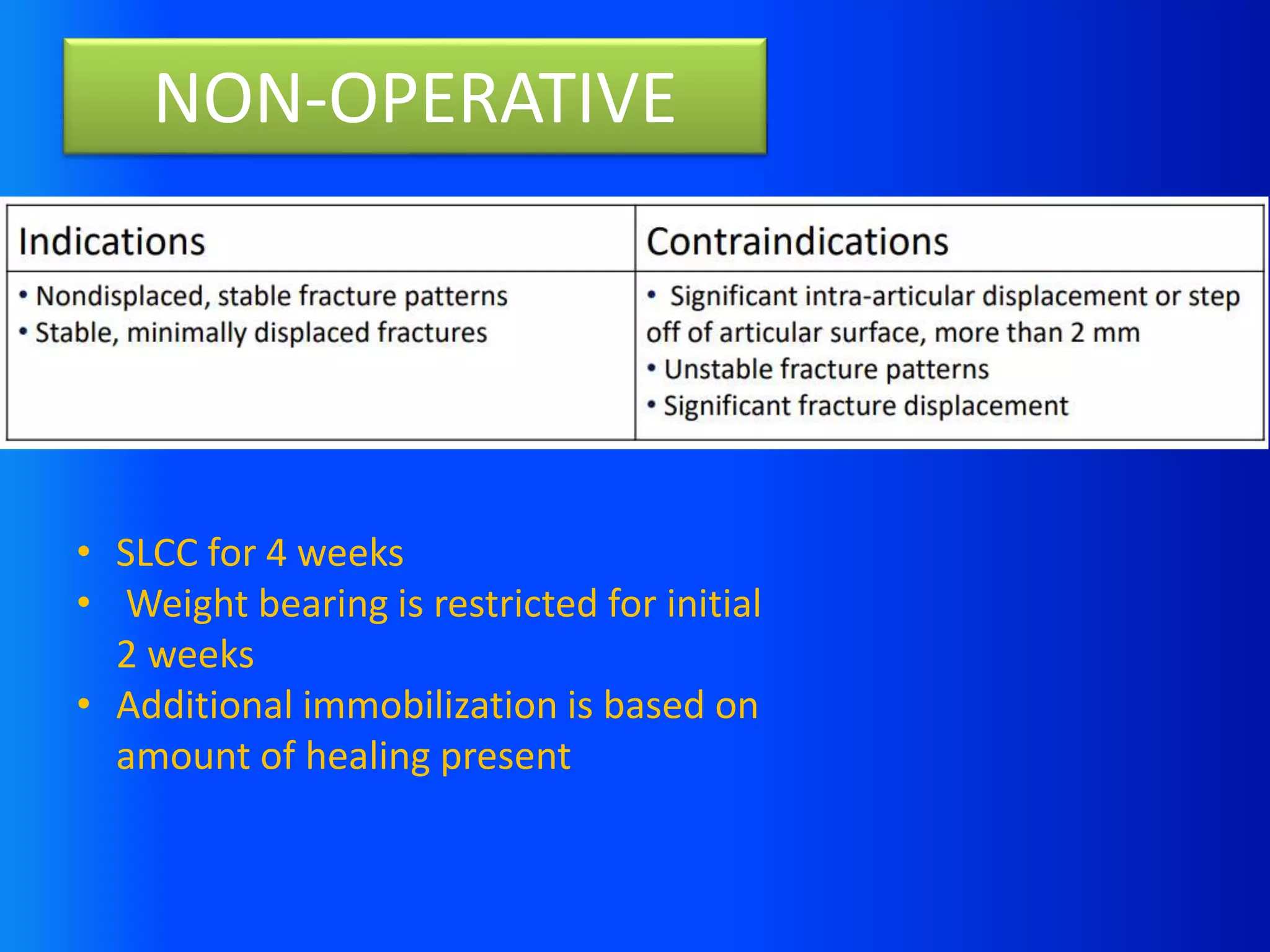
NON-OPERATIVE
• SLCC for 4 weeks
• Weight bearing is restricted for initial
2 weeks
• Additional immobilization is based on
amount of healing present
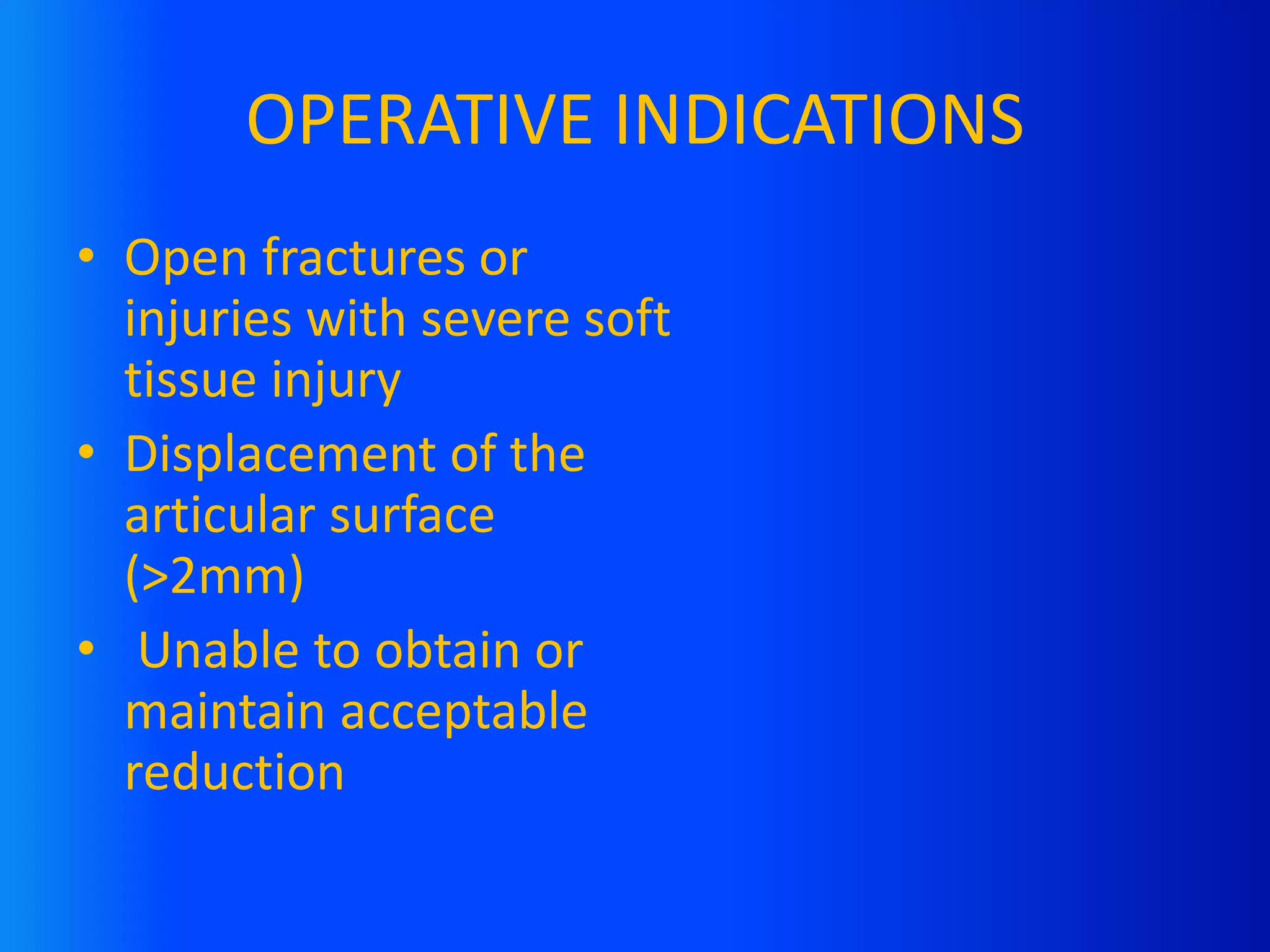
OPERATIVE INDICATIONS
• Open fractures or
injuries with severe soft
tissue injury
• Displacement of the
articular surface
(>2mm)
• Unable to obtain or
maintain acceptable
reduction
TREATMENT

Bimalleolar fracture.pptx

  • 1.
    • Acute AnkleFracture Dislocation • Fracture Closed Complete Transverse Displaced Medial and Lateral Malleolus Left secondary to Motor Vehicular Accident • Weber B • Lauge-Hansen SER Stage IV • Dias-Tachdjian Stage SI • AO 44A2.3
  • 7.
    TALOCRURAL ANGLE Assess forfibular shortening Measurement Mortise view Line along the distal tibial plafond articular surface Line joining the tips of both malleoli Interpretation Normal: 83° ± 4° 2 or 8-15° 3 Fibular shortening: >2° difference to the contralateral side
  • 8.
    TALAR TILT MORTISE VIEW Measurementof the angle between the talus and the distal tibia, used in the assessment of: 1. Ankle instability 2. Ankle osteoarthritis Measurement Talar tilt is measured on either AP or mortise view radiographs of the ankle. Talar tilt is the angle between the articular surface of the talar dome and the articular surface of the tibial plafond. Interpretation Normal values <2° on non-stress radiographs <5° on inversion stress radiographs Talar tilt ≥2° upgrades Kellgren and Lawrence ankle OA from grade 3a to 3b, which is associated with worse clinical outcomes
  • 9.
    MORTISE VIEW Mortise jointspace should uniformly: < 4mm Lateral Clear Space: <3-6mm Distal tibiofibular overlap >1mm Fibular fossa: Visible AP VIEW Distal tibio-fibular joint: < 5.5mm Distal tibofibular overlap: >6mm Equal Horizontal and Medial CS: 3mm
  • 10.
    MORTISE VIEW Mortise jointspace should uniformly: < 4mm Lateral Clear Space: <3-6mm Distal tibiofibular overlap >1mm Fibular fossa: Visible AP VIEW Distal tibio-fibular joint: < 5.5mm Distal tibofibular overlap: >6mm Equal Horizontal and Medial CS: 3mm
  • 11.
  • 14.
    PLAN PLAN: Debridement ankleleft, Closed vs Open reduction multiple pinning lateral and medial malleolus left Lined up as STAT CASE LABORATORIES: HEM: 12.8 WBC: 22.2 PLAT: 310 ESR: 120 CRP:140 Covid 19 PT-PCR negative (+)Covid positive exposure 11-10-22
  • 15.
    PHYSIS Distal tibial physis •Contributes 45% of the growth of the tibia • Ossifies between 6 and 12 months of Age • medial malleolus appears at 7 years in girls and 8 years in boys. • The medial malleolus usually ossifies as a down ward extension of the distal tibial ossific nucleus • The distal aspect of the tibia is completely ossified by 14 to 15 years of age and fuses with the diaphysis at 18 years Distal fibula • Ossifies during the second year of life, generally between the ages of 18 and 20 months. • This physis usually closes 12 to 24 months later than the distal tibial physis CHAPTER 30 Lower Extremity Injuries, pg1379 Tachdjian’s Pediatric Orthopaedics 6th ED
  • 16.
    ANATOMY Ankle Syndesmosis • InterosseousLigament • Anterior and Posterior Inferior Tibiofibular Ligaments • Inferior Transverse Ligament Posteriorly
  • 17.
    Medial Ligamentous Structure Deltoidligament Superficial • Anterior Talotibial Ligament • Posterior Talotibial Ligament • Tibionavicular Ligament • Calcaneotibial Ligament Deep • Primary restraint to lateral displacement of talus
  • 18.
    LATERAL LIGAMENTOUS STRUCTURE •Anterior Talofibular Ligament (ATFL) • Calcaneofibular Ligament (CFL) • Posterior Talofibular Ligament (PTFL)
  • 19.
    Type I andII: • Often amenable to closed tx • Lower risk of physeal arrest Type III and IV: • More likely to require operative tx • Higher risk of physeal arrest Classification (Anatomic) Salter-Harris Classification High interobserver correlation Correlated with outcomes
  • 20.
    CLASSIFICATION (MECHANISTIC) DIAS-TACHDJIAN (1978) 4Types A. Supination-inversion B. Pronation-eversion external rotation (PEER) C. Supination-external rotation D. Supination- plantarflexion
  • 21.
    SUPINATION INVERSION Grade 1:Adduction or inversion force avulses fibula • SH type I or II, rarely can be an epiphyseal fracture Grade 2: Further inversion tibia fracture • Compressive force to medial malleolus • SH type III or IV
  • 22.
    VARIANTS OF GRADEII SUPINATION– INVERSION INJURIES A: SH type I fracture of the distal tibia and fibula. B: SH type I fracture of the fibula, type II tibial fracture. C: SH type I fibular fracture, type III tibial fracture D: SH type I fibular fracture, type IV tibial fracture
  • 23.
    SUPINATION INVERSION • McFarlandFracture • Higher likelihood of nonunion Intra-articular fracture • Delayed union not uncommon • Late displacement can occur • Growth arrest most common in this pattern Up to 40-50% • Adequacy of reduction is only predictive factor of physeal arrest
  • 24.
    PRONATION-EVERSION, EXTERNAL- ROTATION • Thisinjury results when an eversion and lateral rotation force is applied to a fully pronated foot • Tibial SH I/II fracture pattern • Thurston-Holland fragment posterolateral • Transverse fibula fracture • Can be a greenstick fracture • Premature physeal closure is common
  • 25.
    Supination-External Rotation Grade 1: •External rotational force • SH type II tibia fracture • Thurston Holland fragment visible on AP Xray • Differentiates from Supination- plantarflexion • Tibial epiphysis displaces posterolaterally • Similar to Supination-plantarflexion Grade 2: • Spiral fx distal fibula metaphysis • Anteroinferior to posterosuperior • Complications: • External rotation deformity can occur due to incomplete reduction
  • 26.
  • 27.
    COTTON FRACTURE Cotton fractureis a three-part fracture of the ankle involving the lateral malleolus, medial malleolus and distal posterior aspect of the tibial plafond (posterior malleolus)
  • 28.
    TREATMENT A. Location offracture B. Amount of displacement C. Age of child (how much growth remains) D. Distal tibia physis contributes: • 3-4 mm growth per year • 35-45% of overall tibia length • Follow up X-rays for 6-12 months to evaluate for physeal closure
  • 29.
    NON-OPERATIVE • SLCC for4 weeks • Weight bearing is restricted for initial 2 weeks • Additional immobilization is based on amount of healing present
  • 30.
    OPERATIVE INDICATIONS • Openfractures or injuries with severe soft tissue injury • Displacement of the articular surface (>2mm) • Unable to obtain or maintain acceptable reduction
  • 31.

Editor's Notes

  • #16 Distal tibial physis Contributes 45% of the growth of the tibia Ossifies between 6 and 12 months of Age medial malleolus appears at 7 years in girls and 8 years in boys. The medial malleolus usually ossifies as a down ward extension of the distal tibial ossific nucleus The distal aspect of the tibia is completely ossified by 14 to 15 years of age and fuses with the diaphysis at 18 years Distal fibula Ossifies during the second year of life, generally between the ages of 18 and 20 months. This physis usually closes 12 to 24 months later than the distal tibial physis
  • #18 Because ligamentous structures are stronger than the physis in children, avulsion-type injuries, in which traumatic forces exerted through the ankle ligaments create physeal ractures, are common.
  • #19 Because ligamentous structures are stronger than the physis in children, avulsion-type injuries, in which traumatic forces exerted through the ankle ligaments create physeal ractures, are common.
  • #25 This injury results when an eversion and lateral rotation force is applied to a fully pronated foot Typically, a Salter-Harris type I or II fracture of the distal tibia occurs, together with a transverse or short oblique fibular fracture located 4 to 7 cm proximal to the tip of the lateral malleolus Tibial SH I/II fracture pattern Thurston-Holland fragment posterolateral Transverse fibula fracture Can be a greenstick fracture Premature physeal closure is common
  • #26 Radiographic appearance of a supination–lateral rotation fracture pattern. The distal tibial fracture begins distolaterally and spirals proximomedially. The distal fibula has sustained a spiral fracture as a result of the external rotation force