PRESENTATION
ON
• SUBMITTED TO:
• -MRS LEHALI BALA MADAM
• SUBJECT COORDINATOR
• COLLEGE OF NURSING RIMS
,RANCHI
• SUBMITTED BY :-
• NITU KUMARI
• ROLL NO -15
• SEEMA KUMARI
• ROLL NO -32
• 2ND YEAR BASIC B.SC NURSING
RIMS, RANCHI
CONTENTS
1.Objective
2.Concept of group dynamic
3.Definition
4.What is group?
5.Types of group?
6.Why do people join group?
7.Group structure
8.Aspects of group discipline
9.Stages of group development
10.Strategies to improve group functioning
11.References
12.Bibliography
OBJECTIVES
To identifiy analyze the social processes that impact on
group development and performance
To acquire the skills necessary to intervene and improve
individual and group performance in an organisational
context
To build more successful organizations by applying
techniques that provide positive impact on goal
achievement
CONCEPT OF GROUP DYNAMIC
It was founded by Kurt Lewin to study group decision , group
Productivity, group interaction, group cohesiveness and group communication. The
underlying assumption was that the laws of the group behaviour can be estabilished
independently of the goals or specific activities of the group irrespective of the
structure of the group.
Group dynamics contains two terms : group and dynamics. Group is
basically a collectivity of two or more persons. Dynamics comes from greek words
meaning FORCE.
Thus, “Group dynamics is concerned with the interaction of forces among
group members in a social situation.”
DEFINITION
Group dynamis refers to a system of
behaviour and psychological processes
occurring within a social group or
between social group.
- ( kurt lewin)
WHAT IS GROUP ?
Group
Two or more people
Shared goals
People see themselves
as members
There is interaction
among members
TYPES OF GROUP
Group
Formal Informal
Task
Command
Friendship
Interest
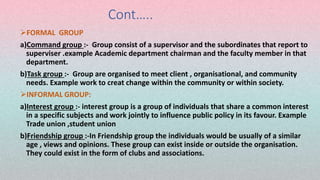
Cont…..
FORMAL GROUP
a)Command group :- Group consist of a supervisor and the subordinates that report to
superviser .example Academic department chairman and the faculty member in that
department.
b)Task group :- Group are organised to meet client , organisational, and community
needs. Example work to creat change within the community or within society.
INFORMAL GROUP:
a)Interest group :- interest group is a group of individuals that share a common interest
in a specific subjects and work jointly to influence public policy in its favour. Example
Trade union ,student union
b)Friendship group :-In Friendship group the individuals would be usually of a similar
age , views and opinions. These group can exist inside or outside the organisation.
They could exist in the form of clubs and associations.
WHY DO PEOPLE JOIN GROUP??
The people often join groups since the groups give the members a
stability and enhances their achievement capacity .The main
reasons to join a group are:
Have a sense of security
Have a status
Develop self-esteem
Power
Goal achievement
GROUP STRUCTURE
Four different aspects of group structure are:
1.Norms
2.Roles
3.Status
4.Cohesiveness
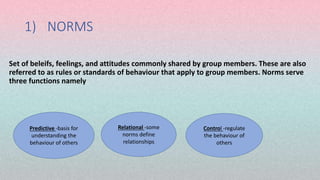
1) NORMS
Set of beleifs, feelings, and attitudes commonly shared by group members. These are also
referred to as rules or standards of behaviour that apply to group members. Norms serve
three functions namely
Predictive -basis for
understanding the
behaviour of others
Relational -some
norms define
relationships
Control -regulate
the behaviour of
others
2) ROLE
There are two elements that define this role identity-
Role perception – An individual is expected to behave according to
his own perception in the group.
Role expectation – It is defined as how others believe one should
behave in a given situation.
3) STATUS
Status is “a socially defined position or rank given to groups or group
members by others.” group members get high status or low status in the
group based on their authority and performance.
High status members of the group have more freedom to deviate
from the norms. This facility enables them to have the discriminatory
powers in decision making. Low status members of the group should
not have freedom to deviate from the norms as it leads to status
inequality.
4) COHESIVENESS
COHESION
SOCIAL TASK
The bonds of interpersonal
attraction that link group
members
The way in which skills and
abilities of the group
members mesh to allow
satisfactory performance
ASPECTS OF GROUP DISCIPLINE
1.Formation of group
2.Group task
3.Composition of group
4.Communication between group members
5.Mode of working relationship between members of a group
6.Growth, downfall, and decision of the group
7.Group dissolution
8.Method to achieve oneness and building consent
9.Adjustment to meet the needs of the group
10.Task performance
STAGES OF GROUP DEVELOPMENT
1. Forming
phase
2 storming
phase
3 Norming
phase
4
Performing
phase
Stages of
group
formation
CONT…
1 FORMING PHASE :- Members get to know each other and set ground
rules.
2 STORMING PHASE :- Members come to resist controle by group
leaders and show hostility.
3 NORMING PHASE :- Members work together developing close
relationships feelings of cohesiveness .
4 PERFORMING PHASE :- Group members work towards getting their
jobs done.
STRATEGIES TO IMPROVE GROUP
FUNCTIONING
1.Individuals participating in a group must have a clear understanding of individual goal as well as group
objective so that their interaction is goal oriented.
2.Members in a group must follow the principle of positive competence; so that assigned tasks can be
carried out more competently and efficiently.
3.Appropriate control over the functioning of group members must be maintained for cohesiveness and
smooth functioning in a group.
4.The success of a group primarily depends on the collaboration of the fuctions of its members. Group
members must carry out their functions with a collaborative approach.
5.Effective communication is essential for afficient group functioning.group members must communicate
effectively and appropriately for a group to function smoothly.
6.Coordination between individual tasks is essential in achieving efficient group functioning. A group
leader must coordinate individual tasks to obtained group objectives.
RESOURCES
• BOOKS
• INTERNET
• CONSULTATION WITH TEACHER
BIBLIOGRAPHY
 Pramilaa R Textbook of Communication and Educational
Technology. 1st Edition. Frontline publication. PAGE No. 51-70.
 Dr. Sharma Suresh K. and Sharma Reema. Textbook of
Communication and Educational Technology. 2nd
Edition. Elesvier publication Page No 64-66
 www.shareslide.com
 www.Wikipedia.com
THANK YOU

Group dynamics

  • 1.
    PRESENTATION ON • SUBMITTED TO: •-MRS LEHALI BALA MADAM • SUBJECT COORDINATOR • COLLEGE OF NURSING RIMS ,RANCHI • SUBMITTED BY :- • NITU KUMARI • ROLL NO -15 • SEEMA KUMARI • ROLL NO -32 • 2ND YEAR BASIC B.SC NURSING RIMS, RANCHI
  • 2.
    CONTENTS 1.Objective 2.Concept of groupdynamic 3.Definition 4.What is group? 5.Types of group? 6.Why do people join group? 7.Group structure 8.Aspects of group discipline 9.Stages of group development 10.Strategies to improve group functioning 11.References 12.Bibliography
  • 3.
    OBJECTIVES To identifiy analyzethe social processes that impact on group development and performance To acquire the skills necessary to intervene and improve individual and group performance in an organisational context To build more successful organizations by applying techniques that provide positive impact on goal achievement
  • 4.
    CONCEPT OF GROUPDYNAMIC It was founded by Kurt Lewin to study group decision , group Productivity, group interaction, group cohesiveness and group communication. The underlying assumption was that the laws of the group behaviour can be estabilished independently of the goals or specific activities of the group irrespective of the structure of the group. Group dynamics contains two terms : group and dynamics. Group is basically a collectivity of two or more persons. Dynamics comes from greek words meaning FORCE. Thus, “Group dynamics is concerned with the interaction of forces among group members in a social situation.”
  • 5.
    DEFINITION Group dynamis refersto a system of behaviour and psychological processes occurring within a social group or between social group. - ( kurt lewin)
  • 6.
    WHAT IS GROUP? Group Two or more people Shared goals People see themselves as members There is interaction among members
  • 7.
    TYPES OF GROUP Group FormalInformal Task Command Friendship Interest
  • 8.
    Cont….. FORMAL GROUP a)Command group:- Group consist of a supervisor and the subordinates that report to superviser .example Academic department chairman and the faculty member in that department. b)Task group :- Group are organised to meet client , organisational, and community needs. Example work to creat change within the community or within society. INFORMAL GROUP: a)Interest group :- interest group is a group of individuals that share a common interest in a specific subjects and work jointly to influence public policy in its favour. Example Trade union ,student union b)Friendship group :-In Friendship group the individuals would be usually of a similar age , views and opinions. These group can exist inside or outside the organisation. They could exist in the form of clubs and associations.
  • 9.
    WHY DO PEOPLEJOIN GROUP?? The people often join groups since the groups give the members a stability and enhances their achievement capacity .The main reasons to join a group are: Have a sense of security Have a status Develop self-esteem Power Goal achievement
  • 10.
    GROUP STRUCTURE Four differentaspects of group structure are: 1.Norms 2.Roles 3.Status 4.Cohesiveness
  • 11.
    1) NORMS Set ofbeleifs, feelings, and attitudes commonly shared by group members. These are also referred to as rules or standards of behaviour that apply to group members. Norms serve three functions namely Predictive -basis for understanding the behaviour of others Relational -some norms define relationships Control -regulate the behaviour of others
  • 12.
    2) ROLE There aretwo elements that define this role identity- Role perception – An individual is expected to behave according to his own perception in the group. Role expectation – It is defined as how others believe one should behave in a given situation.
  • 13.
    3) STATUS Status is“a socially defined position or rank given to groups or group members by others.” group members get high status or low status in the group based on their authority and performance. High status members of the group have more freedom to deviate from the norms. This facility enables them to have the discriminatory powers in decision making. Low status members of the group should not have freedom to deviate from the norms as it leads to status inequality.
  • 14.
    4) COHESIVENESS COHESION SOCIAL TASK Thebonds of interpersonal attraction that link group members The way in which skills and abilities of the group members mesh to allow satisfactory performance
  • 15.
    ASPECTS OF GROUPDISCIPLINE 1.Formation of group 2.Group task 3.Composition of group 4.Communication between group members 5.Mode of working relationship between members of a group 6.Growth, downfall, and decision of the group 7.Group dissolution 8.Method to achieve oneness and building consent 9.Adjustment to meet the needs of the group 10.Task performance
  • 16.
    STAGES OF GROUPDEVELOPMENT 1. Forming phase 2 storming phase 3 Norming phase 4 Performing phase Stages of group formation
  • 17.
    CONT… 1 FORMING PHASE:- Members get to know each other and set ground rules. 2 STORMING PHASE :- Members come to resist controle by group leaders and show hostility. 3 NORMING PHASE :- Members work together developing close relationships feelings of cohesiveness . 4 PERFORMING PHASE :- Group members work towards getting their jobs done.
  • 18.
    STRATEGIES TO IMPROVEGROUP FUNCTIONING 1.Individuals participating in a group must have a clear understanding of individual goal as well as group objective so that their interaction is goal oriented. 2.Members in a group must follow the principle of positive competence; so that assigned tasks can be carried out more competently and efficiently. 3.Appropriate control over the functioning of group members must be maintained for cohesiveness and smooth functioning in a group. 4.The success of a group primarily depends on the collaboration of the fuctions of its members. Group members must carry out their functions with a collaborative approach. 5.Effective communication is essential for afficient group functioning.group members must communicate effectively and appropriately for a group to function smoothly. 6.Coordination between individual tasks is essential in achieving efficient group functioning. A group leader must coordinate individual tasks to obtained group objectives.
  • 19.
    RESOURCES • BOOKS • INTERNET •CONSULTATION WITH TEACHER
  • 20.
    BIBLIOGRAPHY  Pramilaa RTextbook of Communication and Educational Technology. 1st Edition. Frontline publication. PAGE No. 51-70.  Dr. Sharma Suresh K. and Sharma Reema. Textbook of Communication and Educational Technology. 2nd Edition. Elesvier publication Page No 64-66  www.shareslide.com  www.Wikipedia.com
  • 21.