Copyright © 2010 Pearson Education, Inc. Publishing as Prentice Hall1
Introduction
Chapter 1
Copyright © 2010 Pearson Education, Inc. Publishing as Prentice H2
Types of Assets
Tangible Assets
Value is based on physical properties
Examples include buildings, land, machinery
Intangible Assets
Claim to future income
Examples include various types of financial assets
Copyright © 2010 Pearson Education, Inc. Publishing as Prentice H3
Types of Financial Assets
Bank loans
Government bonds
Corporate bonds
Municipal bonds
Foreign bond
Common stock
Preferred stock
Foreign stock
Copyright © 2010 Pearson Education, Inc. Publishing as Prentice H4
Debt vs. Equity
Debt Instruments
Fixed dollar payments
Examples include loans, bonds
Equity Claims
Dollar payment is based on earnings
Residual claims
Examples include common stock, partnership share
Copyright © 2010 Pearson Education, Inc. Publishing as Prentice H5
Price of Financial Asset and Risk
The price or value of a financial asset is equal to the present
value of all expected future cash flows.
Expected rate of return
Risk of expected cash flow
Copyright © 2010 Pearson Education, Inc. Publishing as Prentice H6
Types of Investment Risks
Purchasing power risk or inflation risk
Default or credit risk
Exchange rate or currency risk
Copyright © 2010 Pearson Education, Inc. Publishing as Prentice H7
Role of Financial Assets
Transfer funds from surplus units to deficit units.
Transfer funds so as to redistribute unavoidable risk
associated with cash flows generated from both tangible and
intangible assets.
Copyright © 2010 Pearson Education, Inc. Publishing as Prentice H8
Key Points You Should
Understand
Difference between tangible and financial assets
Difference between debt and equity
Cash flow of a financial asset
Three types of risks associated with financial asset
Two principal economic functions of financial assets
Copyright © 2010 Pearson Education, Inc. Publishing as Prentice H9
Role of Financial Markets
Determine price or required rate of return of asset.
Provide liquidity.
Reduce transactions costs, which consists of search costs and
information costs.
Copyright © 2010 Pearson Education, Inc. Publishing as Prentice H10
Classification of Financial Markets
Debt vs. equity markets
Money market vs. capital market
Primary vs. secondary market
Cash or spot vs. derivatives market
Auction vs. over-the-counter vs. intermediated market
Copyright © 2010 Pearson Education, Inc. Publishing as Prentice H11
Financial Market Participants
Households
Business units
Federal, state, and local governments
Government agencies
Supranationals
Regulators
Copyright © 2010 Pearson Education, Inc. Publishing as Prentice H12
Key Points You Should
Understand
Three economic functions of financial markets
Ways that financial markets can be classified
Market participants
Copyright © 2010 Pearson Education, Inc. Publishing as Prentice H13
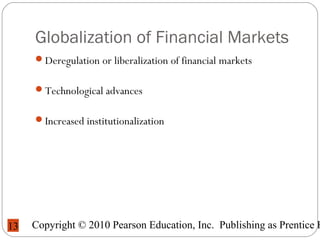
Globalization of Financial Markets
Deregulation or liberalization of financial markets
Technological advances
Increased institutionalization
Copyright © 2010 Pearson Education, Inc. Publishing as Prentice H14
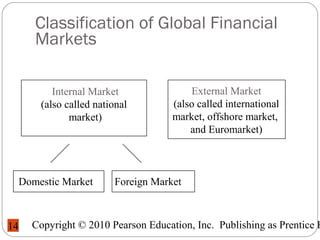
Classification of Global Financial
Markets
Internal Market
(also called national
market)
External Market
(also called international
market, offshore market,
and Euromarket)
Domestic Market Foreign Market
Copyright © 2010 Pearson Education, Inc. Publishing as Prentice H15
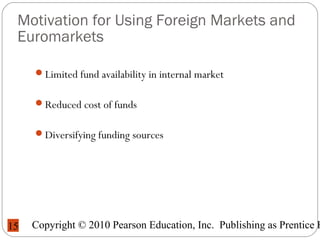
Motivation for Using Foreign Markets and
Euromarkets
Limited fund availability in internal market
Reduced cost of funds
Diversifying funding sources
Copyright © 2010 Pearson Education, Inc. Publishing as Prentice H16
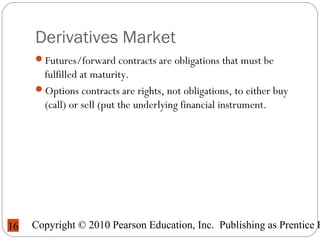
Derivatives Market
Futures/forward contracts are obligations that must be
fulfilled at maturity.
Options contracts are rights, not obligations, to either buy
(call) or sell (put the underlying financial instrument.
Copyright © 2010 Pearson Education, Inc. Publishing as Prentice H17
Role of Derivative Instruments
Protect against different types of investment risks, such as
purchasing power risk, interest rate risk, exchange rate risk.
Advantages:
Lower transactions costs
Faster to carry out transaction
Greater liquidity
Copyright © 2010 Pearson Education, Inc. Publishing as Prentice H18
Key Points You Should
Understand
Three major factors that have integrated financial markets
Institutionalization of financial markets
Internal and external markets
Motive to raise money outside of domestic market
Two basic types of derivatives
Principal economic role of derivatives
Potential uses of derivatives
Copyright © 2010 Pearson Education, Inc. Publishing as Prentice H19
Types of Regulation
Disclosure regulation
Financial activity regulation
Regulation of financial institution
Regulation of foreign participation
Copyright © 2010 Pearson Education, Inc. Publishing as Prentice H20
Regulation in the United States
Reasons for regulation
Stock market crash of 1929
Great Depression of 1930s
Regulation primarily by SEC, CFTC, Treasury, and Federal
Reserve
“Blueprint for Regulatory Reform”
Split regulation by functions
Market stability regulator
Prudential regulator
Business conduct regulator
Copyright © 2010 Pearson Education, Inc. Publishing as Prentice H21
Key Points You Should
Understand
Explanation for the existence of regulation
Goals sought in regulation
Major forms of regulation
“Blueprint for Regulatory Reform”
Copyright © 2010 Pearson Education, Inc. Publishing as Prentice H22
All rights reserved. No part of this publication may be reproduced,
stored in a retrieval system, or transmitted, in any form or by any means,
electronic, mechanical, photocopying, recording, or otherwise, without
the prior written permission of the publisher. Printed in the United
States of America.

Chapter 1 Introduction

  • 1.
    Copyright © 2010Pearson Education, Inc. Publishing as Prentice Hall1 Introduction Chapter 1
  • 2.
    Copyright © 2010Pearson Education, Inc. Publishing as Prentice H2 Types of Assets Tangible Assets Value is based on physical properties Examples include buildings, land, machinery Intangible Assets Claim to future income Examples include various types of financial assets
  • 3.
    Copyright © 2010Pearson Education, Inc. Publishing as Prentice H3 Types of Financial Assets Bank loans Government bonds Corporate bonds Municipal bonds Foreign bond Common stock Preferred stock Foreign stock
  • 4.
    Copyright © 2010Pearson Education, Inc. Publishing as Prentice H4 Debt vs. Equity Debt Instruments Fixed dollar payments Examples include loans, bonds Equity Claims Dollar payment is based on earnings Residual claims Examples include common stock, partnership share
  • 5.
    Copyright © 2010Pearson Education, Inc. Publishing as Prentice H5 Price of Financial Asset and Risk The price or value of a financial asset is equal to the present value of all expected future cash flows. Expected rate of return Risk of expected cash flow
  • 6.
    Copyright © 2010Pearson Education, Inc. Publishing as Prentice H6 Types of Investment Risks Purchasing power risk or inflation risk Default or credit risk Exchange rate or currency risk
  • 7.
    Copyright © 2010Pearson Education, Inc. Publishing as Prentice H7 Role of Financial Assets Transfer funds from surplus units to deficit units. Transfer funds so as to redistribute unavoidable risk associated with cash flows generated from both tangible and intangible assets.
  • 8.
    Copyright © 2010Pearson Education, Inc. Publishing as Prentice H8 Key Points You Should Understand Difference between tangible and financial assets Difference between debt and equity Cash flow of a financial asset Three types of risks associated with financial asset Two principal economic functions of financial assets
  • 9.
    Copyright © 2010Pearson Education, Inc. Publishing as Prentice H9 Role of Financial Markets Determine price or required rate of return of asset. Provide liquidity. Reduce transactions costs, which consists of search costs and information costs.
  • 10.
    Copyright © 2010Pearson Education, Inc. Publishing as Prentice H10 Classification of Financial Markets Debt vs. equity markets Money market vs. capital market Primary vs. secondary market Cash or spot vs. derivatives market Auction vs. over-the-counter vs. intermediated market
  • 11.
    Copyright © 2010Pearson Education, Inc. Publishing as Prentice H11 Financial Market Participants Households Business units Federal, state, and local governments Government agencies Supranationals Regulators
  • 12.
    Copyright © 2010Pearson Education, Inc. Publishing as Prentice H12 Key Points You Should Understand Three economic functions of financial markets Ways that financial markets can be classified Market participants
  • 13.
    Copyright © 2010Pearson Education, Inc. Publishing as Prentice H13 Globalization of Financial Markets Deregulation or liberalization of financial markets Technological advances Increased institutionalization
  • 14.
    Copyright © 2010Pearson Education, Inc. Publishing as Prentice H14 Classification of Global Financial Markets Internal Market (also called national market) External Market (also called international market, offshore market, and Euromarket) Domestic Market Foreign Market
  • 15.
    Copyright © 2010Pearson Education, Inc. Publishing as Prentice H15 Motivation for Using Foreign Markets and Euromarkets Limited fund availability in internal market Reduced cost of funds Diversifying funding sources
  • 16.
    Copyright © 2010Pearson Education, Inc. Publishing as Prentice H16 Derivatives Market Futures/forward contracts are obligations that must be fulfilled at maturity. Options contracts are rights, not obligations, to either buy (call) or sell (put the underlying financial instrument.
  • 17.
    Copyright © 2010Pearson Education, Inc. Publishing as Prentice H17 Role of Derivative Instruments Protect against different types of investment risks, such as purchasing power risk, interest rate risk, exchange rate risk. Advantages: Lower transactions costs Faster to carry out transaction Greater liquidity
  • 18.
    Copyright © 2010Pearson Education, Inc. Publishing as Prentice H18 Key Points You Should Understand Three major factors that have integrated financial markets Institutionalization of financial markets Internal and external markets Motive to raise money outside of domestic market Two basic types of derivatives Principal economic role of derivatives Potential uses of derivatives
  • 19.
    Copyright © 2010Pearson Education, Inc. Publishing as Prentice H19 Types of Regulation Disclosure regulation Financial activity regulation Regulation of financial institution Regulation of foreign participation
  • 20.
    Copyright © 2010Pearson Education, Inc. Publishing as Prentice H20 Regulation in the United States Reasons for regulation Stock market crash of 1929 Great Depression of 1930s Regulation primarily by SEC, CFTC, Treasury, and Federal Reserve “Blueprint for Regulatory Reform” Split regulation by functions Market stability regulator Prudential regulator Business conduct regulator
  • 21.
    Copyright © 2010Pearson Education, Inc. Publishing as Prentice H21 Key Points You Should Understand Explanation for the existence of regulation Goals sought in regulation Major forms of regulation “Blueprint for Regulatory Reform”
  • 22.
    Copyright © 2010Pearson Education, Inc. Publishing as Prentice H22 All rights reserved. No part of this publication may be reproduced, stored in a retrieval system, or transmitted, in any form or by any means, electronic, mechanical, photocopying, recording, or otherwise, without the prior written permission of the publisher. Printed in the United States of America.

Editor's Notes