Money, Banking, the Fed, Money Creation,  and  Monetary  Policy   There is   $665   billion   in  currency [notes  &  coins].   $37 million   in notes is   printed  each  day.
Dollar Decoded Fed bank that issued the bill   [Chi.] Bills  are  crowded  with  numbers  and letters that help  the  U.S. Treasury track printing errors & authenticate currency. Here’s  what  many  of  them  mean: Number corresponds to letter in  circle indicating issuing Fed bank. First letter corresponds to issuing Fed bank Last letter tells how many  times serial number has run 25 Branches
[Jackson’s portrait is larger, free from the oval] New $20 colors are   peach ,  blue ,  and   green .  This  is the   20’ s  20 th   new look . New background colors add an extra layer of  complexity  for counterfeiters Ink appears either copper  or  green , depending upon the angle at which the bill is viewed. The  first  $20   bill was introduced in 1861 .  Back  then, $20 was about the monthly wage  for manual  laborers. The average $20 bill lasts  3 years . There are  5 billion twenties  in circulation, enough to circle the earth 19 times.  An  ATM  can hold up to 7,500 bills, or  $150,000  in twenties. The  $20  bill  is the most counterfeited in  the  U. S. ,  while the  $100  is  most counterfeited abroad .
Donald Stokes,  in  2005, pleaded guilty to stealing  $700,000  since 1998 from  the  Ft Worth Currency C enter . His job was making sure flawed currency was shipped off to destruction.  He  was  stopped  for  a routine  traffic stop,  then took off on a high-speed chase.  When  stopped, he had  $79,000  in flawed currency in his car, which he said he won in Reno]. Stokes faces 10 years in prison and a $250,000 in fine. Shredding of U.S. Money $500 million  is shredded at the 12 Feds each day.  That is  over  $100 billion each year .  A typical dollar last about 18  months. Higher denominations last longer. Despite a camera on those whose job it is to shred money –  can you get out of the shredding room with some of the notes?  Yes!!! An employee in Washington  took $1.7 million  in $100 bills [ he sneaked 1,700 $100 bills past his security].  He  was caught  when his bank teller reported his frequent large deposits in his bank. A woman at the Atlanta Fed made off with  $277,000  over a 3 year period. She was observed “concealing bills on her person”.  At the Boston Fed, an employee made off with  $23,000  when he stuffed money  into  his  pockets  after  obstructing  the  view  of his coworkers. He was caught when his employer viewed the video.
$100   Dollar Bill –  Red Polymer Thread $50  –  Yellow $20  –  Green $10  –  Orange $5  – Blue [This $5 will be hard to counterfeit]
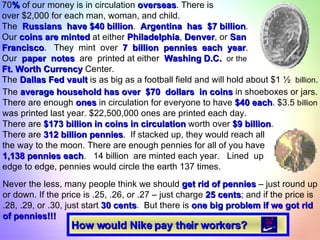
70 %  of our money is in circulation  overseas . There is  over $2,000 for each   man, woman, and child. The  Russians  have $40 billion .  Argentina  has  $7 billion . Our  coins are minted  at either  Philadelphia ,  Denver , or  San  Francisco .  They  mint  over  7  billion  pennies   each  year . Our  paper  notes   are  printed at either  Washing D.C.   or the   Ft. Worth Currency  Center.  The  Dallas Fed vault  is as big as a football field and will hold about $1 ½  billion . The  average household   has over  $70  dollars  in coins  in shoeboxes or jars. There are enough  ones  in circulation for everyone to have  $40 each . $3.5  billion was printed last year. $22,500,000 ones are printed each day. There are  $173 billion in coins in circulation  worth over  $9 billion .  There are  312 billion pennies .  If stacked up, they would reach all  the way to the moon. There are enough pennies for all of you have  1,138 pennies each .  14 billion  are minted each year.  Lined  up  edge to edge, pennies would circle the earth 137 times.  Never the less, many people think we should  get rid of pennies  – just round up or down. If the price is .25, .26, or .27 – just charge  25 cents ; and if the price is .28, .29, or .30, just start  30 cents .  But there is  one big problem if we got rid of pennies!!! How would Nike pay their workers?
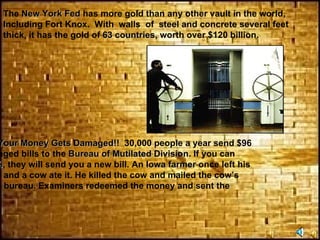
The  New York Fed  has more gold than any other vault in the world,  Including Fort Knox.  With  walls  of  steel and concrete several feet  thick, it has the gold of  63 countries , worth over $120 billion.  What To Do If Your Money Gets Damaged!!   30,000 people a year send $96  million of damaged bills to the  Bureau of Mutilated Division . If you can  send them  51% , they will send you a new bill. An  Iowa farmer  once left his  wallet in a field and a cow ate it. He killed the cow and mailed the cow’s  stomach to the bureau. Examiners redeemed the money and sent the  farmer  $850 .
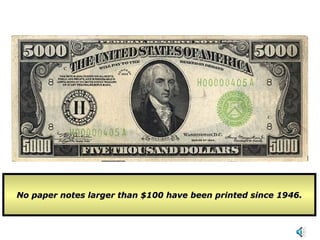
No paper notes larger than $100 have been printed since 1946.
 
And – what about the new “ Bush Dollar” coming out next week? And  the  new $1 bill coming out W ednesday ?
Bogus Bills – fined up to $5,000 [5,000 arrested in 2002]  - imprisoned up to 15 years . The so-called  supernote  – a  counterfeit $100 bill  of extremely  high quality began showing up around  1990 . 40%  of world’s bogus bills come from  Columbia . They border  Ecuador , which converted to the U.S. dollar in 2000. The  $20 bill  is the most popular  domestic counterfeit bill , while  the  $100 bill  is most popular among  foreign counterfeiters . Of the fake bills found in the U.S. in 2002,  half   were produced with  computers, copiers, and printers ,  up from just   1% in 1996 . Only about  3/100ths of 1% is counterfeited .  $44 in 02
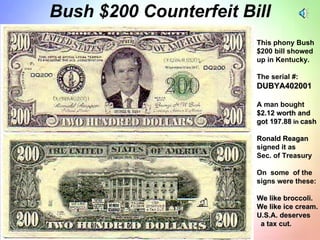
Bush $200 Counterfeit Bill This phony Bush  $200 bill showed up in Kentucky.  The serial #: DUBYA402001 A man bought $2.12 worth and got 197.88  in  cash Ronald Reagan signed it as  Sec. of Treasury On  some  of the signs were these: We like broccoli. We like ice cream. U.S.A. deserves  a tax cut.
It cost 3.5 cents to print a dollar which last 1.5 years. It  cost  12 cents to mint a  sacagawea  [“bird  woman ”] but they last 30 years. [500 million  were minted  but  you seldom see them.]  The government could save $400 million if people would use more sacagaweas.
 
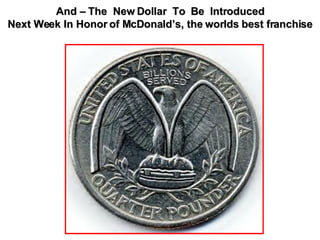
And – The  New Dollar  To  Be  Introduced Next Week In Honor of McDonald’s, the worlds best franchise
The  1899 Dollar
“ Show me the Wampum!!!” History of U.S. Money  [A Panorama of Legal Tender] From Wampum to Credit Cards
Continental Currency  [1775-1781] [$1/6;$1/2;$1/3;$2/3;$1;$2;$3;$4;$5;$6;$8;$30;$40;$45 ;$60;&$80]
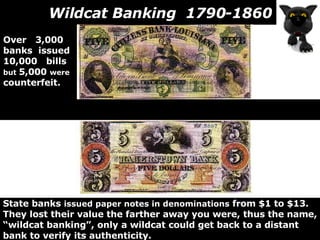
Wildcat Banking  1790-1860 State banks  issued paper notes in denominations  from $1 to $13. They lost their value the farther away you were, thus the name, “ wildcat banking”, only a wildcat could get back to a distant bank to verify its authenticity.  Over  3,000  banks  issued 10,000  bills but  5,000  were counterfeit.
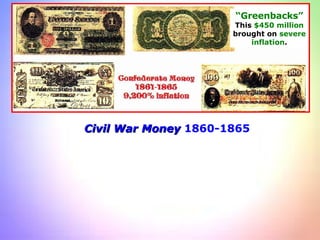
Civil War Money  1860-1865 “ Greenbacks” This  $450 million brought on  severe  inflation .
Yap Island Money Yap Island  is  a tiny,  U.S. trust  territory  in the S. Pacific,  500 miles from Guam.  It is one of the  4  Federated States of Micronesia  & has   12,000 Yapese & 6,000 “rai”  limestone stones.
Great Seal of The U.S. The  Great Seal  (on the $1) was adopted in 1783. The American Bald Eagle holds an  olive branch -symbolizing   peace-with 13 berries & 13 leaves . In the left talon, the eagle holds  13 arrows-symbolizing war . The 13 units represent  the original  13 colonies .  The  eagle’s  head  is turned toward the olive branch showing a desire for peace . E Pluribus Unum – “Out of Many, One” The  pyramid  stands  for  permanence  and strength .  The  pyramid is   unfinished  signifying  future growth  of the U.S. and the goal of perfection. A  sunburst   and  an  eye   are above the pyramid standing  for  the  Deity . The  All-Seeing Eye is a   Masonic symbol  [Franklin  &  Washington  were  Masons]. The  eye represents the eternal eye of God  and the virtue of  “putting the  spiritual above the material.”
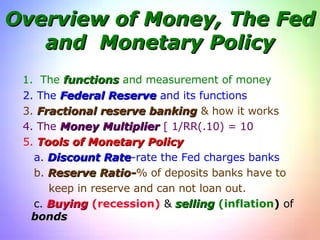
Overview of Money, The Fed and  Monetary Policy 1.  The  functions  and measurement of money 2. The  Federal Reserve  and its functions 3.  Fractional reserve banking  & how it works 4. The  Money Multiplier  [ 1/RR(.10) = 10 5.  Tools of Monetary Policy a.  Discount Rate -rate the Fed charges banks b.  Reserve Ratio- % of deposits banks have to keep in reserve and can not loan out. c.  Buying   (recession)  &  selling   (inflation )  of  bonds
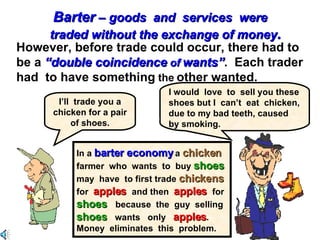
. However, before trade could occur, there had to  be a  “double coincidence  of  wants” .  Each trader  had  to have something  the  other wanted. I’ll  trade you a chicken for a pair of shoes. I would  love  to  sell you these shoes but I  can’t  eat  chicken, due to my bad teeth, caused by smoking. In a  barter economy  a  chicken   farmer  who  wants  to  buy  shoes   may  have  to first trade  chickens   for  apples  and then  apples  for  shoes  because  the  guy  selling  shoes  wants  only  apples .  Money  eliminates  this  problem.  Barter  – goods  and  services  were  traded without the exchange of money .
Money is also  easier to tax .  So a  monetary system  is better   than a   barter system . T he  m onetary system enables the   “calculation   of exchange”  to go much faster.
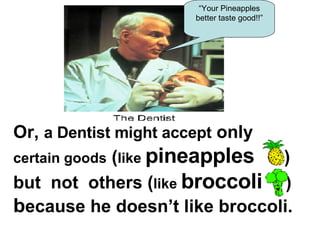
Problems with barter Or,  a Dentist might accept  only  certain goods  ( like  pineapples   )  but  not  others ( like  broccoli  )  b ecause he doesn’t like broccoli.   “ Your Pineapples better taste good!!”
Three FUNCTIONS OF MONEY 1.   Medium of Exchange [ any  asset  that  sellers will accept  as  payment Avoids “double coincidence of wants”  that bartering requires. You would  have to have a  trading partner who  “wants  to  sell you  goods  you  want  to buy”  and   “wants  to  buy  goods  you  want  to  sell.”
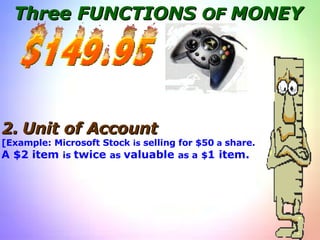
Three FUNCTIONS  OF  MONEY 2.   Unit of   Account [Example: Microsoft Stock  is  selling for $50  a  share. A $2 item  is  twice  as  valuable  as a   $ 1 item.
Three FUNCTIONS OF MONEY 3. Store of Value   [from  one point in time to another ] [ doesn’t wear out easily and holds up to inflation ] Greek Coin 2,500 years old
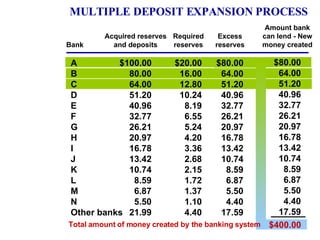
MULTIPLE DEPOSIT EXPANSION PROCESS $400.00 Total amount of money created by the banking system Bank Acquired reserves and deposits Required reserves Excess reserves Amount bank can lend - New money created A B C D E F G H I J K L M N Other banks $100.00 80.00 64.00 51.20 40.96 32.77 26.21 20.97 16.78 13.42 10.74 8.59 6.87 5.50 21.99 $20.00 16.00 12.80 10.24 8.19 6.55 5.24 4.20 3.36 2.68 2.15 1.72 1.37 1.10 4.40 $80.00 64.00 51.20 40.96 32.77 26.21 20.97 16.78 13.42 10.74 8.59 6.87 5.50 4.40 17.59 $80.00 64.00 51.20 40.96 32.77 26.21 20.97 16.78 13.42 10.74 8.59 6.87 5.50 4.40 17.59
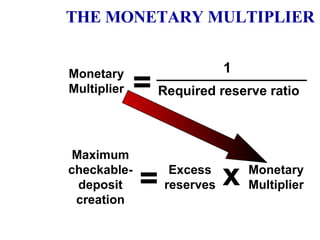
THE MONETARY MULTIPLIER Maximum checkable- deposit creation = Excess reserves x Monetary Multiplier Monetary Multiplier Required reserve ratio 1 =
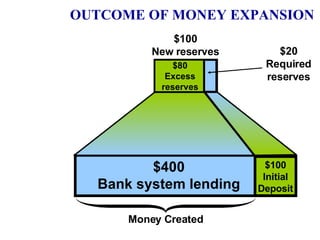
$20 Required reserves $100 New reserves $100 Initial Deposit $400 Bank system lending Money Created $80 Excess reserves OUTCOME OF MONEY EXPANSION
M1 M2 M3 $1,287 $6,076 $8,595 billions plus  savings deposits, MMA’s, and small  Time Deposits under $100,000   equal   M2 plus large time deposits over $100,000equal   M3 Currency   +  DD  equal  M1   [Spendable Money] “ V”  – how many times a dollar turns over in a year A lso  included here  would be  Travelers checks,  Checklike deposits Money In The American Economy 2%  50%  48%  M 1 Completely Liquid
WHAT ABOUT   CREDIT CARDS? What About   Debit Cards ? Debit cards  are  money . They serve  as a   medium of exchange ;  they serve  as a   store  of  value   (not an extension  of  credit); and debit card statements serve as a  unit of account . [ no store of value ]
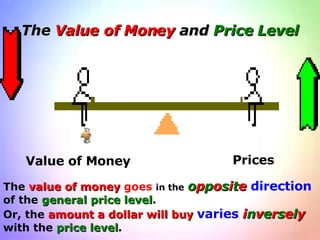
The   Value of Money   and   Price Level The  value of money  goes   in the   o p p o s i t e  direction of the  general price level .  Or, the  amount a dollar will buy   varies  i n v e r s e l y   with the  price level . Value of Money Prices
The Two Types of Money Commodity Money :  something that performs  the function of money and  has alternative, non-monetary uses. Examples:  Gold, silver, cigarettes, corn Fiat Money : something  that  serves as  money  but has  no other important uses. Paper notes Coins

Money And Banking

  • 1.
    Money, Banking, theFed, Money Creation, and Monetary Policy There is $665 billion in currency [notes & coins]. $37 million in notes is printed each day.
  • 2.
    Dollar Decoded Fedbank that issued the bill [Chi.] Bills are crowded with numbers and letters that help the U.S. Treasury track printing errors & authenticate currency. Here’s what many of them mean: Number corresponds to letter in circle indicating issuing Fed bank. First letter corresponds to issuing Fed bank Last letter tells how many times serial number has run 25 Branches
  • 3.
    [Jackson’s portrait islarger, free from the oval] New $20 colors are peach , blue , and green . This is the 20’ s 20 th new look . New background colors add an extra layer of complexity for counterfeiters Ink appears either copper or green , depending upon the angle at which the bill is viewed. The first $20 bill was introduced in 1861 . Back then, $20 was about the monthly wage for manual laborers. The average $20 bill lasts 3 years . There are 5 billion twenties in circulation, enough to circle the earth 19 times. An ATM can hold up to 7,500 bills, or $150,000 in twenties. The $20 bill is the most counterfeited in the U. S. , while the $100 is most counterfeited abroad .
  • 4.
    Donald Stokes, in 2005, pleaded guilty to stealing $700,000 since 1998 from the Ft Worth Currency C enter . His job was making sure flawed currency was shipped off to destruction. He was stopped for a routine traffic stop, then took off on a high-speed chase. When stopped, he had $79,000 in flawed currency in his car, which he said he won in Reno]. Stokes faces 10 years in prison and a $250,000 in fine. Shredding of U.S. Money $500 million is shredded at the 12 Feds each day. That is over $100 billion each year . A typical dollar last about 18 months. Higher denominations last longer. Despite a camera on those whose job it is to shred money – can you get out of the shredding room with some of the notes? Yes!!! An employee in Washington took $1.7 million in $100 bills [ he sneaked 1,700 $100 bills past his security]. He was caught when his bank teller reported his frequent large deposits in his bank. A woman at the Atlanta Fed made off with $277,000 over a 3 year period. She was observed “concealing bills on her person”. At the Boston Fed, an employee made off with $23,000 when he stuffed money into his pockets after obstructing the view of his coworkers. He was caught when his employer viewed the video.
  • 5.
    $100 Dollar Bill – Red Polymer Thread $50 – Yellow $20 – Green $10 – Orange $5 – Blue [This $5 will be hard to counterfeit]
  • 6.
    70 % of our money is in circulation overseas . There is over $2,000 for each man, woman, and child. The Russians have $40 billion . Argentina has $7 billion . Our coins are minted at either Philadelphia , Denver , or San Francisco . They mint over 7 billion pennies each year . Our paper notes are printed at either Washing D.C. or the Ft. Worth Currency Center. The Dallas Fed vault is as big as a football field and will hold about $1 ½ billion . The average household has over $70 dollars in coins in shoeboxes or jars. There are enough ones in circulation for everyone to have $40 each . $3.5 billion was printed last year. $22,500,000 ones are printed each day. There are $173 billion in coins in circulation worth over $9 billion . There are 312 billion pennies . If stacked up, they would reach all the way to the moon. There are enough pennies for all of you have 1,138 pennies each . 14 billion are minted each year. Lined up edge to edge, pennies would circle the earth 137 times. Never the less, many people think we should get rid of pennies – just round up or down. If the price is .25, .26, or .27 – just charge 25 cents ; and if the price is .28, .29, or .30, just start 30 cents . But there is one big problem if we got rid of pennies!!! How would Nike pay their workers?
  • 7.
    The NewYork Fed has more gold than any other vault in the world, Including Fort Knox. With walls of steel and concrete several feet thick, it has the gold of 63 countries , worth over $120 billion. What To Do If Your Money Gets Damaged!! 30,000 people a year send $96 million of damaged bills to the Bureau of Mutilated Division . If you can send them 51% , they will send you a new bill. An Iowa farmer once left his wallet in a field and a cow ate it. He killed the cow and mailed the cow’s stomach to the bureau. Examiners redeemed the money and sent the farmer $850 .
  • 8.
    No paper noteslarger than $100 have been printed since 1946.
  • 9.
  • 10.
    And – whatabout the new “ Bush Dollar” coming out next week? And the new $1 bill coming out W ednesday ?
  • 11.
    Bogus Bills –fined up to $5,000 [5,000 arrested in 2002] - imprisoned up to 15 years . The so-called supernote – a counterfeit $100 bill of extremely high quality began showing up around 1990 . 40% of world’s bogus bills come from Columbia . They border Ecuador , which converted to the U.S. dollar in 2000. The $20 bill is the most popular domestic counterfeit bill , while the $100 bill is most popular among foreign counterfeiters . Of the fake bills found in the U.S. in 2002, half were produced with computers, copiers, and printers , up from just 1% in 1996 . Only about 3/100ths of 1% is counterfeited . $44 in 02
  • 12.
    Bush $200 CounterfeitBill This phony Bush $200 bill showed up in Kentucky. The serial #: DUBYA402001 A man bought $2.12 worth and got 197.88 in cash Ronald Reagan signed it as Sec. of Treasury On some of the signs were these: We like broccoli. We like ice cream. U.S.A. deserves a tax cut.
  • 13.
    It cost 3.5cents to print a dollar which last 1.5 years. It cost 12 cents to mint a sacagawea [“bird woman ”] but they last 30 years. [500 million were minted but you seldom see them.] The government could save $400 million if people would use more sacagaweas.
  • 14.
  • 15.
    And – The New Dollar To Be Introduced Next Week In Honor of McDonald’s, the worlds best franchise
  • 16.
    The 1899Dollar
  • 17.
    “ Show methe Wampum!!!” History of U.S. Money [A Panorama of Legal Tender] From Wampum to Credit Cards
  • 18.
    Continental Currency [1775-1781] [$1/6;$1/2;$1/3;$2/3;$1;$2;$3;$4;$5;$6;$8;$30;$40;$45 ;$60;&$80]
  • 19.
    Wildcat Banking 1790-1860 State banks issued paper notes in denominations from $1 to $13. They lost their value the farther away you were, thus the name, “ wildcat banking”, only a wildcat could get back to a distant bank to verify its authenticity. Over 3,000 banks issued 10,000 bills but 5,000 were counterfeit.
  • 20.
    Civil War Money 1860-1865 “ Greenbacks” This $450 million brought on severe inflation .
  • 21.
    Yap Island MoneyYap Island is a tiny, U.S. trust territory in the S. Pacific, 500 miles from Guam. It is one of the 4 Federated States of Micronesia & has 12,000 Yapese & 6,000 “rai” limestone stones.
  • 22.
    Great Seal ofThe U.S. The Great Seal (on the $1) was adopted in 1783. The American Bald Eagle holds an olive branch -symbolizing peace-with 13 berries & 13 leaves . In the left talon, the eagle holds 13 arrows-symbolizing war . The 13 units represent the original 13 colonies . The eagle’s head is turned toward the olive branch showing a desire for peace . E Pluribus Unum – “Out of Many, One” The pyramid stands for permanence and strength . The pyramid is unfinished signifying future growth of the U.S. and the goal of perfection. A sunburst and an eye are above the pyramid standing for the Deity . The All-Seeing Eye is a Masonic symbol [Franklin & Washington were Masons]. The eye represents the eternal eye of God and the virtue of “putting the spiritual above the material.”
  • 23.
    Overview of Money,The Fed and Monetary Policy 1. The functions and measurement of money 2. The Federal Reserve and its functions 3. Fractional reserve banking & how it works 4. The Money Multiplier [ 1/RR(.10) = 10 5. Tools of Monetary Policy a. Discount Rate -rate the Fed charges banks b. Reserve Ratio- % of deposits banks have to keep in reserve and can not loan out. c. Buying (recession) & selling (inflation ) of bonds
  • 24.
    . However, beforetrade could occur, there had to be a “double coincidence of wants” . Each trader had to have something the other wanted. I’ll trade you a chicken for a pair of shoes. I would love to sell you these shoes but I can’t eat chicken, due to my bad teeth, caused by smoking. In a barter economy a chicken farmer who wants to buy shoes may have to first trade chickens for apples and then apples for shoes because the guy selling shoes wants only apples . Money eliminates this problem. Barter – goods and services were traded without the exchange of money .
  • 25.
    Money is also easier to tax . So a monetary system is better than a barter system . T he m onetary system enables the “calculation of exchange” to go much faster.
  • 26.
    Problems with barterOr, a Dentist might accept only certain goods ( like pineapples ) but not others ( like broccoli ) b ecause he doesn’t like broccoli. “ Your Pineapples better taste good!!”
  • 27.
    Three FUNCTIONS OFMONEY 1. Medium of Exchange [ any asset that sellers will accept as payment Avoids “double coincidence of wants” that bartering requires. You would have to have a trading partner who “wants to sell you goods you want to buy” and “wants to buy goods you want to sell.”
  • 28.
    Three FUNCTIONS OF MONEY 2. Unit of Account [Example: Microsoft Stock is selling for $50 a share. A $2 item is twice as valuable as a $ 1 item.
  • 29.
    Three FUNCTIONS OFMONEY 3. Store of Value [from one point in time to another ] [ doesn’t wear out easily and holds up to inflation ] Greek Coin 2,500 years old
  • 30.
    MULTIPLE DEPOSIT EXPANSIONPROCESS $400.00 Total amount of money created by the banking system Bank Acquired reserves and deposits Required reserves Excess reserves Amount bank can lend - New money created A B C D E F G H I J K L M N Other banks $100.00 80.00 64.00 51.20 40.96 32.77 26.21 20.97 16.78 13.42 10.74 8.59 6.87 5.50 21.99 $20.00 16.00 12.80 10.24 8.19 6.55 5.24 4.20 3.36 2.68 2.15 1.72 1.37 1.10 4.40 $80.00 64.00 51.20 40.96 32.77 26.21 20.97 16.78 13.42 10.74 8.59 6.87 5.50 4.40 17.59 $80.00 64.00 51.20 40.96 32.77 26.21 20.97 16.78 13.42 10.74 8.59 6.87 5.50 4.40 17.59
  • 31.
    THE MONETARY MULTIPLIERMaximum checkable- deposit creation = Excess reserves x Monetary Multiplier Monetary Multiplier Required reserve ratio 1 =
  • 32.
    $20 Required reserves$100 New reserves $100 Initial Deposit $400 Bank system lending Money Created $80 Excess reserves OUTCOME OF MONEY EXPANSION
  • 33.
    M1 M2 M3$1,287 $6,076 $8,595 billions plus savings deposits, MMA’s, and small Time Deposits under $100,000 equal M2 plus large time deposits over $100,000equal M3 Currency + DD equal M1 [Spendable Money] “ V” – how many times a dollar turns over in a year A lso included here would be Travelers checks, Checklike deposits Money In The American Economy 2% 50% 48% M 1 Completely Liquid
  • 34.
    WHAT ABOUT CREDIT CARDS? What About Debit Cards ? Debit cards are money . They serve as a medium of exchange ; they serve as a store of value (not an extension of credit); and debit card statements serve as a unit of account . [ no store of value ]
  • 35.
    The Value of Money and Price Level The value of money goes in the o p p o s i t e direction of the general price level . Or, the amount a dollar will buy varies i n v e r s e l y with the price level . Value of Money Prices
  • 36.
    The Two Typesof Money Commodity Money : something that performs the function of money and has alternative, non-monetary uses. Examples: Gold, silver, cigarettes, corn Fiat Money : something that serves as money but has no other important uses. Paper notes Coins