Money
History of which sculptured the
history.
NOTE:
References will listed be at the last slide, even the sites
which I took synonyms for the hard words, I worked hard
on it, no copy paste without understanding important
copy paste are paraphrased by me, and I am ready to be
asked about. Thank you for your efforts Mr.Sajjad.
Money
 What is Money?
History of the Money
How it’s printed?
Stability of currencies and why some currencies
are robuster than others?
What is the granule of Humans?
Money or ‘granule’ which is a alluring word to describe it , is in
wikipedian definition “an any item or verifiable record that is generally
accepted as payment for goods and services and repayment of debts,
such as taxes, in a particular country or socio-economic context”.
For me and for most of you it’s a matter made of atoms that everybody
uses it, want it, think about it and surely get up early in the morning to
get it ‘work’. Money also is the way we get the things we need and
desire so, it’s a priority.
History of Money
Who invented Money as we recognized it now?
Three parts.
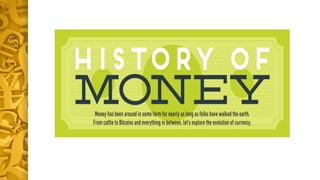
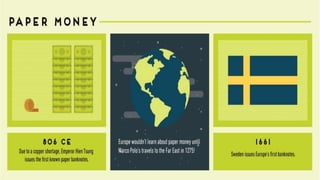
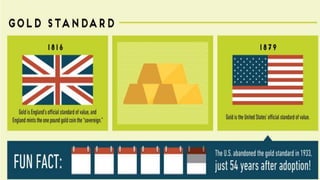
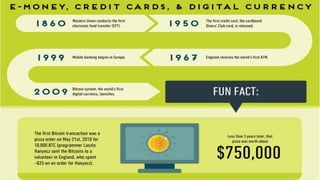
In a chronological order, the History of trading using
different types of Money represented by a well
explained Infographic with a Fun Facts!
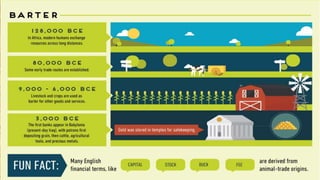
Invention of Money and the start, 1
In fact, bartering was the way people exchanged goods and services from the earliest days of
human beings on Earth. If you grew rice, for example, you could trade bags of rice for the
other goods and services you needed.
Over time, though, bartering wasn't always possible. Sometimes people couldn't agree on
what goods were worth in exchanges. In other situations, people simply might not want to
trade for what you had available. These situations led to the development of commodity
money.
Commodities are basic items used by almost everyone. In the past, popular commodities
included salt, tea, cattle, and seeds. Using these items of money alleviated some of the
problems of bartering. However, using commodities raised other problems. Commodities
weren't always easy to transport and often they were perishable or difficult to store.
Invention of Money and the start, 2
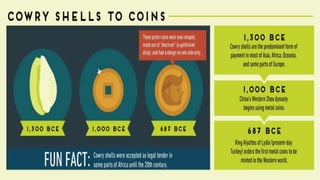
These issues with commodities led people to create coins out of precious metals to
use as money. No one knows for sure who first invented such money, but historians
believe metal objects were first used as money as early as 5,000 B.C.
Around 700 B.C., the Lydians became the first Western culture to make coins. Other
countries and civilizations soon began to mint their own coins with specific values.
Using coins with set values made it easier to compare values and trade money for
goods and services.
Eventually, societies moved away from using precious metals to make money.
Known as representative money, the new paper bills and coins made of non-
precious metals represented certain values that everyone in those societies could
agree upon. Governments or banks would promise to exchange representative
money for a specific amount of silver or gold.
Invention of Money and the start, 3
Today, most modern currency is not backed by silver or gold.
Instead, today's money is known as fiat money. Fiat is a Latin word
that means “let it be done." Money has a certain value today because
it was given that value by government fiat or decree. Legal tender
laws now make it illegal to refuse legal currency in favor of some
other form of payment.
The first paper money issued in the United States occurred on March
10, 1862. The $5, $10, and $20 bills issued were made legal tender
by an act of Congress on March 17, 1862.
Now let’s understand the
exciting history of trading
using different types of Money
represented by an Infographic.
NOTE : Every and each needed information is given by the description in the Info graph.
Big Question
Process of printing Money
 Took the US dollar as an example
 Raw Materials used in the process
 The design of the front and back of each denomination bill
 The Manufacturing process which contains five main steps:
i. Engraving the master die
ii. Making the master printing plate
iii. Printing the front and back of the bills
iv. Printing the colored Treasury seal and serial numbers
Cutting and wrapping the bills
 Quality Control
 Destruction of Paper Money
Explaining the process of printing Money in specific details
1) Raw Materials used in the process
With paper money, the materials are as important as the manufacturing process in producing the
final product. The paper, also known as the substrate, is a special blend of 75% cotton and 25%
linen to give it the proper feel. It contains small segments of red and blue fibers scattered
throughout for visual identification. Starting in 1990, the paper for $10 bills and higher
denominations was made of two plies with a polymer security thread laminated between them.
The thread was added to $5 bills in 1993. This thread is visible only when the bill is held up to a
light and cannot be duplicated in photocopiers or printers.
The inks consist of dry color pigments blended with oils and extenders to produce especially
thick printing inks. Black ink is used to print the front of the bills, and green ink is used on the
backs (thus giving rise to the term greenbacks for paper money). The colored seals and serial
numbers on the Paper Currency front of the bill are printed separately using regular printing
inks.
Explaining the process of printing Money in specific details
2) The design of the front and back of each denomination bill
The design of the front and back of each denomination bill is hand tooled by engravers working from a drawing or
photograph. Each engraver is responsible for a single portion of the design—one doing the portrait, another the numerals,
and so on.
The portrait on the face of each bill varies by the denomination. George Washington appears on the $1 bill, Abraham Lincoln
on the $5, up to Benjamin Franklin on the $100 bill. These persons were selected because of their importance in history and
the fact that their images are generally well known to the public. By law, no portrait of a living person may appear on paper
money.
In 1955, Congress passed a law requiring that the words "In God We Trust" appear on all U.S. currency and coins. The first
bills with this inscription were printed in 1957, and it now appears on the back of all paper money.
Starting in 1990, very small printing, called microprinting, was added around the outside of the portrait. This printing,
which measures only 0.006-0.007 inches (0.15-0.18 mm) high, repeats the words "The United States of America." It appears
on all paper money except the $1 bill.
Explaining the process of printing Money in specific details
3) The Manufacturing Process
In the United States, all paper money is engraved and printed by the Bureau of Engraving and
Printing, which is part of the Department of the Treasury of the federal government. The
Bureau also prints postage stamps, savings bonds, treasury notes, and many other items. The
main production facility is located in Washington, D.C., and there is a smaller facility in Fort
Worth, Texas. Every day, the Bureau prints approximately 38 million pieces of paper money.
About 45% of this production are $1 bills and 25% are $20 bills. The rest of the production is
divided between $5, $10, $50, and $100 bills. Although the $2 bill is still in circulation, it is
rarely used, and therefore is rarely printed. Each bill, regardless of its denomination, costs the
government about 3.8 cents to produce.
There are 65 separate operations in the production of
paper money. Here are the major steps in the following
slides:
Explaining the process of printing Money in specific details
Engraving the master die
1) Engravers hand cut the design into a piece of soft steel, known as the master die, using very fine
engraving tools and a magnifying glass. The portrait and images consist of numerous lines, dots,
and dashes which are cut in various sizes and shapes. The fine crosshatched lines in the
background of the portrait are produced by a ruling machine, and the scrollwork in the borders are
cut using a geometric lathe.
2) Every time a new Treasurer of the United States or a new Secretary of the Treasury is appointed,
their signatures must be engraved on a new master die for each denomination bill. First the
signatures are photographically enlarged. An engraver then traces the signatures by hand with one
end of a device known as a pantograph. This motion is mechanically reduced through a set of
linkages, causing several diamond-tipped needles on the other end of the pantograph to cut the
signatures into the master dies.
Making the master printing plate
3) Once the master die has been inspected, it is heated and a thin plastic sheet is pressed into it to
form a raised impression of the design. Thirty-two of these raised plastic impressions are bonded
together in a configuration of four across and eight down to form what is known as an alto. The
master die is then placed in storage.
4 )The plastic alto is placed in an electrolytic plating tank and is plated with copper. The plastic is
stripped away leaving a thin plate of metal, known as a basso, with 32 recessed impressions of the
design. The metal basso is then cleaned, polished, and inspected. If it passes inspection.
Explaining the process of printing Money in specific details
Printing the front and back of the bills
5) The principal printing process is known as intaglio printing. This process is used
because of its ability to produce extremely fine detail that remains legible under repeated
handling and is difficult to counterfeit. A stack of 10,000 sheets of paper is loaded into a
high-speed, rotary intaglio printing press. Each sheet is sized to allow 32 individual bills to
be printed on the same sheet. The paper is inspected to ensure that it contains the proper
security thread for the denomination to be printed. A master printing plate of the proper
denomination is secured around the master plate cylinder in the press.
6) The rotating master printing plate is coated with ink. A wiper removes the ink from the
surface of the plate, leaving only the ink that is trapped in the engraved recesses of the
design. A sheet of paper is fed into the press where it passes between the master plate
cylinder and a hard, smooth impression cylinder under pressures reaching 15,000 psi
(1,034 bar). The impression cylinder forces the paper into the fine, engraved lines of the
printing plate to pick up the ink, leaving a raised image about 0.0008 in (0.02 mm) above
the paper. This process is repeated at a rate of about 10,000 sheets per hour.
7) The printed sheets are then stacked on top of each other. The backs are printed with
green ink first and are allowed to dry for 24-48 hours before the fronts are printed with
black ink.
Explaining the process of printing Money in specific details
Printing the colored Treasury seal and serial numbers
8) After the intaglio printing process, the stacks are cut into two stacks of 10,000 sheets and are visually
examined for defects. Each sheet is fed into a letterpress which prints the colored Treasury seal and serial
numbers on the face of the bills. Sixteen serial numbers are printed at the same time. The press then
automatically advances the numbers before the next sheet of sixteen is printed. The numbers on any sheet
are separated by 20,000 between adjacent bills. Thus, the bill in the upper left-hand corner of the first
sheet would be serial number 0000001 and the one below it on the same sheet would be 0020001, and so
on. On the second sheet, all the numbers would advance by one giving 0000002 in the upper left, 0020002
below it, etc. In this manner, when the sheets are cut into separate stacks, the bills within each stack will
have sequential serial numbers.
Paper Currency
9) The finished sheets are inspected with machine sensors, and any printing errors, folded paper,
inclusion of foreign objects, or other defects are identified. Any bills which are found to be defective are
marked for later removal. Such bills are replaced with star notes which are numbered in a different
sequence and have a star printed after the serial number.
Cutting and wrapping the bills
10) The sheets are gathered in stacks of 100 and cut into 16 individual stacks of 100 bills
each with a vertical guillotine knife. Any bills which have been identified as defective are
replaced with star notes at this time. The stacks of 100 bills are then wrapped with a paper
band. The banded stacks are given a final visual inspection and are shrink-wrapped with
plastic in bundles of 10 stacks. Four of these 10-stack bundles are then wrapped together to
form a "brick" before they are shipped to the various federal reserve banks and other
agencies.
This is the main and major five steps in The Manufacturing Process.
Quality Control
Anything as important as money requires strict quality control standards. Flawed money is bad money and
cannot be placed into circulation. In addition to the many inspections that occur during the printing process,
the raw materials are also subject to strict inspections before they are used. The inks are tested for color,
viscosity (thickness), and other properties. The paper is produced by a single manufacturer in a secret, tightly
controlled process. The paper is tested for chemical composition, thickness, and other properties. It is illegal
for anyone else to manufacture or possess this specific paper.
The finished bills are also tested periodically for durability. Some bills are put through a washing machine to
determine the colorfastness of the inks, while others are repeatedly rolled into a cylinder and crushed on end
to determine their resistance to handling. It is estimated that a bill can be folded and crumpled up to 4,000
times before it has to be replaced.
Destruction of Paper Money
Despite the use of high-quality paper and inks, the average life of a $1 bill in circulation is only
about 18 months. Other denominations last somewhat longer. When a bill has been defaced, torn,
or worn to the point where it is no longer identifiable or useable, it is taken out of circulation and
returned to the federal reserve banks for destruction by shredding. Some of this shredded money
is recycled to make roofing shingles or insulation. Money that is damaged or otherwise flawed
during the printing process is shredded at the Bureau of Engraving and Printing plants.
This was the last slide in explaining the process of printing
money.
Why one currency is stronger than other?
There are three crucial factors that affect the value of any currency in the
world:
 Interest rates
 Economic policies
 Stability
The three factors will be explained in the following slides:
Why one currency is stronger than other?
Interest rates
High interest rates help promote a strong currency, because foreign investors can get a higher
return by investing in that country. However, the level of interest rates is relative. You've probably
noticed that interest rates on CDs, savings accounts and money market accounts are very low
right now. So are U.S. Treasury bond rates and the U.S. federal funds rate. Ordinarily, this would
weaken the U.S. dollar, except for the fact that interest rates behind other major world currencies
are also low.
Why one currency is stronger than other?
Economic policies
Tight fiscal discipline and anti-inflationary
monetary policies help promote a strong
currency. Again, this is all relative the US has its
fiscal problems, but so do many other nations
around the world.
Why one currency is stronger than other?
Stability
A strong government with a well-established rule of law and a history of constructive
economic policies are the type of things that attract investment and thus promote a strong
currency. In the case of the U.S. dollar, its strength is further augmented by the fact that
commodities are generally traded in dollars, and many countries use the dollar as a reserve
currency.
Speaking of stability, that is probably what governments seek for their currencies, more so
than strength. A strong currency makes a country's exports more expensive, hurting that
nation's trade competitiveness. On the other hand, a weak currency makes imports more
expensive, boosting domestic inflation. So the ideal course is to aim down the middle and
avoid destabilizing fluctuations.
For me, I am a beginner
speculator and an investor in
the FOREX market, I am in the
learning process and I use the
MetaTrader4 as a platform. My
goal is to be a business man
and to think like a business
man Insha'Allah.
REFERENCES
translate.google.com
www.wordhippo.com
www.investopedia.com
www.telegraph.co.uk/finance/businessclub/money/
http://www.visualcapitalist.com
wonderopolis.org
http://www.madehow.com
en.wikipedia.org
www.forbes.com
DONE BY : SHAWKI MOHAMMED
CLASS : 10/C
ASSIGNEND BY : Mr.Sjjad ur Rehman Khan
TOPIC : “6) History of Money; How it is printed?
Why Some currencies are more powerful than
others”
THANK YOU!

Money presentation

  • 1.
    Money History of whichsculptured the history.
  • 2.
    NOTE: References will listedbe at the last slide, even the sites which I took synonyms for the hard words, I worked hard on it, no copy paste without understanding important copy paste are paraphrased by me, and I am ready to be asked about. Thank you for your efforts Mr.Sajjad.
  • 3.
    Money  What isMoney? History of the Money How it’s printed? Stability of currencies and why some currencies are robuster than others?
  • 4.
    What is thegranule of Humans? Money or ‘granule’ which is a alluring word to describe it , is in wikipedian definition “an any item or verifiable record that is generally accepted as payment for goods and services and repayment of debts, such as taxes, in a particular country or socio-economic context”. For me and for most of you it’s a matter made of atoms that everybody uses it, want it, think about it and surely get up early in the morning to get it ‘work’. Money also is the way we get the things we need and desire so, it’s a priority.
  • 5.
    History of Money Whoinvented Money as we recognized it now? Three parts. In a chronological order, the History of trading using different types of Money represented by a well explained Infographic with a Fun Facts!
  • 6.
    Invention of Moneyand the start, 1 In fact, bartering was the way people exchanged goods and services from the earliest days of human beings on Earth. If you grew rice, for example, you could trade bags of rice for the other goods and services you needed. Over time, though, bartering wasn't always possible. Sometimes people couldn't agree on what goods were worth in exchanges. In other situations, people simply might not want to trade for what you had available. These situations led to the development of commodity money. Commodities are basic items used by almost everyone. In the past, popular commodities included salt, tea, cattle, and seeds. Using these items of money alleviated some of the problems of bartering. However, using commodities raised other problems. Commodities weren't always easy to transport and often they were perishable or difficult to store.
  • 7.
    Invention of Moneyand the start, 2 These issues with commodities led people to create coins out of precious metals to use as money. No one knows for sure who first invented such money, but historians believe metal objects were first used as money as early as 5,000 B.C. Around 700 B.C., the Lydians became the first Western culture to make coins. Other countries and civilizations soon began to mint their own coins with specific values. Using coins with set values made it easier to compare values and trade money for goods and services. Eventually, societies moved away from using precious metals to make money. Known as representative money, the new paper bills and coins made of non- precious metals represented certain values that everyone in those societies could agree upon. Governments or banks would promise to exchange representative money for a specific amount of silver or gold.
  • 8.
    Invention of Moneyand the start, 3 Today, most modern currency is not backed by silver or gold. Instead, today's money is known as fiat money. Fiat is a Latin word that means “let it be done." Money has a certain value today because it was given that value by government fiat or decree. Legal tender laws now make it illegal to refuse legal currency in favor of some other form of payment. The first paper money issued in the United States occurred on March 10, 1862. The $5, $10, and $20 bills issued were made legal tender by an act of Congress on March 17, 1862.
  • 9.
    Now let’s understandthe exciting history of trading using different types of Money represented by an Infographic. NOTE : Every and each needed information is given by the description in the Info graph.
  • 16.
  • 17.
    Process of printingMoney  Took the US dollar as an example  Raw Materials used in the process  The design of the front and back of each denomination bill  The Manufacturing process which contains five main steps: i. Engraving the master die ii. Making the master printing plate iii. Printing the front and back of the bills iv. Printing the colored Treasury seal and serial numbers Cutting and wrapping the bills  Quality Control  Destruction of Paper Money
  • 18.
    Explaining the processof printing Money in specific details 1) Raw Materials used in the process With paper money, the materials are as important as the manufacturing process in producing the final product. The paper, also known as the substrate, is a special blend of 75% cotton and 25% linen to give it the proper feel. It contains small segments of red and blue fibers scattered throughout for visual identification. Starting in 1990, the paper for $10 bills and higher denominations was made of two plies with a polymer security thread laminated between them. The thread was added to $5 bills in 1993. This thread is visible only when the bill is held up to a light and cannot be duplicated in photocopiers or printers. The inks consist of dry color pigments blended with oils and extenders to produce especially thick printing inks. Black ink is used to print the front of the bills, and green ink is used on the backs (thus giving rise to the term greenbacks for paper money). The colored seals and serial numbers on the Paper Currency front of the bill are printed separately using regular printing inks.
  • 19.
    Explaining the processof printing Money in specific details 2) The design of the front and back of each denomination bill The design of the front and back of each denomination bill is hand tooled by engravers working from a drawing or photograph. Each engraver is responsible for a single portion of the design—one doing the portrait, another the numerals, and so on. The portrait on the face of each bill varies by the denomination. George Washington appears on the $1 bill, Abraham Lincoln on the $5, up to Benjamin Franklin on the $100 bill. These persons were selected because of their importance in history and the fact that their images are generally well known to the public. By law, no portrait of a living person may appear on paper money. In 1955, Congress passed a law requiring that the words "In God We Trust" appear on all U.S. currency and coins. The first bills with this inscription were printed in 1957, and it now appears on the back of all paper money. Starting in 1990, very small printing, called microprinting, was added around the outside of the portrait. This printing, which measures only 0.006-0.007 inches (0.15-0.18 mm) high, repeats the words "The United States of America." It appears on all paper money except the $1 bill.
  • 20.
    Explaining the processof printing Money in specific details 3) The Manufacturing Process In the United States, all paper money is engraved and printed by the Bureau of Engraving and Printing, which is part of the Department of the Treasury of the federal government. The Bureau also prints postage stamps, savings bonds, treasury notes, and many other items. The main production facility is located in Washington, D.C., and there is a smaller facility in Fort Worth, Texas. Every day, the Bureau prints approximately 38 million pieces of paper money. About 45% of this production are $1 bills and 25% are $20 bills. The rest of the production is divided between $5, $10, $50, and $100 bills. Although the $2 bill is still in circulation, it is rarely used, and therefore is rarely printed. Each bill, regardless of its denomination, costs the government about 3.8 cents to produce. There are 65 separate operations in the production of paper money. Here are the major steps in the following slides:
  • 21.
    Explaining the processof printing Money in specific details Engraving the master die 1) Engravers hand cut the design into a piece of soft steel, known as the master die, using very fine engraving tools and a magnifying glass. The portrait and images consist of numerous lines, dots, and dashes which are cut in various sizes and shapes. The fine crosshatched lines in the background of the portrait are produced by a ruling machine, and the scrollwork in the borders are cut using a geometric lathe. 2) Every time a new Treasurer of the United States or a new Secretary of the Treasury is appointed, their signatures must be engraved on a new master die for each denomination bill. First the signatures are photographically enlarged. An engraver then traces the signatures by hand with one end of a device known as a pantograph. This motion is mechanically reduced through a set of linkages, causing several diamond-tipped needles on the other end of the pantograph to cut the signatures into the master dies. Making the master printing plate 3) Once the master die has been inspected, it is heated and a thin plastic sheet is pressed into it to form a raised impression of the design. Thirty-two of these raised plastic impressions are bonded together in a configuration of four across and eight down to form what is known as an alto. The master die is then placed in storage. 4 )The plastic alto is placed in an electrolytic plating tank and is plated with copper. The plastic is stripped away leaving a thin plate of metal, known as a basso, with 32 recessed impressions of the design. The metal basso is then cleaned, polished, and inspected. If it passes inspection.
  • 22.
    Explaining the processof printing Money in specific details Printing the front and back of the bills 5) The principal printing process is known as intaglio printing. This process is used because of its ability to produce extremely fine detail that remains legible under repeated handling and is difficult to counterfeit. A stack of 10,000 sheets of paper is loaded into a high-speed, rotary intaglio printing press. Each sheet is sized to allow 32 individual bills to be printed on the same sheet. The paper is inspected to ensure that it contains the proper security thread for the denomination to be printed. A master printing plate of the proper denomination is secured around the master plate cylinder in the press. 6) The rotating master printing plate is coated with ink. A wiper removes the ink from the surface of the plate, leaving only the ink that is trapped in the engraved recesses of the design. A sheet of paper is fed into the press where it passes between the master plate cylinder and a hard, smooth impression cylinder under pressures reaching 15,000 psi (1,034 bar). The impression cylinder forces the paper into the fine, engraved lines of the printing plate to pick up the ink, leaving a raised image about 0.0008 in (0.02 mm) above the paper. This process is repeated at a rate of about 10,000 sheets per hour. 7) The printed sheets are then stacked on top of each other. The backs are printed with green ink first and are allowed to dry for 24-48 hours before the fronts are printed with black ink.
  • 23.
    Explaining the processof printing Money in specific details Printing the colored Treasury seal and serial numbers 8) After the intaglio printing process, the stacks are cut into two stacks of 10,000 sheets and are visually examined for defects. Each sheet is fed into a letterpress which prints the colored Treasury seal and serial numbers on the face of the bills. Sixteen serial numbers are printed at the same time. The press then automatically advances the numbers before the next sheet of sixteen is printed. The numbers on any sheet are separated by 20,000 between adjacent bills. Thus, the bill in the upper left-hand corner of the first sheet would be serial number 0000001 and the one below it on the same sheet would be 0020001, and so on. On the second sheet, all the numbers would advance by one giving 0000002 in the upper left, 0020002 below it, etc. In this manner, when the sheets are cut into separate stacks, the bills within each stack will have sequential serial numbers. Paper Currency 9) The finished sheets are inspected with machine sensors, and any printing errors, folded paper, inclusion of foreign objects, or other defects are identified. Any bills which are found to be defective are marked for later removal. Such bills are replaced with star notes which are numbered in a different sequence and have a star printed after the serial number.
  • 24.
    Cutting and wrappingthe bills 10) The sheets are gathered in stacks of 100 and cut into 16 individual stacks of 100 bills each with a vertical guillotine knife. Any bills which have been identified as defective are replaced with star notes at this time. The stacks of 100 bills are then wrapped with a paper band. The banded stacks are given a final visual inspection and are shrink-wrapped with plastic in bundles of 10 stacks. Four of these 10-stack bundles are then wrapped together to form a "brick" before they are shipped to the various federal reserve banks and other agencies. This is the main and major five steps in The Manufacturing Process.
  • 25.
    Quality Control Anything asimportant as money requires strict quality control standards. Flawed money is bad money and cannot be placed into circulation. In addition to the many inspections that occur during the printing process, the raw materials are also subject to strict inspections before they are used. The inks are tested for color, viscosity (thickness), and other properties. The paper is produced by a single manufacturer in a secret, tightly controlled process. The paper is tested for chemical composition, thickness, and other properties. It is illegal for anyone else to manufacture or possess this specific paper. The finished bills are also tested periodically for durability. Some bills are put through a washing machine to determine the colorfastness of the inks, while others are repeatedly rolled into a cylinder and crushed on end to determine their resistance to handling. It is estimated that a bill can be folded and crumpled up to 4,000 times before it has to be replaced.
  • 26.
    Destruction of PaperMoney Despite the use of high-quality paper and inks, the average life of a $1 bill in circulation is only about 18 months. Other denominations last somewhat longer. When a bill has been defaced, torn, or worn to the point where it is no longer identifiable or useable, it is taken out of circulation and returned to the federal reserve banks for destruction by shredding. Some of this shredded money is recycled to make roofing shingles or insulation. Money that is damaged or otherwise flawed during the printing process is shredded at the Bureau of Engraving and Printing plants. This was the last slide in explaining the process of printing money.
  • 27.
    Why one currencyis stronger than other? There are three crucial factors that affect the value of any currency in the world:  Interest rates  Economic policies  Stability The three factors will be explained in the following slides:
  • 28.
    Why one currencyis stronger than other? Interest rates High interest rates help promote a strong currency, because foreign investors can get a higher return by investing in that country. However, the level of interest rates is relative. You've probably noticed that interest rates on CDs, savings accounts and money market accounts are very low right now. So are U.S. Treasury bond rates and the U.S. federal funds rate. Ordinarily, this would weaken the U.S. dollar, except for the fact that interest rates behind other major world currencies are also low.
  • 29.
    Why one currencyis stronger than other? Economic policies Tight fiscal discipline and anti-inflationary monetary policies help promote a strong currency. Again, this is all relative the US has its fiscal problems, but so do many other nations around the world.
  • 30.
    Why one currencyis stronger than other? Stability A strong government with a well-established rule of law and a history of constructive economic policies are the type of things that attract investment and thus promote a strong currency. In the case of the U.S. dollar, its strength is further augmented by the fact that commodities are generally traded in dollars, and many countries use the dollar as a reserve currency. Speaking of stability, that is probably what governments seek for their currencies, more so than strength. A strong currency makes a country's exports more expensive, hurting that nation's trade competitiveness. On the other hand, a weak currency makes imports more expensive, boosting domestic inflation. So the ideal course is to aim down the middle and avoid destabilizing fluctuations.
  • 31.
    For me, Iam a beginner speculator and an investor in the FOREX market, I am in the learning process and I use the MetaTrader4 as a platform. My goal is to be a business man and to think like a business man Insha'Allah.
  • 32.
  • 33.
    DONE BY :SHAWKI MOHAMMED CLASS : 10/C ASSIGNEND BY : Mr.Sjjad ur Rehman Khan TOPIC : “6) History of Money; How it is printed? Why Some currencies are more powerful than others”
  • 34.