$Money$
Made By:
Ashutosh Goel, 9E, Economics,
9B5
Definitions Related to Money:
• Money (money supply)-anything that is generally
accepted in payment for goods or services or in the
repayment of debts; a stock concept. Money supply is the
total amount of money available in the economy. (stock)
• Wealth-the total collection of pieces of property that serve
to store value (stock)
• Income-flow of earnings per unit
of time (flow).
• Stock- the goods or merchandise kept on the premises of
a shop or warehouse and available for sale or distribution.
• Flow- a steady, continuous supply of something.
Functions of Money:
• Medium of Exchange-promotes economic efficiency by minimizing the time spent in exchanging
goods and services. Facilitates specialization and division of labor.
A good medium of exchange:
 Must be easily standardized
 Must be widely accepted
 Must be divisible
 Must be easy to carry
 Must not deteriorate quickly
• Unit of Account-used to measure value in the economy: assets, goods, services.
• Store of Value-used to save purchasing power; allows intertemporal substitution of income.
• Standard of deferred payment- A standard of deferred payment is the accepted way, in a
given market, to settle a debt– a deferred payment" is not as widely used as other terms for functions
of money, though it is distinguished in some works.
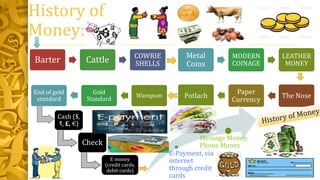
History of
Money:
Barter Cattle COWRIE
SHELLS
Metal
Coins
MODERN
COINAGE
LEATHER
MONEY
Potlach
Paper
Currency
The Nose
End of gold
standard
Gold
Standard
Wampum
Cash ($,
₹, £, €)
Check
E money
(credit cards,
debit cards)
E-Payment, via
internet
through credit
cards
Message Money,
Phone Money
History of Money and its Evolution of the
Payments System:
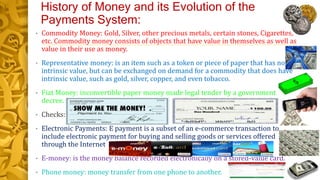
• Commodity Money: Gold, Silver, other precious metals, certain stones, Cigarettes,
etc. Commodity money consists of objects that have value in themselves as well as
value in their use as money.
• Representative money: is an item such as a token or piece of paper that has no
intrinsic value, but can be exchanged on demand for a commodity that does have
intrinsic value, such as gold, silver, copper, and even tobacco.
• Fiat Money: inconvertible paper money made legal tender by a government
decree.
• Checks:
• Electronic Payments: E payment is a subset of an e-commerce transaction to
include electronic payment for buying and selling goods or services offered
through the Internet
• E-money: is the money balance recorded electronically on a stored-value card.
• Phone money: money transfer from one phone to another.
Video 1 Video 2
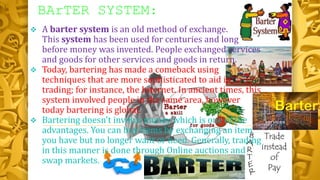
BArTER SYSTEM:
 A barter system is an old method of exchange.
This system has been used for centuries and long
before money was invented. People exchanged services
and goods for other services and goods in return.
 Today, bartering has made a comeback using
techniques that are more sophisticated to aid in
trading; for instance, the Internet. In ancient times, this
system involved people in the same area, however
today bartering is global.
 Bartering doesn't involve money which is one of the
advantages. You can buy items by exchanging an item
you have but no longer want or need. Generally, trading
in this manner is done through Online auctions and
swap markets.
Advantages and Disadvantages of Barter System:
Advantages
• The problems of international trade, such
as, foreign exchange crisis, adverse balance
of payments, do not exist under barter
system.
• No money involved.
• Personal and natural resources are ideally
utilised to meet the needs of the society
without involving any wastage.
• There is no question of over or under-
production, under the barter system since
goods are produced just to meet the needs
of the society.
• The economic power is not concentrated at
one particular place in barter system
because people do not gather wealth.
Disadvantages
• In the barter system it is difficult to divide and
sub-divide goods. Possibility of exchange his
good for only one good not for two or more.
• The value of the goods cannot be distributed
equally as there were no measure during that
period.
• In barter system the goods were limited. Barter
system was lead only to lower level
development.
• Barter system was good when needs were
limited. Needs of man were increased but the
supply of goods were not enough to satisfy
man’s needs.
• A lot of difficulty in storage value.
• Barter system cannot exchange goods for
services.
Characteristics of good money:
1.) Portability – It should be easily transported from one place to another, even in bulk.
2.) Acceptability – It should be accepted throughout the general region.
3.) Durability – It should be able to withstand thousands of exchanges through its lifetime before it is
recycled to produce new money. If durability is a problem, more money will be used to produce more
money.
4.) Divisibility – It should be able to offer exact amounts of change after a transaction. This is the reason
why we have smaller banknotes and coins to buy goods that are not exactly worth certain amounts.
5.) Scarcity – It should be scarce as too much of it may cause it too become fiat money. Fiat money refers
to when money looses its money due to too much of it. This explains how precious and valuable items are
not so commonly seen.
6.) Recognisability- money should be easy to recognize .
7.) Malleability - money should be Malleable so that it could be made into new money.
8.) Uniformity - It means that All version of the same denomination of currency must have the same
purchasing power so that very denomination must be in uniform.
Works Cited: MLA WAY
Beattie, A.
Beattie, Andrew. "The History Of Money:
From Barter To Banknotes |
Investopedia".Investopedia. N. p., 2007. Web.
27 Dec. 2015.
Google.co.in
Google.co.in,. "E Money - Google Search". N.
p., 2015. Web. 27 Dec. 2015.
Google.co.in
Google.co.in,. "Google". N. p., 2015. Web. 27
Dec. 2015.
Google.co.in
Google.co.in,. "Commodity Money - Google
Search". N. p., 2015. Web. 27 Dec. 2015.
Google.co.in
Google.co.in,. "Intrinsic Value - Google
Search". N. p., 2015. Web. 27 Dec. 2015.
Google.co.in
Google.co.in,. "Characteristics Of Good Money. -
Google Search". N. p., 2015. Web. 27 Dec. 2015.
YouTube
YouTube,. "The Story Of Money". N. p., 2015.
Web. 27 Dec. 2015.
YouTube
YouTube,. "Barter - Trading - Comical But So
True- Hosted By The Barter Corp.". N. p., 2015.
Web. 27 Dec. 2015.
Pbs.org
Pbs.org,. "The History Of Money". N. p., 2015.
Web. 27 Dec. 2015.
Wikipedia
Wikipedia,. "History Of Money". N. p., 2015.
Web. 27 Dec. 2015.

Money

  • 1.
  • 2.
    Definitions Related toMoney: • Money (money supply)-anything that is generally accepted in payment for goods or services or in the repayment of debts; a stock concept. Money supply is the total amount of money available in the economy. (stock) • Wealth-the total collection of pieces of property that serve to store value (stock) • Income-flow of earnings per unit of time (flow). • Stock- the goods or merchandise kept on the premises of a shop or warehouse and available for sale or distribution. • Flow- a steady, continuous supply of something.
  • 3.
    Functions of Money: •Medium of Exchange-promotes economic efficiency by minimizing the time spent in exchanging goods and services. Facilitates specialization and division of labor. A good medium of exchange:  Must be easily standardized  Must be widely accepted  Must be divisible  Must be easy to carry  Must not deteriorate quickly • Unit of Account-used to measure value in the economy: assets, goods, services. • Store of Value-used to save purchasing power; allows intertemporal substitution of income. • Standard of deferred payment- A standard of deferred payment is the accepted way, in a given market, to settle a debt– a deferred payment" is not as widely used as other terms for functions of money, though it is distinguished in some works.
  • 4.
    History of Money: Barter CattleCOWRIE SHELLS Metal Coins MODERN COINAGE LEATHER MONEY Potlach Paper Currency The Nose End of gold standard Gold Standard Wampum Cash ($, ₹, £, €) Check E money (credit cards, debit cards) E-Payment, via internet through credit cards Message Money, Phone Money
  • 5.
    History of Moneyand its Evolution of the Payments System: • Commodity Money: Gold, Silver, other precious metals, certain stones, Cigarettes, etc. Commodity money consists of objects that have value in themselves as well as value in their use as money. • Representative money: is an item such as a token or piece of paper that has no intrinsic value, but can be exchanged on demand for a commodity that does have intrinsic value, such as gold, silver, copper, and even tobacco. • Fiat Money: inconvertible paper money made legal tender by a government decree. • Checks: • Electronic Payments: E payment is a subset of an e-commerce transaction to include electronic payment for buying and selling goods or services offered through the Internet • E-money: is the money balance recorded electronically on a stored-value card. • Phone money: money transfer from one phone to another.
  • 6.
  • 7.
    BArTER SYSTEM:  Abarter system is an old method of exchange. This system has been used for centuries and long before money was invented. People exchanged services and goods for other services and goods in return.  Today, bartering has made a comeback using techniques that are more sophisticated to aid in trading; for instance, the Internet. In ancient times, this system involved people in the same area, however today bartering is global.  Bartering doesn't involve money which is one of the advantages. You can buy items by exchanging an item you have but no longer want or need. Generally, trading in this manner is done through Online auctions and swap markets.
  • 8.
    Advantages and Disadvantagesof Barter System: Advantages • The problems of international trade, such as, foreign exchange crisis, adverse balance of payments, do not exist under barter system. • No money involved. • Personal and natural resources are ideally utilised to meet the needs of the society without involving any wastage. • There is no question of over or under- production, under the barter system since goods are produced just to meet the needs of the society. • The economic power is not concentrated at one particular place in barter system because people do not gather wealth. Disadvantages • In the barter system it is difficult to divide and sub-divide goods. Possibility of exchange his good for only one good not for two or more. • The value of the goods cannot be distributed equally as there were no measure during that period. • In barter system the goods were limited. Barter system was lead only to lower level development. • Barter system was good when needs were limited. Needs of man were increased but the supply of goods were not enough to satisfy man’s needs. • A lot of difficulty in storage value. • Barter system cannot exchange goods for services.
  • 9.
    Characteristics of goodmoney: 1.) Portability – It should be easily transported from one place to another, even in bulk. 2.) Acceptability – It should be accepted throughout the general region. 3.) Durability – It should be able to withstand thousands of exchanges through its lifetime before it is recycled to produce new money. If durability is a problem, more money will be used to produce more money. 4.) Divisibility – It should be able to offer exact amounts of change after a transaction. This is the reason why we have smaller banknotes and coins to buy goods that are not exactly worth certain amounts. 5.) Scarcity – It should be scarce as too much of it may cause it too become fiat money. Fiat money refers to when money looses its money due to too much of it. This explains how precious and valuable items are not so commonly seen. 6.) Recognisability- money should be easy to recognize . 7.) Malleability - money should be Malleable so that it could be made into new money. 8.) Uniformity - It means that All version of the same denomination of currency must have the same purchasing power so that very denomination must be in uniform.
  • 10.
    Works Cited: MLAWAY Beattie, A. Beattie, Andrew. "The History Of Money: From Barter To Banknotes | Investopedia".Investopedia. N. p., 2007. Web. 27 Dec. 2015. Google.co.in Google.co.in,. "E Money - Google Search". N. p., 2015. Web. 27 Dec. 2015. Google.co.in Google.co.in,. "Google". N. p., 2015. Web. 27 Dec. 2015. Google.co.in Google.co.in,. "Commodity Money - Google Search". N. p., 2015. Web. 27 Dec. 2015. Google.co.in Google.co.in,. "Intrinsic Value - Google Search". N. p., 2015. Web. 27 Dec. 2015. Google.co.in Google.co.in,. "Characteristics Of Good Money. - Google Search". N. p., 2015. Web. 27 Dec. 2015. YouTube YouTube,. "The Story Of Money". N. p., 2015. Web. 27 Dec. 2015. YouTube YouTube,. "Barter - Trading - Comical But So True- Hosted By The Barter Corp.". N. p., 2015. Web. 27 Dec. 2015. Pbs.org Pbs.org,. "The History Of Money". N. p., 2015. Web. 27 Dec. 2015. Wikipedia Wikipedia,. "History Of Money". N. p., 2015. Web. 27 Dec. 2015.