History of
Money
 In the beginning, trading or bartering was
the way of life.
 Bartering predates the use of money. As a
matter of fact, money derived from bartering.
 Even today, individuals, governments, and
institutions use bartering as a form of
exchanging goods and services.
 The use of livestock, shells, and beads were
later used as money.
 Money is any commodity that satisfies the
following:
 Medium of exchange (item accepted for exchange)
 Store of value (value stored over time)
 Unit of Account (common measure of goods/services)
 Portability (easily transported)
 Durability (lasts when handled)
 Divisibility (divisible into smaller units)
 Limited Availability ( available in limited supply.
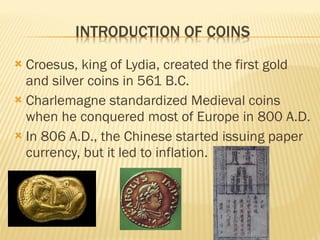
 Croesus, king of Lydia, created the first gold
and silver coins in 561 B.C.
 Charlemagne standardized Medieval coins
when he conquered most of Europe in 800 A.D.
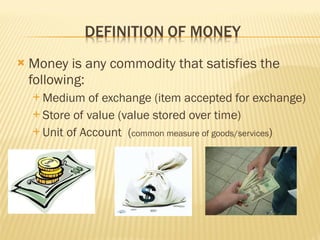
 In 806 A.D., the Chinese started issuing paper
currency, but it led to inflation.
 Gunpowder, musket balls, corn, and hemp
served s commodity money. It was used to
settle debts and make purchases.
 Some colonies established fiat monies such as
wampum (shells used by Narragansett Native
Americans).
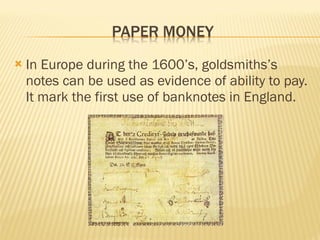
 In Europe during the 1600’s, goldsmiths’s
notes can be used as evidence of ability to pay.
It mark the first use of banknotes in England.
 A monetary standard where basic currency unit is equal to and
exchanged for a specific amount of gold.
 Advantages:
 People feel secure about their money
 Prevents government from printing too much paper currency
Disadvantages:
 Gold stock don’t grow fast enough to support economy
 Price of gold likely to change
 The colony of Massachusetts was the first
colony to issue paper currency in the US.
 When George Washington was president, the
Spanish peso was used. He assigned Benjamin
Franklin and Alexander Hamilton to establish a
money supply for the new country.
 During the Revolutionary War, congress issued
“Continentals”. Due to oversupply, they were
worthless.
 Continental Congress chartered a national
bank in 1781.
 Second Bank of the US charted in 1816.
 Design of U.S. currency made in 1863.
 “In God We Trust” first appeared on currency in
1955.
 Dollar bills redesigned to make counterfeiting
more difficult.
 http://www.pbs.org/newshour/on2/money/histor
 http://library.thinkquest.org/28718/history.html
 http://projects.exeter.ac.uk/RDavies/arian/llyfr.h
 http://www.wdfi.org/ymm/kids/history/default.as

moneythingy-111106004618-phpapp02.pdf

  • 1.
  • 2.
     In thebeginning, trading or bartering was the way of life.  Bartering predates the use of money. As a matter of fact, money derived from bartering.  Even today, individuals, governments, and institutions use bartering as a form of exchanging goods and services.  The use of livestock, shells, and beads were later used as money.
  • 3.
     Money isany commodity that satisfies the following:  Medium of exchange (item accepted for exchange)  Store of value (value stored over time)  Unit of Account (common measure of goods/services)
  • 4.
     Portability (easilytransported)  Durability (lasts when handled)  Divisibility (divisible into smaller units)  Limited Availability ( available in limited supply.
  • 5.
     Croesus, kingof Lydia, created the first gold and silver coins in 561 B.C.  Charlemagne standardized Medieval coins when he conquered most of Europe in 800 A.D.  In 806 A.D., the Chinese started issuing paper currency, but it led to inflation.
  • 6.
     Gunpowder, musketballs, corn, and hemp served s commodity money. It was used to settle debts and make purchases.  Some colonies established fiat monies such as wampum (shells used by Narragansett Native Americans).
  • 7.
     In Europeduring the 1600’s, goldsmiths’s notes can be used as evidence of ability to pay. It mark the first use of banknotes in England.
  • 8.
     A monetarystandard where basic currency unit is equal to and exchanged for a specific amount of gold.  Advantages:  People feel secure about their money  Prevents government from printing too much paper currency Disadvantages:  Gold stock don’t grow fast enough to support economy  Price of gold likely to change
  • 9.
     The colonyof Massachusetts was the first colony to issue paper currency in the US.  When George Washington was president, the Spanish peso was used. He assigned Benjamin Franklin and Alexander Hamilton to establish a money supply for the new country.  During the Revolutionary War, congress issued “Continentals”. Due to oversupply, they were worthless.
  • 10.
     Continental Congresschartered a national bank in 1781.  Second Bank of the US charted in 1816.  Design of U.S. currency made in 1863.  “In God We Trust” first appeared on currency in 1955.  Dollar bills redesigned to make counterfeiting more difficult.
  • 11.
     http://www.pbs.org/newshour/on2/money/histor  http://library.thinkquest.org/28718/history.html http://projects.exeter.ac.uk/RDavies/arian/llyfr.h  http://www.wdfi.org/ymm/kids/history/default.as