A
PRESENTATION
ON
CREDIT CREATION
&
CREDIT CONTROL
PRESENTED BY
LOVE KR. PATWA
Aims of Credit Control
• To stabilize the price level in the country.
• To eliminate violent fluctuations in production and
employment,
• To keep the exchange rate stable,
• To maintain the gold reserves of the country.
• To keep the rate of growth in business activities
normal and steady
Credit control is one of the component/tool (others
are- Currency, Deposits and Foreign exchange) of
central bank or R.B.I. under the monetary policy.
• R.B.I./CENTRAL BANK
• THE RESERVE BANK OF INDIA WAS NATIONALISED IN 1949
• Head office – MUMBAI
• Regional office – In every state of India
• Organizational set-up
One Governor – Honorable D. Subbarav (currently)
Four Deputy Directors
Four Executive Directors and
Fifteen Directors
• CREDIT CREATION
“It is an expansion of bank deposits. Through the
process of more loans and advances by bank.”
For obtaining loan from bank a person must furnish
sufficient security.
Generally, bank and borrower prefers to deposit the
loan amount in borrower’s current account by
issuing cheque book.
So, the bank is able lend money without loosing the
cash.
Here, bank has created credit.
As conclusion we find that,
“The Bank’s loan create deposits or it create a
credit for the borrower.”
• PROCESS OF CREDIT CREATION
In western or in developed countries, banking habit
of people is developed, thus bank keeps 10% as
cash reserve and rest of the deposit money will be
available for loan.
In underdeveloped countries, bank having the cash
reserve up to 20% of total deposits and rest 80%
money keeps available for loan (i.e. creation of
credit).
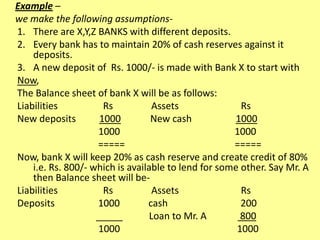
Example –
we make the following assumptions-
1. There are X,Y,Z BANKS with different deposits.
2. Every bank has to maintain 20% of cash reserves against it
deposits.
3. A new deposit of Rs. 1000/- is made with Bank X to start with
Now,
The Balance sheet of bank X will be as follows:
Liabilities Rs Assets Rs
New deposits 1000 New cash 1000
1000 1000
===== =====
Now, bank X will keep 20% as cash reserve and create credit of 80%
i.e. Rs. 800/- which is available to lend for some other. Say Mr. A
then Balance sheet will be-
Liabilities Rs Assets Rs
Deposits 1000 cash 200
_____ Loan to Mr. A 800
1000 1000
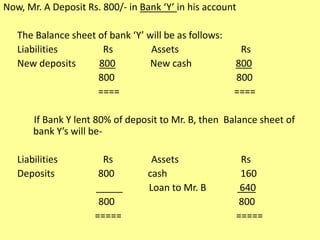
Now, Mr. A Deposit Rs. 800/- in Bank ‘Y’ in his account
The Balance sheet of bank ‘Y’ will be as follows:
Liabilities Rs Assets Rs
New deposits 800 New cash 800
800 800
==== ====
If Bank Y lent 80% of deposit to Mr. B, then Balance sheet of
bank Y’s will be-
Liabilities Rs Assets Rs
Deposits 800 cash 160
_____ Loan to Mr. B 640
800 800
===== =====
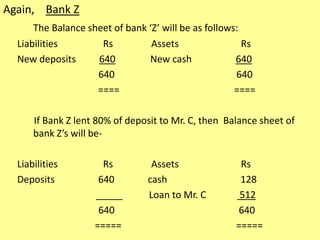
Again, Bank Z
The Balance sheet of bank ‘Z’ will be as follows:
Liabilities Rs Assets Rs
New deposits 640 New cash 640
640 640
==== ====
If Bank Z lent 80% of deposit to Mr. C, then Balance sheet of
bank Z’s will be-
Liabilities Rs Assets Rs
Deposits 640 cash 128
_____ Loan to Mr. C 512
640 640
===== =====
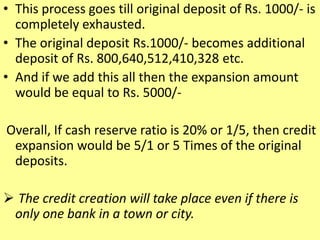
• This process goes till original deposit of Rs. 1000/- is
completely exhausted.
• The original deposit Rs.1000/- becomes additional
deposit of Rs. 800,640,512,410,328 etc.
• And if we add this all then the expansion amount
would be equal to Rs. 5000/-
Overall, If cash reserve ratio is 20% or 1/5, then credit
expansion would be 5/1 or 5 Times of the original
deposits.
 The credit creation will take place even if there is
only one bank in a town or city.
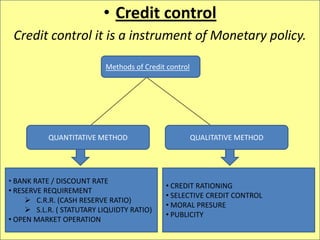
• Credit control
Credit control it is a instrument of Monetary policy.
QUALITATIVE METHODQUANTITATIVE METHOD
Methods of Credit control
• BANK RATE / DISCOUNT RATE
• RESERVE REQUIREMENT
 C.R.R. (CASH RESERVE RATIO)
 S.L.R. ( STATUTARY LIQUIDTY RATIO)
• OPEN MARKET OPERATION
• CREDIT RATIONING
• SELECTIVE CREDIT CONTROL
• MORAL PRESURE
• PUBLICITY
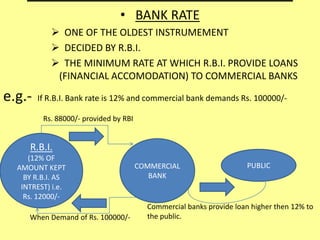
• BANK RATE
 ONE OF THE OLDEST INSTRUMEMENT
 DECIDED BY R.B.I.
 THE MINIMUM RATE AT WHICH R.B.I. PROVIDE LOANS
(FINANCIAL ACCOMODATION) TO COMMERCIAL BANKS
e.g.- If R.B.I. Bank rate is 12% and commercial bank demands Rs. 100000/-
R.B.I.
(12% OF
AMOUNT KEPT
BY R.B.I. AS
INTREST) i.e.
Rs. 12000/-
Rs. 88000/- provided by RBI
When Demand of Rs. 100000/-
COMMERCIAL
BANK
PUBLIC
Commercial banks provide loan higher then 12% to
the public.
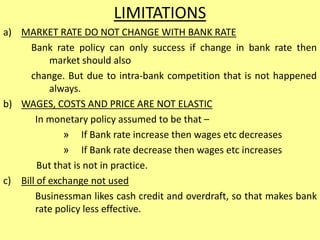
LIMITATIONS
a) MARKET RATE DO NOT CHANGE WITH BANK RATE
Bank rate policy can only success if change in bank rate then
market should also
change. But due to intra-bank competition that is not happened
always.
b) WAGES, COSTS AND PRICE ARE NOT ELASTIC
In monetary policy assumed to be that –
» If Bank rate increase then wages etc decreases
» If Bank rate decrease then wages etc increases
But that is not in practice.
c) Bill of exchange not used
Businessman likes cash credit and overdraft, so that makes bank
rate policy less effective.
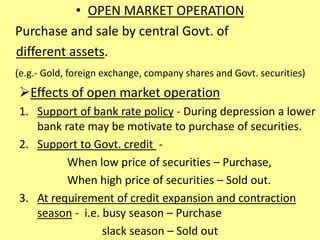
• OPEN MARKET OPERATION
Purchase and sale by central Govt. of
different assets.
(e.g.- Gold, foreign exchange, company shares and Govt. securities)
Effects of open market operation
1. Support of bank rate policy - During depression a lower
bank rate may be motivate to purchase of securities.
2. Support to Govt. credit -
When low price of securities – Purchase,
When high price of securities – Sold out.
3. At requirement of credit expansion and contraction
season - i.e. busy season – Purchase
slack season – Sold out
 Limitations of open market operation
1. Lack of security market
2. C.R.R. not stable
Normally, When RBI sells or buy securities then
reserves of commercial bank will also be increase or
decrease.
But, practically commercial bank keeps a higher
ratio then it(as prescribed by RBI)
• RESERVE REQUIREMENT
 C.R.R. –
1. Bank in India required to hold a certain
proportion of their deposits in the form of
cash.
However, actually Banks does not hold these
cash with themselves, but deposit such cash
with RBI / Currency chests, which considered
as equivalent to holding cash themselves.
2. RBI can vary this ratio between 3% to 15% of
total demand and liabilities.
3. At present C.R.R. is - 5.50% w.e.f. 28/01/2012
(Decreased from 6.00% to 5.50% which was
continuing since 24/04/2010)
S.L.R. –
1. Every bank is required to maintain at the close of
business every day, a minimum percentage of their
Net Demand and Liabilities as liquid assets in form
of gold , cash, or other approved securities.
2. At present S.L.R. is (w.e.f. 18/12/2010) – 24%
(i.e. decrease from 25% since 07/11/2009 )
3. As per Banking regulation Act, All bank have to
maintain 20% S.L.R.
• LIMITATIONS
1. Less effectively - Excess reserves kept by bank,
which is cause of infectivity of CRR and SLR.
2. Inflexible – Banks are situated in all regions of
country and/ so it is not a justified policy.
• Repo rate and Reverse Repo rate
• Repo (Repurchase) rate is the rate at which the RBI
lends shot-term money to the banks against
securities. When the repo rate increases borrowing
from RBI becomes more expensive.
Therefore, we can say that in case, RBI wants to
make it more expensive for the banks to borrow
money, it increases the repo rate; similarly, if it
wants to make it cheaper for banks to borrow
money, it reduces the repo rate.
• Reverse Repo rate is the rate at which banks park
their short-term excess liquidity with the RBI. The
banks use this tool when they feel that they are
stuck with excess funds and are not able to invest
anywhere for reasonable returns.
An increase in the reverse repo rate means that the
RBI is ready to borrow money from the banks at a
higher rate of interest. As a result, banks would
prefer to keep more and more surplus funds with
RBI.
Thus, we can conclude that
Repo Rate signifies the rate at which
liquidity is injected in the banking
system by RBI, whereas
Reverse repo rate signifies the rate at
which the central bank absorbs
liquidity from the banks.
(Note: data taken from internet on 31-01-2012 from R.B.I. website)
• Bank Rate
6.00% (w.e.f. 29/04/2003)
• Cash Reserve Ratio (CRR)
5.50% (w.e.f. 28/01/2012)
Decreased from 6.00% to 5.50% which was
continuing since 24/04/2010
• Statutory Liquidity Ratio (SLR)
24%(w.e.f. 18/12/2010)
Decreased from 25% which was continuing since
07/11/2009
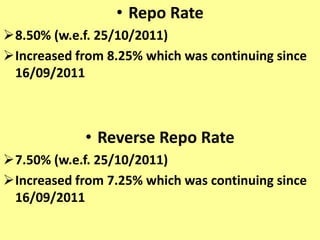
• Repo Rate
8.50% (w.e.f. 25/10/2011)
Increased from 8.25% which was continuing since
16/09/2011
• Reverse Repo Rate
7.50% (w.e.f. 25/10/2011)
Increased from 7.25% which was continuing since
16/09/2011
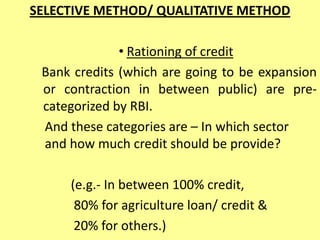
SELECTIVE METHOD/ QUALITATIVE METHOD
• Rationing of credit
Bank credits (which are going to be expansion
or contraction in between public) are pre-
categorized by RBI.
And these categories are – In which sector
and how much credit should be provide?
(e.g.- In between 100% credit,
80% for agriculture loan/ credit &
20% for others.)
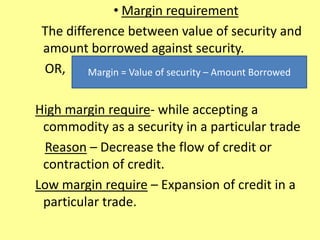
• Margin requirement
The difference between value of security and
amount borrowed against security.
OR,
High margin require- while accepting a
commodity as a security in a particular trade
Reason – Decrease the flow of credit or
contraction of credit.
Low margin require – Expansion of credit in a
particular trade.
Margin = Value of security – Amount Borrowed
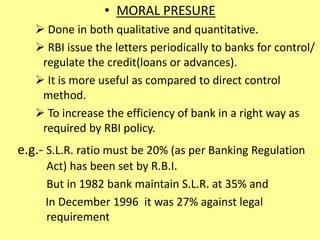
• MORAL PRESURE
 Done in both qualitative and quantitative.
 RBI issue the letters periodically to banks for control/
regulate the credit(loans or advances).
 It is more useful as compared to direct control
method.
 To increase the efficiency of bank in a right way as
required by RBI policy.
e.g.- S.L.R. ratio must be 20% (as per Banking Regulation
Act) has been set by R.B.I.
But in 1982 bank maintain S.L.R. at 35% and
In December 1996 it was 27% against legal
requirement
• PUBLICITY
The central bank issues weekly reports and other
publications.
From them publications the commercial banks
become aware of the latest position in the money
market, public finance, trade and industry, etc., in
the country.
They can, therefore, adjust their credit operations
according to the market situation.
Thank you

Cerdit cotrol ppt

  • 1.
  • 2.
    Aims of CreditControl • To stabilize the price level in the country. • To eliminate violent fluctuations in production and employment, • To keep the exchange rate stable, • To maintain the gold reserves of the country. • To keep the rate of growth in business activities normal and steady
  • 3.
    Credit control isone of the component/tool (others are- Currency, Deposits and Foreign exchange) of central bank or R.B.I. under the monetary policy. • R.B.I./CENTRAL BANK • THE RESERVE BANK OF INDIA WAS NATIONALISED IN 1949 • Head office – MUMBAI • Regional office – In every state of India • Organizational set-up One Governor – Honorable D. Subbarav (currently) Four Deputy Directors Four Executive Directors and Fifteen Directors
  • 4.
    • CREDIT CREATION “Itis an expansion of bank deposits. Through the process of more loans and advances by bank.” For obtaining loan from bank a person must furnish sufficient security. Generally, bank and borrower prefers to deposit the loan amount in borrower’s current account by issuing cheque book. So, the bank is able lend money without loosing the cash. Here, bank has created credit.
  • 5.
    As conclusion wefind that, “The Bank’s loan create deposits or it create a credit for the borrower.” • PROCESS OF CREDIT CREATION In western or in developed countries, banking habit of people is developed, thus bank keeps 10% as cash reserve and rest of the deposit money will be available for loan. In underdeveloped countries, bank having the cash reserve up to 20% of total deposits and rest 80% money keeps available for loan (i.e. creation of credit).
  • 6.
    Example – we makethe following assumptions- 1. There are X,Y,Z BANKS with different deposits. 2. Every bank has to maintain 20% of cash reserves against it deposits. 3. A new deposit of Rs. 1000/- is made with Bank X to start with Now, The Balance sheet of bank X will be as follows: Liabilities Rs Assets Rs New deposits 1000 New cash 1000 1000 1000 ===== ===== Now, bank X will keep 20% as cash reserve and create credit of 80% i.e. Rs. 800/- which is available to lend for some other. Say Mr. A then Balance sheet will be- Liabilities Rs Assets Rs Deposits 1000 cash 200 _____ Loan to Mr. A 800 1000 1000
  • 7.
    Now, Mr. ADeposit Rs. 800/- in Bank ‘Y’ in his account The Balance sheet of bank ‘Y’ will be as follows: Liabilities Rs Assets Rs New deposits 800 New cash 800 800 800 ==== ==== If Bank Y lent 80% of deposit to Mr. B, then Balance sheet of bank Y’s will be- Liabilities Rs Assets Rs Deposits 800 cash 160 _____ Loan to Mr. B 640 800 800 ===== =====
  • 8.
    Again, Bank Z TheBalance sheet of bank ‘Z’ will be as follows: Liabilities Rs Assets Rs New deposits 640 New cash 640 640 640 ==== ==== If Bank Z lent 80% of deposit to Mr. C, then Balance sheet of bank Z’s will be- Liabilities Rs Assets Rs Deposits 640 cash 128 _____ Loan to Mr. C 512 640 640 ===== =====
  • 9.
    • This processgoes till original deposit of Rs. 1000/- is completely exhausted. • The original deposit Rs.1000/- becomes additional deposit of Rs. 800,640,512,410,328 etc. • And if we add this all then the expansion amount would be equal to Rs. 5000/- Overall, If cash reserve ratio is 20% or 1/5, then credit expansion would be 5/1 or 5 Times of the original deposits.  The credit creation will take place even if there is only one bank in a town or city.
  • 10.
    • Credit control Creditcontrol it is a instrument of Monetary policy. QUALITATIVE METHODQUANTITATIVE METHOD Methods of Credit control • BANK RATE / DISCOUNT RATE • RESERVE REQUIREMENT  C.R.R. (CASH RESERVE RATIO)  S.L.R. ( STATUTARY LIQUIDTY RATIO) • OPEN MARKET OPERATION • CREDIT RATIONING • SELECTIVE CREDIT CONTROL • MORAL PRESURE • PUBLICITY
  • 11.
    • BANK RATE ONE OF THE OLDEST INSTRUMEMENT  DECIDED BY R.B.I.  THE MINIMUM RATE AT WHICH R.B.I. PROVIDE LOANS (FINANCIAL ACCOMODATION) TO COMMERCIAL BANKS e.g.- If R.B.I. Bank rate is 12% and commercial bank demands Rs. 100000/- R.B.I. (12% OF AMOUNT KEPT BY R.B.I. AS INTREST) i.e. Rs. 12000/- Rs. 88000/- provided by RBI When Demand of Rs. 100000/- COMMERCIAL BANK PUBLIC Commercial banks provide loan higher then 12% to the public.
  • 12.
    LIMITATIONS a) MARKET RATEDO NOT CHANGE WITH BANK RATE Bank rate policy can only success if change in bank rate then market should also change. But due to intra-bank competition that is not happened always. b) WAGES, COSTS AND PRICE ARE NOT ELASTIC In monetary policy assumed to be that – » If Bank rate increase then wages etc decreases » If Bank rate decrease then wages etc increases But that is not in practice. c) Bill of exchange not used Businessman likes cash credit and overdraft, so that makes bank rate policy less effective.
  • 13.
    • OPEN MARKETOPERATION Purchase and sale by central Govt. of different assets. (e.g.- Gold, foreign exchange, company shares and Govt. securities) Effects of open market operation 1. Support of bank rate policy - During depression a lower bank rate may be motivate to purchase of securities. 2. Support to Govt. credit - When low price of securities – Purchase, When high price of securities – Sold out. 3. At requirement of credit expansion and contraction season - i.e. busy season – Purchase slack season – Sold out
  • 14.
     Limitations ofopen market operation 1. Lack of security market 2. C.R.R. not stable Normally, When RBI sells or buy securities then reserves of commercial bank will also be increase or decrease. But, practically commercial bank keeps a higher ratio then it(as prescribed by RBI)
  • 15.
    • RESERVE REQUIREMENT C.R.R. – 1. Bank in India required to hold a certain proportion of their deposits in the form of cash. However, actually Banks does not hold these cash with themselves, but deposit such cash with RBI / Currency chests, which considered as equivalent to holding cash themselves. 2. RBI can vary this ratio between 3% to 15% of total demand and liabilities. 3. At present C.R.R. is - 5.50% w.e.f. 28/01/2012 (Decreased from 6.00% to 5.50% which was continuing since 24/04/2010)
  • 16.
    S.L.R. – 1. Everybank is required to maintain at the close of business every day, a minimum percentage of their Net Demand and Liabilities as liquid assets in form of gold , cash, or other approved securities. 2. At present S.L.R. is (w.e.f. 18/12/2010) – 24% (i.e. decrease from 25% since 07/11/2009 ) 3. As per Banking regulation Act, All bank have to maintain 20% S.L.R.
  • 17.
    • LIMITATIONS 1. Lesseffectively - Excess reserves kept by bank, which is cause of infectivity of CRR and SLR. 2. Inflexible – Banks are situated in all regions of country and/ so it is not a justified policy.
  • 18.
    • Repo rateand Reverse Repo rate • Repo (Repurchase) rate is the rate at which the RBI lends shot-term money to the banks against securities. When the repo rate increases borrowing from RBI becomes more expensive. Therefore, we can say that in case, RBI wants to make it more expensive for the banks to borrow money, it increases the repo rate; similarly, if it wants to make it cheaper for banks to borrow money, it reduces the repo rate.
  • 19.
    • Reverse Reporate is the rate at which banks park their short-term excess liquidity with the RBI. The banks use this tool when they feel that they are stuck with excess funds and are not able to invest anywhere for reasonable returns. An increase in the reverse repo rate means that the RBI is ready to borrow money from the banks at a higher rate of interest. As a result, banks would prefer to keep more and more surplus funds with RBI.
  • 20.
    Thus, we canconclude that Repo Rate signifies the rate at which liquidity is injected in the banking system by RBI, whereas Reverse repo rate signifies the rate at which the central bank absorbs liquidity from the banks.
  • 21.
    (Note: data takenfrom internet on 31-01-2012 from R.B.I. website) • Bank Rate 6.00% (w.e.f. 29/04/2003) • Cash Reserve Ratio (CRR) 5.50% (w.e.f. 28/01/2012) Decreased from 6.00% to 5.50% which was continuing since 24/04/2010 • Statutory Liquidity Ratio (SLR) 24%(w.e.f. 18/12/2010) Decreased from 25% which was continuing since 07/11/2009
  • 22.
    • Repo Rate 8.50%(w.e.f. 25/10/2011) Increased from 8.25% which was continuing since 16/09/2011 • Reverse Repo Rate 7.50% (w.e.f. 25/10/2011) Increased from 7.25% which was continuing since 16/09/2011
  • 23.
    SELECTIVE METHOD/ QUALITATIVEMETHOD • Rationing of credit Bank credits (which are going to be expansion or contraction in between public) are pre- categorized by RBI. And these categories are – In which sector and how much credit should be provide? (e.g.- In between 100% credit, 80% for agriculture loan/ credit & 20% for others.)
  • 24.
    • Margin requirement Thedifference between value of security and amount borrowed against security. OR, High margin require- while accepting a commodity as a security in a particular trade Reason – Decrease the flow of credit or contraction of credit. Low margin require – Expansion of credit in a particular trade. Margin = Value of security – Amount Borrowed
  • 25.
    • MORAL PRESURE Done in both qualitative and quantitative.  RBI issue the letters periodically to banks for control/ regulate the credit(loans or advances).  It is more useful as compared to direct control method.  To increase the efficiency of bank in a right way as required by RBI policy. e.g.- S.L.R. ratio must be 20% (as per Banking Regulation Act) has been set by R.B.I. But in 1982 bank maintain S.L.R. at 35% and In December 1996 it was 27% against legal requirement
  • 26.
    • PUBLICITY The centralbank issues weekly reports and other publications. From them publications the commercial banks become aware of the latest position in the money market, public finance, trade and industry, etc., in the country. They can, therefore, adjust their credit operations according to the market situation.
  • 27.