How to Implement
the TMF Reference
Model
1
House Keeping
About the company
• This webinar is being recorded and will be
made available after this session
• Feel free to use the chatbox to submit your
questions at anytime
• Q&A will take place at the end of the webinar
• We will send these slides to your email at the
end of the webinar
3
Agenda
LIVE WEBINAR
• TMF Reference Model overview and organization
• Adapting the Model for any trial organization
• Applying the Model in eTMF
• Enabling the TMF Exchange Mechanism Standard
4
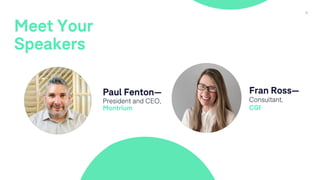
Meet Your
Speakers
Paul Fenton—
President and CEO,
Montrium
Fran Ross—
Consultant,
CGI
• Montrium was founded in 2005
• Headquartered in Montreal, Canada
• EU HQ in Brussels
• Clients in North America, Europe & Asia
• Work exclusively in the Life Sciences Industry
• We have over 8000 Users in 20+ Countries
• Leading Content Management Platform
• Experienced Professional Services Group
5
About
Montrium
Connecting People,
Processes & Technology
About the company
6
Electronic Content
Management & Business
Intelligence for Clinical
Trials
connect platform
Regulatory Document
Management &
Submission Planning for
Drugs and Devices
Integrated and Data
Driven Quality
Management Solutions
for Life Sciences
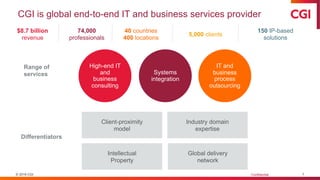
© 2019 CGI Confidential
Range of
services
High-end IT
and
business
consulting
Systems
integration
IT and
business
process
outsourcing
Differentiators
7
Client-proximity
model
Industry domain
expertise
Intellectual
Property
Global delivery
network
CGI is global end-to-end IT and business services provider
$8.7 billion
revenue
74,000
professionals
40 countries
400 locations
5,000 clients
150 IP-based
solutions
8
POLL
A B O U T T H E C O M P A N Y
What is your highest priority TMF
challenge today?
a) Leveraging the TMF Reference Model
b) Improving our eTMF system
c) Exchanging TMF records
d) Getting through an inspection
e) All of them!
TMF Reference Model
Overview
S E C T I O N # 1
10
What is
the TMF
Reference
Model?
A B O U T T H E C O M P A N Y
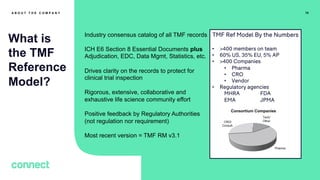
Industry consensus catalog of all TMF records
ICH E6 Section 8 Essential Documents plus
Adjudication, EDC, Data Mgmt, Statistics, etc.
Drives clarity on the records to protect for
clinical trial inspection
Rigorous, extensive, collaborative and
exhaustive life science community effort
Positive feedback by Regulatory Authorities
(not regulation nor requirement)
Most recent version = TMF RM v3.1
TMF Ref Model By the Numbers
• >400 members on team
• 60% US, 35% EU, 5% AP
• >400 Companies
• Pharma
• CRO
• Vendor
• Regulatory agencies
MHRA FDA
EMA JPMA
Tech/
Other
Pharma
CRO/
Consult.
Consortium Companies
Source: https://tmfrefmodel.com/wp-content/uploads/2019/02/2019-02-tmf-reference-model-v3.1.0.pdf
TMF Ref Model
Participation
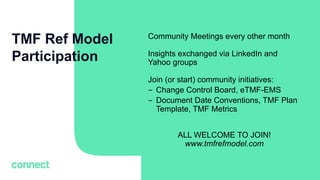
Community Meetings every other month
Insights exchanged via LinkedIn and
Yahoo groups
Join (or start) community initiatives:
- Change Control Board, eTMF-EMS
- Document Date Conventions, TMF Plan
Template, TMF Metrics
ALL WELCOME TO JOIN!
www.tmfrefmodel.com
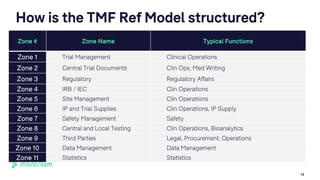
How is the TMF Ref Model structured?
13
Zone # Zone Name Typical Functions
Zone 1 Trial Management Clinical Operations
Zone 2 Central Trial Documents Clin Ops, Med Writing
Zone 3 Regulatory Regulatory Affairs
Zone 4 IRB / IEC Clin Operations
Zone 5 Site Management Clin Operations
Zone 6 IP and Trial Supplies Clin Operations, IP Supply
Zone 7 Safety Management Safety
Zone 8 Central and Local Testing Clin Operations, Bioanalytics
Zone 9 Third Parties Legal, Procurement, Operations
Zone 10 Data Management Data Management
Zone 11 Statistics Statistics
14
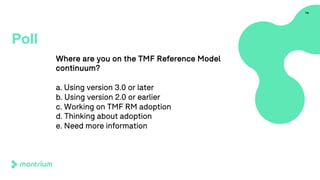
Poll
Where are you on the TMF Reference Model
continuum?
a. Using version 3.0 or later
b. Using version 2.0 or earlier
c. Working on TMF RM adoption
d. Thinking about adoption
e. Need more information
Adapting the Model for
any trial organization
S E C T I O N # 2
16
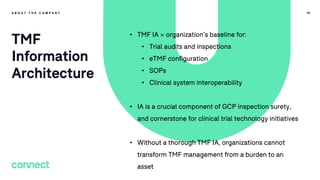
TMF
Information
Architecture
A B O U T T H E C O M P A N Y
• TMF IA = organization’s baseline for:
• Trial audits and inspections
• eTMF configuration
• SOPs
• Clinical system interoperability
• IA is a crucial component of GCP inspection surety,
and cornerstone for clinical trial technology initiatives
• Without a thorough TMF IA, organizations cannot
transform TMF management from a burden to an
asset
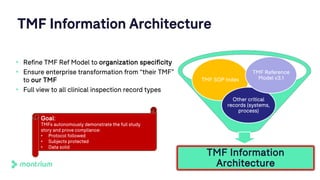
TMF Information Architecture
• Refine TMF Ref Model to organization specificity
• Ensure enterprise transformation from “their TMF”
to our TMF
• Full view to all clinical inspection record types
TMF Information
Architecture
TMF SOP Index
Other critical
records (systems,
process)
TMF Reference
Model v3.1
Goal:
TMFs autonomously demonstrate the full study
story and prove compliance:
• Protocol followed
• Subjects protected
• Data solid
TMF Information Architecture
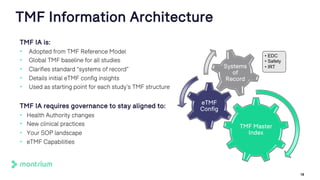
TMF IA is:
• Adopted from TMF Reference Model
• Global TMF baseline for all studies
• Clarifies standard “systems of record”
• Details initial eTMF config insights
• Used as starting point for each study’s TMF structure
TMF IA requires governance to stay aligned to:
• Health Authority changes
• New clinical practices
• Your SOP landscape
• eTMF Capabilities
18
TMF Master
Index
eTMF
Config
Systems
of
Record
• EDC
• Safety
• IRT
19
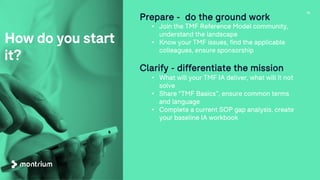
How do you start
it?
Prepare - do the ground work
• Join the TMF Reference Model community,
understand the landscape
• Know your TMF issues, find the applicable
colleagues, ensure sponsorship
Clarify - differentiate the mission
• What will your TMF IA deliver, what will it not
solve
• Share “TMF Basics”, ensure common terms
and language
• Complete a current SOP gap analysis, create
your baseline IA workbook
20
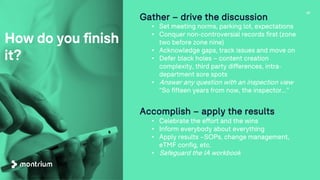
How do you finish
it?
Gather – drive the discussion
• Set meeting norms, parking lot, expectations
• Conquer non-controversial records first (zone
two before zone nine)
• Acknowledge gaps, track issues and move on
• Defer black holes – content creation
complexity, third party differences, intra-
department sore spots
• Answer any question with an inspection view
“So fifteen years from now, the inspector…”
Accomplish – apply the results
• Celebrate the effort and the wins
• Inform everybody about everything
• Apply results –SOPs, change management,
eTMF config, etc.
• Safeguard the IA workbook
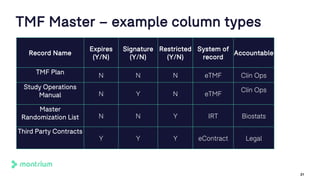
TMF Master – example column types
21
Record Name
Expires
(Y/N)
Signature
(Y/N)
Restricted
(Y/N)
System of
record
Accountable
TMF Plan
N N N eTMF Clin Ops
Study Operations
Manual N Y N eTMF
Clin Ops
Master
Randomization List N N Y IRT Biostats
Third Party Contracts
Y Y Y eContract Legal
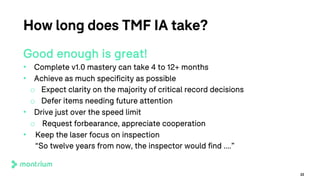
How long does TMF IA take?
Good enough is great!
• Complete v1.0 mastery can take 4 to 12+ months
• Achieve as much specificity as possible
o Expect clarity on the majority of critical record decisions
o Defer items needing future attention
• Drive just over the speed limit
o Request forbearance, appreciate cooperation
• Keep the laser focus on inspection
“So twelve years from now, the inspector would find ….”
22
23
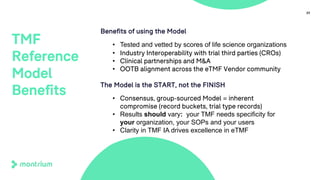
TMF
Reference
Model
Benefits
Benefits of using the Model
• Tested and vetted by scores of life science organizations
• Industry Interoperability with trial third parties (CROs)
• Clinical partnerships and M&A
• OOTB alignment across the eTMF Vendor community
The Model is the START, not the FINISH
• Consensus, group-sourced Model = inherent
compromise (record buckets, trial type records)
• Results should vary: your TMF needs specificity for
your organization, your SOPs and your users
• Clarity in TMF IA drives excellence in eTMF
Applying the Model in
eTMF
S E C T I O N # 5
The reference model was
designed for both paper and
electronic systems…
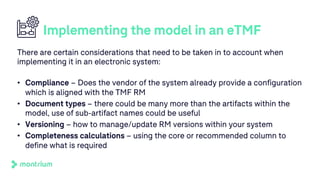
Implementing the model in an eTMF
There are certain considerations that need to be taken in to account when
implementing it in an electronic system:
• Compliance – Does the vendor of the system already provide a configuration
which is aligned with the TMF RM
• Document types – there could be many more than the artifacts within the
model, use of sub-artifact names could be useful
• Versioning – how to manage/update RM versions within your system
• Completeness calculations – using the core or recommended column to
define what is required
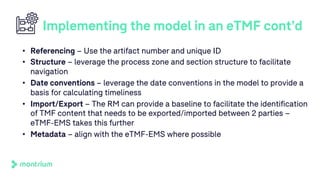
Implementing the model in an eTMF cont’d
• Referencing – Use the artifact number and unique ID
• Structure – leverage the process zone and section structure to facilitate
navigation
• Date conventions – leverage the date conventions in the model to provide a
basis for calculating timeliness
• Import/Export – The RM can provide a baseline to facilitate the identification
of TMF content that needs to be exported/imported between 2 parties –
eTMF-EMS takes this further
• Metadata – align with the eTMF-EMS where possible
28
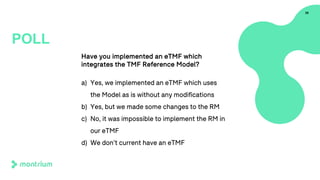
POLL
Have you implemented an eTMF which
integrates the TMF Reference Model?
a) Yes, we implemented an eTMF which uses
the Model as is without any modifications
b) Yes, but we made some changes to the RM
c) No, it was impossible to implement the RM in
our eTMF
d) We don’t current have an eTMF
Enabling the
TMF Exchange
Mechanism Standard
S E C T I O N # 6
• An extension of the TMF RM which focuses on the transfer of
content, metadata, audit trail and eSig information
• A TMF metadata standard
• A mechanism for exchanging TMF content between systems
• A method for describing TMF artifacts which is
comprehensible by both humans and machines
What is the eTMF-EMS
Electronic Trial Master File –
Exchange Mechanism Standard
What are we trying to solve
• More electronic systems are being used to manage
TMF
• Most systems use the TMF RM to organize artifacts
• At the end of the study, the TMF needs to be
transferred back to the sponsor
• This often requires a significant amount of mapping
and manipulation to be able to import the content
Solution: A transport protocol which facilitates
exchange of eTMF content…The eTMF Exchange
mechanism Standard
• Prior to the TMF RM, organization of TMF
content was a free-for-all
• Since then, we have seen massive
uptake of the TMF RM across the
industry and globally
• The TMF RM provides us with structure
and a certain level of ‘standardization’
• Focus is still very much on the
organization of the artifacts rather than
describing artifacts through metadata
• This is a challenge for systems…the
eTMF-EMS is aiming to solve this
Where we have
come from
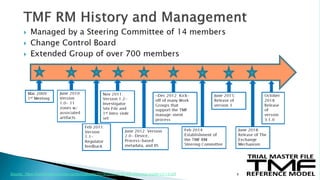
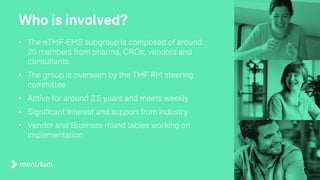
• The eTMF-EMS subgroup is composed of around
25 members from pharma, CROs, vendors and
consultants
• The group is overseen by the TMF RM steering
committee
• Active for around 2.5 years and meets weekly
• Significant interest and support from industry
• Vendor and Business round tables working on
implementation
Who is involved?
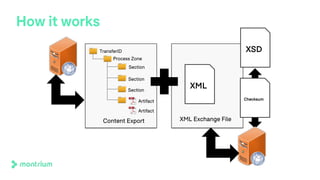
How it works
TransferID
Process Zone
Section
Section
Section
Artifact
Artifact
Content Export XML Exchange File
XML
XSD
Checksum
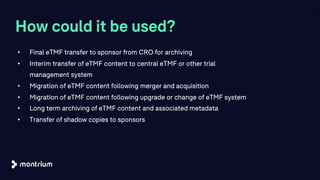
How could it be used?
35
• Final eTMF transfer to sponsor from CRO for archiving
• Interim transfer of eTMF content to central eTMF or other trial
management system
• Migration of eTMF content following merger and acquisition
• Migration of eTMF content following upgrade or change of eTMF system
• Long term archiving of eTMF content and associated metadata
• Transfer of shadow copies to sponsors
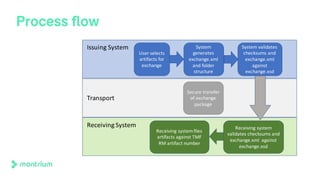
Process flow
Issuing	System
Receiving	System
Transport
User	selects	
artifacts	for	
exchange
System	
generates	
exchange.xml
and	folder	
structure
System	validates	
checksums	and	
exchange.xml
against	
exchange.xsd
Secure	transfer	
of	exchange	
package
Receiving	system	files	
artifacts	against	TMF	
RM	artifact	number
Receiving	system	
validates	checksums	and	
exchange.xml against	
exchange.xsd
37
How does it link to the RM?
• The eTMF-EMS is linked to the RM through the following
cross references:
- Artifact Number i.e. 01.01.01
- Unique ID i.e. 001
- RM version number
• When an artifact is exchanged it must be cross referenced
with the above information
• This allows the receiving system to properly identify and file it
within it RM based structure
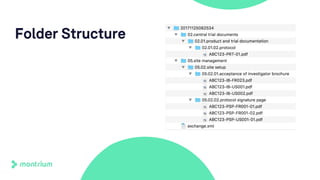
Folder Structure
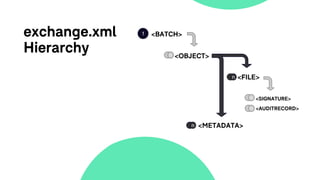
exchange.xml
Hierarchy
40
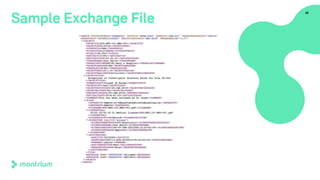
Sample Exchange File
Exchange Agreements allow two parties
to define how content exchanges will
occur as well as organizational specific
information and standards
42
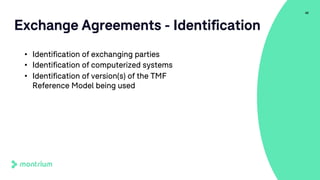
Exchange Agreements - Identification
• Identification of exchanging parties
• Identification of computerized systems
• Identification of version(s) of the TMF
Reference Model being used
43
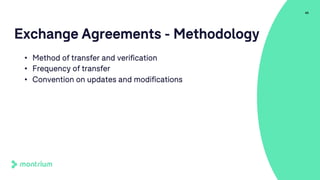
Exchange Agreements - Methodology
• Method of transfer and verification
• Frequency of transfer
• Convention on updates and modifications
44
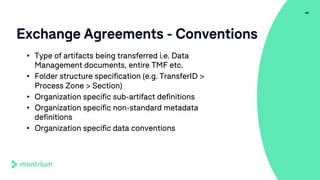
Exchange Agreements - Conventions
• Type of artifacts being transferred i.e. Data
Management documents, entire TMF etc.
• Folder structure specification (e.g. TransferID >
Process Zone > Section)
• Organization specific sub-artifact definitions
• Organization specific non-standard metadata
definitions
• Organization specific data conventions
QUESTIONS?
45A B O U T T H E C O M P A N Y
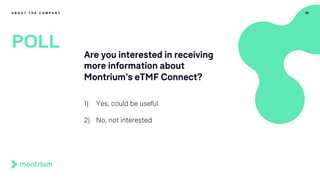
Are you interested in receiving
more information about
Montrium’s eTMF Connect?
1) Yes, could be useful
2) No, not interested
46
POLL
A B O U T T H E C O M P A N Y

Implementing the TMF Reference Model

  • 1.
    How to Implement theTMF Reference Model 1
  • 2.
    House Keeping About thecompany • This webinar is being recorded and will be made available after this session • Feel free to use the chatbox to submit your questions at anytime • Q&A will take place at the end of the webinar • We will send these slides to your email at the end of the webinar
  • 3.
    3 Agenda LIVE WEBINAR • TMFReference Model overview and organization • Adapting the Model for any trial organization • Applying the Model in eTMF • Enabling the TMF Exchange Mechanism Standard
  • 4.
    4 Meet Your Speakers Paul Fenton— Presidentand CEO, Montrium Fran Ross— Consultant, CGI
  • 5.
    • Montrium wasfounded in 2005 • Headquartered in Montreal, Canada • EU HQ in Brussels • Clients in North America, Europe & Asia • Work exclusively in the Life Sciences Industry • We have over 8000 Users in 20+ Countries • Leading Content Management Platform • Experienced Professional Services Group 5 About Montrium Connecting People, Processes & Technology About the company
  • 6.
    6 Electronic Content Management &Business Intelligence for Clinical Trials connect platform Regulatory Document Management & Submission Planning for Drugs and Devices Integrated and Data Driven Quality Management Solutions for Life Sciences
  • 7.
    © 2019 CGIConfidential Range of services High-end IT and business consulting Systems integration IT and business process outsourcing Differentiators 7 Client-proximity model Industry domain expertise Intellectual Property Global delivery network CGI is global end-to-end IT and business services provider $8.7 billion revenue 74,000 professionals 40 countries 400 locations 5,000 clients 150 IP-based solutions
  • 8.
    8 POLL A B OU T T H E C O M P A N Y What is your highest priority TMF challenge today? a) Leveraging the TMF Reference Model b) Improving our eTMF system c) Exchanging TMF records d) Getting through an inspection e) All of them!
  • 9.
  • 10.
    10 What is the TMF Reference Model? AB O U T T H E C O M P A N Y Industry consensus catalog of all TMF records ICH E6 Section 8 Essential Documents plus Adjudication, EDC, Data Mgmt, Statistics, etc. Drives clarity on the records to protect for clinical trial inspection Rigorous, extensive, collaborative and exhaustive life science community effort Positive feedback by Regulatory Authorities (not regulation nor requirement) Most recent version = TMF RM v3.1 TMF Ref Model By the Numbers • >400 members on team • 60% US, 35% EU, 5% AP • >400 Companies • Pharma • CRO • Vendor • Regulatory agencies MHRA FDA EMA JPMA Tech/ Other Pharma CRO/ Consult. Consortium Companies
  • 11.
  • 12.
    TMF Ref Model Participation CommunityMeetings every other month Insights exchanged via LinkedIn and Yahoo groups Join (or start) community initiatives: - Change Control Board, eTMF-EMS - Document Date Conventions, TMF Plan Template, TMF Metrics ALL WELCOME TO JOIN! www.tmfrefmodel.com
  • 13.
    How is theTMF Ref Model structured? 13 Zone # Zone Name Typical Functions Zone 1 Trial Management Clinical Operations Zone 2 Central Trial Documents Clin Ops, Med Writing Zone 3 Regulatory Regulatory Affairs Zone 4 IRB / IEC Clin Operations Zone 5 Site Management Clin Operations Zone 6 IP and Trial Supplies Clin Operations, IP Supply Zone 7 Safety Management Safety Zone 8 Central and Local Testing Clin Operations, Bioanalytics Zone 9 Third Parties Legal, Procurement, Operations Zone 10 Data Management Data Management Zone 11 Statistics Statistics
  • 14.
    14 Poll Where are youon the TMF Reference Model continuum? a. Using version 3.0 or later b. Using version 2.0 or earlier c. Working on TMF RM adoption d. Thinking about adoption e. Need more information
  • 15.
    Adapting the Modelfor any trial organization S E C T I O N # 2
  • 16.
    16 TMF Information Architecture A B OU T T H E C O M P A N Y • TMF IA = organization’s baseline for: • Trial audits and inspections • eTMF configuration • SOPs • Clinical system interoperability • IA is a crucial component of GCP inspection surety, and cornerstone for clinical trial technology initiatives • Without a thorough TMF IA, organizations cannot transform TMF management from a burden to an asset
  • 17.
    TMF Information Architecture •Refine TMF Ref Model to organization specificity • Ensure enterprise transformation from “their TMF” to our TMF • Full view to all clinical inspection record types TMF Information Architecture TMF SOP Index Other critical records (systems, process) TMF Reference Model v3.1 Goal: TMFs autonomously demonstrate the full study story and prove compliance: • Protocol followed • Subjects protected • Data solid
  • 18.
    TMF Information Architecture TMFIA is: • Adopted from TMF Reference Model • Global TMF baseline for all studies • Clarifies standard “systems of record” • Details initial eTMF config insights • Used as starting point for each study’s TMF structure TMF IA requires governance to stay aligned to: • Health Authority changes • New clinical practices • Your SOP landscape • eTMF Capabilities 18 TMF Master Index eTMF Config Systems of Record • EDC • Safety • IRT
  • 19.
    19 How do youstart it? Prepare - do the ground work • Join the TMF Reference Model community, understand the landscape • Know your TMF issues, find the applicable colleagues, ensure sponsorship Clarify - differentiate the mission • What will your TMF IA deliver, what will it not solve • Share “TMF Basics”, ensure common terms and language • Complete a current SOP gap analysis, create your baseline IA workbook
  • 20.
    20 How do youfinish it? Gather – drive the discussion • Set meeting norms, parking lot, expectations • Conquer non-controversial records first (zone two before zone nine) • Acknowledge gaps, track issues and move on • Defer black holes – content creation complexity, third party differences, intra- department sore spots • Answer any question with an inspection view “So fifteen years from now, the inspector…” Accomplish – apply the results • Celebrate the effort and the wins • Inform everybody about everything • Apply results –SOPs, change management, eTMF config, etc. • Safeguard the IA workbook
  • 21.
    TMF Master –example column types 21 Record Name Expires (Y/N) Signature (Y/N) Restricted (Y/N) System of record Accountable TMF Plan N N N eTMF Clin Ops Study Operations Manual N Y N eTMF Clin Ops Master Randomization List N N Y IRT Biostats Third Party Contracts Y Y Y eContract Legal
  • 22.
    How long doesTMF IA take? Good enough is great! • Complete v1.0 mastery can take 4 to 12+ months • Achieve as much specificity as possible o Expect clarity on the majority of critical record decisions o Defer items needing future attention • Drive just over the speed limit o Request forbearance, appreciate cooperation • Keep the laser focus on inspection “So twelve years from now, the inspector would find ….” 22
  • 23.
    23 TMF Reference Model Benefits Benefits of usingthe Model • Tested and vetted by scores of life science organizations • Industry Interoperability with trial third parties (CROs) • Clinical partnerships and M&A • OOTB alignment across the eTMF Vendor community The Model is the START, not the FINISH • Consensus, group-sourced Model = inherent compromise (record buckets, trial type records) • Results should vary: your TMF needs specificity for your organization, your SOPs and your users • Clarity in TMF IA drives excellence in eTMF
  • 24.
    Applying the Modelin eTMF S E C T I O N # 5
  • 25.
    The reference modelwas designed for both paper and electronic systems…
  • 26.
    Implementing the modelin an eTMF There are certain considerations that need to be taken in to account when implementing it in an electronic system: • Compliance – Does the vendor of the system already provide a configuration which is aligned with the TMF RM • Document types – there could be many more than the artifacts within the model, use of sub-artifact names could be useful • Versioning – how to manage/update RM versions within your system • Completeness calculations – using the core or recommended column to define what is required
  • 27.
    Implementing the modelin an eTMF cont’d • Referencing – Use the artifact number and unique ID • Structure – leverage the process zone and section structure to facilitate navigation • Date conventions – leverage the date conventions in the model to provide a basis for calculating timeliness • Import/Export – The RM can provide a baseline to facilitate the identification of TMF content that needs to be exported/imported between 2 parties – eTMF-EMS takes this further • Metadata – align with the eTMF-EMS where possible
  • 28.
    28 POLL Have you implementedan eTMF which integrates the TMF Reference Model? a) Yes, we implemented an eTMF which uses the Model as is without any modifications b) Yes, but we made some changes to the RM c) No, it was impossible to implement the RM in our eTMF d) We don’t current have an eTMF
  • 29.
    Enabling the TMF Exchange MechanismStandard S E C T I O N # 6
  • 30.
    • An extensionof the TMF RM which focuses on the transfer of content, metadata, audit trail and eSig information • A TMF metadata standard • A mechanism for exchanging TMF content between systems • A method for describing TMF artifacts which is comprehensible by both humans and machines What is the eTMF-EMS Electronic Trial Master File – Exchange Mechanism Standard
  • 31.
    What are wetrying to solve • More electronic systems are being used to manage TMF • Most systems use the TMF RM to organize artifacts • At the end of the study, the TMF needs to be transferred back to the sponsor • This often requires a significant amount of mapping and manipulation to be able to import the content Solution: A transport protocol which facilitates exchange of eTMF content…The eTMF Exchange mechanism Standard
  • 32.
    • Prior tothe TMF RM, organization of TMF content was a free-for-all • Since then, we have seen massive uptake of the TMF RM across the industry and globally • The TMF RM provides us with structure and a certain level of ‘standardization’ • Focus is still very much on the organization of the artifacts rather than describing artifacts through metadata • This is a challenge for systems…the eTMF-EMS is aiming to solve this Where we have come from
  • 33.
    • The eTMF-EMSsubgroup is composed of around 25 members from pharma, CROs, vendors and consultants • The group is overseen by the TMF RM steering committee • Active for around 2.5 years and meets weekly • Significant interest and support from industry • Vendor and Business round tables working on implementation Who is involved?
  • 34.
    How it works TransferID ProcessZone Section Section Section Artifact Artifact Content Export XML Exchange File XML XSD Checksum
  • 35.
    How could itbe used? 35 • Final eTMF transfer to sponsor from CRO for archiving • Interim transfer of eTMF content to central eTMF or other trial management system • Migration of eTMF content following merger and acquisition • Migration of eTMF content following upgrade or change of eTMF system • Long term archiving of eTMF content and associated metadata • Transfer of shadow copies to sponsors
  • 36.
  • 37.
    37 How does itlink to the RM? • The eTMF-EMS is linked to the RM through the following cross references: - Artifact Number i.e. 01.01.01 - Unique ID i.e. 001 - RM version number • When an artifact is exchanged it must be cross referenced with the above information • This allows the receiving system to properly identify and file it within it RM based structure
  • 38.
  • 39.
  • 40.
  • 41.
    Exchange Agreements allowtwo parties to define how content exchanges will occur as well as organizational specific information and standards
  • 42.
    42 Exchange Agreements -Identification • Identification of exchanging parties • Identification of computerized systems • Identification of version(s) of the TMF Reference Model being used
  • 43.
    43 Exchange Agreements -Methodology • Method of transfer and verification • Frequency of transfer • Convention on updates and modifications
  • 44.
    44 Exchange Agreements -Conventions • Type of artifacts being transferred i.e. Data Management documents, entire TMF etc. • Folder structure specification (e.g. TransferID > Process Zone > Section) • Organization specific sub-artifact definitions • Organization specific non-standard metadata definitions • Organization specific data conventions
  • 45.
    QUESTIONS? 45A B OU T T H E C O M P A N Y
  • 46.
    Are you interestedin receiving more information about Montrium’s eTMF Connect? 1) Yes, could be useful 2) No, not interested 46 POLL A B O U T T H E C O M P A N Y