TOPIC: BIOETHICS INVOLVED IN CLONING
PRESENTED BY:
MOHSIN SHAD (2013-BC-005)
PRESENTED TO:
MAM SHAGUFTA SAEED
1
WHAT IS BIO-ETHICS?
• The study of the ethical and moral implications of new
biological discoveries and biomedical advances, as in
the fields of genetic engineering and drug research
2
CLONING: WHAT IS IT ?
•The production of multiple, exact copies of a single
gene, DNA fragment, cell line, or organism.
•3 types of cloning technology today:
1.Recombinant DNA technology,
2.Reproductive cloning
3.Therapeutic cloning
3
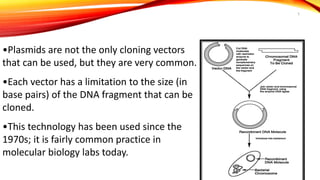
RECOMBINANT DNA TECHNOLOGY
• The gene of interest is cut from the genome using
restriction enzymes.
• It is then joined with a similarly cut DNA molecule, a
plasmid. The plasmid is known as the cloning vector.
• Plasmids are circular molecules found in bacteria that
are separate from the bacterium’s normal genome.
• Plasmids are self-replicating, allowing the new
recombinant DNA molecule to produce its gene product
in its new environment.
4
•Plasmids are not the only cloning vectors
that can be used, but they are very common.
•Each vector has a limitation to the size (in
base pairs) of the DNA fragment that can be
cloned.
•This technology has been used since the
1970s; it is fairly common practice in
molecular biology labs today.
5
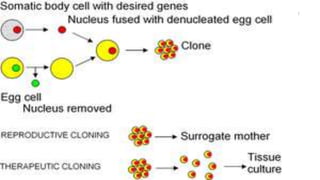
REPRODUCTIVE CLONING
• The generation of a new animal that has the same nuclear DNA as a
previously existing animal.
• Artificial Embryo Twinning: A blastomere is induced to split, forming
identical twins.
• Nuclear Somatic Transfer: The nucleus of an adult body (somatic) cell is
transferred into an egg which has had its nucleus removed. After
treatment to make it begin dividing, the embryo is transplanted into a
host uterus.
• Dolly was created using nuclear somatic transfer.
• Extremely inefficient, most eggs do not develop into an organism.
6
7
THERAPEUTIC CLONING
• Uses the process of nuclear somatic transfer to create an embryo.
• However, the embryo is destroyed and harvested for stem cells.
• Stem cells are undifferentiated and retain the ability to develop
into many cell types depending on their potency.
• Totipotent cells can develop into any tissue in the human body,
plus tissues needed for development such as placental cells.
• Pluripotent cells can develop into almost all cells, but cannot
produce a new organism.
8
THERAPEUTIC CLONING
• Also multipotent and unipotent cells that can only develop into a
specific tissue or cell type. These are obviously less useful.
• These cell cultures are maintained in a “lineage.” Dr. Hwang claimed to
have several human stem cell lineages.
• An embryo must be destroyed, whether it be naturally or artificially
created.
• Can possibly use stem cells to treat cancer, regrow damaged nerve or
muscle cells, etc.
• Due to the controversy stirred by recent events, it is unclear how far
science has progressed towards creating and maintaing human stem
cell lines.
9
BIOETHICS REQUIRED FOR CLONING OR RESEARCH
• Cloning is one of the most controversial issues in today’s society
due to every person’s own set of moral beliefs.
• There are many different policies that must be considered when
conducting clinical research.
1) Value - when doing experimentation with cloning, we must first
decide whether or not the conclusions will lead to some sort of
improvement in health and well-being.
2) Scientific Validity – there must be a clear objective for cloning.
Cloning research must be based on proven scientific knowledge
and methods.
10
BIOETHICS REQUIRED FOR CLONING OR RESEARCH
3) Fair Subject Selection - In choosing subjects to take part in
cloning, there mustn’t be any biases or discrimination.
4) Favorable risk-benefit ratio - minimize the risk and maximize the
benefits of cloning.
5) Independent Review – A board reviews the topics and ethical
issues of cloning.
6) Consent – When human cloning begins it will be relevant that the
subject give consent to the experimentation.
7) Respect for Enrolled Subjects – Those who take place in cloning
research or processes must be guaranteed their human rights and be
given the proper respect
11
BIOETHICS INVOLVED IN ANIMAL CLONING
Different Bioethics involved in cloning described below:
• Survival rate of cloned embryos low
• Over weighing of calves at birth
• Breeders may want to keep their animal unique
• Breeders may want to create better offspring
•Poor development of heart, lung and immune system
• Might have genetic disorder
12
BIOETHICS INVOLVED IN HUMAN CLONING
Humans Cloning is Ethically Unacceptable due to following
factors;
• Controlling Someone Else's makeup
• Instrumentality
• Infertility - an Exception to Instrumentality
• Psychological Effects - Identity and Relationship
• Physical Risk
• Social Risk
13
WHY HUMANS CLONING IS ETHICALLY UNACCEPTABLE
1. CONTROLLING SOMEONE ELSE‘S GENETIC MAKEUP:
Child can reject any aspect of its upbringing, but it could never reject the
genes that were chosen for it
• Such control by one human over another is incompatible with the ethical
notion of human freedom, in the sense of that each individual's genetic
identity should be inherently unpredictable and unplanned
2. INSTRUMENTALALITY:
• Cloning raises a number of concerns arising from its consequences, of which
instrumentality and risk are of especial importance.
14
3.INFERTILITY - AN EXCEPTION TO INSTRUMENTALITY:
• An exception to this objection would be the idea of producing
a child from an infertile couple by cloning one of them.
• But this raises other problems. Instead of being the unique
genetic product of both parents, the child is a copy of one of
them.
• It would not be the biological child of both parents in the
normal sense.
15
4.PSYCHOLOGICAL EFFECTS - IDENTITY AND RELATIONSHIP:
• Would the clone feel that he or she was just a copy of
someone else who's already existed and not really
themselves?
• Am I really someone else but put into a different womb?
• What will be my relationship to the one I was cloned from?
• No one can predict with any degree of assurance what the
response would be.
16
5.PHYSICAL RISK:
• To repeat the same thing on humans would be giving both the mother and
the potential fetus an unacceptably high risk of damage.
• How many abnormal babies would have to be produced to get one right?
• Roslin researchers have said that there is no experiment that could be done
to prove the safety of human cloning without causing serious risk to
humans in the process.
6. SOCIAL RISK:
Human cloning would bring grave risks of abuses to human dignity and
exploitation by unscrupulous people.
17
RELIGIOUS VIEWS ABOUT CLONING
Religious views about cloning are mixed
ISLAM:
• The cloning of specific parts of the human body for medical
purposes is not prohibited in ISLAM but to clone the whole
human body would not be permitted under any circumstances
but on the issue of animal ethics he takes a more lenient
position.
18
RELIGIOUS VIEWS ABOUT CLONING
CHRISTIANITY:
The World Council of Churches opposed cloning of both human
embryos and whole humans in February 2006.
The United Methodist Church opposed research and reproductive
cloning in May 2000 and again in May 2004.
RAELISM:
is the only religious group of which any part (specifically, the
religion's medical arm Cloned) has claimed to have successfully
cloned a human being. Cloned claims that cloning will bring
humanity closer to immortality
19
LAW'S THAT CONTROL CLONING
• There have been numerous bills that have been introduced into
Congress to prohibit or control cloning practices.
• Congress explains that cloning is illegal in the following terms:
• “It shall be unlawful for any person or entity –
1) to perform or attempt human cloning
2) to participate in an attempt to perform human cloning
3) to ship or receive the product of human cloning for any purpose.
• Federal funding of cloning is prohibited in the US.
20
NATIONAL INSTITUTE OF HEALTH
According to National Institute of Health:
•Research should be allowed on preexisting embryos.
•In certain compelling instances, researchers would be allowed
to remove embryonic cells from embryos that were meant for
in vitro fertilization.
•Impregnating clone embryos into humans should be banned.
21
NATIONAL BIOETHICS ADVISORY COMMISSION
According to National Bioethics Advisory Commission:
• It is morally unacceptable for anyone in public or private sector
to clone humans.
•Any attempt to clone humans is irresponsible and unethical.
•It is ok to clone DNA sequences, cell lines, and animals
because it does not raise the issues human cloning does.
•There should be regulations on the humane useof animals.
22
23

BIOETHICS INVOLVED IN CLONING

  • 1.
    TOPIC: BIOETHICS INVOLVEDIN CLONING PRESENTED BY: MOHSIN SHAD (2013-BC-005) PRESENTED TO: MAM SHAGUFTA SAEED 1
  • 2.
    WHAT IS BIO-ETHICS? •The study of the ethical and moral implications of new biological discoveries and biomedical advances, as in the fields of genetic engineering and drug research 2
  • 3.
    CLONING: WHAT ISIT ? •The production of multiple, exact copies of a single gene, DNA fragment, cell line, or organism. •3 types of cloning technology today: 1.Recombinant DNA technology, 2.Reproductive cloning 3.Therapeutic cloning 3
  • 4.
    RECOMBINANT DNA TECHNOLOGY •The gene of interest is cut from the genome using restriction enzymes. • It is then joined with a similarly cut DNA molecule, a plasmid. The plasmid is known as the cloning vector. • Plasmids are circular molecules found in bacteria that are separate from the bacterium’s normal genome. • Plasmids are self-replicating, allowing the new recombinant DNA molecule to produce its gene product in its new environment. 4
  • 5.
    •Plasmids are notthe only cloning vectors that can be used, but they are very common. •Each vector has a limitation to the size (in base pairs) of the DNA fragment that can be cloned. •This technology has been used since the 1970s; it is fairly common practice in molecular biology labs today. 5
  • 6.
    REPRODUCTIVE CLONING • Thegeneration of a new animal that has the same nuclear DNA as a previously existing animal. • Artificial Embryo Twinning: A blastomere is induced to split, forming identical twins. • Nuclear Somatic Transfer: The nucleus of an adult body (somatic) cell is transferred into an egg which has had its nucleus removed. After treatment to make it begin dividing, the embryo is transplanted into a host uterus. • Dolly was created using nuclear somatic transfer. • Extremely inefficient, most eggs do not develop into an organism. 6
  • 7.
  • 8.
    THERAPEUTIC CLONING • Usesthe process of nuclear somatic transfer to create an embryo. • However, the embryo is destroyed and harvested for stem cells. • Stem cells are undifferentiated and retain the ability to develop into many cell types depending on their potency. • Totipotent cells can develop into any tissue in the human body, plus tissues needed for development such as placental cells. • Pluripotent cells can develop into almost all cells, but cannot produce a new organism. 8
  • 9.
    THERAPEUTIC CLONING • Alsomultipotent and unipotent cells that can only develop into a specific tissue or cell type. These are obviously less useful. • These cell cultures are maintained in a “lineage.” Dr. Hwang claimed to have several human stem cell lineages. • An embryo must be destroyed, whether it be naturally or artificially created. • Can possibly use stem cells to treat cancer, regrow damaged nerve or muscle cells, etc. • Due to the controversy stirred by recent events, it is unclear how far science has progressed towards creating and maintaing human stem cell lines. 9
  • 10.
    BIOETHICS REQUIRED FORCLONING OR RESEARCH • Cloning is one of the most controversial issues in today’s society due to every person’s own set of moral beliefs. • There are many different policies that must be considered when conducting clinical research. 1) Value - when doing experimentation with cloning, we must first decide whether or not the conclusions will lead to some sort of improvement in health and well-being. 2) Scientific Validity – there must be a clear objective for cloning. Cloning research must be based on proven scientific knowledge and methods. 10
  • 11.
    BIOETHICS REQUIRED FORCLONING OR RESEARCH 3) Fair Subject Selection - In choosing subjects to take part in cloning, there mustn’t be any biases or discrimination. 4) Favorable risk-benefit ratio - minimize the risk and maximize the benefits of cloning. 5) Independent Review – A board reviews the topics and ethical issues of cloning. 6) Consent – When human cloning begins it will be relevant that the subject give consent to the experimentation. 7) Respect for Enrolled Subjects – Those who take place in cloning research or processes must be guaranteed their human rights and be given the proper respect 11
  • 12.
    BIOETHICS INVOLVED INANIMAL CLONING Different Bioethics involved in cloning described below: • Survival rate of cloned embryos low • Over weighing of calves at birth • Breeders may want to keep their animal unique • Breeders may want to create better offspring •Poor development of heart, lung and immune system • Might have genetic disorder 12
  • 13.
    BIOETHICS INVOLVED INHUMAN CLONING Humans Cloning is Ethically Unacceptable due to following factors; • Controlling Someone Else's makeup • Instrumentality • Infertility - an Exception to Instrumentality • Psychological Effects - Identity and Relationship • Physical Risk • Social Risk 13
  • 14.
    WHY HUMANS CLONINGIS ETHICALLY UNACCEPTABLE 1. CONTROLLING SOMEONE ELSE‘S GENETIC MAKEUP: Child can reject any aspect of its upbringing, but it could never reject the genes that were chosen for it • Such control by one human over another is incompatible with the ethical notion of human freedom, in the sense of that each individual's genetic identity should be inherently unpredictable and unplanned 2. INSTRUMENTALALITY: • Cloning raises a number of concerns arising from its consequences, of which instrumentality and risk are of especial importance. 14
  • 15.
    3.INFERTILITY - ANEXCEPTION TO INSTRUMENTALITY: • An exception to this objection would be the idea of producing a child from an infertile couple by cloning one of them. • But this raises other problems. Instead of being the unique genetic product of both parents, the child is a copy of one of them. • It would not be the biological child of both parents in the normal sense. 15
  • 16.
    4.PSYCHOLOGICAL EFFECTS -IDENTITY AND RELATIONSHIP: • Would the clone feel that he or she was just a copy of someone else who's already existed and not really themselves? • Am I really someone else but put into a different womb? • What will be my relationship to the one I was cloned from? • No one can predict with any degree of assurance what the response would be. 16
  • 17.
    5.PHYSICAL RISK: • Torepeat the same thing on humans would be giving both the mother and the potential fetus an unacceptably high risk of damage. • How many abnormal babies would have to be produced to get one right? • Roslin researchers have said that there is no experiment that could be done to prove the safety of human cloning without causing serious risk to humans in the process. 6. SOCIAL RISK: Human cloning would bring grave risks of abuses to human dignity and exploitation by unscrupulous people. 17
  • 18.
    RELIGIOUS VIEWS ABOUTCLONING Religious views about cloning are mixed ISLAM: • The cloning of specific parts of the human body for medical purposes is not prohibited in ISLAM but to clone the whole human body would not be permitted under any circumstances but on the issue of animal ethics he takes a more lenient position. 18
  • 19.
    RELIGIOUS VIEWS ABOUTCLONING CHRISTIANITY: The World Council of Churches opposed cloning of both human embryos and whole humans in February 2006. The United Methodist Church opposed research and reproductive cloning in May 2000 and again in May 2004. RAELISM: is the only religious group of which any part (specifically, the religion's medical arm Cloned) has claimed to have successfully cloned a human being. Cloned claims that cloning will bring humanity closer to immortality 19
  • 20.
    LAW'S THAT CONTROLCLONING • There have been numerous bills that have been introduced into Congress to prohibit or control cloning practices. • Congress explains that cloning is illegal in the following terms: • “It shall be unlawful for any person or entity – 1) to perform or attempt human cloning 2) to participate in an attempt to perform human cloning 3) to ship or receive the product of human cloning for any purpose. • Federal funding of cloning is prohibited in the US. 20
  • 21.
    NATIONAL INSTITUTE OFHEALTH According to National Institute of Health: •Research should be allowed on preexisting embryos. •In certain compelling instances, researchers would be allowed to remove embryonic cells from embryos that were meant for in vitro fertilization. •Impregnating clone embryos into humans should be banned. 21
  • 22.
    NATIONAL BIOETHICS ADVISORYCOMMISSION According to National Bioethics Advisory Commission: • It is morally unacceptable for anyone in public or private sector to clone humans. •Any attempt to clone humans is irresponsible and unethical. •It is ok to clone DNA sequences, cell lines, and animals because it does not raise the issues human cloning does. •There should be regulations on the humane useof animals. 22
  • 23.