BY DR.
MOATAZ AHMED SALAMA
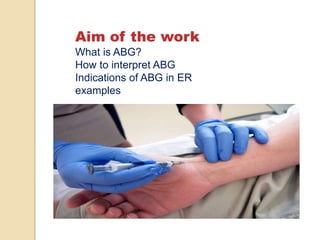
Aim of the work
What is ABG?
How to interpret ABG
Indications of ABG in ER
examples
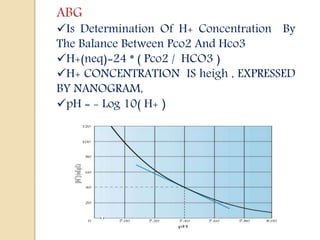
ABG
Is Determination Of H+ Concentration By
The Balance Between Pco2 And Hco3
H+(neq)=24 * ( Pco2 / HCO3 )
H+ CONCENTRATION IS heigh , EXPRESSED
BY NANOGRAM,
pH = - Log 10( H+ )
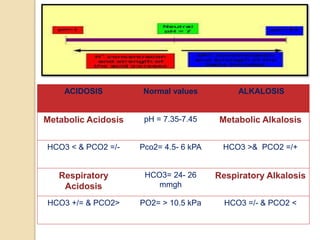
ACIDOSIS Normal values ALKALOSIS
Metabolic Acidosis pH = 7.35-7.45 Metabolic Alkalosis
HCO3 < & PCO2 =/- Pco2= 4.5- 6 kPA HCO3 >& PCO2 =/+
Respiratory
Acidosis
HCO3= 24- 26
mmgh
Respiratory Alkalosis
HCO3 +/= & PCO2> PO2= > 10.5 kPa HCO3 =/- & PCO2 <
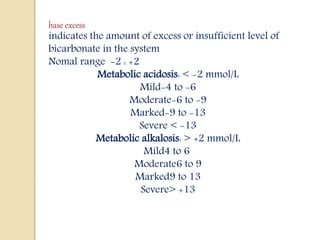
base excess
indicates the amount of excess or insufficient level of
bicarbonate in the system
Nomal range -2 : +2
Metabolic acidosis: < -2 mmol/L
Mild-4 to -6
Moderate-6 to -9
Marked-9 to -13
Severe < -13
Metabolic alkalosis: > +2 mmol/L
Mild4 to 6
Moderate6 to 9
Marked9 to 13
Severe> +13
Degree Of Compensation
In respiratory causes:
oIf acute acidosis: pH falls by 0.08 and HCO3 rises by
1 mmol/L for each 1.5 kPa above 5.5.
oIf chronic acidosis: pH falls by 0.03 and HCO3 rises
by 2-4 mmol/L for each each 1.5 kPa above 5.5 kPa.
oFor respiratory alkalosis, the opposite directions are
present for all changes.
In metabolic causes
oIf metabolic acidosis: Expected PaCO2 = (1.5 x
[HCO3] + 8) +/- 2.
oIn metabolic alkalosis: Expected PaCO2 = (0.9 x
[HCO3] + 9) +/- 2.
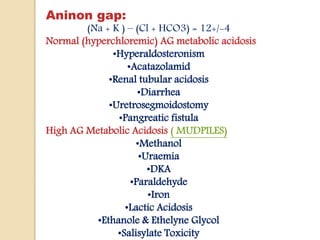
Aninon gap:
(Na + K ) – (Cl + HCO3) = 12+/-4
Normal (hyperchloremic) AG metabolic acidosis
•Hyperaldosteronism
•Acatazolamid
•Renal tubular acidosis
•Diarrhea
•Uretrosegmoidostomy
•Pangreatic fistula
High AG Metabolic Acidosis ( MUDPILES)
•Methanol
•Uraemia
•DKA
•Paraldehyde
•Iron
•Lactic Acidosis
•Ethanole & Ethelyne Glycol
•Salisylate Toxicity
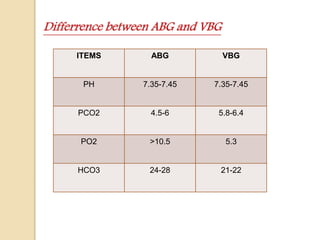
Differrence between ABG and VBG
ITEMS ABG VBG
PH 7.35-7.45 7.35-7.45
PCO2 4.5-6 5.8-6.4
PO2 >10.5 5.3
HCO3 24-28 21-22
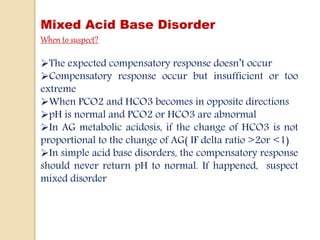
Mixed Acid Base Disorder
When to suspect?
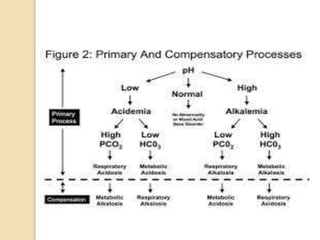
The expected compensatory response doesn’t occur
Compensatory response occur but insufficient or too
extreme
When PCO2 and HCO3 becomes in opposite directions
pH is normal and PCO2 or HCO3 are abnormal
In AG metabolic acidosis, if the change of HCO3 is not
proportional to the change of AG( IF delta ratio >2or <1)
In simple acid base disorders, the compensatory response
should never return pH to normal. If happened, suspect
mixed disorder
Mixed Acid Base Disorder
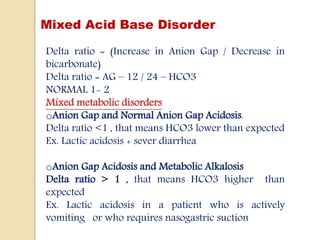
Delta ratio = (Increase in Anion Gap / Decrease in
bicarbonate)
Delta ratio = AG – 12 / 24 – HCO3
NORMAL 1- 2
Mixed metabolic disorders
oAnion Gap and Normal Anion Gap Acidosis.
Delta ratio <1 , that means HCO3 lower than expected
Ex. Lactic acidosis + sever diarrhea
oAnion Gap Acidosis and Metabolic Alkalosis
Delta ratio > 1 , that means HCO3 higher than
expected
Ex. Lactic acidosis in a patient who is actively
vomiting or who requires nasogastric suction
Mixed Acid Base Disorder
Mixed metabolic respiratory disorder
When the PCO2 is elevated and the [HCO3-] reduced,
respiratory acidosis and metabolic acidosis coexist. And vice
vecra
oChronic Respiratory Acidosis and Anion Gap Metabolic
Acidosis
Example:
COPD patient who develops shock and lactic acidosis
oChronic Respiratory Acidosis and Metabolic Alkalosis
Example:
Pulmonary insufficiency and diuretic therapy
oRespiratory Alkalosis and Metabolic Acidosis
Example:
Salicylate intoxication
INDICATIONS OF ABG:
Respiratory failure - in acute and chronic states.
Any severe illness which may lead to a metabolic
acidosis - for example:
Cardiac failure.
Liver failure.
Renal failure.
Hyperglycaemic states
Multiorgan failure.
sepsis
Burns.
Poisons/toxins.
Acute confusion state
Poisons and ABG
Metabolic acidosis
Direct: Salicylate, ethanole, methanol, ethylene
glychol, paraldehyde, iron
Indirect:
•Convulsions: asTCA and theophyllin ( respiratory
alkalosis followed by MA)
•Hypotension: as narcotics, digitalis toxicity
•Hypoxaemia as CO and Cyanid poisoning
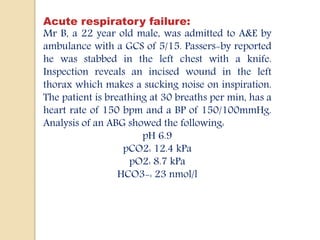
Acute respiratory failure:
Mr B, a 22 year old male, was admitted to A&E by
ambulance with a GCS of 5/15. Passers-by reported
he was stabbed in the left chest with a knife.
Inspection reveals an incised wound in the left
thorax which makes a sucking noise on inspiration.
The patient is breathing at 30 breaths per min, has a
heart rate of 150 bpm and a BP of 150/100mmHg.
Analysis of an ABG showed the following:
pH 6.9
pCO2: 12.4 kPa
pO2: 8.7 kPa
HCO3-: 23 nmol/l
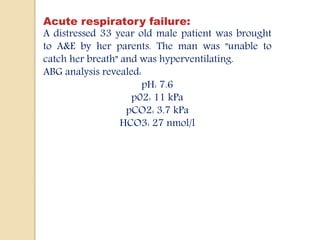
Acute respiratory failure:
A distressed 33 year old male patient was brought
to A&E by her parents. The man was "unable to
catch her breath" and was hyperventilating.
ABG analysis revealed:
pH: 7.6
p02: 11 kPa
pCO2: 3.7 kPa
HCO3: 27 nmol/l
METABOLIC ACIDOSIS
A 21 year-old female is found outside a pub
unconscious and smelling of alcohol. On admission to
hospital, doctors identified the smell as being ketone
bodies rather than alcohol. The patient had a
respiratory rate of 8 breaths/min, heart rate of 60 bpm,
BP 80/60 mmHg and a core temperature of 35 degrees.
ABG revealed:
pH6.9
pO2: 9.3 kPa
pC02 6.2 kPa
HCO3: 9 nmol/l
METABOLIC ALKALOSIS
Mr A is brought into A&E with a severe bout of
vomiting. His vomiting persists despite administration
of antiemetic therapy. As his vomiting continues he
begins to drop in consciousness, his breathing becomes
shallow and his respiratory rate falls. You take an ABG
sample and the results are as follows (the results were
taken on room air):
pH: 7.55
p02: 8 kpa
pC02: 10 kpa
HCO3: 40 mmol/l
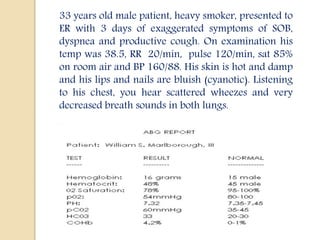
33 years old male patient, heavy smoker, presented to
ER with 3 days of exaggerated symptoms of SOB,
dyspnea and productive cough. On examination his
temp was 38.5, RR 20/min, pulse 120/min, sat 85%
on room air and BP 160/88. His skin is hot and damp
and his lips and nails are bluish (cyanotic). Listening
to his chest, you hear scattered wheezes and very
decreased breath sounds in both lungs.
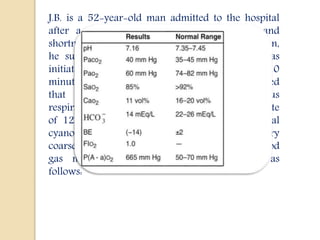
J.B. is a 52-year-old man admitted to the hospital
after a sudden onset of severe chest pain and
shortness of breath. Within 5 min after presentation,
he suffered a cardiopulmonary arrest. CPR was
initiated and was successful after approximately 10
minutes. The initial examination after CPR revealed
that pt had hypotension with a spontaneous
respiratory rate of 40 breaths/min and a heart rate
of 120 beats/min. He was comatose, with central
cyanosis, cool extremities, inspiratory and expiratory
coarse crackles, and weak pulses. The initial blood
gas measurements after resuscitation were as
follows:
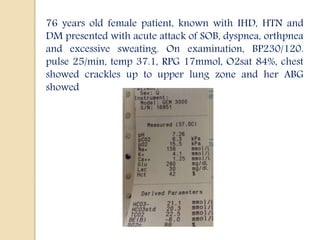
76 years old female patient, known with IHD, HTN and
DM presented with acute attack of SOB, dyspnea, orthpnea
and excessive sweating. On examination, BP230/120.
pulse 25/min, temp 37.1, RPG 17mmol, O2sat 84%, chest
showed crackles up to upper lung zone and her ABG
showed
16 years old female patient with no past medical hx,
presented with acute confusional state following 2
days of mild abd. Pain and vomiting twice. On
examination patient was afebrile, BP130/90, RR
10/min, RPG 6.5, pupils RRR and neck lax and her
ABG was as follow:
pH: 70.8
PCO2: 8.5 kPa
PO2: 9.5 kPa
HCO3: 15
SUMMARY
ABG IS ONE OF THE MOST USEFULL DIAGNOSTIC
TOOLS IN EMERGENCY MEDICINE
PH IS THE –LOG (H+)
THE PRIMARY PATHOLOGY MAY BE METABOLIC OR
RESPIRATORY OR MIXED
COMPENSATORY MECHANISMS ARE RESPONSIBLE
FOR RETURN PH TO NORMAL RANGE
ANION GAP SHOULD BE CONCERNED IN METABOLIC
INSULTS
ABG FOR EMERGENCY DEPARTMENT

ABG FOR EMERGENCY DEPARTMENT

  • 1.
  • 2.
    Aim of thework What is ABG? How to interpret ABG Indications of ABG in ER examples
  • 3.
    ABG Is Determination OfH+ Concentration By The Balance Between Pco2 And Hco3 H+(neq)=24 * ( Pco2 / HCO3 ) H+ CONCENTRATION IS heigh , EXPRESSED BY NANOGRAM, pH = - Log 10( H+ )
  • 4.
    ACIDOSIS Normal valuesALKALOSIS Metabolic Acidosis pH = 7.35-7.45 Metabolic Alkalosis HCO3 < & PCO2 =/- Pco2= 4.5- 6 kPA HCO3 >& PCO2 =/+ Respiratory Acidosis HCO3= 24- 26 mmgh Respiratory Alkalosis HCO3 +/= & PCO2> PO2= > 10.5 kPa HCO3 =/- & PCO2 <
  • 6.
    base excess indicates theamount of excess or insufficient level of bicarbonate in the system Nomal range -2 : +2 Metabolic acidosis: < -2 mmol/L Mild-4 to -6 Moderate-6 to -9 Marked-9 to -13 Severe < -13 Metabolic alkalosis: > +2 mmol/L Mild4 to 6 Moderate6 to 9 Marked9 to 13 Severe> +13
  • 7.
    Degree Of Compensation Inrespiratory causes: oIf acute acidosis: pH falls by 0.08 and HCO3 rises by 1 mmol/L for each 1.5 kPa above 5.5. oIf chronic acidosis: pH falls by 0.03 and HCO3 rises by 2-4 mmol/L for each each 1.5 kPa above 5.5 kPa. oFor respiratory alkalosis, the opposite directions are present for all changes. In metabolic causes oIf metabolic acidosis: Expected PaCO2 = (1.5 x [HCO3] + 8) +/- 2. oIn metabolic alkalosis: Expected PaCO2 = (0.9 x [HCO3] + 9) +/- 2.
  • 8.
    Aninon gap: (Na +K ) – (Cl + HCO3) = 12+/-4 Normal (hyperchloremic) AG metabolic acidosis •Hyperaldosteronism •Acatazolamid •Renal tubular acidosis •Diarrhea •Uretrosegmoidostomy •Pangreatic fistula High AG Metabolic Acidosis ( MUDPILES) •Methanol •Uraemia •DKA •Paraldehyde •Iron •Lactic Acidosis •Ethanole & Ethelyne Glycol •Salisylate Toxicity
  • 9.
    Differrence between ABGand VBG ITEMS ABG VBG PH 7.35-7.45 7.35-7.45 PCO2 4.5-6 5.8-6.4 PO2 >10.5 5.3 HCO3 24-28 21-22
  • 10.
    Mixed Acid BaseDisorder When to suspect? The expected compensatory response doesn’t occur Compensatory response occur but insufficient or too extreme When PCO2 and HCO3 becomes in opposite directions pH is normal and PCO2 or HCO3 are abnormal In AG metabolic acidosis, if the change of HCO3 is not proportional to the change of AG( IF delta ratio >2or <1) In simple acid base disorders, the compensatory response should never return pH to normal. If happened, suspect mixed disorder
  • 11.
    Mixed Acid BaseDisorder Delta ratio = (Increase in Anion Gap / Decrease in bicarbonate) Delta ratio = AG – 12 / 24 – HCO3 NORMAL 1- 2 Mixed metabolic disorders oAnion Gap and Normal Anion Gap Acidosis. Delta ratio <1 , that means HCO3 lower than expected Ex. Lactic acidosis + sever diarrhea oAnion Gap Acidosis and Metabolic Alkalosis Delta ratio > 1 , that means HCO3 higher than expected Ex. Lactic acidosis in a patient who is actively vomiting or who requires nasogastric suction
  • 12.
    Mixed Acid BaseDisorder Mixed metabolic respiratory disorder When the PCO2 is elevated and the [HCO3-] reduced, respiratory acidosis and metabolic acidosis coexist. And vice vecra oChronic Respiratory Acidosis and Anion Gap Metabolic Acidosis Example: COPD patient who develops shock and lactic acidosis oChronic Respiratory Acidosis and Metabolic Alkalosis Example: Pulmonary insufficiency and diuretic therapy oRespiratory Alkalosis and Metabolic Acidosis Example: Salicylate intoxication
  • 13.
    INDICATIONS OF ABG: Respiratoryfailure - in acute and chronic states. Any severe illness which may lead to a metabolic acidosis - for example: Cardiac failure. Liver failure. Renal failure. Hyperglycaemic states Multiorgan failure. sepsis Burns. Poisons/toxins. Acute confusion state
  • 14.
    Poisons and ABG Metabolicacidosis Direct: Salicylate, ethanole, methanol, ethylene glychol, paraldehyde, iron Indirect: •Convulsions: asTCA and theophyllin ( respiratory alkalosis followed by MA) •Hypotension: as narcotics, digitalis toxicity •Hypoxaemia as CO and Cyanid poisoning
  • 15.
    Acute respiratory failure: MrB, a 22 year old male, was admitted to A&E by ambulance with a GCS of 5/15. Passers-by reported he was stabbed in the left chest with a knife. Inspection reveals an incised wound in the left thorax which makes a sucking noise on inspiration. The patient is breathing at 30 breaths per min, has a heart rate of 150 bpm and a BP of 150/100mmHg. Analysis of an ABG showed the following: pH 6.9 pCO2: 12.4 kPa pO2: 8.7 kPa HCO3-: 23 nmol/l
  • 16.
    Acute respiratory failure: Adistressed 33 year old male patient was brought to A&E by her parents. The man was "unable to catch her breath" and was hyperventilating. ABG analysis revealed: pH: 7.6 p02: 11 kPa pCO2: 3.7 kPa HCO3: 27 nmol/l
  • 17.
    METABOLIC ACIDOSIS A 21year-old female is found outside a pub unconscious and smelling of alcohol. On admission to hospital, doctors identified the smell as being ketone bodies rather than alcohol. The patient had a respiratory rate of 8 breaths/min, heart rate of 60 bpm, BP 80/60 mmHg and a core temperature of 35 degrees. ABG revealed: pH6.9 pO2: 9.3 kPa pC02 6.2 kPa HCO3: 9 nmol/l
  • 18.
    METABOLIC ALKALOSIS Mr Ais brought into A&E with a severe bout of vomiting. His vomiting persists despite administration of antiemetic therapy. As his vomiting continues he begins to drop in consciousness, his breathing becomes shallow and his respiratory rate falls. You take an ABG sample and the results are as follows (the results were taken on room air): pH: 7.55 p02: 8 kpa pC02: 10 kpa HCO3: 40 mmol/l
  • 19.
    33 years oldmale patient, heavy smoker, presented to ER with 3 days of exaggerated symptoms of SOB, dyspnea and productive cough. On examination his temp was 38.5, RR 20/min, pulse 120/min, sat 85% on room air and BP 160/88. His skin is hot and damp and his lips and nails are bluish (cyanotic). Listening to his chest, you hear scattered wheezes and very decreased breath sounds in both lungs.
  • 20.
    J.B. is a52-year-old man admitted to the hospital after a sudden onset of severe chest pain and shortness of breath. Within 5 min after presentation, he suffered a cardiopulmonary arrest. CPR was initiated and was successful after approximately 10 minutes. The initial examination after CPR revealed that pt had hypotension with a spontaneous respiratory rate of 40 breaths/min and a heart rate of 120 beats/min. He was comatose, with central cyanosis, cool extremities, inspiratory and expiratory coarse crackles, and weak pulses. The initial blood gas measurements after resuscitation were as follows:
  • 21.
    76 years oldfemale patient, known with IHD, HTN and DM presented with acute attack of SOB, dyspnea, orthpnea and excessive sweating. On examination, BP230/120. pulse 25/min, temp 37.1, RPG 17mmol, O2sat 84%, chest showed crackles up to upper lung zone and her ABG showed
  • 22.
    16 years oldfemale patient with no past medical hx, presented with acute confusional state following 2 days of mild abd. Pain and vomiting twice. On examination patient was afebrile, BP130/90, RR 10/min, RPG 6.5, pupils RRR and neck lax and her ABG was as follow: pH: 70.8 PCO2: 8.5 kPa PO2: 9.5 kPa HCO3: 15
  • 23.
    SUMMARY ABG IS ONEOF THE MOST USEFULL DIAGNOSTIC TOOLS IN EMERGENCY MEDICINE PH IS THE –LOG (H+) THE PRIMARY PATHOLOGY MAY BE METABOLIC OR RESPIRATORY OR MIXED COMPENSATORY MECHANISMS ARE RESPONSIBLE FOR RETURN PH TO NORMAL RANGE ANION GAP SHOULD BE CONCERNED IN METABOLIC INSULTS

Editor's Notes

  • #22 Mixed respiratory and metabolic acidosis