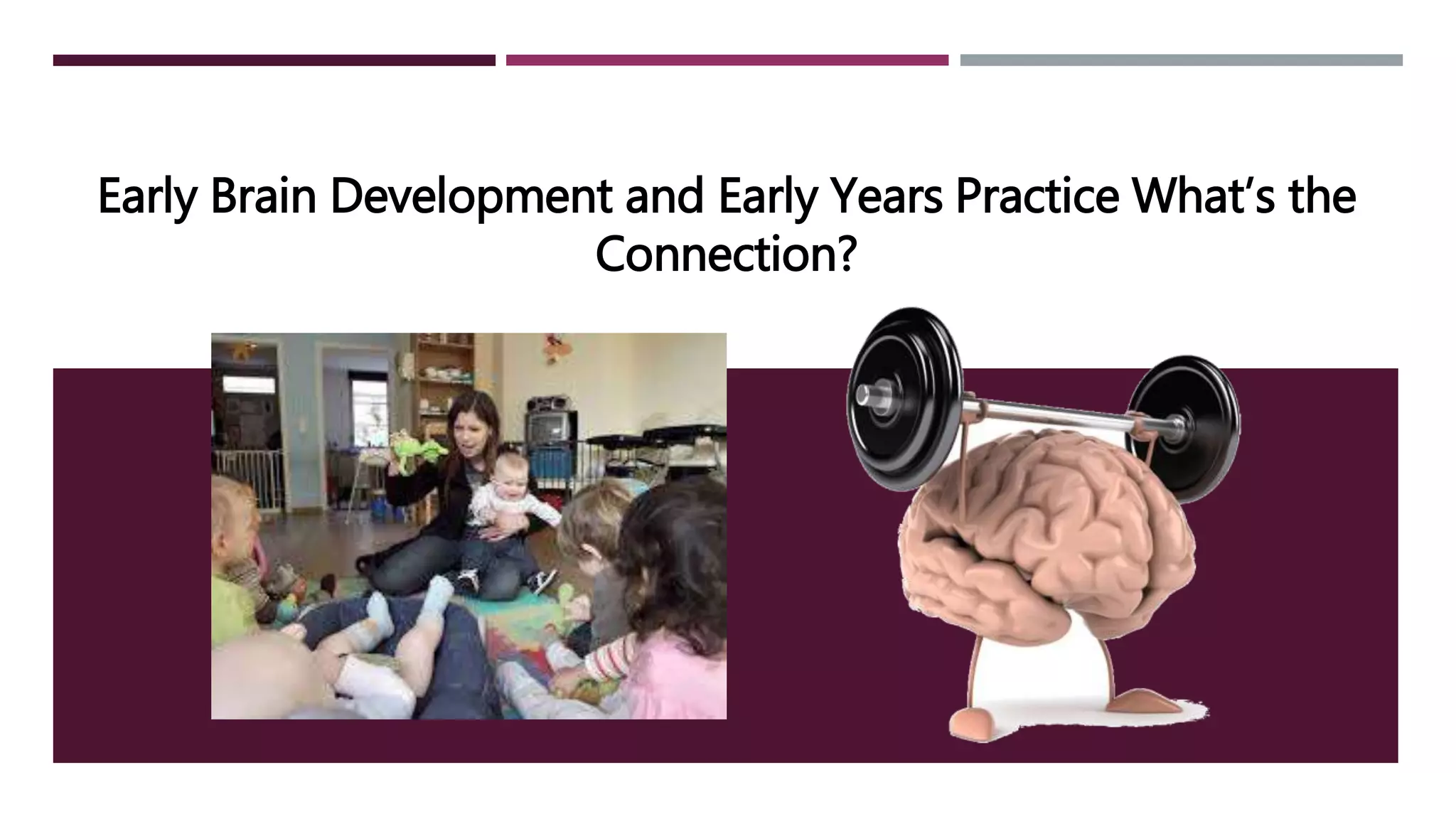
Early Brain Development and Early Years Practice What’s the
Connection?
LEARNING OUTCOMES:
By the end of this workshop, you should be able to:
1. Identify at least three key aspects of early brain
development
2. Show understanding of the connection between
early brain development and delivery of quality child
care
3. To think of at least one action you will implement in
your practice, as a result of this workshop
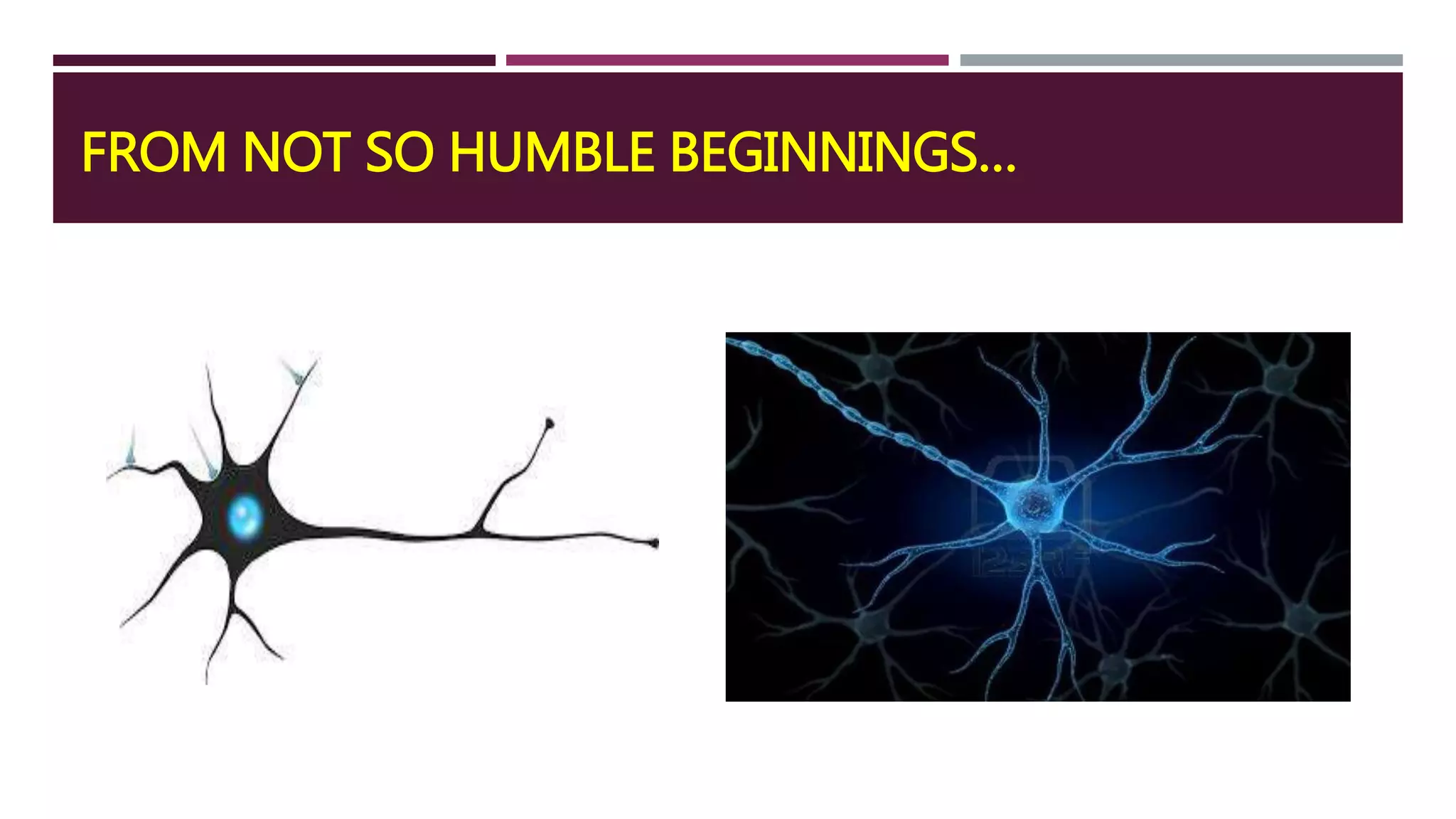
FROM NOT SO HUMBLE BEGINNINGS…
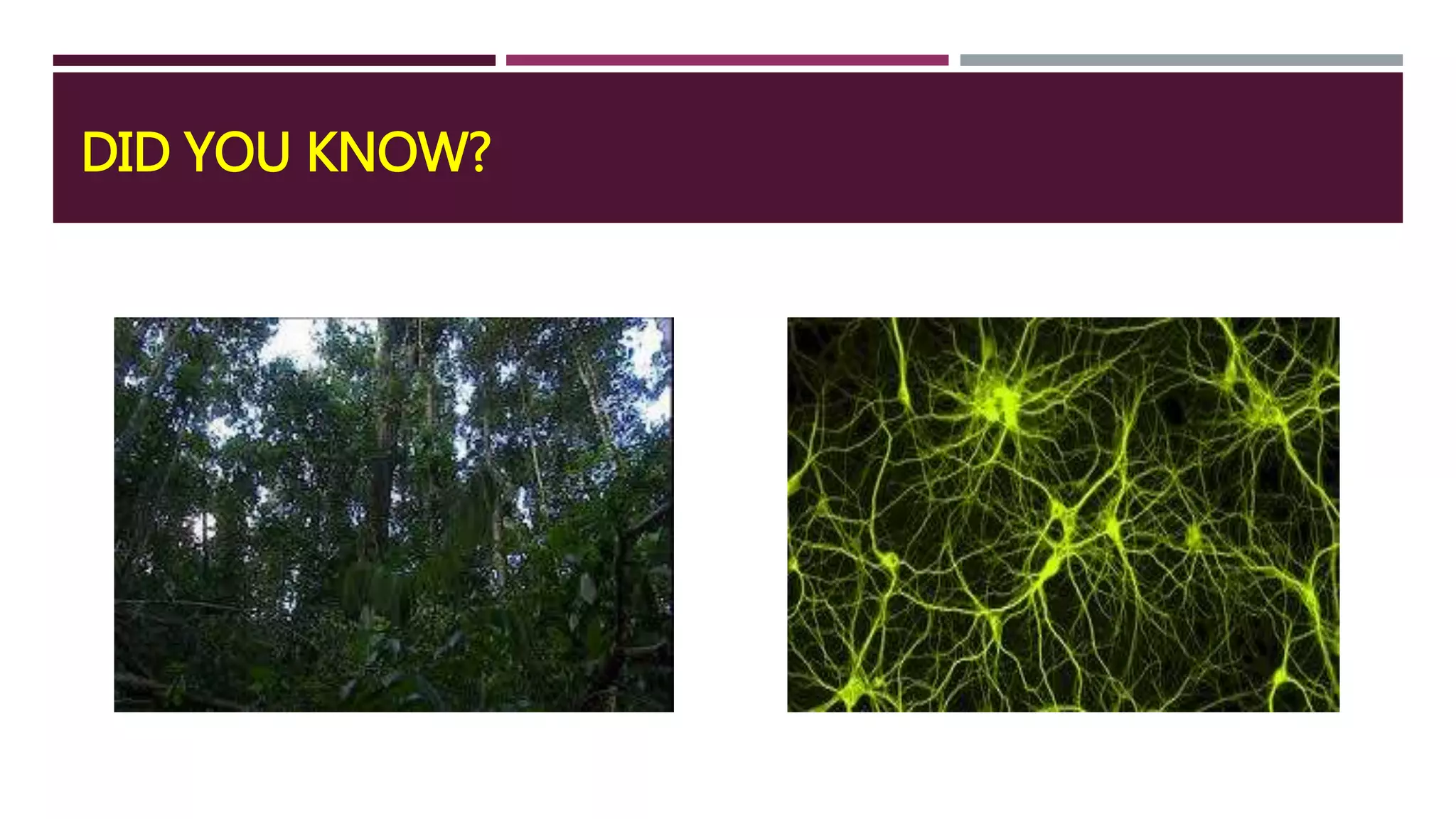
DID YOU KNOW?
 Ensuring that the brain achieves its optimum development and nurturing during this peak
 period of growth is therefore vitally important, and enables babies to achieve the best start in life.
 From birth to age 18 months, connections in the brain are created at a rate of one million
 per second! The earliest experiences shape a baby’s brain development, and have a lifelong
 impact on that baby’s mental and emotional health.
 TAKEN FROM (AND USE MORE OF)
http://www.wavetrust.org/sites/default/files/reports/1001%20Critical%20Days%20-
%20The%20Importance%20of%20the%20Conception%20to%20Age%20Two%20Period%20Refreshed_0.
pdf
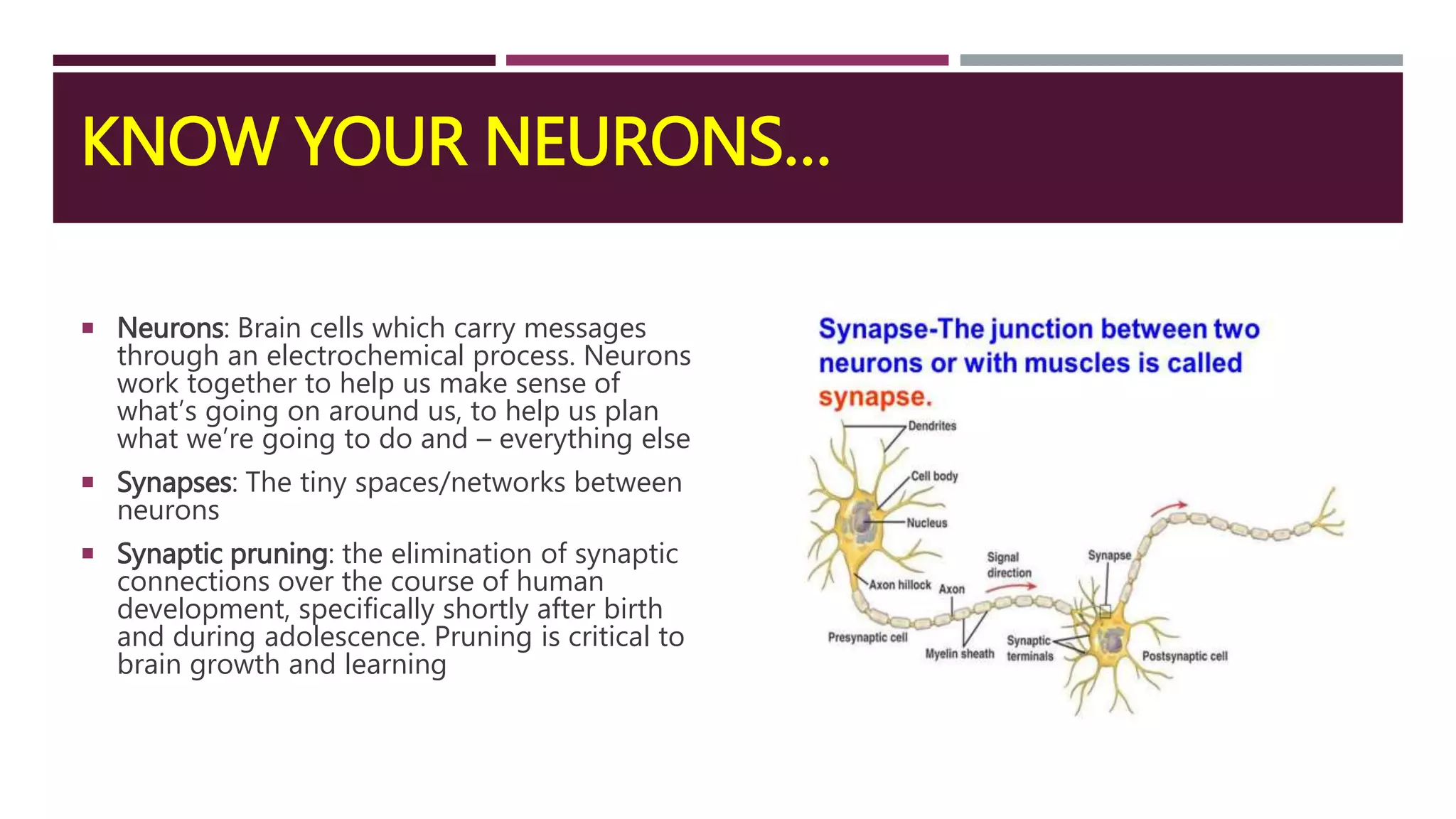
KNOW YOUR NEURONS…
 Neurons: Brain cells which carry messages
through an electrochemical process. Neurons
work together to help us make sense of
what’s going on around us, to help us plan
what we’re going to do and – everything else
 Synapses: The tiny spaces/networks between
neurons
 Synaptic pruning: the elimination of synaptic
connections over the course of human
development, specifically shortly after birth
and during adolescence. Pruning is critical to
brain growth and learning
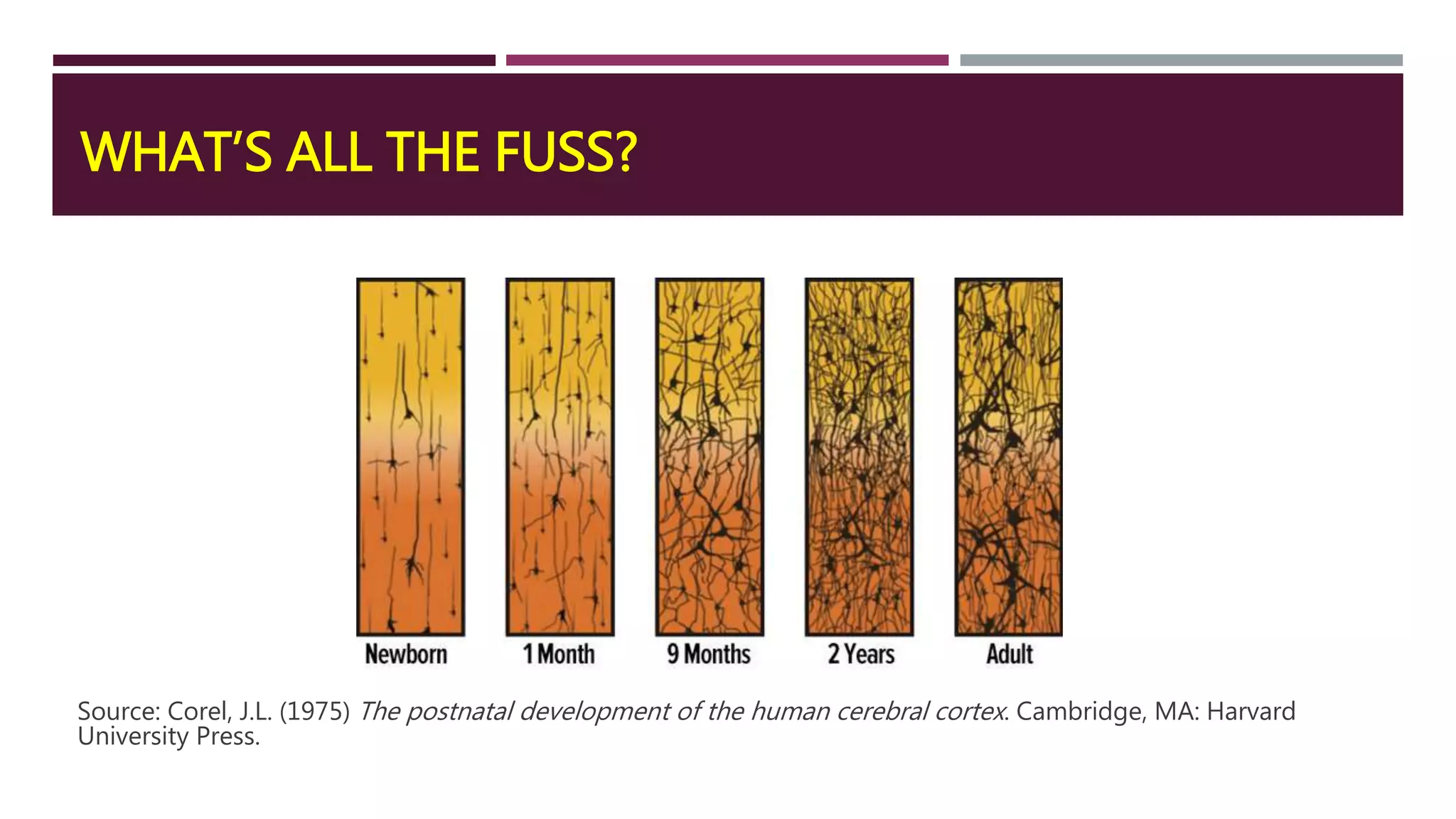
WHAT’S ALL THE FUSS?
Source: Corel, J.L. (1975) The postnatal development of the human cerebral cortex. Cambridge, MA: Harvard
University Press.
THE YOUNG BRAIN IN TROUBLE
 https://www.youtube.com/watch?v=HguwWGoQ
-rQ (53 secs)
 What are the most salient points for you from
this clip?
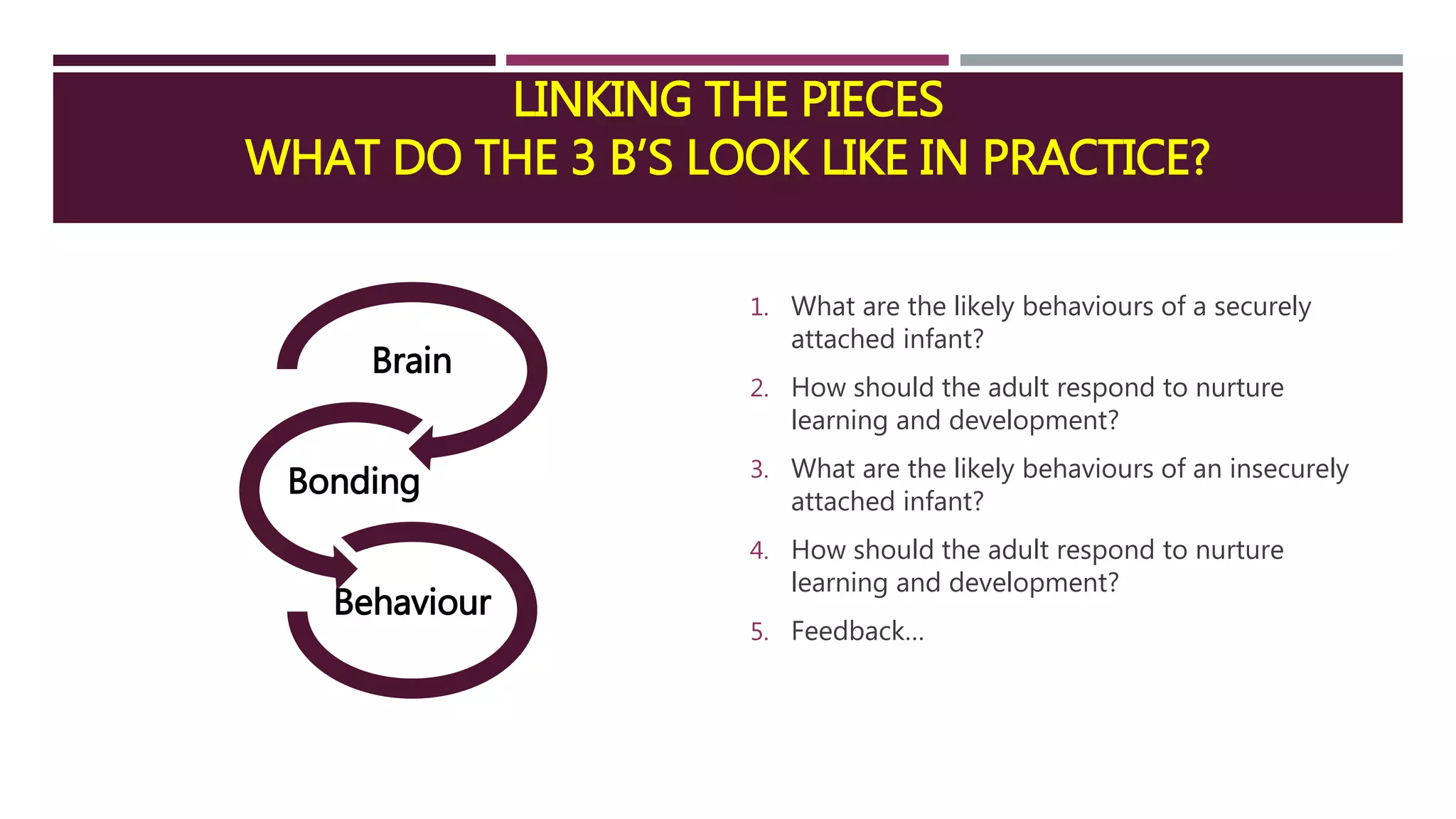
LINKING THE PIECES
WHAT DO THE 3 B’S LOOK LIKE IN PRACTICE?
Brain
Bonding
Behaviour
1. What are the likely behaviours of a securely
attached infant?
2. How should the adult respond to nurture
learning and development?
3. What are the likely behaviours of an insecurely
attached infant?
4. How should the adult respond to nurture
learning and development?
5. Feedback…
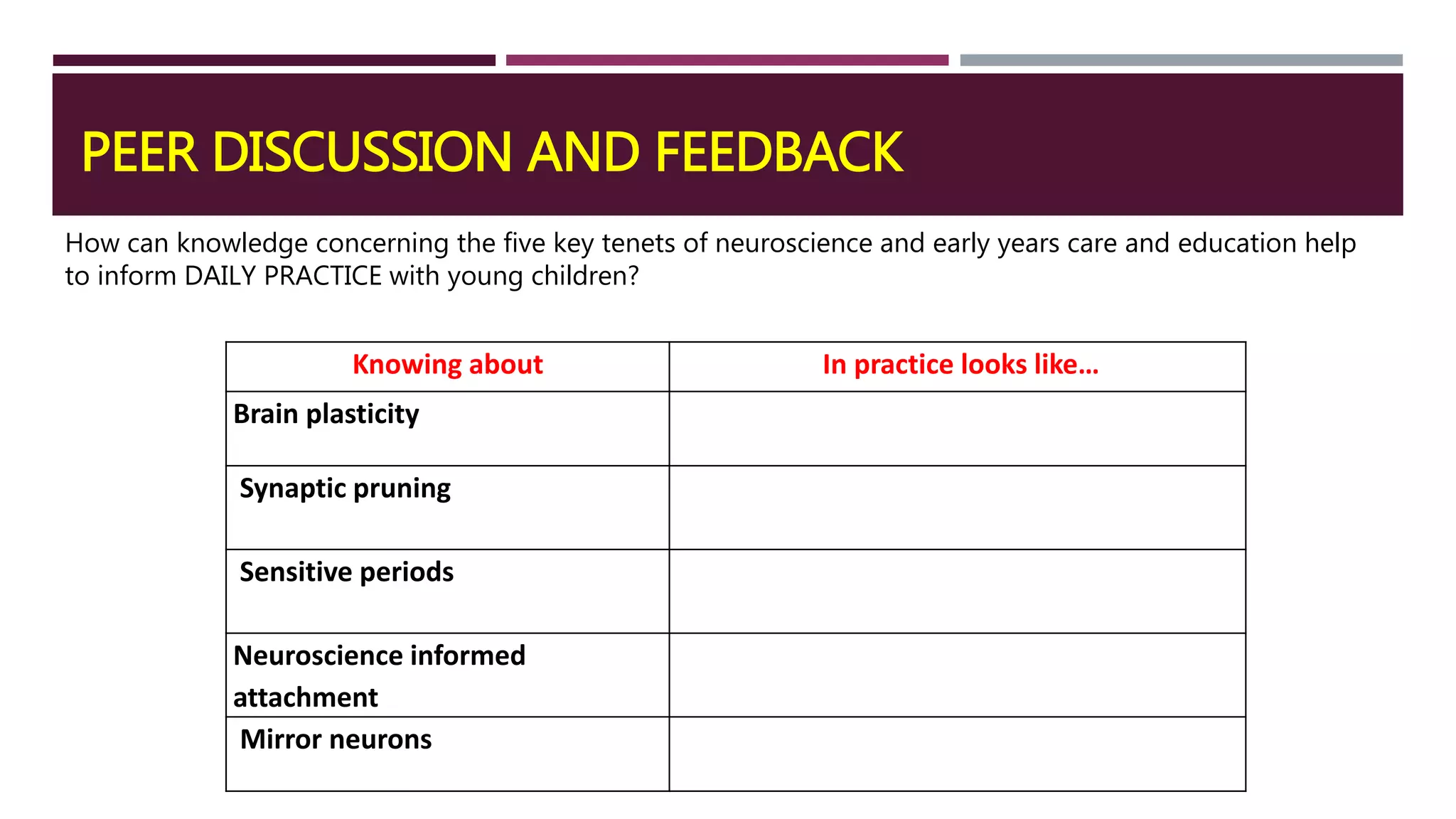
PEER DISCUSSION AND FEEDBACK
Knowing about In practice looks like…
Brain plasticity
Synaptic pruning
Sensitive periods
Neuroscience informed
attachment
Mirror neurons
How can knowledge concerning the five key tenets of neuroscience and early years care and education help
to inform DAILY PRACTICE with young children?
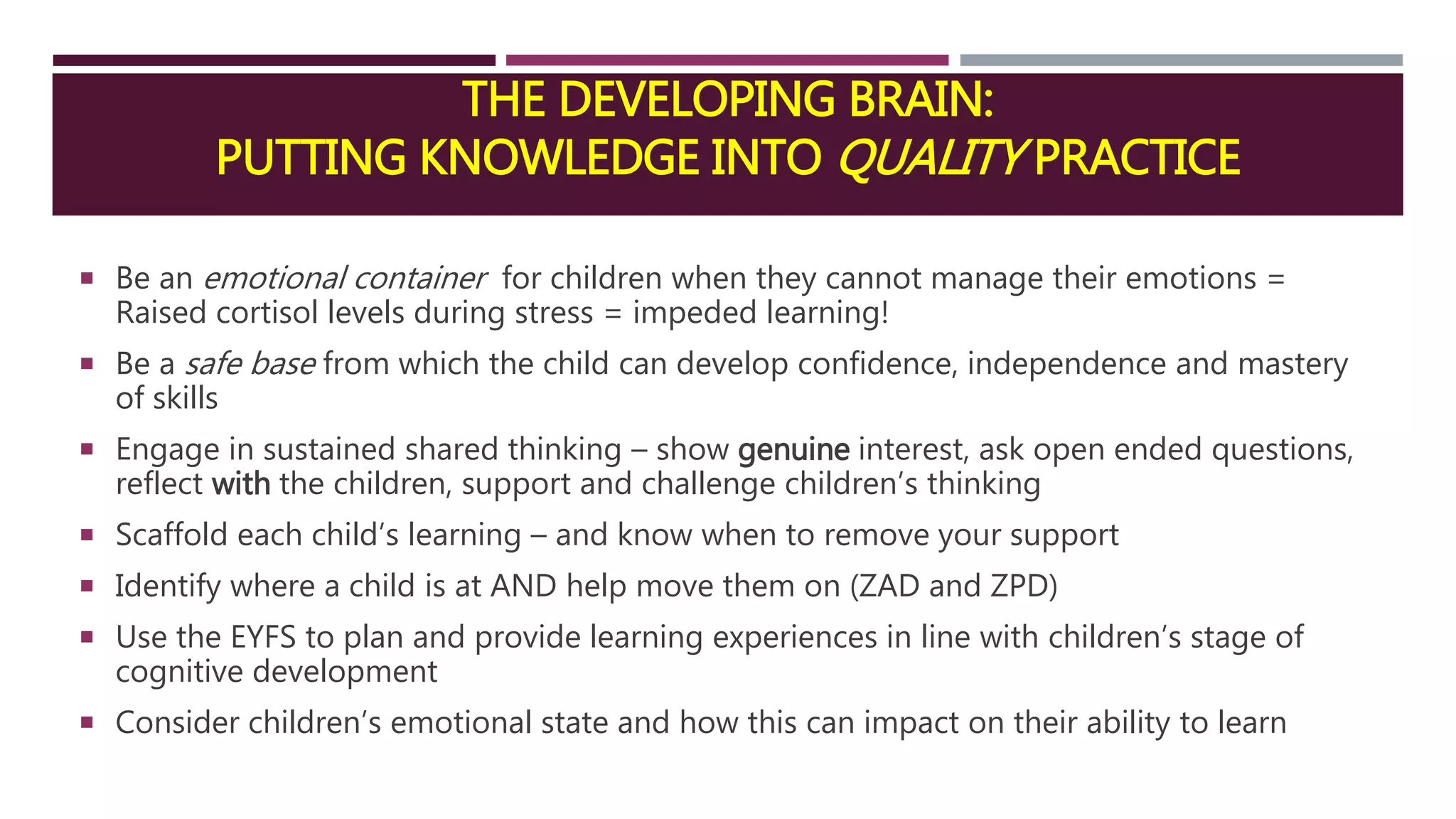
THE DEVELOPING BRAIN:
PUTTING KNOWLEDGE INTO QUALITY PRACTICE
 Be an emotional container for children when they cannot manage their emotions =
Raised cortisol levels during stress = impeded learning!
 Be a safe base from which the child can develop confidence, independence and mastery
of skills
 Engage in sustained shared thinking – show genuine interest, ask open ended questions,
reflect with the children, support and challenge children’s thinking
 Scaffold each child’s learning – and know when to remove your support
 Identify where a child is at AND help move them on (ZAD and ZPD)
 Use the EYFS to plan and provide learning experiences in line with children’s stage of
cognitive development
 Consider children’s emotional state and how this can impact on their ability to learn
TAKE AWAY TIME!
 With the person beside you, discuss
one action you will implement in
your practice, as a result of this
workshop.
 Write your action on the post-it
note.
 Feedback!
REFERENCES
 Conkbayir, M. and Pascal, C. (2014) Early Childhood Theories and Contemporary Issues. London:
Bloomsbury.
 Conkbayir, M. (to be published in 2016) Early Childhood and Neuroscience: Theory, Research and
Implications for Practice. London: Bloomsbury.
 Howard-Jones, P., Pickering, S. and Diack, A. (2007) Perceptions of the role of neuroscience in
education. London: Crown copyright 2007.
 Oates, J., Karmiloff-Smith, A. and Johnson, M. H. (2012) Early Childhood in Focus 7: Developing
Brains. Milton Keynes: Open University.
 Young Brains (2003) Research Report Number 444. London: Department for Education and Skills.
 http://www.practicalpreschoolbooks.com/content/site120/basics/1303projapproac_00000000894.p
df = A good introduction to sustained shared thinking
THANK YOU FOR LISTENING
Mine Conkbayir
Find me on LinkedIn
Mine.conkbayir@westherts.ac.uk

Early brain development

  • 1.
    Early Brain Developmentand Early Years Practice What’s the Connection?
  • 2.
    LEARNING OUTCOMES: By theend of this workshop, you should be able to: 1. Identify at least three key aspects of early brain development 2. Show understanding of the connection between early brain development and delivery of quality child care 3. To think of at least one action you will implement in your practice, as a result of this workshop
  • 3.
    FROM NOT SOHUMBLE BEGINNINGS…
  • 4.
  • 5.
     Ensuring thatthe brain achieves its optimum development and nurturing during this peak  period of growth is therefore vitally important, and enables babies to achieve the best start in life.  From birth to age 18 months, connections in the brain are created at a rate of one million  per second! The earliest experiences shape a baby’s brain development, and have a lifelong  impact on that baby’s mental and emotional health.  TAKEN FROM (AND USE MORE OF) http://www.wavetrust.org/sites/default/files/reports/1001%20Critical%20Days%20- %20The%20Importance%20of%20the%20Conception%20to%20Age%20Two%20Period%20Refreshed_0. pdf
  • 6.
    KNOW YOUR NEURONS… Neurons: Brain cells which carry messages through an electrochemical process. Neurons work together to help us make sense of what’s going on around us, to help us plan what we’re going to do and – everything else  Synapses: The tiny spaces/networks between neurons  Synaptic pruning: the elimination of synaptic connections over the course of human development, specifically shortly after birth and during adolescence. Pruning is critical to brain growth and learning
  • 7.
    WHAT’S ALL THEFUSS? Source: Corel, J.L. (1975) The postnatal development of the human cerebral cortex. Cambridge, MA: Harvard University Press.
  • 8.
    THE YOUNG BRAININ TROUBLE  https://www.youtube.com/watch?v=HguwWGoQ -rQ (53 secs)  What are the most salient points for you from this clip?
  • 9.
    LINKING THE PIECES WHATDO THE 3 B’S LOOK LIKE IN PRACTICE? Brain Bonding Behaviour 1. What are the likely behaviours of a securely attached infant? 2. How should the adult respond to nurture learning and development? 3. What are the likely behaviours of an insecurely attached infant? 4. How should the adult respond to nurture learning and development? 5. Feedback…
  • 10.
    PEER DISCUSSION ANDFEEDBACK Knowing about In practice looks like… Brain plasticity Synaptic pruning Sensitive periods Neuroscience informed attachment Mirror neurons How can knowledge concerning the five key tenets of neuroscience and early years care and education help to inform DAILY PRACTICE with young children?
  • 11.
    THE DEVELOPING BRAIN: PUTTINGKNOWLEDGE INTO QUALITY PRACTICE  Be an emotional container for children when they cannot manage their emotions = Raised cortisol levels during stress = impeded learning!  Be a safe base from which the child can develop confidence, independence and mastery of skills  Engage in sustained shared thinking – show genuine interest, ask open ended questions, reflect with the children, support and challenge children’s thinking  Scaffold each child’s learning – and know when to remove your support  Identify where a child is at AND help move them on (ZAD and ZPD)  Use the EYFS to plan and provide learning experiences in line with children’s stage of cognitive development  Consider children’s emotional state and how this can impact on their ability to learn
  • 12.
    TAKE AWAY TIME! With the person beside you, discuss one action you will implement in your practice, as a result of this workshop.  Write your action on the post-it note.  Feedback!
  • 13.
    REFERENCES  Conkbayir, M.and Pascal, C. (2014) Early Childhood Theories and Contemporary Issues. London: Bloomsbury.  Conkbayir, M. (to be published in 2016) Early Childhood and Neuroscience: Theory, Research and Implications for Practice. London: Bloomsbury.  Howard-Jones, P., Pickering, S. and Diack, A. (2007) Perceptions of the role of neuroscience in education. London: Crown copyright 2007.  Oates, J., Karmiloff-Smith, A. and Johnson, M. H. (2012) Early Childhood in Focus 7: Developing Brains. Milton Keynes: Open University.  Young Brains (2003) Research Report Number 444. London: Department for Education and Skills.  http://www.practicalpreschoolbooks.com/content/site120/basics/1303projapproac_00000000894.p df = A good introduction to sustained shared thinking
  • 14.
    THANK YOU FORLISTENING Mine Conkbayir Find me on LinkedIn Mine.conkbayir@westherts.ac.uk