Resuscitation
Devices for Positive-
Pressure Ventilation
Marwa Elhady
Ass prof pediatrics
Al-Azhar University
When to give
positive-pressure
ventilation
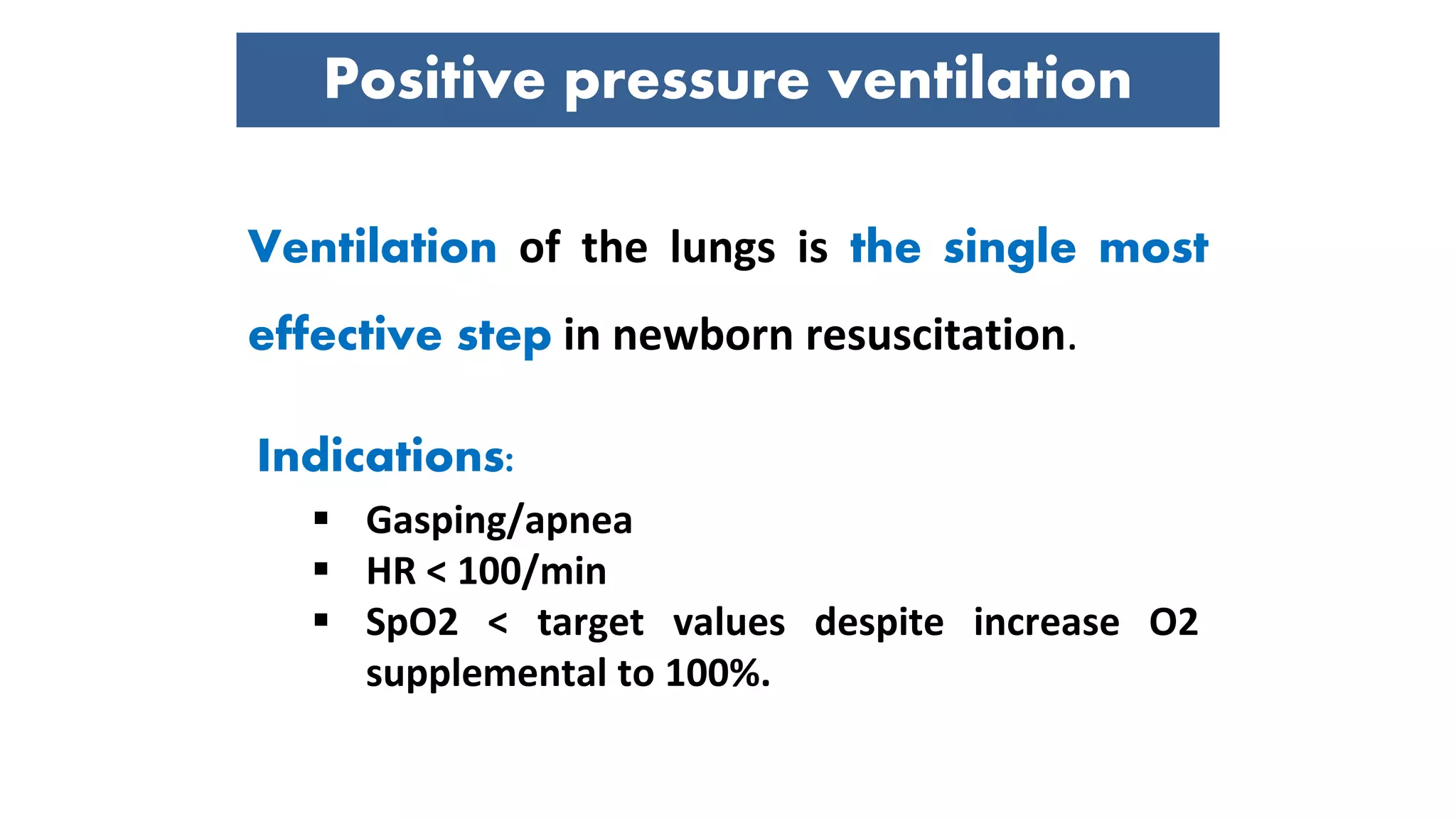
Ventilation of the lungs is the single most
effective step in newborn resuscitation.
Positive pressure ventilation
Indications:
 Gasping/apnea
 HR < 100/min
 SpO2 < target values despite increase O2
supplemental to 100%.
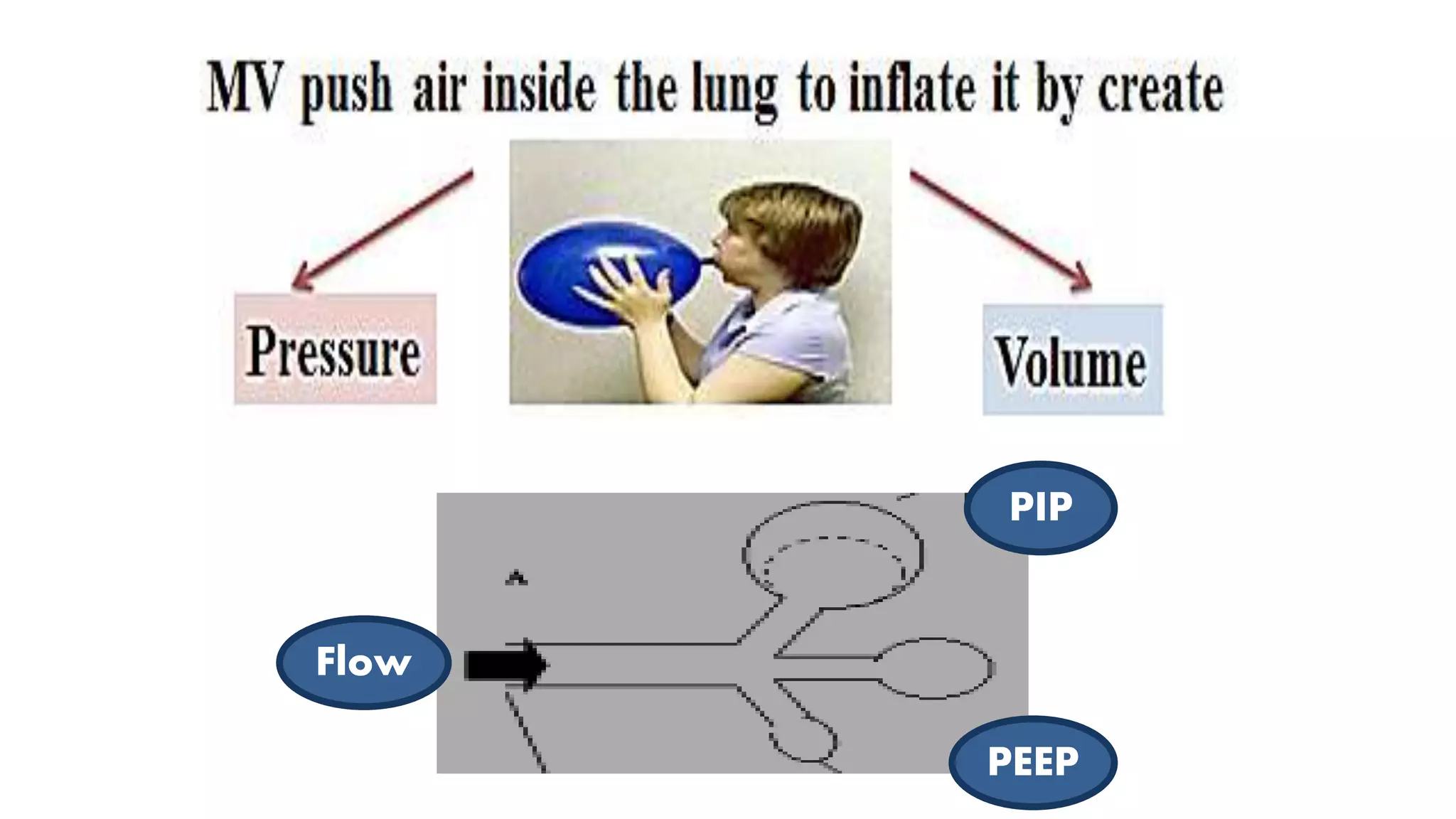
PIP
PEEP
Flow
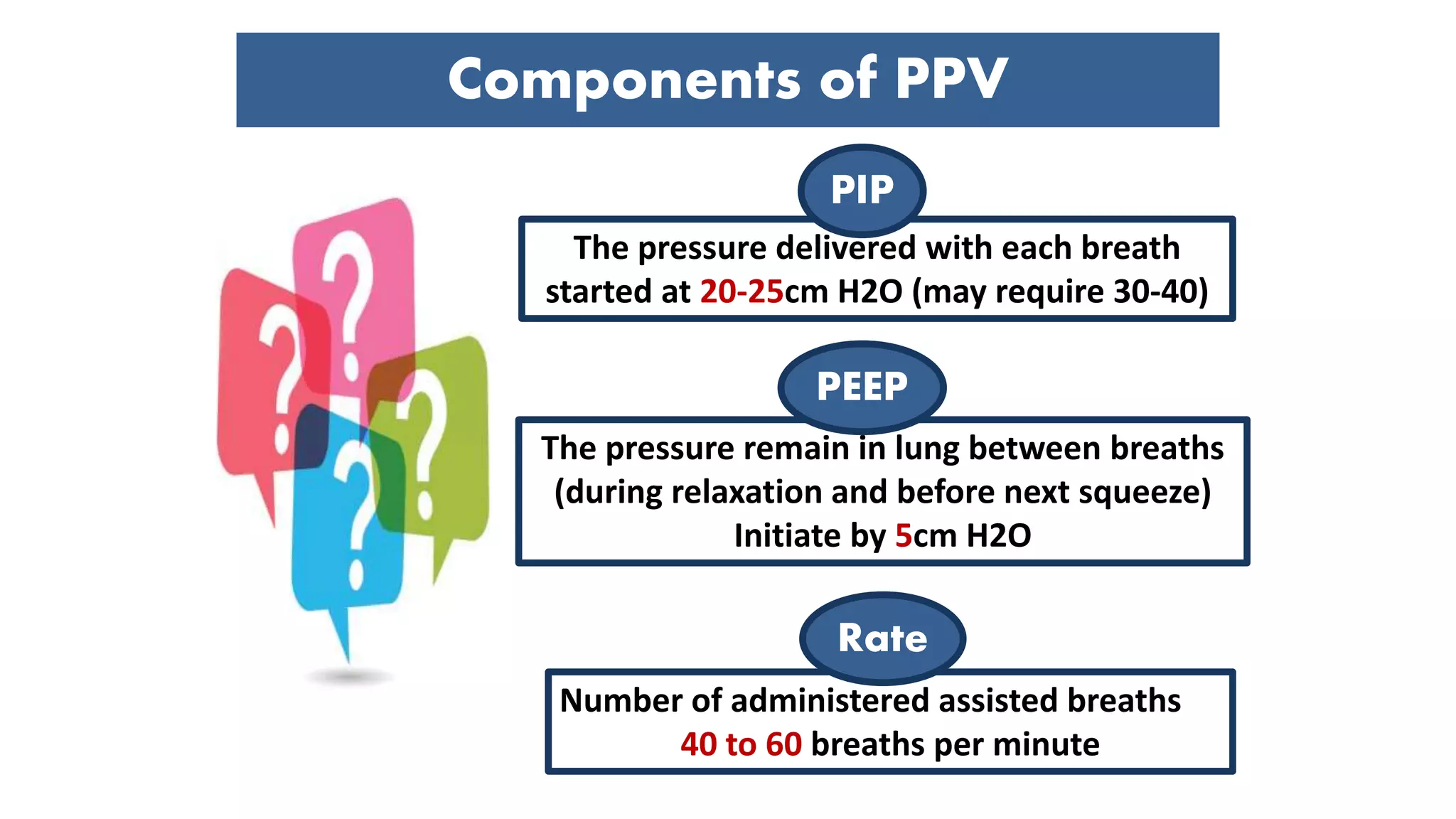
Components of PPV
The pressure delivered with each breath
started at 20-25cm H2O (may require 30-40)
PIP
The pressure remain in lung between breaths
(during relaxation and before next squeeze)
Initiate by 5cm H2O
PEEP
Number of administered assisted breaths
40 to 60 breaths per minute
Rate
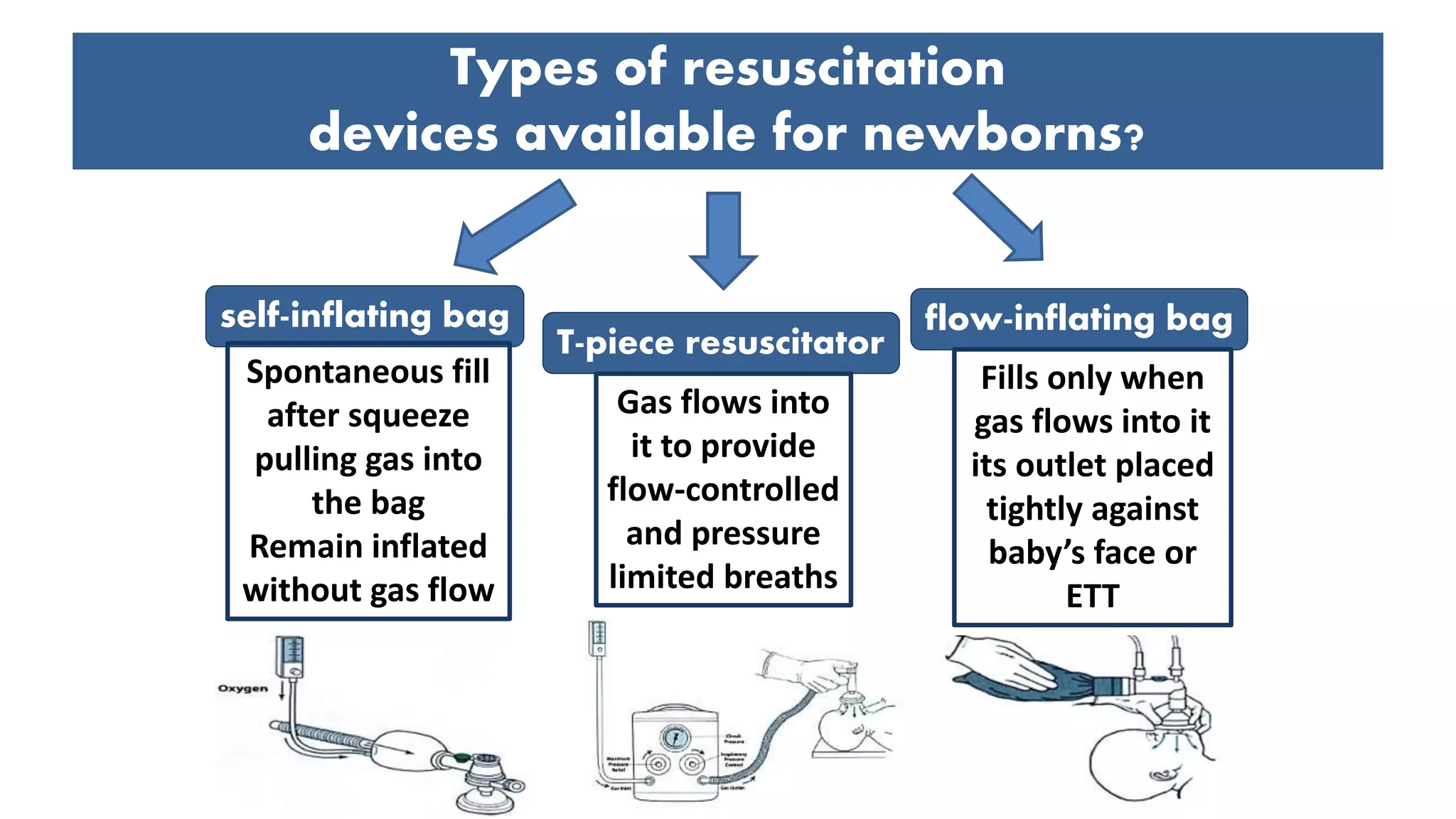
Types of resuscitation
devices available for newborns?
self-inflating bag
T-piece resuscitator
flow-inflating bag
Spontaneous fill
after squeeze
pulling gas into
the bag
Remain inflated
without gas flow
Gas flows into
it to provide
flow-controlled
and pressure
limited breaths
Fills only when
gas flows into it
its outlet placed
tightly against
baby’s face or
ETT
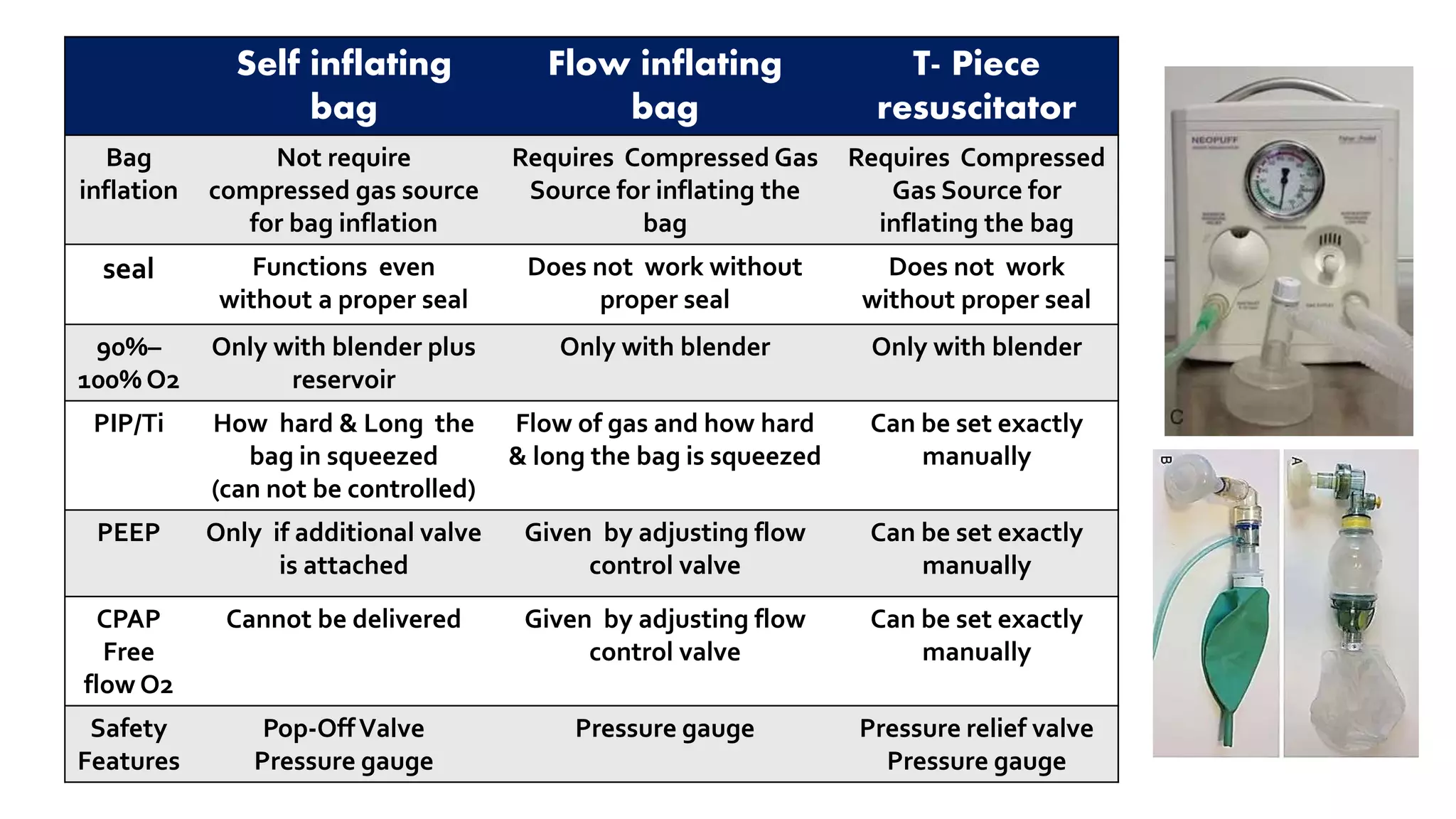
Self inflating
bag
Flow inflating
bag
T- Piece
resuscitator
Bag
inflation
Not require
compressed gas source
for bag inflation
Requires Compressed Gas
Source for inflating the
bag
Requires Compressed
Gas Source for
inflating the bag
seal Functions even
without a proper seal
Does not work without
proper seal
Does not work
without proper seal
90%–
100% O2
Only with blender plus
reservoir
Only with blender Only with blender
PIP/Ti How hard & Long the
bag in squeezed
(can not be controlled)
Flow of gas and how hard
& long the bag is squeezed
Can be set exactly
manually
PEEP Only if additional valve
is attached
Given by adjusting flow
control valve
Can be set exactly
manually
CPAP
Free
flow O2
Cannot be delivered Given by adjusting flow
control valve
Can be set exactly
manually
Safety
Features
Pop-OffValve
Pressure gauge
Pressure gauge Pressure relief valve
Pressure gauge
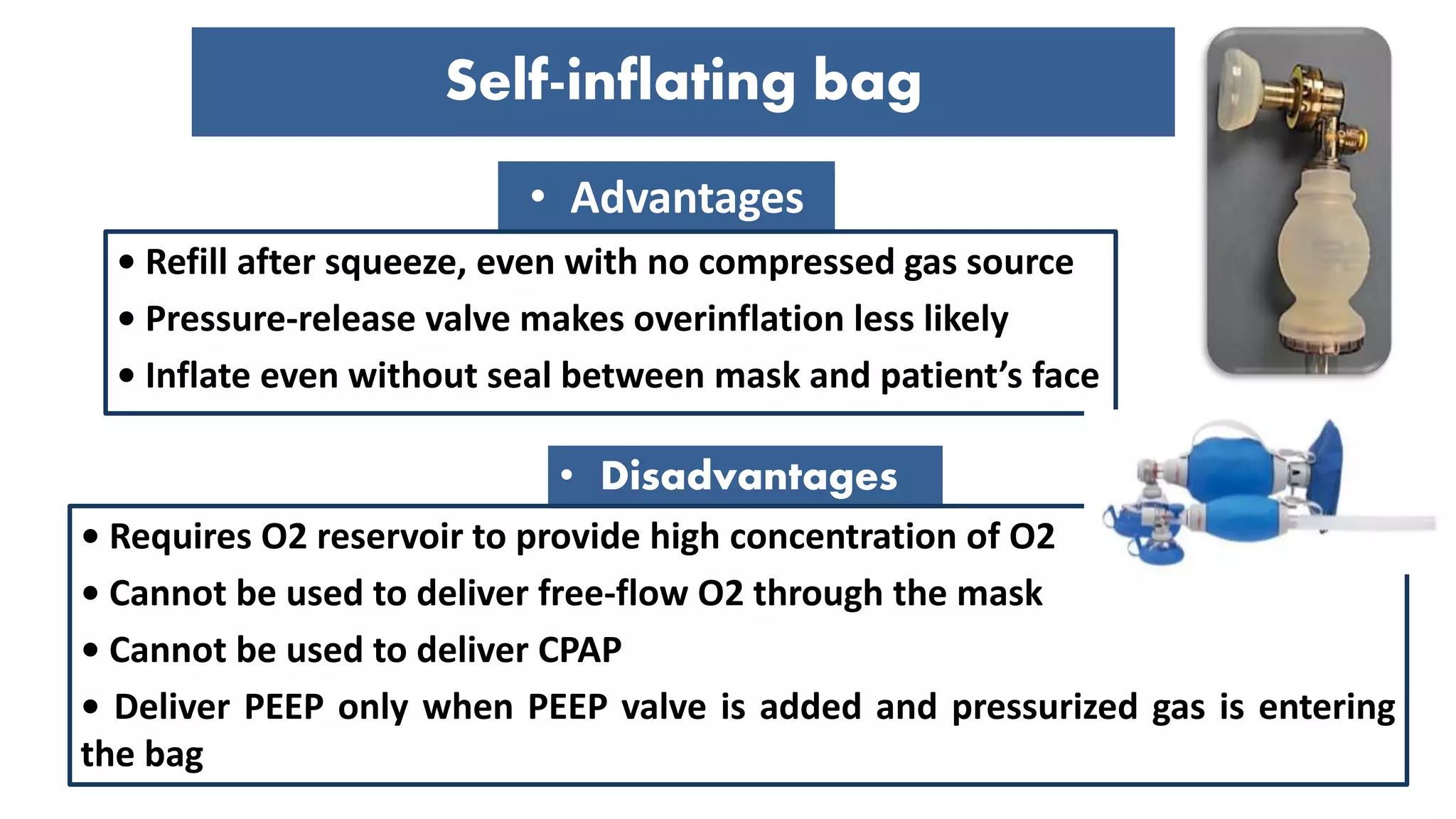
• Advantages
• Refill after squeeze, even with no compressed gas source
• Pressure-release valve makes overinflation less likely
• Inflate even without seal between mask and patient’s face
Self-inflating bag
• Disadvantages
• Requires O2 reservoir to provide high concentration of O2
• Cannot be used to deliver free-flow O2 through the mask
• Cannot be used to deliver CPAP
• Deliver PEEP only when PEEP valve is added and pressurized gas is entering
the bag
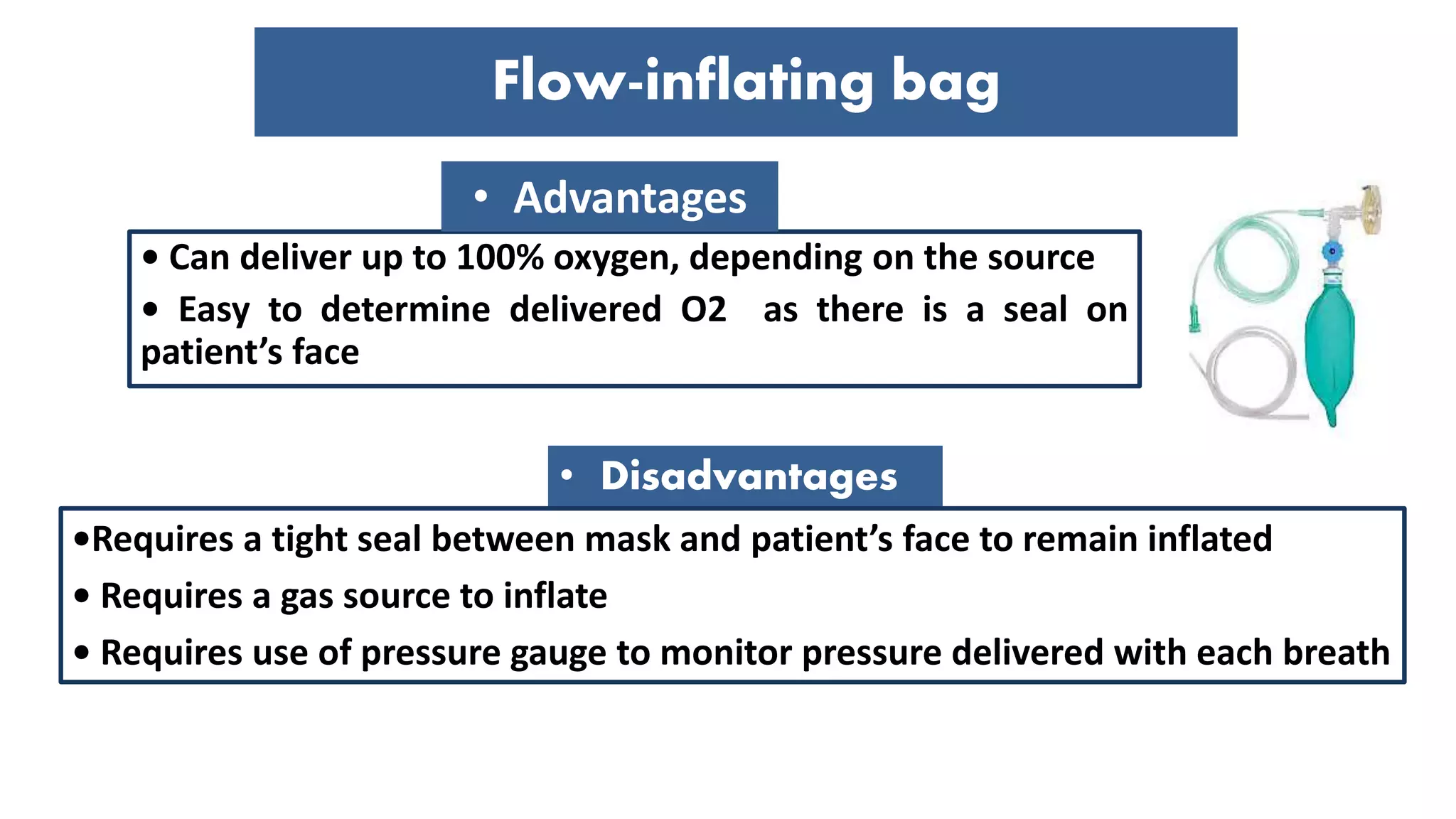
• Can deliver up to 100% oxygen, depending on the source
• Easy to determine delivered O2 as there is a seal on
patient’s face
Flow-inflating bag
• Advantages
• Disadvantages
•Requires a tight seal between mask and patient’s face to remain inflated
• Requires a gas source to inflate
• Requires use of pressure gauge to monitor pressure delivered with each breath
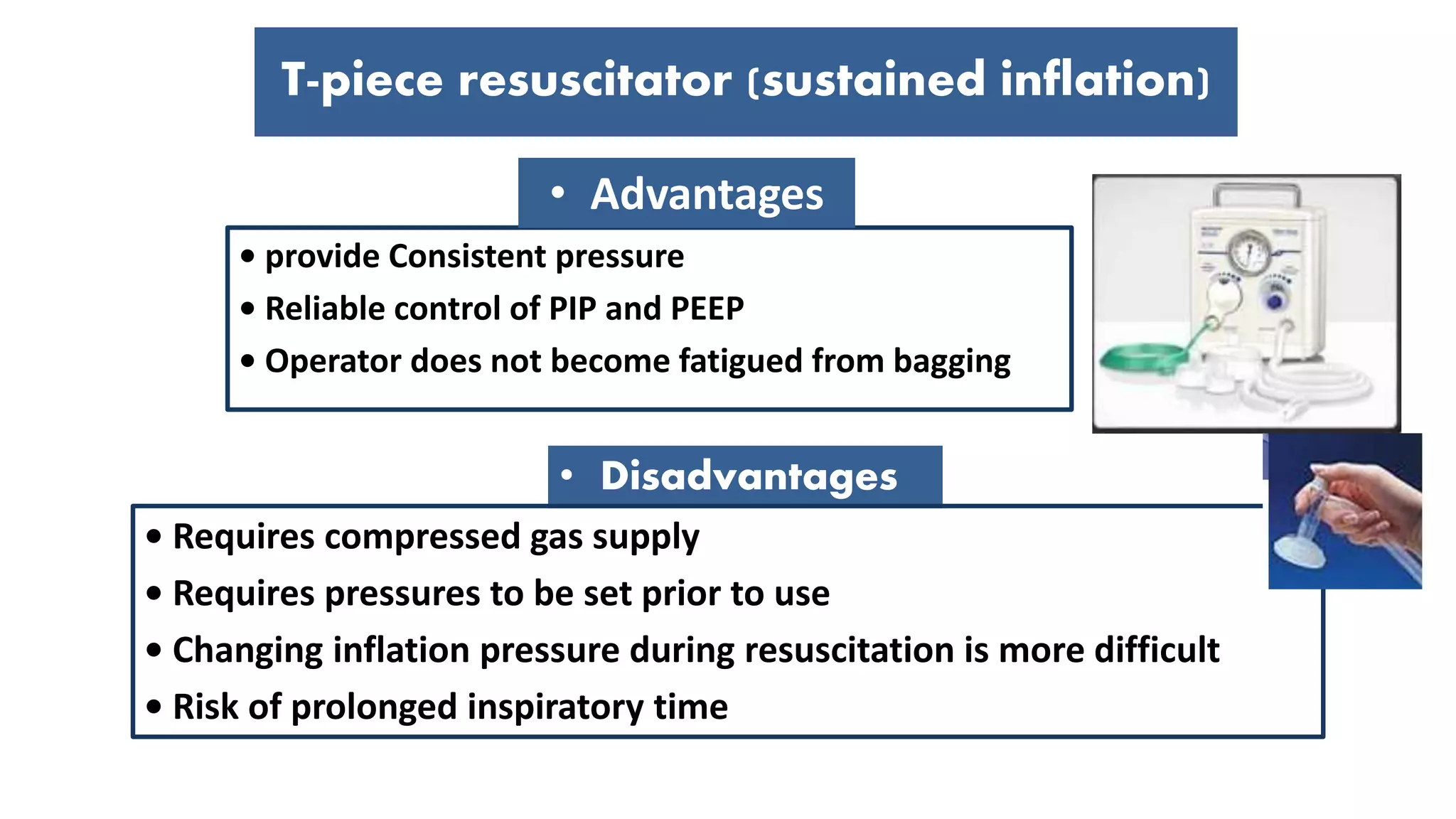
• provide Consistent pressure
• Reliable control of PIP and PEEP
• Operator does not become fatigued from bagging
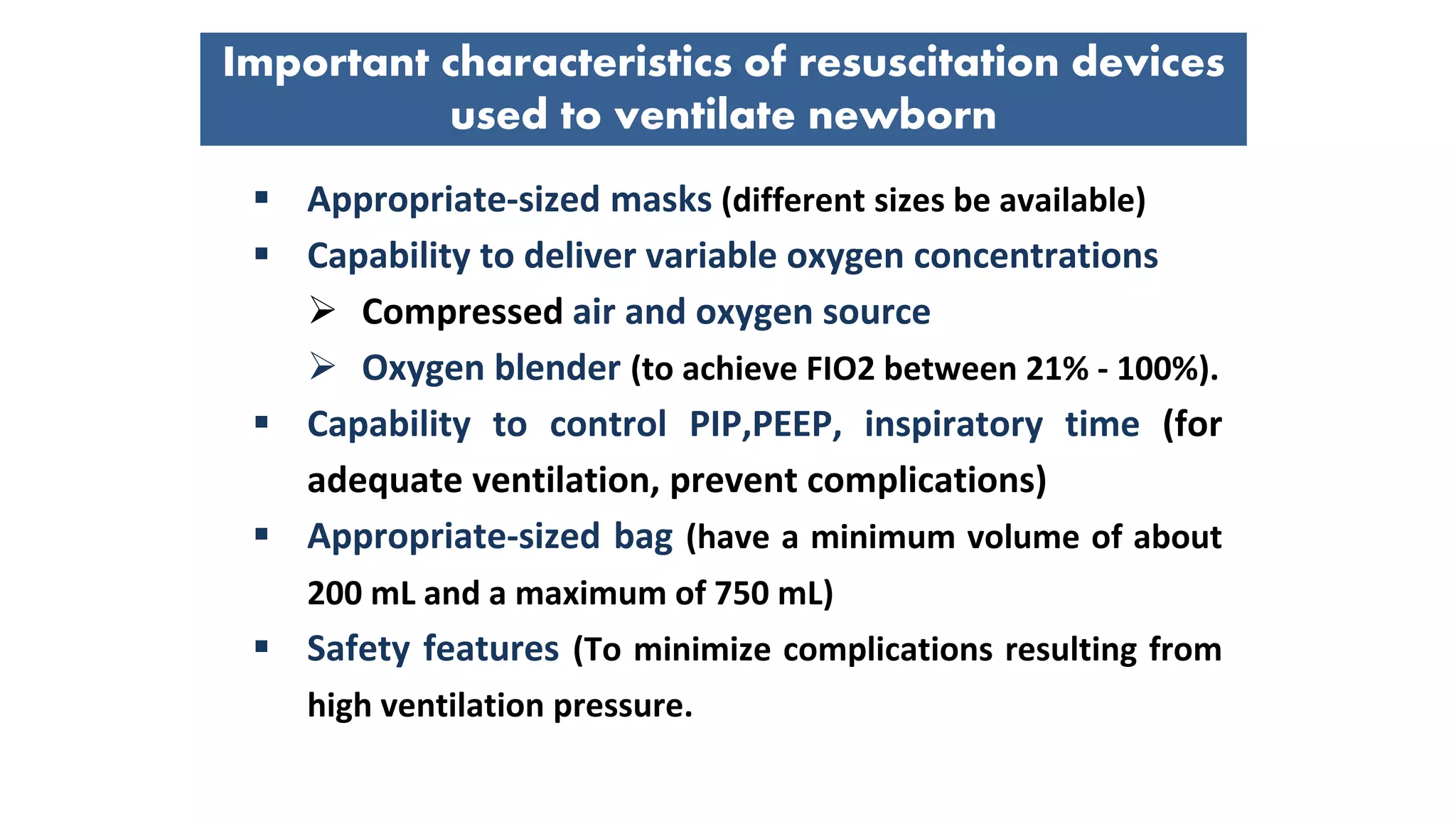
T-piece resuscitator (sustained inflation)
• Advantages
• Disadvantages
• Requires compressed gas supply
• Requires pressures to be set prior to use
• Changing inflation pressure during resuscitation is more difficult
• Risk of prolonged inspiratory time
Important characteristics of resuscitation devices
used to ventilate newborn
 Appropriate-sized masks (different sizes be available)
 Capability to deliver variable oxygen concentrations
 Compressed air and oxygen source
 Oxygen blender (to achieve FIO2 between 21% - 100%).
 Capability to control PIP,PEEP, inspiratory time (for
adequate ventilation, prevent complications)
 Appropriate-sized bag (have a minimum volume of about
200 mL and a maximum of 750 mL)
 Safety features (To minimize complications resulting from
high ventilation pressure.
The most important indicator of
successful PPV is rising heart rate.
Effective PPV detected by rising of
chest wall and auscultation for air entry
prepare the resuscitation device for an
anticipated resuscitation
 Use proper size
(the rim cover the tip of the chin,
the mouth, and the nose, but not
the eyes)
 Correct position
(Cup the chin in the mask and then
cover the nose)
 Tight seal between the mask and
newborn’s face.
Face masks
prepare the resuscitation device for an
anticipated resuscitation
 have appropriate-sized Masks
 PPV device should be checked and connected to a blender
 Blender should has both an oxygen and an air supply to
deliver oxygen from 21%-100%
 If use self-inflating bag, be sure the oxygen reservoir is
attached.
 Prepare oximeter with neonatal-sized probe
Assemble the equipment
prepare the resuscitation device for an
anticipated resuscitation
 check the device and mask to be sure they function
properly.
 Bags that have cracks or holes, valves that stick or leak,
devices that do not function properly, or defective masks
must not be used.
 Double check
 specific checklist for each of the devices
Test the equipment
What do you need to do before beginning
positive-pressure ventilation?
 If you are alone, call second person for assistance
 Select the appropriate-sized mask.
 Test the equipment
 Be sure there is a clear airway.
 Position the baby’s head.
 Position yourself at the bedside.
oxygen should be used when giving PPV during
resuscitation
 Resuscitation of term newborns with 21% oxygen (room air)
 Initial FIO2 set at 21% (room air) for term and 21-30% for Preterm and
titrate O2 concentration to achieve preductal O2 saturation
Rate of 3:1 compressions to breaths (90 compressions and 30 breaths per minute)
Count "one-and-two-and-three-and-breath"
Time Target
Spo2
1min 60-65%
2min 65-70%
3min 70-75%
4min 75-80%
5min 80-85%
10min 85-95%
If PPV will be continued for more than several
minutes
• Distended stomach puts upward pressure on the
diaphragm, preventing full expansion of the lungs.
• Gas in the stomach may cause regurgitation and
aspiration during PPV.
Consider placing an orogastric tube and
leaving it in place
Endotracheal Intubation
When should ETT intubation be considered?
• If there is meconium in non vigorous baby
• Inadequate clinical improvement after PPV, corrective steps
• If the need for PPV lasts beyond a few minutes
• If chest compressions are necessary
• For surfactant administration
• If suspected diaphragmatic hernia.
Endotracheal Intubation- Equipment and supplies
• Laryngoscope with different blade size
• Term – 1
• Preterm – 0
• Extremely preterm - 00
• Straight blades
• Proper ETT size
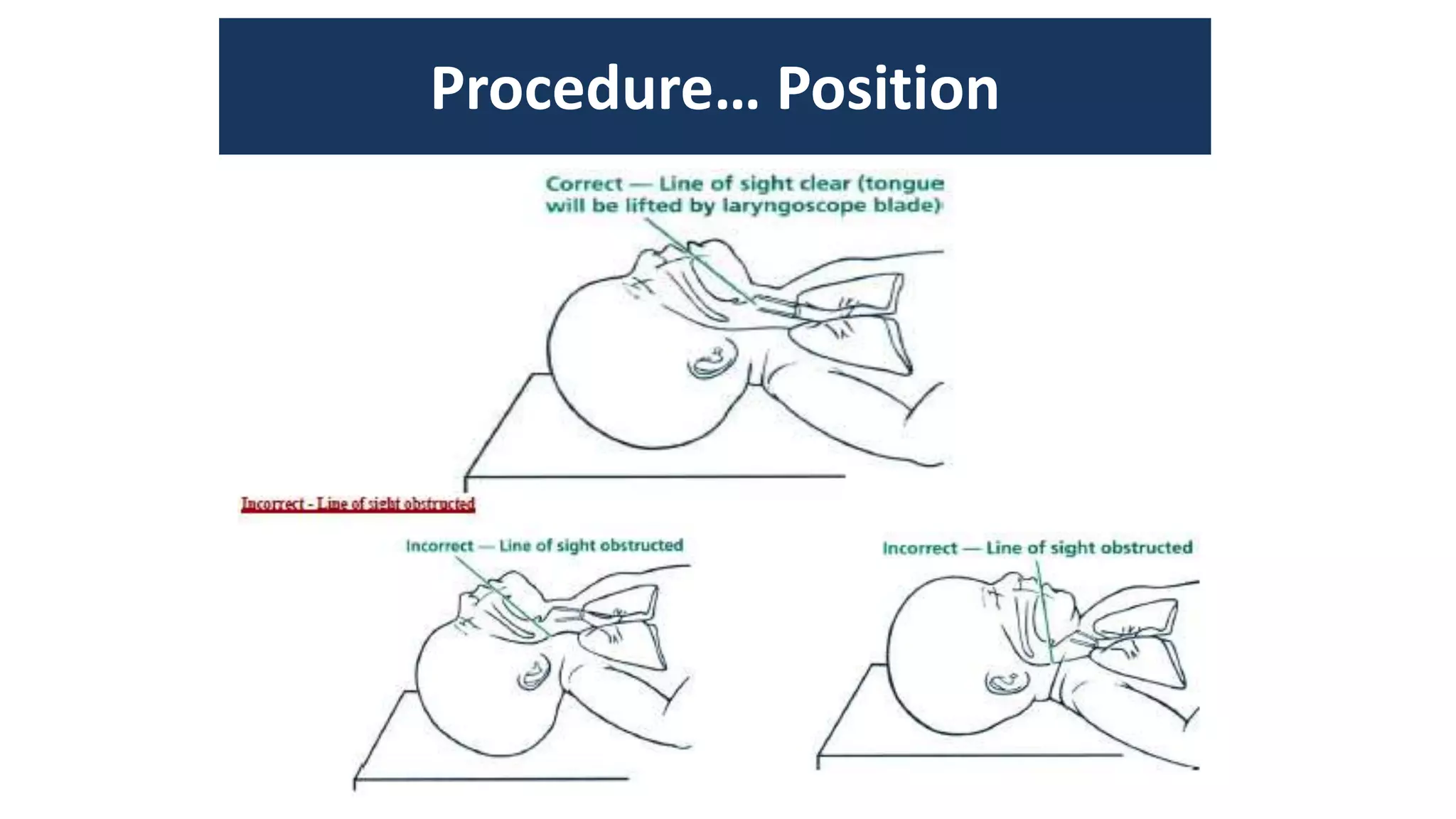
Procedure… Position
Position
CRICOID PRESSURE
SUCTIONING
Insertion
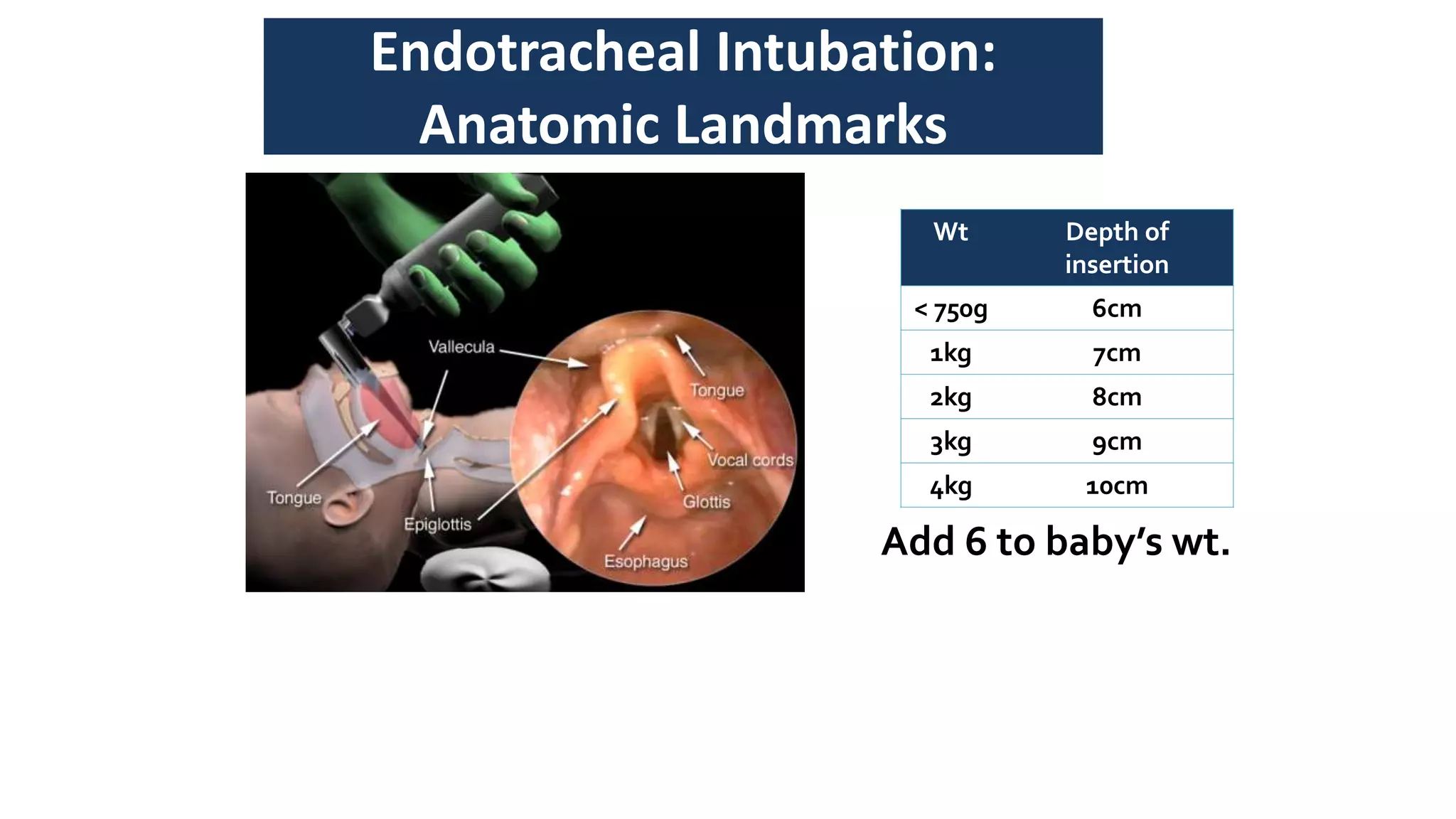
Endotracheal Intubation:
Anatomic Landmarks
Wt Depth of
insertion
< 750g 6cm
1kg 7cm
2kg 8cm
3kg 9cm
4kg 10cm
Add 6 to baby’s wt.
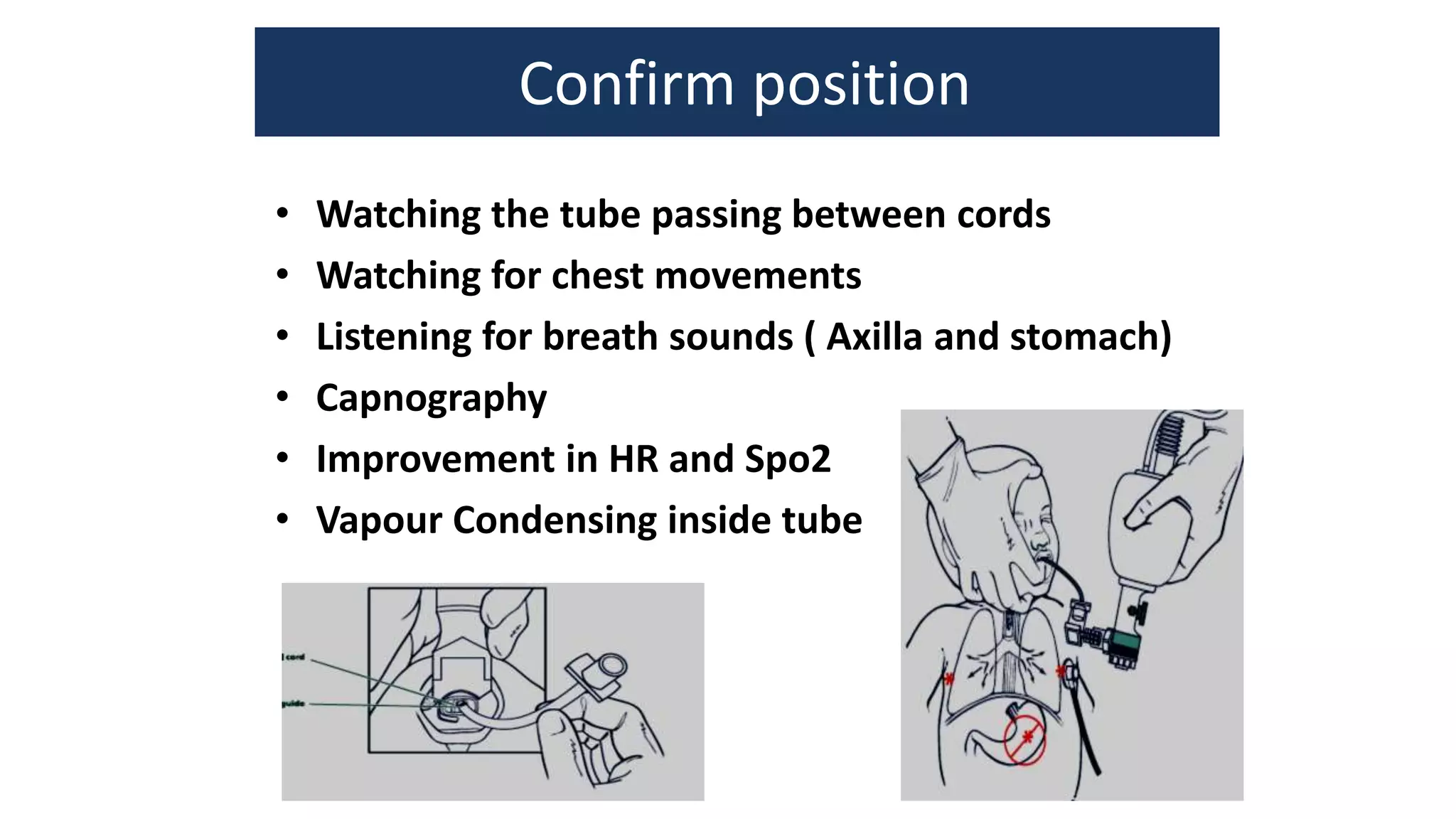
Confirm position
• Watching the tube passing between cords
• Watching for chest movements
• Listening for breath sounds ( Axilla and stomach)
• Capnography
• Improvement in HR and Spo2
• Vapour Condensing inside tube
Laryngeal Mask Airway
LMA
Laryngeal Mask Airway
LMA
• Laryngeal masks fit over the laryngeal
inlet, can achieve effective ventilation
in FT and PT newborns > 34 weeks
• laryngeal mask is an alternative to ETT
if face-mask ventilation is unsuccessful
for effective ventilation
Monitor
• Use of respiratory mechanics monitors have been
reported to prevent excessive pressures
• Oxygen Saturation is normally 60-65% in the first minute
of life (and increases 5% every minute)
• Tidal volumes and exhaled CO2 monitors help assess that
actual gas exchange is occurring during face-mask PPV
• In preterm newborns (<35 weeks of gestation) begin with 21% to 30%
oxygen with subsequent oxygen titration based on pulse oximetry
• In term and late-preterm newborns (≥35 weeks of gestation) initial use
of 21% oxygen is reasonable
• 100% oxygen should not be used to initiate resuscitation because it is
associated with excess mortality
O2 supply
Thank you

positive pressure ventilation in NRP

  • 1.
    Resuscitation Devices for Positive- PressureVentilation Marwa Elhady Ass prof pediatrics Al-Azhar University
  • 2.
  • 3.
    Ventilation of thelungs is the single most effective step in newborn resuscitation. Positive pressure ventilation Indications:  Gasping/apnea  HR < 100/min  SpO2 < target values despite increase O2 supplemental to 100%.
  • 4.
  • 5.
    Components of PPV Thepressure delivered with each breath started at 20-25cm H2O (may require 30-40) PIP The pressure remain in lung between breaths (during relaxation and before next squeeze) Initiate by 5cm H2O PEEP Number of administered assisted breaths 40 to 60 breaths per minute Rate
  • 6.
    Types of resuscitation devicesavailable for newborns? self-inflating bag T-piece resuscitator flow-inflating bag Spontaneous fill after squeeze pulling gas into the bag Remain inflated without gas flow Gas flows into it to provide flow-controlled and pressure limited breaths Fills only when gas flows into it its outlet placed tightly against baby’s face or ETT
  • 7.
    Self inflating bag Flow inflating bag T-Piece resuscitator Bag inflation Not require compressed gas source for bag inflation Requires Compressed Gas Source for inflating the bag Requires Compressed Gas Source for inflating the bag seal Functions even without a proper seal Does not work without proper seal Does not work without proper seal 90%– 100% O2 Only with blender plus reservoir Only with blender Only with blender PIP/Ti How hard & Long the bag in squeezed (can not be controlled) Flow of gas and how hard & long the bag is squeezed Can be set exactly manually PEEP Only if additional valve is attached Given by adjusting flow control valve Can be set exactly manually CPAP Free flow O2 Cannot be delivered Given by adjusting flow control valve Can be set exactly manually Safety Features Pop-OffValve Pressure gauge Pressure gauge Pressure relief valve Pressure gauge
  • 8.
    • Advantages • Refillafter squeeze, even with no compressed gas source • Pressure-release valve makes overinflation less likely • Inflate even without seal between mask and patient’s face Self-inflating bag • Disadvantages • Requires O2 reservoir to provide high concentration of O2 • Cannot be used to deliver free-flow O2 through the mask • Cannot be used to deliver CPAP • Deliver PEEP only when PEEP valve is added and pressurized gas is entering the bag
  • 9.
    • Can deliverup to 100% oxygen, depending on the source • Easy to determine delivered O2 as there is a seal on patient’s face Flow-inflating bag • Advantages • Disadvantages •Requires a tight seal between mask and patient’s face to remain inflated • Requires a gas source to inflate • Requires use of pressure gauge to monitor pressure delivered with each breath
  • 10.
    • provide Consistentpressure • Reliable control of PIP and PEEP • Operator does not become fatigued from bagging T-piece resuscitator (sustained inflation) • Advantages • Disadvantages • Requires compressed gas supply • Requires pressures to be set prior to use • Changing inflation pressure during resuscitation is more difficult • Risk of prolonged inspiratory time
  • 12.
    Important characteristics ofresuscitation devices used to ventilate newborn  Appropriate-sized masks (different sizes be available)  Capability to deliver variable oxygen concentrations  Compressed air and oxygen source  Oxygen blender (to achieve FIO2 between 21% - 100%).  Capability to control PIP,PEEP, inspiratory time (for adequate ventilation, prevent complications)  Appropriate-sized bag (have a minimum volume of about 200 mL and a maximum of 750 mL)  Safety features (To minimize complications resulting from high ventilation pressure.
  • 13.
    The most importantindicator of successful PPV is rising heart rate. Effective PPV detected by rising of chest wall and auscultation for air entry
  • 14.
    prepare the resuscitationdevice for an anticipated resuscitation  Use proper size (the rim cover the tip of the chin, the mouth, and the nose, but not the eyes)  Correct position (Cup the chin in the mask and then cover the nose)  Tight seal between the mask and newborn’s face. Face masks
  • 15.
    prepare the resuscitationdevice for an anticipated resuscitation  have appropriate-sized Masks  PPV device should be checked and connected to a blender  Blender should has both an oxygen and an air supply to deliver oxygen from 21%-100%  If use self-inflating bag, be sure the oxygen reservoir is attached.  Prepare oximeter with neonatal-sized probe Assemble the equipment
  • 17.
    prepare the resuscitationdevice for an anticipated resuscitation  check the device and mask to be sure they function properly.  Bags that have cracks or holes, valves that stick or leak, devices that do not function properly, or defective masks must not be used.  Double check  specific checklist for each of the devices Test the equipment
  • 18.
    What do youneed to do before beginning positive-pressure ventilation?  If you are alone, call second person for assistance  Select the appropriate-sized mask.  Test the equipment  Be sure there is a clear airway.  Position the baby’s head.  Position yourself at the bedside.
  • 19.
    oxygen should beused when giving PPV during resuscitation  Resuscitation of term newborns with 21% oxygen (room air)  Initial FIO2 set at 21% (room air) for term and 21-30% for Preterm and titrate O2 concentration to achieve preductal O2 saturation Rate of 3:1 compressions to breaths (90 compressions and 30 breaths per minute) Count "one-and-two-and-three-and-breath" Time Target Spo2 1min 60-65% 2min 65-70% 3min 70-75% 4min 75-80% 5min 80-85% 10min 85-95%
  • 20.
    If PPV willbe continued for more than several minutes • Distended stomach puts upward pressure on the diaphragm, preventing full expansion of the lungs. • Gas in the stomach may cause regurgitation and aspiration during PPV. Consider placing an orogastric tube and leaving it in place
  • 21.
  • 22.
    When should ETTintubation be considered? • If there is meconium in non vigorous baby • Inadequate clinical improvement after PPV, corrective steps • If the need for PPV lasts beyond a few minutes • If chest compressions are necessary • For surfactant administration • If suspected diaphragmatic hernia.
  • 23.
    Endotracheal Intubation- Equipmentand supplies • Laryngoscope with different blade size • Term – 1 • Preterm – 0 • Extremely preterm - 00 • Straight blades • Proper ETT size
  • 24.
  • 25.
  • 26.
  • 27.
    Endotracheal Intubation: Anatomic Landmarks WtDepth of insertion < 750g 6cm 1kg 7cm 2kg 8cm 3kg 9cm 4kg 10cm Add 6 to baby’s wt.
  • 29.
    Confirm position • Watchingthe tube passing between cords • Watching for chest movements • Listening for breath sounds ( Axilla and stomach) • Capnography • Improvement in HR and Spo2 • Vapour Condensing inside tube
  • 31.
  • 32.
    Laryngeal Mask Airway LMA •Laryngeal masks fit over the laryngeal inlet, can achieve effective ventilation in FT and PT newborns > 34 weeks • laryngeal mask is an alternative to ETT if face-mask ventilation is unsuccessful for effective ventilation
  • 34.
    Monitor • Use ofrespiratory mechanics monitors have been reported to prevent excessive pressures • Oxygen Saturation is normally 60-65% in the first minute of life (and increases 5% every minute) • Tidal volumes and exhaled CO2 monitors help assess that actual gas exchange is occurring during face-mask PPV
  • 35.
    • In pretermnewborns (<35 weeks of gestation) begin with 21% to 30% oxygen with subsequent oxygen titration based on pulse oximetry • In term and late-preterm newborns (≥35 weeks of gestation) initial use of 21% oxygen is reasonable • 100% oxygen should not be used to initiate resuscitation because it is associated with excess mortality O2 supply
  • 36.