NEONATAL RESUSCITATION:
CURRENT GUIDELINES
Dr Deepak Chawla
MD, DM (Neonatology)
Associate Professor
Department of Pediatrics
GMCH, Chandigarh
WHY LEARN RESUSCITATION
• Birth asphyxia - 19% ( 5 million) of all neonatal deaths every year
(WHO 1995)
• By appropriate resuscitation: Outcome of thousands of newborns may
improve
• 10% of all babies require resuscitation; 1% need extensive resuscitative
measures
ABCS OF RESUSCITATION
Temperature
Airway (position and clear)
Breathing (stimulate to breathe)
Circulation (assess heart rate and color)
Drugs (Medications)
Always needed
by
newborns
Needed less
frequently
Rarely needed
by
newborns
Assess baby’s risk for requiring resuscitation
Provide Warmth
Position, Clear airway, Dry, stimulate to
breathe
Assist ventilation with positive pressure
Provide chest
compressions
Administer
medications
Give Supplemental Oxygen, as necessary
Intubate the trachea
Need For Resuscitation
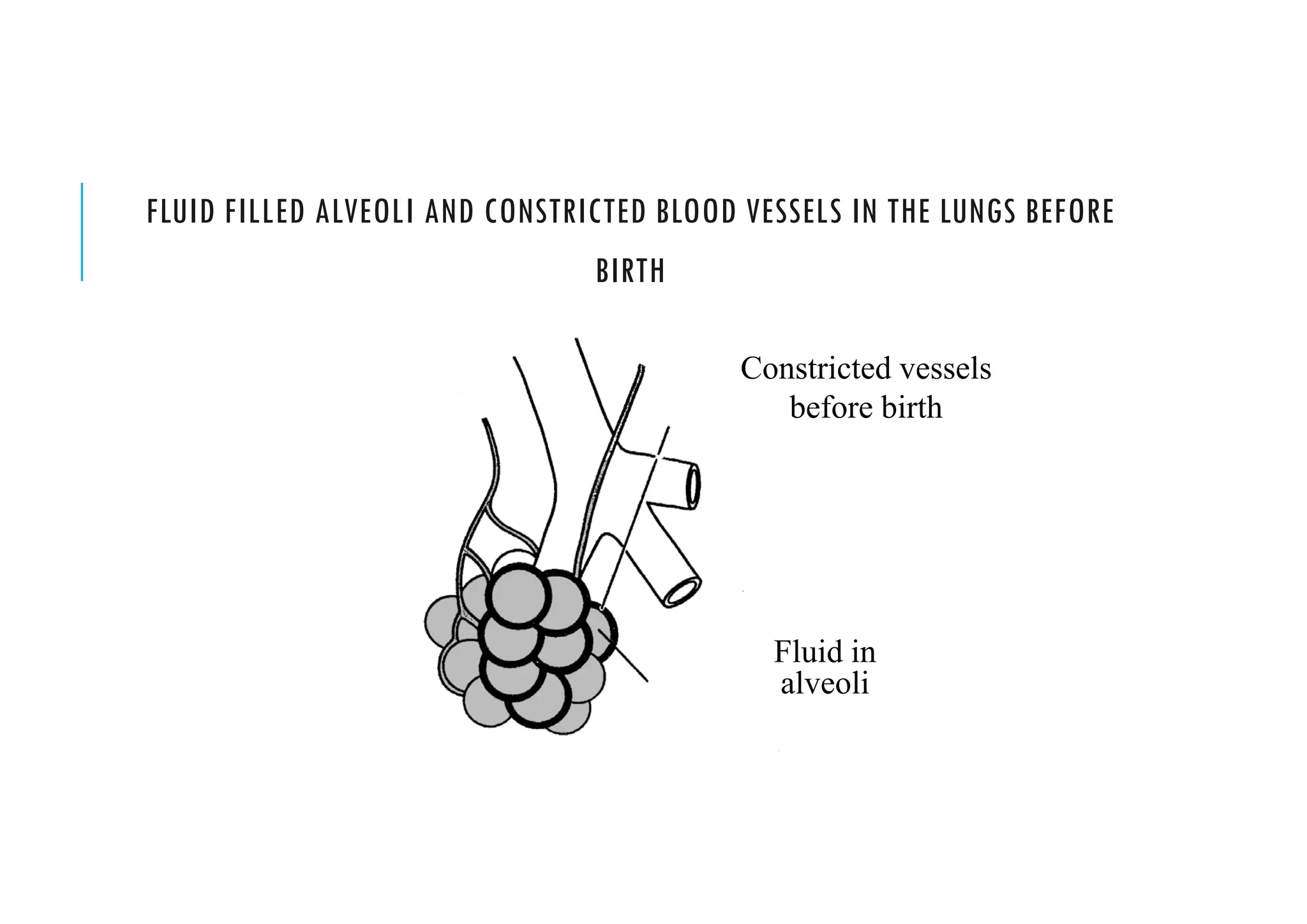
FLUID FILLED ALVEOLI AND CONSTRICTED BLOOD VESSELS IN THE LUNGS BEFORE
BIRTH
Constricted vessels
before birth
Fluid in
alveoli
SHUNTING OF BLOOD THRU DUCTUS AWAY FROM LUNGS BEFORE BIRTH
WHAT NORMALLY HAPPENS AT BIRTH
Three major changes occur
• The Fluid in the alveoli is absorbed
• The umbilical arteries and vein constrict and are clamped
Removes low-resistance placental circuit
Increase systemic blood pressure
• Blood vessels in the lung tissue relax
Decrease resistance to blood flow
CHANGES AT BIRTH
Fluid in the alveoli absorbed and replaced by air
Constricted vessels
before birth
Dilated vessels
after birth
Fluid in
alveoli
Oxygen in
alveoli
Dilatation of Pulmonary Blood vessels at Birth
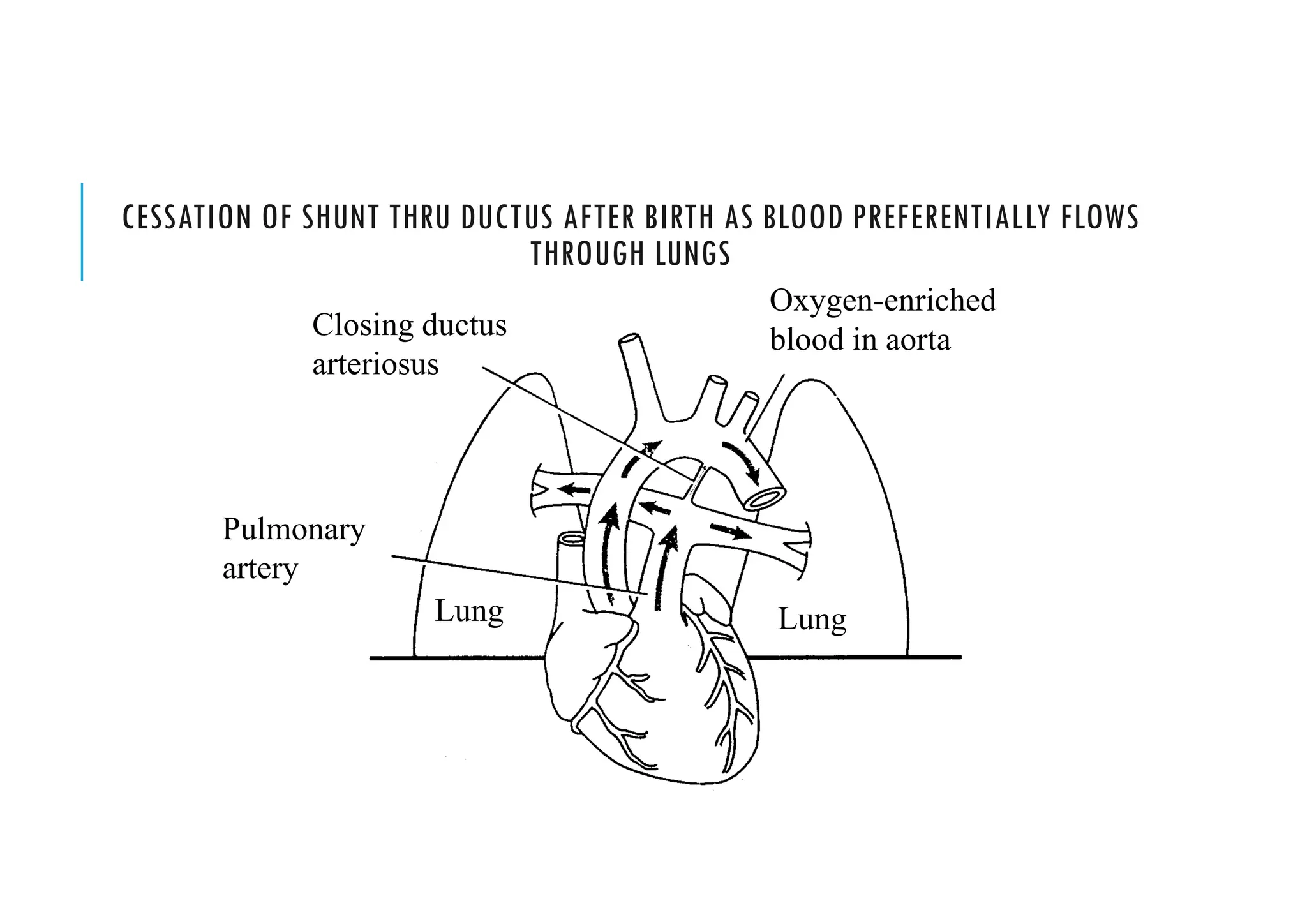
CESSATION OF SHUNT THRU DUCTUS AFTER BIRTH AS BLOOD PREFERENTIALLY FLOWS
THROUGH LUNGS
Closing ductus
arteriosus
Pulmonary
artery
Oxygen-enriched
blood in aorta
Lung Lung
WHAT CAN GO WRONG DURING TRANSITION?
• Breaths not forceful to remove alveolar fluid
or
• Foreign material blocks air entry oxygen not available
• Excessive blood loss/poor cardiac contractility systemic hypotension
• Hypoxia constriction of pulmonary arterioles tissue oxygen deprivation
(PPHN)
RESPONSE OF THE BABY TO AN INTERRUPTION IN NORMAL
TRANSITION
• Poor muscle tone due to insufficient oxygen supply to brain, muscles and other
organs
• Depression of respiratory drive from insufficient oxygen supply to the brain
• Bradycardia
 Insufficient delivery of oxygen to heart, muscle or brain stem
• Low Blood pressure
 Poor myocardial contractility or blood loss
• Tachypnea from failure to absorb lung fluid
• Cyanosis from insufficient oxygen in blood
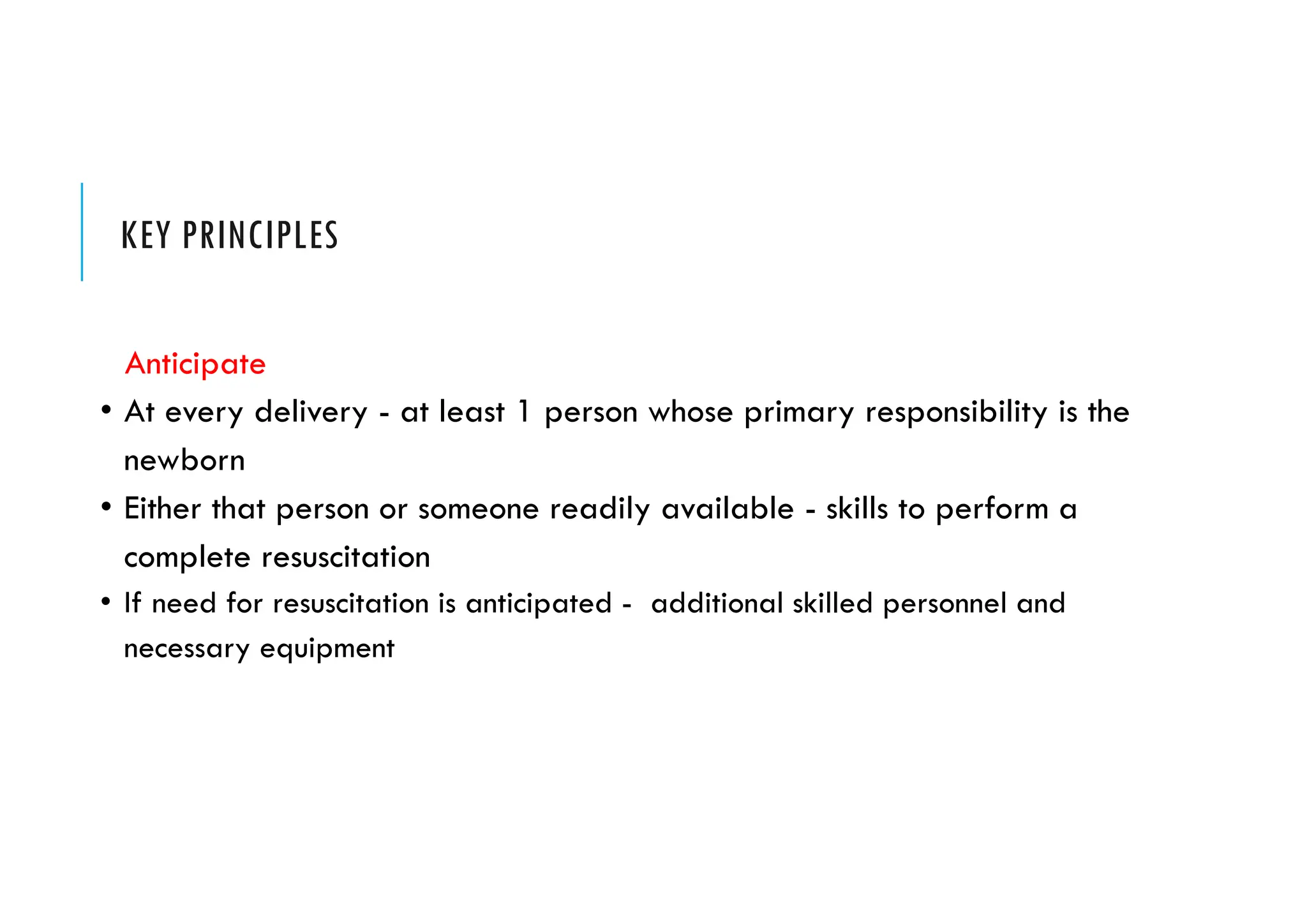
KEY PRINCIPLES
Anticipate
• At every delivery - at least 1 person whose primary responsibility is the
newborn
• Either that person or someone readily available - skills to perform a
complete resuscitation
• If need for resuscitation is anticipated - additional skilled personnel and
necessary equipment
Term gestation?
Breathing or crying?
Good tone?
Routine care
•Provide warmth
•Clear airway if necessary
•Dry
•Ongoing evaluation
Yes, stay
with mother
Birth
30 Sec
60 Sec
INITIAL STEPS
Term gestation?
Breathing or crying?
Good tone?
Warm, clear airway if necessary,
dry, stimulate
Routine care
• Provide warmth
• Clear airway if necessary
• Dry
• Ongoing evaluation
Yes, stay with
mother
No
Birth
30 Sec
60 Sec
INITIAL STEPS
Provide warmth…
Place under the
warmer!
Clear airways
Position – ‘Sniffing’
First mouth, then nose
Clear airways: suction
Dry, stimulate
Dry, stimulate
Assessment of oxygen need:
Pulse-oximetry
• Goal: Achieve oxygen saturation in the IQR of pre-ductal saturations
(both term & pre-term)
Administration of oxygen
• Achieve targets by either initiating resuscitation:
 With room air (preferred in term infants)
 With blended O2 & titrating as necessary (in PT)
• If blended oxygen unavailable, initiate resuscitation with room air
• Increase O2 to 100% if persistently bradycardic (<60 bpm) after 90
seconds of resuscitation with a lower FiO2
INDICATIONS OF BAG & MASK VENTILATION
After 30 seconds of Initial steps if (any):
• Baby is not breathing or is gasping
• Heart rate is less than 100 bpm
• Is Cyanotic despite supplemental oxygen
DIFFERENT TYPES OF
RESUSCITATION DEVICES
Self inflating bags
Fills spontaneously after
it is squeezed, pulling
oxygen or air in to the
bag
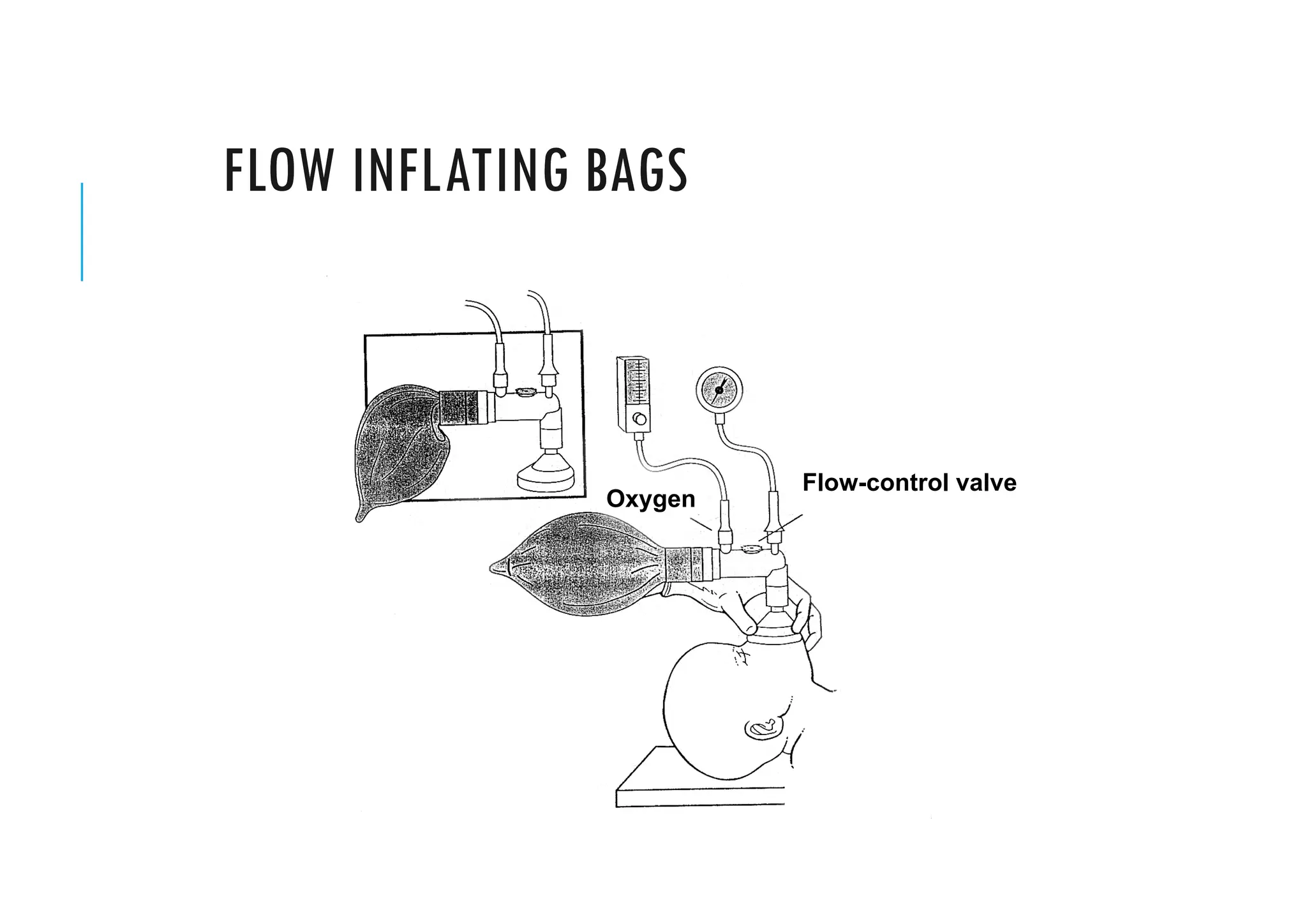
Flow inflating bags
Fills only when oxygen
from a compressed source
flows in to it
T-piece resuscitator
Also works when gas from compressed source
flows into it. The gas is directed into the baby by
occluding the opening on T-piece
FLOW INFLATING BAGS
FLOW INFLATING BAGS
Oxygen
Flow-control valve
SELF INFLATING BAGS
SELF INFLATING BAGS
Oxygen
T-PIECE RESUSCITATOR
PEEP
Adjustment
Maximum
Pressure
Relief
Gas Inlet
Gas Outlet
Inspiratory
Pressure
Control
Circuit
Pressure
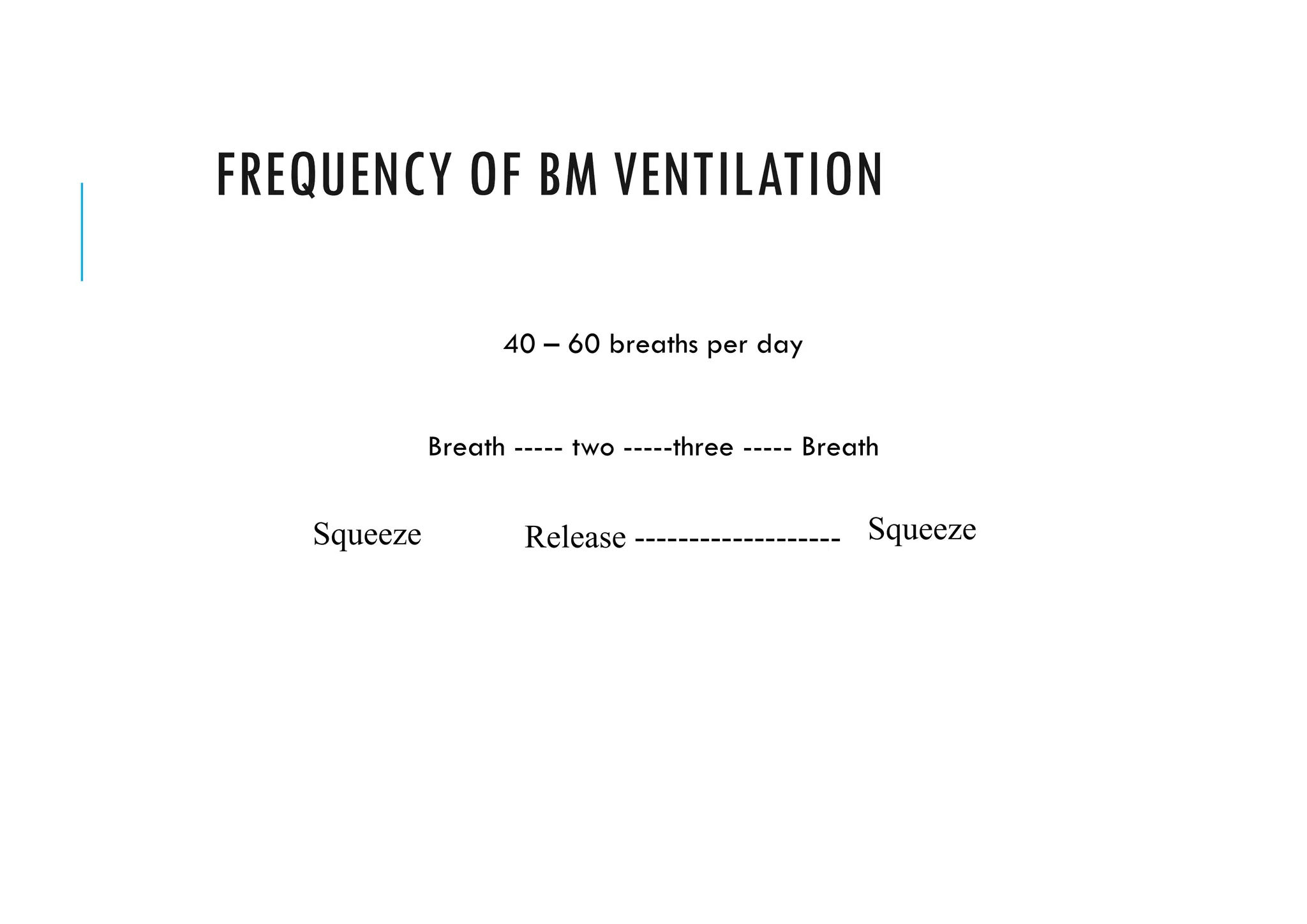
FREQUENCY OF BM VENTILATION
40 – 60 breaths per day
Breath ----- two -----three ----- Breath
Squeeze Squeeze
Release -------------------
FREQUENCY OF PPV
FREQUENCY OF PPV
SIGNS OF EFFECTIVE POSITIVE-PRESSURE VENTILATION
• Rapid rise in heart rate
• Improvement in oxygenation
• Improving muscle tone
• Audible breath sound
• Chest movement
IMPROVING EFFICACY OF PPV
CHEST COMPRESSIONS
• Heart rate less than 60 BPM despite 30 sec of effective positive-pressure ventilation
WHEN TO USE MEDICATIONS
• Despite Administration of effective chest compressions and
effective positive-pressure ventilation with 100% oxygen:
• Heart Rate is below 60 bpm
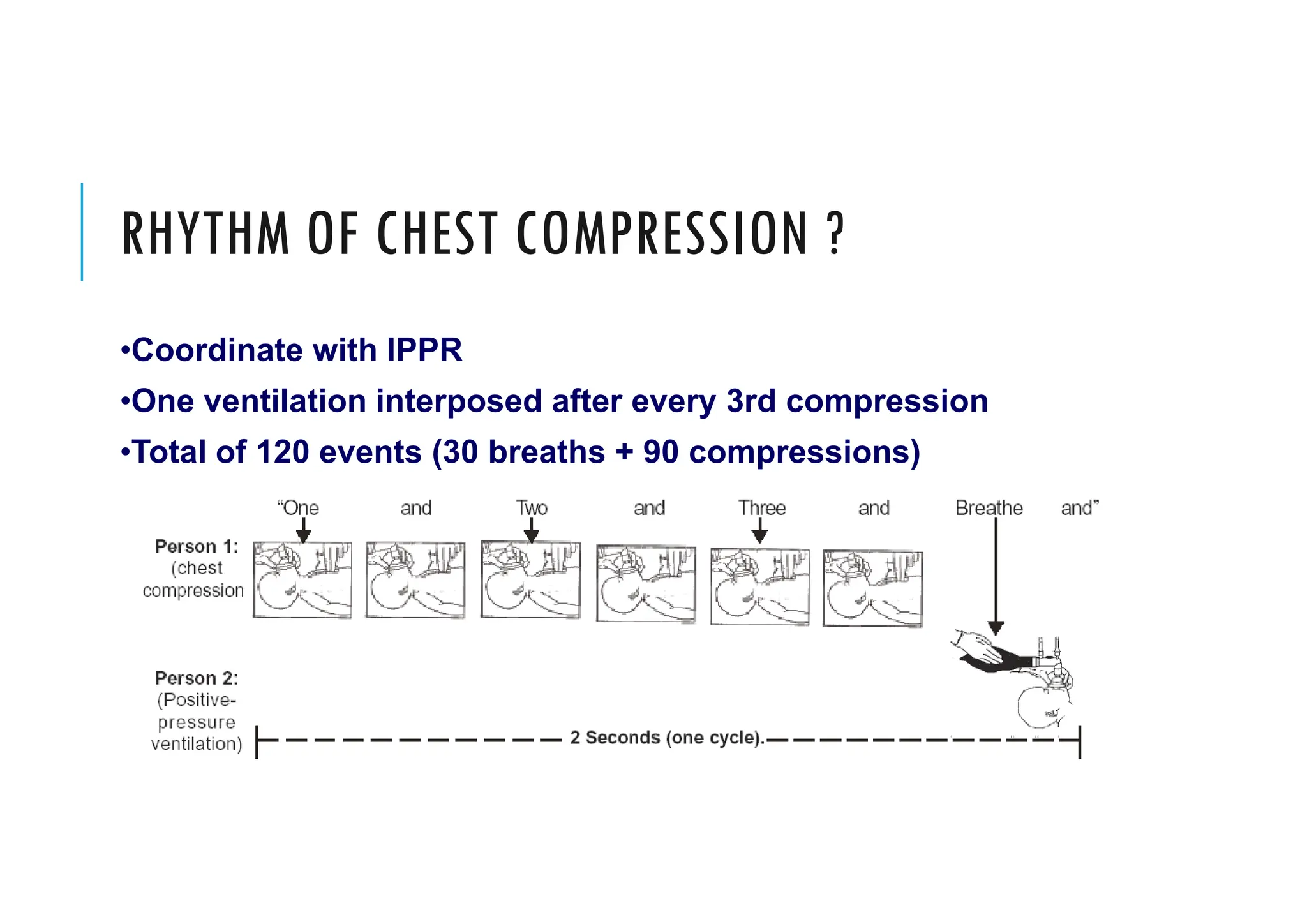
RHYTHM OF CHEST COMPRESSION ?
•Coordinate with IPPR
•One ventilation interposed after every 3rd compression
•Total of 120 events (30 breaths + 90 compressions)
EPINEPHRINE HYDROCHLORIDE
• Cardiac stimulant
 Increases strength & rate of cardiac contractions
 Causes peripheral vasoconstriction
• It is indicated when HR remains < 60 after 30 sec of effective PPV
and another 30 sec of coordinated chest compressions and
ventilation
VOLUME EXPANDER
• Poor response to resuscitation
• Evidence of blood loss
• Pale
• Poor pulses
• CFT
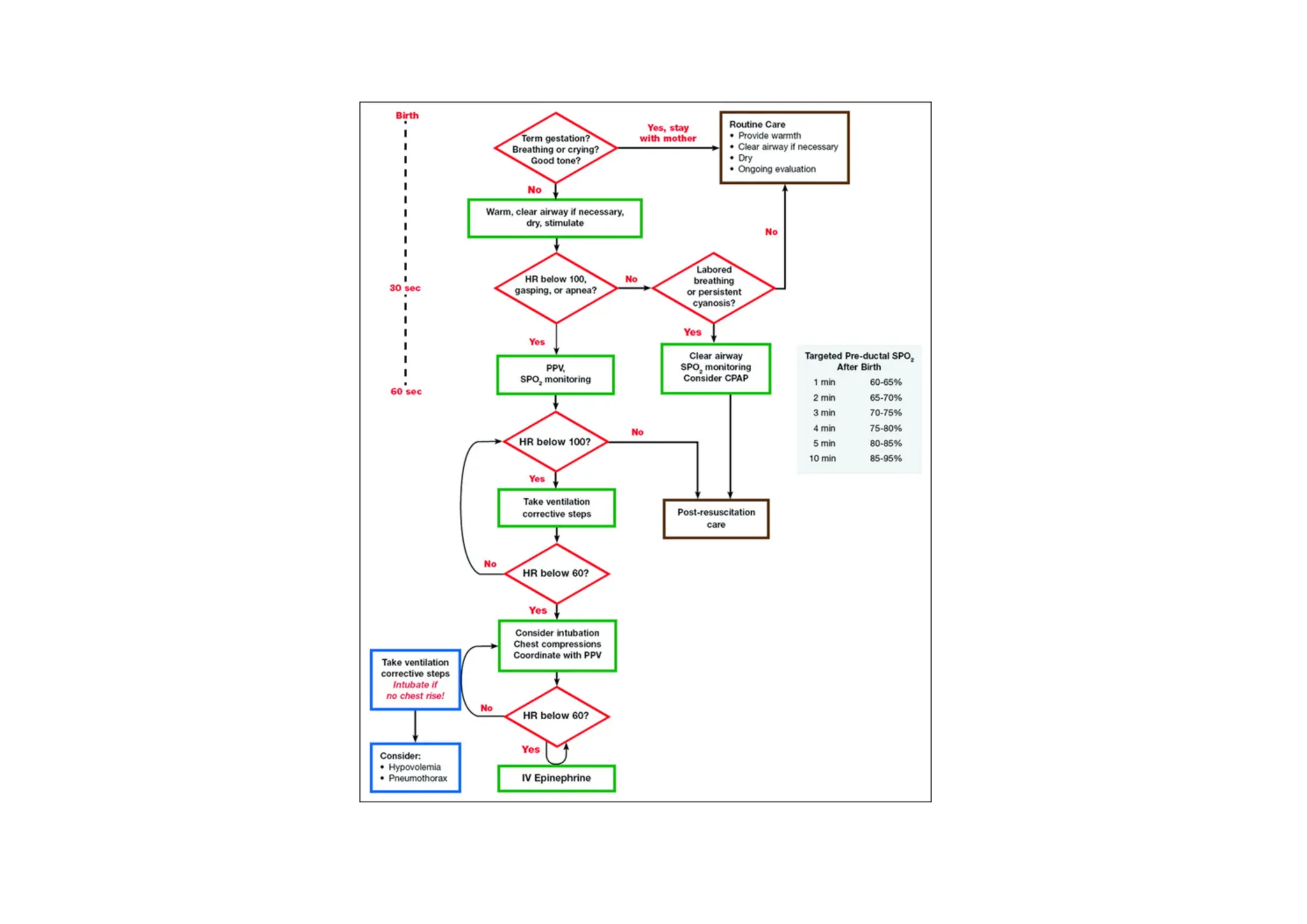
Term gestation?
Breathing or crying?
Good tone?
Warm, clear airway if necessary, dry,
stimulate
HR below 100,
Gasping, or apnea?
PPV, spo2 Monitoring
HR below 100?
Take ventilation
Corrective steps
Consider intubation
Chest compressions
Coordinate with PPV
IV epinephrine
Take ventilation Corrective steps
Intubate if No chest rise!
Consider
• Hypovolemia
• Pneumothorax
Routine care
• Provide warmth
• Clear airway if necessary
• Dry
• Ongoing evaluation
Labored breathing
Or persistent
Cyanosis?
Clear airway spo2
monitoring
Consider CPAP
Postresuscitation Care
HR below 60?
HR below 60?
Yes, stay with
mother
No
Yes
Yes
No
No
No
No
Yes
Yes
Birth
30 Sec
60 Sec
NRP 2010
THANKS

NnnnnNeonatal Resuscitation shortttt.pdf

  • 1.
    NEONATAL RESUSCITATION: CURRENT GUIDELINES DrDeepak Chawla MD, DM (Neonatology) Associate Professor Department of Pediatrics GMCH, Chandigarh
  • 3.
    WHY LEARN RESUSCITATION •Birth asphyxia - 19% ( 5 million) of all neonatal deaths every year (WHO 1995) • By appropriate resuscitation: Outcome of thousands of newborns may improve • 10% of all babies require resuscitation; 1% need extensive resuscitative measures
  • 4.
    ABCS OF RESUSCITATION Temperature Airway(position and clear) Breathing (stimulate to breathe) Circulation (assess heart rate and color) Drugs (Medications)
  • 5.
    Always needed by newborns Needed less frequently Rarelyneeded by newborns Assess baby’s risk for requiring resuscitation Provide Warmth Position, Clear airway, Dry, stimulate to breathe Assist ventilation with positive pressure Provide chest compressions Administer medications Give Supplemental Oxygen, as necessary Intubate the trachea Need For Resuscitation
  • 6.
    FLUID FILLED ALVEOLIAND CONSTRICTED BLOOD VESSELS IN THE LUNGS BEFORE BIRTH Constricted vessels before birth Fluid in alveoli
  • 7.
    SHUNTING OF BLOODTHRU DUCTUS AWAY FROM LUNGS BEFORE BIRTH
  • 8.
    WHAT NORMALLY HAPPENSAT BIRTH Three major changes occur • The Fluid in the alveoli is absorbed • The umbilical arteries and vein constrict and are clamped Removes low-resistance placental circuit Increase systemic blood pressure • Blood vessels in the lung tissue relax Decrease resistance to blood flow
  • 9.
    CHANGES AT BIRTH Fluidin the alveoli absorbed and replaced by air
  • 10.
    Constricted vessels before birth Dilatedvessels after birth Fluid in alveoli Oxygen in alveoli Dilatation of Pulmonary Blood vessels at Birth
  • 11.
    CESSATION OF SHUNTTHRU DUCTUS AFTER BIRTH AS BLOOD PREFERENTIALLY FLOWS THROUGH LUNGS Closing ductus arteriosus Pulmonary artery Oxygen-enriched blood in aorta Lung Lung
  • 12.
    WHAT CAN GOWRONG DURING TRANSITION? • Breaths not forceful to remove alveolar fluid or • Foreign material blocks air entry oxygen not available • Excessive blood loss/poor cardiac contractility systemic hypotension • Hypoxia constriction of pulmonary arterioles tissue oxygen deprivation (PPHN)
  • 13.
    RESPONSE OF THEBABY TO AN INTERRUPTION IN NORMAL TRANSITION • Poor muscle tone due to insufficient oxygen supply to brain, muscles and other organs • Depression of respiratory drive from insufficient oxygen supply to the brain • Bradycardia  Insufficient delivery of oxygen to heart, muscle or brain stem • Low Blood pressure  Poor myocardial contractility or blood loss • Tachypnea from failure to absorb lung fluid • Cyanosis from insufficient oxygen in blood
  • 14.
    KEY PRINCIPLES Anticipate • Atevery delivery - at least 1 person whose primary responsibility is the newborn • Either that person or someone readily available - skills to perform a complete resuscitation • If need for resuscitation is anticipated - additional skilled personnel and necessary equipment
  • 15.
    Term gestation? Breathing orcrying? Good tone? Routine care •Provide warmth •Clear airway if necessary •Dry •Ongoing evaluation Yes, stay with mother Birth 30 Sec 60 Sec INITIAL STEPS
  • 16.
    Term gestation? Breathing orcrying? Good tone? Warm, clear airway if necessary, dry, stimulate Routine care • Provide warmth • Clear airway if necessary • Dry • Ongoing evaluation Yes, stay with mother No Birth 30 Sec 60 Sec INITIAL STEPS
  • 17.
  • 18.
  • 19.
    First mouth, thennose Clear airways: suction
  • 20.
  • 21.
  • 22.
    Assessment of oxygenneed: Pulse-oximetry • Goal: Achieve oxygen saturation in the IQR of pre-ductal saturations (both term & pre-term)
  • 23.
    Administration of oxygen •Achieve targets by either initiating resuscitation:  With room air (preferred in term infants)  With blended O2 & titrating as necessary (in PT) • If blended oxygen unavailable, initiate resuscitation with room air • Increase O2 to 100% if persistently bradycardic (<60 bpm) after 90 seconds of resuscitation with a lower FiO2
  • 24.
    INDICATIONS OF BAG& MASK VENTILATION INDICATIONS OF BAG & MASK VENTILATION After 30 seconds of Initial steps if (any): • Baby is not breathing or is gasping • Heart rate is less than 100 bpm • Is Cyanotic despite supplemental oxygen
  • 25.
    DIFFERENT TYPES OF RESUSCITATIONDEVICES Self inflating bags Fills spontaneously after it is squeezed, pulling oxygen or air in to the bag Flow inflating bags Fills only when oxygen from a compressed source flows in to it T-piece resuscitator Also works when gas from compressed source flows into it. The gas is directed into the baby by occluding the opening on T-piece
  • 26.
    FLOW INFLATING BAGS FLOWINFLATING BAGS Oxygen Flow-control valve
  • 27.
    SELF INFLATING BAGS SELFINFLATING BAGS Oxygen
  • 28.
    T-PIECE RESUSCITATOR T-PIECE RESUSCITATOR PEEP Adjustment Maximum Pressure Relief GasInlet Gas Outlet Inspiratory Pressure Control Circuit Pressure
  • 29.
    FREQUENCY OF BMVENTILATION FREQUENCY OF BM VENTILATION 40 – 60 breaths per day Breath ----- two -----three ----- Breath Squeeze Squeeze Release -------------------
  • 30.
  • 31.
    SIGNS OF EFFECTIVEPOSITIVE-PRESSURE VENTILATION SIGNS OF EFFECTIVE POSITIVE-PRESSURE VENTILATION • Rapid rise in heart rate • Improvement in oxygenation • Improving muscle tone • Audible breath sound • Chest movement
  • 32.
  • 33.
    CHEST COMPRESSIONS • Heartrate less than 60 BPM despite 30 sec of effective positive-pressure ventilation
  • 34.
    WHEN TO USEMEDICATIONS • Despite Administration of effective chest compressions and effective positive-pressure ventilation with 100% oxygen: • Heart Rate is below 60 bpm
  • 35.
    RHYTHM OF CHESTCOMPRESSION ? •Coordinate with IPPR •One ventilation interposed after every 3rd compression •Total of 120 events (30 breaths + 90 compressions)
  • 36.
    EPINEPHRINE HYDROCHLORIDE • Cardiacstimulant  Increases strength & rate of cardiac contractions  Causes peripheral vasoconstriction • It is indicated when HR remains < 60 after 30 sec of effective PPV and another 30 sec of coordinated chest compressions and ventilation
  • 37.
    VOLUME EXPANDER • Poorresponse to resuscitation • Evidence of blood loss • Pale • Poor pulses • CFT
  • 38.
    Term gestation? Breathing orcrying? Good tone? Warm, clear airway if necessary, dry, stimulate HR below 100, Gasping, or apnea? PPV, spo2 Monitoring HR below 100? Take ventilation Corrective steps Consider intubation Chest compressions Coordinate with PPV IV epinephrine Take ventilation Corrective steps Intubate if No chest rise! Consider • Hypovolemia • Pneumothorax Routine care • Provide warmth • Clear airway if necessary • Dry • Ongoing evaluation Labored breathing Or persistent Cyanosis? Clear airway spo2 monitoring Consider CPAP Postresuscitation Care HR below 60? HR below 60? Yes, stay with mother No Yes Yes No No No No Yes Yes Birth 30 Sec 60 Sec NRP 2010
  • 39.