Restraints
SAMRUDDI
COLLEGE OF
NURSING GOKAK
Assignment on Restraints
Submitted to
Mr.Basavaraj Navi sir
Submitted by
MahammadyaseenMulla
Bsc Nursing3rd year
Restraints
Meaning
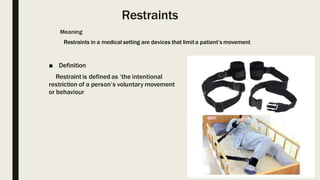
Restraints in a medical setting are devices that limita patient’s movement
■ Definition
Restraintis defined as ‘the intentional
restriction of a person’s voluntary movement
or behaviour
General Principles For Use Of
Restraints
■ Should be selected to reduce clients movementonly as much as necessary
■ Should not interfere with treatment
■ Nurse should explain it.and reason for its use.
■ Should be changed when they become soiled
■ Should be removed every 2hrs
■ It should attach to bed frame not to side rails.
■ Should be able to quickly release the device
■ It should be away fromclients reach.
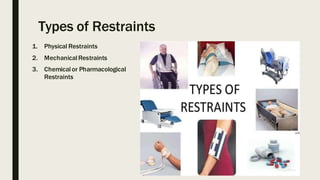
Types of Restraints
1. Physical Restraints
2. MechanicalRestraints
3. Chemical or Pharmacological
Restraints
Physical Restraints
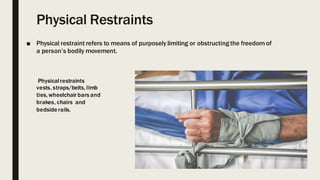
■ Physical restraint refers to means of purposely limiting or obstructingthe freedom of
a person’s bodily movement.
Physicalrestraints
vests, straps/belts, limb
ties, wheelchair bars and
brakes, chairs and
bedsiderails.
Mechanical Restraints
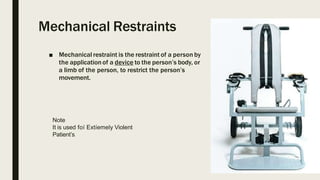
■ Mechanical restraint is the restraint of a person by
the applicationof a device to the person’s body, or
a limb of the person, to restrict the person’s
movement.
Note
It is used foí Extíemely Violent
Patient’s.
Chemical or Pharmacological Restraints
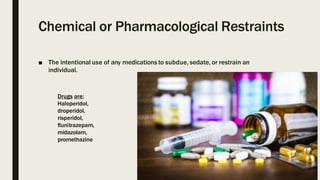
■ The intentional use of any medications to subdue, sedate, or restrain an
individual.
Drugs are;
Haloperidol,
droperidol,
risperidol,
flunitrazepam,
midazolam,
promethazine
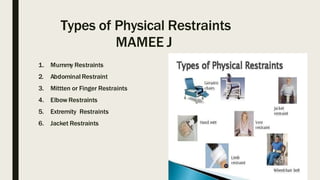
Types of Physical Restraints
MAMEE J
1. Mummy Restraints
2. Abdominal Restraint
3. Mittten or Finger Restraints
4. Elbow Restraints
5. Extremity Restraints
6. Jacket Restraints
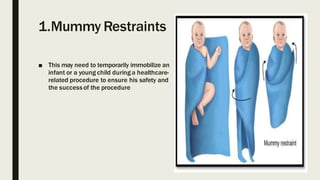
1.Mummy Restraints
■ This may need to temporarily immobilize an
infant or a young child duringa healthcare-
related procedure to ensure his safety and
the successof the procedure
2.Abdominal Restraints
■ The abdominal constraint device was applied before
resuscitation, ensuringa suitable abdominal
compartment to contain hydropicorgans and leaked
fluid in a certain period of time
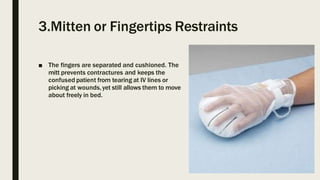
3.Mitten or Fingertips Restraints
■ The fingers are separated and cushioned. The
mitt prevents contractures and keeps the
confused patient from tearing at IV lines or
picking at wounds,yet still allows them to move
about freely in bed.
4.Elbow Restraints
■ Elbow restraints is used to prevent the infant from
flexing his elbow so that he is unable to remove the
nasogastric tube or scalp vein
5.Extremity Restraints
■ Limb restraints are soft, padded cuffs which are applied to a
patient to prevent the patient from causing harm to themselves
or to others.
6.Jacket Restraints
■ Ajacket-shaped restraint that’s meant to
confine a violent person safely is called a
straitjacket. Straitjackets were once
commonly used in psychiatric hospitals.
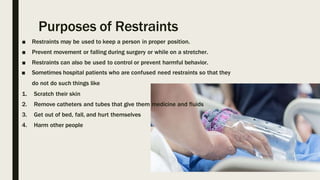
Purposes of Restraints
■ Restraints may be used to keep a person in proper position.
■ Prevent movement or falling during surgery or while on a stretcher.
■ Restraints can also be used to control or prevent harmful behavior.
■ Sometimes hospital patients who are confused need restraints so that they
do not do such things like
1. Scratch their skin
2. Remove catheters and tubes that give them medicine and fluids
3. Get out of bed, fall, and hurt themselves
4. Harm other people
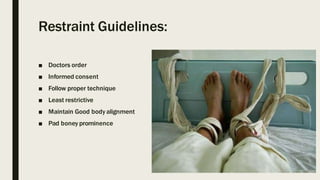
Restraint Guidelines:
■ Doctors order
■ Informed consent
■ Follow proper technique
■ Least restrictive
■ Maintain Good body alignment
■ Pad boney prominence
Side effects of Restraints
Psychological /Emotional
■ Increased agitation & hostility
■ Feelings of humiliation,loss of dignity
■ Increased confusion
■ Fear
Physical:
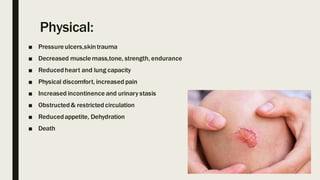
■ Pressureulcers,skintrauma
■ Decreased musclemass,tone, strength, endurance
■ Reducedheart and lung capacity
■ Physical discomfort, increased pain
■ Increased incontinence and urinary stasis
■ Obstructed& restricted circulation
■ Reducedappetite, Dehydration
■ Death
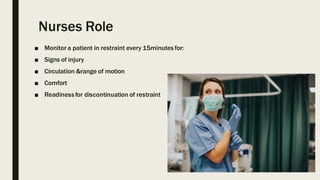
Nurses Role
■ Monitor a patient in restraint every 15minutes for:
■ Signs of injury
■ Circulation &range of motion
■ Comfort
■ Readinessfor discontinuation of restraint
Responsibility of Nurrse
■ Assess the client’s behaviour & the need for restraint & apply it
■ Get written order & obtain consent as per hospital policy
■ Must communicateswith client and family members
■ Explain the client the reason for the restraint and cooperation
■ Apply the least restrictive, reasonableand appropriate devices
■ Arrange the client under restraint in a place for easy,, close & regular observation
■ Attend the client’s biological & psychologicalneeds during restraint at regular
intervals.
■ Document the use of restraint for record & inspection purpose
Conclusion
Restraints were not associated with a significantly
lower risk of falls or injuries in subgroups of residents
likely to be restrained.
Thank you all

Restraints.pptx

  • 1.
  • 2.
  • 3.
    Assignment on Restraints Submittedto Mr.Basavaraj Navi sir Submitted by MahammadyaseenMulla Bsc Nursing3rd year
  • 4.
    Restraints Meaning Restraints in amedical setting are devices that limita patient’s movement ■ Definition Restraintis defined as ‘the intentional restriction of a person’s voluntary movement or behaviour
  • 5.
    General Principles ForUse Of Restraints ■ Should be selected to reduce clients movementonly as much as necessary ■ Should not interfere with treatment ■ Nurse should explain it.and reason for its use. ■ Should be changed when they become soiled ■ Should be removed every 2hrs ■ It should attach to bed frame not to side rails. ■ Should be able to quickly release the device ■ It should be away fromclients reach.
  • 6.
    Types of Restraints 1.Physical Restraints 2. MechanicalRestraints 3. Chemical or Pharmacological Restraints
  • 7.
    Physical Restraints ■ Physicalrestraint refers to means of purposely limiting or obstructingthe freedom of a person’s bodily movement. Physicalrestraints vests, straps/belts, limb ties, wheelchair bars and brakes, chairs and bedsiderails.
  • 8.
    Mechanical Restraints ■ Mechanicalrestraint is the restraint of a person by the applicationof a device to the person’s body, or a limb of the person, to restrict the person’s movement. Note It is used foí Extíemely Violent Patient’s.
  • 9.
    Chemical or PharmacologicalRestraints ■ The intentional use of any medications to subdue, sedate, or restrain an individual. Drugs are; Haloperidol, droperidol, risperidol, flunitrazepam, midazolam, promethazine
  • 10.
    Types of PhysicalRestraints MAMEE J 1. Mummy Restraints 2. Abdominal Restraint 3. Mittten or Finger Restraints 4. Elbow Restraints 5. Extremity Restraints 6. Jacket Restraints
  • 11.
    1.Mummy Restraints ■ Thismay need to temporarily immobilize an infant or a young child duringa healthcare- related procedure to ensure his safety and the successof the procedure
  • 12.
    2.Abdominal Restraints ■ Theabdominal constraint device was applied before resuscitation, ensuringa suitable abdominal compartment to contain hydropicorgans and leaked fluid in a certain period of time
  • 13.
    3.Mitten or FingertipsRestraints ■ The fingers are separated and cushioned. The mitt prevents contractures and keeps the confused patient from tearing at IV lines or picking at wounds,yet still allows them to move about freely in bed.
  • 14.
    4.Elbow Restraints ■ Elbowrestraints is used to prevent the infant from flexing his elbow so that he is unable to remove the nasogastric tube or scalp vein
  • 15.
    5.Extremity Restraints ■ Limbrestraints are soft, padded cuffs which are applied to a patient to prevent the patient from causing harm to themselves or to others.
  • 16.
    6.Jacket Restraints ■ Ajacket-shapedrestraint that’s meant to confine a violent person safely is called a straitjacket. Straitjackets were once commonly used in psychiatric hospitals.
  • 17.
    Purposes of Restraints ■Restraints may be used to keep a person in proper position. ■ Prevent movement or falling during surgery or while on a stretcher. ■ Restraints can also be used to control or prevent harmful behavior. ■ Sometimes hospital patients who are confused need restraints so that they do not do such things like 1. Scratch their skin 2. Remove catheters and tubes that give them medicine and fluids 3. Get out of bed, fall, and hurt themselves 4. Harm other people
  • 18.
    Restraint Guidelines: ■ Doctorsorder ■ Informed consent ■ Follow proper technique ■ Least restrictive ■ Maintain Good body alignment ■ Pad boney prominence
  • 19.
    Side effects ofRestraints Psychological /Emotional ■ Increased agitation & hostility ■ Feelings of humiliation,loss of dignity ■ Increased confusion ■ Fear
  • 20.
    Physical: ■ Pressureulcers,skintrauma ■ Decreasedmusclemass,tone, strength, endurance ■ Reducedheart and lung capacity ■ Physical discomfort, increased pain ■ Increased incontinence and urinary stasis ■ Obstructed& restricted circulation ■ Reducedappetite, Dehydration ■ Death
  • 21.
    Nurses Role ■ Monitora patient in restraint every 15minutes for: ■ Signs of injury ■ Circulation &range of motion ■ Comfort ■ Readinessfor discontinuation of restraint
  • 22.
    Responsibility of Nurrse ■Assess the client’s behaviour & the need for restraint & apply it ■ Get written order & obtain consent as per hospital policy ■ Must communicateswith client and family members ■ Explain the client the reason for the restraint and cooperation ■ Apply the least restrictive, reasonableand appropriate devices ■ Arrange the client under restraint in a place for easy,, close & regular observation ■ Attend the client’s biological & psychologicalneeds during restraint at regular intervals. ■ Document the use of restraint for record & inspection purpose
  • 23.
    Conclusion Restraints were notassociated with a significantly lower risk of falls or injuries in subgroups of residents likely to be restrained.
  • 24.