CDMA
Cellular Radio Network
By:
Md. Saddam Hossain (Noyon)
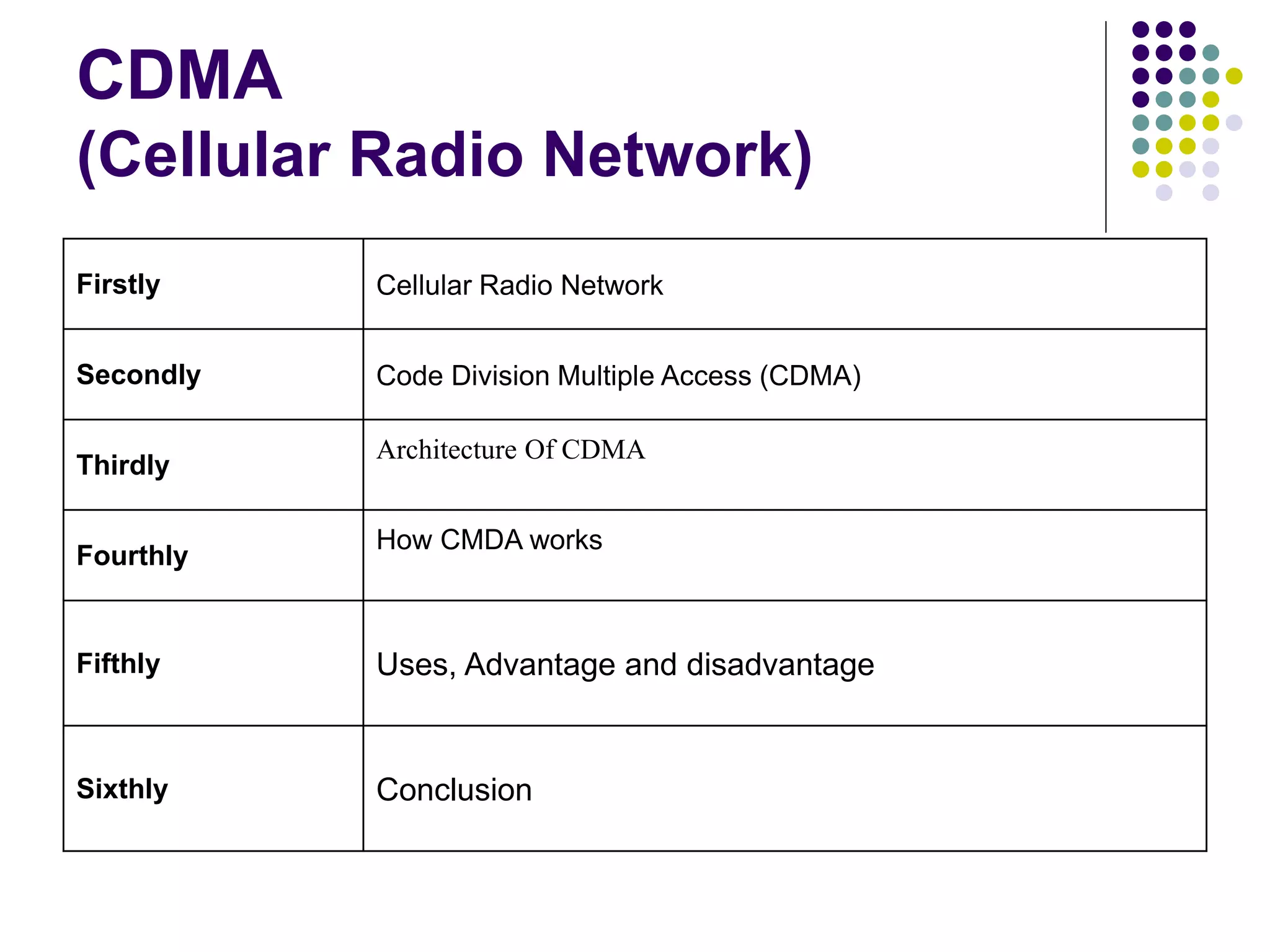
CDMA
(Cellular Radio Network)
Firstly Cellular Radio Network
Secondly Code Division Multiple Access (CDMA)
Thirdly
Architecture Of CDMA
Fourthly
How CMDA works
Fifthly Uses, Advantage and disadvantage
Sixthly Conclusion
Cellular Radio Network
 Network distributed over land through cells
where each cell includes a fixed location
transceiver known as base station. These cells
together provide radio coverage over larger
geographical areas.
.
Cellular Radio Network
CDMA
 Code Division Multiple Access.
 Third generation mobile system communication
standard where Multiple user connected to the
tower with the same radio channel
 Technology in radio communication system for
multiple channel access where Numerous
signals occupy a single transmission channel
 Different user allocated different code for
transmission over the same radio channel
Architecture Of CDMA:
ME
SIM
BTS
BTS
BSC
BSC
MSC
VLR
EIR
HLR
AuC
AUm
Abis
PSTN
ISDN
Mobile
station
Base Station
Subsystem
Network
Subsystem
MS BSS NS
Architecture Of CDMA:
• Mobile Station (MS): Two Blocks
o Mobile Equipment (ME)
o Subscribers Identity Module (SIM)
 Function of Mobile Station:
1. Personal Mobility
2. IMEI (International Mobile Equipment
Identity)
3. IMSI (International Mobile Subscriber Identity
Architecture Of CDMA:
 Base Station Subsystem (BSS)
1.Base Transceiver Station (BTS)
a. It defines the cell .
b. It handles the radio link protocol
with the mobile station
2. Base Station Controller (BSC)
a. It manages radio resources for one or more BTS.
b. Allocation and Deallocation of channels.
c. Transmitter power control.
d. Handoff control
BSC
Architecture Of CDMA:
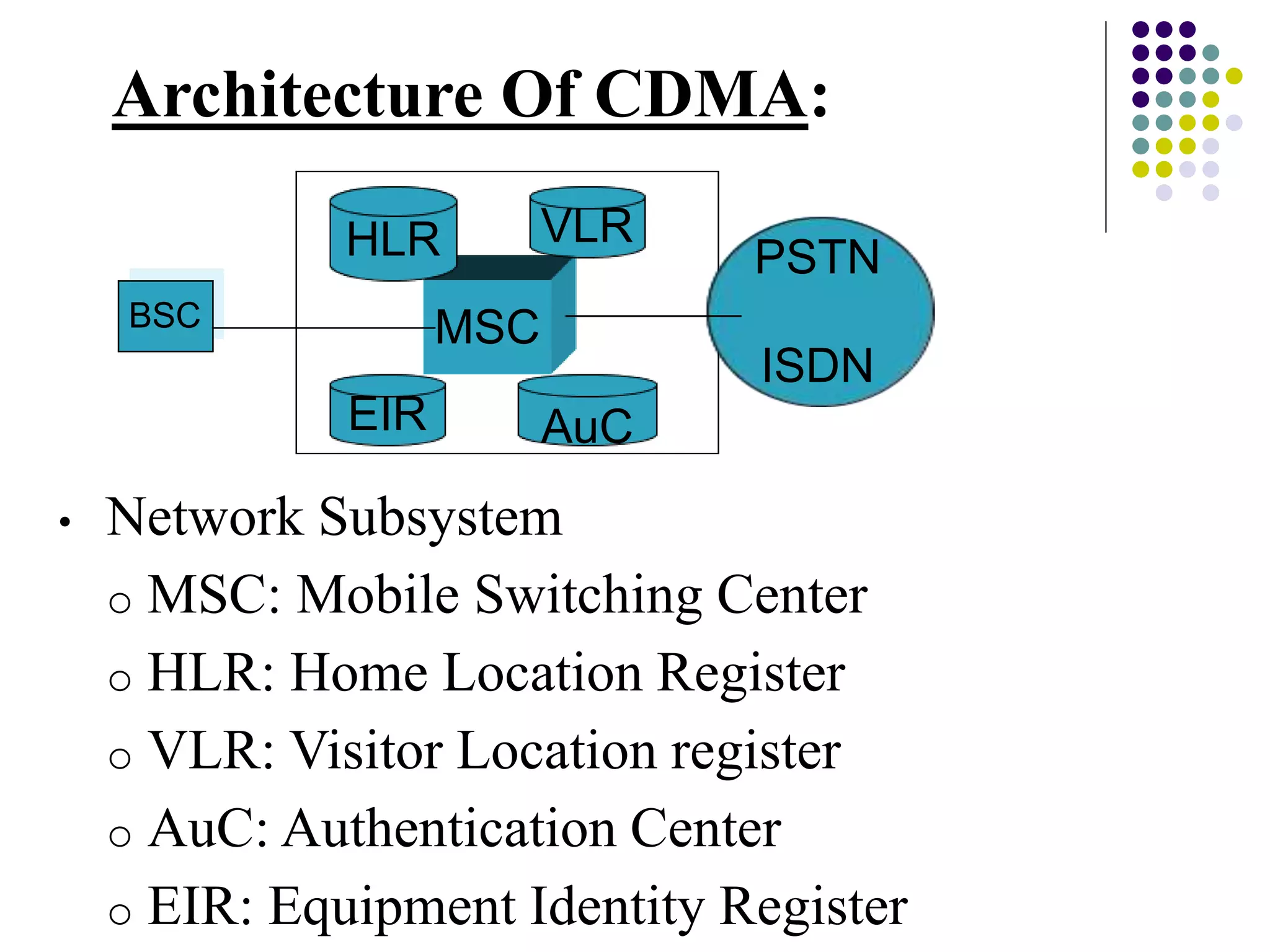
• Network Subsystem
o MSC: Mobile Switching Center
o HLR: Home Location Register
o VLR: Visitor Location register
o AuC: Authentication Center
o EIR: Equipment Identity Register
BSC MSC
VLR
EIR
HLR
AuC
PSTN
ISDN
How CDMA works
Common
Radio
Channel User 0
User 1
• CDMA is a technology for multiple access
• It’s means Multiple user connected to the
tower with the same radio channel
• In CDMA different user are allocated different
code for transmission over the radio channel
ExampleBS
How CDMA works
User
User-0
User-1
c0 = 1 , 1 , 1, 1
c1 = 1 , -1 ,-1, 1
Consider Two user with two code
a0 =symbol of user-0
a1 =symbol of user-1
How CDMA works
Multiple Symbol of each user with respective
code
a0 × c0 = a0 × 1 , 1 , 1, 1
= a0, a0, a0, a0
a1 × c1 = a1 × 1 ,-1 ,-1, 1
= a1,-a1,-a1, a1
How CDMA works
 Now we are generate the combine signal at
the base station
= a0 × c0 + a1 × c1
= a0+a1 ,a0-a1 ,a0-a1 , a0+a1
Combined signal of two user
The combined signal is transmitted
over the same radio channel
How CDMA works
From this sum signal each user has to extract
his corresponding signal
User 0 correlated with c0 that is multiplies
elements by element and sum
c0 = 1 , 1 , 1, 1
= 1 ×(a0+a1) + 1 × (a0-a1 ) +1 ×(a0-a1 )
+1 ×( a0+a1 )
How CDMA works
= (a0+a1) + (a0-a1 ) +(a0-a1 ) +( a0+a1 )
= 4a0
This is the symbol of user 0
Similarly for user 1 the symbol is
= 4a1
By performing this correlation User are able to
extract symbol from this common signal that
has been transmitted over the common radio
channel
CDMA Advantage
 Spread Spectrum
 Soft & Softer Handoff
 Rake Receiver
 Variable Rate Vocoder
 High quality voice and Power control
 Simple Network Planning
 Green Handset and Coverage
 Smooth migration to 3G and the operator’s
benefit is protected at the most
CDMA Disadvantage
• Near far problem.
• CDMA is relatively low, and the network is
not as mature as GSM.
• CDMA can not offer international roaming,
a large GSM advantage.
Conclusion
 The CDMA will allow many signals to be
transmitted at the same channel at the same time.
This done by giving each user a Pseudo-Noise
code which is a binary sequence. This code
should have low cross-correlation between each
other.
 CDMA cellular system is deemed superior to
the FDMA and TDMA
 cellular systems for the time being.
Conclusion
 Therefore, CDMA technique becomes more
important in radio
 communication systems.
 CDMA is based on the spread spectrum technique
which has been used at military field.
Thanks

CDMA cellular radio network

  • 1.
  • 2.
    CDMA (Cellular Radio Network) FirstlyCellular Radio Network Secondly Code Division Multiple Access (CDMA) Thirdly Architecture Of CDMA Fourthly How CMDA works Fifthly Uses, Advantage and disadvantage Sixthly Conclusion
  • 3.
    Cellular Radio Network Network distributed over land through cells where each cell includes a fixed location transceiver known as base station. These cells together provide radio coverage over larger geographical areas. . Cellular Radio Network
  • 4.
    CDMA  Code DivisionMultiple Access.  Third generation mobile system communication standard where Multiple user connected to the tower with the same radio channel  Technology in radio communication system for multiple channel access where Numerous signals occupy a single transmission channel  Different user allocated different code for transmission over the same radio channel
  • 5.
  • 6.
    Architecture Of CDMA: •Mobile Station (MS): Two Blocks o Mobile Equipment (ME) o Subscribers Identity Module (SIM)  Function of Mobile Station: 1. Personal Mobility 2. IMEI (International Mobile Equipment Identity) 3. IMSI (International Mobile Subscriber Identity
  • 7.
    Architecture Of CDMA: Base Station Subsystem (BSS) 1.Base Transceiver Station (BTS) a. It defines the cell . b. It handles the radio link protocol with the mobile station 2. Base Station Controller (BSC) a. It manages radio resources for one or more BTS. b. Allocation and Deallocation of channels. c. Transmitter power control. d. Handoff control BSC
  • 8.
    Architecture Of CDMA: •Network Subsystem o MSC: Mobile Switching Center o HLR: Home Location Register o VLR: Visitor Location register o AuC: Authentication Center o EIR: Equipment Identity Register BSC MSC VLR EIR HLR AuC PSTN ISDN
  • 9.
    How CDMA works Common Radio ChannelUser 0 User 1 • CDMA is a technology for multiple access • It’s means Multiple user connected to the tower with the same radio channel • In CDMA different user are allocated different code for transmission over the radio channel ExampleBS
  • 10.
    How CDMA works User User-0 User-1 c0= 1 , 1 , 1, 1 c1 = 1 , -1 ,-1, 1 Consider Two user with two code a0 =symbol of user-0 a1 =symbol of user-1
  • 11.
    How CDMA works MultipleSymbol of each user with respective code a0 × c0 = a0 × 1 , 1 , 1, 1 = a0, a0, a0, a0 a1 × c1 = a1 × 1 ,-1 ,-1, 1 = a1,-a1,-a1, a1
  • 12.
    How CDMA works Now we are generate the combine signal at the base station = a0 × c0 + a1 × c1 = a0+a1 ,a0-a1 ,a0-a1 , a0+a1 Combined signal of two user The combined signal is transmitted over the same radio channel
  • 13.
    How CDMA works Fromthis sum signal each user has to extract his corresponding signal User 0 correlated with c0 that is multiplies elements by element and sum c0 = 1 , 1 , 1, 1 = 1 ×(a0+a1) + 1 × (a0-a1 ) +1 ×(a0-a1 ) +1 ×( a0+a1 )
  • 14.
    How CDMA works =(a0+a1) + (a0-a1 ) +(a0-a1 ) +( a0+a1 ) = 4a0 This is the symbol of user 0 Similarly for user 1 the symbol is = 4a1 By performing this correlation User are able to extract symbol from this common signal that has been transmitted over the common radio channel
  • 15.
    CDMA Advantage  SpreadSpectrum  Soft & Softer Handoff  Rake Receiver  Variable Rate Vocoder  High quality voice and Power control  Simple Network Planning  Green Handset and Coverage  Smooth migration to 3G and the operator’s benefit is protected at the most
  • 16.
    CDMA Disadvantage • Nearfar problem. • CDMA is relatively low, and the network is not as mature as GSM. • CDMA can not offer international roaming, a large GSM advantage.
  • 17.
    Conclusion  The CDMAwill allow many signals to be transmitted at the same channel at the same time. This done by giving each user a Pseudo-Noise code which is a binary sequence. This code should have low cross-correlation between each other.  CDMA cellular system is deemed superior to the FDMA and TDMA  cellular systems for the time being.
  • 18.
    Conclusion  Therefore, CDMAtechnique becomes more important in radio  communication systems.  CDMA is based on the spread spectrum technique which has been used at military field.
  • 19.