FUNDAMENTALS OF BPM:
50 Years of BPM Teaching Distilled
Marlon Dumas (University of Tartu)
Marcello La Rosa (University of Melbourne)
Jan Mendling (WU University)
Hajo Reijers (Vrije Universiteit Amsterdam)
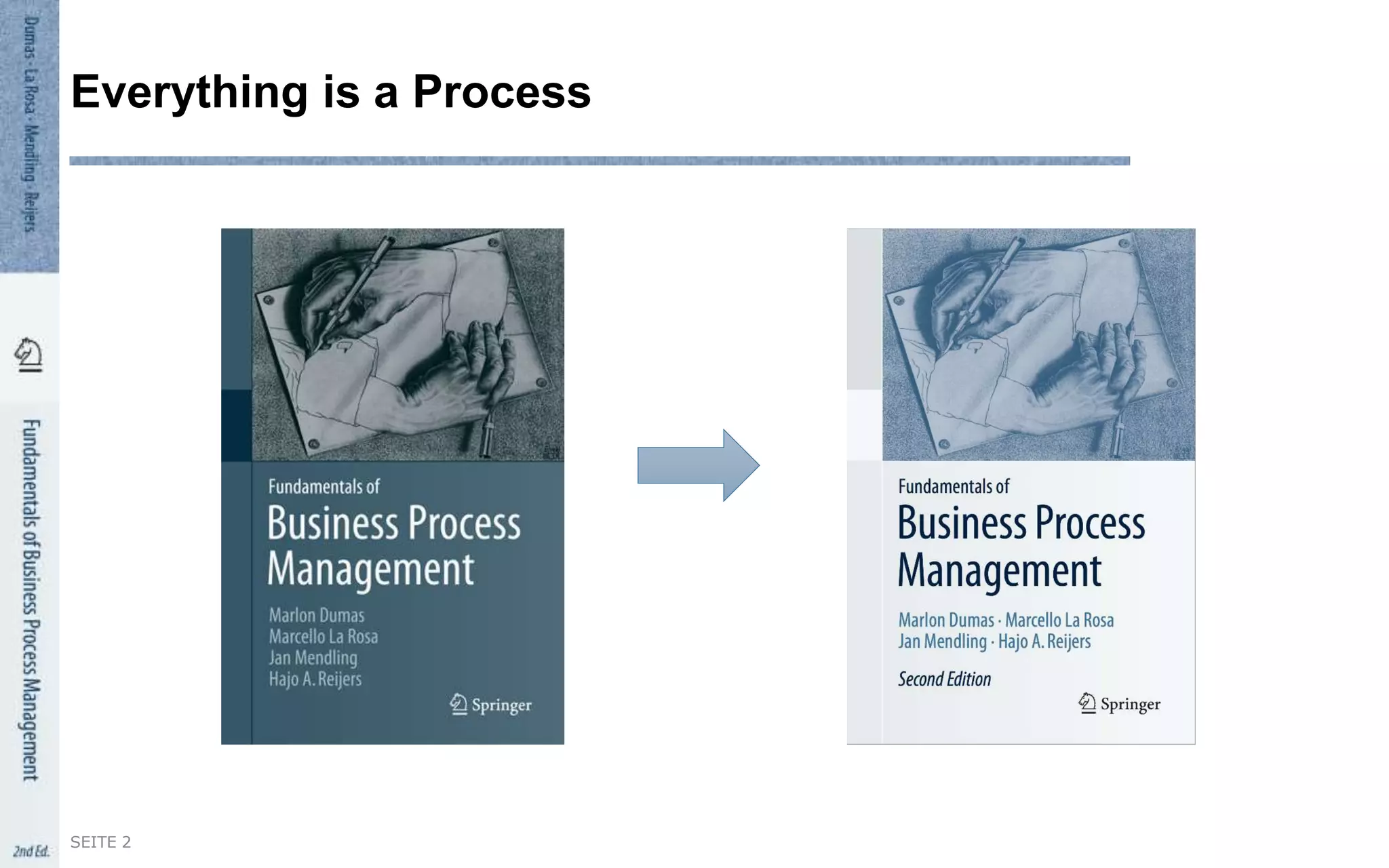
Everything is a Process
SEITE 2
 Over 50 years experience in teaching BPM
 950 citations since 2013
 Adopted in courses at more than 200 universities in more than 60 countries
 Available from the library of nearly 450 universities
 Used in MOOCs teaching to more than 25,000 students
 Over 300 subscriptions to the online instructors group
 Translations to Chinese, German, Greek, Persian and Spanish to be published
Some Measures of Success
SEITE 3
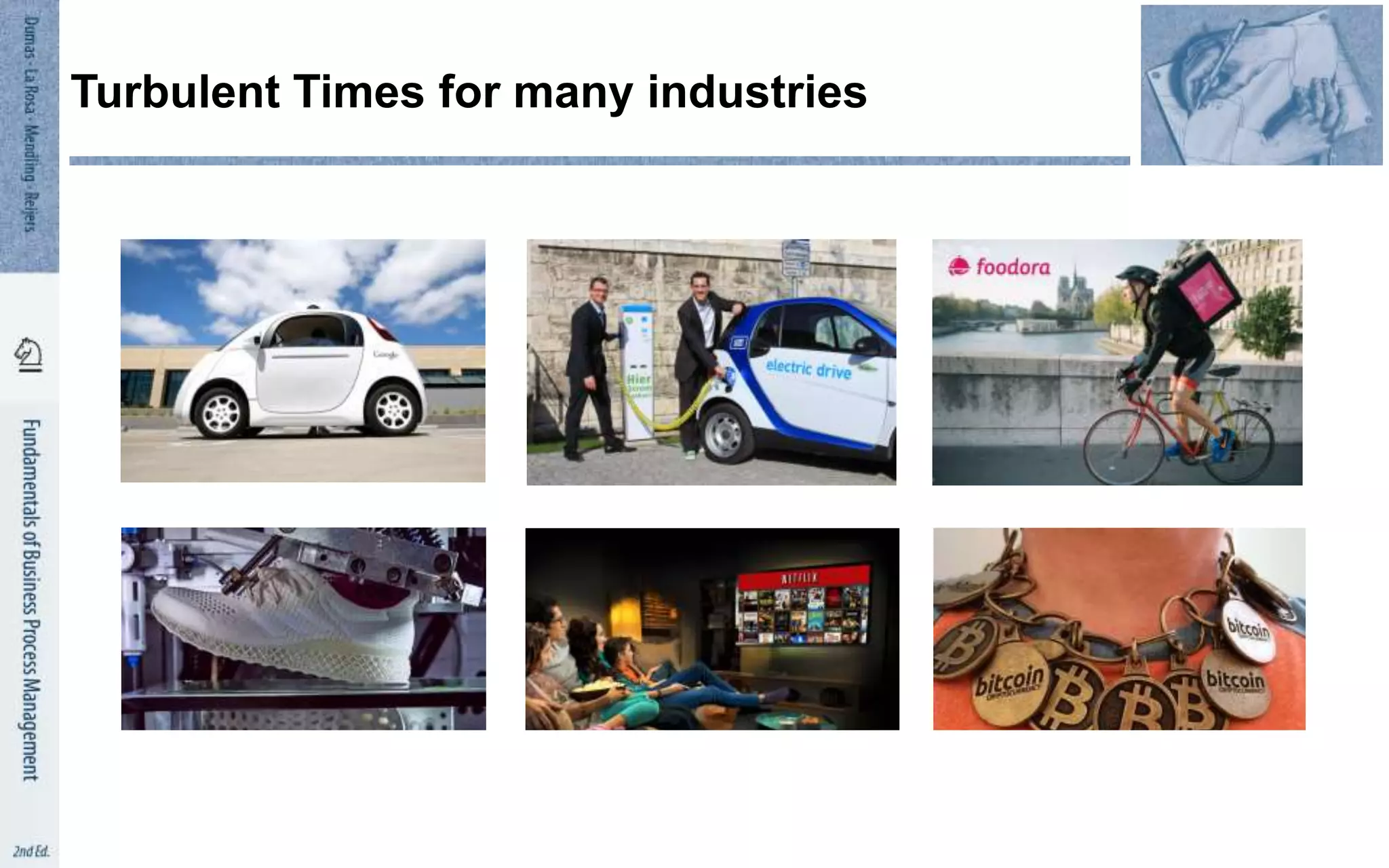
Turbulent Times for many industries
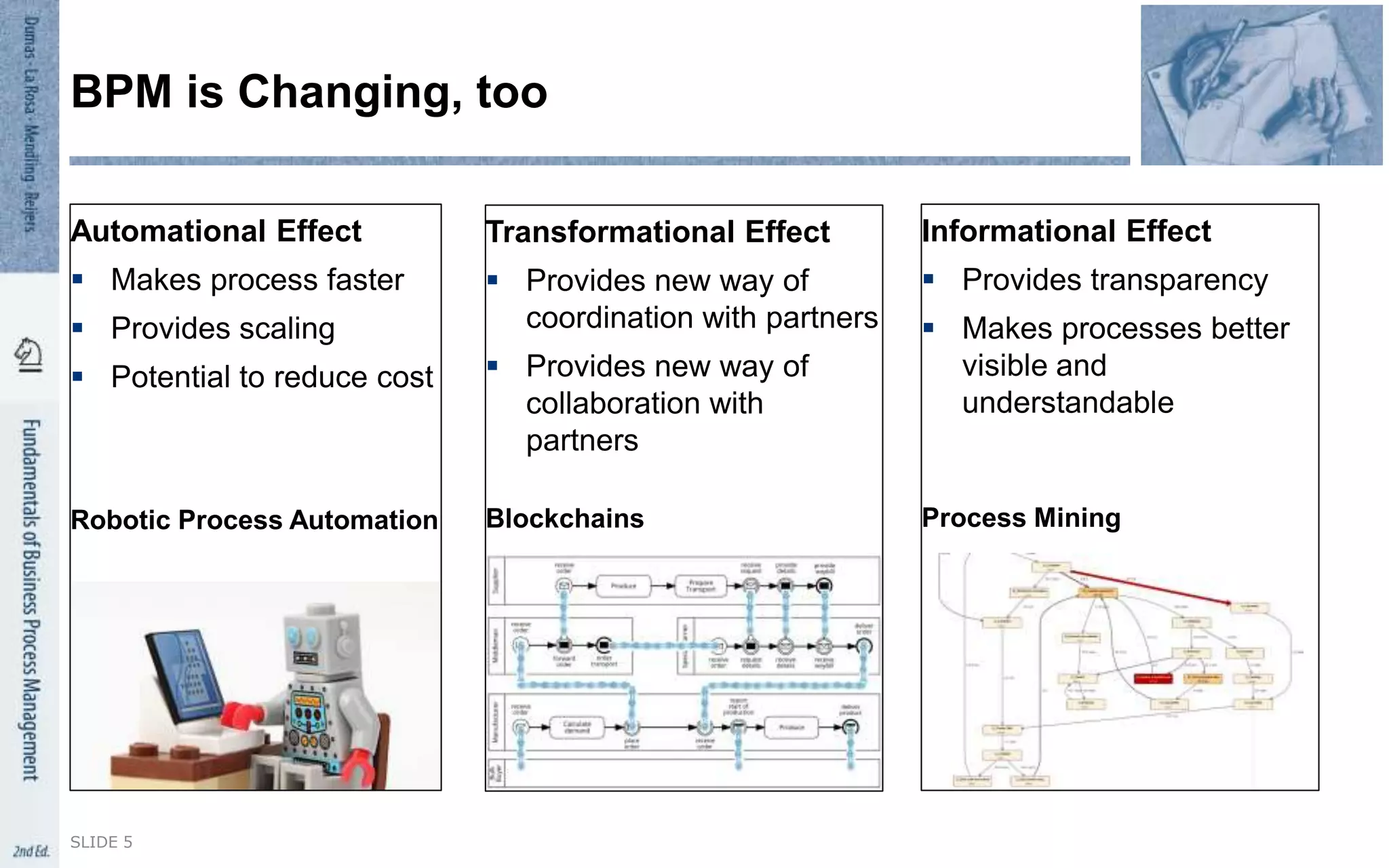
Automational Effect
 Makes process faster
 Provides scaling
 Potential to reduce cost
Robotic Process Automation
Informational Effect
 Provides transparency
 Makes processes better
visible and
understandable
Process Mining
SLIDE 5
BPM is Changing, too
Transformational Effect
 Provides new way of
coordination with partners
 Provides new way of
collaboration with
partners
Blockchains
SLIDE 6
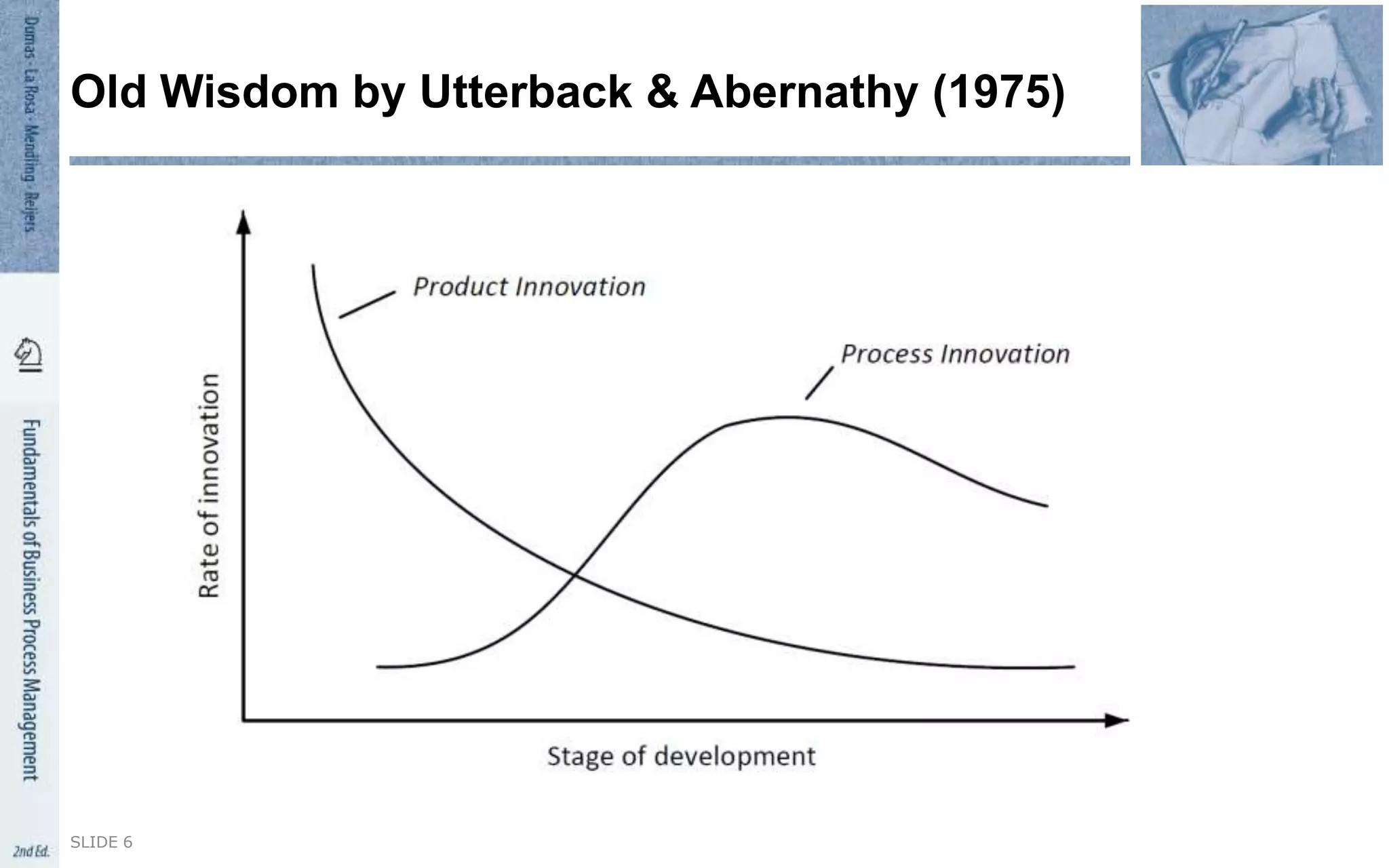
Old Wisdom by Utterback & Abernathy (1975)
 Extended from 399 to 526 pages
 Added 2 new chapters, 4 fully-reworked chapters and many refinements
 Enriched with 230 exercises
 Full coverage of the redesign orbit
 New standards like DMN and CMMN covered
 Enhanced presentation of monitoring including recent process mining techniques
 Holistic discussion of BPM as an enterprise capability
Summary of Changes
SEITE 7
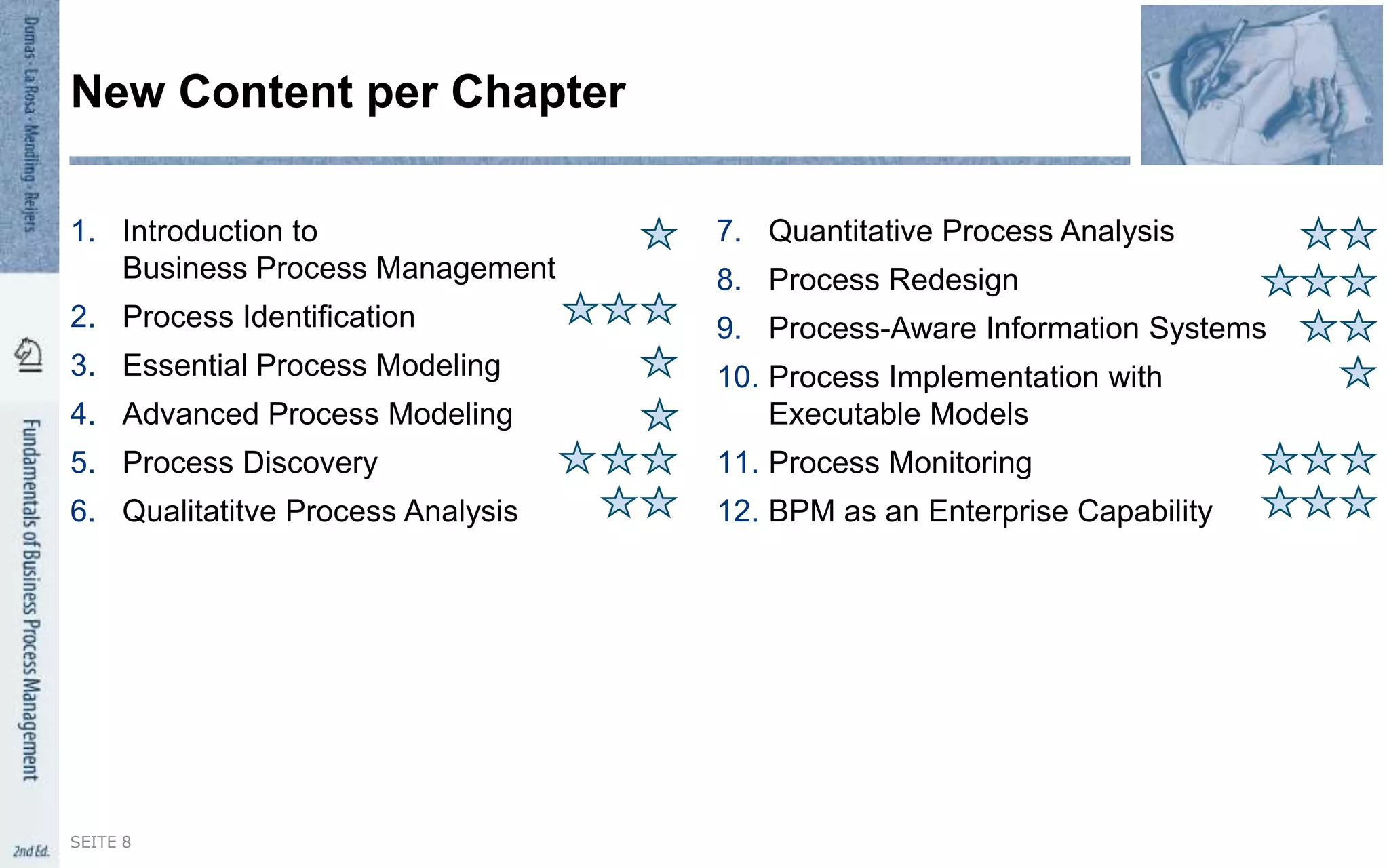
1. Introduction to
Business Process Management
2. Process Identification
3. Essential Process Modeling
4. Advanced Process Modeling
5. Process Discovery
6. Qualitatitve Process Analysis
7. Quantitative Process Analysis
8. Process Redesign
9. Process-Aware Information Systems
10. Process Implementation with
Executable Models
11. Process Monitoring
12. BPM as an Enterprise Capability
New Content per Chapter
SEITE 8
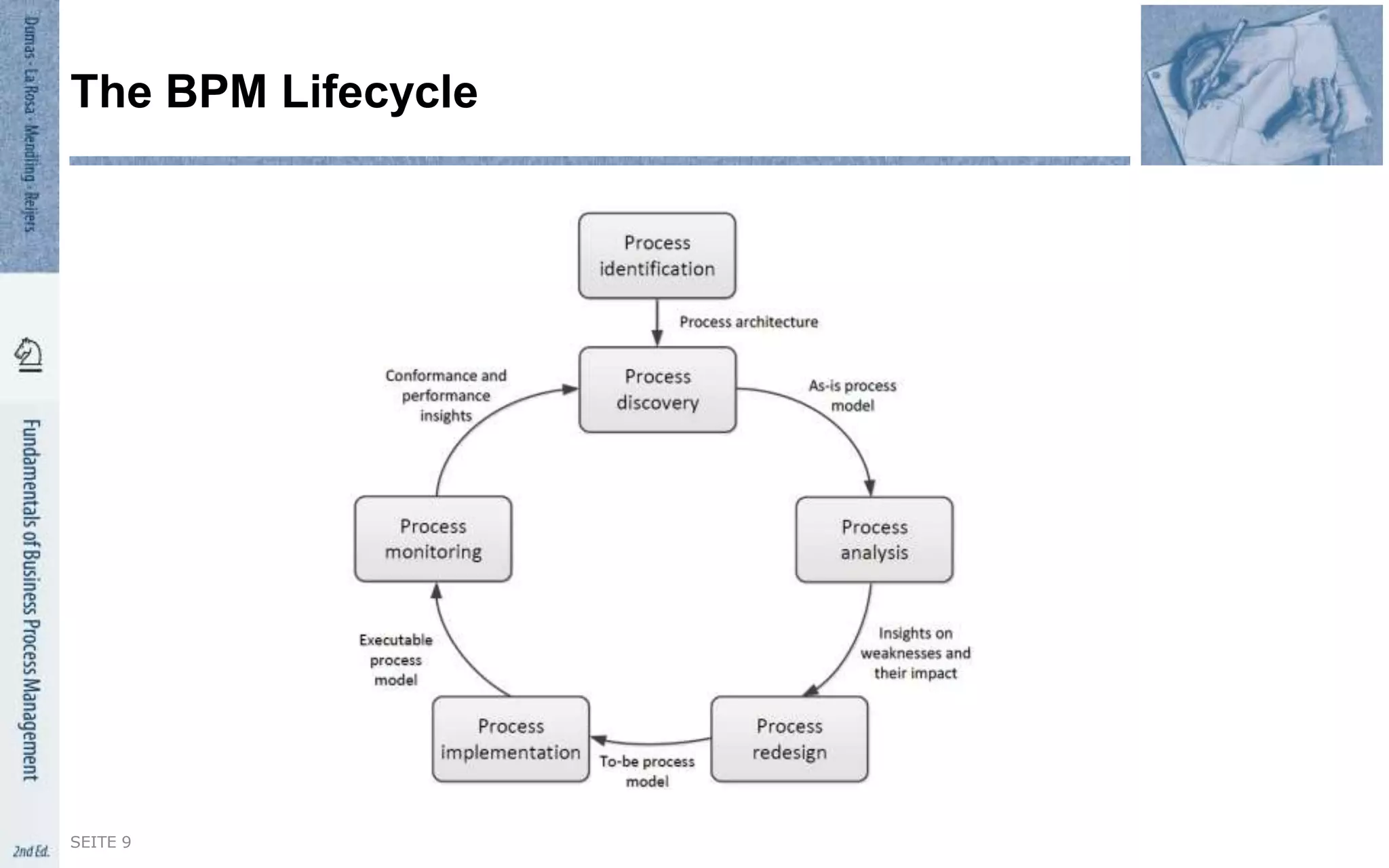
The BPM Lifecycle
SEITE 9
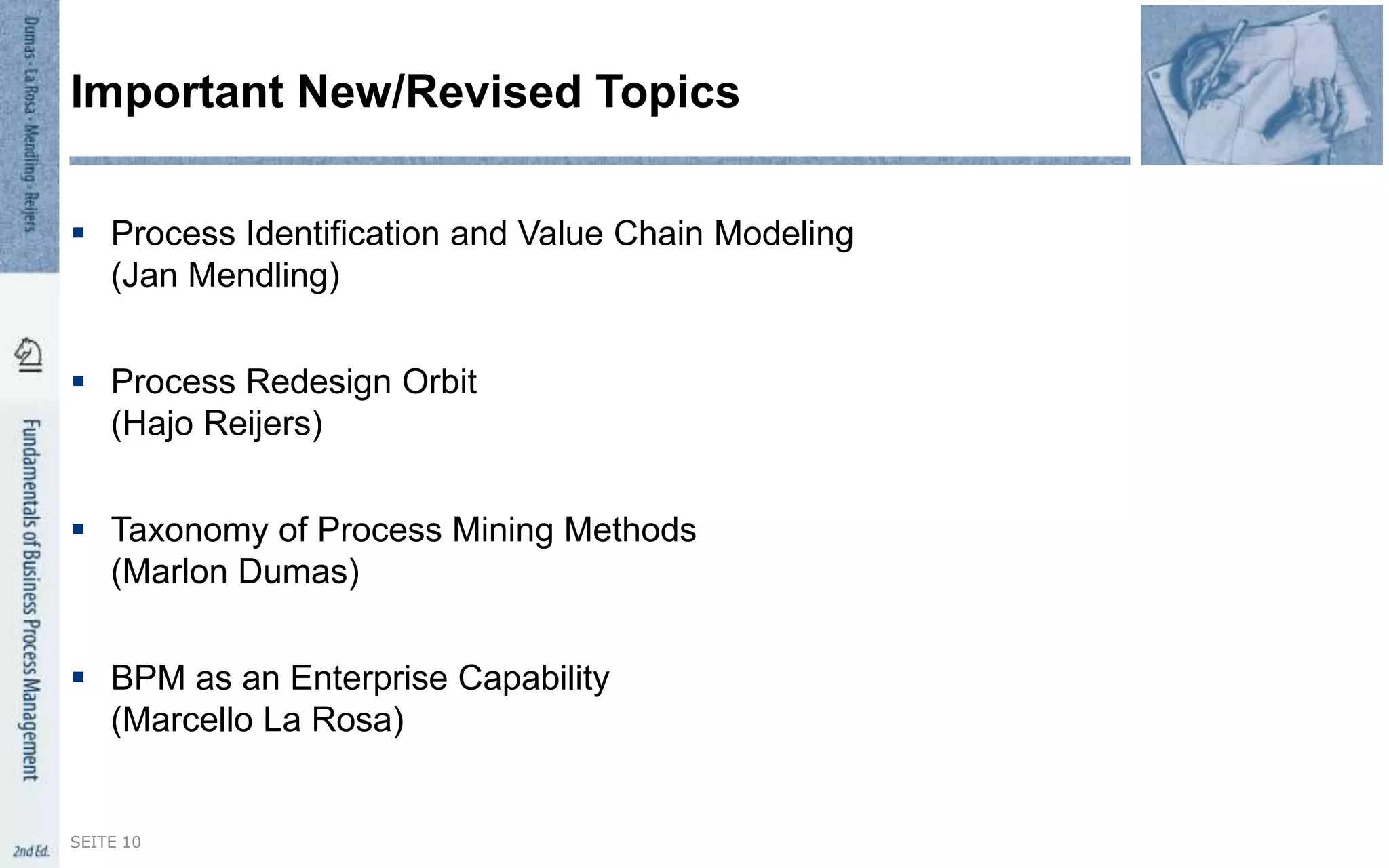
 Process Identification and Value Chain Modeling
(Jan Mendling)
 Process Redesign Orbit
(Hajo Reijers)
 Taxonomy of Process Mining Methods
(Marlon Dumas)
 BPM as an Enterprise Capability
(Marcello La Rosa)
Important New/Revised Topics
SEITE 10
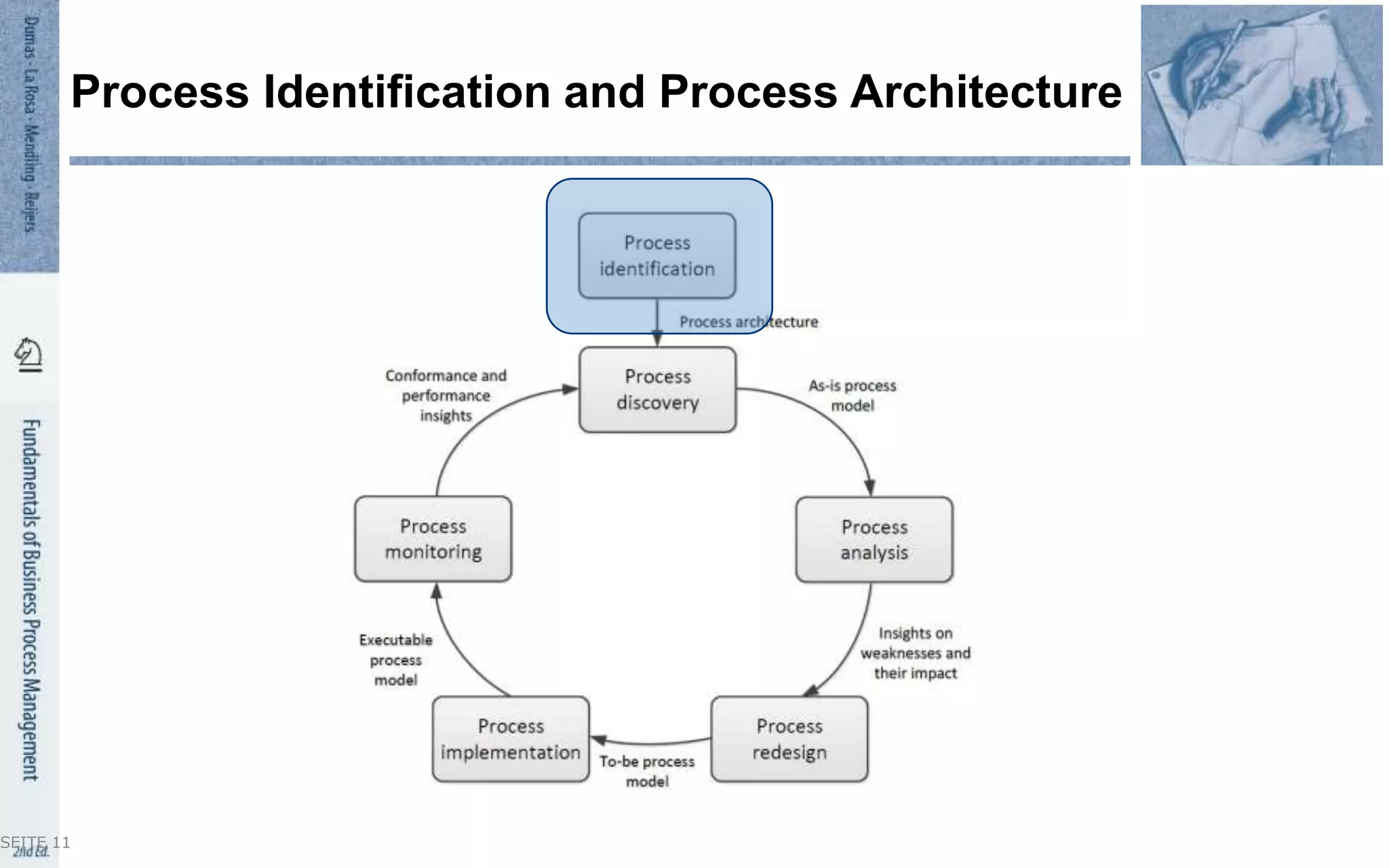
Process Identification and Process Architecture
SEITE 11
1. Designation step
• Enumerate main processes
• Determine process scope
2. Prioritization step (aka Process selection)
Prioritize processes based on:
• Importance
• Health
• Feasibility
Process identification steps
After Davenport (1993)
Process
Architecture
Prioritized
Process
Portfolio
Logical
Levels
Physical
Levels
BusinessLevelsOperationsLevelsProcessLevels
Model structure, methodology and
modelling standards
Shows groups of related business
functions and standard end-to-end
processes (e.g. Service Streams)
Decomposition of core processes into
detailed ‘success model’ business
process flows
Detailed operational process flows
with error conditions and product and
geographical variants (where
required).
Further decomposition of detailed
operational where required
Process Groupings
Business Activities
Core Processes
Business Process Flows
Detailed Process Flows
Level A
Level B
Level C
Level D
Level E
Level F
Operational Process Flows
Defines business activities
Distinguishes operational customer
oriented processes from management
and strategic process
Core processes that combine together to
deliver Service Streams and other end-
to-end processes
Meta
Level
© British Telecommunications (2005)
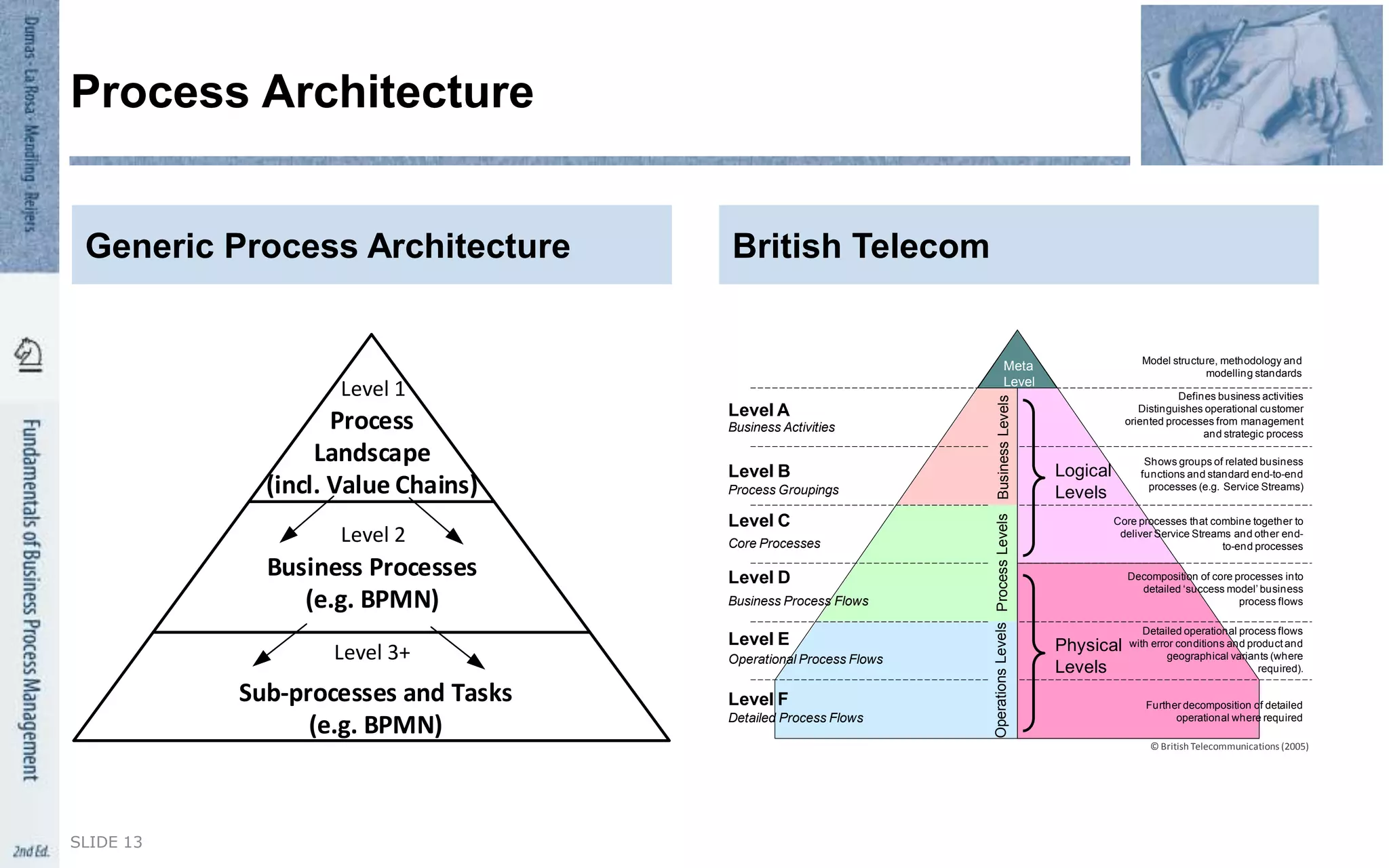
Generic Process Architecture
SLIDE 13
Process Architecture
British Telecom
Level 1
Level 2
Level 3+
Process
Landscape
(incl. Value Chains)
Business Processes
(e.g. BPMN)
Sub-processes and Tasks
(e.g. BPMN)
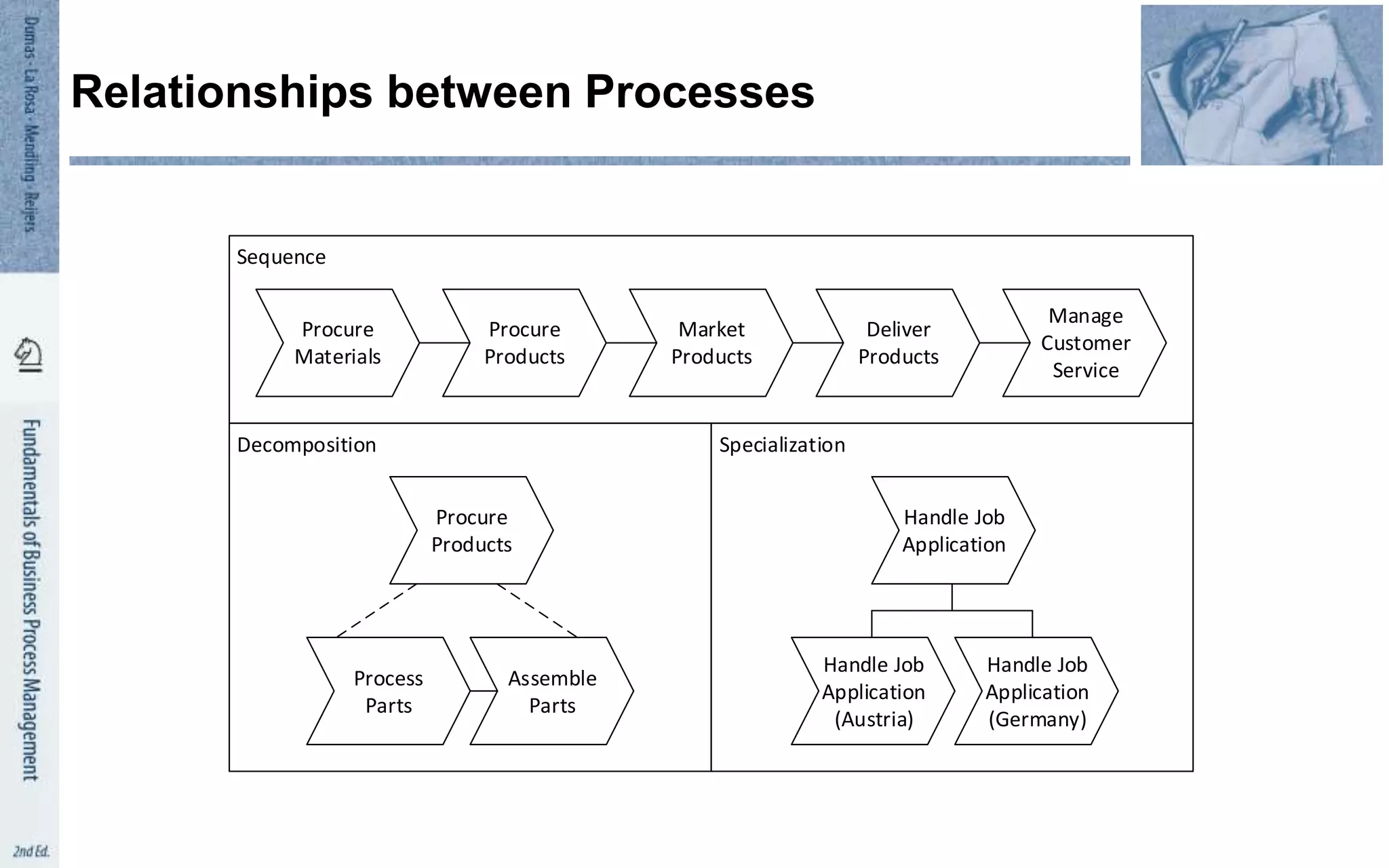
Procure
Materials
Procure
Products
Market
Products
Deliver
Products
Manage
Customer
Service
Sequence
Decomposition Specialization
Procure
Products
Handle Job
Application
Process
Parts
Assemble
Parts
Handle Job
Application
(Austria)
Handle Job
Application
(Germany)
Relationships between Processes
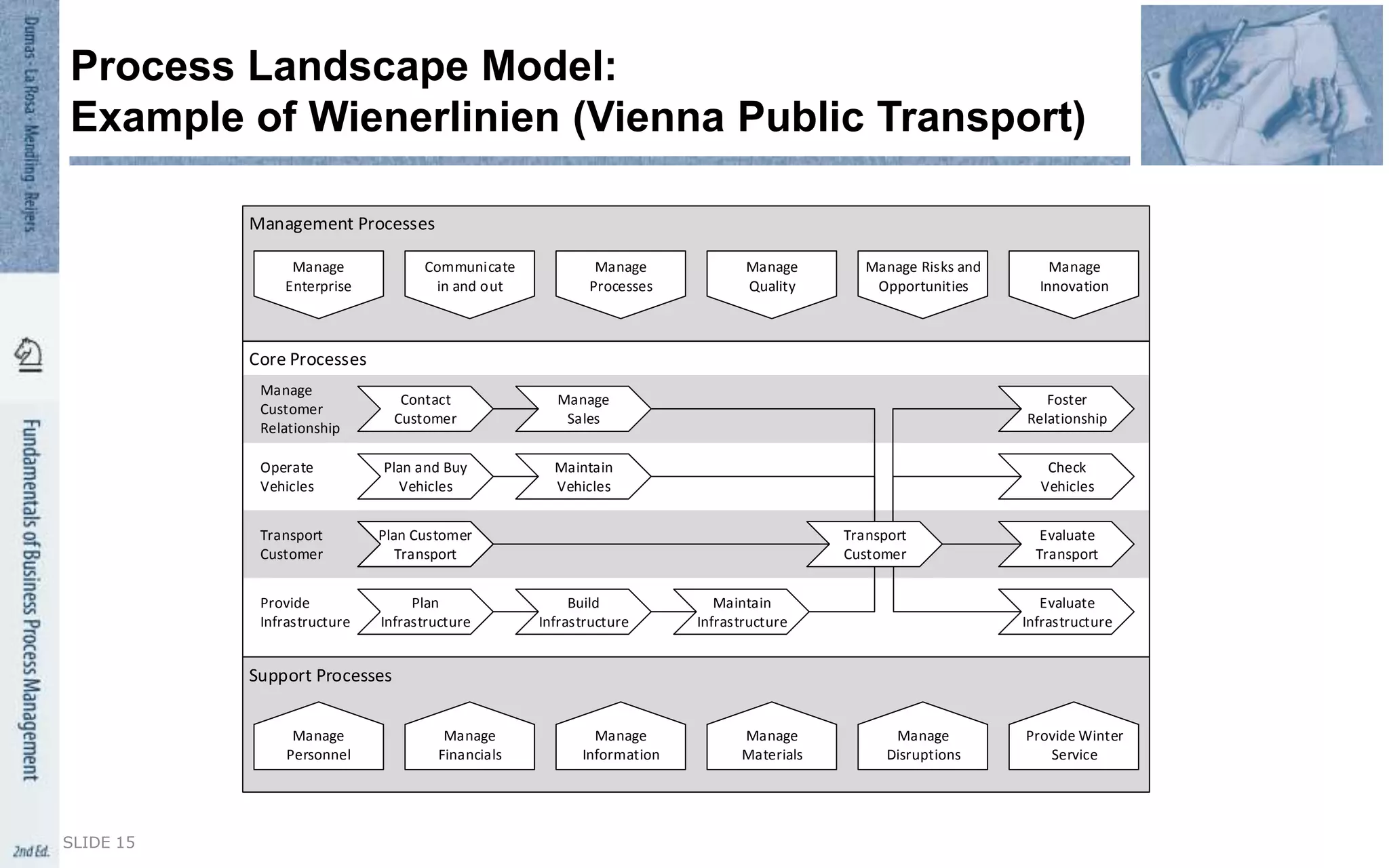
Process Landscape Model:
Example of Wienerlinien (Vienna Public Transport)
SLIDE 15
Manage
Enterprise
Manage
Personnel
Management Processes
Core Processes
Support Processes
Communicate
in and out
Manage
Processes
Manage
Quality
Manage Risks and
Opportunities
Manage
Innovation
Contact
Customer
Manage
Sales
Manage
Customer
Relationship
Operate
Vehicles
Plan and Buy
Vehicles
Maintain
Vehicles
Transport
Customer
Transport
Customer
Evaluate
Transport
Provide
Infrastructure
Plan
Infrastructure
Build
Infrastructure
Maintain
Infrastructure
Evaluate
Infrastructure
Check
Vehicles
Foster
Relationship
Manage
Financials
Manage
Information
Manage
Materials
Manage
Disruptions
Provide Winter
Service
Plan Customer
Transport
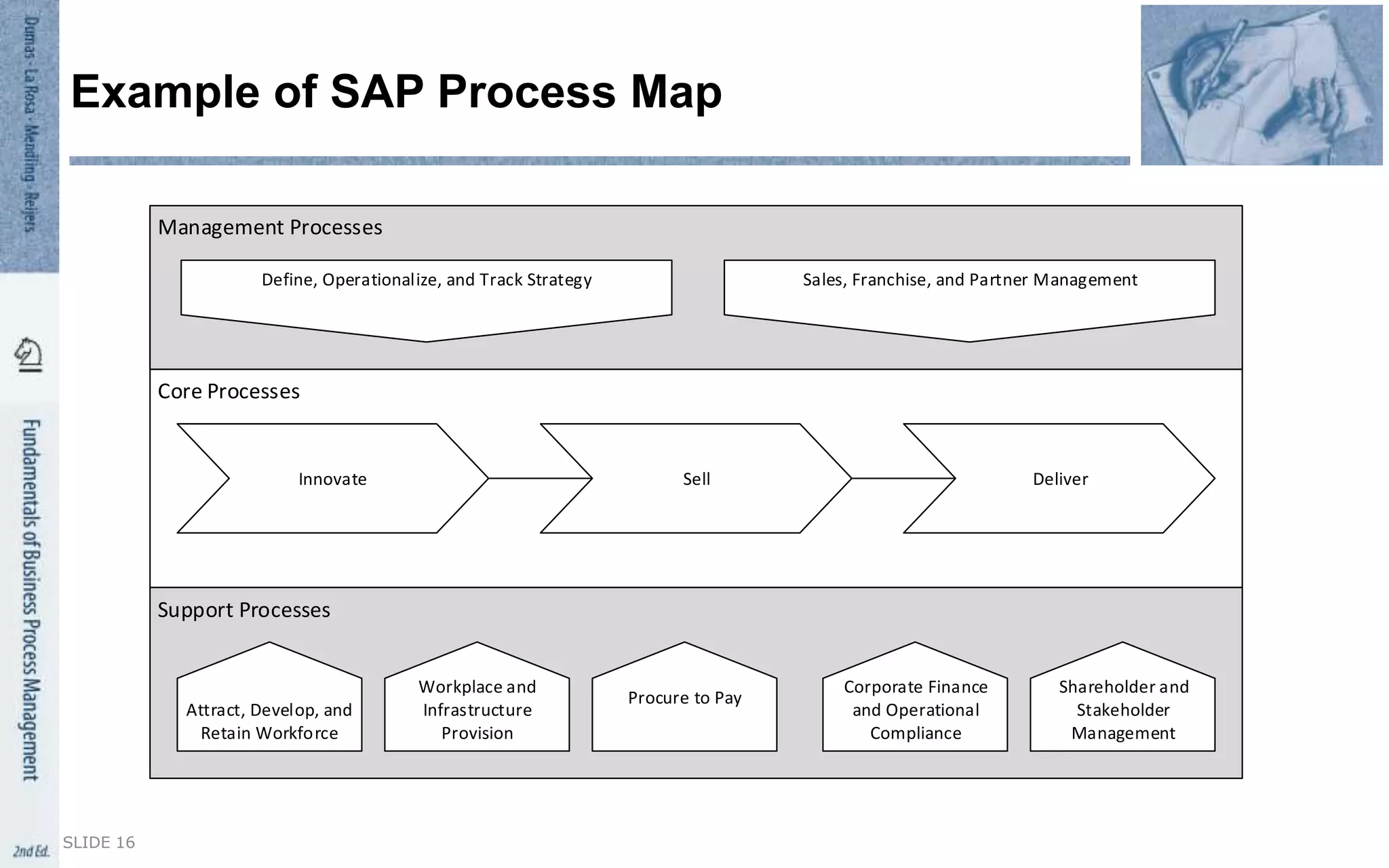
Example of SAP Process Map
SLIDE 16
Manage
Enterprise
Management Processes
Manage
Innovation
Define, Operationalize, and Track Strategy
Attract, Develop, and
Retain Workforce
Management Processes
Core Processes
Support Processes
Workplace and
Infrastructure
Provision
Procure to Pay
Corporate Finance
and Operational
Compliance
Shareholder and
Stakeholder
Management
Sales, Franchise, and Partner Management
Innovate Sell Deliver
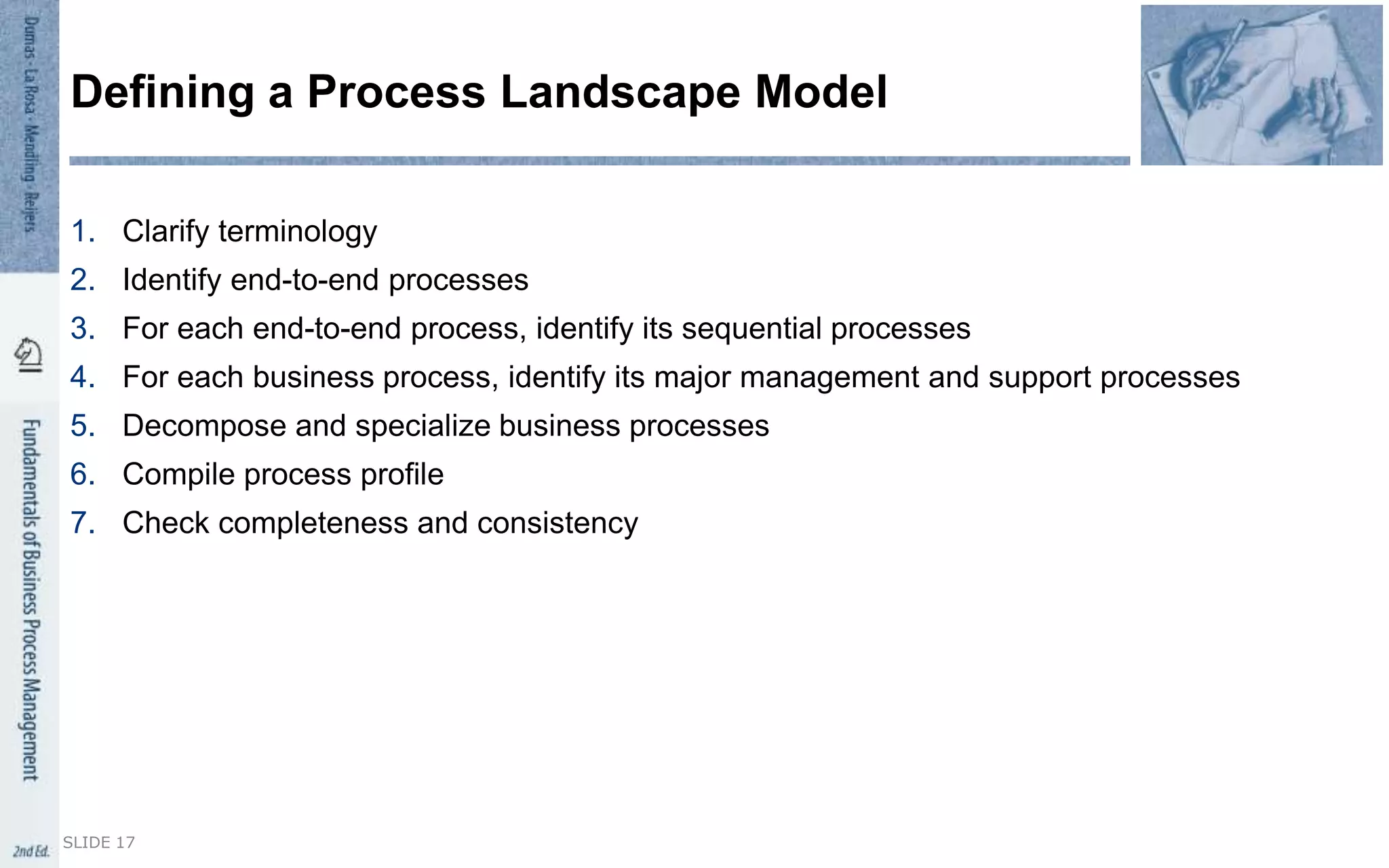
1. Clarify terminology
2. Identify end-to-end processes
3. For each end-to-end process, identify its sequential processes
4. For each business process, identify its major management and support processes
5. Decompose and specialize business processes
6. Compile process profile
7. Check completeness and consistency
Defining a Process Landscape Model
SLIDE 17
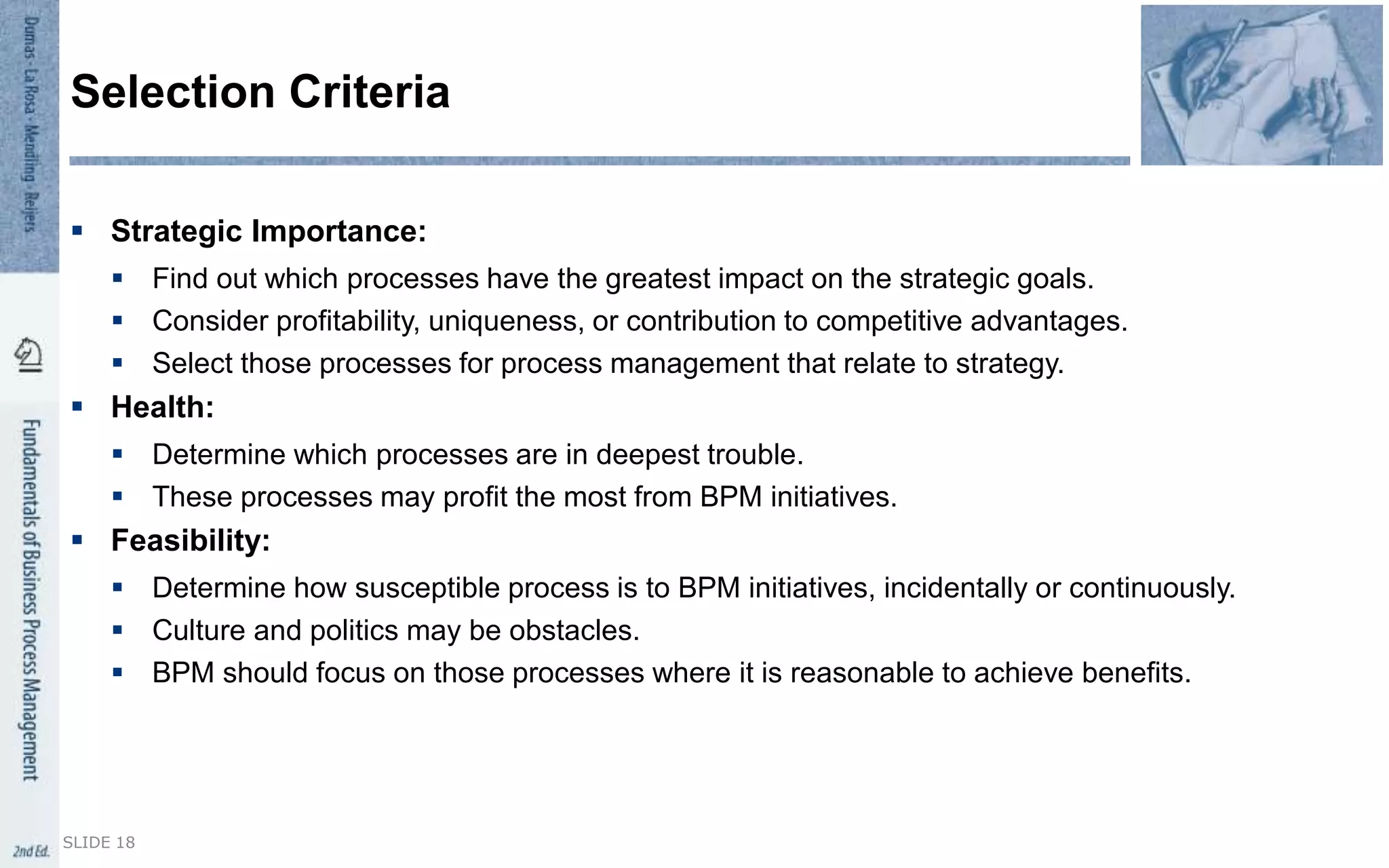
 Strategic Importance:
 Find out which processes have the greatest impact on the strategic goals.
 Consider profitability, uniqueness, or contribution to competitive advantages.
 Select those processes for process management that relate to strategy.
 Health:
 Determine which processes are in deepest trouble.
 These processes may profit the most from BPM initiatives.
 Feasibility:
 Determine how susceptible process is to BPM initiatives, incidentally or continuously.
 Culture and politics may be obstacles.
 BPM should focus on those processes where it is reasonable to achieve benefits.
Selection Criteria
SLIDE 18
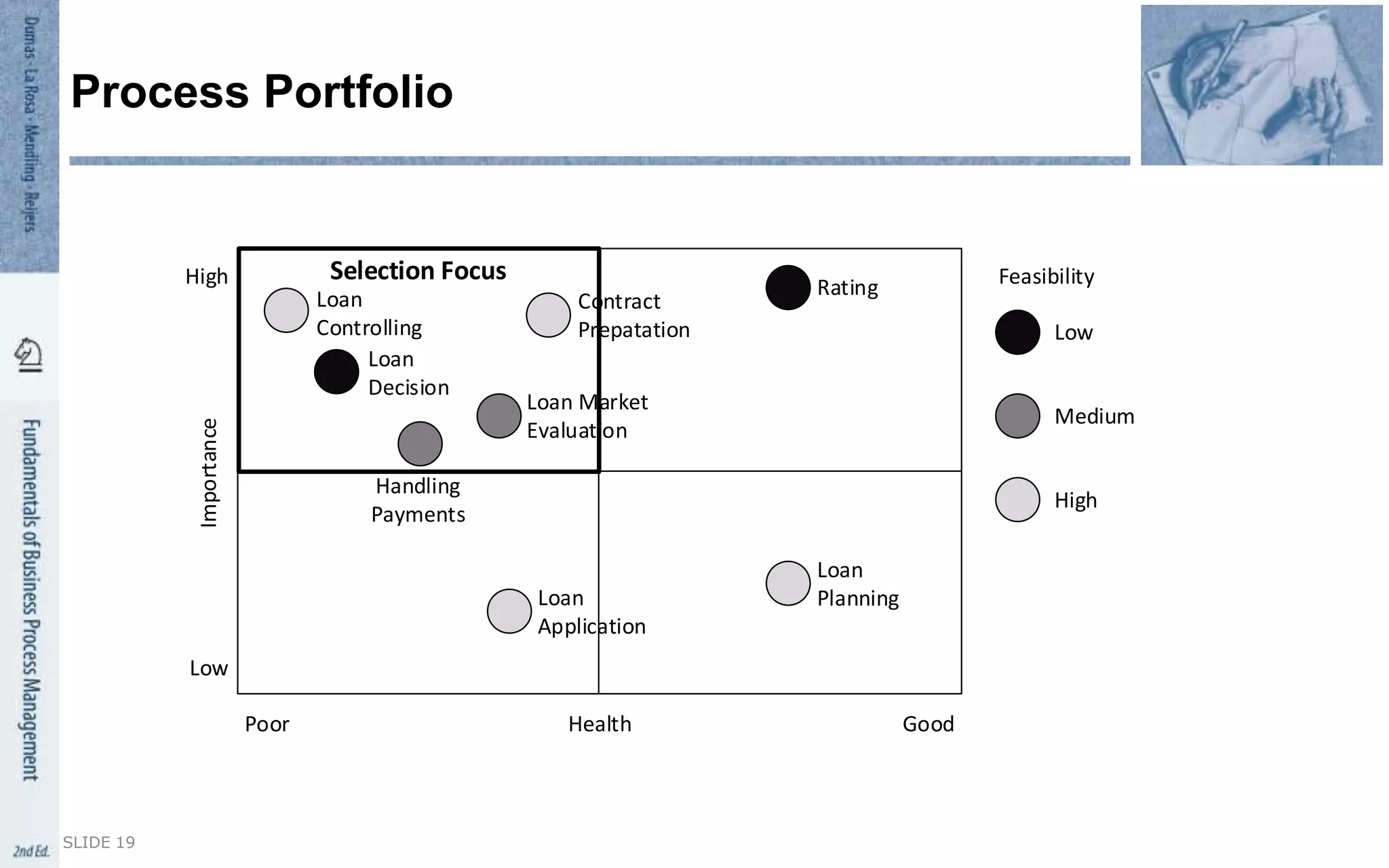
Importance
HealthPoor Good
Low
High Feasibility
Low
Medium
High
Loan
Controlling
Loan
Decision
Loan Market
Evaluation
Contract
Prepatation
Rating
Handling
Payments
Loan
Application
Loan
Planning
Selection Focus
Process Portfolio
SLIDE 19
Quiz 1:
Why should you revise your
process architecture?
SLIDE 21
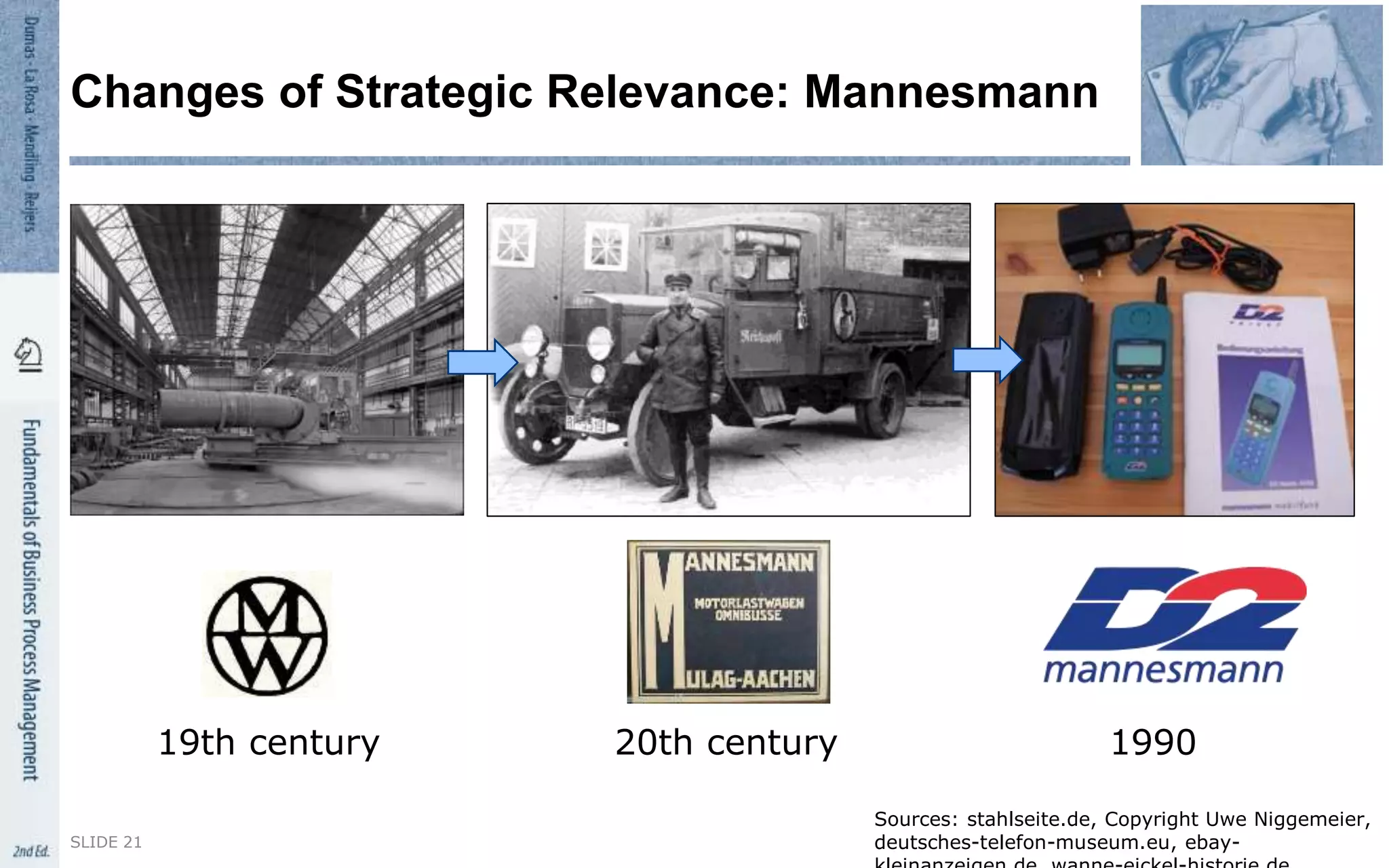
Changes of Strategic Relevance: Mannesmann
Sources: stahlseite.de, Copyright Uwe Niggemeier,
deutsches-telefon-museum.eu, ebay-
19th century 20th century 1990
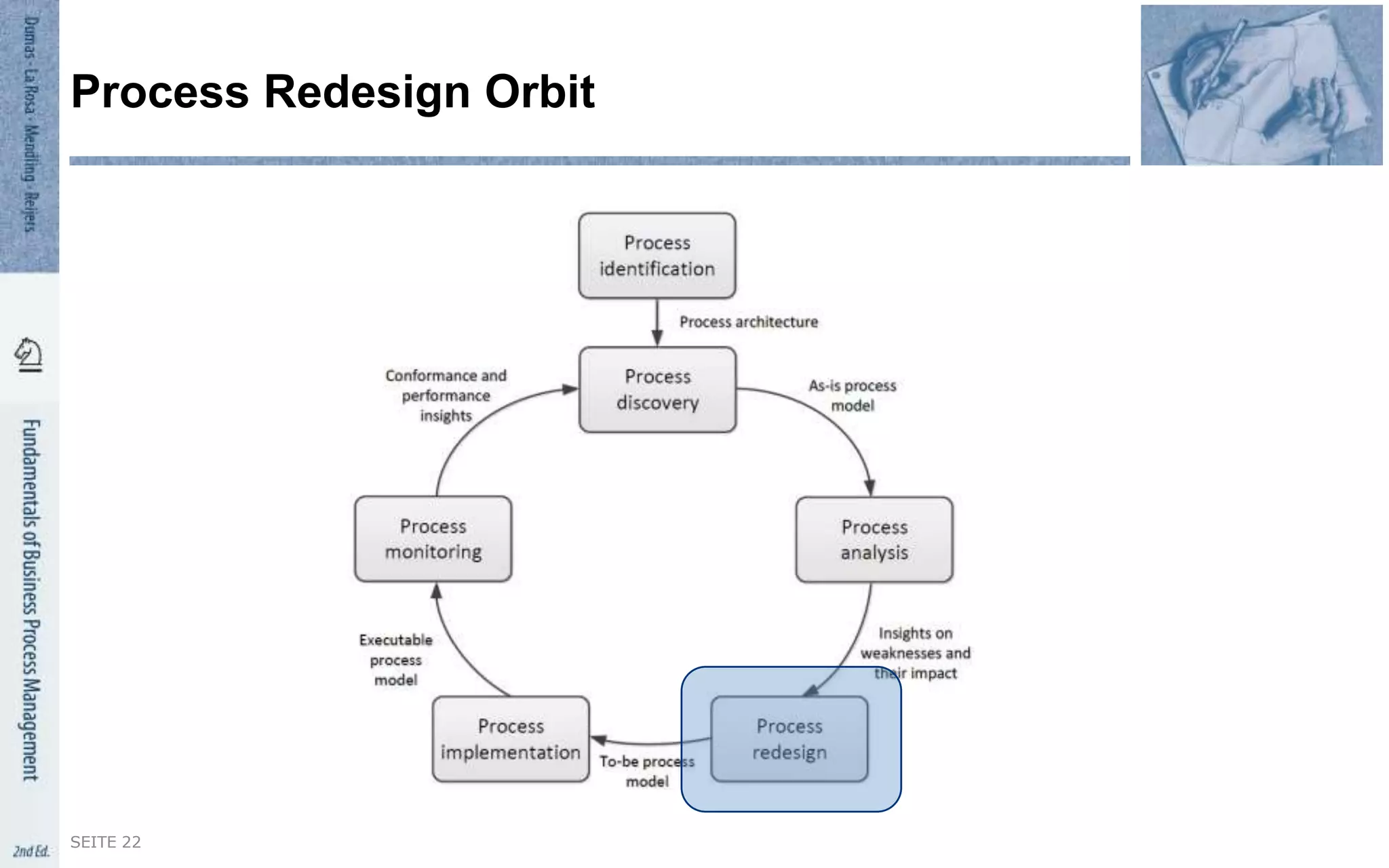
Process Redesign Orbit
SEITE 22
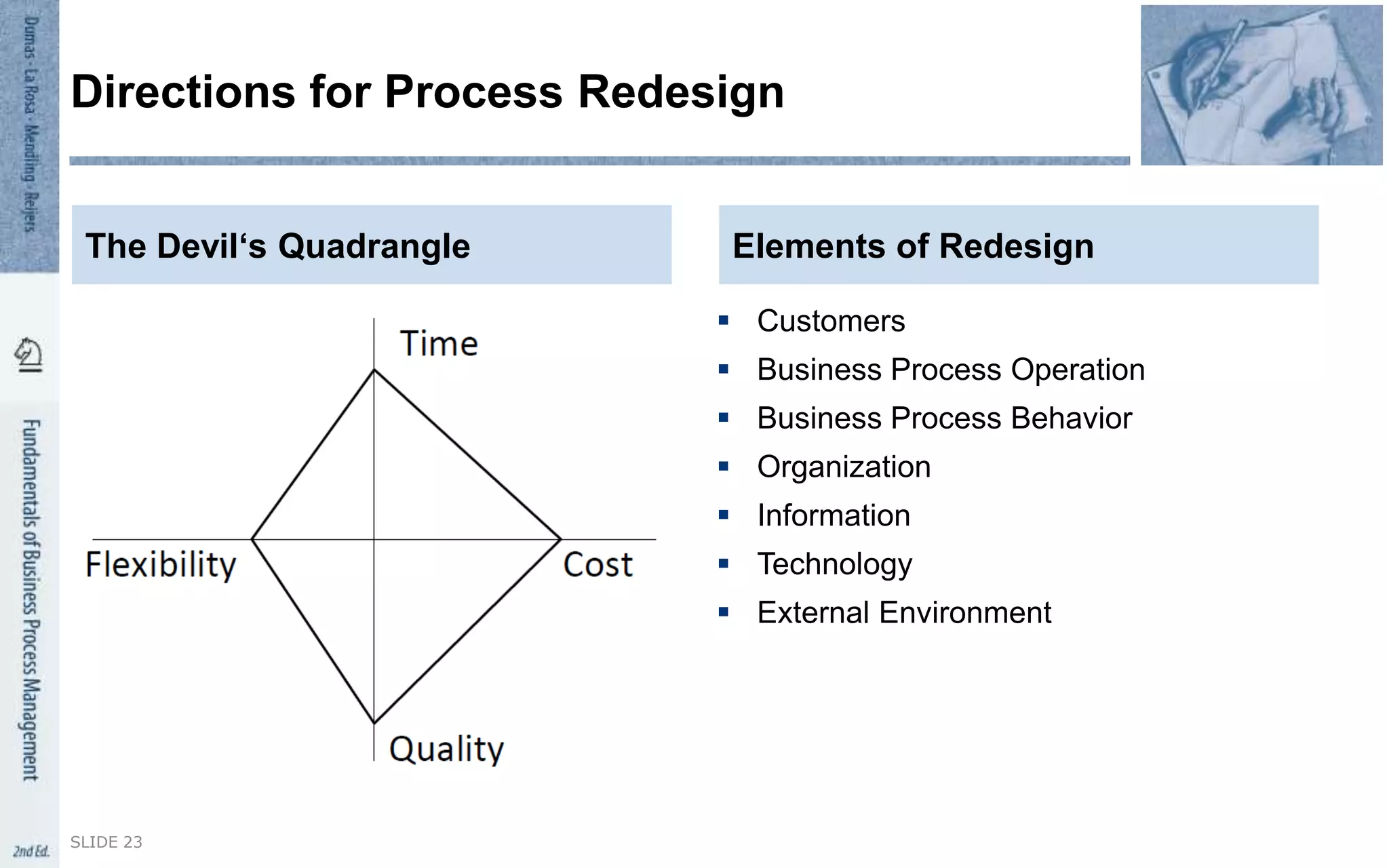
 Customers
 Business Process Operation
 Business Process Behavior
 Organization
 Information
 Technology
 External Environment
The Devil‘s Quadrangle
SLIDE 23
Directions for Process Redesign
Elements of Redesign
How to do Redesign?
“How to get from the as-is to the to-be [in a
redesign project] isn’t explained, so we
conclude that during the break, the famous
ATAMO procedure is invoked – And Then, A
Miracle occurs”.
Sharp & McDermott, 2002
SLIDE 25
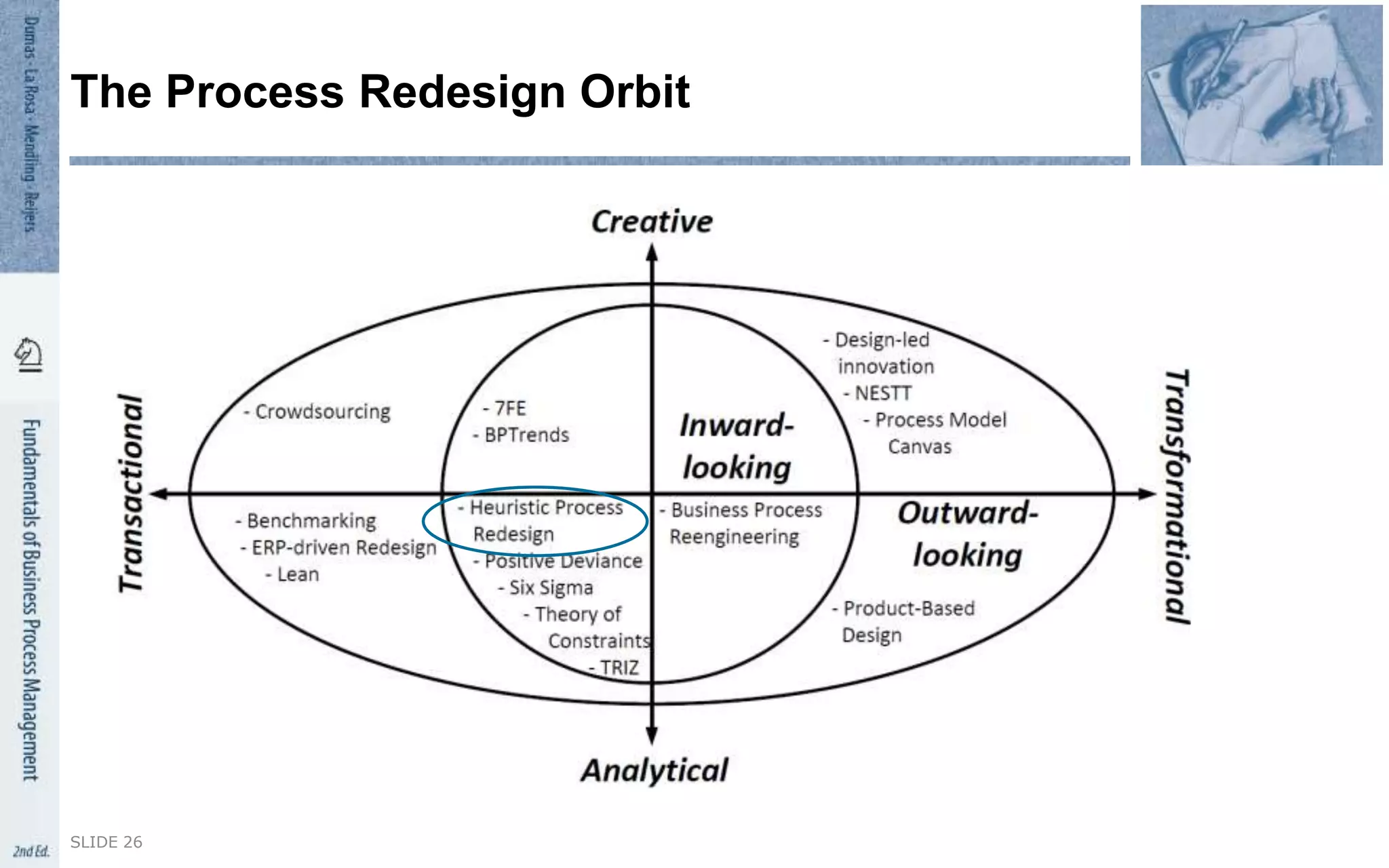
SLIDE 26
The Process Redesign Orbit
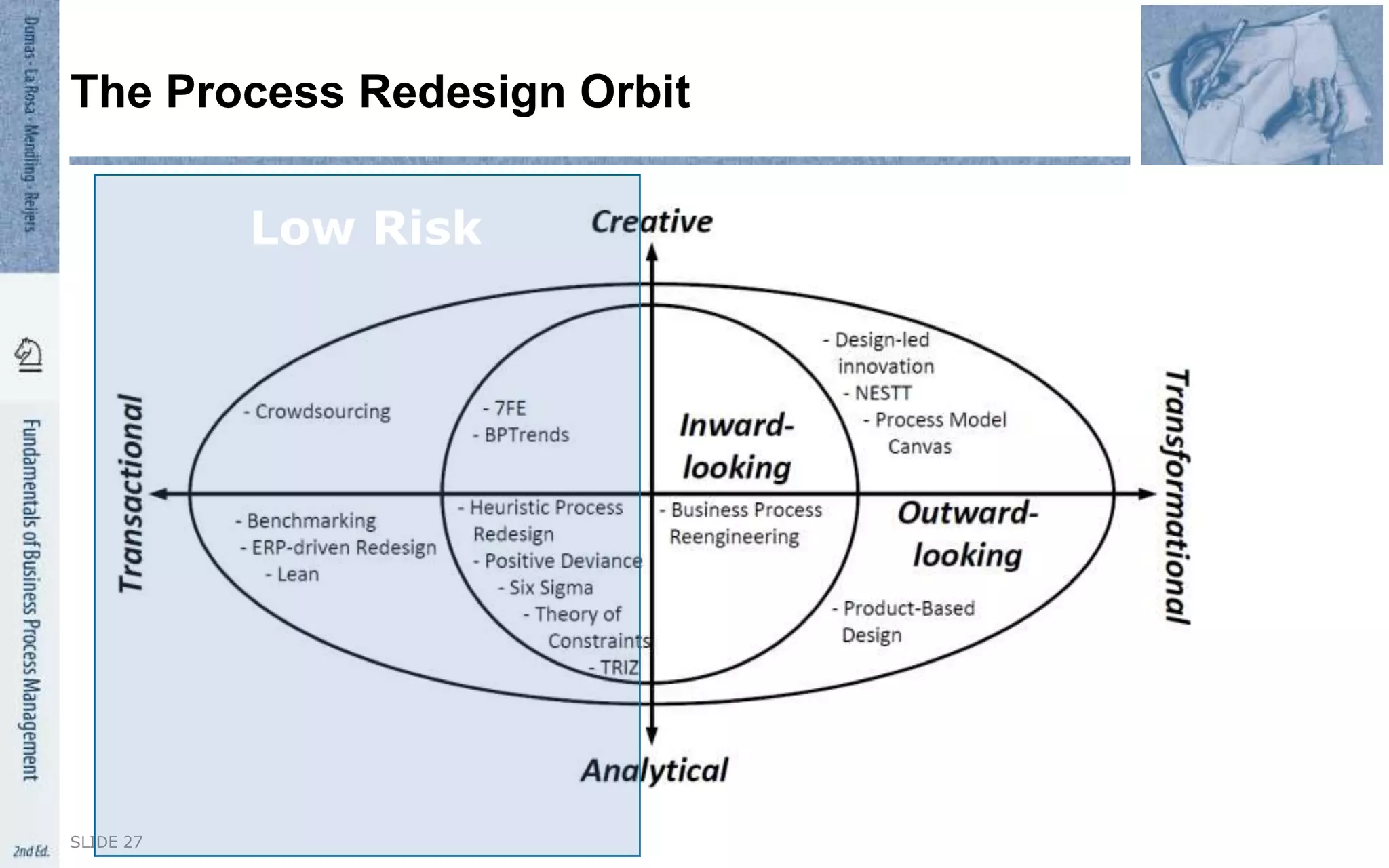
SLIDE 27
The Process Redesign Orbit
Low Risk
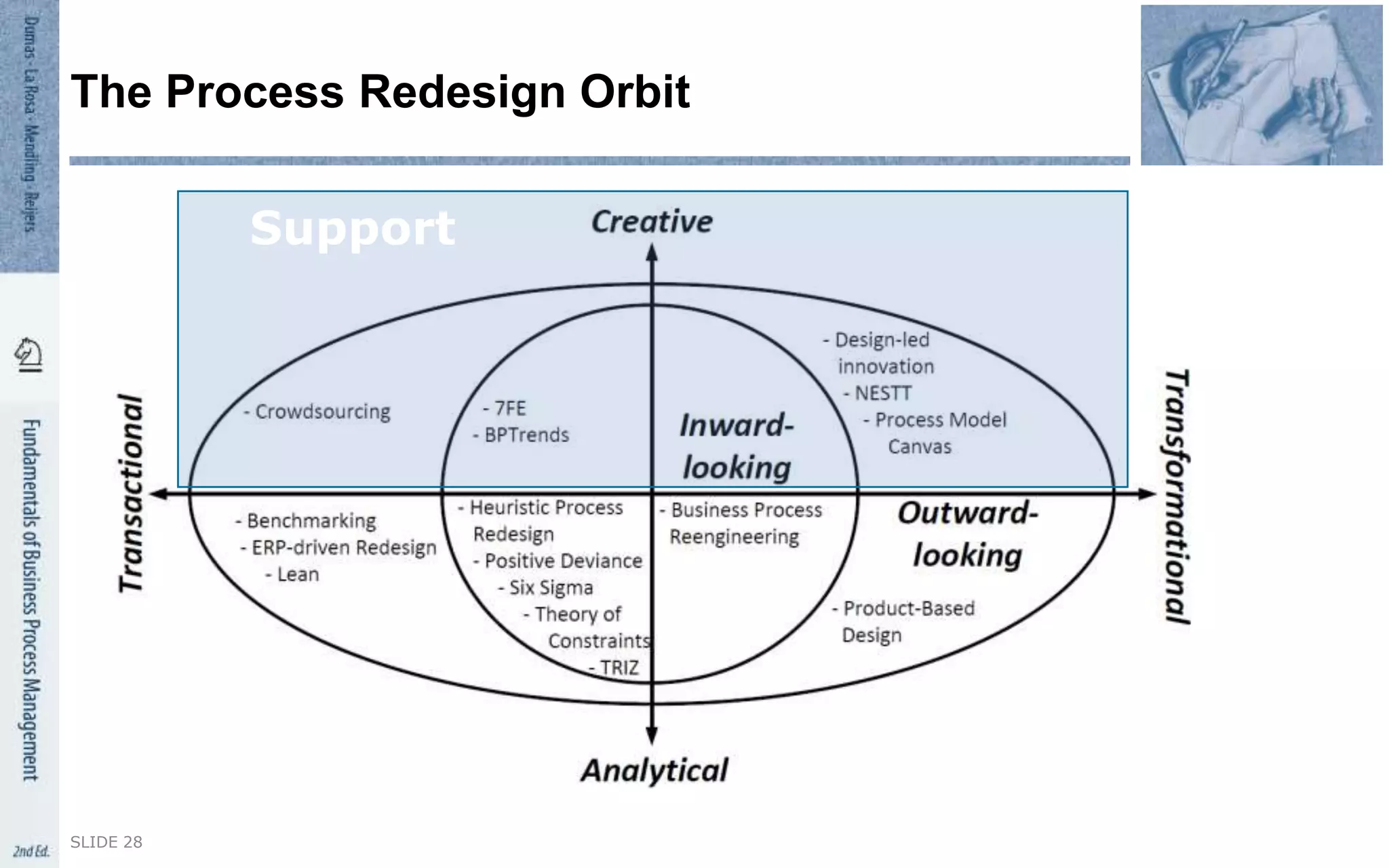
SLIDE 28
The Process Redesign Orbit
Support
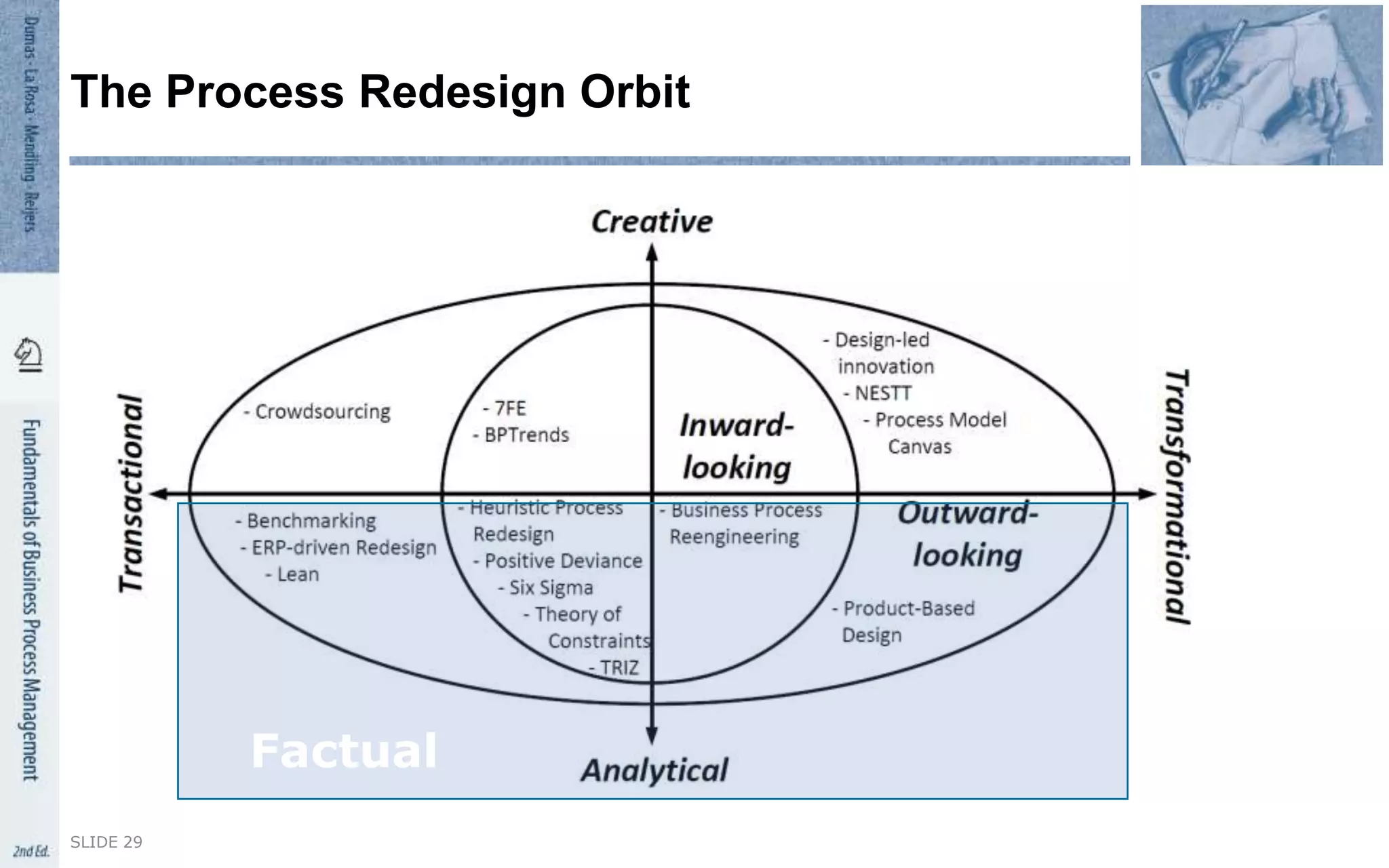
SLIDE 29
The Process Redesign Orbit
Factual
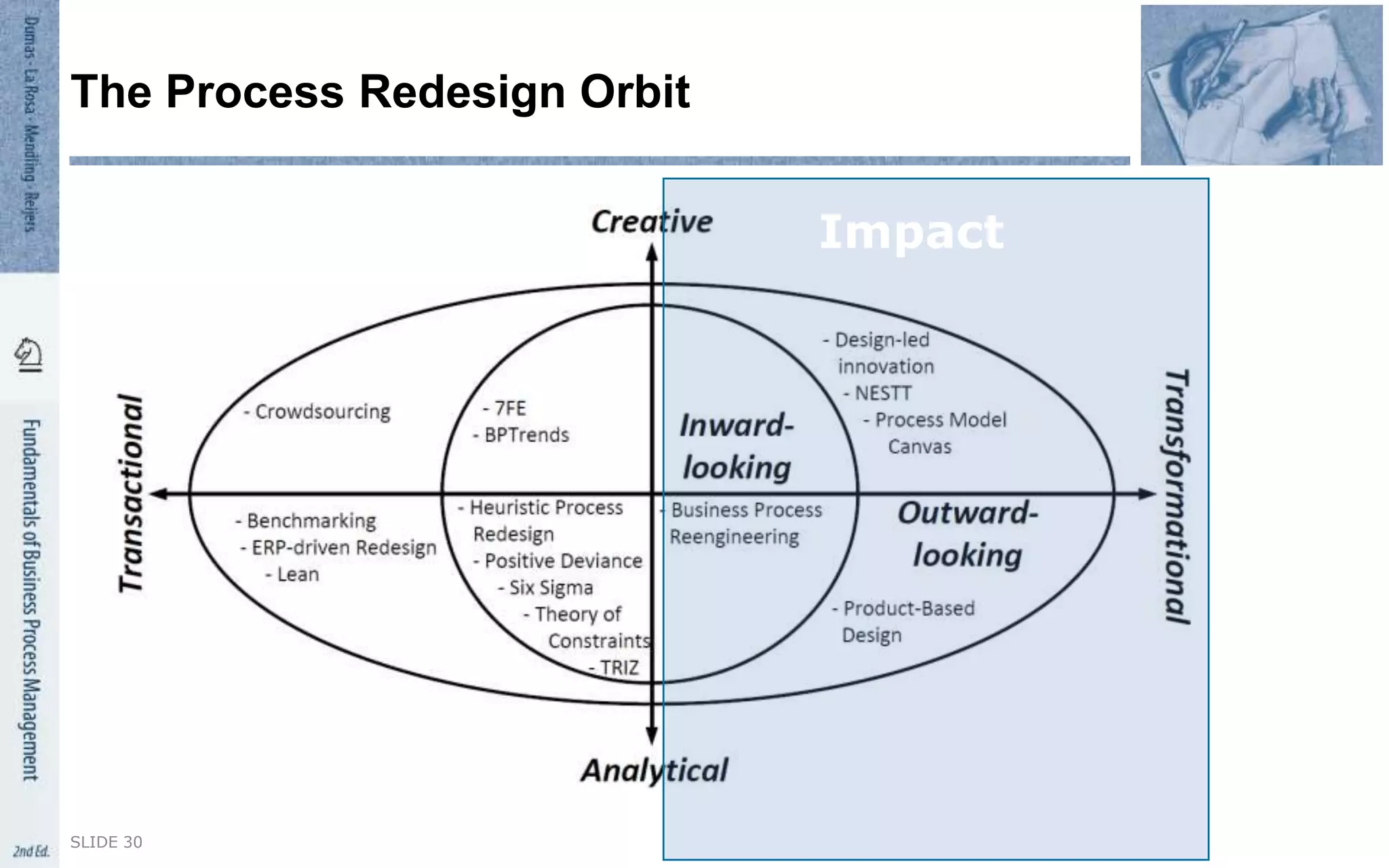
SLIDE 30
The Process Redesign Orbit
Impact
Quiz 2:
Name two redesign heuristics
and describe their expected
outcome on the process.
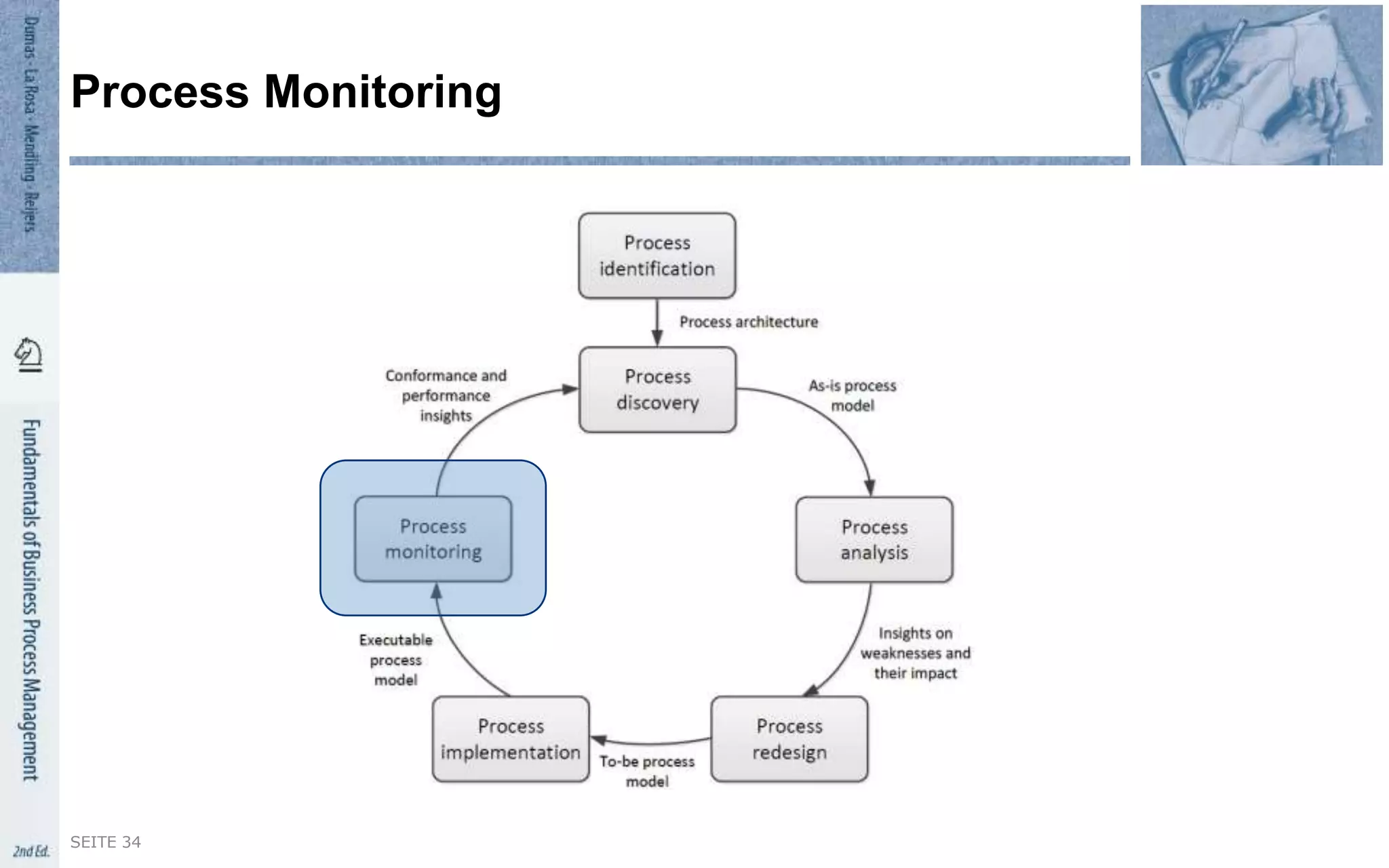
Process Monitoring
SEITE 34
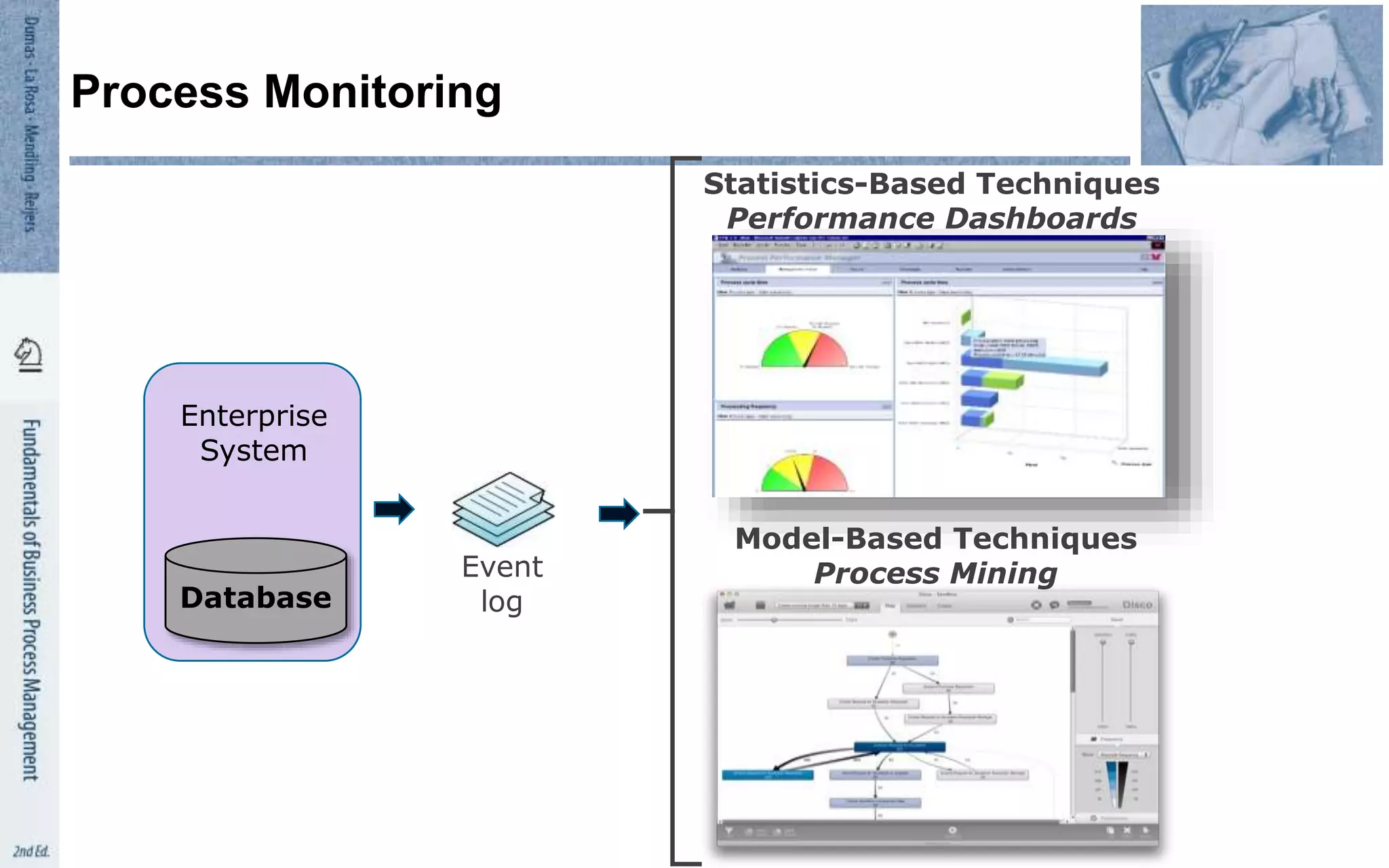
Statistics-Based Techniques
Performance Dashboards
Model-Based Techniques
Process Mining
Database
Event
log
Enterprise
System
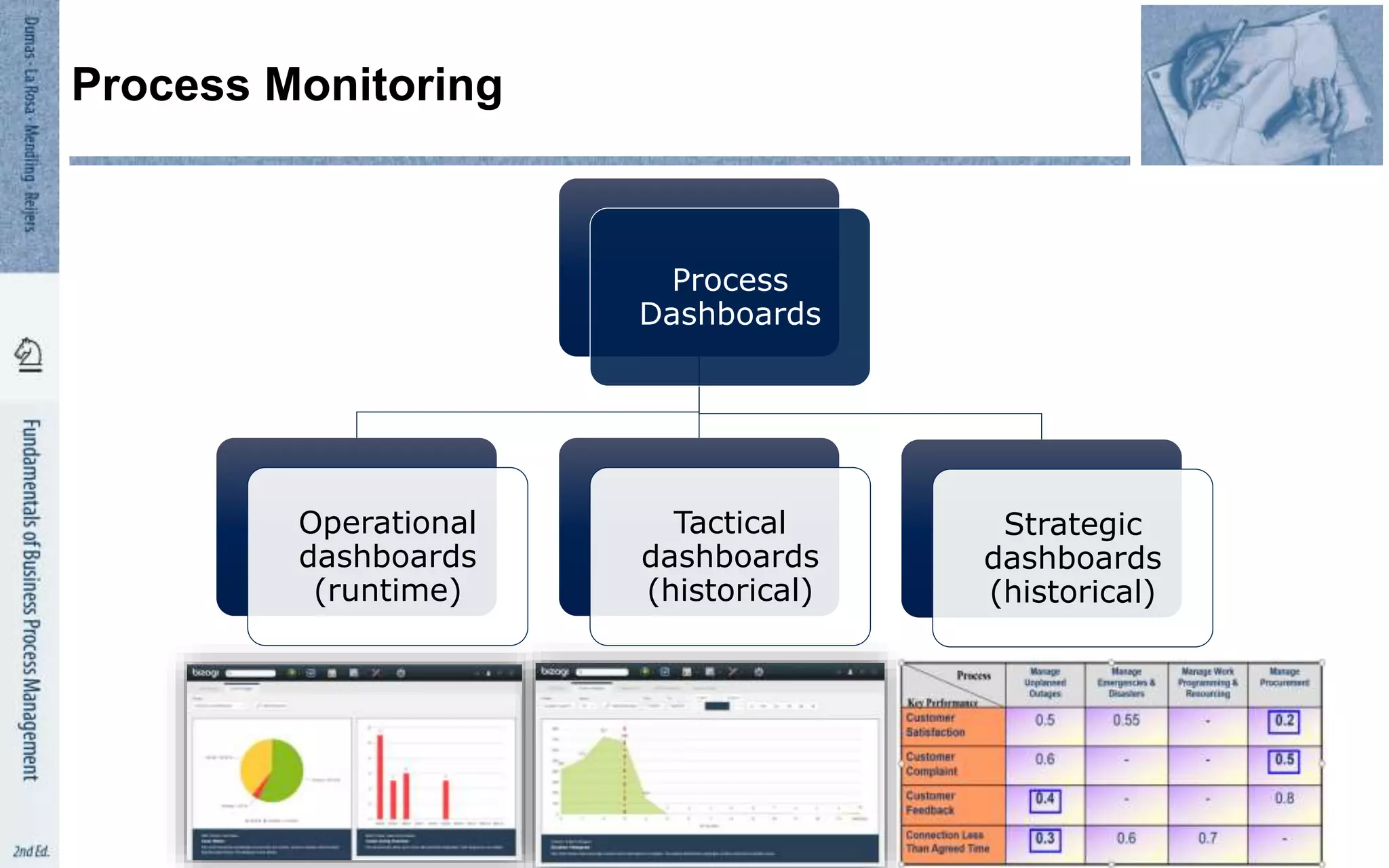
Process Monitoring
Process
Dashboards
Operational
dashboards
(runtime)
Tactical
dashboards
(historical)
Strategic
dashboards
(historical)
Process Monitoring
SLIDE 37
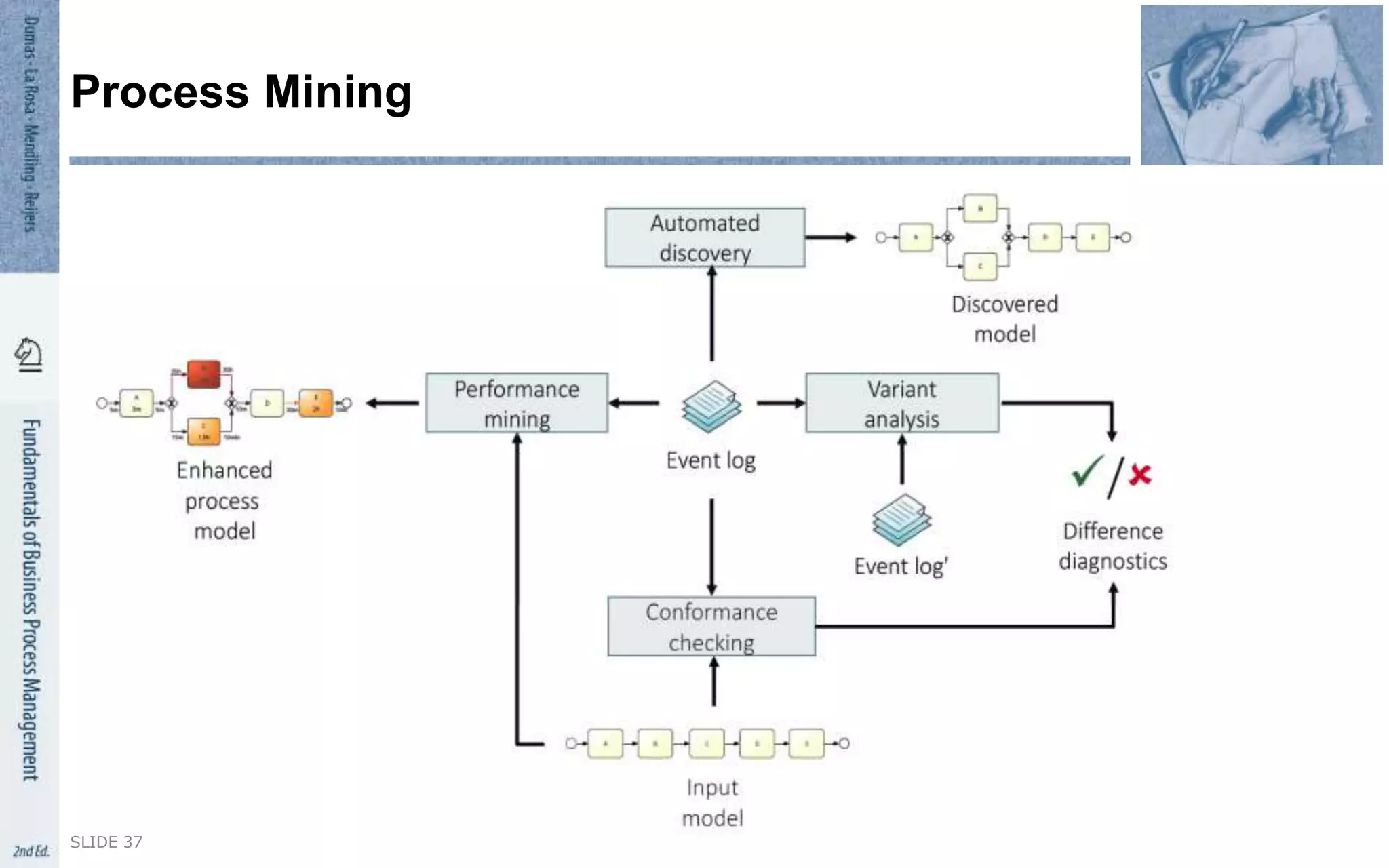
Process Mining
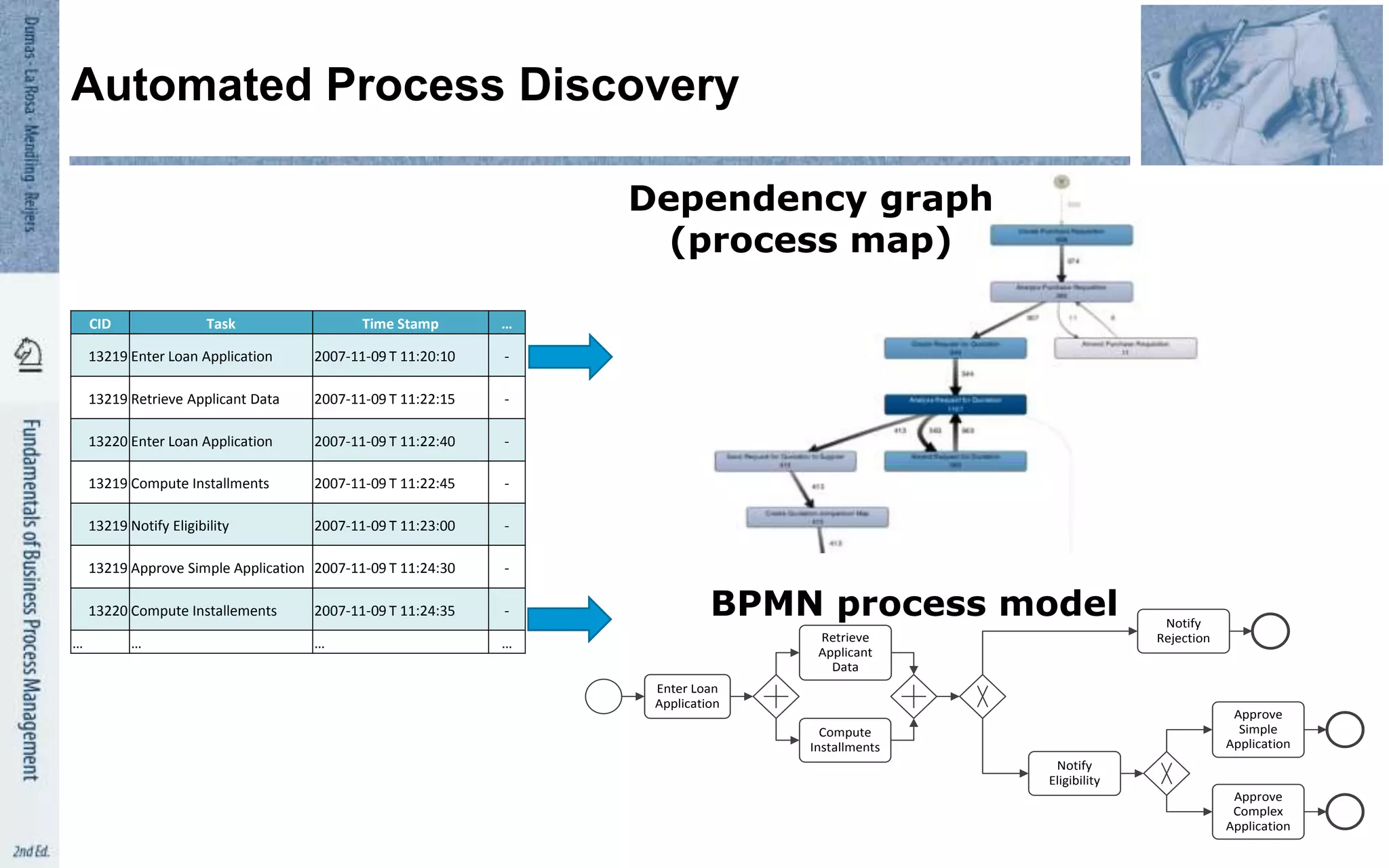
Automated Process Discovery
Enter Loan
Application
Retrieve
Applicant
Data
Compute
Installments
Approve
Simple
Application
Approve
Complex
Application
Notify
Rejection
Notify
Eligibility
CID Task Time Stamp …
13219 Enter Loan Application 2007-11-09 T 11:20:10 -
13219 Retrieve Applicant Data 2007-11-09 T 11:22:15 -
13220 Enter Loan Application 2007-11-09 T 11:22:40 -
13219 Compute Installments 2007-11-09 T 11:22:45 -
13219 Notify Eligibility 2007-11-09 T 11:23:00 -
13219 Approve Simple Application 2007-11-09 T 11:24:30 -
13220 Compute Installements 2007-11-09 T 11:24:35 -
… … … …
Dependency graph
(process map)
BPMN process model
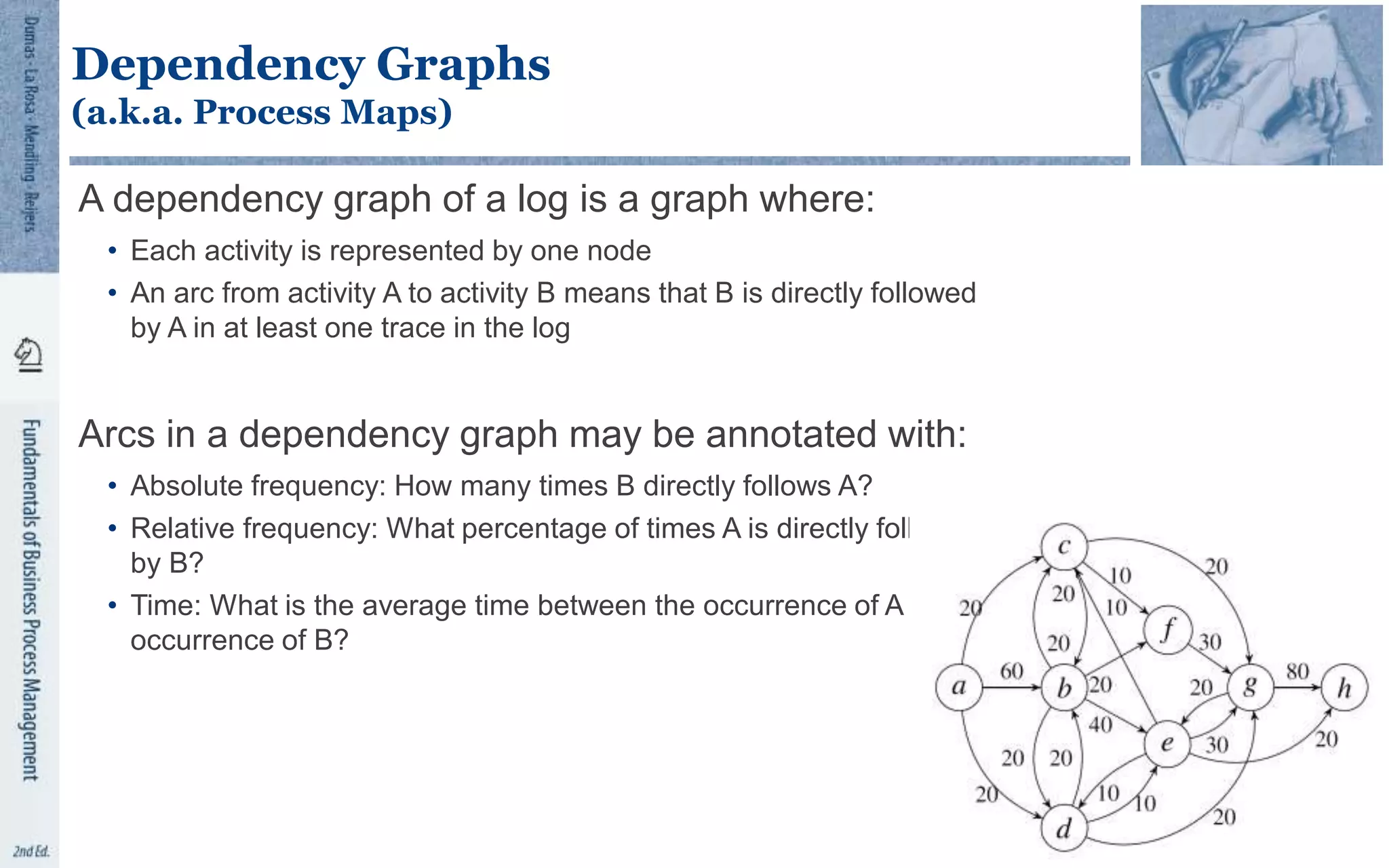
Dependency Graphs
(a.k.a. Process Maps)
A dependency graph of a log is a graph where:
• Each activity is represented by one node
• An arc from activity A to activity B means that B is directly followed
by A in at least one trace in the log
Arcs in a dependency graph may be annotated with:
• Absolute frequency: How many times B directly follows A?
• Relative frequency: What percentage of times A is directly followed
by B?
• Time: What is the average time between the occurrence of A and the
occurrence of B?
Quiz 3: Write the dependency graph (process map) of the
following event log. Include absolute frequencies.
Abstraction and Filtering
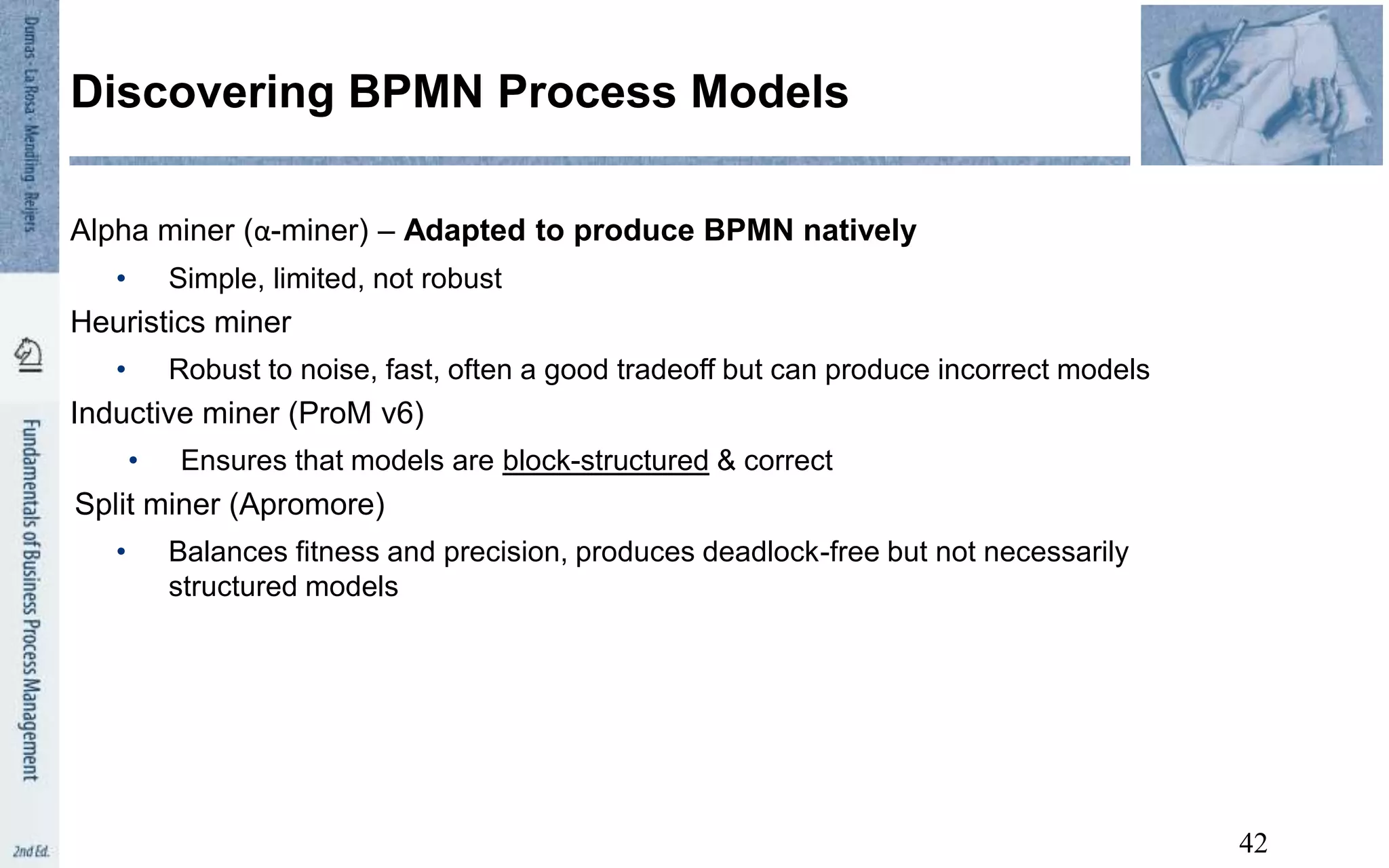
To cope with the complexity of large real-life logs, process maps
are often used in conjunction with two operations:
1. Abstract the process map:
• Show only most frequent activities
• Show only most frequent arcs
2. Filter the traces in the event log
• Remove all events that fulfil a condition
• Remove traces that fulfil a condition (or traces that do not fulfil a condition)
Alpha miner (α-miner) – Adapted to produce BPMN natively
• Simple, limited, not robust
Heuristics miner
• Robust to noise, fast, often a good tradeoff but can produce incorrect models
Inductive miner (ProM v6)
• Ensures that models are block-structured & correct
Split miner (Apromore)
• Balances fitness and precision, produces deadlock-free but not necessarily
structured models
Discovering BPMN Process Models
42
SLIDE 43
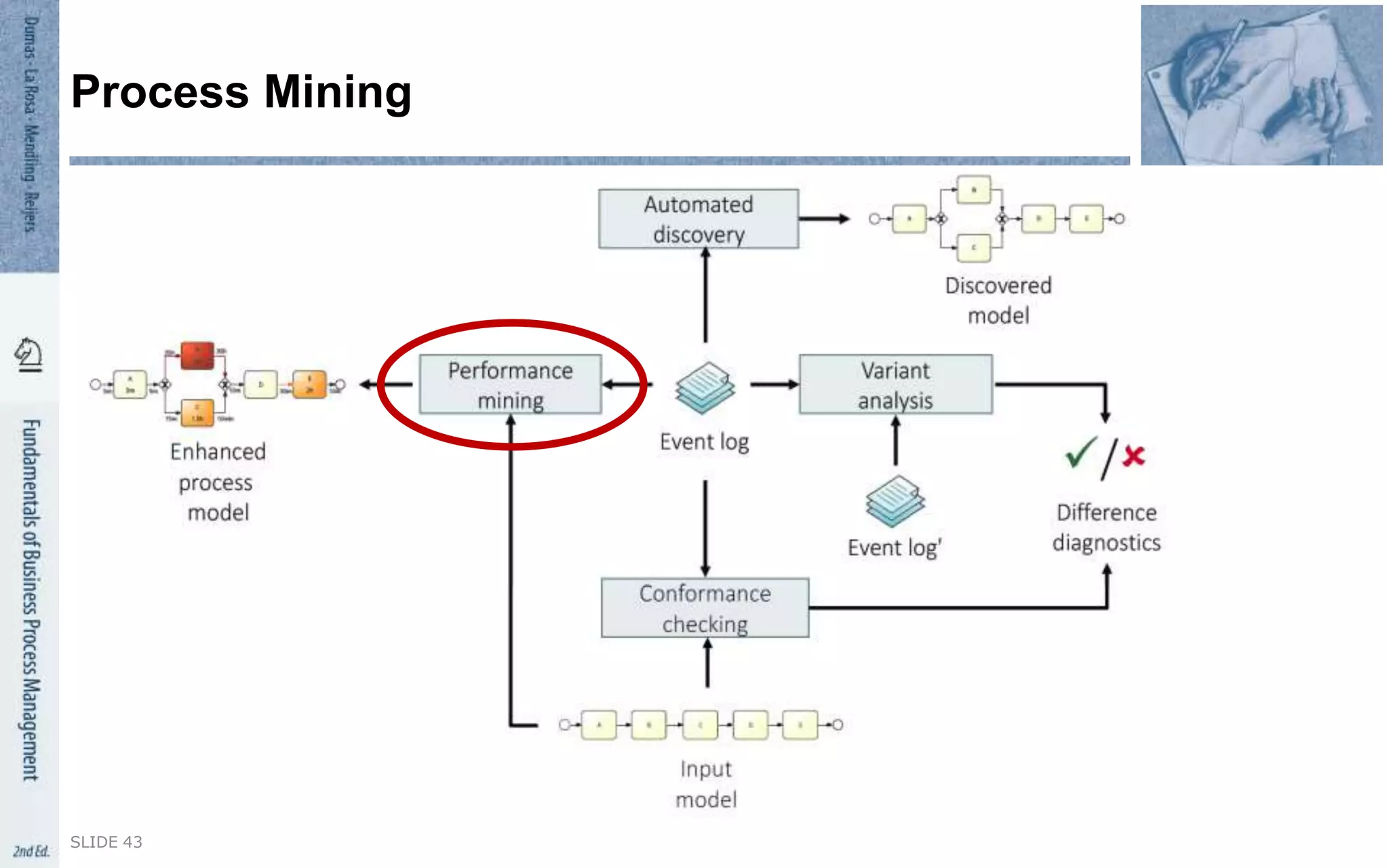
Process Mining
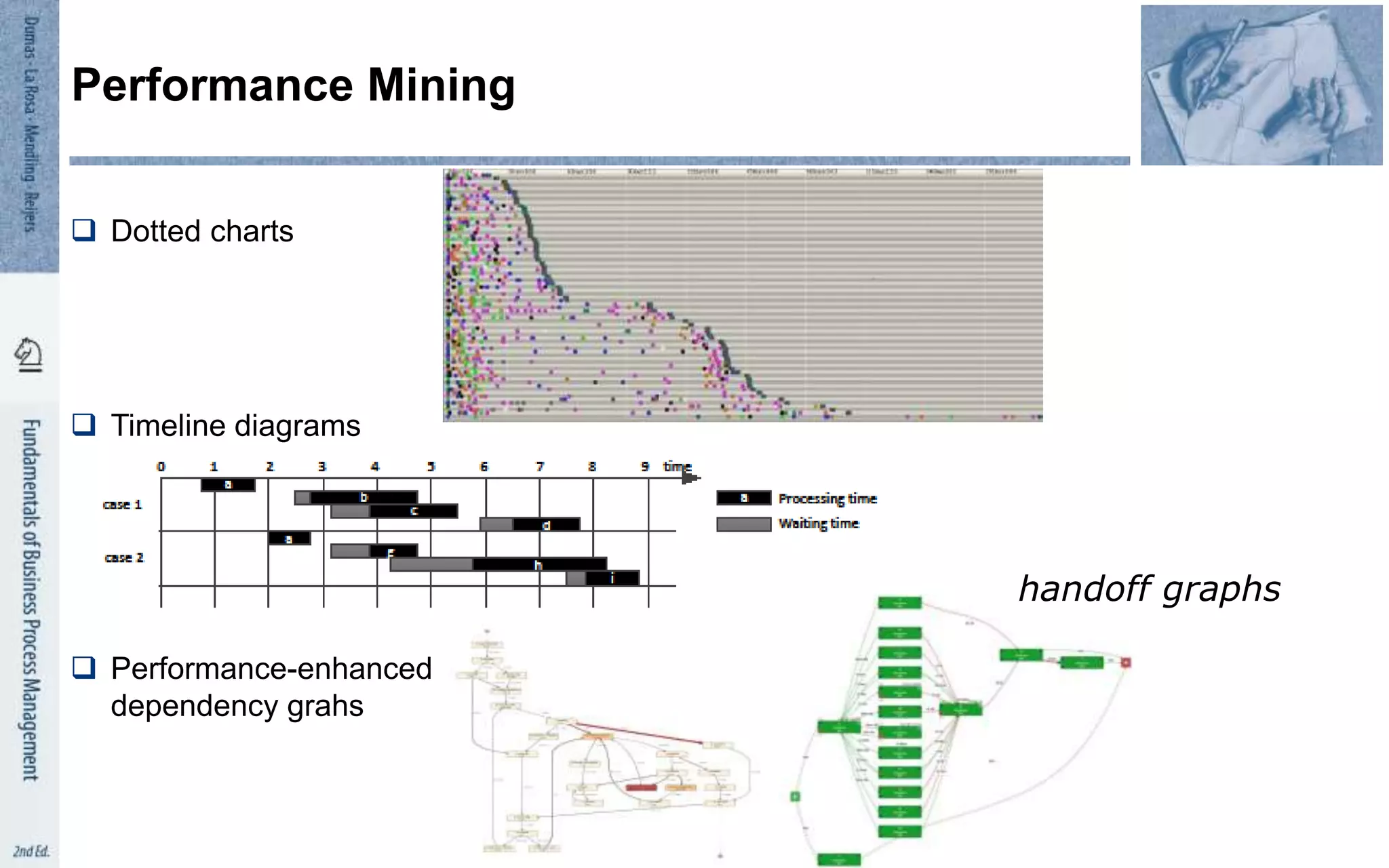
 Dotted charts
 Timeline diagrams
 Performance-enhanced
dependency grahs
handoff graphs
Performance Mining
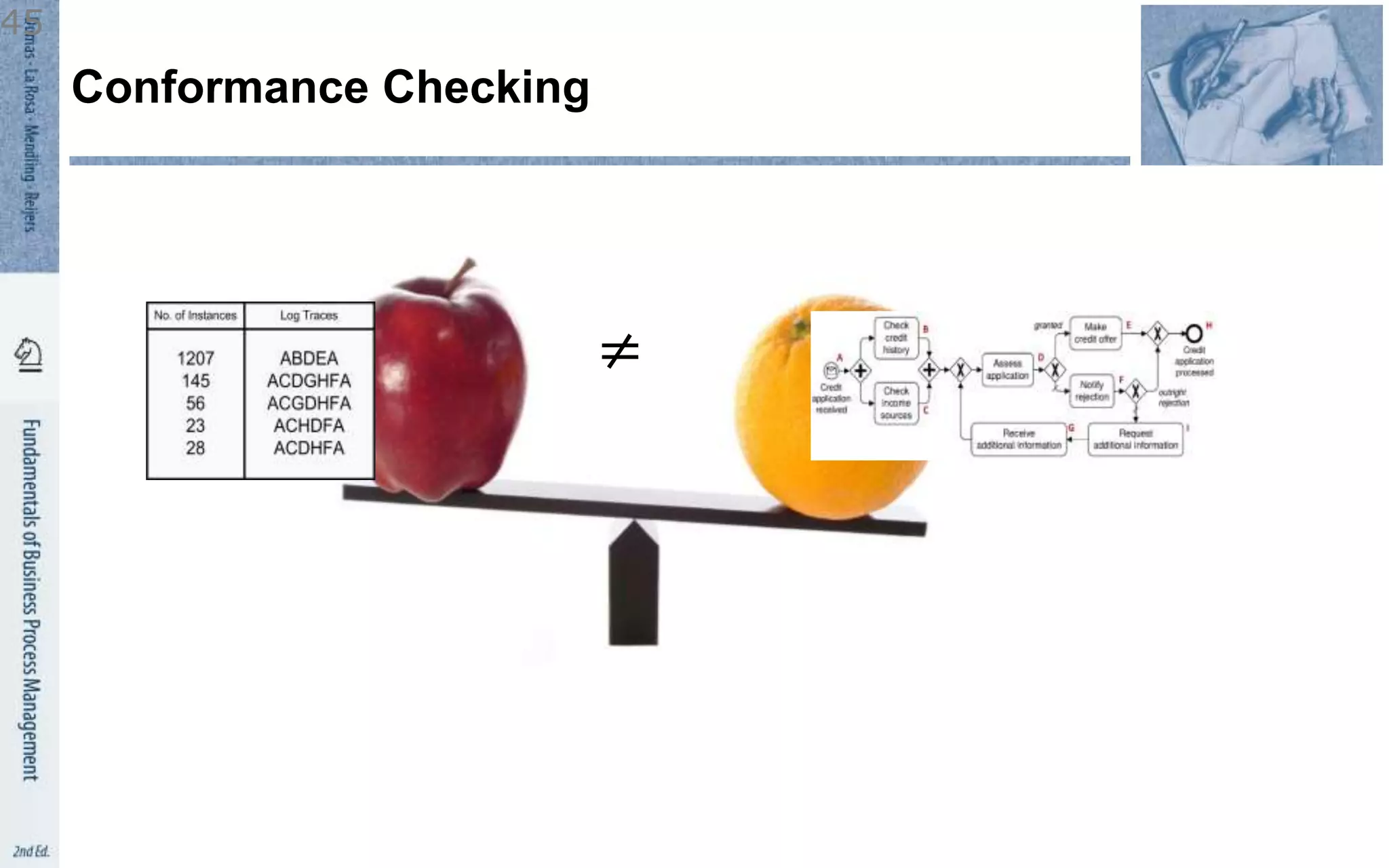
Conformance Checking
45
≠
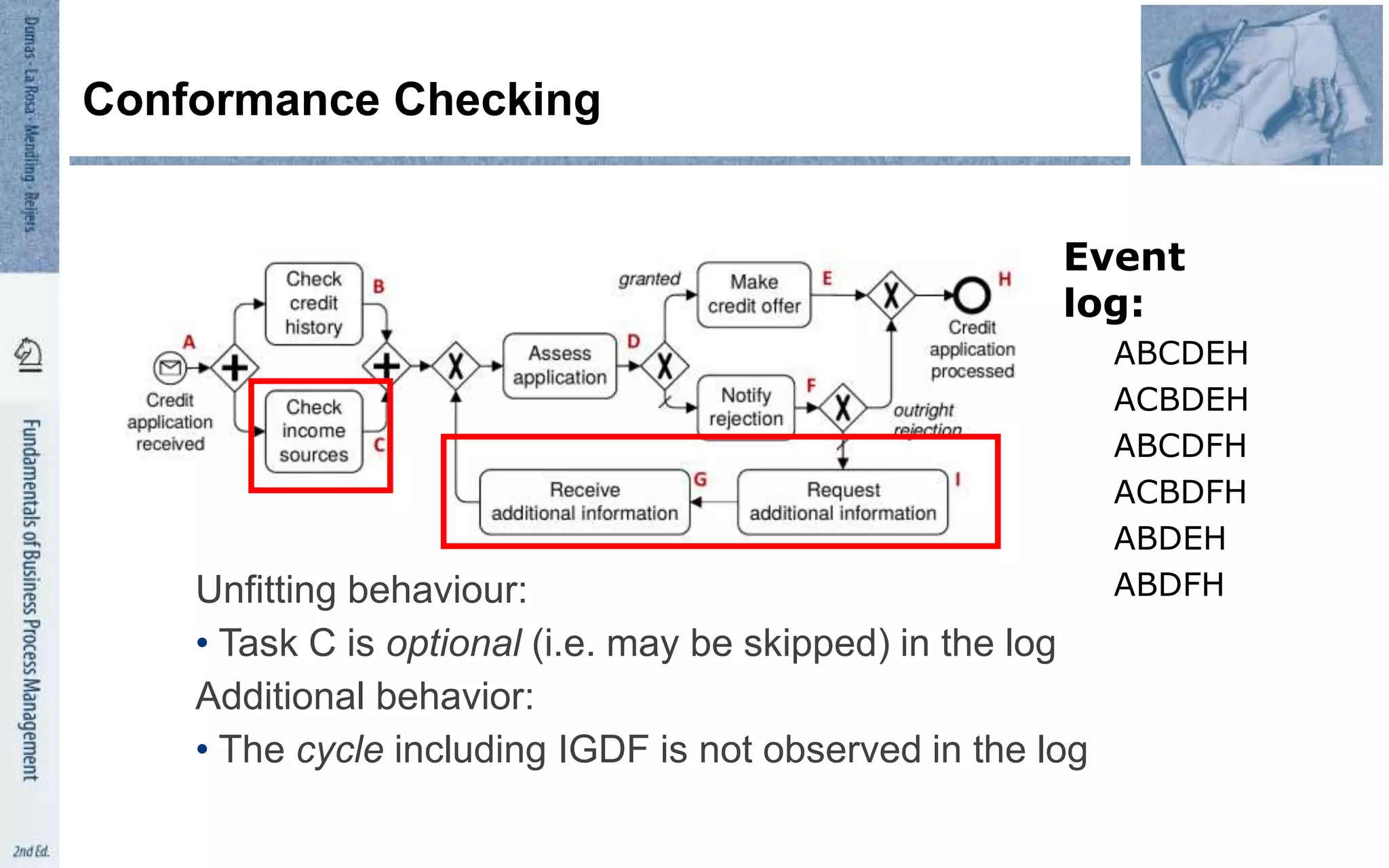
Conformance Checking
Unfitting behaviour:
• Task C is optional (i.e. may be skipped) in the log
Additional behavior:
• The cycle including IGDF is not observed in the log
Event
log:
ABCDEH
ACBDEH
ABCDFH
ACBDFH
ABDEH
ABDFH
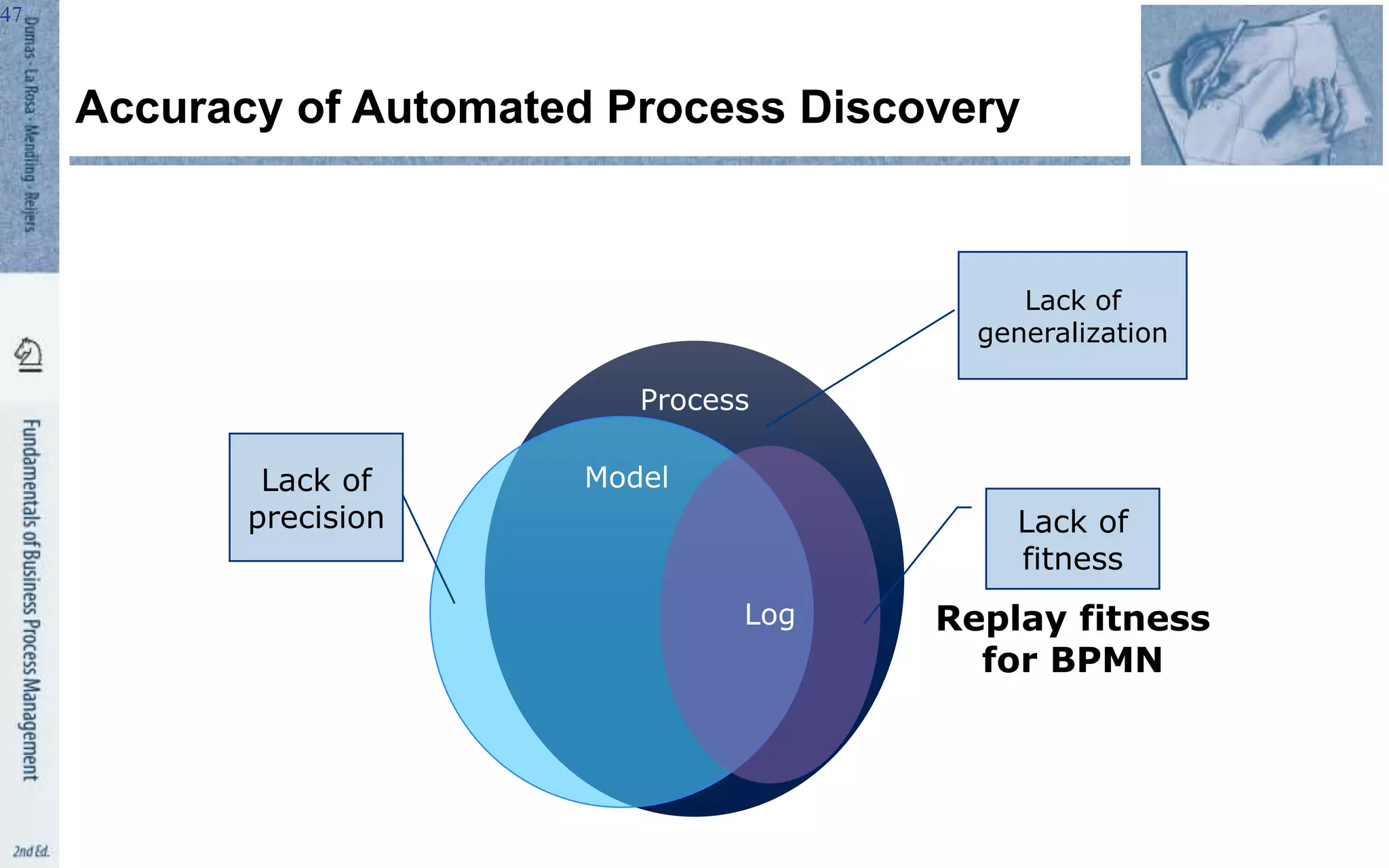
Accuracy of Automated Process Discovery
47
Process
Model
Log
Lack of
fitness
Lack of
precision
Lack of
generalization
Replay fitness
for BPMN
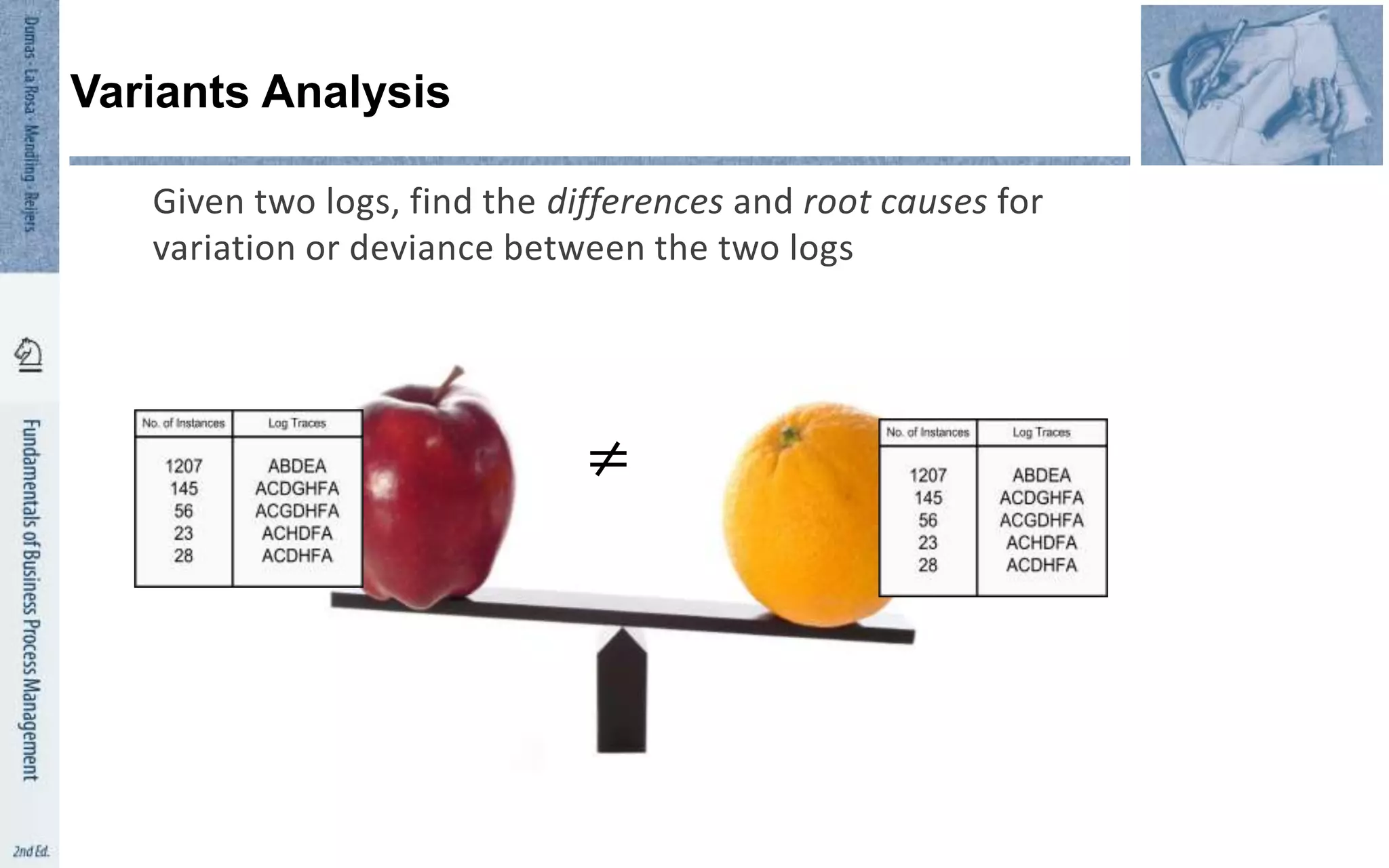
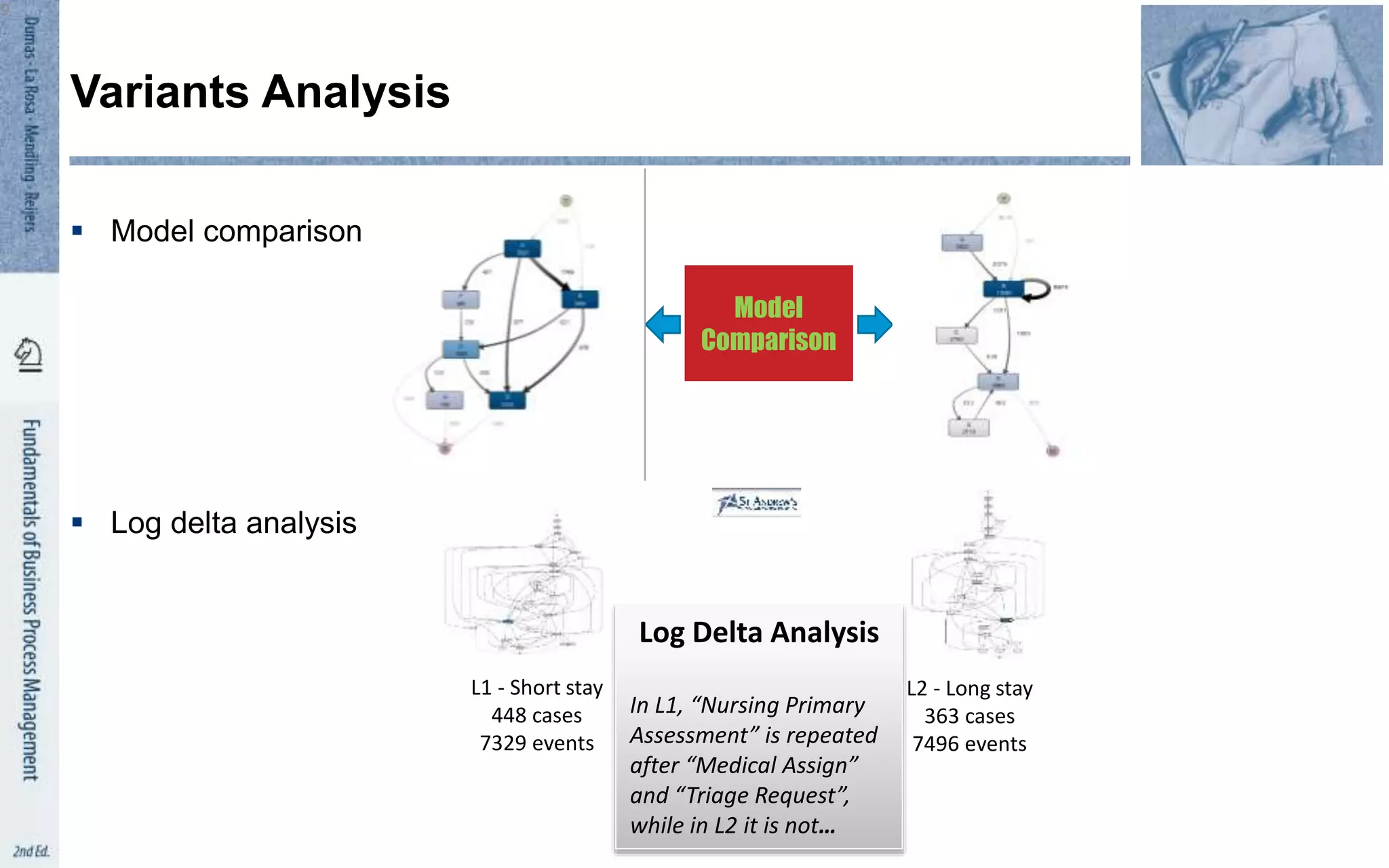
Given two logs, find the differences and root causes for
variation or deviance between the two logs
Variants Analysis
≠
 Model comparison
 Log delta analysis
Variants Analysis
9
Model
Comparison
L1 - Short stay
448 cases
7329 events
L2 - Long stay
363 cases
7496 events
Log Delta Analysis
In L1, “Nursing Primary
Assessment” is repeated
after “Medical Assign”
and “Triage Request”,
while in L2 it is not…
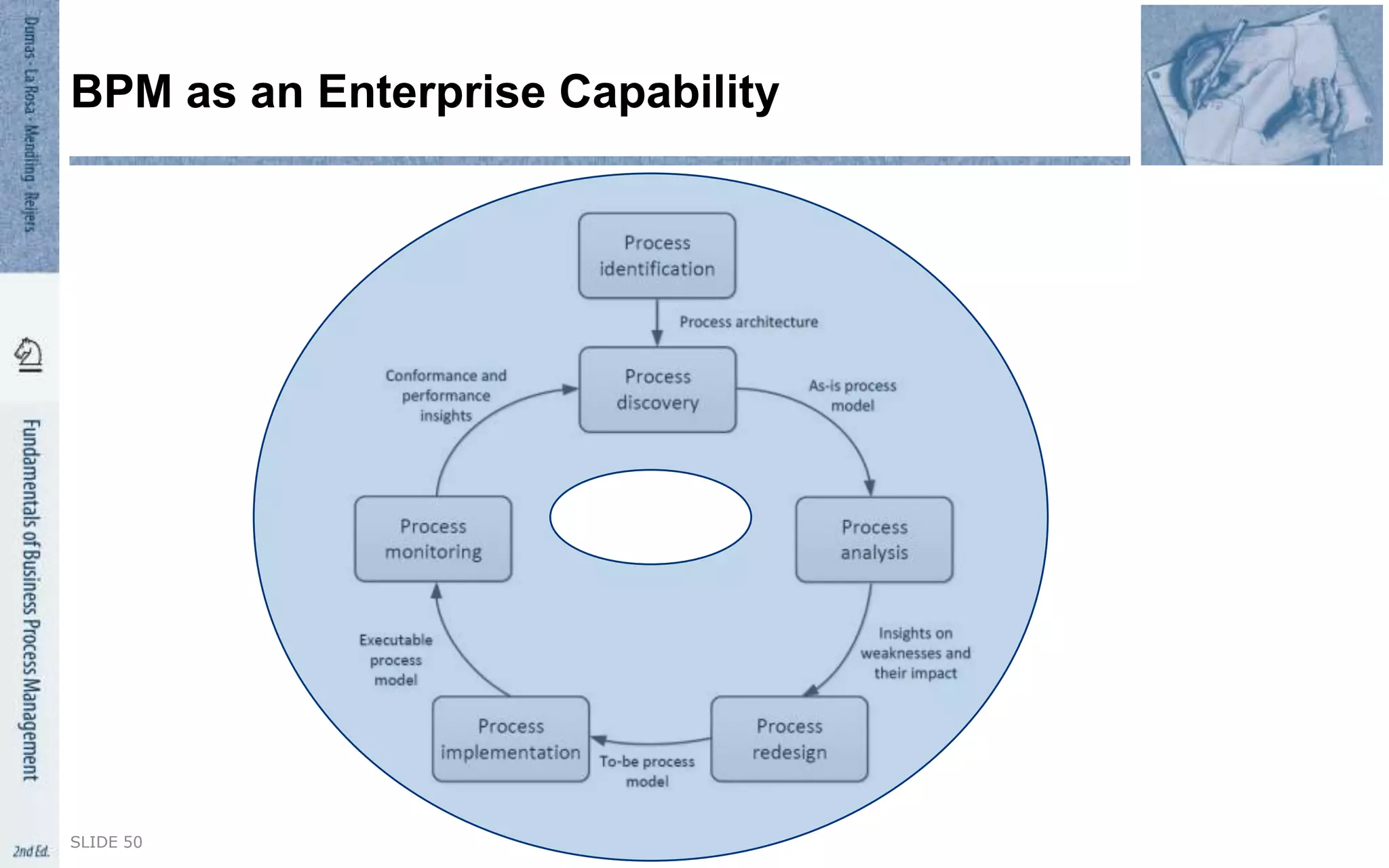
BPM as an Enterprise Capability
SLIDE 50
51
How do you know that in one year
you’ve been successful with
BPM?
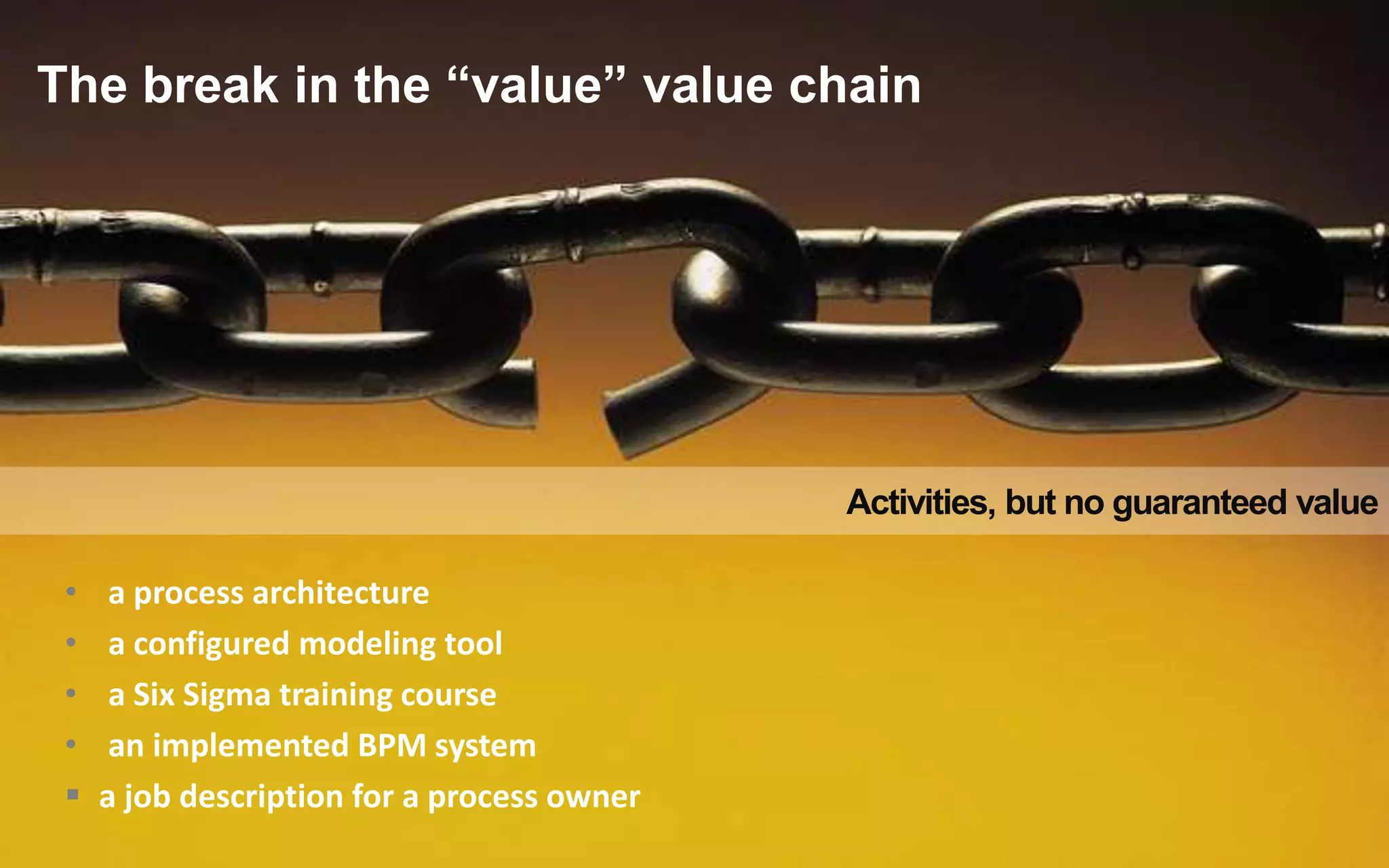
• a process architecture
• a configured modeling tool
• a Six Sigma training course
• an implemented BPM system
 a job description for a process owner
Activities, but no guaranteed value
The break in the “value” value chain
• Focus on activities, methods & tools, not values
• Believing BPM is the single source of truth
• Siloed BPM initiatives
• No change management plan
Typical failure reasons of BPM projects?
After de Bruin and Rosemann (2015)
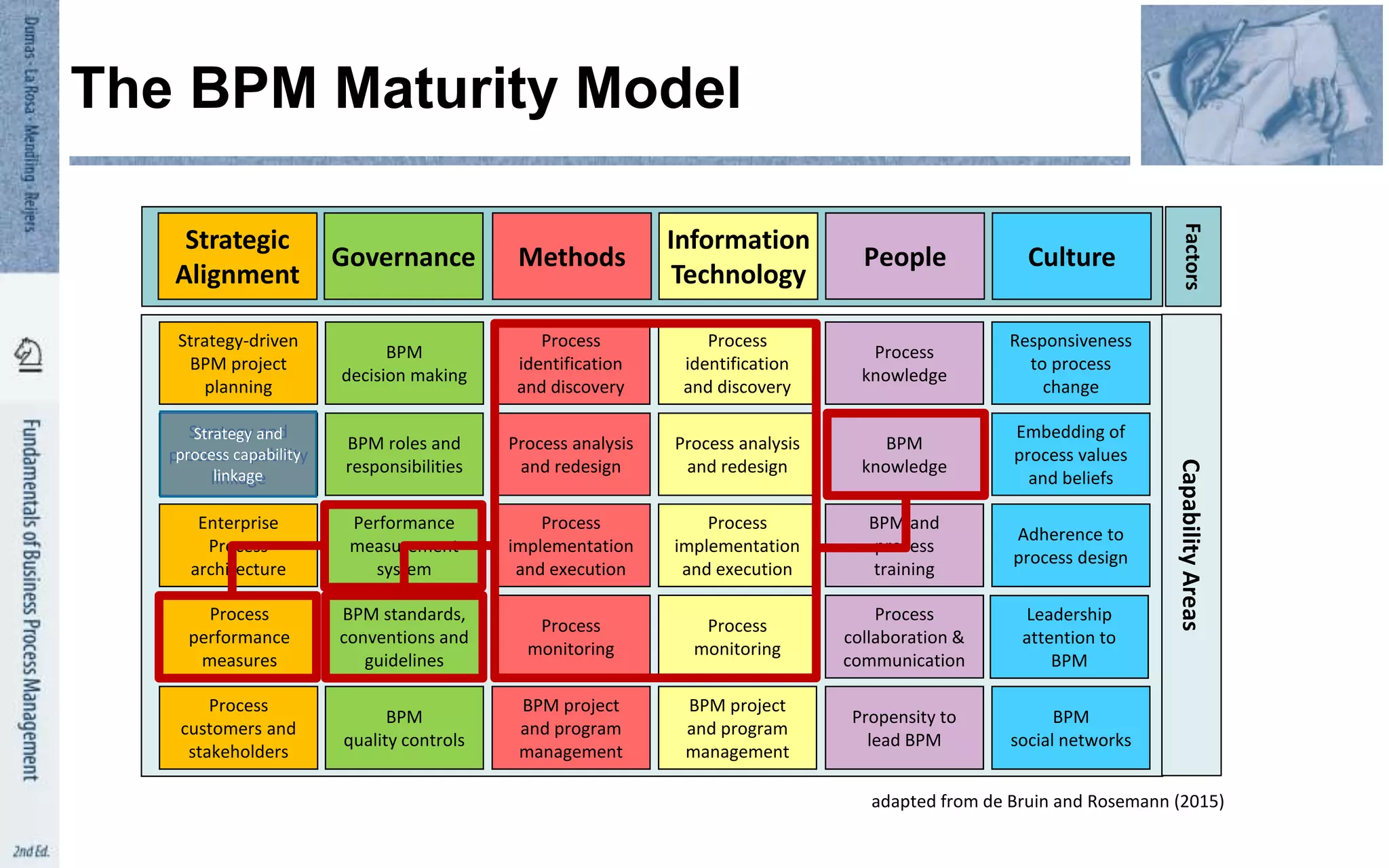
Beyond a single BPM project…The BPM Maturity Model
Process
monitoring
BPM
decision making
Process
performance
measures
Strategy-driven
BPM project
planning
BPM
knowledge
Process
knowledge
Embedding of
process values
and beliefs
Responsiveness
to process
change
Propensity to
lead BPM
Process
collaboration &
communication
Leadership
attention to
BPM
BPM standards,
conventions and
guidelines
Performance
measurement
system
BPM roles and
responsibilities
Enterprise
Process
architecture
Strategy and
process capability
linkage
Process
customers and
stakeholders
Process
implementation
and execution
Process analysis
and redesign
Process
identification
and discovery
Process
implementation
and execution
Process analysis
and redesign
Process
identification
and discovery
BPM and
process
training
Adherence to
process design
BPM project
and program
management
Process
monitoring
BPM project
and program
management
BPM
social networks
BPM
quality controls
Governance Methods
Strategic
Alignment
Information
Technology
People Culture
FactorsCapabilityAreas
adapted from de Bruin and Rosemann (2015)
Strategy and
process capability
linkage
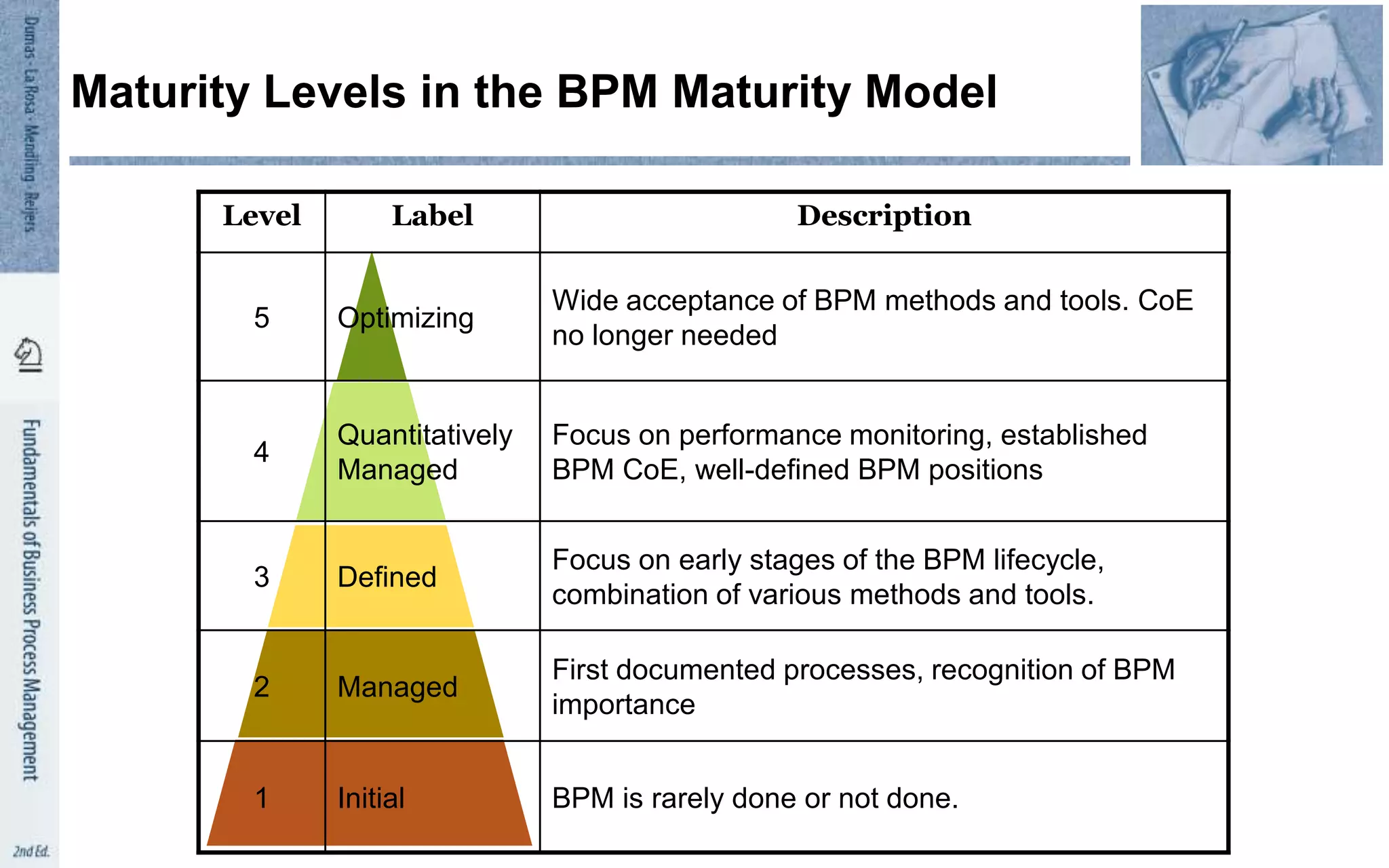
Maturity Levels in the BPM Maturity Model
Level Label Description
5 Optimizing
Wide acceptance of BPM methods and tools. CoE
no longer needed
4
Quantitatively
Managed
Focus on performance monitoring, established
BPM CoE, well-defined BPM positions
3 Defined
Focus on early stages of the BPM lifecycle,
combination of various methods and tools.
2 Managed
First documented processes, recognition of BPM
importance
1 Initial BPM is rarely done or not done.
© QUT – BPM Research Group
14 June 2018 - Slide 56
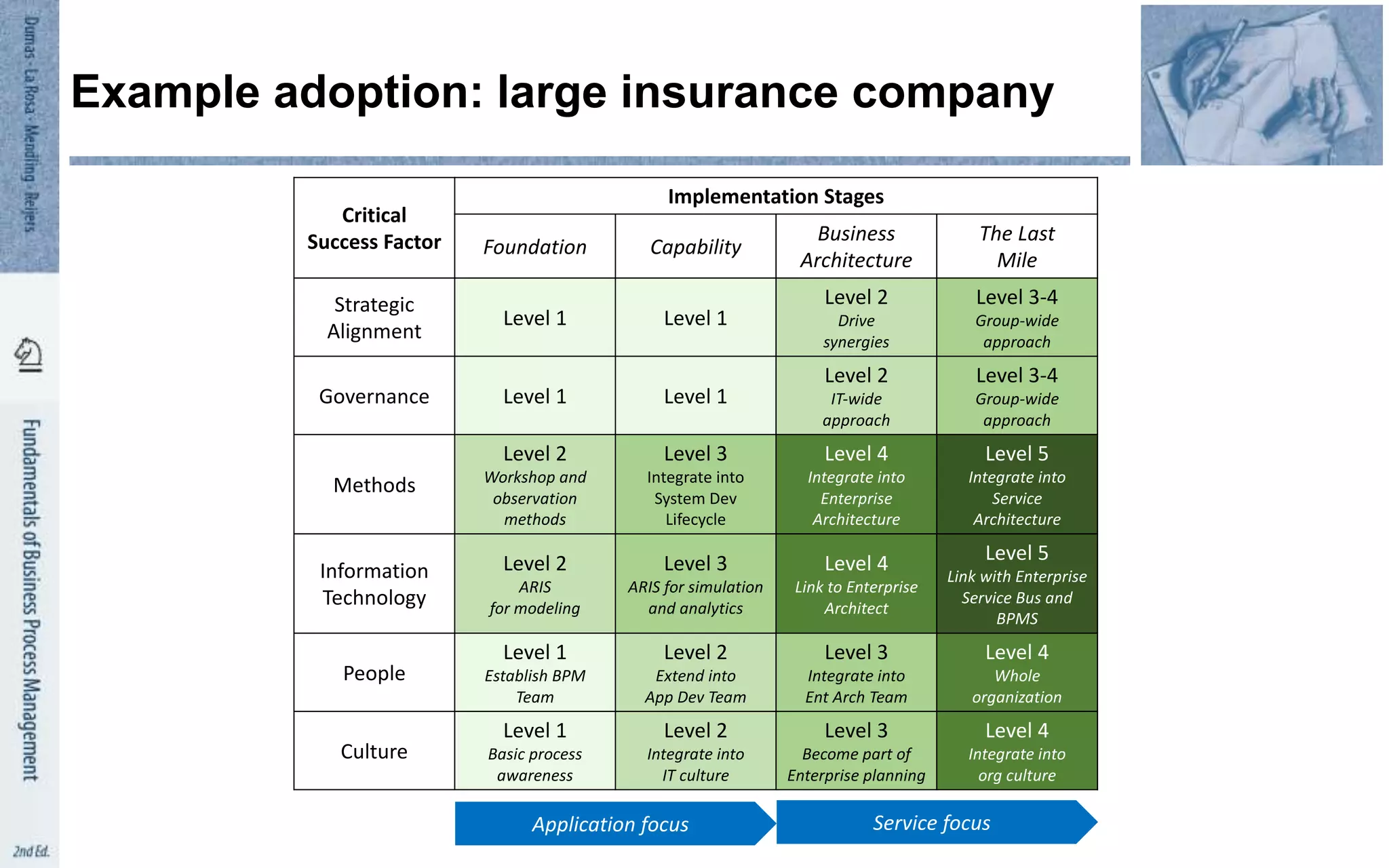
Example adoption: large insurance company
Critical
Success Factor
Implementation Stages
Foundation Capability
Business
Architecture
The Last
Mile
Strategic
Alignment
Level 1 Level 1
Level 2
Drive
synergies
Level 3-4
Group-wide
approach
Governance Level 1 Level 1
Level 2
IT-wide
approach
Level 3-4
Group-wide
approach
Methods
Level 2
Workshop and
observation
methods
Level 3
Integrate into
System Dev
Lifecycle
Level 4
Integrate into
Enterprise
Architecture
Level 5
Integrate into
Service
Architecture
Information
Technology
Level 2
ARIS
for modeling
Level 3
ARIS for simulation
and analytics
Level 4
Link to Enterprise
Architect
Level 5
Link with Enterprise
Service Bus and
BPMS
People
Level 1
Establish BPM
Team
Level 2
Extend into
App Dev Team
Level 3
Integrate into
Ent Arch Team
Level 4
Whole
organization
Culture
Level 1
Basic process
awareness
Level 2
Integrate into
IT culture
Level 3
Become part of
Enterprise planning
Level 4
Integrate into
org culture
Application focus Service focus
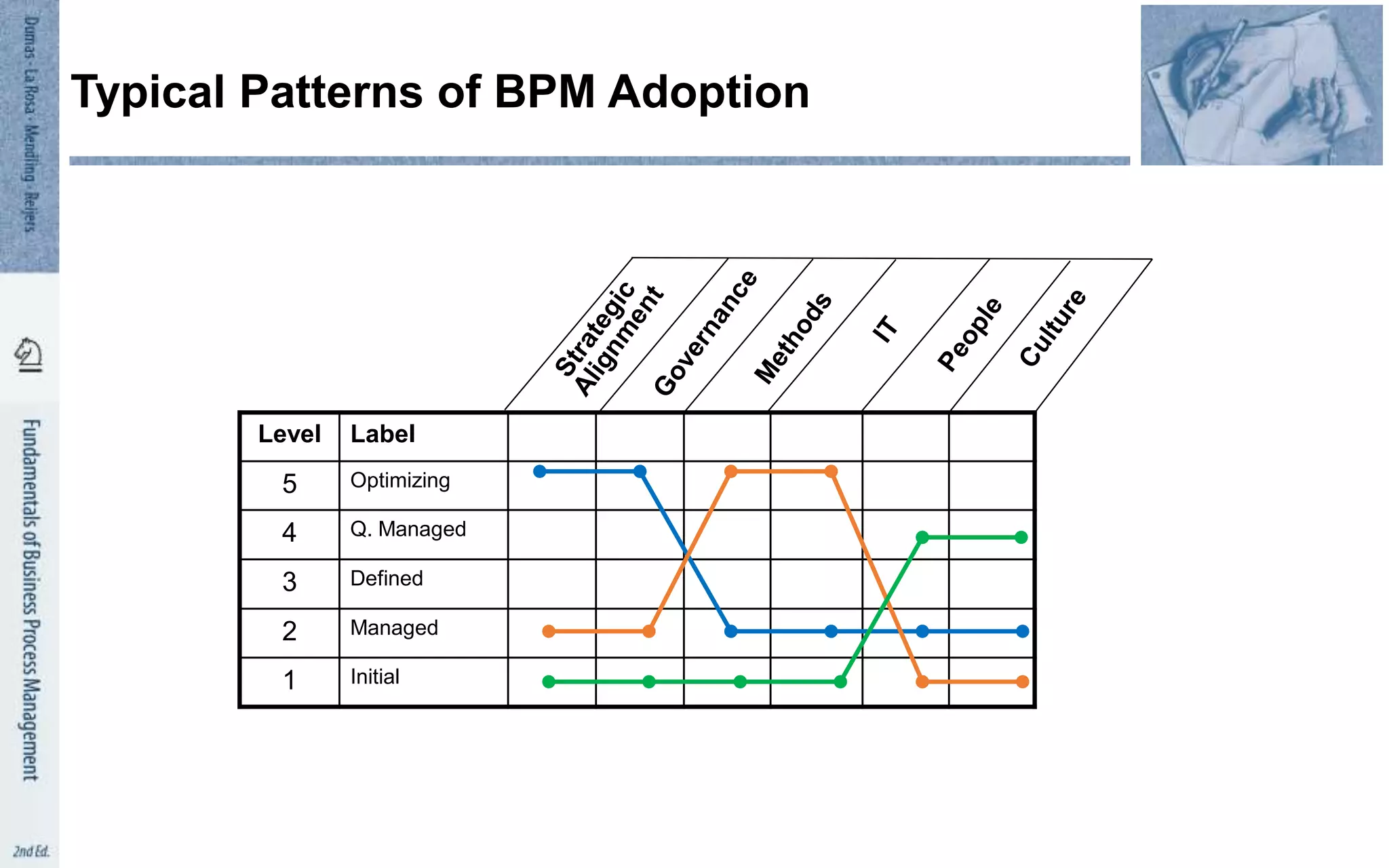
Typical Patterns of BPM Adoption
Level Label
5 Optimizing
4 Q. Managed
3 Defined
2 Managed
1 Initial
The Business Processes of the Future?
SLIDE 58
BPM: from the past to the present to the future
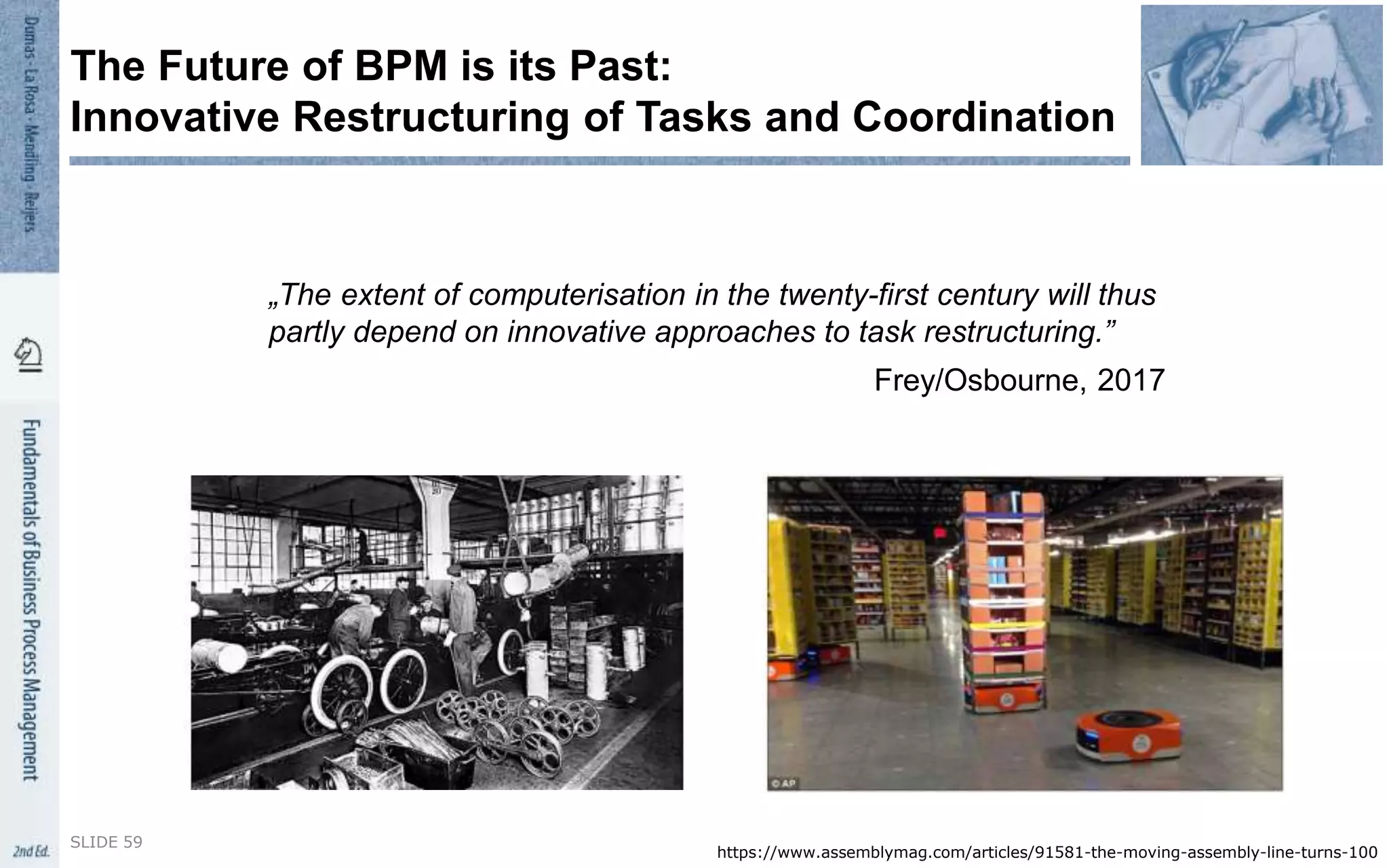
„The extent of computerisation in the twenty-first century will thus
partly depend on innovative approaches to task restructuring.”
Frey/Osbourne, 2017
SLIDE 59
The Future of BPM is its Past:
Innovative Restructuring of Tasks and Coordination
https://www.assemblymag.com/articles/91581-the-moving-assembly-line-turns-100
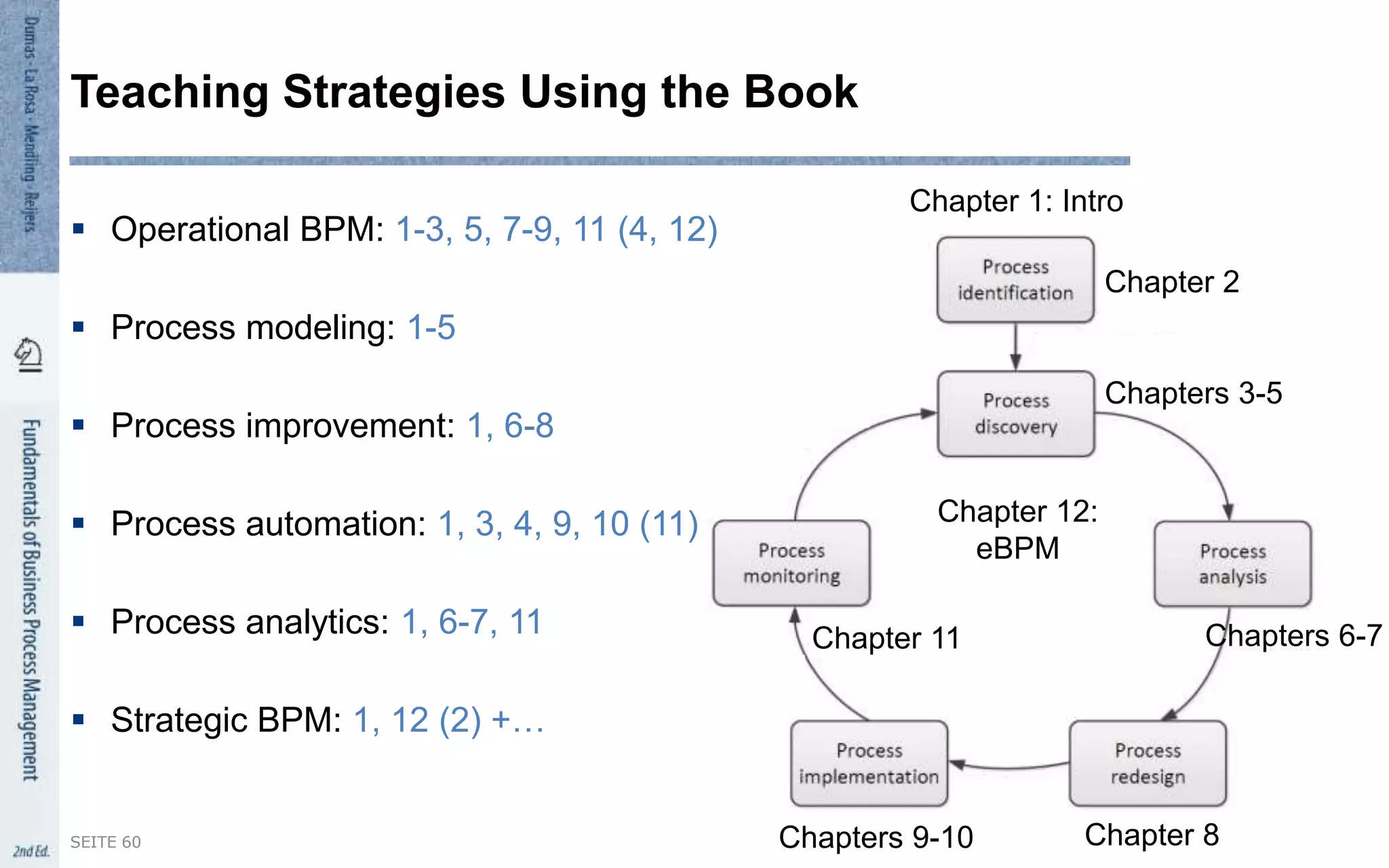
Teaching Strategies Using the Book
SEITE 60
 Operational BPM: 1-3, 5, 7-9, 11 (4, 12)
 Process modeling: 1-5
 Process improvement: 1, 6-8
 Process automation: 1, 3, 4, 9, 10 (11)
 Process analytics: 1, 6-7, 11
 Strategic BPM: 1, 12 (2) +…
Chapter 1: Intro
Chapter 2
Chapters 3-5
Chapters 6-7
Chapter 8Chapters 9-10
Chapter 11
Chapter 12:
eBPM
 Request an evaluation copy from Springer:
https://www.springer.com/gp/book/9783662565087
 Check out the supplementary material online:
http://fundamentals-of-bpm.org
 Register to the online instructors group:
https://groups.google.com/forum/#!forum/fundamentals-of-bpm
Next Steps
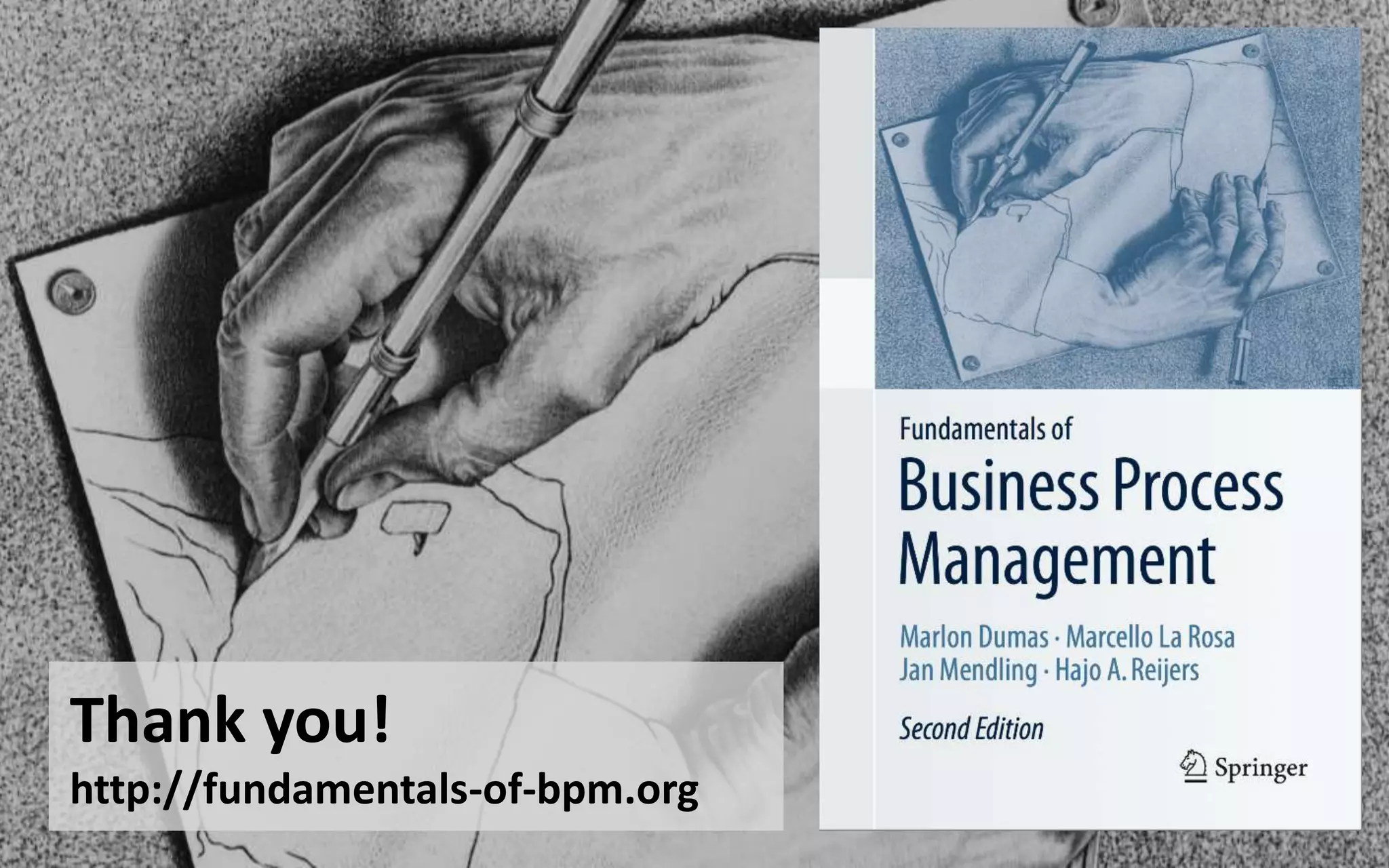
Thank you!
http://fundamentals-of-bpm.org

Fundamentals of Business Process Management - Tutorial at CAiSE'2018

  • 1.
    FUNDAMENTALS OF BPM: 50Years of BPM Teaching Distilled Marlon Dumas (University of Tartu) Marcello La Rosa (University of Melbourne) Jan Mendling (WU University) Hajo Reijers (Vrije Universiteit Amsterdam)
  • 2.
    Everything is aProcess SEITE 2
  • 3.
     Over 50years experience in teaching BPM  950 citations since 2013  Adopted in courses at more than 200 universities in more than 60 countries  Available from the library of nearly 450 universities  Used in MOOCs teaching to more than 25,000 students  Over 300 subscriptions to the online instructors group  Translations to Chinese, German, Greek, Persian and Spanish to be published Some Measures of Success SEITE 3
  • 4.
    Turbulent Times formany industries
  • 5.
    Automational Effect  Makesprocess faster  Provides scaling  Potential to reduce cost Robotic Process Automation Informational Effect  Provides transparency  Makes processes better visible and understandable Process Mining SLIDE 5 BPM is Changing, too Transformational Effect  Provides new way of coordination with partners  Provides new way of collaboration with partners Blockchains
  • 6.
    SLIDE 6 Old Wisdomby Utterback & Abernathy (1975)
  • 7.
     Extended from399 to 526 pages  Added 2 new chapters, 4 fully-reworked chapters and many refinements  Enriched with 230 exercises  Full coverage of the redesign orbit  New standards like DMN and CMMN covered  Enhanced presentation of monitoring including recent process mining techniques  Holistic discussion of BPM as an enterprise capability Summary of Changes SEITE 7
  • 8.
    1. Introduction to BusinessProcess Management 2. Process Identification 3. Essential Process Modeling 4. Advanced Process Modeling 5. Process Discovery 6. Qualitatitve Process Analysis 7. Quantitative Process Analysis 8. Process Redesign 9. Process-Aware Information Systems 10. Process Implementation with Executable Models 11. Process Monitoring 12. BPM as an Enterprise Capability New Content per Chapter SEITE 8
  • 9.
  • 10.
     Process Identificationand Value Chain Modeling (Jan Mendling)  Process Redesign Orbit (Hajo Reijers)  Taxonomy of Process Mining Methods (Marlon Dumas)  BPM as an Enterprise Capability (Marcello La Rosa) Important New/Revised Topics SEITE 10
  • 11.
    Process Identification andProcess Architecture SEITE 11
  • 12.
    1. Designation step •Enumerate main processes • Determine process scope 2. Prioritization step (aka Process selection) Prioritize processes based on: • Importance • Health • Feasibility Process identification steps After Davenport (1993) Process Architecture Prioritized Process Portfolio
  • 13.
    Logical Levels Physical Levels BusinessLevelsOperationsLevelsProcessLevels Model structure, methodologyand modelling standards Shows groups of related business functions and standard end-to-end processes (e.g. Service Streams) Decomposition of core processes into detailed ‘success model’ business process flows Detailed operational process flows with error conditions and product and geographical variants (where required). Further decomposition of detailed operational where required Process Groupings Business Activities Core Processes Business Process Flows Detailed Process Flows Level A Level B Level C Level D Level E Level F Operational Process Flows Defines business activities Distinguishes operational customer oriented processes from management and strategic process Core processes that combine together to deliver Service Streams and other end- to-end processes Meta Level © British Telecommunications (2005) Generic Process Architecture SLIDE 13 Process Architecture British Telecom Level 1 Level 2 Level 3+ Process Landscape (incl. Value Chains) Business Processes (e.g. BPMN) Sub-processes and Tasks (e.g. BPMN)
  • 14.
  • 15.
    Process Landscape Model: Exampleof Wienerlinien (Vienna Public Transport) SLIDE 15 Manage Enterprise Manage Personnel Management Processes Core Processes Support Processes Communicate in and out Manage Processes Manage Quality Manage Risks and Opportunities Manage Innovation Contact Customer Manage Sales Manage Customer Relationship Operate Vehicles Plan and Buy Vehicles Maintain Vehicles Transport Customer Transport Customer Evaluate Transport Provide Infrastructure Plan Infrastructure Build Infrastructure Maintain Infrastructure Evaluate Infrastructure Check Vehicles Foster Relationship Manage Financials Manage Information Manage Materials Manage Disruptions Provide Winter Service Plan Customer Transport
  • 16.
    Example of SAPProcess Map SLIDE 16 Manage Enterprise Management Processes Manage Innovation Define, Operationalize, and Track Strategy Attract, Develop, and Retain Workforce Management Processes Core Processes Support Processes Workplace and Infrastructure Provision Procure to Pay Corporate Finance and Operational Compliance Shareholder and Stakeholder Management Sales, Franchise, and Partner Management Innovate Sell Deliver
  • 17.
    1. Clarify terminology 2.Identify end-to-end processes 3. For each end-to-end process, identify its sequential processes 4. For each business process, identify its major management and support processes 5. Decompose and specialize business processes 6. Compile process profile 7. Check completeness and consistency Defining a Process Landscape Model SLIDE 17
  • 18.
     Strategic Importance: Find out which processes have the greatest impact on the strategic goals.  Consider profitability, uniqueness, or contribution to competitive advantages.  Select those processes for process management that relate to strategy.  Health:  Determine which processes are in deepest trouble.  These processes may profit the most from BPM initiatives.  Feasibility:  Determine how susceptible process is to BPM initiatives, incidentally or continuously.  Culture and politics may be obstacles.  BPM should focus on those processes where it is reasonable to achieve benefits. Selection Criteria SLIDE 18
  • 19.
    Importance HealthPoor Good Low High Feasibility Low Medium High Loan Controlling Loan Decision LoanMarket Evaluation Contract Prepatation Rating Handling Payments Loan Application Loan Planning Selection Focus Process Portfolio SLIDE 19
  • 20.
    Quiz 1: Why shouldyou revise your process architecture?
  • 21.
    SLIDE 21 Changes ofStrategic Relevance: Mannesmann Sources: stahlseite.de, Copyright Uwe Niggemeier, deutsches-telefon-museum.eu, ebay- 19th century 20th century 1990
  • 22.
  • 23.
     Customers  BusinessProcess Operation  Business Process Behavior  Organization  Information  Technology  External Environment The Devil‘s Quadrangle SLIDE 23 Directions for Process Redesign Elements of Redesign
  • 24.
    How to doRedesign?
  • 25.
    “How to getfrom the as-is to the to-be [in a redesign project] isn’t explained, so we conclude that during the break, the famous ATAMO procedure is invoked – And Then, A Miracle occurs”. Sharp & McDermott, 2002 SLIDE 25
  • 26.
    SLIDE 26 The ProcessRedesign Orbit
  • 27.
    SLIDE 27 The ProcessRedesign Orbit Low Risk
  • 28.
    SLIDE 28 The ProcessRedesign Orbit Support
  • 29.
    SLIDE 29 The ProcessRedesign Orbit Factual
  • 30.
    SLIDE 30 The ProcessRedesign Orbit Impact
  • 31.
    Quiz 2: Name tworedesign heuristics and describe their expected outcome on the process.
  • 32.
  • 33.
    Statistics-Based Techniques Performance Dashboards Model-BasedTechniques Process Mining Database Event log Enterprise System Process Monitoring
  • 34.
  • 35.
  • 36.
    Automated Process Discovery EnterLoan Application Retrieve Applicant Data Compute Installments Approve Simple Application Approve Complex Application Notify Rejection Notify Eligibility CID Task Time Stamp … 13219 Enter Loan Application 2007-11-09 T 11:20:10 - 13219 Retrieve Applicant Data 2007-11-09 T 11:22:15 - 13220 Enter Loan Application 2007-11-09 T 11:22:40 - 13219 Compute Installments 2007-11-09 T 11:22:45 - 13219 Notify Eligibility 2007-11-09 T 11:23:00 - 13219 Approve Simple Application 2007-11-09 T 11:24:30 - 13220 Compute Installements 2007-11-09 T 11:24:35 - … … … … Dependency graph (process map) BPMN process model
  • 37.
    Dependency Graphs (a.k.a. ProcessMaps) A dependency graph of a log is a graph where: • Each activity is represented by one node • An arc from activity A to activity B means that B is directly followed by A in at least one trace in the log Arcs in a dependency graph may be annotated with: • Absolute frequency: How many times B directly follows A? • Relative frequency: What percentage of times A is directly followed by B? • Time: What is the average time between the occurrence of A and the occurrence of B?
  • 38.
    Quiz 3: Writethe dependency graph (process map) of the following event log. Include absolute frequencies.
  • 39.
    Abstraction and Filtering Tocope with the complexity of large real-life logs, process maps are often used in conjunction with two operations: 1. Abstract the process map: • Show only most frequent activities • Show only most frequent arcs 2. Filter the traces in the event log • Remove all events that fulfil a condition • Remove traces that fulfil a condition (or traces that do not fulfil a condition)
  • 40.
    Alpha miner (α-miner)– Adapted to produce BPMN natively • Simple, limited, not robust Heuristics miner • Robust to noise, fast, often a good tradeoff but can produce incorrect models Inductive miner (ProM v6) • Ensures that models are block-structured & correct Split miner (Apromore) • Balances fitness and precision, produces deadlock-free but not necessarily structured models Discovering BPMN Process Models 42
  • 41.
  • 42.
     Dotted charts Timeline diagrams  Performance-enhanced dependency grahs handoff graphs Performance Mining
  • 43.
  • 44.
    Conformance Checking Unfitting behaviour: •Task C is optional (i.e. may be skipped) in the log Additional behavior: • The cycle including IGDF is not observed in the log Event log: ABCDEH ACBDEH ABCDFH ACBDFH ABDEH ABDFH
  • 45.
    Accuracy of AutomatedProcess Discovery 47 Process Model Log Lack of fitness Lack of precision Lack of generalization Replay fitness for BPMN
  • 46.
    Given two logs,find the differences and root causes for variation or deviance between the two logs Variants Analysis ≠
  • 47.
     Model comparison Log delta analysis Variants Analysis 9 Model Comparison L1 - Short stay 448 cases 7329 events L2 - Long stay 363 cases 7496 events Log Delta Analysis In L1, “Nursing Primary Assessment” is repeated after “Medical Assign” and “Triage Request”, while in L2 it is not…
  • 48.
    BPM as anEnterprise Capability SLIDE 50
  • 49.
    51 How do youknow that in one year you’ve been successful with BPM?
  • 50.
    • a processarchitecture • a configured modeling tool • a Six Sigma training course • an implemented BPM system  a job description for a process owner Activities, but no guaranteed value The break in the “value” value chain
  • 51.
    • Focus onactivities, methods & tools, not values • Believing BPM is the single source of truth • Siloed BPM initiatives • No change management plan Typical failure reasons of BPM projects? After de Bruin and Rosemann (2015)
  • 52.
    Beyond a singleBPM project…The BPM Maturity Model Process monitoring BPM decision making Process performance measures Strategy-driven BPM project planning BPM knowledge Process knowledge Embedding of process values and beliefs Responsiveness to process change Propensity to lead BPM Process collaboration & communication Leadership attention to BPM BPM standards, conventions and guidelines Performance measurement system BPM roles and responsibilities Enterprise Process architecture Strategy and process capability linkage Process customers and stakeholders Process implementation and execution Process analysis and redesign Process identification and discovery Process implementation and execution Process analysis and redesign Process identification and discovery BPM and process training Adherence to process design BPM project and program management Process monitoring BPM project and program management BPM social networks BPM quality controls Governance Methods Strategic Alignment Information Technology People Culture FactorsCapabilityAreas adapted from de Bruin and Rosemann (2015) Strategy and process capability linkage
  • 53.
    Maturity Levels inthe BPM Maturity Model Level Label Description 5 Optimizing Wide acceptance of BPM methods and tools. CoE no longer needed 4 Quantitatively Managed Focus on performance monitoring, established BPM CoE, well-defined BPM positions 3 Defined Focus on early stages of the BPM lifecycle, combination of various methods and tools. 2 Managed First documented processes, recognition of BPM importance 1 Initial BPM is rarely done or not done.
  • 54.
    © QUT –BPM Research Group 14 June 2018 - Slide 56 Example adoption: large insurance company Critical Success Factor Implementation Stages Foundation Capability Business Architecture The Last Mile Strategic Alignment Level 1 Level 1 Level 2 Drive synergies Level 3-4 Group-wide approach Governance Level 1 Level 1 Level 2 IT-wide approach Level 3-4 Group-wide approach Methods Level 2 Workshop and observation methods Level 3 Integrate into System Dev Lifecycle Level 4 Integrate into Enterprise Architecture Level 5 Integrate into Service Architecture Information Technology Level 2 ARIS for modeling Level 3 ARIS for simulation and analytics Level 4 Link to Enterprise Architect Level 5 Link with Enterprise Service Bus and BPMS People Level 1 Establish BPM Team Level 2 Extend into App Dev Team Level 3 Integrate into Ent Arch Team Level 4 Whole organization Culture Level 1 Basic process awareness Level 2 Integrate into IT culture Level 3 Become part of Enterprise planning Level 4 Integrate into org culture Application focus Service focus
  • 55.
    Typical Patterns ofBPM Adoption Level Label 5 Optimizing 4 Q. Managed 3 Defined 2 Managed 1 Initial
  • 56.
    The Business Processesof the Future? SLIDE 58 BPM: from the past to the present to the future
  • 57.
    „The extent ofcomputerisation in the twenty-first century will thus partly depend on innovative approaches to task restructuring.” Frey/Osbourne, 2017 SLIDE 59 The Future of BPM is its Past: Innovative Restructuring of Tasks and Coordination https://www.assemblymag.com/articles/91581-the-moving-assembly-line-turns-100
  • 58.
    Teaching Strategies Usingthe Book SEITE 60  Operational BPM: 1-3, 5, 7-9, 11 (4, 12)  Process modeling: 1-5  Process improvement: 1, 6-8  Process automation: 1, 3, 4, 9, 10 (11)  Process analytics: 1, 6-7, 11  Strategic BPM: 1, 12 (2) +… Chapter 1: Intro Chapter 2 Chapters 3-5 Chapters 6-7 Chapter 8Chapters 9-10 Chapter 11 Chapter 12: eBPM
  • 59.
     Request anevaluation copy from Springer: https://www.springer.com/gp/book/9783662565087  Check out the supplementary material online: http://fundamentals-of-bpm.org  Register to the online instructors group: https://groups.google.com/forum/#!forum/fundamentals-of-bpm Next Steps
  • 60.

Editor's Notes