Conditional Probability
Engr. Maria Romina P. Angustia
Conditional Probability:
• the probability of an event ( A ), given that
another ( B ) has already occurred.
• Where two events, A and B, are dependent.
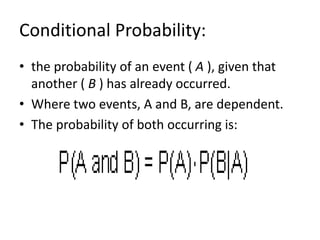
• The probability of both occurring is:
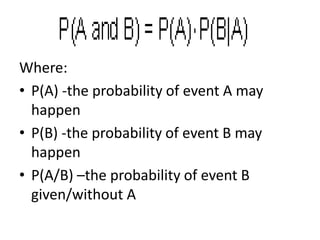
Where:
• P(A) -the probability of event A may
happen
• P(B) -the probability of event B may
happen
• P(A/B) –the probability of event B
given/without A
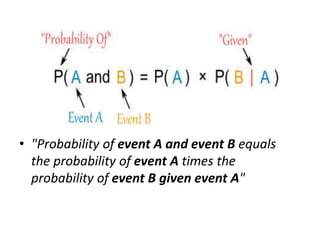
• "Probability of event A and event B equals
the probability of event A times the
probability of event B given event A"
Example:
• An urn contains 3 white balls and 1 black ball.
Determine the probability of drawing two
white balls in succession from the urn without
replacing the ball after each drawing.
• P(A and B) =
3
4
𝑥
2
3
=
1
2
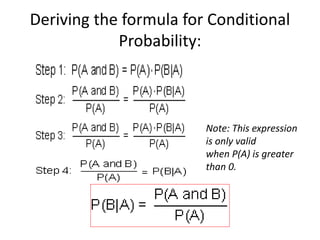
Deriving the formula for Conditional
Probability:
Note: This expression
is only valid
when P(A) is greater
than 0.
• "The probability of event B given event
A equals the probability of event A and event
B divided by the probability of event A.”
Example:
• 70% of your friends like Chocolate, and 35%
like Chocolate AND like Strawberry. What
percent of those who like Chocolate also like
Strawberry?
• P(Strawberry|Chocolate) = P(Chocolate and
Strawberry) / P(Chocolate)
P(Strawberry|Chocolate) =0.35 / 0.7 = 50%

Conditional Probability

  • 1.
  • 2.
    Conditional Probability: • theprobability of an event ( A ), given that another ( B ) has already occurred. • Where two events, A and B, are dependent. • The probability of both occurring is:
  • 3.
    Where: • P(A) -theprobability of event A may happen • P(B) -the probability of event B may happen • P(A/B) –the probability of event B given/without A
  • 4.
    • "Probability ofevent A and event B equals the probability of event A times the probability of event B given event A"
  • 5.
    Example: • An urncontains 3 white balls and 1 black ball. Determine the probability of drawing two white balls in succession from the urn without replacing the ball after each drawing. • P(A and B) = 3 4 𝑥 2 3 = 1 2
  • 6.
    Deriving the formulafor Conditional Probability: Note: This expression is only valid when P(A) is greater than 0.
  • 7.
    • "The probabilityof event B given event A equals the probability of event A and event B divided by the probability of event A.”
  • 8.
    Example: • 70% ofyour friends like Chocolate, and 35% like Chocolate AND like Strawberry. What percent of those who like Chocolate also like Strawberry? • P(Strawberry|Chocolate) = P(Chocolate and Strawberry) / P(Chocolate) P(Strawberry|Chocolate) =0.35 / 0.7 = 50%