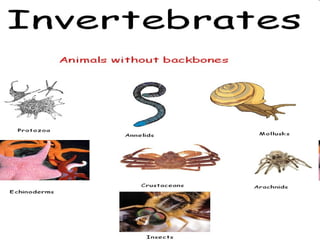
LAND INVERTEBRATES I nvertebrate animals have a shell to protect their soft bodies. Some have a hard outside covering called an  exoskeleton Spider Snail beetle Wasp
Arthropods:insects Beetle Grasshopper Grasshopper Ant Butterfly Wasp Ladybird Dragonfly
What is an insect? An insect has a hard outer skeleton It has a three part body: head,  thorax and abdomen It has six legs An insect has antennae on his head. Most insects have two pairs of wings.  Not all insects fly.
 
Arachnids: spiders They have eight legs They have two main parts They lay eggs Their skin is covered with tiny hairs They make silk using spinnerets on the end of their abdomens
OCEAN INVERTABRATES  Cnidarians Jellyfish and anemones are cnidarians They have been around for millions of years, they can sting but they are very beautiful. Jellyfish can only move vertically and are  unable to swim , they rely on currents to move.
MOLLUSKS They have soft body with no bones. They have tentacles for feeling and seeing. They can have one shell: cone snail,limpet Cone snail Limpet
Mollusks with two shells When they open their shells, water flows over their gills.  The shell is closed tight for protection Oyster Scallop Clams
Mollucks with no shell: Cephalpods They have to use other protection like tasting bad to predators, coloration or squirting purple ink. They move on a “foot” like a snail´s foot Octopus Cuttlefish Squid
ARTHROPODS Crustaceans They have a hard outside covering. As they grow bigger, they have to crawl out of their old skeletons and grow new, bigger ones. Crab Shrimps Lobster
ECHINODERMS They have a hard outside covering.  They move around on tiny tube feet. Sea stars have  Sea Urchins are  five or more arms  covered with spines.
Creada la presentación  Por MªÁngeles Cola Para segundo ciclo de primaria bilingüe Science: INVERTEBRATES

Invertebrates 2

  • 1.
  • 2.
  • 3.
    LAND INVERTEBRATES Invertebrate animals have a shell to protect their soft bodies. Some have a hard outside covering called an exoskeleton Spider Snail beetle Wasp
  • 4.
    Arthropods:insects Beetle GrasshopperGrasshopper Ant Butterfly Wasp Ladybird Dragonfly
  • 5.
    What is aninsect? An insect has a hard outer skeleton It has a three part body: head, thorax and abdomen It has six legs An insect has antennae on his head. Most insects have two pairs of wings. Not all insects fly.
  • 6.
  • 7.
    Arachnids: spiders Theyhave eight legs They have two main parts They lay eggs Their skin is covered with tiny hairs They make silk using spinnerets on the end of their abdomens
  • 8.
    OCEAN INVERTABRATES Cnidarians Jellyfish and anemones are cnidarians They have been around for millions of years, they can sting but they are very beautiful. Jellyfish can only move vertically and are unable to swim , they rely on currents to move.
  • 9.
    MOLLUSKS They havesoft body with no bones. They have tentacles for feeling and seeing. They can have one shell: cone snail,limpet Cone snail Limpet
  • 10.
    Mollusks with twoshells When they open their shells, water flows over their gills. The shell is closed tight for protection Oyster Scallop Clams
  • 11.
    Mollucks with noshell: Cephalpods They have to use other protection like tasting bad to predators, coloration or squirting purple ink. They move on a “foot” like a snail´s foot Octopus Cuttlefish Squid
  • 12.
    ARTHROPODS Crustaceans Theyhave a hard outside covering. As they grow bigger, they have to crawl out of their old skeletons and grow new, bigger ones. Crab Shrimps Lobster
  • 13.
    ECHINODERMS They havea hard outside covering. They move around on tiny tube feet. Sea stars have Sea Urchins are five or more arms covered with spines.
  • 14.
    Creada la presentación Por MªÁngeles Cola Para segundo ciclo de primaria bilingüe Science: INVERTEBRATES