
Presented By:
Mahewash Sana A. Pathan
TARGETED DRUG DELIVERY
SYSTEM
TARGETED DRUG DELIVERY
SYSTEM
Def: “Targeted drug delivery is an advanced method of
delivering drugs to the patients in such a targeted
sequence that increases the concentration of delivered
drug to the targeted body part of interest only
(organs/tissues/cells) which in turn improves efficacy of
treatment by reducing side effects of drug
administration”.
 Targeted drug research began in the 1970s, its main form
is for injection, with the development, the current trend of
drug delivery system, drug research and development is
the use of liposome, lipid, protein, fat, microspheres and
biodegradable polymers as drug carrier. Targeted drugs
originally is mainly used in cancer treatment, to maximize
the efficacy of a drug is of prime importance during the
choice of the delivery system.
2
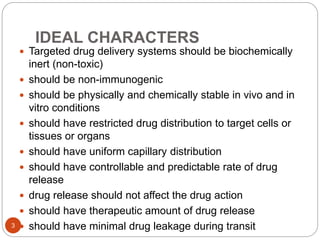
IDEAL CHARACTERS
 Targeted drug delivery systems should be biochemically
inert (non-toxic)
 should be non-immunogenic
 should be physically and chemically stable in vivo and in
vitro conditions
 should have restricted drug distribution to target cells or
tissues or organs
 should have uniform capillary distribution
 should have controllable and predictable rate of drug
release
 drug release should not affect the drug action
 should have therapeutic amount of drug release
 should have minimal drug leakage during transit3
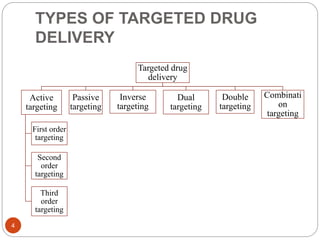
TYPES OF TARGETED DRUG
DELIVERY
Targeted drug
delivery
Active
targeting
First order
targeting
Second
order
targeting
Third
order
targeting
Passive
targeting
Inverse
targeting
Dual
targeting
Double
targeting
Combinati
on
targeting
4
1. Passive targeting
 It refers to the accumulation of drug or drug
carrier system at a specific site.
 The drugs are targeted to systemic circulation.
 Targeting is occurring because of the body’s
natural response to physicochemical
characters of drug.
 Examples include targeting of antimalarial
drugs for treatment of leishmiansis,
brucellosis, and candidiasis.
5
2. Active targeting
 Active targeting means a specific ligand– receptor type
interaction for intracellular localization which occurs only after
blood circulation and extravasations. This active targeting
approach can be further classified into three different levels of
targeting which are:
a) First order targeting refers to restricted distribution of the drug
carrier systems to the capillary bed of a predetermined target
site, organ or tissue e.g. compartmental targeting in lymphatic,
peritoneal cavity, plural cavity, cerebral ventricles and eyes,
joints.
b) Second order targeting refers to selective delivery of drugs to
specific cell types such as tumour cells and not to the normal
cells e.g. selective drug delivery to kupffer cells in the liver.
c) Third order targeting refers to drug delivery specifically to the
intracellular site of targeted cells e.g. receptor based ligand6
3. Inverse targeting
 This approach leads to saturation of RES and
suppression of defense mechanism by pre-
injecting large amount of blank colloidal
carriers. This is an effective approach for non-
RES organs.
7
4. Dual targeting
 The carrier molecule itself has their own
therapeutic activity and therefore increases effect
of drug
8
5. Double targeting
 In this type the temporal and spatial
methodologies are combined to target a carrier
system.
9
6. Combination targeting
 similar to double targeting, the combination
targeting systems for the site specific delivery
of proteins and peptides are equipped with
molecular specificity. The latter provides a
direct access to the target site.
10
COMPONENTS OF DRUG
TARGETING
1. Target:
Target means an organ or a tissue or a cell,
which is in need of treatment.
2. Drug Carrier or Marker:
Drug delivery is possible only by means of a
carrier system. Carriers are molecules or any
other systems responsible for the successful
transportation of a drug to the site of interest.
Carriers are vectors specifically engineered for
the purpose of holding a drug inside them. This is
possible by means of encapsulation.
11
DRUG DELIVERY VEHICLES
 These transport the drug either within or in the
vicinity of target. An ideal drug delivery vehicle is
supposed to cross even stubborn sites such as a
blood brain barrier.
 It should be easily recognized by the target cells
and the drug-ligand complex hence formed
should be stable. These need to be non-toxic,
biodegradable as well.
 The biodegradable nature of drug carrier enables
them to be easily cleared away by the body and
physiological mechanism, and thus avoids any
chance of their accumulation within cells that may
lead to cytotoxicity.
12
1. Liposome: Liposomes are small artificial vesicles of
spherical shape that can be created from cholesterol and
natural nontoxic phospholipids. Due to their size and
hydrophobic and hydrophilic character (besides
biocompatibility), liposomes are promising systems for drug
delivery.
2. Carbon Materials: Nanoscale carbon materials usually
including carbon nanotubes97, graphene98 / graphene-
oxide99, and nano diamond Targeting and selectivity during
cancer cell destruction has also been reported through
molecular surface functionalization of single-walled carbon
nanotubes (SWCNTs) both in vitro and in vivo. It usually has
a diameter between 10 nm and 1000 nm. The drug is usually
made from natural polymer material and has been fully
applied to treatment course of tumor, diabetes and vascular
disease. It can effectively extend action time of drug, then
effectively improve clinical effect of the drug and minimize
toxic and side effects of the drug. Compare with other
materials, Carbon can be much cheaper, but the chirality
and diameter of nanotubes, which severely impact the
physical and chemical properties, they are difficult to control.
13
3. Metallic nanomaterials: Metallic nanomaterials including
gold and silver nanocrystals and nano rods have been
shown to generate localized hyper thermal heating through
the absorption of incident optical radiation and surface
Plasmon relaxation to treat the disease. Its advantage is low
cost, easily synthesized nanoparticles and the particles are
also having a high thermal stability. PEG-DSPE coating may
be related to better absorption, based on the stability and a
pharmacokinetic improvement in the blood circulation time.
This method will lead to enhanced permeation for
nanoparticles to across the vascular endothelium and
achieve improved accumulation in the tumor.
4. Iron oxide nanocrystals: The difference between the
magnetic particles and their metallic and
semiconducting counterparts is the mechanism by
which the particle is heated. Briefly, magnetic
hyperthermia is achieved by applying external
alternating magnetic fields to cause the magnetic
particles to heat through hysteresis loss (Néel
14
5. Nano micelles: Polymeric Nano micelles are formed by amphiphilic
polymers with distinct hydrophobic and hydrophilic segments. The
polymer self-assembles to form micelles in aqueous solution. The
mechanism of drug release from Nano micelles is dependent on the
nature and strength of interactions between core-forming polymer
and drug molecules, micelle stability.
6. Carbon nanotubes: Carbon nanotubes (CNT) have recently been
studied as novel and versatile drug and gene delivery vehicles.
When CNT are suitably functionalized, they can interact with various
cell types and are taken up by endocytosis. Some anti-cancer drugs
cisplatin, methotrexate, the antifungal compound amphotericin B and
doxorubicin have been delivered by these. Shorter multi-walled CNTs
(MWCNTs, i.e., 1 μm) have been reported to penetrate the cell
membrane more efficiently than the longer CNTs, which can inhibit
their uptake by self-arranging into a coiled or bundled shape.
Different types of nucleic acids such as micro-RNA (miRNA), small-
interfering (siRNA) and plasmid DNA (pDNA) can be bound to CNTs
and transferred into mammalian cells. Oral administration of peptides
has problems with enzymatic degradation and poor uptake from the
gut, but CNTs were proposed to overcome these limitations.15
7. Mesoporous silica materials: Mesoporous silica
nanoparticles (MSNPs) is uniformly sized, porous and
dispersible nanoparticles using colloidal chemistry and
evaporation-induced self-assembly. This kind of material
enables the loading of diverse cargos and cargo
combinations at levels exceeding those of other common
drug delivery carriers such as liposomes or polymer
conjugates.
8. Noisome: Noisome are non-ionic surfactant vesicles
obtained on hydration of synthetic nonionic surfactants,
with or without incorporation of cholesterol or other lipids.
They are vesicular systems similar to liposomes that can
be used as carriers of amphiphilic and lipophilic drugs.
9. Lymphocytes: They act as a source of macromolecule
particularly DNA for other cells.
16
10. Microspheres and microcapsules:
Microencapsulation is a process in which solids. Liquids
and gases are enveloped in a membrane that may be
impermeable or semi impermeable. Microspheres and
microcapsules differ from the reservoir system. Targeting
of these is based on the fact that the capillary of human
body are in microns. So one can easily target the
capillaries of lung, blood, liver, etc.
11. Neutrophils: These are an attractive carrier system for
the transport of diagnostic or therapeutic agents to acute
inflammation. They can be highly purified to contain
carrier proteins within their granules and are designed to
accumulate in large number at area of pathology.
12. Fibroblasts: They are used as a source of lysosomal
enzymes. These are advantageous in replacement
therapy because no surgery is needed for the recipient
17
13. Artificial cells: These cells envelopes smaller
spherical membrane system which contain different
enzyme systems. This is useful for sequential type of
compartmentalization. These cells can be used for any
type of material which needs to be microencapsulated by
interfacial polymerization technique.
15. Nanoerythrosomes: These are the derivative of
erythrocyte ghosts. Nanoerythrocytes are vesicles
prepared by extrusion, sonication or electric breakdown
of RBC, the average diameter of these vescicles are 0.1
to 0.2 nm.
16. Resealed erythrocytes: Carrier erythrocytes have
many attributes of ideal carrier. Since the patient’s own
erythrocytes may be used, these are no danger of
adverse effects from foreign net negative charge due
largely to hydroxyl group of sialic acid.
17. Lymphocytes: These cells acts as a source of
macromolecules particularly DNA for other cells.
18
18. Ufasomes: Unsaturated fatty acid vesicles (
ufosomes) are suspensions of closed lipid bilayer that are
composed of fatty acids, and their ionized species
(soaps) which are restricted to narrow pH range from 7 to
9.
19. Neutrophils: A neutrophil is a type of WBC, a type of
granulocyte, and a type of phagocyte. These are a type
of immune cell that is one of the first cell types to travel to
the site of an infection. These are attractive carrier
systems for the transport of diagnostic and therapeutic
agents to areas of acute inflammation.
20. Pharmacosomes: Pharmacosomes may be defined as
a neutral molecule possessing both positive and negative
charge, water loving and fat loving properties, and an
optimum ratio of polyphenol with phospholipids in a
complex form. The drug is present in a dispersion form in
these lipoidal DDS conjugated by electron pair sharing
and electrostatic forces or by forming a hydrogen bond
19
21. Virosome: Virosomes are consist of spherical or
unilamellar phospholipids bilayer vescicle having
mean diameter in the range of 120-180 nm.
Influenza virus is most commonly used for virosome
production and genetic material of the source virus.
Virosomes are biodegradable, non-poisonous and
non-auto immunogenic. They enable medication
conveyance into the cytoplasm of target cells.
23. Proteosome: The proteosome is a large protein
complex responsible for degradation of intracellular
proteins, a process that requires metabolic energy.
Proteosome proteins are highly hydrophobic and
their protein-protein interaction causes them to form
multimolecular membrane vescicles.
24. Cubosome: Cubosomes are distinct, sub-micron,
nano-shaped particles of bicontinuous cubic liquid
crystalline stages. Mostly cubosomes are prepared
by polymers, lipids and surfactants with polar and
nonpolar constituents hence said to be amphiphilic.
20
25. Monoclonal antibodies: These are the antibodies that are made
by identical immune cells that are clones of unique parent cell. These
are highly specific and recognize only antigenic determinants or
receptor site. MABs coupled with an active drug hold great promises
for site specific delivery of drug, particularly in cancer chemotherapy.
26. Resealed erythrocytes: The drug loaded carrier erythrocytes are
prepared by collecting blood samples from the organism of interest,
separating them from plasma, entrapping drug in the erythrocytes,
and resealing the resultant cellular carriers hence these carriers are
called as resealed erythrocytes. Upon reinjection the drug loaded
erythrocytes serve as slow circulating depots and target the drug to
reticuloendothelial system (RES).
27. Quantum dots: A quantum dot is a semiconductor nanostructure
that confines the motion of conduction band electrons, valence band
holes or bound pairs of conduction band electrons and valence band
holes in all three spatial directions. The ability to tune the size of
quantum dots is advantageous for many applications and it is one of
the most promising candidates as vehicle for drug transportation with
it’s in solid-state quantum computation used for diagnosis, drug
delivery, Tissue engineering, catalysis, filtration and textiles
21
28. Prodrug: Prodrugs have also been called latentiated
drugs, bio-reversible derivatives and congeners. Usually
prodrug implies a covalent link between a drug and
chemical moiety, although some times this term is used
to characterize some salt of active drug. These
approaches are not only very useful in decreasing side
effects but also increase/decrease solubility as required,
lipophilicity, mask taste and enhance bioavailability. A
more advanced version of prodrug is chemical delivery
system (CDS) in which drug is transformed into an
inactive derivative which involve a cascade of enzymatic
reaction for activation.
22
CONCLUSION
 Delivery of drug molecule to reach its specific site is itself
a difficult task in the complex cellular network of an
organism.
 The term drug targeting implies to the drug delivery which
exist for localizing a therapeutic agent on the minority of
cells that are actually in need of treatment.
 Nano delivery systems hold great potential to overcome
some of the obstacles to efficiently target a number of
diverse cell types.
 This represents an exciting possibility to overcome
problems of drug resistance in target cells and to
facilitate the movement of drugs across barriers (e.g.,
BBB).
 Research related to the development of targeted drug
delivery system is now a day is highly preferred and
23
REFERENCES:
 Bae YH, Park K. Targeted drug delivery to tumors: myths, reality and possibility.
Journal of Controlled Release, vol. 153, 2011.
 Gupta M, Sharma V. Targeted drug delivery system: A review. Research Journal of
Chemical Sciences, vol. 1, 2011.
 Agnihotri J, Saraf S, Khale A. Targeting: new potential carriers for targeted drug
delivery system. International Journal of Pharmaceutical Sciences Review and
Research, vol. 8, 2004.
 K. Rani and S. Paliwal, A review on targeted drug delivery: Its entire focus on
advanced therapeutics and diagnostics, Scholars Journals of Applied Medical
Sciences, 2014.
 R. Singh and J.W. Lillard Jr., Nanoparticle-based targeted drug delivery,
ExpMolPathol, vol.86, 2009.
 A. Pandey et al., Targeted drug delivery (site specific drug delivery), Journal of
Scientific and Industrial research, vol. 63, 2004.
 N. Mishra et al., Targeted Drug Delivery: A Review, American Journal of PharmTech
Research 2016.
 J. Gautami, Targeted Drug delivery systems, Research and Reviews: Journal of
Pharmaceutics and Nanotechnology, vol.3, 2015.
 Akbarzadeh et al., Liposome: classification, preparation, and applications, Nanoscale
Research Letters 2013.
 Madhava NVS et al., Niosomes: A Novel Drug Delivery System, International Journal
of Research in Pharmacy and Chemistry, 2011.
24
25

Targeted drug delivery system

  • 1.
    Presented By: Mahewash SanaA. Pathan TARGETED DRUG DELIVERY SYSTEM
  • 2.
    TARGETED DRUG DELIVERY SYSTEM Def:“Targeted drug delivery is an advanced method of delivering drugs to the patients in such a targeted sequence that increases the concentration of delivered drug to the targeted body part of interest only (organs/tissues/cells) which in turn improves efficacy of treatment by reducing side effects of drug administration”.  Targeted drug research began in the 1970s, its main form is for injection, with the development, the current trend of drug delivery system, drug research and development is the use of liposome, lipid, protein, fat, microspheres and biodegradable polymers as drug carrier. Targeted drugs originally is mainly used in cancer treatment, to maximize the efficacy of a drug is of prime importance during the choice of the delivery system. 2
  • 3.
    IDEAL CHARACTERS  Targeteddrug delivery systems should be biochemically inert (non-toxic)  should be non-immunogenic  should be physically and chemically stable in vivo and in vitro conditions  should have restricted drug distribution to target cells or tissues or organs  should have uniform capillary distribution  should have controllable and predictable rate of drug release  drug release should not affect the drug action  should have therapeutic amount of drug release  should have minimal drug leakage during transit3
  • 4.
    TYPES OF TARGETEDDRUG DELIVERY Targeted drug delivery Active targeting First order targeting Second order targeting Third order targeting Passive targeting Inverse targeting Dual targeting Double targeting Combinati on targeting 4
  • 5.
    1. Passive targeting It refers to the accumulation of drug or drug carrier system at a specific site.  The drugs are targeted to systemic circulation.  Targeting is occurring because of the body’s natural response to physicochemical characters of drug.  Examples include targeting of antimalarial drugs for treatment of leishmiansis, brucellosis, and candidiasis. 5
  • 6.
    2. Active targeting Active targeting means a specific ligand– receptor type interaction for intracellular localization which occurs only after blood circulation and extravasations. This active targeting approach can be further classified into three different levels of targeting which are: a) First order targeting refers to restricted distribution of the drug carrier systems to the capillary bed of a predetermined target site, organ or tissue e.g. compartmental targeting in lymphatic, peritoneal cavity, plural cavity, cerebral ventricles and eyes, joints. b) Second order targeting refers to selective delivery of drugs to specific cell types such as tumour cells and not to the normal cells e.g. selective drug delivery to kupffer cells in the liver. c) Third order targeting refers to drug delivery specifically to the intracellular site of targeted cells e.g. receptor based ligand6
  • 7.
    3. Inverse targeting This approach leads to saturation of RES and suppression of defense mechanism by pre- injecting large amount of blank colloidal carriers. This is an effective approach for non- RES organs. 7
  • 8.
    4. Dual targeting The carrier molecule itself has their own therapeutic activity and therefore increases effect of drug 8
  • 9.
    5. Double targeting In this type the temporal and spatial methodologies are combined to target a carrier system. 9
  • 10.
    6. Combination targeting similar to double targeting, the combination targeting systems for the site specific delivery of proteins and peptides are equipped with molecular specificity. The latter provides a direct access to the target site. 10
  • 11.
    COMPONENTS OF DRUG TARGETING 1.Target: Target means an organ or a tissue or a cell, which is in need of treatment. 2. Drug Carrier or Marker: Drug delivery is possible only by means of a carrier system. Carriers are molecules or any other systems responsible for the successful transportation of a drug to the site of interest. Carriers are vectors specifically engineered for the purpose of holding a drug inside them. This is possible by means of encapsulation. 11
  • 12.
    DRUG DELIVERY VEHICLES These transport the drug either within or in the vicinity of target. An ideal drug delivery vehicle is supposed to cross even stubborn sites such as a blood brain barrier.  It should be easily recognized by the target cells and the drug-ligand complex hence formed should be stable. These need to be non-toxic, biodegradable as well.  The biodegradable nature of drug carrier enables them to be easily cleared away by the body and physiological mechanism, and thus avoids any chance of their accumulation within cells that may lead to cytotoxicity. 12
  • 13.
    1. Liposome: Liposomesare small artificial vesicles of spherical shape that can be created from cholesterol and natural nontoxic phospholipids. Due to their size and hydrophobic and hydrophilic character (besides biocompatibility), liposomes are promising systems for drug delivery. 2. Carbon Materials: Nanoscale carbon materials usually including carbon nanotubes97, graphene98 / graphene- oxide99, and nano diamond Targeting and selectivity during cancer cell destruction has also been reported through molecular surface functionalization of single-walled carbon nanotubes (SWCNTs) both in vitro and in vivo. It usually has a diameter between 10 nm and 1000 nm. The drug is usually made from natural polymer material and has been fully applied to treatment course of tumor, diabetes and vascular disease. It can effectively extend action time of drug, then effectively improve clinical effect of the drug and minimize toxic and side effects of the drug. Compare with other materials, Carbon can be much cheaper, but the chirality and diameter of nanotubes, which severely impact the physical and chemical properties, they are difficult to control. 13
  • 14.
    3. Metallic nanomaterials:Metallic nanomaterials including gold and silver nanocrystals and nano rods have been shown to generate localized hyper thermal heating through the absorption of incident optical radiation and surface Plasmon relaxation to treat the disease. Its advantage is low cost, easily synthesized nanoparticles and the particles are also having a high thermal stability. PEG-DSPE coating may be related to better absorption, based on the stability and a pharmacokinetic improvement in the blood circulation time. This method will lead to enhanced permeation for nanoparticles to across the vascular endothelium and achieve improved accumulation in the tumor. 4. Iron oxide nanocrystals: The difference between the magnetic particles and their metallic and semiconducting counterparts is the mechanism by which the particle is heated. Briefly, magnetic hyperthermia is achieved by applying external alternating magnetic fields to cause the magnetic particles to heat through hysteresis loss (Néel 14
  • 15.
    5. Nano micelles:Polymeric Nano micelles are formed by amphiphilic polymers with distinct hydrophobic and hydrophilic segments. The polymer self-assembles to form micelles in aqueous solution. The mechanism of drug release from Nano micelles is dependent on the nature and strength of interactions between core-forming polymer and drug molecules, micelle stability. 6. Carbon nanotubes: Carbon nanotubes (CNT) have recently been studied as novel and versatile drug and gene delivery vehicles. When CNT are suitably functionalized, they can interact with various cell types and are taken up by endocytosis. Some anti-cancer drugs cisplatin, methotrexate, the antifungal compound amphotericin B and doxorubicin have been delivered by these. Shorter multi-walled CNTs (MWCNTs, i.e., 1 μm) have been reported to penetrate the cell membrane more efficiently than the longer CNTs, which can inhibit their uptake by self-arranging into a coiled or bundled shape. Different types of nucleic acids such as micro-RNA (miRNA), small- interfering (siRNA) and plasmid DNA (pDNA) can be bound to CNTs and transferred into mammalian cells. Oral administration of peptides has problems with enzymatic degradation and poor uptake from the gut, but CNTs were proposed to overcome these limitations.15
  • 16.
    7. Mesoporous silicamaterials: Mesoporous silica nanoparticles (MSNPs) is uniformly sized, porous and dispersible nanoparticles using colloidal chemistry and evaporation-induced self-assembly. This kind of material enables the loading of diverse cargos and cargo combinations at levels exceeding those of other common drug delivery carriers such as liposomes or polymer conjugates. 8. Noisome: Noisome are non-ionic surfactant vesicles obtained on hydration of synthetic nonionic surfactants, with or without incorporation of cholesterol or other lipids. They are vesicular systems similar to liposomes that can be used as carriers of amphiphilic and lipophilic drugs. 9. Lymphocytes: They act as a source of macromolecule particularly DNA for other cells. 16
  • 17.
    10. Microspheres andmicrocapsules: Microencapsulation is a process in which solids. Liquids and gases are enveloped in a membrane that may be impermeable or semi impermeable. Microspheres and microcapsules differ from the reservoir system. Targeting of these is based on the fact that the capillary of human body are in microns. So one can easily target the capillaries of lung, blood, liver, etc. 11. Neutrophils: These are an attractive carrier system for the transport of diagnostic or therapeutic agents to acute inflammation. They can be highly purified to contain carrier proteins within their granules and are designed to accumulate in large number at area of pathology. 12. Fibroblasts: They are used as a source of lysosomal enzymes. These are advantageous in replacement therapy because no surgery is needed for the recipient 17
  • 18.
    13. Artificial cells:These cells envelopes smaller spherical membrane system which contain different enzyme systems. This is useful for sequential type of compartmentalization. These cells can be used for any type of material which needs to be microencapsulated by interfacial polymerization technique. 15. Nanoerythrosomes: These are the derivative of erythrocyte ghosts. Nanoerythrocytes are vesicles prepared by extrusion, sonication or electric breakdown of RBC, the average diameter of these vescicles are 0.1 to 0.2 nm. 16. Resealed erythrocytes: Carrier erythrocytes have many attributes of ideal carrier. Since the patient’s own erythrocytes may be used, these are no danger of adverse effects from foreign net negative charge due largely to hydroxyl group of sialic acid. 17. Lymphocytes: These cells acts as a source of macromolecules particularly DNA for other cells. 18
  • 19.
    18. Ufasomes: Unsaturatedfatty acid vesicles ( ufosomes) are suspensions of closed lipid bilayer that are composed of fatty acids, and their ionized species (soaps) which are restricted to narrow pH range from 7 to 9. 19. Neutrophils: A neutrophil is a type of WBC, a type of granulocyte, and a type of phagocyte. These are a type of immune cell that is one of the first cell types to travel to the site of an infection. These are attractive carrier systems for the transport of diagnostic and therapeutic agents to areas of acute inflammation. 20. Pharmacosomes: Pharmacosomes may be defined as a neutral molecule possessing both positive and negative charge, water loving and fat loving properties, and an optimum ratio of polyphenol with phospholipids in a complex form. The drug is present in a dispersion form in these lipoidal DDS conjugated by electron pair sharing and electrostatic forces or by forming a hydrogen bond 19
  • 20.
    21. Virosome: Virosomesare consist of spherical or unilamellar phospholipids bilayer vescicle having mean diameter in the range of 120-180 nm. Influenza virus is most commonly used for virosome production and genetic material of the source virus. Virosomes are biodegradable, non-poisonous and non-auto immunogenic. They enable medication conveyance into the cytoplasm of target cells. 23. Proteosome: The proteosome is a large protein complex responsible for degradation of intracellular proteins, a process that requires metabolic energy. Proteosome proteins are highly hydrophobic and their protein-protein interaction causes them to form multimolecular membrane vescicles. 24. Cubosome: Cubosomes are distinct, sub-micron, nano-shaped particles of bicontinuous cubic liquid crystalline stages. Mostly cubosomes are prepared by polymers, lipids and surfactants with polar and nonpolar constituents hence said to be amphiphilic. 20
  • 21.
    25. Monoclonal antibodies:These are the antibodies that are made by identical immune cells that are clones of unique parent cell. These are highly specific and recognize only antigenic determinants or receptor site. MABs coupled with an active drug hold great promises for site specific delivery of drug, particularly in cancer chemotherapy. 26. Resealed erythrocytes: The drug loaded carrier erythrocytes are prepared by collecting blood samples from the organism of interest, separating them from plasma, entrapping drug in the erythrocytes, and resealing the resultant cellular carriers hence these carriers are called as resealed erythrocytes. Upon reinjection the drug loaded erythrocytes serve as slow circulating depots and target the drug to reticuloendothelial system (RES). 27. Quantum dots: A quantum dot is a semiconductor nanostructure that confines the motion of conduction band electrons, valence band holes or bound pairs of conduction band electrons and valence band holes in all three spatial directions. The ability to tune the size of quantum dots is advantageous for many applications and it is one of the most promising candidates as vehicle for drug transportation with it’s in solid-state quantum computation used for diagnosis, drug delivery, Tissue engineering, catalysis, filtration and textiles 21
  • 22.
    28. Prodrug: Prodrugshave also been called latentiated drugs, bio-reversible derivatives and congeners. Usually prodrug implies a covalent link between a drug and chemical moiety, although some times this term is used to characterize some salt of active drug. These approaches are not only very useful in decreasing side effects but also increase/decrease solubility as required, lipophilicity, mask taste and enhance bioavailability. A more advanced version of prodrug is chemical delivery system (CDS) in which drug is transformed into an inactive derivative which involve a cascade of enzymatic reaction for activation. 22
  • 23.
    CONCLUSION  Delivery ofdrug molecule to reach its specific site is itself a difficult task in the complex cellular network of an organism.  The term drug targeting implies to the drug delivery which exist for localizing a therapeutic agent on the minority of cells that are actually in need of treatment.  Nano delivery systems hold great potential to overcome some of the obstacles to efficiently target a number of diverse cell types.  This represents an exciting possibility to overcome problems of drug resistance in target cells and to facilitate the movement of drugs across barriers (e.g., BBB).  Research related to the development of targeted drug delivery system is now a day is highly preferred and 23
  • 24.
    REFERENCES:  Bae YH,Park K. Targeted drug delivery to tumors: myths, reality and possibility. Journal of Controlled Release, vol. 153, 2011.  Gupta M, Sharma V. Targeted drug delivery system: A review. Research Journal of Chemical Sciences, vol. 1, 2011.  Agnihotri J, Saraf S, Khale A. Targeting: new potential carriers for targeted drug delivery system. International Journal of Pharmaceutical Sciences Review and Research, vol. 8, 2004.  K. Rani and S. Paliwal, A review on targeted drug delivery: Its entire focus on advanced therapeutics and diagnostics, Scholars Journals of Applied Medical Sciences, 2014.  R. Singh and J.W. Lillard Jr., Nanoparticle-based targeted drug delivery, ExpMolPathol, vol.86, 2009.  A. Pandey et al., Targeted drug delivery (site specific drug delivery), Journal of Scientific and Industrial research, vol. 63, 2004.  N. Mishra et al., Targeted Drug Delivery: A Review, American Journal of PharmTech Research 2016.  J. Gautami, Targeted Drug delivery systems, Research and Reviews: Journal of Pharmaceutics and Nanotechnology, vol.3, 2015.  Akbarzadeh et al., Liposome: classification, preparation, and applications, Nanoscale Research Letters 2013.  Madhava NVS et al., Niosomes: A Novel Drug Delivery System, International Journal of Research in Pharmacy and Chemistry, 2011. 24
  • 25.