Niek Timmers
Senior Security Analyst
@tieknimmers / niek@riscure.com
KERNELFAULT:
R00ting the Unexploitable using Hardware Fault Injection
Cristofaro Mune
Product Security Consultant
@pulsoid / c.mune@pulse-sec.com
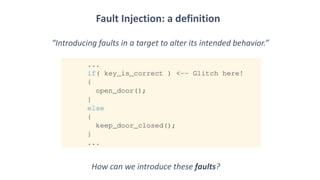
Fault Injection: a definition
“Introducing faults in a target to alter its intended behavior.”
How can we introduce these faults?
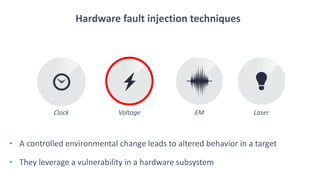
• A controlled environmental change leads to altered behavior in a target
• They leverage a vulnerability in a hardware subsystem
Hardware fault injection techniques
Clock Voltage EM Laser
Glitch
“A controlled environmental change.”
These glitches can result in fault injection vulnerabilities!
• Located in hardware
• Cannot be identified by (code) review only
• Can only be identified by performing a successful attack
• Can only be entirely addressed in hardware
Vulnerability
“Susceptibility of a given hardware subsystem to a specific
fault injection technique, which has an impact on security.”
These vulnerabilities lead to faults!
• Happens at a specific moment in time
• May be (semi-)persistent
• May be mitigated in software
Fault
“An unintended alteration of a target
as a consequence of a vulnerability.”
These faults potentially lead to compromised systems!
What do we need to glitch?
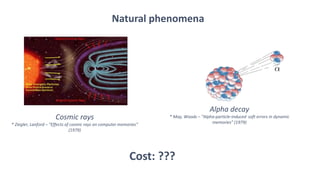
Natural phenomena
Cosmic rays
* Ziegler, Lanford – “Effects of cosmic rays on computer memories”
(1979)
Alpha decay
* May, Woods – “Alpha-particle-induced soft errors in dynamic
memories” (1979)
Cost: ???
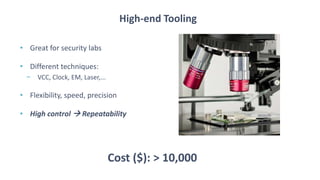
High-end Tooling
Cost ($): > 10,000
• Great for security labs
• Different techniques:
− VCC, Clock, EM, Laser,...
• Flexibility, speed, precision
• High control  Repeatability
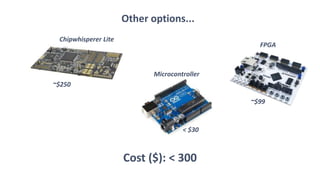
Other options...
Chipwhisperer Lite
FPGA
Microcontroller
~$250
~$99
< $30
Cost ($): < 300
Do we always need specialized tooling?
• Possible when software can activate hardware vulnerabilities
• The vulnerabilities and faults are still in hardware!
Some recent examples...
• Rowhammer (Kim et al., 2014; many more afterwards)
− Constantly reading a DDR address leads to bit flips in neighboring bits
• CLKSCREW (Tang et al., 2017)
− Manipulating Digital Voltage Frequency Scaling (DVFS) registers
− Operate the chip out of its specifications
Software activated fault injection
You can do this remotely without specialized tooling!
Some real world examples…
Hardware Fault Injection
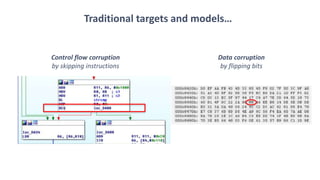
Traditional targets and models…
Control flow corruption
by skipping instructions
Data corruption
by flipping bits
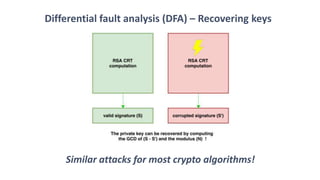
Differential fault analysis (DFA) – Recovering keys
Similar attacks for most crypto algorithms!
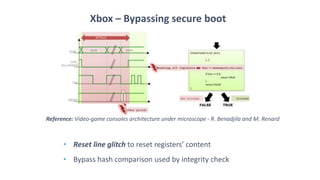
Xbox – Bypassing secure boot
• Reset line glitch to reset registers’ content
• Bypass hash comparison used by integrity check
Reference: Video-game consoles architecture under microscope - R. Benadjila and M. Renard
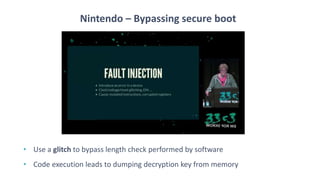
Nintendo – Bypassing secure boot
• Use a glitch to bypass length check performed by software
• Code execution leads to dumping decryption key from memory
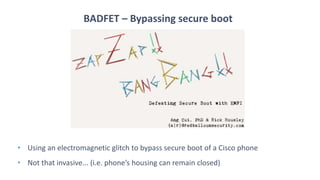
BADFET – Bypassing secure boot
• Using an electromagnetic glitch to bypass secure boot of a Cisco phone
• Not that invasive... (i.e. phone’s housing can remain closed)
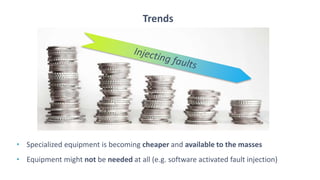
Trends
• Specialized equipment is becoming cheaper and available to the masses
• Equipment might not be needed at all (e.g. software activated fault injection)
How can these attacks be mitigated?
• Hardware-based
− Specifically designed hardware logic for redundancy and detection
− Detection by hardware close to the glitch injection moment
− May prevent injection (e.g. shielding)
− Not implemented on standard embedded technology
• Software-based
− Based on computational checks, redundancy and random delays
− Detection by software after the glitch injection moment
− Do not prevent injection
Traditional fault injection countermeasures
Both can be effective at lowering the probability for a successful attack!
• They do not prevent fault injection but increase attack complexity
• They require software to be executed after the glitch is injected
• They (often) protect specific parts of the code
− Critical decision points
− Crypto operations
− Data integrity
Notes on software countermeasures
Are software fault injection countermeasures sufficient?
Most real world examples target secure boot…
Why not use fault injection at runtime?
Fault Injection meets Linux!
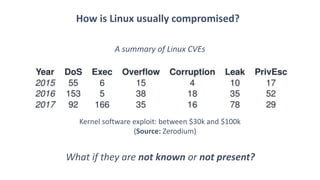
How is Linux usually compromised?
Kernel software exploit: between $30k and $100k
(Source: Zerodium)
A summary of Linux CVEs
What if they are not known or not present?
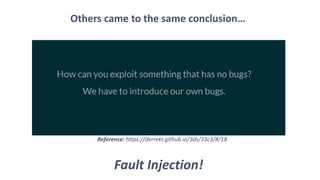
Others came to the same conclusion…
Fault Injection!
Reference: https://derrekr.github.io/3ds/33c3/#/18
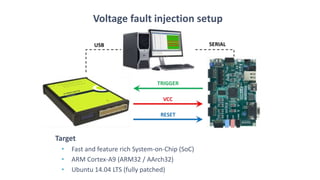
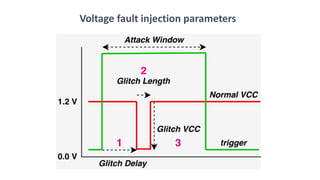
Voltage fault injection setup
Target
• Fast and feature rich System-on-Chip (SoC)
• ARM Cortex-A9 (ARM32 / AArch32)
• Ubuntu 14.04 LTS (fully patched)
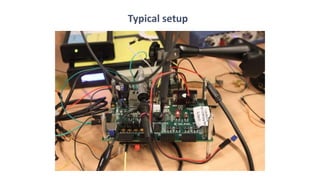
Typical setup
Voltage fault injection parameters
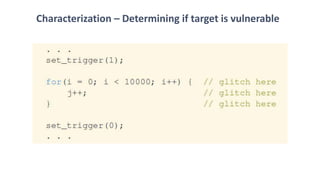
Characterization – Determining if target is vulnerable
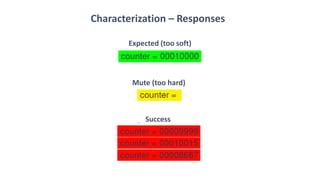
Characterization – Responses
Expected (too soft)
Mute (too hard)
Success
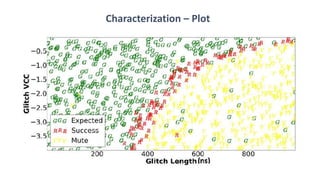
Characterization – Plot
Attacking Linux
More info: https://www.riscure.com/publication/escalating-privileges-linux-using-fault-injection/
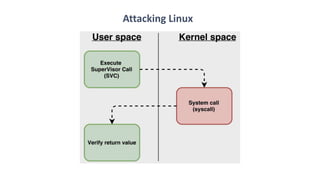
Attacking Linux
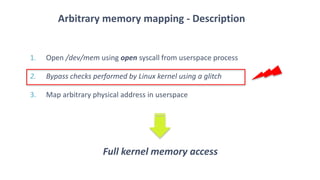
Arbitrary memory mapping - Description
1. Open /dev/mem using open syscall from userspace process
2. Bypass checks performed by Linux kernel using a glitch
3. Map arbitrary physical address in userspace
Full kernel memory access
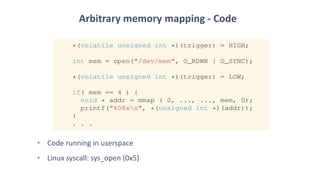
Arbitrary memory mapping - Code
• Code running in userspace
• Linux syscall: sys_open (0x5)
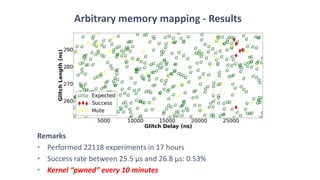
Arbitrary memory mapping - Results
Remarks
• Performed 22118 experiments in 17 hours
• Success rate between 25.5 µs and 26.8 µs: 0.53%
• Kernel “pwned” every 10 minutes
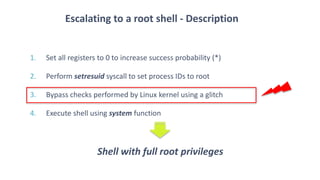
Escalating to a root shell - Description
1. Set all registers to 0 to increase success probability (*)
2. Perform setresuid syscall to set process IDs to root
3. Bypass checks performed by Linux kernel using a glitch
4. Execute shell using system function
Shell with full root privileges
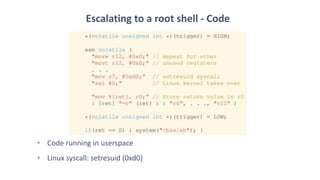
Escalating to a root shell - Code
• Code running in userspace
• Linux syscall: setresuid (0xd0)
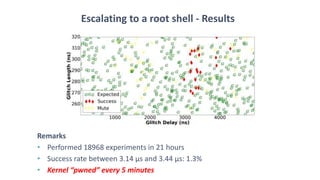
Escalating to a root shell - Results
Remarks
• Performed 18968 experiments in 21 hours
• Success rate between 3.14 µs and 3.44 µs: 1.3%
• Kernel “pwned” every 5 minutes
• Security boundary bypass
− Full access to kernel memory
− Root shell execution
• Not dependent on software vulnerabilities
• For these attack specific checks are targeted
− No need not know which check exactly
Summary
Traditional SW countermeasures do apply!
Let’s go a little deeper…
• Some examples: instruction skipping and bit flipping
• Are used for envisioning new attacks
− Instruction skipping leads to bypassing conditional checks
− Bit flips lead to cryptographic attacks
• Are used for identifying vulnerable targets
• Are used to invent new countermeasures
Fault injection fault model
“A theoretical model for describing the effects of fault injection.”
If it is not modeled…it may have not been researched. Yet.
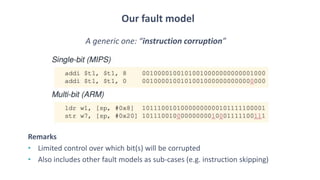
Remarks
• Limited control over which bit(s) will be corrupted
• Also includes other fault models as sub-cases (e.g. instruction skipping)
Our fault model
A generic one: “instruction corruption”
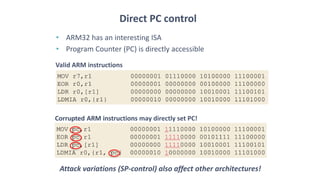
• ARM32 has an interesting ISA
• Program Counter (PC) is directly accessible
Direct PC control
Attack variations (SP-control) also affect other architectures!
Valid ARM instructions
Corrupted ARM instructionsCorrupted ARM instructions may directly set PC!
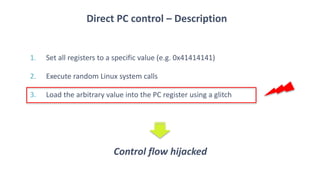
Direct PC control – Description
1. Set all registers to a specific value (e.g. 0x41414141)
2. Execute random Linux system calls
3. Load the arbitrary value into the PC register using a glitch
Control flow hijacked
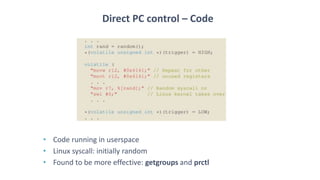
Direct PC control – Code
• Code running in userspace
• Linux syscall: initially random
• Found to be more effective: getgroups and prctl
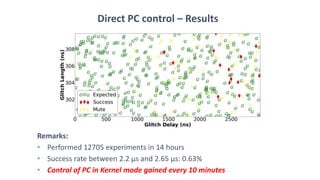
Direct PC control – Results
Remarks:
• Performed 12705 experiments in 14 hours
• Success rate between 2.2 µs and 2.65 µs: 0.63%
• Control of PC in Kernel mode gained every 10 minutes
Video demonstration
• Security boundary bypass
− Kernel level code execution
• Not dependent on SW vulnerabilities
• Any instruction is a potential target
Direct PC control – Summary
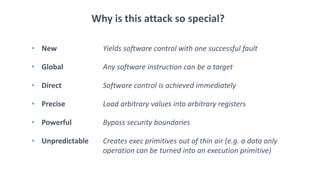
• New Yields software control with one successful fault
• Global Any software instruction can be a target
• Direct Software control is achieved immediately
• Precise Load arbitrary values into arbitrary registers
• Powerful Bypass security boundaries
• Unpredictable Creates exec primitives out of thin air (e.g. a data only
operation can be turned into an execution primitive)
Why is this attack so special?
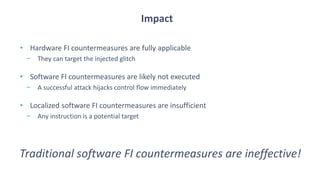
• Hardware FI countermeasures are fully applicable
− They can target the injected glitch
• Software FI countermeasures are likely not executed
− A successful attack hijacks control flow immediately
• Localized software FI countermeasures are insufficient
− Any instruction is a potential target
Impact
Traditional software FI countermeasures are ineffective!
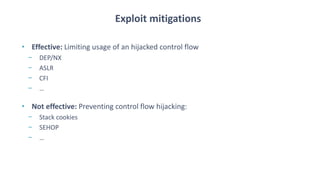
• Effective: Limiting usage of an hijacked control flow
− DEP/NX
− ASLR
− CFI
− …
• Not effective: Preventing control flow hijacking:
− Stack cookies
− SEHOP
− …
Exploit mitigations
Wrapping up
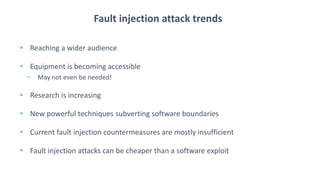
• Reaching a wider audience
• Equipment is becoming accessible
− May not even be needed!
• Research is increasing
• New powerful techniques subverting software boundaries
• Current fault injection countermeasures are mostly insufficient
• Fault injection attacks can be cheaper than a software exploit
Fault injection attack trends
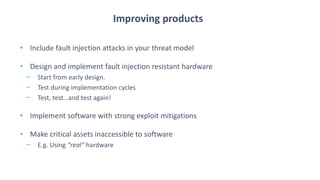
• Include fault injection attacks in your threat model
• Design and implement fault injection resistant hardware
− Start from early design.
− Test during implementation cycles
− Test, test…and test again!
• Implement software with strong exploit mitigations
• Make critical assets inaccessible to software
− E.g. Using “real” hardware
Improving products
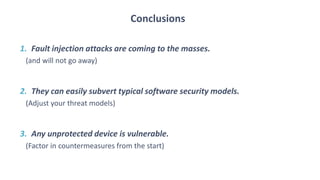
Conclusions
1. Fault injection attacks are coming to the masses.
(and will not go away)
2. They can easily subvert typical software security models.
(Adjust your threat models)
3. Any unprotected device is vulnerable.
(Factor in countermeasures from the start)
Niek Timmers
Senior Security Analyst
@tieknimmers / niek@riscure.com
Questions?
Cristofaro Mune
Product Security Consultant
@pulsoid / c.mune@pulse-sec.com
https://www.riscure.com/careers

BlueHat v17 || KERNELFAULT: R00ting the Unexploitable using Hardware Fault Injection

  • 1.
    Niek Timmers Senior SecurityAnalyst @tieknimmers / niek@riscure.com KERNELFAULT: R00ting the Unexploitable using Hardware Fault Injection Cristofaro Mune Product Security Consultant @pulsoid / c.mune@pulse-sec.com
  • 2.
    Fault Injection: adefinition “Introducing faults in a target to alter its intended behavior.” How can we introduce these faults?
  • 3.
    • A controlledenvironmental change leads to altered behavior in a target • They leverage a vulnerability in a hardware subsystem Hardware fault injection techniques Clock Voltage EM Laser
  • 4.
    Glitch “A controlled environmentalchange.” These glitches can result in fault injection vulnerabilities!
  • 5.
    • Located inhardware • Cannot be identified by (code) review only • Can only be identified by performing a successful attack • Can only be entirely addressed in hardware Vulnerability “Susceptibility of a given hardware subsystem to a specific fault injection technique, which has an impact on security.” These vulnerabilities lead to faults!
  • 6.
    • Happens ata specific moment in time • May be (semi-)persistent • May be mitigated in software Fault “An unintended alteration of a target as a consequence of a vulnerability.” These faults potentially lead to compromised systems!
  • 7.
    What do weneed to glitch?
  • 8.
    Natural phenomena Cosmic rays *Ziegler, Lanford – “Effects of cosmic rays on computer memories” (1979) Alpha decay * May, Woods – “Alpha-particle-induced soft errors in dynamic memories” (1979) Cost: ???
  • 9.
    High-end Tooling Cost ($):> 10,000 • Great for security labs • Different techniques: − VCC, Clock, EM, Laser,... • Flexibility, speed, precision • High control  Repeatability
  • 10.
  • 11.
    Do we alwaysneed specialized tooling?
  • 12.
    • Possible whensoftware can activate hardware vulnerabilities • The vulnerabilities and faults are still in hardware! Some recent examples... • Rowhammer (Kim et al., 2014; many more afterwards) − Constantly reading a DDR address leads to bit flips in neighboring bits • CLKSCREW (Tang et al., 2017) − Manipulating Digital Voltage Frequency Scaling (DVFS) registers − Operate the chip out of its specifications Software activated fault injection You can do this remotely without specialized tooling!
  • 13.
    Some real worldexamples… Hardware Fault Injection
  • 14.
    Traditional targets andmodels… Control flow corruption by skipping instructions Data corruption by flipping bits
  • 15.
    Differential fault analysis(DFA) – Recovering keys Similar attacks for most crypto algorithms!
  • 16.
    Xbox – Bypassingsecure boot • Reset line glitch to reset registers’ content • Bypass hash comparison used by integrity check Reference: Video-game consoles architecture under microscope - R. Benadjila and M. Renard
  • 17.
    Nintendo – Bypassingsecure boot • Use a glitch to bypass length check performed by software • Code execution leads to dumping decryption key from memory
  • 18.
    BADFET – Bypassingsecure boot • Using an electromagnetic glitch to bypass secure boot of a Cisco phone • Not that invasive... (i.e. phone’s housing can remain closed)
  • 19.
    Trends • Specialized equipmentis becoming cheaper and available to the masses • Equipment might not be needed at all (e.g. software activated fault injection)
  • 20.
    How can theseattacks be mitigated?
  • 21.
    • Hardware-based − Specificallydesigned hardware logic for redundancy and detection − Detection by hardware close to the glitch injection moment − May prevent injection (e.g. shielding) − Not implemented on standard embedded technology • Software-based − Based on computational checks, redundancy and random delays − Detection by software after the glitch injection moment − Do not prevent injection Traditional fault injection countermeasures Both can be effective at lowering the probability for a successful attack!
  • 22.
    • They donot prevent fault injection but increase attack complexity • They require software to be executed after the glitch is injected • They (often) protect specific parts of the code − Critical decision points − Crypto operations − Data integrity Notes on software countermeasures Are software fault injection countermeasures sufficient?
  • 23.
    Most real worldexamples target secure boot… Why not use fault injection at runtime?
  • 24.
  • 25.
    How is Linuxusually compromised? Kernel software exploit: between $30k and $100k (Source: Zerodium) A summary of Linux CVEs What if they are not known or not present?
  • 26.
    Others came tothe same conclusion… Fault Injection! Reference: https://derrekr.github.io/3ds/33c3/#/18
  • 27.
    Voltage fault injectionsetup Target • Fast and feature rich System-on-Chip (SoC) • ARM Cortex-A9 (ARM32 / AArch32) • Ubuntu 14.04 LTS (fully patched)
  • 28.
  • 29.
  • 30.
    Characterization – Determiningif target is vulnerable
  • 31.
    Characterization – Responses Expected(too soft) Mute (too hard) Success
  • 32.
  • 33.
    Attacking Linux More info:https://www.riscure.com/publication/escalating-privileges-linux-using-fault-injection/
  • 34.
  • 35.
    Arbitrary memory mapping- Description 1. Open /dev/mem using open syscall from userspace process 2. Bypass checks performed by Linux kernel using a glitch 3. Map arbitrary physical address in userspace Full kernel memory access
  • 36.
    Arbitrary memory mapping- Code • Code running in userspace • Linux syscall: sys_open (0x5)
  • 37.
    Arbitrary memory mapping- Results Remarks • Performed 22118 experiments in 17 hours • Success rate between 25.5 µs and 26.8 µs: 0.53% • Kernel “pwned” every 10 minutes
  • 38.
    Escalating to aroot shell - Description 1. Set all registers to 0 to increase success probability (*) 2. Perform setresuid syscall to set process IDs to root 3. Bypass checks performed by Linux kernel using a glitch 4. Execute shell using system function Shell with full root privileges
  • 39.
    Escalating to aroot shell - Code • Code running in userspace • Linux syscall: setresuid (0xd0)
  • 40.
    Escalating to aroot shell - Results Remarks • Performed 18968 experiments in 21 hours • Success rate between 3.14 µs and 3.44 µs: 1.3% • Kernel “pwned” every 5 minutes
  • 41.
    • Security boundarybypass − Full access to kernel memory − Root shell execution • Not dependent on software vulnerabilities • For these attack specific checks are targeted − No need not know which check exactly Summary Traditional SW countermeasures do apply!
  • 42.
    Let’s go alittle deeper…
  • 43.
    • Some examples:instruction skipping and bit flipping • Are used for envisioning new attacks − Instruction skipping leads to bypassing conditional checks − Bit flips lead to cryptographic attacks • Are used for identifying vulnerable targets • Are used to invent new countermeasures Fault injection fault model “A theoretical model for describing the effects of fault injection.” If it is not modeled…it may have not been researched. Yet.
  • 44.
    Remarks • Limited controlover which bit(s) will be corrupted • Also includes other fault models as sub-cases (e.g. instruction skipping) Our fault model A generic one: “instruction corruption”
  • 45.
    • ARM32 hasan interesting ISA • Program Counter (PC) is directly accessible Direct PC control Attack variations (SP-control) also affect other architectures! Valid ARM instructions Corrupted ARM instructionsCorrupted ARM instructions may directly set PC!
  • 46.
    Direct PC control– Description 1. Set all registers to a specific value (e.g. 0x41414141) 2. Execute random Linux system calls 3. Load the arbitrary value into the PC register using a glitch Control flow hijacked
  • 47.
    Direct PC control– Code • Code running in userspace • Linux syscall: initially random • Found to be more effective: getgroups and prctl
  • 48.
    Direct PC control– Results Remarks: • Performed 12705 experiments in 14 hours • Success rate between 2.2 µs and 2.65 µs: 0.63% • Control of PC in Kernel mode gained every 10 minutes
  • 49.
  • 50.
    • Security boundarybypass − Kernel level code execution • Not dependent on SW vulnerabilities • Any instruction is a potential target Direct PC control – Summary
  • 51.
    • New Yieldssoftware control with one successful fault • Global Any software instruction can be a target • Direct Software control is achieved immediately • Precise Load arbitrary values into arbitrary registers • Powerful Bypass security boundaries • Unpredictable Creates exec primitives out of thin air (e.g. a data only operation can be turned into an execution primitive) Why is this attack so special?
  • 52.
    • Hardware FIcountermeasures are fully applicable − They can target the injected glitch • Software FI countermeasures are likely not executed − A successful attack hijacks control flow immediately • Localized software FI countermeasures are insufficient − Any instruction is a potential target Impact Traditional software FI countermeasures are ineffective!
  • 53.
    • Effective: Limitingusage of an hijacked control flow − DEP/NX − ASLR − CFI − … • Not effective: Preventing control flow hijacking: − Stack cookies − SEHOP − … Exploit mitigations
  • 54.
  • 55.
    • Reaching awider audience • Equipment is becoming accessible − May not even be needed! • Research is increasing • New powerful techniques subverting software boundaries • Current fault injection countermeasures are mostly insufficient • Fault injection attacks can be cheaper than a software exploit Fault injection attack trends
  • 56.
    • Include faultinjection attacks in your threat model • Design and implement fault injection resistant hardware − Start from early design. − Test during implementation cycles − Test, test…and test again! • Implement software with strong exploit mitigations • Make critical assets inaccessible to software − E.g. Using “real” hardware Improving products
  • 57.
    Conclusions 1. Fault injectionattacks are coming to the masses. (and will not go away) 2. They can easily subvert typical software security models. (Adjust your threat models) 3. Any unprotected device is vulnerable. (Factor in countermeasures from the start)
  • 58.
    Niek Timmers Senior SecurityAnalyst @tieknimmers / niek@riscure.com Questions? Cristofaro Mune Product Security Consultant @pulsoid / c.mune@pulse-sec.com https://www.riscure.com/careers