Session ID:
Session Classification:
Jasper van Woudenberg
Riscure
HTA-T17
Advanced
EmbeddedSystems UnderFire
Fault Injection on SecureBoot
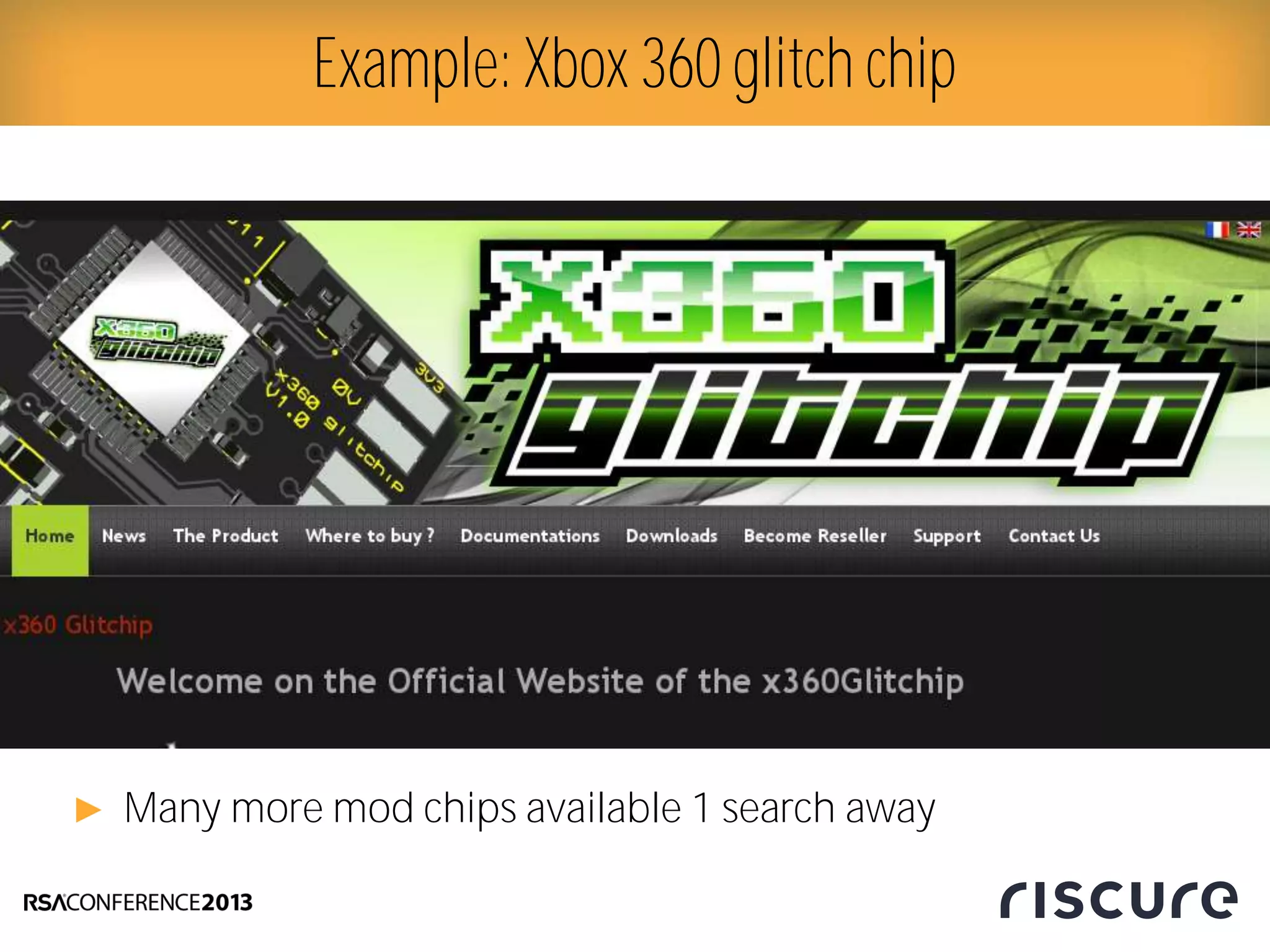
► Many more mod chips available 1 search away
Example: Xbox 360 glitch chip
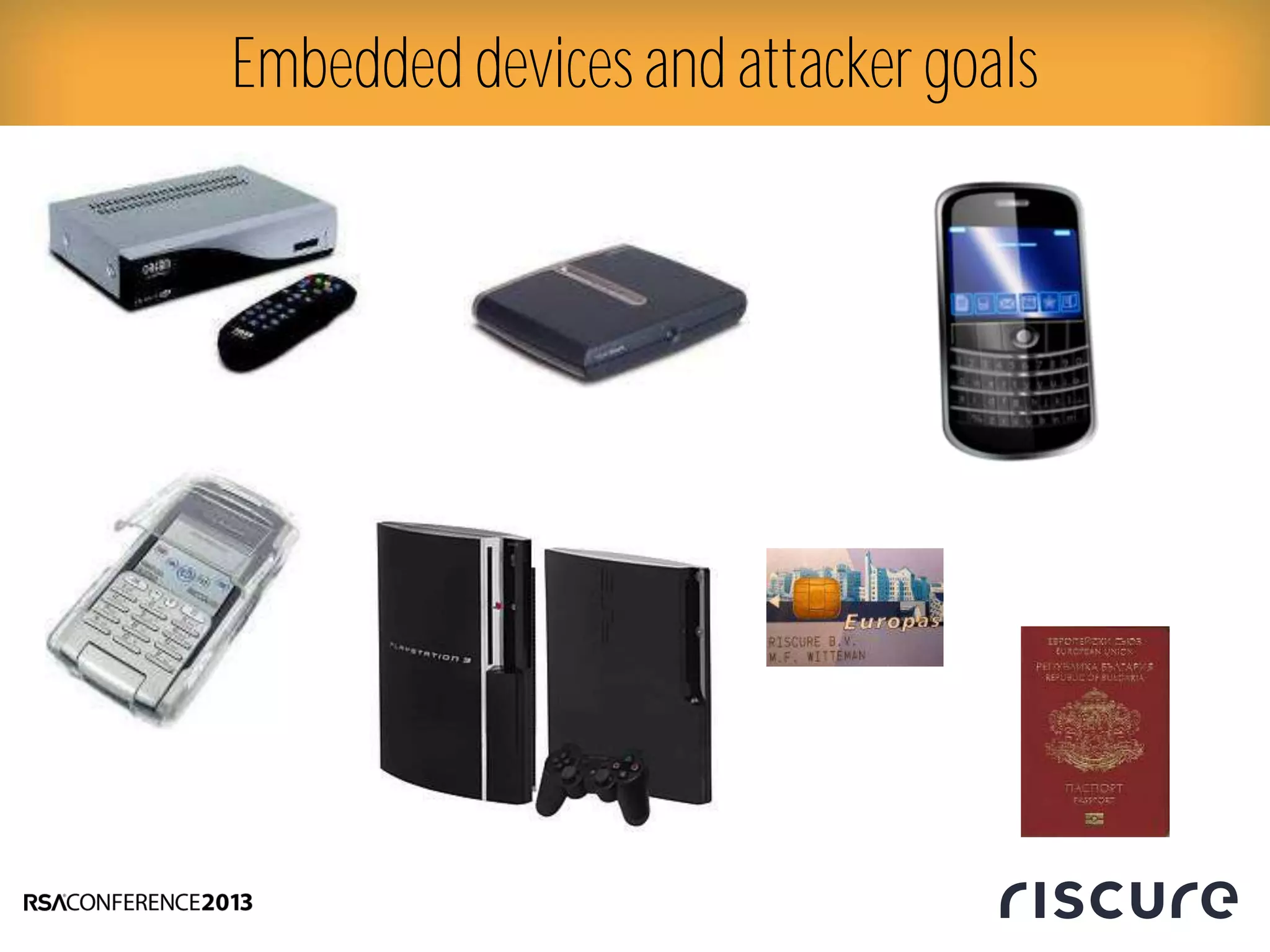
Embedded devices and attacker goals
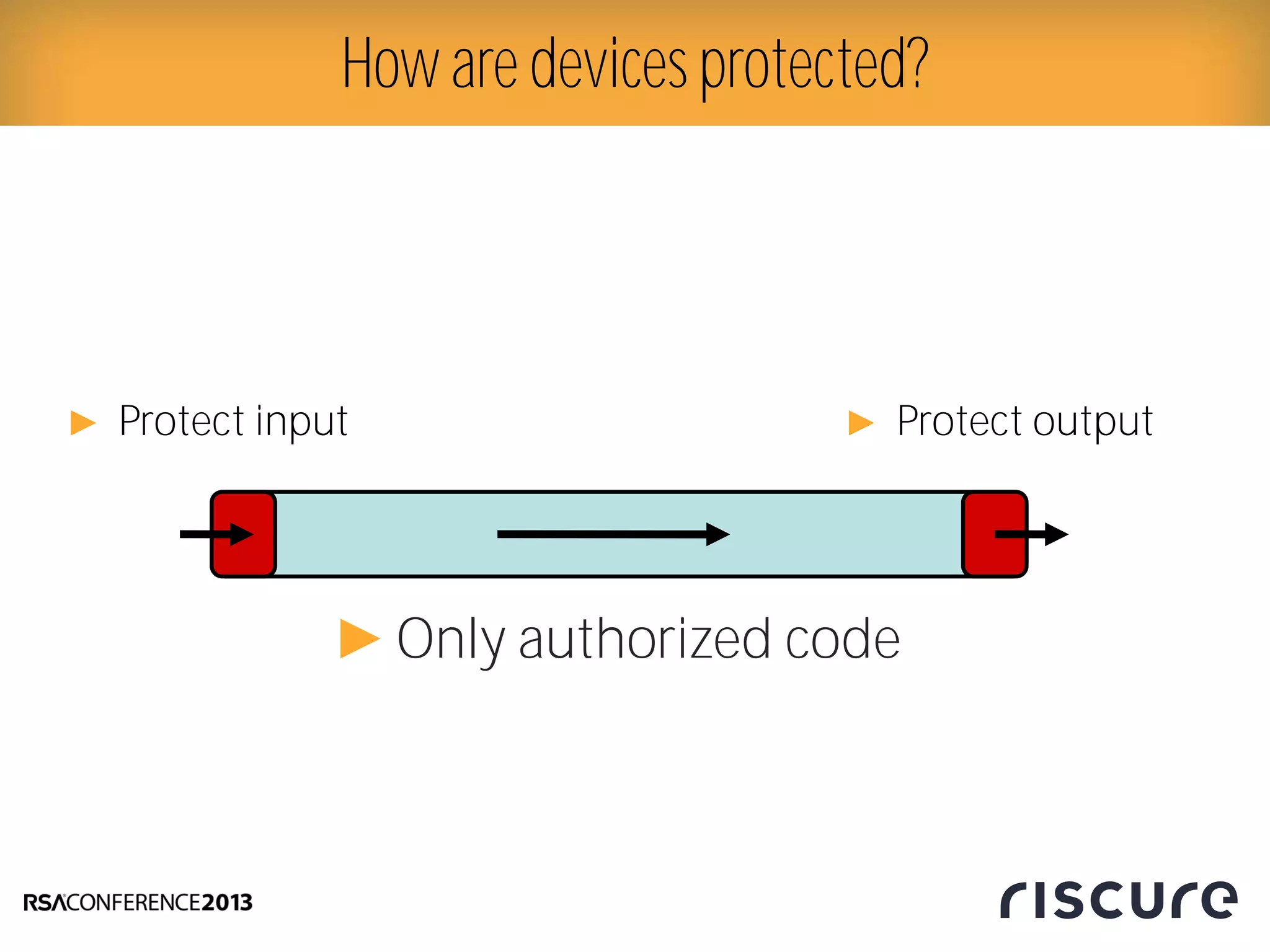
How are devices protected?
► Protect input
►Only authorized code
► Protect output
Hardware root of trust
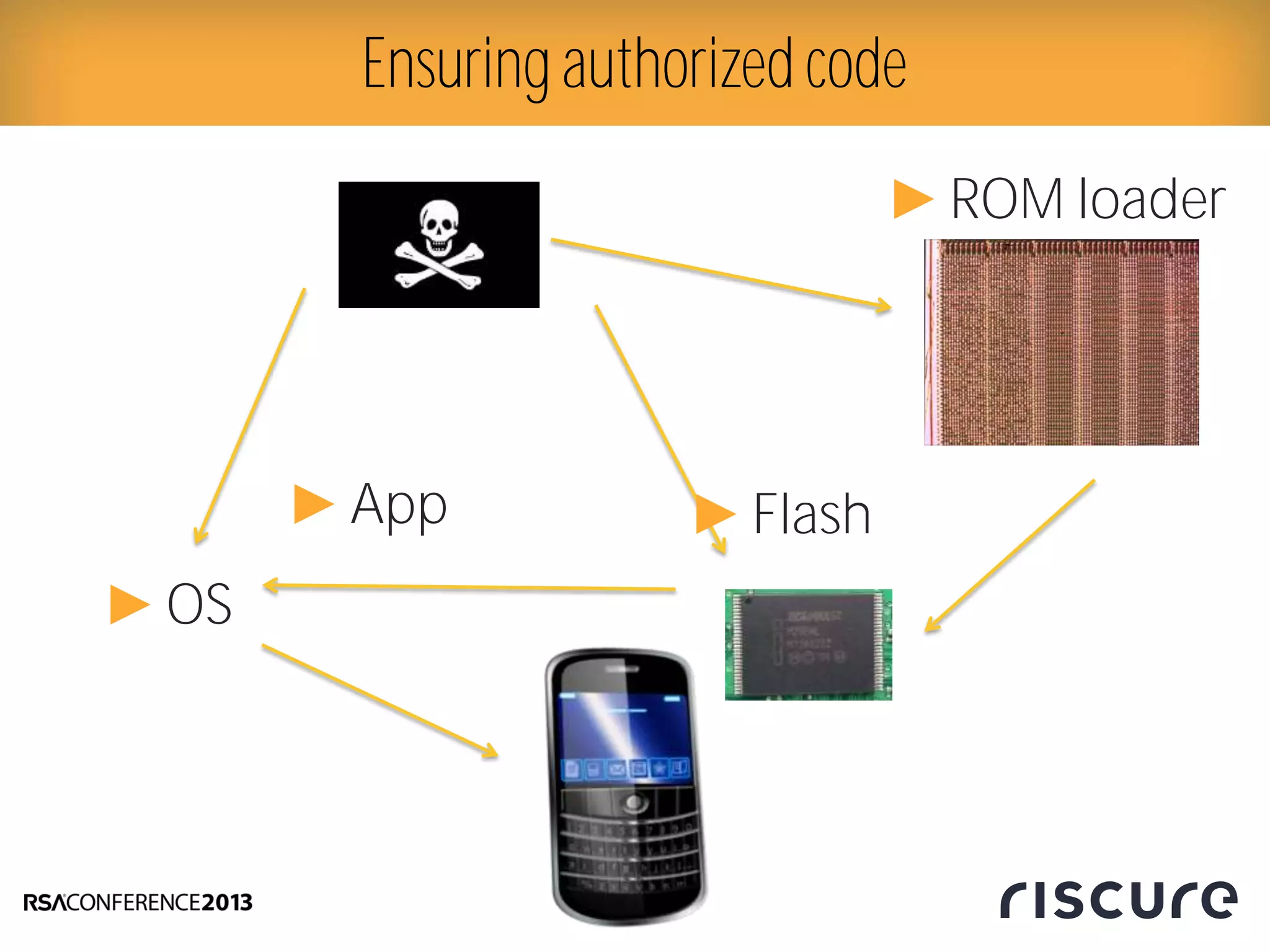
Ensuring authorized code
►App
►OS
►Flash
►ROM loader
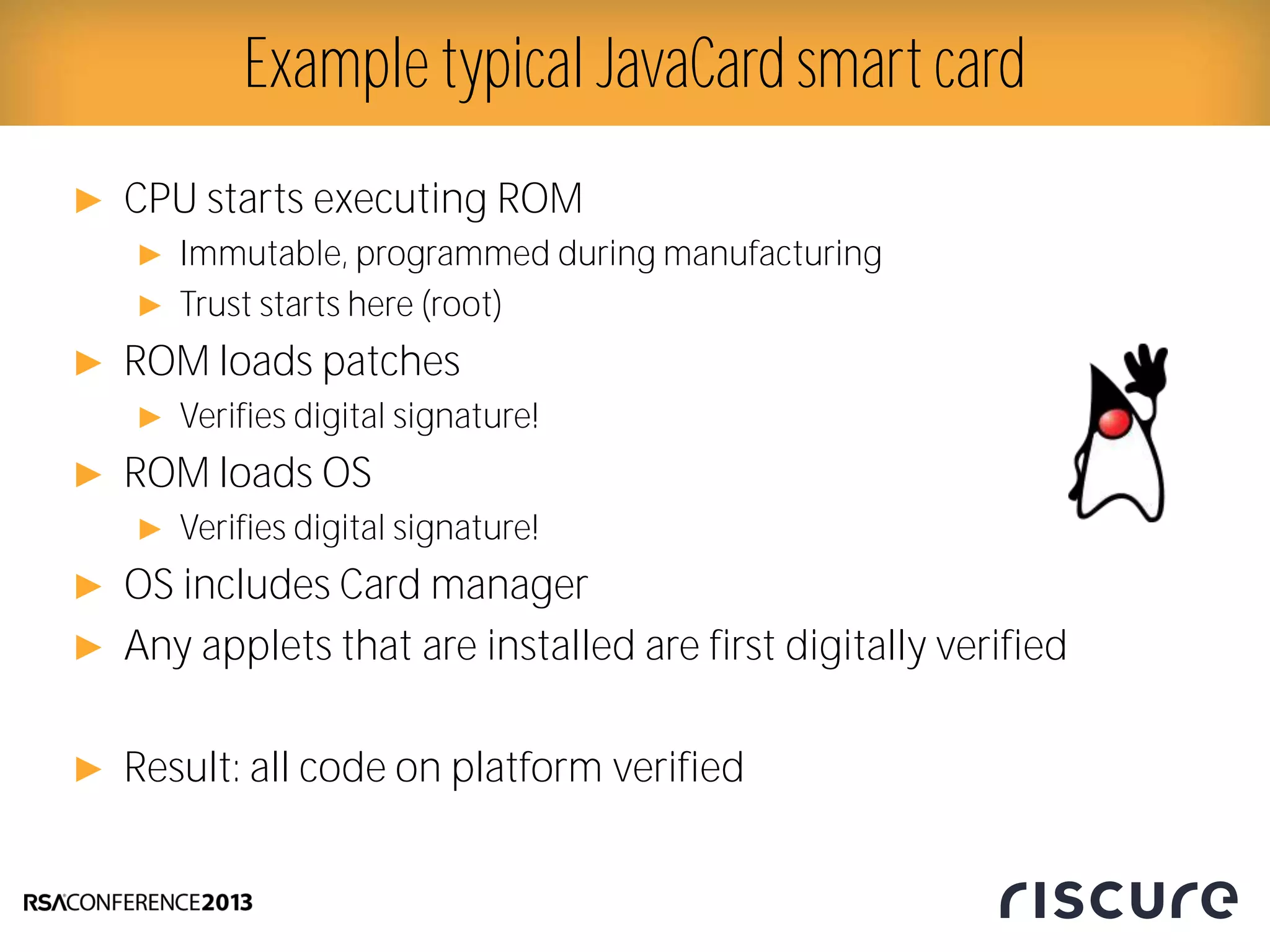
► CPU starts executing ROM
► Immutable, programmed during manufacturing
► Trust starts here (root)
► ROM loads patches
► Verifies digital signature!
► ROM loads OS
► Verifies digital signature!
► OS includes Card manager
► Any applets that are installed are first digitally verified
► Result: all code on platform verified
Example typical JavaCard smart card
► (simplified)
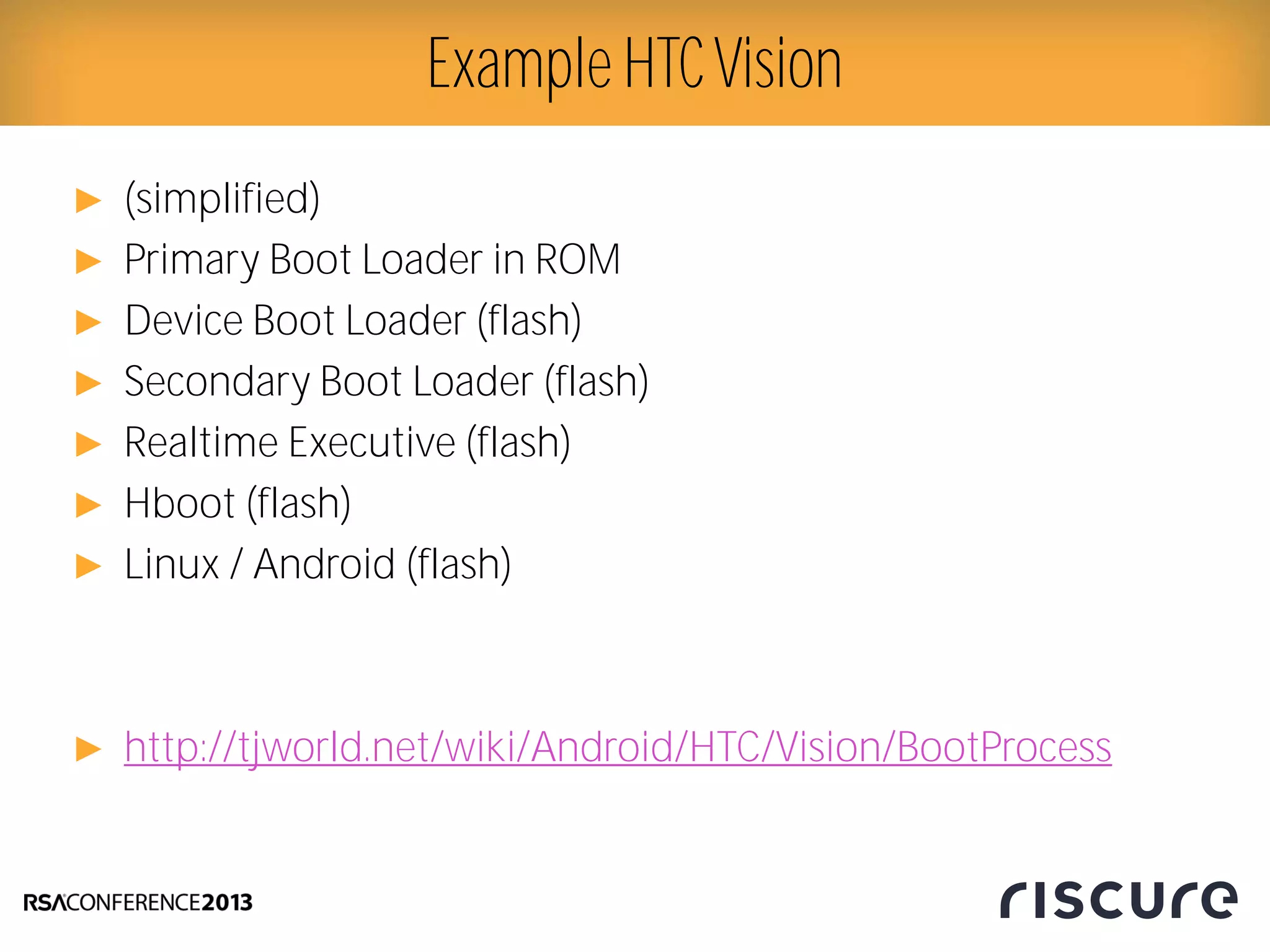
► Primary Boot Loader in ROM
► Device Boot Loader (flash)
► Secondary Boot Loader (flash)
► Realtime Executive (flash)
► Hboot (flash)
► Linux / Android (flash)
► http://tjworld.net/wiki/Android/HTC/Vision/BootProcess
Example HTCVision
►
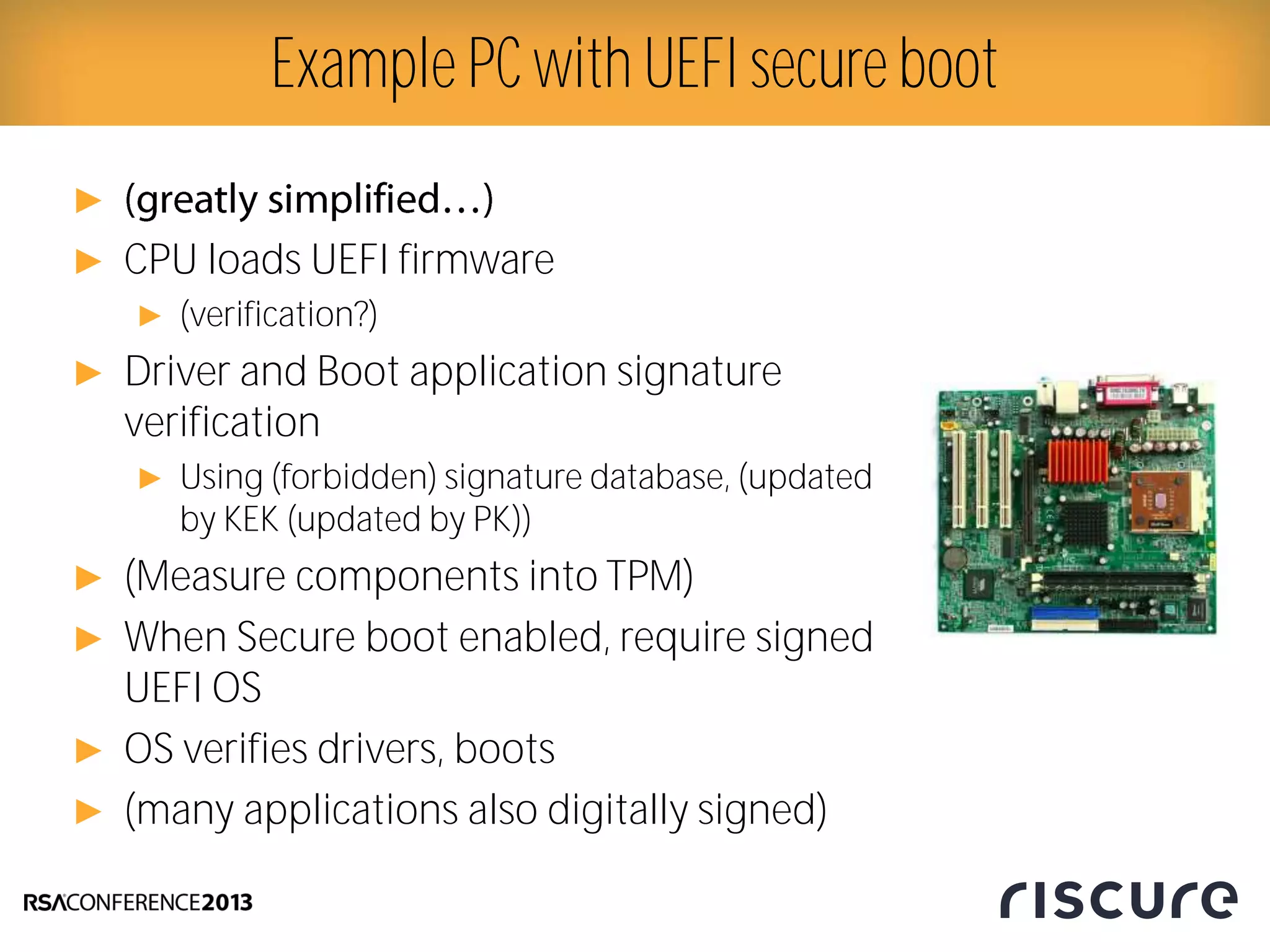
► CPU loads UEFI firmware
► (verification?)
► Driver and Boot application signature
verification
► Using (forbidden) signature database, (updated
by KEK (updated by PK))
► (Measure components into TPM)
► When Secure boot enabled, require signed
UEFI OS
► OS verifies drivers, boots
► (many applications also digitally signed)
Example PC with UEFI secure boot
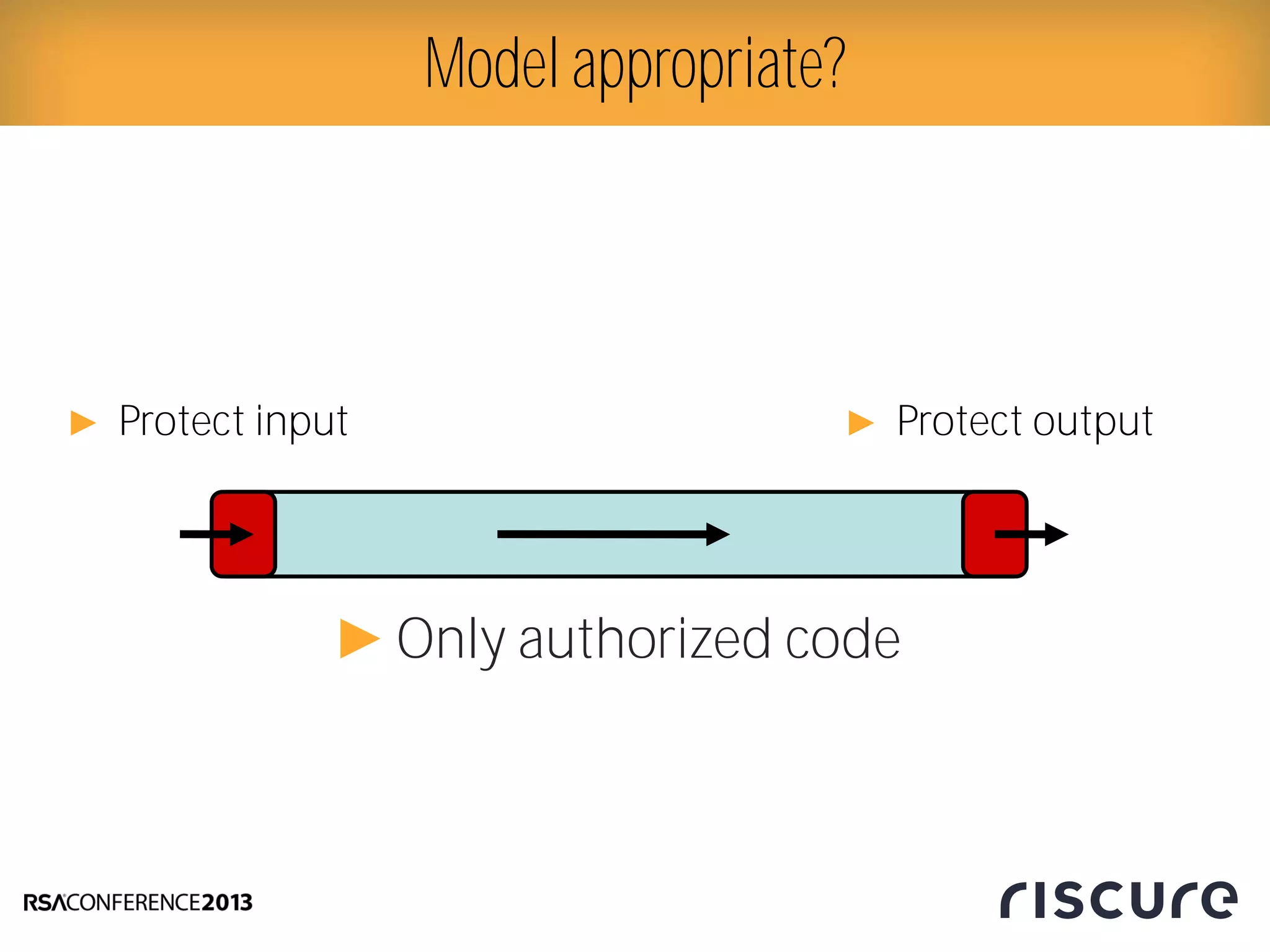
Model appropriate?
► Protect input
►Only authorized code
► Protect output
Fault injection
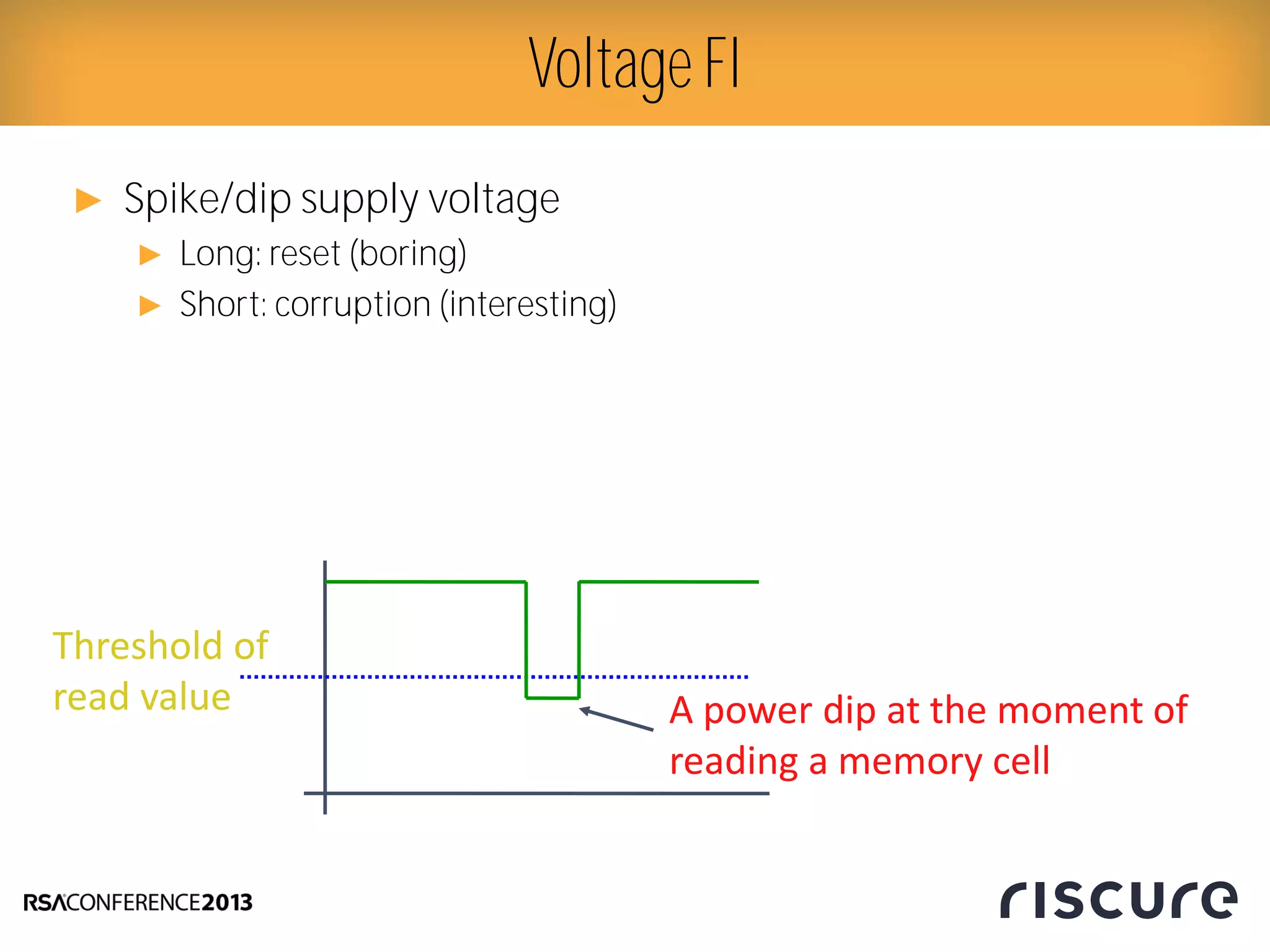
► Spike/dip supply voltage
► Long: reset (boring)
► Short: corruption (interesting)
Voltage FI
Threshold of
read value A power dip at the moment of
reading a memory cell
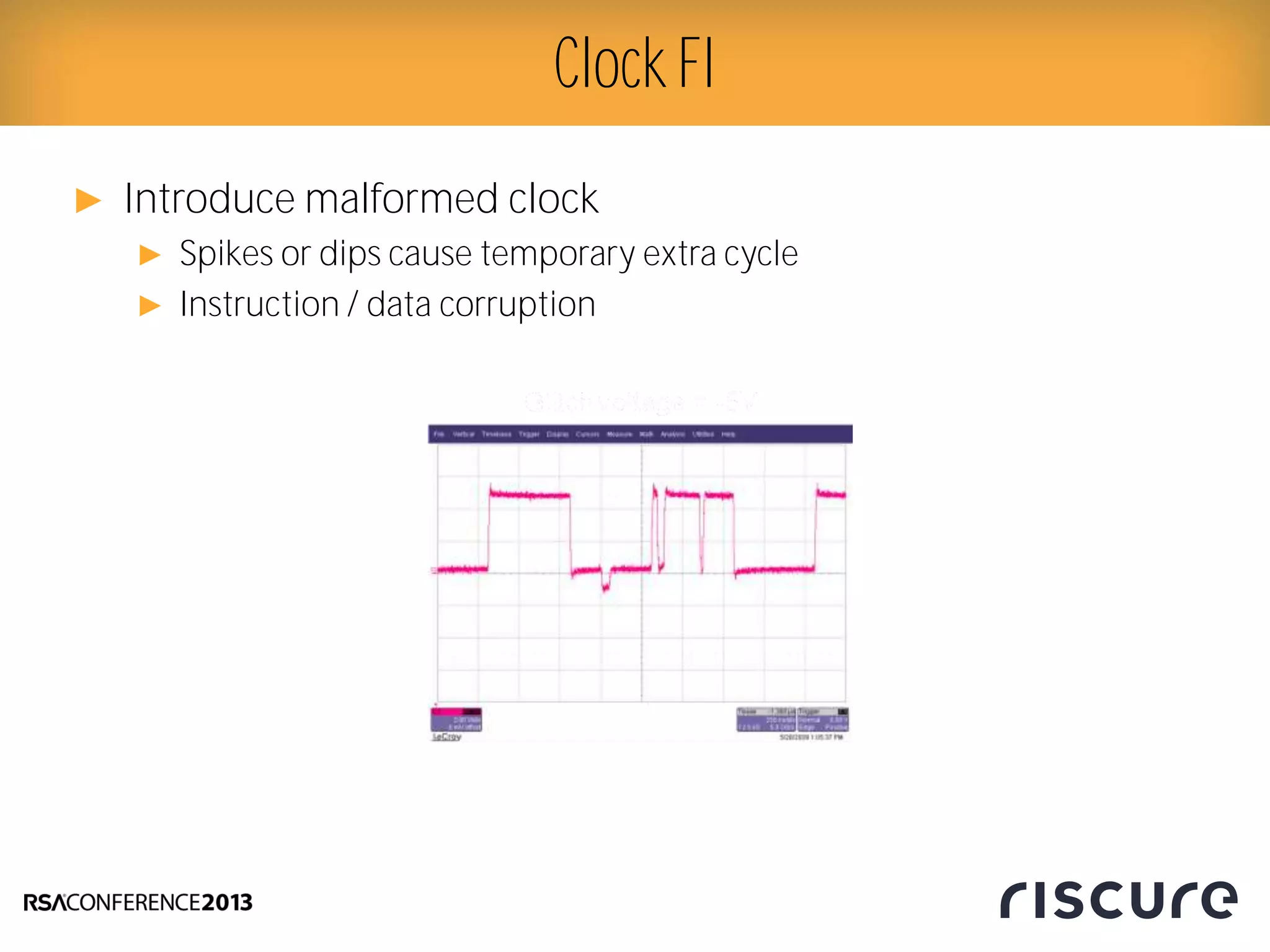
► Introduce malformed clock
► Spikes or dips cause temporary extra cycle
► Instruction / data corruption
Clock FI
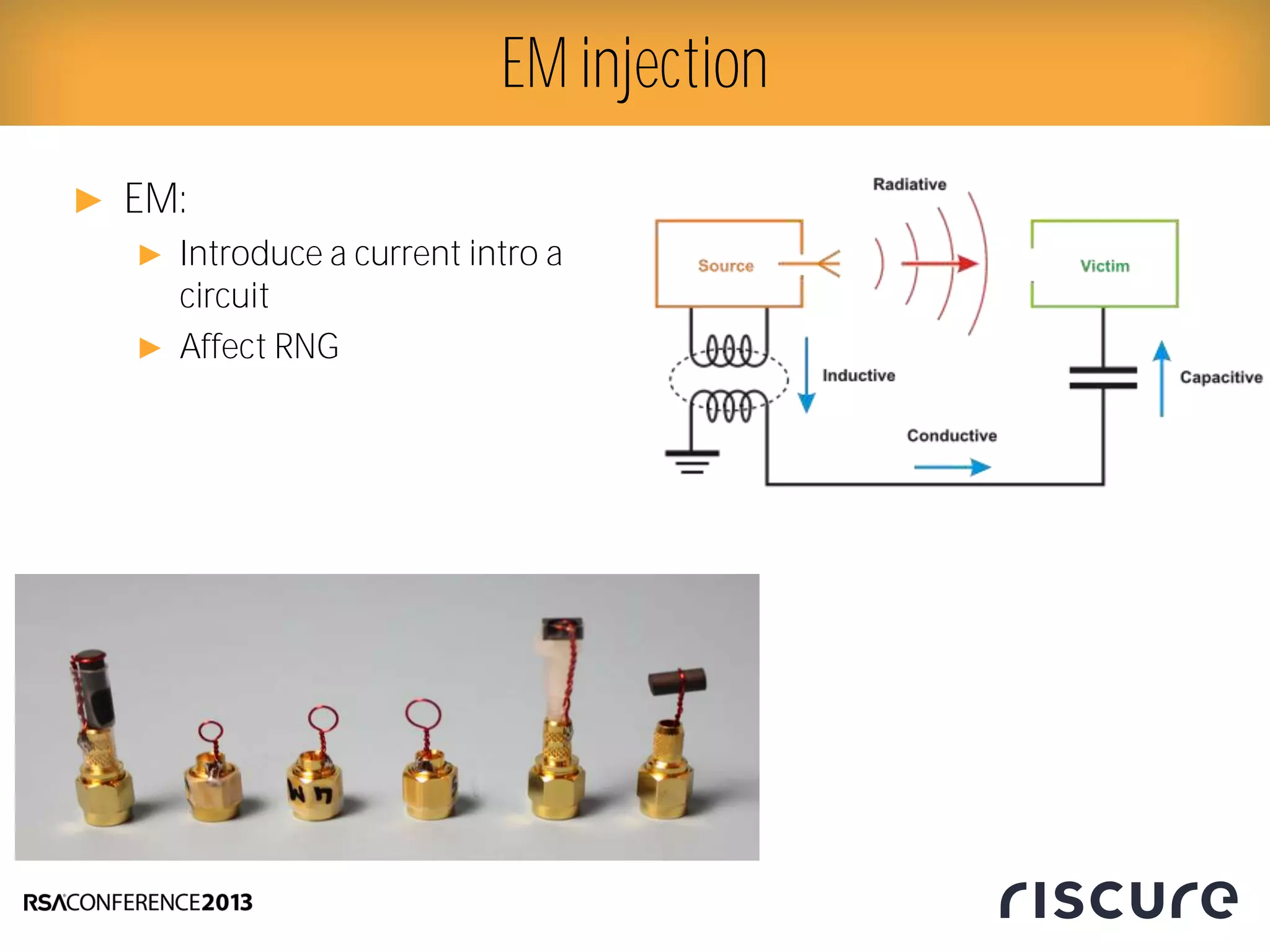
► EM:
► Introduce a current intro a
circuit
► Affect RNG
EM injection
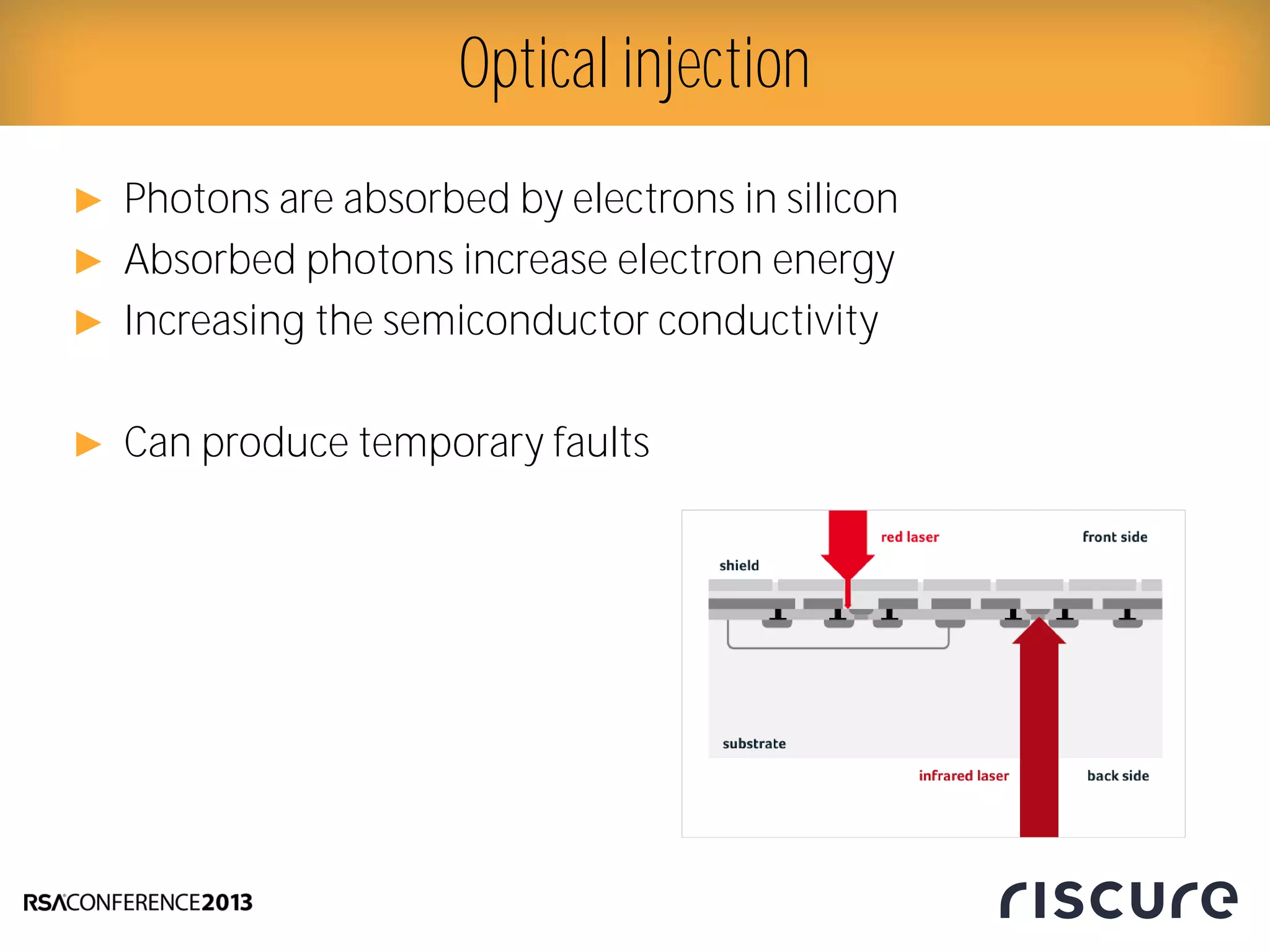
► Photons are absorbed by electrons in silicon
► Absorbed photons increase electron energy
► Increasing the semiconductor conductivity
► Can produce temporary faults
Optical injection
► Data corruption
► Changing verification key
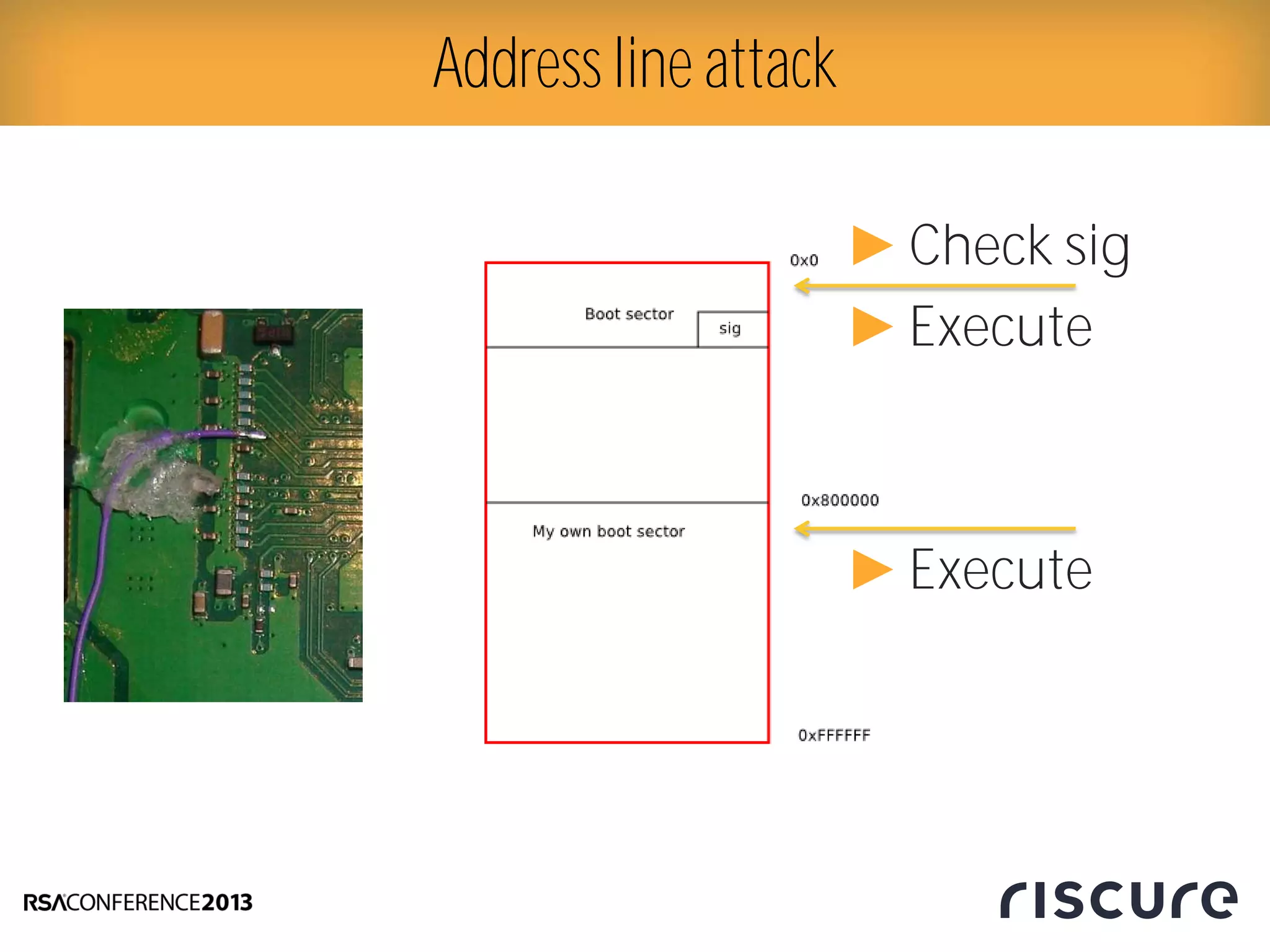
► Address line pulling
► Execute / verify different memory
► Instruction skipping
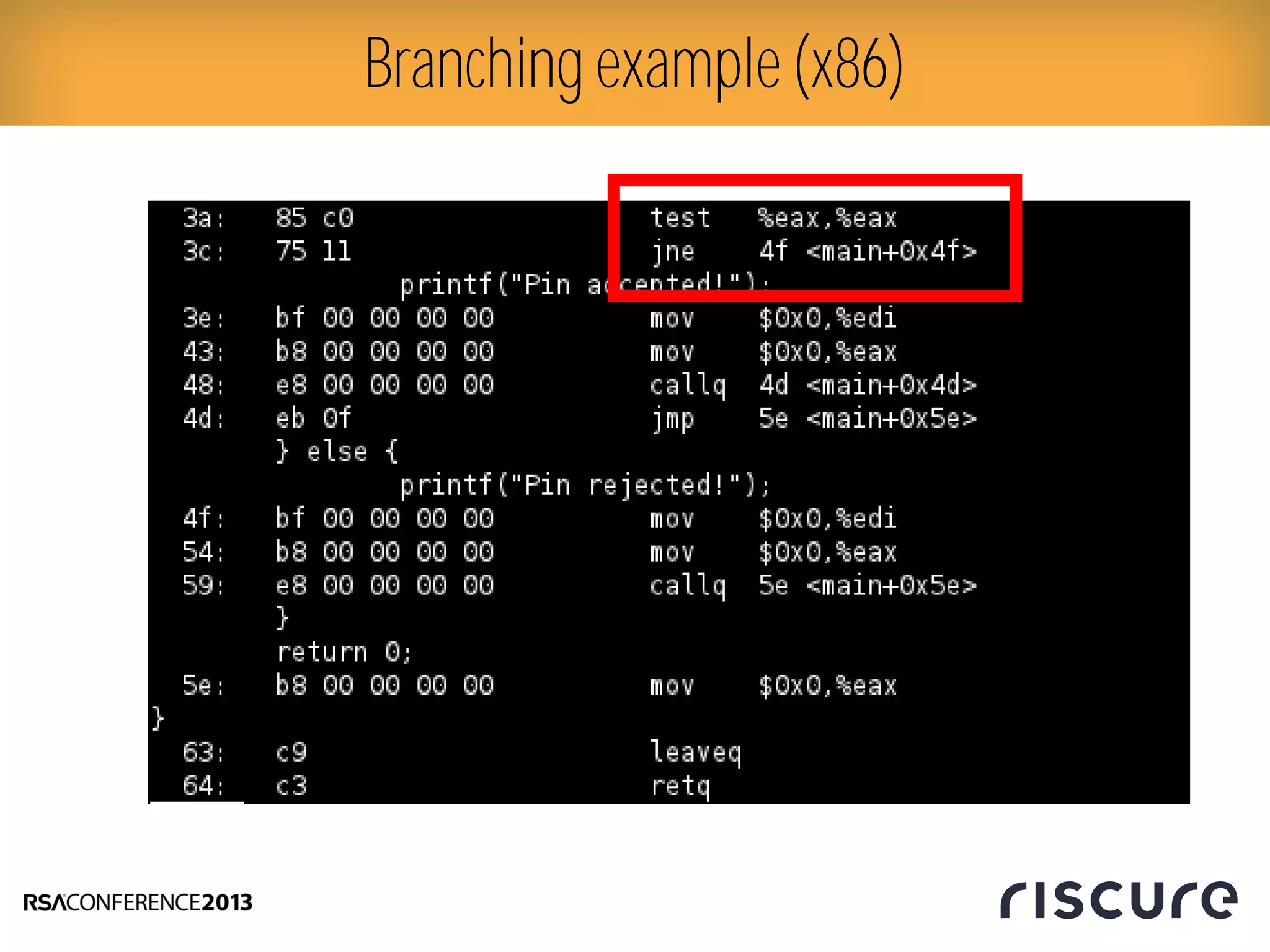
► Flip branches
► http://rdist.root.org/2010/01/27/how-the-ps3-hypervisor-
was-hacked/
► http://www.free60.org/Reset_Glitch_Hack
Fault injection effects
Address line attack
►Execute
►Check sig
►Execute
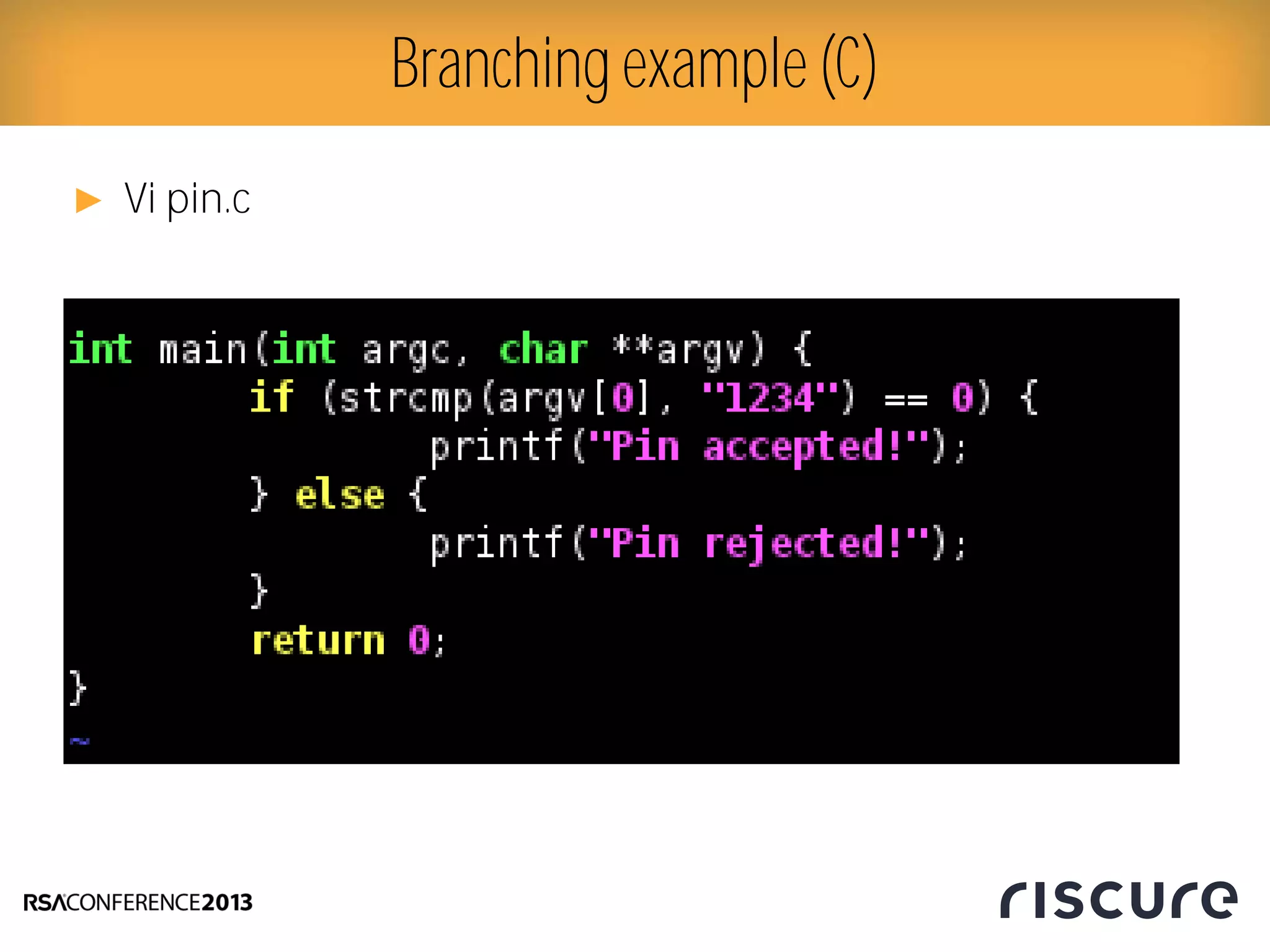
► Vi pin.c
Branching example (C)
Branching example (x86)
►
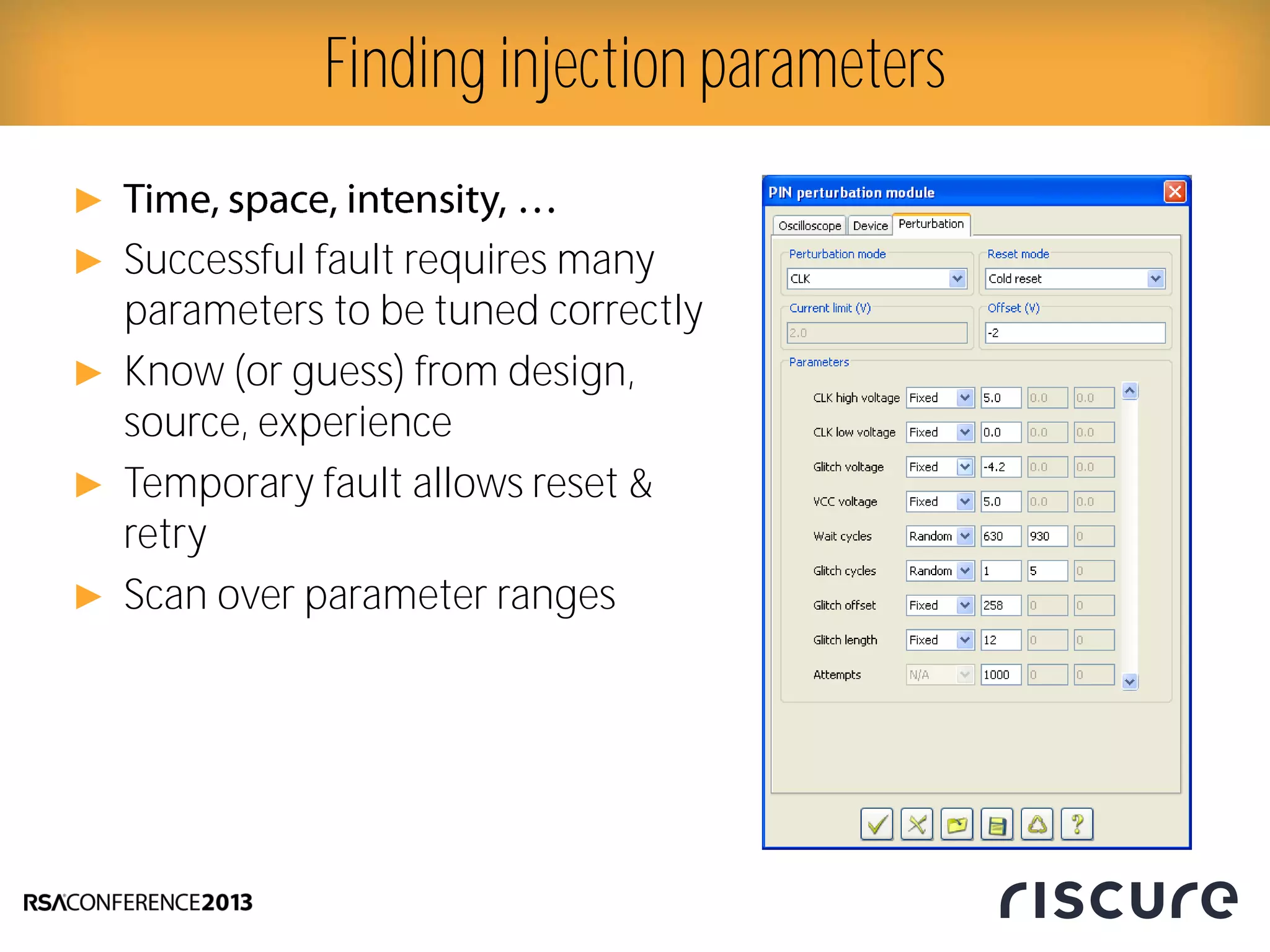
► Successful fault requires many
parameters to be tuned correctly
► Know (or guess) from design,
source, experience
► Temporary fault allows reset &
retry
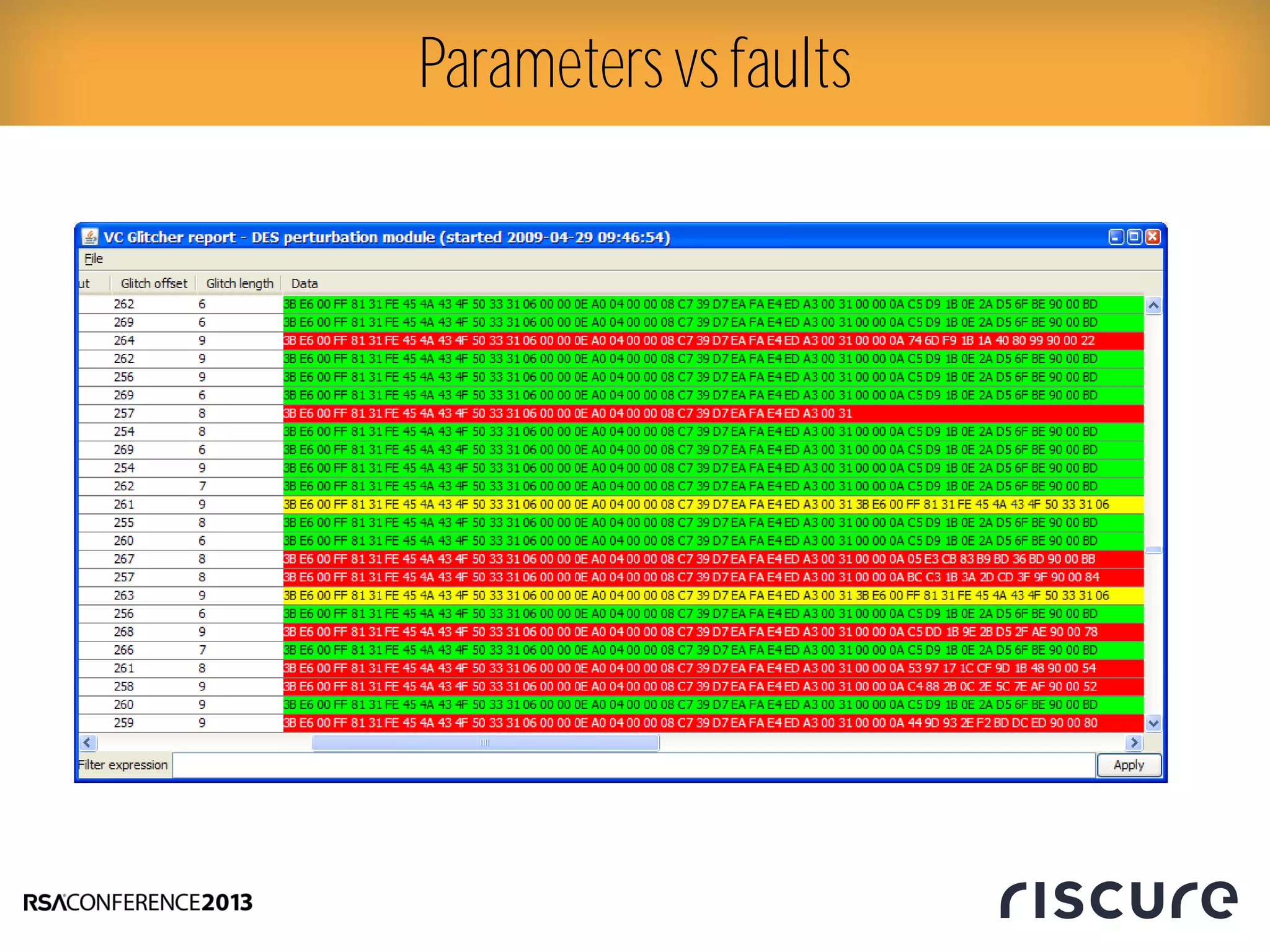
► Scan over parameter ranges
Finding injection parameters
Parameters vs faults
► Root of trust depends on binary decision
►
physical access could circumvent signature verification
► Depending on technology, can be
► Highly repeatable
► Cheaply exploitable
FI as threat to hardware root of trust
Countermeasures
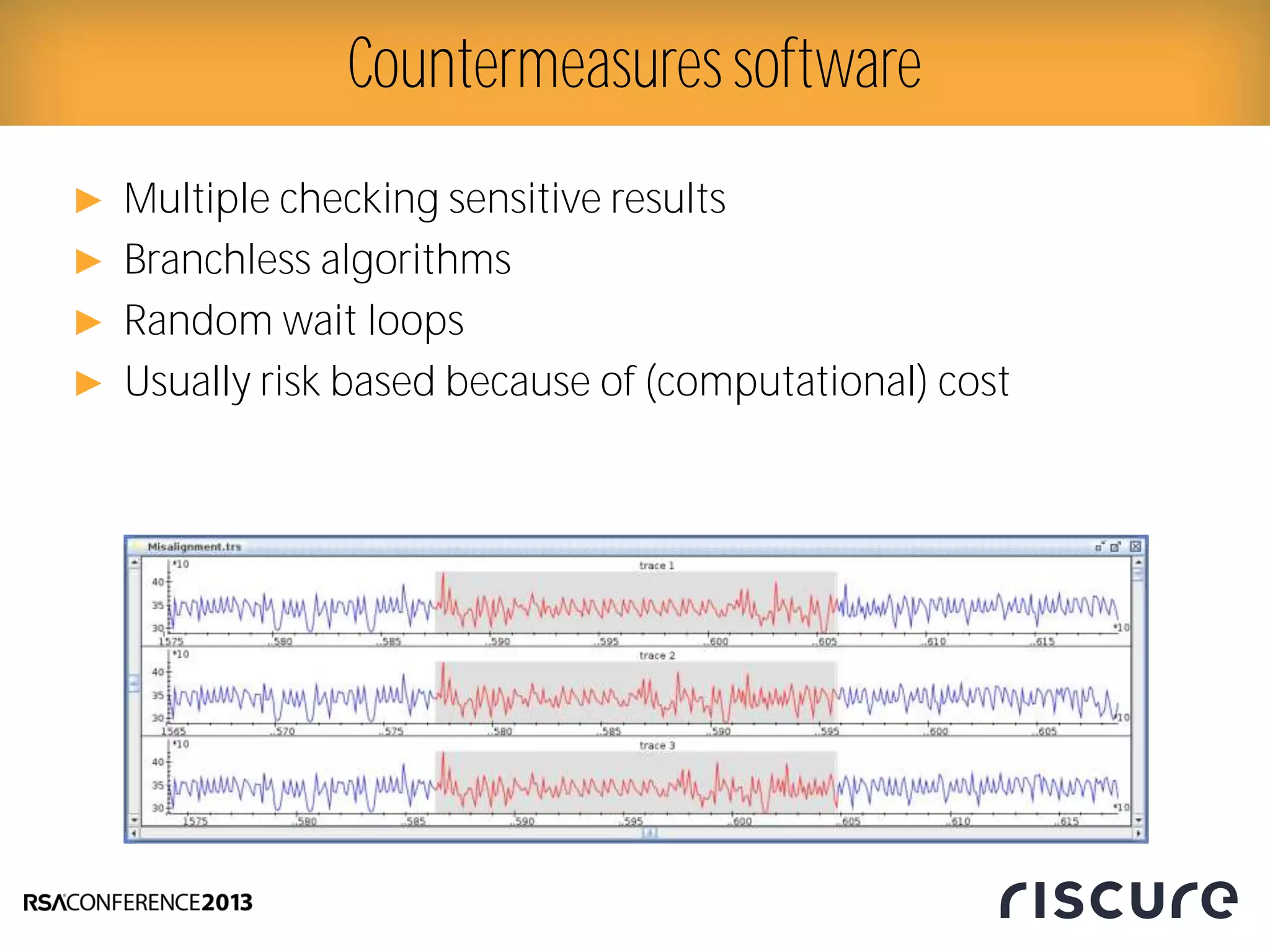
► Multiple checking sensitive results
► Branchless algorithms
► Random wait loops
► Usually risk based because of (computational) cost
Countermeasuressoftware
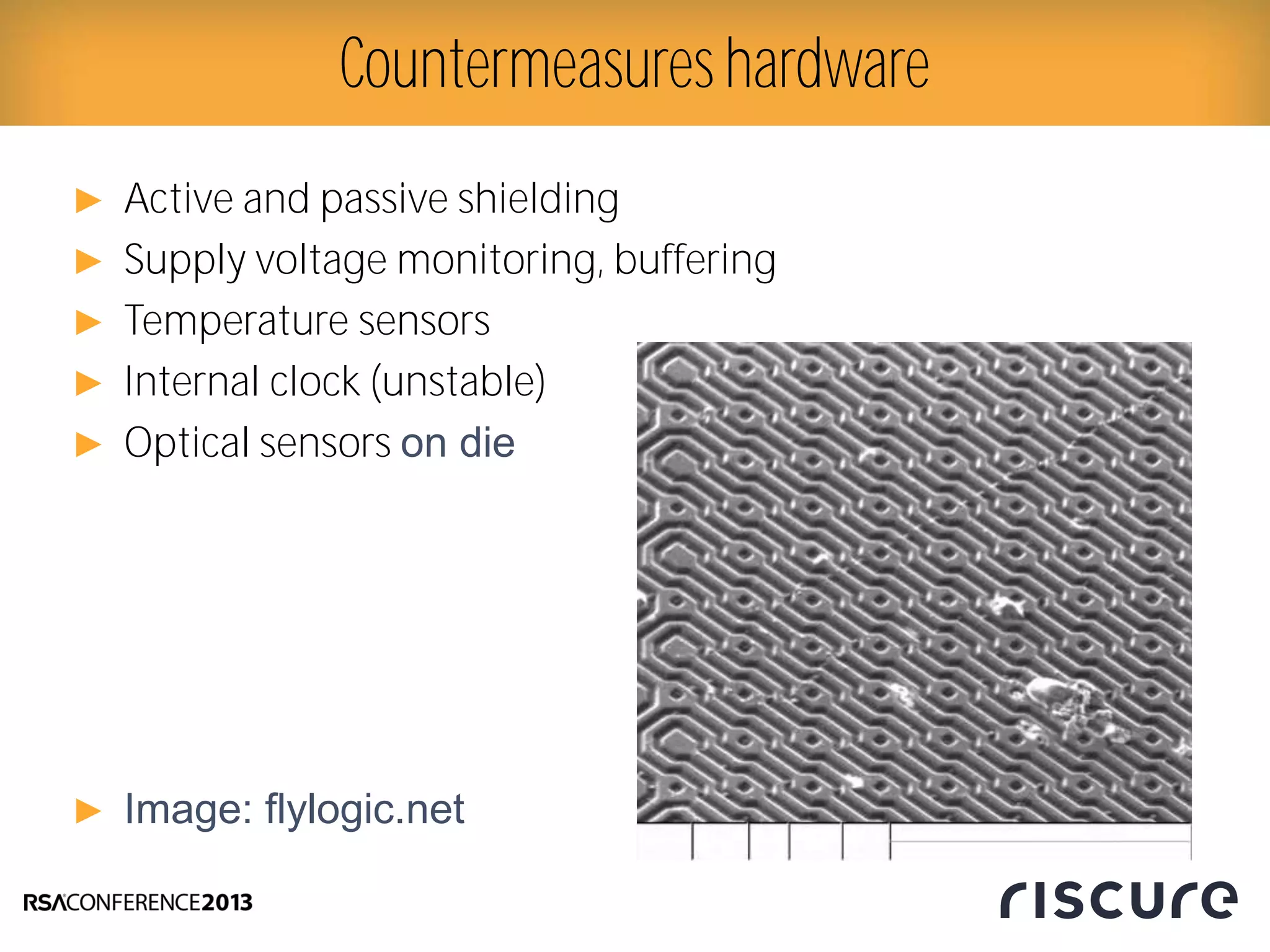
► Active and passive shielding
► Supply voltage monitoring, buffering
► Temperature sensors
► Internal clock (unstable)
► Optical sensors on die
► Image: flylogic.net
Countermeasureshardware
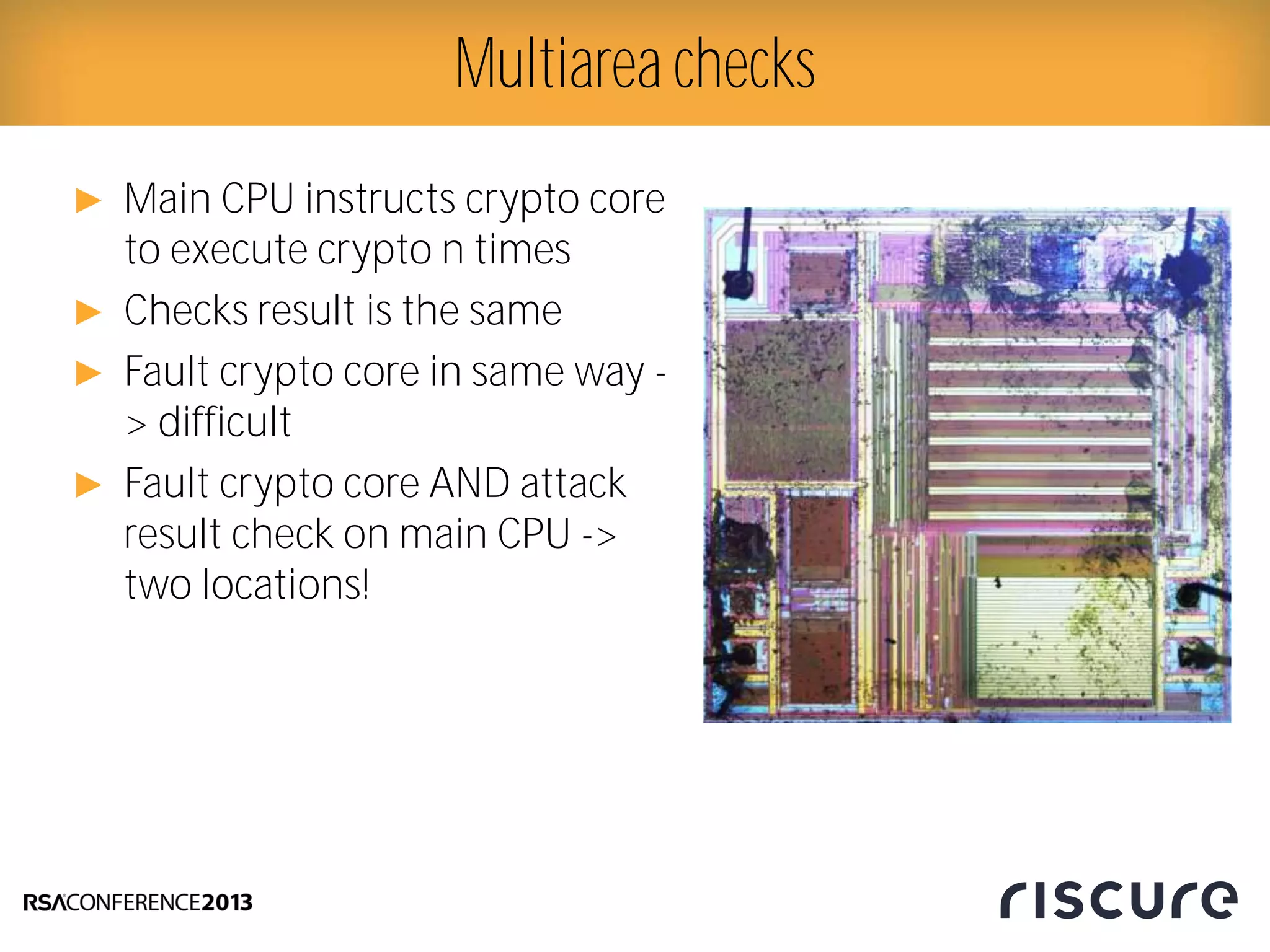
► Main CPU instructs crypto core
to execute crypto n times
► Checks result is the same
► Fault crypto core in same way -
> difficult
► Fault crypto core AND attack
result check on main CPU ->
two locations!
Multiarea checks
► Success rate exponentially decreases with attempts, e.g.
► Forcing an attacker to require multiple faults makes
attacking exponentially harder
►
Future / wrapup
Model appropriate?
► Protect input
►Only authorized code
► Protect output
Code
►Protect authorized code
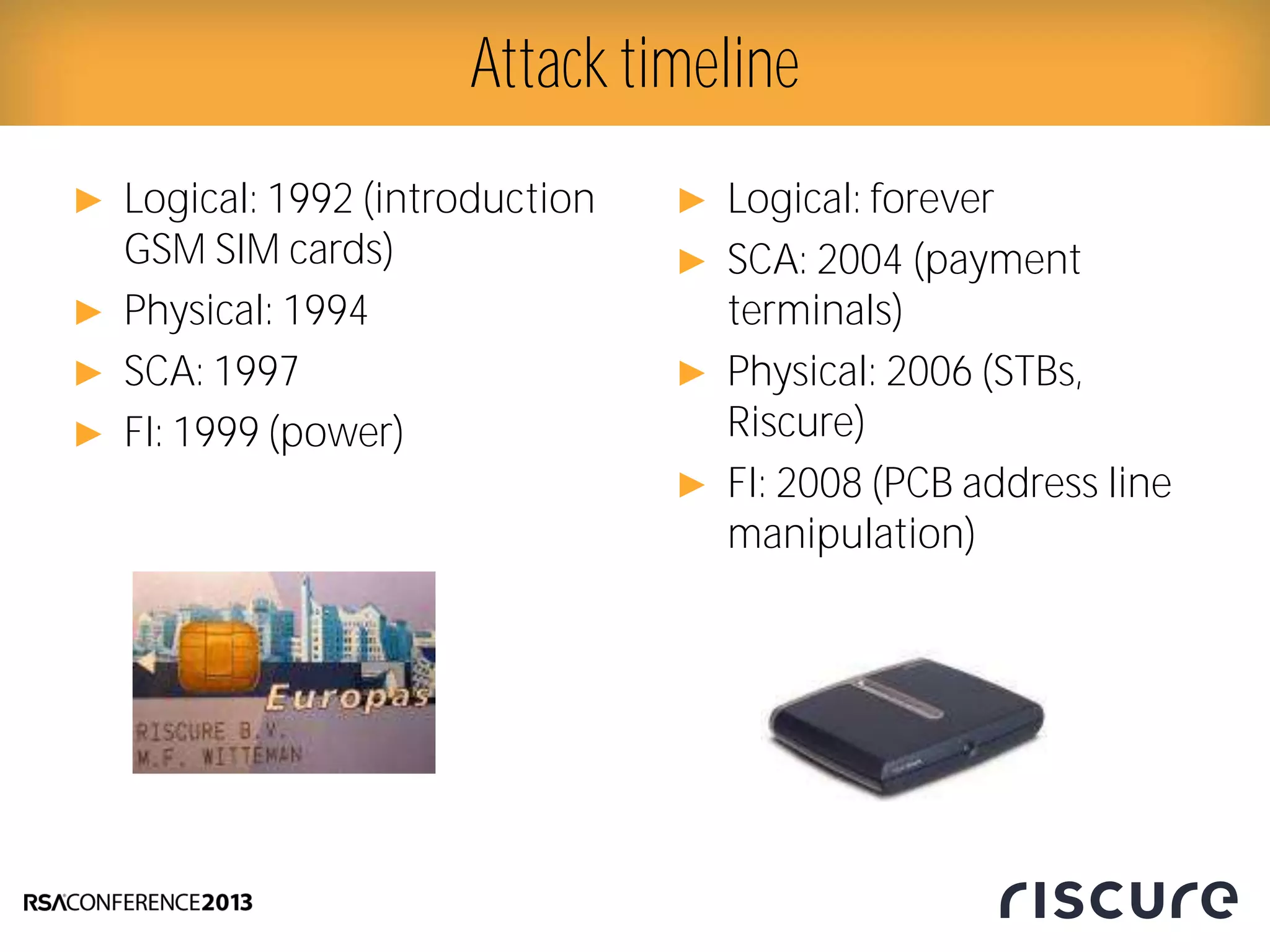
► Logical: 1992 (introduction
GSM SIM cards)
► Physical: 1994
► SCA: 1997
► FI: 1999 (power)
Attack timeline
► Logical: forever
► SCA: 2004 (payment
terminals)
► Physical: 2006 (STBs,
Riscure)
► FI: 2008 (PCB address line
manipulation)
► Physical/SCA/FI attacks about 9 years later on embedded
than on smart cards
► Logical attacks are getting harder..
► .. FI is becoming relevant (and systems are being broken)
Attacker economics
► Improved logical (software) security, combined with attacker
economics leads to hardware attacks
► As seen in the smart card industry
► As we are seeing in the embedded market (STB, mobile)
► (as we will see in the PC market?)
► Hardware root of trust creates protection against simple
injection of unauthorized code
► Not physical attacks!
Conclusions
► The security of a hardware root of trust depends on the
countermeasures implemented
► Secure systems use both hardware and software
countermeasures
► We discussed FI, also consider SCA, logical, physical
Conclusions
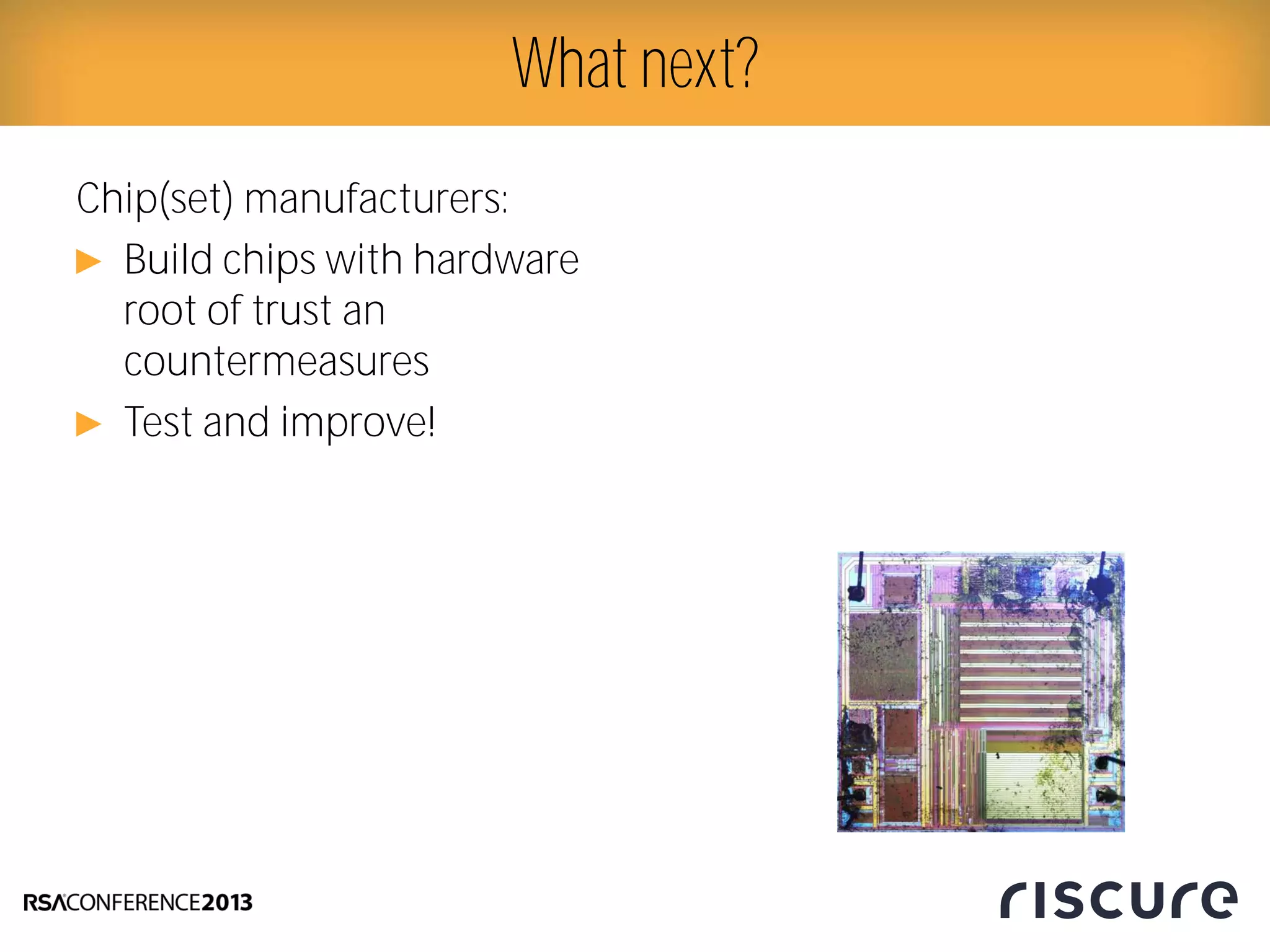
Chip(set) manufacturers:
► Build chips with hardware
root of trust an
countermeasures
► Test and improve!
What next?
Device developers:
► If you are not implementing software verification, go do that
first
► Choose hardware with a hardware root of trust, and
hardware countermeasures
► Enable software and hardware countermeasures in your
system
► Test and improve!
What next?
Questions?

Hta t17

  • 1.
    Session ID: Session Classification: Jaspervan Woudenberg Riscure HTA-T17 Advanced EmbeddedSystems UnderFire Fault Injection on SecureBoot
  • 2.
    ► Many moremod chips available 1 search away Example: Xbox 360 glitch chip
  • 3.
    Embedded devices andattacker goals
  • 4.
    How are devicesprotected? ► Protect input ►Only authorized code ► Protect output
  • 5.
  • 6.
  • 7.
    ► CPU startsexecuting ROM ► Immutable, programmed during manufacturing ► Trust starts here (root) ► ROM loads patches ► Verifies digital signature! ► ROM loads OS ► Verifies digital signature! ► OS includes Card manager ► Any applets that are installed are first digitally verified ► Result: all code on platform verified Example typical JavaCard smart card
  • 8.
    ► (simplified) ► PrimaryBoot Loader in ROM ► Device Boot Loader (flash) ► Secondary Boot Loader (flash) ► Realtime Executive (flash) ► Hboot (flash) ► Linux / Android (flash) ► http://tjworld.net/wiki/Android/HTC/Vision/BootProcess Example HTCVision
  • 9.
    ► ► CPU loadsUEFI firmware ► (verification?) ► Driver and Boot application signature verification ► Using (forbidden) signature database, (updated by KEK (updated by PK)) ► (Measure components into TPM) ► When Secure boot enabled, require signed UEFI OS ► OS verifies drivers, boots ► (many applications also digitally signed) Example PC with UEFI secure boot
  • 10.
    Model appropriate? ► Protectinput ►Only authorized code ► Protect output
  • 11.
  • 12.
    ► Spike/dip supplyvoltage ► Long: reset (boring) ► Short: corruption (interesting) Voltage FI Threshold of read value A power dip at the moment of reading a memory cell
  • 13.
    ► Introduce malformedclock ► Spikes or dips cause temporary extra cycle ► Instruction / data corruption Clock FI
  • 14.
    ► EM: ► Introducea current intro a circuit ► Affect RNG EM injection
  • 15.
    ► Photons areabsorbed by electrons in silicon ► Absorbed photons increase electron energy ► Increasing the semiconductor conductivity ► Can produce temporary faults Optical injection
  • 16.
    ► Data corruption ►Changing verification key ► Address line pulling ► Execute / verify different memory ► Instruction skipping ► Flip branches ► http://rdist.root.org/2010/01/27/how-the-ps3-hypervisor- was-hacked/ ► http://www.free60.org/Reset_Glitch_Hack Fault injection effects
  • 17.
  • 18.
  • 19.
  • 20.
    ► ► Successful faultrequires many parameters to be tuned correctly ► Know (or guess) from design, source, experience ► Temporary fault allows reset & retry ► Scan over parameter ranges Finding injection parameters
  • 21.
  • 22.
    ► Root oftrust depends on binary decision ► physical access could circumvent signature verification ► Depending on technology, can be ► Highly repeatable ► Cheaply exploitable FI as threat to hardware root of trust
  • 23.
  • 24.
    ► Multiple checkingsensitive results ► Branchless algorithms ► Random wait loops ► Usually risk based because of (computational) cost Countermeasuressoftware
  • 25.
    ► Active andpassive shielding ► Supply voltage monitoring, buffering ► Temperature sensors ► Internal clock (unstable) ► Optical sensors on die ► Image: flylogic.net Countermeasureshardware
  • 26.
    ► Main CPUinstructs crypto core to execute crypto n times ► Checks result is the same ► Fault crypto core in same way - > difficult ► Fault crypto core AND attack result check on main CPU -> two locations! Multiarea checks
  • 27.
    ► Success rateexponentially decreases with attempts, e.g. ► Forcing an attacker to require multiple faults makes attacking exponentially harder ►
  • 28.
  • 29.
    Model appropriate? ► Protectinput ►Only authorized code ► Protect output Code ►Protect authorized code
  • 30.
    ► Logical: 1992(introduction GSM SIM cards) ► Physical: 1994 ► SCA: 1997 ► FI: 1999 (power) Attack timeline ► Logical: forever ► SCA: 2004 (payment terminals) ► Physical: 2006 (STBs, Riscure) ► FI: 2008 (PCB address line manipulation)
  • 31.
    ► Physical/SCA/FI attacksabout 9 years later on embedded than on smart cards ► Logical attacks are getting harder.. ► .. FI is becoming relevant (and systems are being broken) Attacker economics
  • 32.
    ► Improved logical(software) security, combined with attacker economics leads to hardware attacks ► As seen in the smart card industry ► As we are seeing in the embedded market (STB, mobile) ► (as we will see in the PC market?) ► Hardware root of trust creates protection against simple injection of unauthorized code ► Not physical attacks! Conclusions
  • 33.
    ► The securityof a hardware root of trust depends on the countermeasures implemented ► Secure systems use both hardware and software countermeasures ► We discussed FI, also consider SCA, logical, physical Conclusions
  • 34.
    Chip(set) manufacturers: ► Buildchips with hardware root of trust an countermeasures ► Test and improve! What next?
  • 35.
    Device developers: ► Ifyou are not implementing software verification, go do that first ► Choose hardware with a hardware root of trust, and hardware countermeasures ► Enable software and hardware countermeasures in your system ► Test and improve! What next?
  • 36.