Multiple MIPI
CSI-2℠ Cameras
Leveraging FPGAs
Ted Marena
Director of SoC FPGA
Marketing, Microsemi
Agenda
•  History & adoption of MIPI CSI-2 image sensors
•  MIPI CSI-2 interface primer
•  FPGA usage models
•  Applications for multiple MIPI CSI-2 image sensors with
FPGAs
•  Summary
2
Evolution of Image Sensor Interfaces
Parallel	CMOS	interface	 subLVDS	/	HiSPi	interface	/	etc.	
In	90s	&	2000s,	parallel	interface	was	the	norm	
In	the	next	decade,	various	proprietary	interfaces	were	introduced	
	~	2-3MP
As mobile platforms exploded, so did CSI-2
4
Because of mobile popularity, everyone
drifted to CSI-2
•  Just like a decade ago when PC components were used
broadly, as mobile adoption exploded, so did the
acceptance of MIPI CSI-2
5
Title & Date
“LP	Mode”	–	1.2V	CMOS	
“HS	Mode”	–	SLVS200;		Vcm	=	200mV	&	Vdiff	=	+/-	100mV	
MIPI CSI-2 D-PHY Overview
•  Waveforms
Low	
Power	
Mode:		
TransiUon	from	
Low	Power	to	
High	Speed	
High	Speed	Mode	
TransiUon	from	
High	Speed	to	
Low	Power	
LP11,	LP01,	LP00,	HS0,	HS-SYNC	….					HS0,	LP-11	
References	the	P	and	N	channel	value	in	LP	mode	respecUvely	
References	the	value	of	the	SLVS200	signal	state	
…00011101	=	‘hB8	
MIPI CSI-2 Transition
MIPI Byte Packet Signaling
8’hB8	
8’hB8	
4-lane	example	
byte_data[7:0]	 {VC,DT}	 Byte(0)	 Byte(4)	 CS	 ECC	 Byte(n)	…	
…	byte_clk	
sync	
byte_data[15:8]	 WC	 Byte(1)	 Byte(5)	 {VC,DT}	 Byte(0)	 Byte(n-1)	
…	
8’hB8	 WC	 Byte(2)	 Byte(6)	 WC	 Byte(1)	 CS	…	
8’hB8	 ECC	 Byte(3)	 CS	 WC	 Byte(2)	 CS	…	
byte_data[23:16]	
byte_data[31:24]	
8’b00011101	HS-SYNC	Sequence	
Packet	Header	
VC	–	Virtual	Channel	number	
DT	–	Data	Type	
WC	=	16	bit	word	length	count	
ECC	–	Checksum	
on	word	count	
CS	–Checksum	on		
data
MIPI D-PHY, CSI-2 Overview
•  Universal D-PHY
Title & Date
1.2V	CMOS	Transminer	
1.2V	CMOS	Receiver	
1.2V	CMOS		
ContenUon	DetecUon		
Circuit	
SLVS200	Transminer	
SLVS200	Receiver	
Dynamic	TerminaUon
D-PHY vs. C-PHY
•  The majority of MIPI CSI-2 cameras use the D-PHY.
C-PHY,	3-wire,	embedded	clock,	3-phase	coding	
D-PHY,	diff-pairs,	source	synchronous,	no	coding	
TransiUon	at	every	symbol,	used	for	clock	recovery
Emulating D-PHY in FPGA
•  Normally FPGAs do not have a D-PHY hard I/O block
•  They usually interface via translation resistors
11
FPGA	I/Os	
Image		
Sensor	I/Os
Key Blocks Used in FPGAs for Imaging
12
AP/uP/uC	
Math	Blocks/DSP	 Memory	Blocks	
I/O	Gearing	 Processor/Micro
FPGAs in Imaging/Video Applications
Bridging is the simplest design.
Acceleration requires more performance & capabilities.
13
FPGA	
A	 B	 FPGA	
HW	ACC	
A	 A’	
DRAM	
Op9onal	
Bridging	
AcceleraUon
FPGAs Also Do Processing & Aggregating
Processing could be in an embedded processor or with FPGA fabric,
memory and math blocks (DSP blocks).
Aggregation leverages the large I/O capability of FPGAs and the fabric.
14
FPGA	
Aggrega9on	
A	
A’	
DRAM	
Processing	 AggregaUon	
FPGA	
Processing	
A	 A’	
B’	
DRAM	
B	
C
Why Use an FPGA?
•  Not enough MIPI CSI-2 or other inputs on an AP/ISP
•  Limited numbers of ISP engines on an AP/ISP
•  FPGA may perform some processing allowing for a lower
cost AP/ISP
•  Newer capabilities that are not available with an AP/ISP
•  An FPGA can implement a complete ISP
15
Multi MIPI CSI-2 Camera Applications
•  3D camera / virtual reality
•  Dual surveillance
•  Multiple-image sensor HDR
•  180-degree surveillance
•  360-degree panorama
•  Surround view automotive
•  Depth-detection applications
•  Drone usage
16
3D Camera Example
Dual	Image	Sensors	
Bridge
CSI-2
CSI-2	
1-4	
Data	
Lanes	
Dual CSI-2 Bridge
CSI-2	
1-4	
Data	
Lanes	
Sync	and		
format	logic	
Although	ISP	devices	oren	have	mulUple	camera	inputs,	they	oren	benefit	from	
an	FPGA.	Synchronizing	the	image	sensors	&	arranging	them
3D Camera FPGA Implementation
Dual	Image	Sensors	
Bridge
CSI-2
CSI-2	
1-4	
Data	
Lanes	
Dual CSI-2 Bridge
CSI-2	
1-4	
Data	
Lanes	
Sync	and		
format	logic	
The	FPGA	can	arrange	the	image	in	a	side-by-side	or	a	top-bonom	configuraUon.	
This	makes	it	easier	for	the	ISP	or	AP	to	process	the	image.
Dual Surveillance Camera
Dual	Image	Sensors	
Bridge
CSI-2
CSI-2	
1-4	
Data	
Lanes	
CSI-2	
1-4	
Data	
Lanes	
CSI-2	Tx	
Although	ISP	devices	oren	have	mulUple	camera	inputs,	they	oren	benefit	from	
an	FPGA	that	can	arrange	the	image.	
ISP	
Image	Buffer	
Memory	
Display		
spliter
Dual Surveillance FPGA Function
This	soluUon	allows	an	ISP	to	process	both	images.	
•  Both	images	are	recovered	in	the	FPGA	
•  The	FPGA	combines	the	two	images	into	
one	for	the	ISP	–	oren	a	top-bonom	
configuraUon	
•  This	allows	the	ISP	to	process	the	two	
images	as	one,	but	the	output	can	be	
split	into	two	images
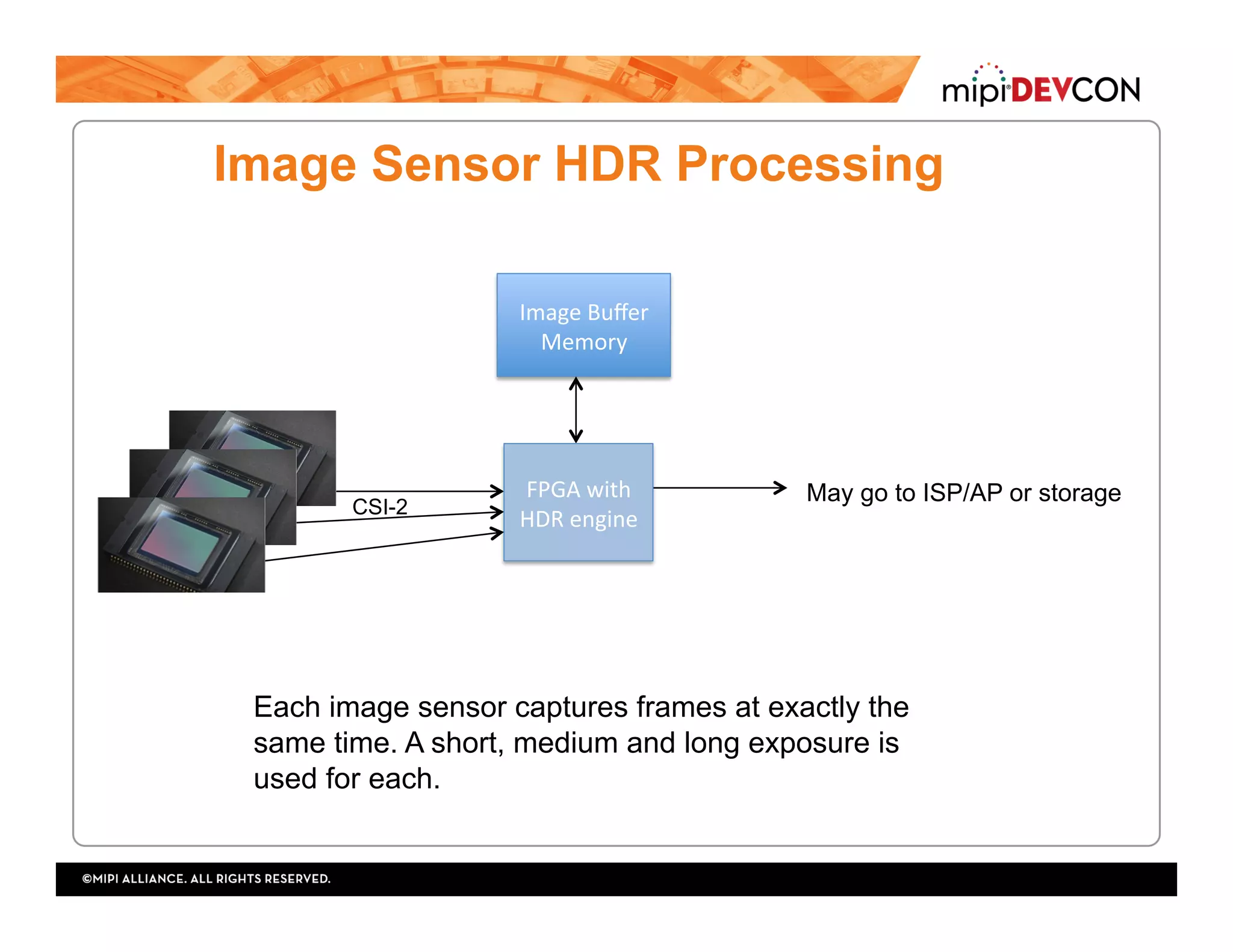
Image Sensor HDR Processing
CSI-2
May go to ISP/AP or storage
Each image sensor captures frames at exactly the
same time. A short, medium and long exposure is
used for each.
Image	Buffer	
Memory	
FPGA	with	
HDR	engine
Image Sensor HDR Processing
CSI-2
Short-, medium- and long-exposure images. Processed using local and global
tone mapping, motion artifact correction, etc.
Image	Buffer	
Memory	
FPGA	with	
HDR	engine
180-Degree Surveillance Camera
Bridge
CSI-2
CSI-2	
1-4	
Data	
Lanes	
CSI-2 Stitching
CSI-2	
1-4	
Data	
Lanes	
CSI-2	
The	image	sUtching	funcUon	is	more	easily	done	in	an	FPGA.	
In	this	design,	the	enUre	ISP	could	also	be	in	the	FPGA.	
ISP	
Image	Buffer	
Memory	
.	
.	
.	
3 or more
180-Degree Surveillance FPGA Function
•  MulUple	images	are	recovered	in	the	
FPGA	
•  The	frames	are	stored	likely	in	external	
memory	
•  The	FPGA	performs	an	analysis	to	
determine	where	to	merge	the	image	
•  The	images	are	sUtched	together		
•  Also	likely	a	smoothing	technique	is	used	
•  The	image	output	is	then	processed	in	
the	FPGA	or	formaned	and	passed	onto	
the	ISP	or	AP
360-Degree Cameras
CSI-2
Each image sensor frames are captured and combined.
Image processing could be in the FPGA or AP/ISP.
Image	Buffer	
Memory	
FPGA	with	
sUtching,	
fisheye	
correcUon,	etc	
.	
.	
.	
ISP	or	AP
360-Degree Cameras
•  The FPGA performs an analysis to determine
where to merge the images
•  The images are stitched together
•  Depending on the output format, fisheye
correction may be implemented
•  The image output is then processed in the FPGA
or formatted and passed onto the ISP or AP
26
Surround View Automotive
CSI-2
Frame	
Buffer	
memory	
FPGA	
FPD3	Link	to	
MIPI	CSI-2	
FPD3	Link	to	
MIPI	CSI-2
Surround View Application
•  The FPGA implements the stitching of the images
•  It formats the image for the ISP/AP
•  Or FPGA processes the image and drives the display
•  FPGA could add overlay such as directional lines
Multi Camera for Depth Detection
CSI-2
The FPGA processes all the images and
provides the lowest possible latency for
highest accuracy & response.
Image	Buffer	
Memory	
FPGA	syncs	
dual	camera	
pairs	&	does	
the	processing	
.	
.	
.	
CSI-2
Could	be	one	or	more	pairs
Multi Cameras for Depth-Based Analytics
Dual	Image	Sensors	
The	FPGA	or	AP	computes	3D	point	cloud	from	a	top-down	stereo	pair.	Depth-based	
analyUcs	can	disUnguish	adults,	kids,	people	from	shopping	carts	for	accurate	people	
counUng.	
Top-Down		
Depth		
Image	
FlowMetrics™	by	PercepTonic
Depth Detection for Robotics
•  The FPGA synchronizes each camera pair and processes what each
camera pair sees
•  The robot can preciously determine the distance for each axis that
has a camera pair
•  Parallel processing of the FPGA gives the robot the quickest
response & accuracy
Multi Camera Drone Application
CSI-2
These dual cameras allow a drone to “see.”
Image	Buffer	
Memory	
FPGA	syncs	
dual	camera	
pairs,	muxes,	
encrypUon,	
etc.	.	
.	
.	
CSI-2
GigE/10GE
Encrypted	
video	(wifi	or	
other	RF)	
PCIe
Multi Camera Drone Application
•  The FPGA can merge, mux, pre-process, and run
analytics pre-processing before the AP gets involved for
3D point cloud.
Adds situational awareness so that drones do not crash into anything.
Summary
•  Multiple camera applications continue to grow.
•  MIPI CSI-2 adoption will grow and be further adopted
outside of mobile applications.
•  An increasing number of FPGAs will support MIPI CSI-2
image sensors.
•  The parallel architecture of the FPGA is ideal for multiple
camera applications.
34

MIPI DevCon 2016: Multiple MIPI CSI-2 Cameras Leveraging FPGAs

  • 1.
    Multiple MIPI CSI-2℠ Cameras LeveragingFPGAs Ted Marena Director of SoC FPGA Marketing, Microsemi
  • 2.
    Agenda •  History &adoption of MIPI CSI-2 image sensors •  MIPI CSI-2 interface primer •  FPGA usage models •  Applications for multiple MIPI CSI-2 image sensors with FPGAs •  Summary 2
  • 3.
    Evolution of ImageSensor Interfaces Parallel CMOS interface subLVDS / HiSPi interface / etc. In 90s & 2000s, parallel interface was the norm In the next decade, various proprietary interfaces were introduced ~ 2-3MP
  • 4.
    As mobile platformsexploded, so did CSI-2 4
  • 5.
    Because of mobilepopularity, everyone drifted to CSI-2 •  Just like a decade ago when PC components were used broadly, as mobile adoption exploded, so did the acceptance of MIPI CSI-2 5
  • 6.
  • 7.
  • 8.
    MIPI Byte PacketSignaling 8’hB8 8’hB8 4-lane example byte_data[7:0] {VC,DT} Byte(0) Byte(4) CS ECC Byte(n) … … byte_clk sync byte_data[15:8] WC Byte(1) Byte(5) {VC,DT} Byte(0) Byte(n-1) … 8’hB8 WC Byte(2) Byte(6) WC Byte(1) CS … 8’hB8 ECC Byte(3) CS WC Byte(2) CS … byte_data[23:16] byte_data[31:24] 8’b00011101 HS-SYNC Sequence Packet Header VC – Virtual Channel number DT – Data Type WC = 16 bit word length count ECC – Checksum on word count CS –Checksum on data
  • 9.
    MIPI D-PHY, CSI-2Overview •  Universal D-PHY Title & Date 1.2V CMOS Transminer 1.2V CMOS Receiver 1.2V CMOS ContenUon DetecUon Circuit SLVS200 Transminer SLVS200 Receiver Dynamic TerminaUon
  • 10.
    D-PHY vs. C-PHY • The majority of MIPI CSI-2 cameras use the D-PHY. C-PHY, 3-wire, embedded clock, 3-phase coding D-PHY, diff-pairs, source synchronous, no coding TransiUon at every symbol, used for clock recovery
  • 11.
    Emulating D-PHY inFPGA •  Normally FPGAs do not have a D-PHY hard I/O block •  They usually interface via translation resistors 11 FPGA I/Os Image Sensor I/Os
  • 12.
    Key Blocks Usedin FPGAs for Imaging 12 AP/uP/uC Math Blocks/DSP Memory Blocks I/O Gearing Processor/Micro
  • 13.
    FPGAs in Imaging/VideoApplications Bridging is the simplest design. Acceleration requires more performance & capabilities. 13 FPGA A B FPGA HW ACC A A’ DRAM Op9onal Bridging AcceleraUon
  • 14.
    FPGAs Also DoProcessing & Aggregating Processing could be in an embedded processor or with FPGA fabric, memory and math blocks (DSP blocks). Aggregation leverages the large I/O capability of FPGAs and the fabric. 14 FPGA Aggrega9on A A’ DRAM Processing AggregaUon FPGA Processing A A’ B’ DRAM B C
  • 15.
    Why Use anFPGA? •  Not enough MIPI CSI-2 or other inputs on an AP/ISP •  Limited numbers of ISP engines on an AP/ISP •  FPGA may perform some processing allowing for a lower cost AP/ISP •  Newer capabilities that are not available with an AP/ISP •  An FPGA can implement a complete ISP 15
  • 16.
    Multi MIPI CSI-2Camera Applications •  3D camera / virtual reality •  Dual surveillance •  Multiple-image sensor HDR •  180-degree surveillance •  360-degree panorama •  Surround view automotive •  Depth-detection applications •  Drone usage 16
  • 17.
    3D Camera Example Dual Image Sensors Bridge CSI-2 CSI-2 1-4 Data Lanes DualCSI-2 Bridge CSI-2 1-4 Data Lanes Sync and format logic Although ISP devices oren have mulUple camera inputs, they oren benefit from an FPGA. Synchronizing the image sensors & arranging them
  • 18.
    3D Camera FPGAImplementation Dual Image Sensors Bridge CSI-2 CSI-2 1-4 Data Lanes Dual CSI-2 Bridge CSI-2 1-4 Data Lanes Sync and format logic The FPGA can arrange the image in a side-by-side or a top-bonom configuraUon. This makes it easier for the ISP or AP to process the image.
  • 19.
  • 20.
    Dual Surveillance FPGAFunction This soluUon allows an ISP to process both images. •  Both images are recovered in the FPGA •  The FPGA combines the two images into one for the ISP – oren a top-bonom configuraUon •  This allows the ISP to process the two images as one, but the output can be split into two images
  • 21.
    Image Sensor HDRProcessing CSI-2 May go to ISP/AP or storage Each image sensor captures frames at exactly the same time. A short, medium and long exposure is used for each. Image Buffer Memory FPGA with HDR engine
  • 22.
    Image Sensor HDRProcessing CSI-2 Short-, medium- and long-exposure images. Processed using local and global tone mapping, motion artifact correction, etc. Image Buffer Memory FPGA with HDR engine
  • 23.
    180-Degree Surveillance Camera Bridge CSI-2 CSI-2 1-4 Data Lanes CSI-2Stitching CSI-2 1-4 Data Lanes CSI-2 The image sUtching funcUon is more easily done in an FPGA. In this design, the enUre ISP could also be in the FPGA. ISP Image Buffer Memory . . . 3 or more
  • 24.
    180-Degree Surveillance FPGAFunction •  MulUple images are recovered in the FPGA •  The frames are stored likely in external memory •  The FPGA performs an analysis to determine where to merge the image •  The images are sUtched together •  Also likely a smoothing technique is used •  The image output is then processed in the FPGA or formaned and passed onto the ISP or AP
  • 25.
    360-Degree Cameras CSI-2 Each imagesensor frames are captured and combined. Image processing could be in the FPGA or AP/ISP. Image Buffer Memory FPGA with sUtching, fisheye correcUon, etc . . . ISP or AP
  • 26.
    360-Degree Cameras •  TheFPGA performs an analysis to determine where to merge the images •  The images are stitched together •  Depending on the output format, fisheye correction may be implemented •  The image output is then processed in the FPGA or formatted and passed onto the ISP or AP 26
  • 27.
  • 28.
    Surround View Application • The FPGA implements the stitching of the images •  It formats the image for the ISP/AP •  Or FPGA processes the image and drives the display •  FPGA could add overlay such as directional lines
  • 29.
    Multi Camera forDepth Detection CSI-2 The FPGA processes all the images and provides the lowest possible latency for highest accuracy & response. Image Buffer Memory FPGA syncs dual camera pairs & does the processing . . . CSI-2 Could be one or more pairs
  • 30.
    Multi Cameras forDepth-Based Analytics Dual Image Sensors The FPGA or AP computes 3D point cloud from a top-down stereo pair. Depth-based analyUcs can disUnguish adults, kids, people from shopping carts for accurate people counUng. Top-Down Depth Image FlowMetrics™ by PercepTonic
  • 31.
    Depth Detection forRobotics •  The FPGA synchronizes each camera pair and processes what each camera pair sees •  The robot can preciously determine the distance for each axis that has a camera pair •  Parallel processing of the FPGA gives the robot the quickest response & accuracy
  • 32.
    Multi Camera DroneApplication CSI-2 These dual cameras allow a drone to “see.” Image Buffer Memory FPGA syncs dual camera pairs, muxes, encrypUon, etc. . . . CSI-2 GigE/10GE Encrypted video (wifi or other RF) PCIe
  • 33.
    Multi Camera DroneApplication •  The FPGA can merge, mux, pre-process, and run analytics pre-processing before the AP gets involved for 3D point cloud. Adds situational awareness so that drones do not crash into anything.
  • 34.
    Summary •  Multiple cameraapplications continue to grow. •  MIPI CSI-2 adoption will grow and be further adopted outside of mobile applications. •  An increasing number of FPGAs will support MIPI CSI-2 image sensors. •  The parallel architecture of the FPGA is ideal for multiple camera applications. 34