POSIX STANDARDS
Operating Systems Assignment
2014-2015 First Semester
‫بيدوح‬ ‫حسين‬-‫العيني‬ ‫خلود‬-‫إدريس‬ ‫بانا‬
POSIX:
Stands for Portable Operating System Interface, a group of standards
that defines an API to maintain compatibility Between different
operating Systems.
Early POSIX:
• Posix for Unix-like operating systems was first made up of one
document for core pogramming interface, later it has grown to 19
document (POSIX.1, POSIX.2…etc.).
• However, nowadays most of Posix parts are combined into a single
standard.
Early POSIX:
• As of 2009, POSIX documentation is divided in two parts:
• POSIX.1-2008: POSIX Base Definitions, System Interfaces, and
Commands and Utilities (which include POSIX.1, extensions for
POSIX.1, Real-time Services, Threads Interface, Real-time Extensions,
Security Interface, Network File Access and Network Process-to-
Process Communications, User Portability Extensions, Corrections and
Extensions, Protection and Control Utilities and Batch System Utilities)
• POSIX Conformance Testing: A test suite for POSIX accompanies the
standard: PCTS or the POSIX Conformance Test Suite.[6]
POSIX command line and scripting:
• Standard command line and scripting interface were based on Korn
shell. Also many user-level programs services, and utilities were also
standardized along with program-level services (I/O, terminal,
network).
Threading:
• Posix defines a special threading library API which is supported by most
modern operating system
• POSIX Threads, usually referred to as Pthreads.
• Implementations of the API are available on many Unix-like POSIX-
conformant operating systems such as GNU/Linux, Mac OS X and Solaris.
and Microsoft Windows implementations also exist.
• Pthreads defines a set of C programming language types, functions
and constants. It is implemented with a library.
Threading:
• Windows does not support the pthreads standard natively, therefore
the Pthreads-w32 project seeks to provide a portable and open-
source wrapper implementation. It can also be used to port Unix
software (which use pthreads) with little or no modification to the
Windows platform
File System Standard:
• Posix used 512 byte block instead of 1024 to reflect the default size of
block on disk.
• they objected to this on the grounds that most people think in terms
of 1024 byte (or 1 Kb) blocks. The environment variable
POSIXLY_CORRECT was introduced to allow the user to force the
standards-compliant behaviour.
POSIX-oriented operating systems:
• Operating systems can be classified as a POSIX-oriented depending
upon the degree of compliance with the standards.
• Many Operating systems are conformed to be 100% compliant wit
POSIX standards, such as Solaris,Unixware,IRIX.
POSIX for Windows:
• Cygwin is a Unix-like environment for Windows.
• It contains a command-line interface and provides a native integration
of Windows-based applications with software made for Unix-like
environment.
• Microsoft POSIX subsystem, an optional Windows subsystem included
in Windows NT-based operating systems up to Windows 2000.
• UWIN from AT&T Research implements
POSIX for DOS:
Partially POSIX compliant environments for DOS include:
•emx+gcc – largely POSIX compliant
•DJGPP – partially POSIX compliant
•DR-DOS multitasking core
C POSIX library:
• C POSIX library is a specification of a C standard library for POSIX
systems. It was developed at the same time as the ANSI C standard.
Some effort was made to make POSIX compatible with standard C;
POSIX includes additional functions to those introduced in standard C.
C POSIX library
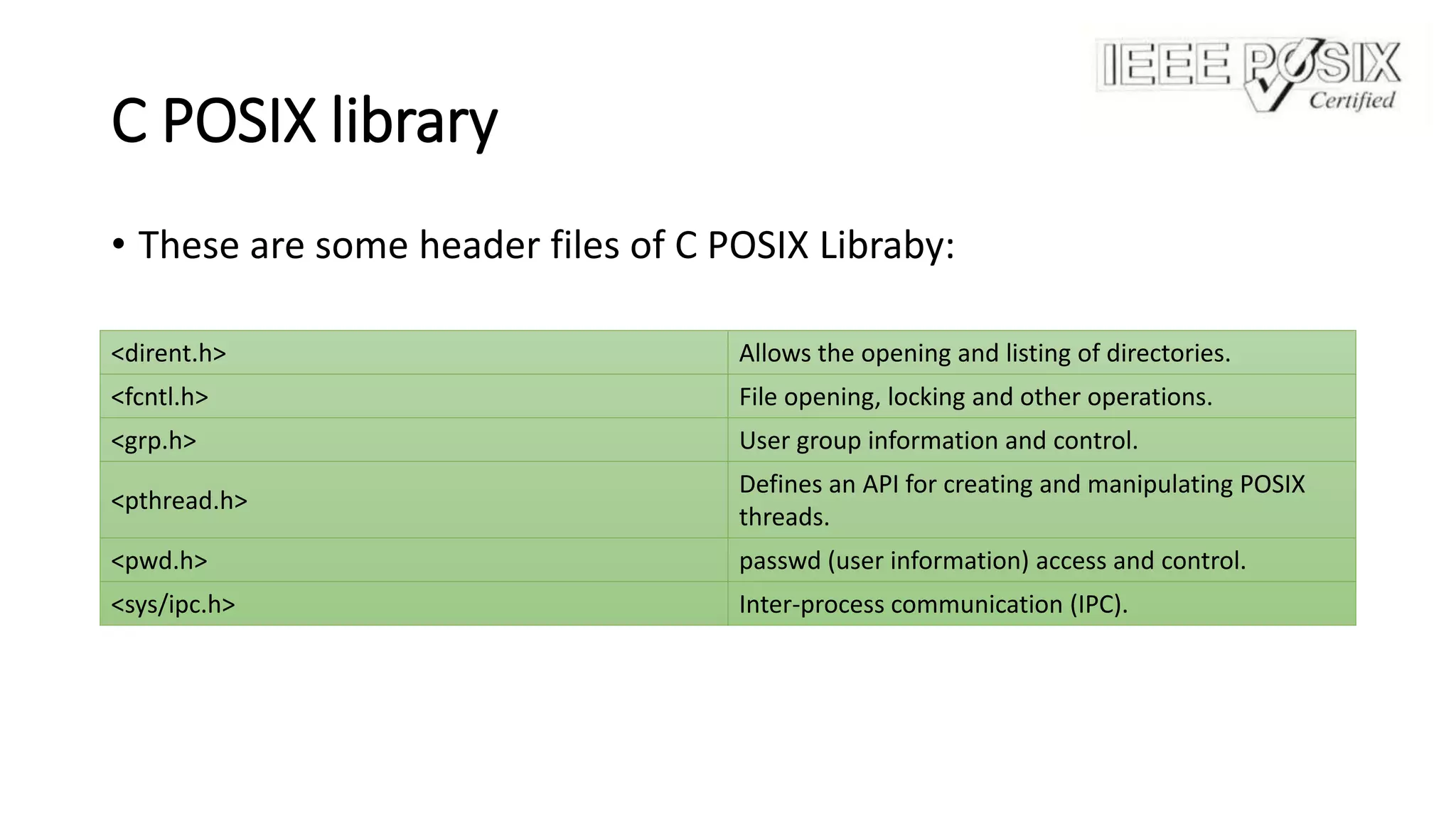
• These are some header files of C POSIX Libraby:
<dirent.h> Allows the opening and listing of directories.
<fcntl.h> File opening, locking and other operations.
<grp.h> User group information and control.
<pthread.h>
Defines an API for creating and manipulating POSIX
threads.
<pwd.h> passwd (user information) access and control.
<sys/ipc.h> Inter-process communication (IPC).

IEEE Posix Standards

  • 1.
    POSIX STANDARDS Operating SystemsAssignment 2014-2015 First Semester ‫بيدوح‬ ‫حسين‬-‫العيني‬ ‫خلود‬-‫إدريس‬ ‫بانا‬
  • 2.
    POSIX: Stands for PortableOperating System Interface, a group of standards that defines an API to maintain compatibility Between different operating Systems.
  • 3.
    Early POSIX: • Posixfor Unix-like operating systems was first made up of one document for core pogramming interface, later it has grown to 19 document (POSIX.1, POSIX.2…etc.). • However, nowadays most of Posix parts are combined into a single standard.
  • 4.
    Early POSIX: • Asof 2009, POSIX documentation is divided in two parts: • POSIX.1-2008: POSIX Base Definitions, System Interfaces, and Commands and Utilities (which include POSIX.1, extensions for POSIX.1, Real-time Services, Threads Interface, Real-time Extensions, Security Interface, Network File Access and Network Process-to- Process Communications, User Portability Extensions, Corrections and Extensions, Protection and Control Utilities and Batch System Utilities) • POSIX Conformance Testing: A test suite for POSIX accompanies the standard: PCTS or the POSIX Conformance Test Suite.[6]
  • 5.
    POSIX command lineand scripting: • Standard command line and scripting interface were based on Korn shell. Also many user-level programs services, and utilities were also standardized along with program-level services (I/O, terminal, network).
  • 6.
    Threading: • Posix definesa special threading library API which is supported by most modern operating system • POSIX Threads, usually referred to as Pthreads. • Implementations of the API are available on many Unix-like POSIX- conformant operating systems such as GNU/Linux, Mac OS X and Solaris. and Microsoft Windows implementations also exist. • Pthreads defines a set of C programming language types, functions and constants. It is implemented with a library.
  • 7.
    Threading: • Windows doesnot support the pthreads standard natively, therefore the Pthreads-w32 project seeks to provide a portable and open- source wrapper implementation. It can also be used to port Unix software (which use pthreads) with little or no modification to the Windows platform
  • 8.
    File System Standard: •Posix used 512 byte block instead of 1024 to reflect the default size of block on disk. • they objected to this on the grounds that most people think in terms of 1024 byte (or 1 Kb) blocks. The environment variable POSIXLY_CORRECT was introduced to allow the user to force the standards-compliant behaviour.
  • 9.
    POSIX-oriented operating systems: •Operating systems can be classified as a POSIX-oriented depending upon the degree of compliance with the standards. • Many Operating systems are conformed to be 100% compliant wit POSIX standards, such as Solaris,Unixware,IRIX.
  • 10.
    POSIX for Windows: •Cygwin is a Unix-like environment for Windows. • It contains a command-line interface and provides a native integration of Windows-based applications with software made for Unix-like environment. • Microsoft POSIX subsystem, an optional Windows subsystem included in Windows NT-based operating systems up to Windows 2000. • UWIN from AT&T Research implements
  • 11.
    POSIX for DOS: PartiallyPOSIX compliant environments for DOS include: •emx+gcc – largely POSIX compliant •DJGPP – partially POSIX compliant •DR-DOS multitasking core
  • 12.
    C POSIX library: •C POSIX library is a specification of a C standard library for POSIX systems. It was developed at the same time as the ANSI C standard. Some effort was made to make POSIX compatible with standard C; POSIX includes additional functions to those introduced in standard C.
  • 13.
    C POSIX library •These are some header files of C POSIX Libraby: <dirent.h> Allows the opening and listing of directories. <fcntl.h> File opening, locking and other operations. <grp.h> User group information and control. <pthread.h> Defines an API for creating and manipulating POSIX threads. <pwd.h> passwd (user information) access and control. <sys/ipc.h> Inter-process communication (IPC).