
Curriculum Framework- its
Significance in School Education
 School is crucial in preparing children to become their future selves.
School is an agency for socialization-which build a network of friends and
like-minded community teamwork. These school activities are based on
curriculum. The whole life of school becomes the curriculum which touch
the life of students at all points and help in the evolution of their balanced
personality. In some cases, people see the curriculum entirely in terms of
the subjects that are taught and a set-out within the set of textbooks, and
forget the wider goals of competencies and personal development. This is
why a curriculum framework is important. It sets the subjects within these
wider contexts and shows how learning experiences within the subjects
need to contribute to the attainment of the wider goals.
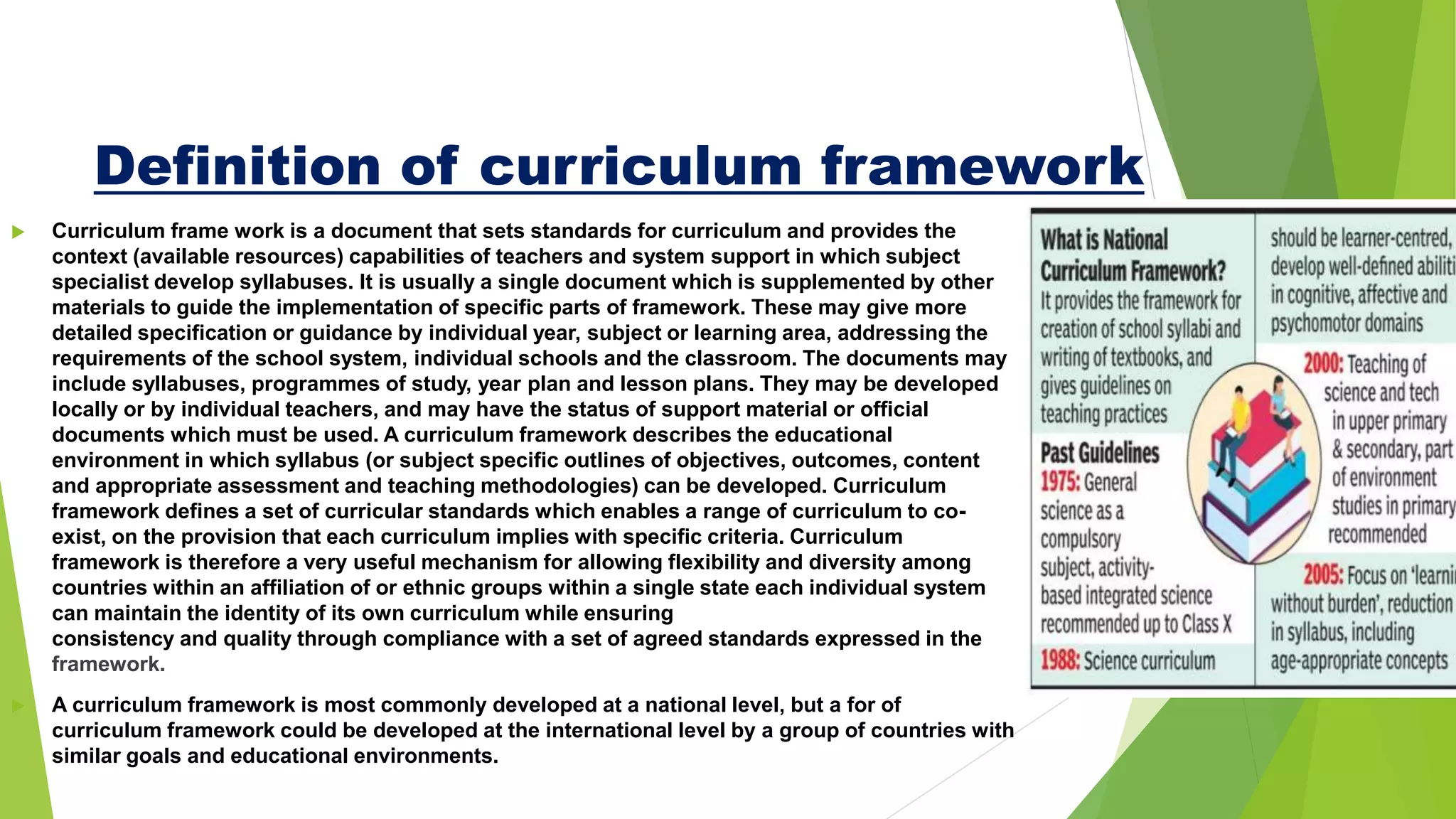
Definition of curriculum framework
 Curriculum frame work is a document that sets standards for curriculum and provides the
context (available resources) capabilities of teachers and system support in which subject
specialist develop syllabuses. It is usually a single document which is supplemented by other
materials to guide the implementation of specific parts of framework. These may give more
detailed specification or guidance by individual year, subject or learning area, addressing the
requirements of the school system, individual schools and the classroom. The documents may
include syllabuses, programmes of study, year plan and lesson plans. They may be developed
locally or by individual teachers, and may have the status of support material or official
documents which must be used. A curriculum framework describes the educational
environment in which syllabus (or subject specific outlines of objectives, outcomes, content
and appropriate assessment and teaching methodologies) can be developed. Curriculum
framework defines a set of curricular standards which enables a range of curriculum to co-
exist, on the provision that each curriculum implies with specific criteria. Curriculum
framework is therefore a very useful mechanism for allowing flexibility and diversity among
countries within an affiliation of or ethnic groups within a single state each individual system
can maintain the identity of its own curriculum while ensuring
consistency and quality through compliance with a set of agreed standards expressed in the
framework.
 A curriculum framework is most commonly developed at a national level, but a for of
curriculum framework could be developed at the international level by a group of countries with
similar goals and educational environments.
NEED FOR CURRICULUM
FRAMEWORK
 • To develop qualities that make a child socially effective and happy in various social settings such as friendliness, cooperativeness, self-
disciplines, self-control, love for social justice etc.
• To develop pre-vocational/vocational skills, willingness to work hard, dignity of manual work and job satisfaction.
• For understanding of the environment and its limited resources and the need for conservation of natural resources and energy.
• To develop ability to appreciate and discover beauty in various life situations and integrate it into ones own personality.
To develop knowledge of scientific methods of inquiry and its use in solving problems.
• To facilitate schools and teachers to make decision about choice of content, pedagogy, teaching, and learning material, evaluation etc, at
school level.
• To give schools and teachers flexibility and ownership to plan and develop alternative curriculum modes to meet their varied needs.
• To help to review school curriculum, learning and teaching strategies and to develop school assessment policy.
• To help the teacher in becoming reflective practitioner who learns from their own experience
To emphasize learning with understanding and learning to learn, and helps children develop their own understanding based on their life
experiences.
• To set out what students should know, value, and be able to do at the various stages of schooling
 We also see few functions of curriculum framework in the field of school education.
FUNCTIONS
 Few functions of curriculum frame works are as follows—
• It defines a set of curriculum standards that enable a range of curricula to coexist on the
provision that each curriculum compiles with specific criteria.
• It functions as a tool that may assist teacher to put the national policy on education—educating
our future into practice.
• It develops certain quality standards for curriculum, evaluation is also needed.
• Gives guidance to syllabus and text book writers.

Once a curriculum framework is agreed, other documents can be developed including
most importantly subject or learning area, syllabuses and text books. It determines the
detail of a range of other policy and funding priorities. In curriculum framework, we see few
related factors that build the relationship between curriculum and aims of education. The
structure demands workable principles and criteria in most of the areas such as selection and
organization of content, ways of interacting with children and classroom organization, type of
teaching learning material, etc. The fundamental assumptions a curriculum framework uses,
needs to be internally consistent, as clearly articulated as possible, and acceptable to all stake
holders.
Finally, operational definitions have also been placed for consideration to
facilitate
 We see that, curriculum framework is part of an outcome-based education or
standards based education reform design. The framework is the second step-
defining clear, high standards which will be achieved by all students. The
curriculum is then aligned to the standards and students are assessed against the
standards.
NCERT is the official agency in India for deciding the curriculum framework for
schools. In India during 2005 National Curriculum framework (NCF-2005) the new
policy was drafted (NCF-2005, 2012)
 NCF is a needful feature of national education system.
National education system is a common education system at a different level. This
aims to bring minimum level of learning at all levels providing minimum facilities to
all schools of nation so that specific quality of education can be provided to
children. It is an approach to minimize the provincial inequalities among children.
NCF 2005 recommendations
 NCF 2005recommends
• Bringing arts, work, peace, health, physical education into the domain of
the curricular infusing them in all areas of learning, while giving them an
identity of their own at relevant stages. Enable learners to find their
voices, nurture their curiosity to think, ask questions, integrate their
experience with school knowledge rather than reproduce textual
knowledge
Shift from content-based testing to problem-solving and competency-
based testing.
• Use of technology in teaching-learning
• Shift from teacher centric to learner centric with flexible designs,
processes providing wider social context to learning as well as multiple
and divergent exposures
Characteristics Of Curriculum
framework
 Describe educational environment- A curriculum framework describes the educational environment in
which syllabus (or subject specific outlines of objective outcomes content and appropriate assessment
and teaching methodologies)can be developed
 Curriculum is most commonly developed at nation level-
 A curriculum framework is most commonly developed at a national level but a form of curriculum
framework could be developed at international level by a group of countries with similar goals and
education environment. One function of a curriculum framework is to define a curriculum standards that
enable a range of curriculum to co-exist such that curriculum complies with specific criteria.
 Provide guidelines at various stages of learning-
 A curriculum framework provides guidelines for translating into practice the scheme of various stages of
learning. For example the National Curriculum framework [1988] provided the objective of education
enlisted scheme at various stages ranging from primary to secondary and outlined the instructional
strategies to be employed.
ELEMENTS FUNCTION/PURPOSE
1 Introduction to current
context.
Describes the social, economic environment in which educational policy is made
and in which teaching and learning occur.
2 Educational policy statements Describes government goals for education such as universal literacy, development
of skill for economic prosperity and creation of stable and tolerant society.
3
Statement of Board learning objectives and
outcomes for each level.
Describes what students should know and be able to do when they complete their
school education. Outcomes should be expressed in terms of domains knowledge
understanding skills, etc.
4
Structure of the education system.
Describes the school system within which the curriculum framework is to be
applied- it should be specified as –
- Number of years of schooling.
- Stages of schooling and their durations.
Number of teaching periods in school week.
5 Structure of curriculum content, learning areas and
subjects.
Describes the pattern of subjects studied in each stage. A brief description of each
subject, the number of hours to be assigned to each subject.
6
Standards of resources
required for
implementation.
Describes standards as they apply to-
- Teachers- qualifications, teaching load.
- Students- number per class in each subject.
- Materials- textbooks, computers, etc.
Facilities- classroom, furniture, etc.
7
Teaching methodology.
Describes the range of teaching approaches that might be employed in the
implementation of the framework.
8
Assessing and reporting
student achievement.
Describes the importance of assessing the extent to which students achieve the
outcomes of each subject, prescribes type of assessment strategies.
Curriculum and its Significance in School
Education
 In accordance with the NCF-2005, curriculum is significant in school education
for
the following reasons:
● Curriculum works to all-round development of the child. It is child centred,
develops all values.
● Creates the citizenry conscious of their rights and duties, commitment to
principles embodied in our constitution. This must be the priority of the school
education.
● Enables the younger generation to reinterpret and re-evaluate the past with
reference to new priorities and emerging outlooks of a changing societal
context.
Significances of curriculum in the context of
school education

Impact of Curriculum on administrators
 Administrators follow a detailed curriculum to help students achieve state and national standards of academic performance.
The curriculum ensures that each school is teaching students relevant material and monitoring the progress of students from
all types of backgrounds.
Impactonteachers
 A school curriculum informs teacher what skills must be taught at each grade to ultimately prepare students to next level. In
the absence of a curriculum, teachers would not know whether student are building a solid foundation to support learning at
the next level.
 Impact on students
 Curriculum outlines for students a sequence of courses and tasks, that must be successfully completed to master a subject,
A good well-developed curriculum promotes skill development. A good curriculum allows student to ask Questions.
Curriculum lays out the directions and the end point of the class. Curriculum allows schools, families to guide their
expectations. It also enables them to teach important subjects like- literature, geography, science, etc. effectively this is so
that families can support their children and to teach them properly. Curriculum develops democratic values- liberty, fraternity,
and equality in the minds, of students. Curriculum is significant in every walk of life.
Recommendations of curriculumframework in New Education
Policy 2020 for school education
Universalization of education from preschool to secondary
level with 100% Gross Enrolment Ratio (GER) in school
education by 2030.
•To bring 2 crore out of school children back into the
mainstream through an open schooling system.
•The current 10+2 system to be replaced by a
new 5+3+3+4 curricular structure corresponding
to ages 3-8, 8-11, 11-14, and 14-18 years
respectively.
• It will bring the uncovered age group
of 3-6 years under school curriculum, which
has been recognized globally as
the crucial stage for development of mental
faculties of a child.
It will also have 12 years of schooling with
three years of Anganwadi/ pre schooling.
•Class 10 and 12 board examinations to be made
easier, to test core competencies rather than
memorized facts, with all students allowed
to take the exam twice.
•School governance is set to change, with a new
accreditation framework and an independent
authority to regulate both public and private
schools.
•Emphasis on Foundational Literacy and
Numeracy, no rigid separation between academic
streams, extracurricular, vocational streams in
schools.
•Vocational Education to start from Class 6 with
Internships.
•Teaching up to at least Grade 5 to be in mother
tongue/regional language. No language will be
imposed on any student.
•Assessment reforms with 360 degree Holistic
Progress Card, tracking Student Progress for
achieving Learning Outcomes
•A new and comprehensive National Curriculum
Framework for Teacher Education (NCFTE)
2021, will be formulated by the National Council
for Teacher Education (NCTE) in consultation
with National Council of Educational Research and
Training (NCERT).
•By 2030, the minimum degree qualification
for teaching will be a 4-year integrated B.Ed.
degree.
•Higher Education:
CONCLUSION
 Curriculum frame work is a document that sets standards for curriculum
and provides the context (available resources) capabilities of teachers
and system support in which subject specialist develop syllabuses. It is
usually a single document which is supplemented by other materials to
guide the implementation of specific parts of framework. These may give
more detailed specification or guidance by individual year, subject or
learning area, addressing the requirements of the school system,
individual schools and the classroom. School is crucial in preparing
children to become their future selves. School is an agency for
socialization-which build a network of friends and like-minded community
teamwork.
KNOWLEDGE AND CURRICULUM PPT

KNOWLEDGE AND CURRICULUM PPT

  • 2.
  • 3.
    Curriculum Framework- its Significancein School Education  School is crucial in preparing children to become their future selves. School is an agency for socialization-which build a network of friends and like-minded community teamwork. These school activities are based on curriculum. The whole life of school becomes the curriculum which touch the life of students at all points and help in the evolution of their balanced personality. In some cases, people see the curriculum entirely in terms of the subjects that are taught and a set-out within the set of textbooks, and forget the wider goals of competencies and personal development. This is why a curriculum framework is important. It sets the subjects within these wider contexts and shows how learning experiences within the subjects need to contribute to the attainment of the wider goals.
  • 4.
    Definition of curriculumframework  Curriculum frame work is a document that sets standards for curriculum and provides the context (available resources) capabilities of teachers and system support in which subject specialist develop syllabuses. It is usually a single document which is supplemented by other materials to guide the implementation of specific parts of framework. These may give more detailed specification or guidance by individual year, subject or learning area, addressing the requirements of the school system, individual schools and the classroom. The documents may include syllabuses, programmes of study, year plan and lesson plans. They may be developed locally or by individual teachers, and may have the status of support material or official documents which must be used. A curriculum framework describes the educational environment in which syllabus (or subject specific outlines of objectives, outcomes, content and appropriate assessment and teaching methodologies) can be developed. Curriculum framework defines a set of curricular standards which enables a range of curriculum to co- exist, on the provision that each curriculum implies with specific criteria. Curriculum framework is therefore a very useful mechanism for allowing flexibility and diversity among countries within an affiliation of or ethnic groups within a single state each individual system can maintain the identity of its own curriculum while ensuring consistency and quality through compliance with a set of agreed standards expressed in the framework.  A curriculum framework is most commonly developed at a national level, but a for of curriculum framework could be developed at the international level by a group of countries with similar goals and educational environments.
  • 5.
    NEED FOR CURRICULUM FRAMEWORK • To develop qualities that make a child socially effective and happy in various social settings such as friendliness, cooperativeness, self- disciplines, self-control, love for social justice etc. • To develop pre-vocational/vocational skills, willingness to work hard, dignity of manual work and job satisfaction. • For understanding of the environment and its limited resources and the need for conservation of natural resources and energy. • To develop ability to appreciate and discover beauty in various life situations and integrate it into ones own personality. To develop knowledge of scientific methods of inquiry and its use in solving problems. • To facilitate schools and teachers to make decision about choice of content, pedagogy, teaching, and learning material, evaluation etc, at school level. • To give schools and teachers flexibility and ownership to plan and develop alternative curriculum modes to meet their varied needs. • To help to review school curriculum, learning and teaching strategies and to develop school assessment policy. • To help the teacher in becoming reflective practitioner who learns from their own experience To emphasize learning with understanding and learning to learn, and helps children develop their own understanding based on their life experiences. • To set out what students should know, value, and be able to do at the various stages of schooling  We also see few functions of curriculum framework in the field of school education.
  • 6.
    FUNCTIONS  Few functionsof curriculum frame works are as follows— • It defines a set of curriculum standards that enable a range of curricula to coexist on the provision that each curriculum compiles with specific criteria. • It functions as a tool that may assist teacher to put the national policy on education—educating our future into practice. • It develops certain quality standards for curriculum, evaluation is also needed. • Gives guidance to syllabus and text book writers.  Once a curriculum framework is agreed, other documents can be developed including most importantly subject or learning area, syllabuses and text books. It determines the detail of a range of other policy and funding priorities. In curriculum framework, we see few related factors that build the relationship between curriculum and aims of education. The structure demands workable principles and criteria in most of the areas such as selection and organization of content, ways of interacting with children and classroom organization, type of teaching learning material, etc. The fundamental assumptions a curriculum framework uses, needs to be internally consistent, as clearly articulated as possible, and acceptable to all stake holders. Finally, operational definitions have also been placed for consideration to facilitate
  • 7.
     We seethat, curriculum framework is part of an outcome-based education or standards based education reform design. The framework is the second step- defining clear, high standards which will be achieved by all students. The curriculum is then aligned to the standards and students are assessed against the standards. NCERT is the official agency in India for deciding the curriculum framework for schools. In India during 2005 National Curriculum framework (NCF-2005) the new policy was drafted (NCF-2005, 2012)  NCF is a needful feature of national education system. National education system is a common education system at a different level. This aims to bring minimum level of learning at all levels providing minimum facilities to all schools of nation so that specific quality of education can be provided to children. It is an approach to minimize the provincial inequalities among children.
  • 8.
    NCF 2005 recommendations NCF 2005recommends • Bringing arts, work, peace, health, physical education into the domain of the curricular infusing them in all areas of learning, while giving them an identity of their own at relevant stages. Enable learners to find their voices, nurture their curiosity to think, ask questions, integrate their experience with school knowledge rather than reproduce textual knowledge Shift from content-based testing to problem-solving and competency- based testing. • Use of technology in teaching-learning • Shift from teacher centric to learner centric with flexible designs, processes providing wider social context to learning as well as multiple and divergent exposures
  • 9.
    Characteristics Of Curriculum framework Describe educational environment- A curriculum framework describes the educational environment in which syllabus (or subject specific outlines of objective outcomes content and appropriate assessment and teaching methodologies)can be developed  Curriculum is most commonly developed at nation level-  A curriculum framework is most commonly developed at a national level but a form of curriculum framework could be developed at international level by a group of countries with similar goals and education environment. One function of a curriculum framework is to define a curriculum standards that enable a range of curriculum to co-exist such that curriculum complies with specific criteria.  Provide guidelines at various stages of learning-  A curriculum framework provides guidelines for translating into practice the scheme of various stages of learning. For example the National Curriculum framework [1988] provided the objective of education enlisted scheme at various stages ranging from primary to secondary and outlined the instructional strategies to be employed.
  • 10.
    ELEMENTS FUNCTION/PURPOSE 1 Introductionto current context. Describes the social, economic environment in which educational policy is made and in which teaching and learning occur. 2 Educational policy statements Describes government goals for education such as universal literacy, development of skill for economic prosperity and creation of stable and tolerant society. 3 Statement of Board learning objectives and outcomes for each level. Describes what students should know and be able to do when they complete their school education. Outcomes should be expressed in terms of domains knowledge understanding skills, etc. 4 Structure of the education system. Describes the school system within which the curriculum framework is to be applied- it should be specified as – - Number of years of schooling. - Stages of schooling and their durations. Number of teaching periods in school week. 5 Structure of curriculum content, learning areas and subjects. Describes the pattern of subjects studied in each stage. A brief description of each subject, the number of hours to be assigned to each subject. 6 Standards of resources required for implementation. Describes standards as they apply to- - Teachers- qualifications, teaching load. - Students- number per class in each subject. - Materials- textbooks, computers, etc. Facilities- classroom, furniture, etc. 7 Teaching methodology. Describes the range of teaching approaches that might be employed in the implementation of the framework. 8 Assessing and reporting student achievement. Describes the importance of assessing the extent to which students achieve the outcomes of each subject, prescribes type of assessment strategies.
  • 11.
    Curriculum and itsSignificance in School Education  In accordance with the NCF-2005, curriculum is significant in school education for the following reasons: ● Curriculum works to all-round development of the child. It is child centred, develops all values. ● Creates the citizenry conscious of their rights and duties, commitment to principles embodied in our constitution. This must be the priority of the school education. ● Enables the younger generation to reinterpret and re-evaluate the past with reference to new priorities and emerging outlooks of a changing societal context.
  • 12.
    Significances of curriculumin the context of school education  Impact of Curriculum on administrators  Administrators follow a detailed curriculum to help students achieve state and national standards of academic performance. The curriculum ensures that each school is teaching students relevant material and monitoring the progress of students from all types of backgrounds. Impactonteachers  A school curriculum informs teacher what skills must be taught at each grade to ultimately prepare students to next level. In the absence of a curriculum, teachers would not know whether student are building a solid foundation to support learning at the next level.  Impact on students  Curriculum outlines for students a sequence of courses and tasks, that must be successfully completed to master a subject, A good well-developed curriculum promotes skill development. A good curriculum allows student to ask Questions. Curriculum lays out the directions and the end point of the class. Curriculum allows schools, families to guide their expectations. It also enables them to teach important subjects like- literature, geography, science, etc. effectively this is so that families can support their children and to teach them properly. Curriculum develops democratic values- liberty, fraternity, and equality in the minds, of students. Curriculum is significant in every walk of life.
  • 13.
    Recommendations of curriculumframeworkin New Education Policy 2020 for school education Universalization of education from preschool to secondary level with 100% Gross Enrolment Ratio (GER) in school education by 2030. •To bring 2 crore out of school children back into the mainstream through an open schooling system. •The current 10+2 system to be replaced by a new 5+3+3+4 curricular structure corresponding to ages 3-8, 8-11, 11-14, and 14-18 years respectively. • It will bring the uncovered age group of 3-6 years under school curriculum, which has been recognized globally as the crucial stage for development of mental faculties of a child. It will also have 12 years of schooling with three years of Anganwadi/ pre schooling. •Class 10 and 12 board examinations to be made easier, to test core competencies rather than memorized facts, with all students allowed to take the exam twice. •School governance is set to change, with a new accreditation framework and an independent authority to regulate both public and private schools. •Emphasis on Foundational Literacy and Numeracy, no rigid separation between academic streams, extracurricular, vocational streams in schools. •Vocational Education to start from Class 6 with Internships. •Teaching up to at least Grade 5 to be in mother tongue/regional language. No language will be imposed on any student. •Assessment reforms with 360 degree Holistic Progress Card, tracking Student Progress for achieving Learning Outcomes •A new and comprehensive National Curriculum Framework for Teacher Education (NCFTE) 2021, will be formulated by the National Council for Teacher Education (NCTE) in consultation with National Council of Educational Research and Training (NCERT). •By 2030, the minimum degree qualification for teaching will be a 4-year integrated B.Ed. degree. •Higher Education:
  • 14.
    CONCLUSION  Curriculum framework is a document that sets standards for curriculum and provides the context (available resources) capabilities of teachers and system support in which subject specialist develop syllabuses. It is usually a single document which is supplemented by other materials to guide the implementation of specific parts of framework. These may give more detailed specification or guidance by individual year, subject or learning area, addressing the requirements of the school system, individual schools and the classroom. School is crucial in preparing children to become their future selves. School is an agency for socialization-which build a network of friends and like-minded community teamwork.