Self-Directed
Learning
Louis Grauer
Post University
Prof. Jill Buban
Understanding Self-Directed
            Learning
 Self-Directed   Learners cringe at the
  following

“The minute adults walk into an activity labeled
„education‟, „training‟ or anything synonymous, they
hark back to their conditioning in their previous
school experience, put on their dunce hats of
dependency, fold their arms, sit back and say
„teach me‟” (Knowles, Holton III and Swanson
2005, p. 65).
Goal of Self-
                     Directed Learning
According to Merriam, Caffarella and
Baumgartner (2009):
 Goal One: enhance the ability to learn
 Goal Two: transformational learning is the center
  of self-directed learning (SDL)
 Goal Three: promotion of emancipatory learning
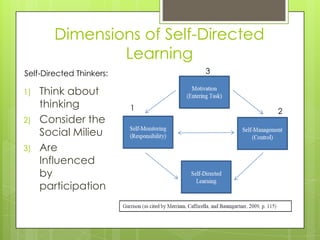
Dimensions of Self-Directed
                Learning
Self-Directed Thinkers:       3

1)   Think about
     thinking             1           2
2)   Consider the
     Social Milieu
3)   Are
     Influenced
     by
     participation
Self-Directed Learning Models
   Linear models: “Self-directed learning as a process of
    learning, in which people take the primary initiative for
    planning, carrying out, and evaluating their own
    learning experiences” (Merriam et al, p. 110).
   Interactive models: These models self-directed
    learning relies on “…two or more factors, such as
    opportunities people find in their environments, the
    personality characteristics of learners, cognitive
    processes, and the context of learning” (Merriam et al,
    2009, p. 111)
   Instructional models: These models help to combine
    traditional instruction with informal, self-directed
    learning in formal classroom setting (Merriam et al,
    2009)
Moving from here
                            Self-Directed Learning
                       To here
 Pedagogy:   The basis of organization
 for this country‟s educational system
    The art and science of teaching
     children
    Assigns the teacher full responsibility for
     decision making            (Knowles et al, 2005)


 Andragogy:  An integrated framework
 of adult learning
    Adults maintain the concept of
     responsibility of their decision to learn
                              (Knowles et al, 2005)
Reference Page
Knowles, M., Holton, E., & Swanson, R. (2005). The adult
learner: the definitive classic in adult education and human
resource development. (6th ed.). Burlington, MA: Elsevier.

Merriam, S. B., Caffarella, R. S., & Baumgartner, L. M. (2007).
Learning in adulthood: A comprehensive guide. (3rd ed.).
San Francisco, CA: Jossey-Bass.

Mikulak, A. (2012, October 4). What makes self-directed
learning effective?. Retrieved from
http://www.psychologicalscience.org/index.php/news/relea
ses/what-makes-self-directed-learning-effective.html

Self directed learning

  • 1.
  • 2.
    Understanding Self-Directed Learning  Self-Directed Learners cringe at the following “The minute adults walk into an activity labeled „education‟, „training‟ or anything synonymous, they hark back to their conditioning in their previous school experience, put on their dunce hats of dependency, fold their arms, sit back and say „teach me‟” (Knowles, Holton III and Swanson 2005, p. 65).
  • 3.
    Goal of Self- Directed Learning According to Merriam, Caffarella and Baumgartner (2009):  Goal One: enhance the ability to learn  Goal Two: transformational learning is the center of self-directed learning (SDL)  Goal Three: promotion of emancipatory learning
  • 4.
    Dimensions of Self-Directed Learning Self-Directed Thinkers: 3 1) Think about thinking 1 2 2) Consider the Social Milieu 3) Are Influenced by participation
  • 5.
    Self-Directed Learning Models  Linear models: “Self-directed learning as a process of learning, in which people take the primary initiative for planning, carrying out, and evaluating their own learning experiences” (Merriam et al, p. 110).  Interactive models: These models self-directed learning relies on “…two or more factors, such as opportunities people find in their environments, the personality characteristics of learners, cognitive processes, and the context of learning” (Merriam et al, 2009, p. 111)  Instructional models: These models help to combine traditional instruction with informal, self-directed learning in formal classroom setting (Merriam et al, 2009)
  • 6.
    Moving from here Self-Directed Learning To here  Pedagogy: The basis of organization for this country‟s educational system  The art and science of teaching children  Assigns the teacher full responsibility for decision making (Knowles et al, 2005)  Andragogy: An integrated framework of adult learning  Adults maintain the concept of responsibility of their decision to learn (Knowles et al, 2005)
  • 7.
    Reference Page Knowles, M.,Holton, E., & Swanson, R. (2005). The adult learner: the definitive classic in adult education and human resource development. (6th ed.). Burlington, MA: Elsevier. Merriam, S. B., Caffarella, R. S., & Baumgartner, L. M. (2007). Learning in adulthood: A comprehensive guide. (3rd ed.). San Francisco, CA: Jossey-Bass. Mikulak, A. (2012, October 4). What makes self-directed learning effective?. Retrieved from http://www.psychologicalscience.org/index.php/news/relea ses/what-makes-self-directed-learning-effective.html