Present, Practice, Produce
Using PPP Lesson Format to Create Effective Lessons
Through Task Based Learning
                                         pp.118-131
Objective/ Schedule
Objective: To have participants create and
assess a lesson plan. To prepare participants for
Practicum 3.

 • Introductions
 • Group discussion activity
 • Lecture on lesson planning
 • Break
 • Lesson planning activity
 • Lesson plan feedback
 • Questions/ Closing
Who am I?

• Certified Teacher – U.S.A

• 7.5yrs teaching experience
      4yrs U.S.
      3.5yrs South Korea

• B.Sc. K-12 Music Education

• MRes- Educational and Social Research

• EPIK/ TaLK Teacher Trainer

• Assistant Professor of English at
  Gimcheon University                     Daniel Moonasar
Who are you?


• Graduates (4yrs with degree)?

• Undergraduates (2yrs and or no degree)?

• Education majors?

• Teaching experience?
• Non internship?

• 6 month contract?
• 1 year contract?

• Visited in South Korea before?
• Lived in South Korea before?
Group Discussion Activity

Objective: To gather and discuss our thoughts
           on the role of lesson planning.


Directions:
1. Make a group of 4-5 people.
2. Discuss and answer the question given to your group.
3. Pick 1 person to speak for your group.
4. When finished, we’ll share answers to the class.
Group Discussion Activity

G1. Why is lesson planning important?

G2. How is lesson planning important for the teacher? For the learners?

G3. What do you take into account when you design a lesson plan?

G4. What constant components are there in your lesson plan?

G5. Can lesson planning be a hindrance to teaching/ learning? Why?

G6. What things are the most difficult when lesson planning? Why?
Group Discussion Activity
G1. Why is lesson planning important?


  Gives teaching structure,
   framework, and an overall shape.        I don’t need to
                                           lesson plan. I
                                           know what I am
  Allows you to communicate more          going to do.
   effectively to students, parents, and
   peers.

  Gives time and structure to allow for
   development of teaching skills.

  It suggests professionalism and
   genuine commitment.
Group Discussion Activity
G2. How is lesson planning important for the teacher? For the learners?


   • Don’t have to think on           • Gives a structured lesson
     your feet.                         and allows for
                                        comprehensible input.
   • Don’t lose “face” in front
     of learners.                     • Builds confidence and
                                        respect for the teacher.
   • You know your procedures
     and sequence.                    • Gives the teacher’s work
                                        as a model to imitate.
Group Discussion Activity
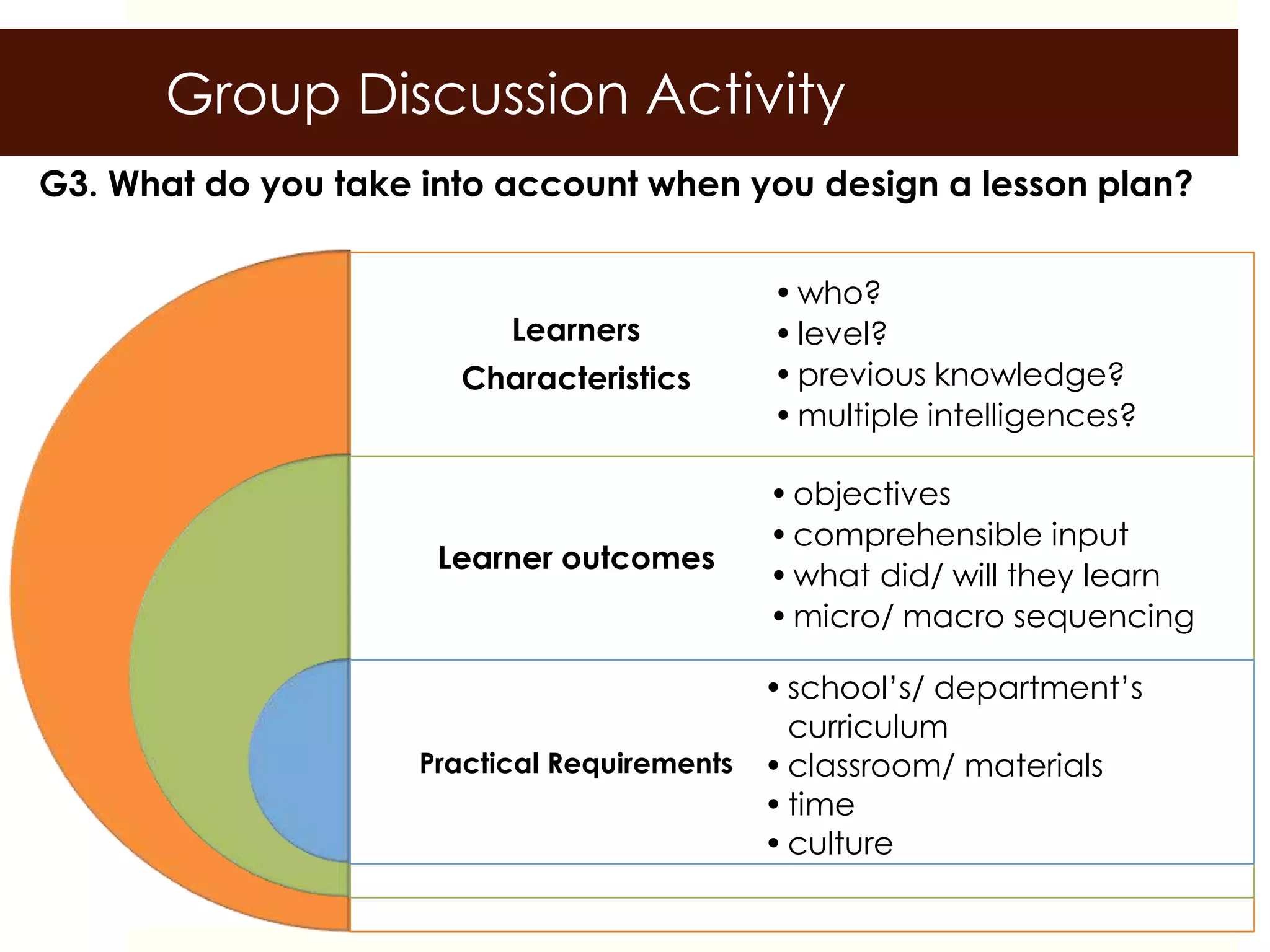
G3. What do you take into account when you design a lesson plan?


                                            • who?
                           Learners         • level?
                       Characteristics      • previous knowledge?
                                            • multiple intelligences?

                                           • objectives
                                           • comprehensible input
                      Learner outcomes
                                           • what did/ will they learn
                                           • micro/ macro sequencing

                                            • school’s/ department’s
                                              curriculum
                     Practical Requirements • classroom/ materials
                                            • time
                                            • culture
Group Discussion Activity
G4. What constant components are there in your lesson plan?


  title

  objectives
  materials

  procedures

  assessment

  anticipated problems &
   solutions.
Group Discussion Activity
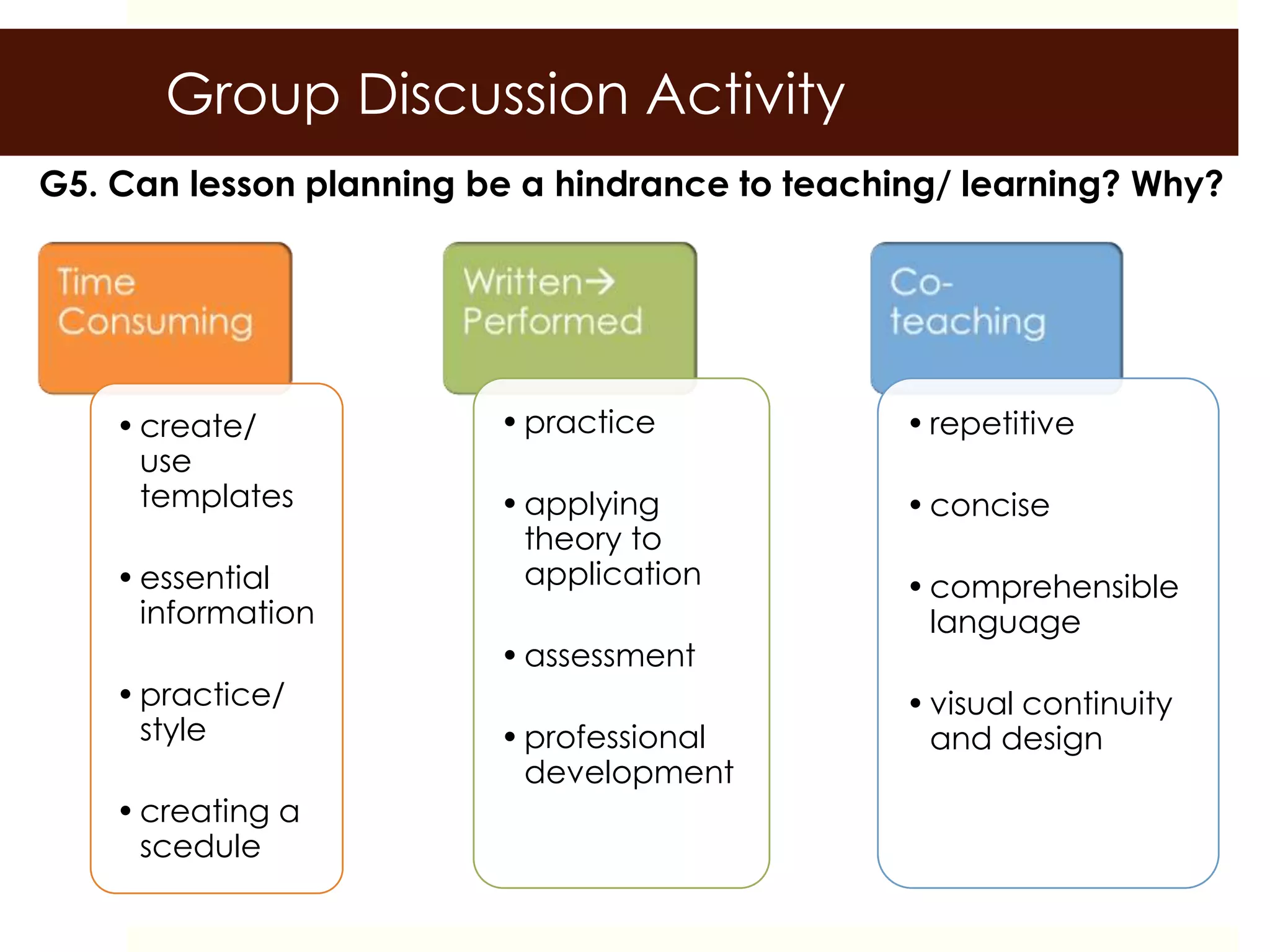
G5. Can lesson planning be a hindrance to teaching/ learning? Why?


    • create/            • practice             • repetitive
      use
      templates          • applying             • concise
                           theory to
    • essential            application          • comprehensible
      information                                 language
                         • assessment
    • practice/                                 • visual continuity
      style              • professional           and design
                           development
    • creating a
      scedule
Group Discussion Activity
G6. What things are the most difficult when lesson planning? Why?


                 My Lesson            Difficulties
Lecture Schedule


1. Skills and Methodology

 2. PPP Lesson Plan Format

 3. Lesson Plan Elements

4. Lesson Planning Activity
1. Bringing Together Language Skills and
pp. 118-119    Methodology
What are the 2 focuses in a language classroom?

What are the 4 associated skills in a language classroom?


      Receptive Skills      Productive Skills

          Reading                Writing

          Listening             Speaking
1. Bringing Together Language Skills and
pp. 121-122    Methodology


• Expected in NSET (Native
  Speaking English Teacher)
  curriculum.

• NSET emphasis on speaking.

• Emphasis on exploring
  language skills through
  producing target language.
1. Bringing Together Language Skills and
pp. 122-123    Methodology


• Receptive based. Allows for
  “correct or incorrect”
  engagement of language.

• Teacher centered,
  component comprehension
  driven. Generally “safe” for
  students

• Excellent for memorizing,
  introduction of core
  concepts, and eliciting
  information from students.
1. Bringing Together Language Skills and
pp. 119-120    Methodology

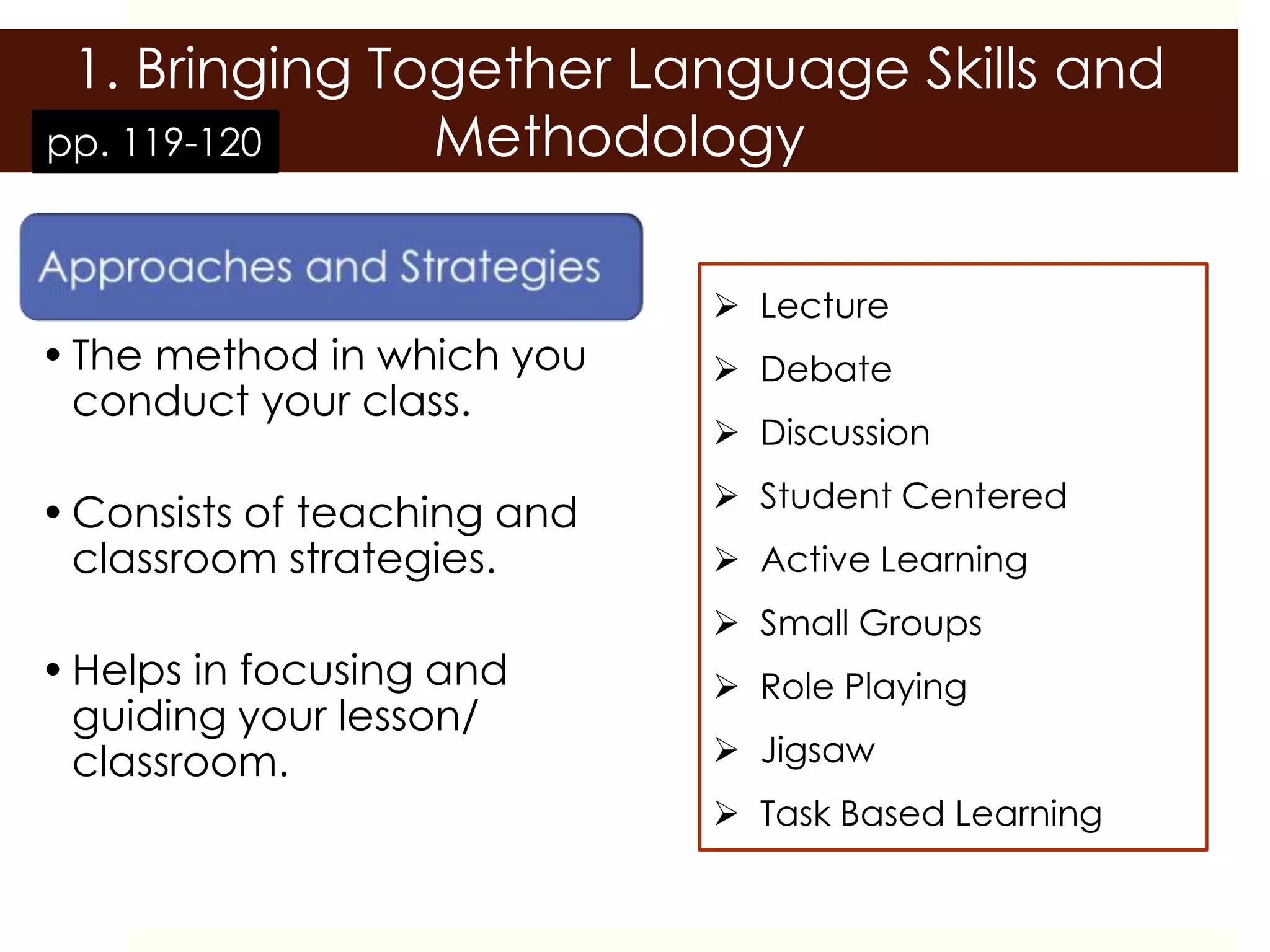
                              Lecture
• The method in which you     Debate
  conduct your class.
                              Discussion
                              Student Centered
• Consists of teaching and
  classroom strategies.       Active Learning
                              Small Groups
• Helps in focusing and       Role Playing
  guiding your lesson/
  classroom.                  Jigsaw
                              Task Based Learning
1. Bringing Together Language Skills and
pp. 119-120    Methodology

• Tasks in which learners generates authentic language.

• The task is based on students using the language to
  achieve specific outcomes.

• Task and the language are the instruments to complete the
  task.

• The task is an activity that:
  • reflects real life or authentic tasks
  • has students focus on meaning
  • uses language freely
  • allows students to experiment or make mistakes
1. Bringing Together Language Skills and
pp. 119-120    Methodology


•Questioning
•Games with specific outcomes
•Surveys
•Interviews
•Story building
•Role plays
•Ordering/ Sorting
•Experimenting/ Building
2. PPP Format and it’s Reasoning
pp. 120-122


• Easy 3 staged lesson plan.

• Most accepted lesson plan format
  in South Korea and NSETs           Present
• Allows for receptive and
  productive language skills.        Practice
• Flexible for multi strategy
  approaches.                        Produce
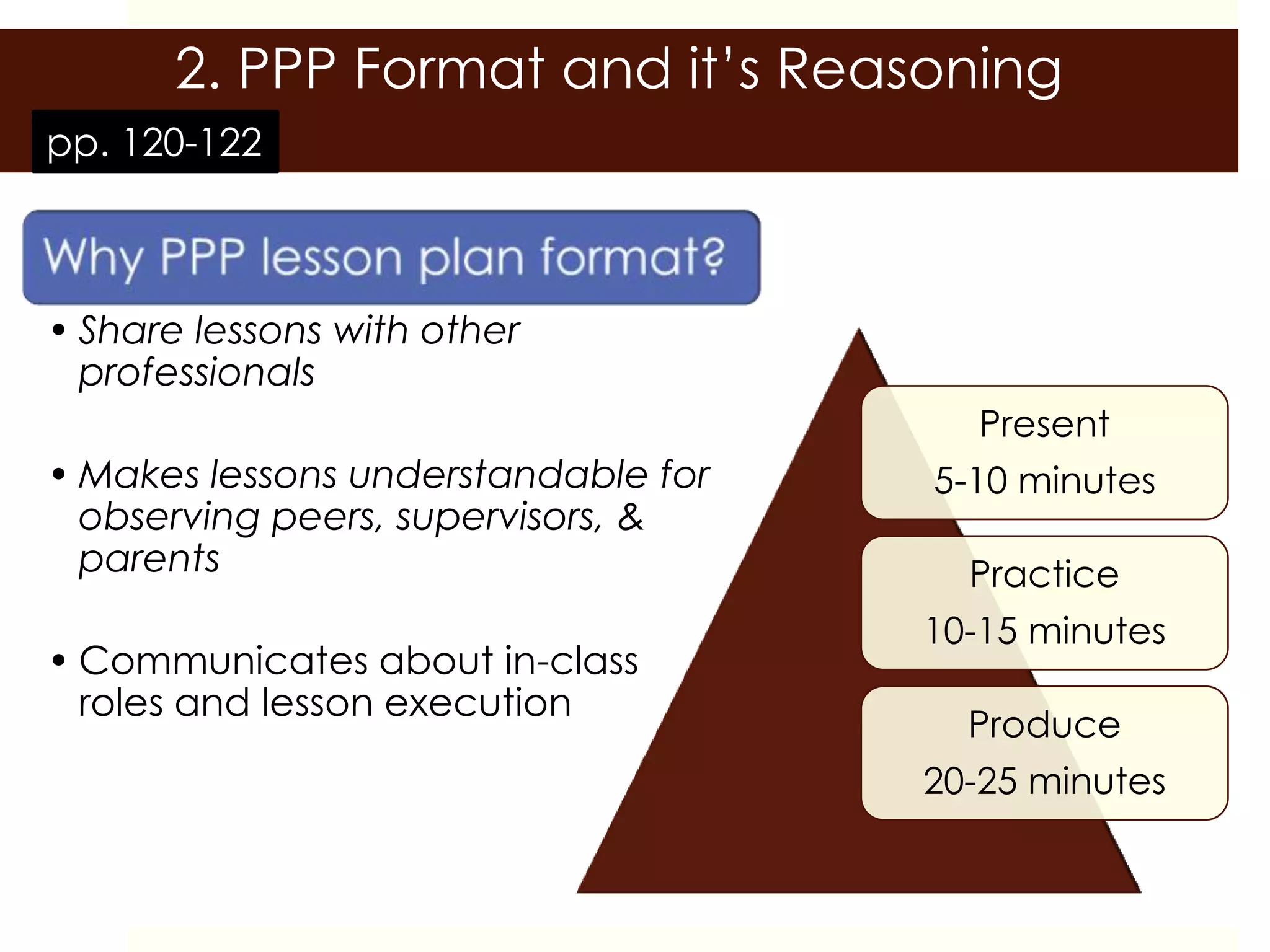
2. PPP Format and it’s Reasoning
pp. 120-122


• Share lessons with other
  professionals
                                       Present
• Makes lessons understandable for   5-10 minutes
  observing peers, supervisors, &
  parents                              Practice
                                     10-15 minutes
• Communicates about in-class
  roles and lesson execution
                                       Produce
                                     20-25 minutes
2. PPP Format and it’s Reasoning
pp. 120-122


• Used to introduce new or target language.

• Teacher can use:
          PPT              songs

       flash cards         drills

      picture cards       games               Present
         videos       direct questions
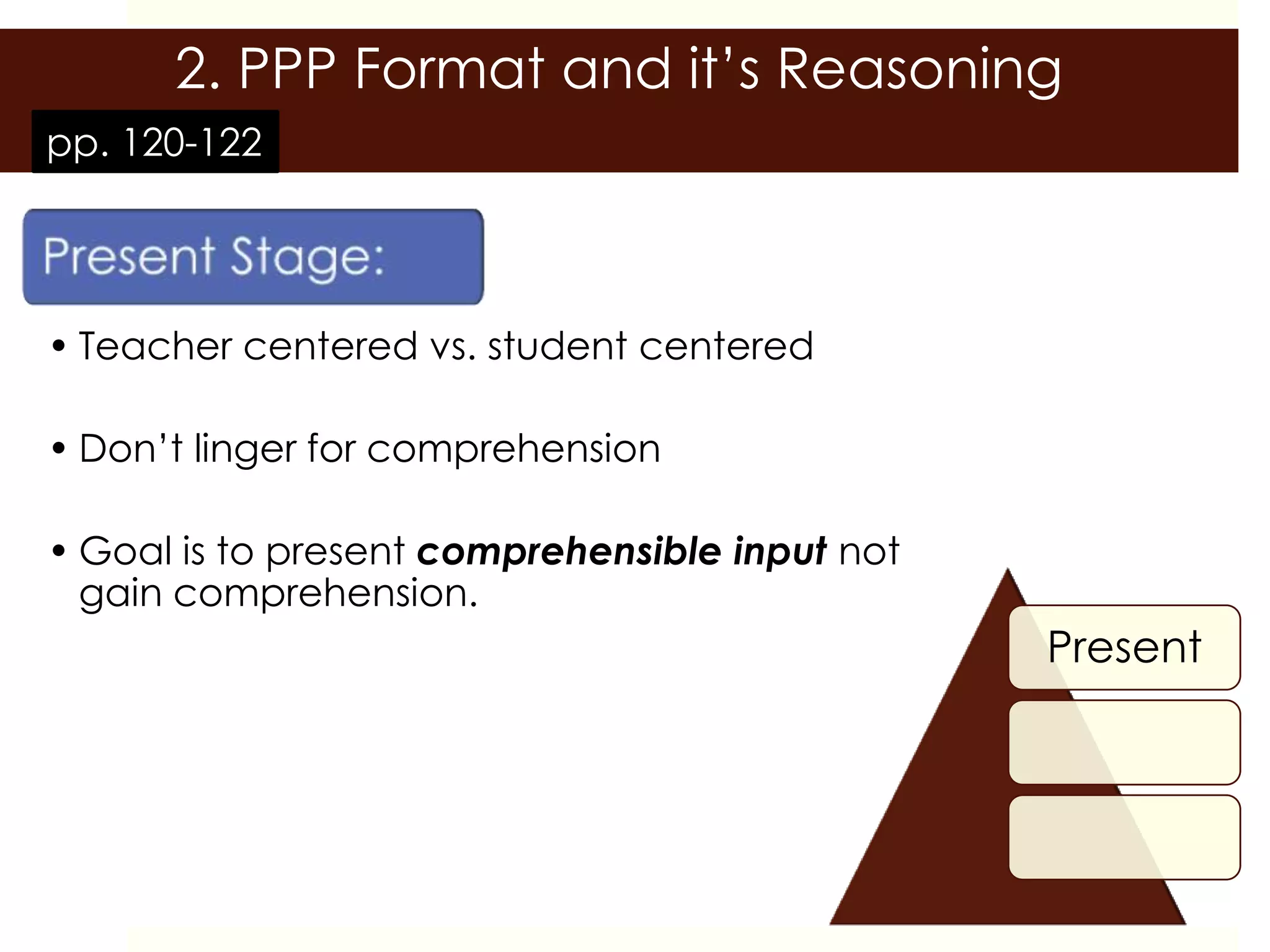
2. PPP Format and it’s Reasoning
pp. 120-122


• Teacher centered vs. student centered

• Don’t linger for comprehension

• Goal is to present comprehensible input not
  gain comprehension.
                                                Present
2. PPP Format and it’s Reasoning
pp. 120-122


• Gives controlled practice through controlled activities

• Teacher can use:
       question and    pre-written role
         answer             plays
     choral response   jigsaw activities

     read and repeat       games

        worksheets     direct questions               Practice
2. PPP Format and it’s Reasoning
pp. 120-122


• Goal is to give students boundaries to safely use the
  language

• Clearly defined correct and incorrect answers

• Give clear feedback

• Time to assess
                                                      Practice
2. PPP Format and it’s Reasoning
pp. 120-122


• To freely as possible interact and explore the language

• Teacher can use:

    group & pair work      gathering
                          information
    creating dialogue      interviews

    creating role plays      games

     creating stories     presentations

                                                    Produce
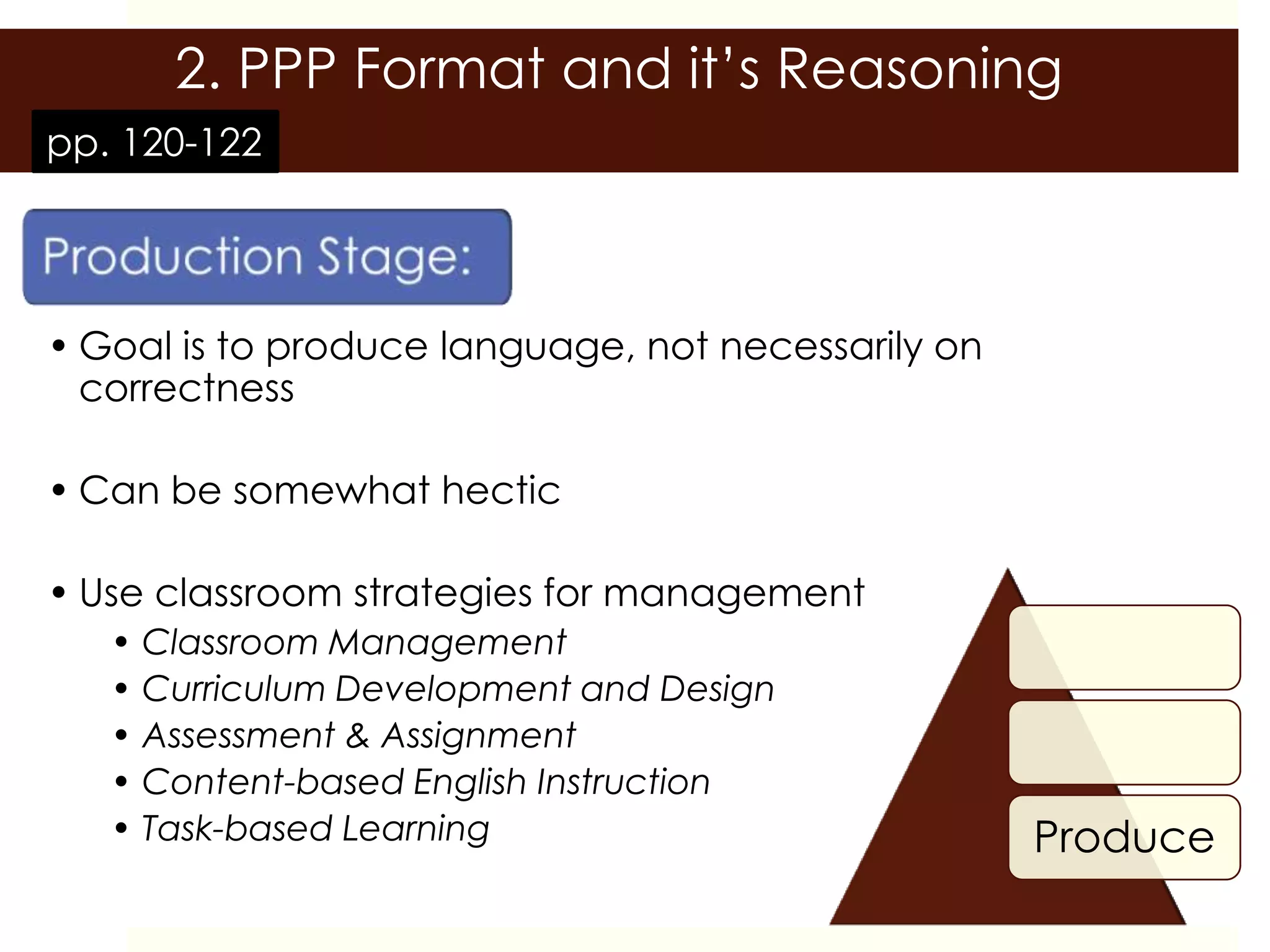
2. PPP Format and it’s Reasoning
pp. 120-122


• Goal is to produce language, not necessarily on
  correctness

• Can be somewhat hectic

• Use classroom strategies for management
   • Classroom Management
   • Curriculum Development and Design
   • Assessment & Assignment
   • Content-based English Instruction
   • Task-based Learning                            Produce
p. 123   3. Lesson Plan Elements
p.123
Table 1.4   3. Lesson Plan Elements
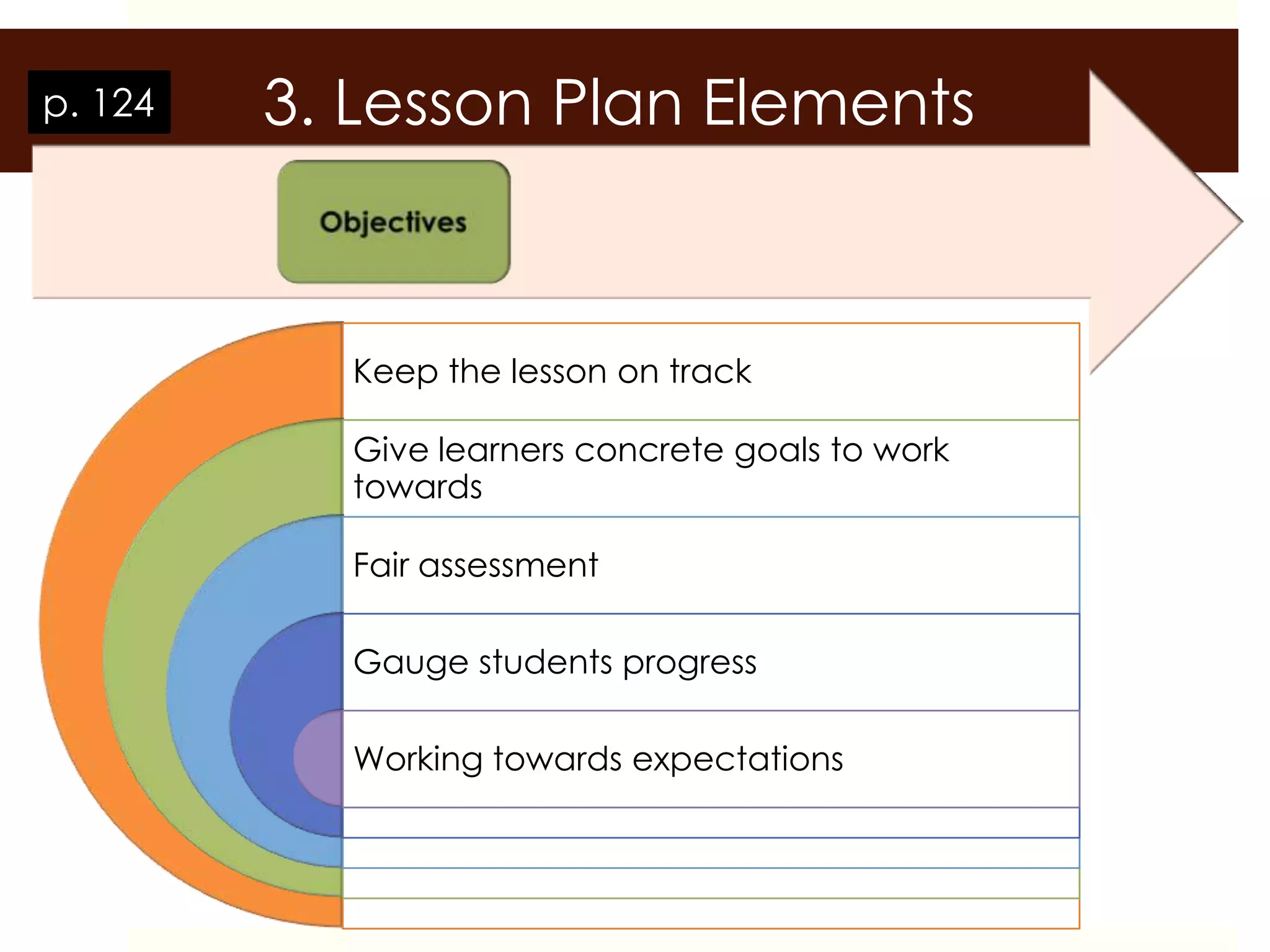
p. 124   3. Lesson Plan Elements


           Keep the lesson on track

           Give learners concrete goals to work
           towards

           Fair assessment

           Gauge students progress

           Working towards expectations
p. 124    3. Lesson Plan Elements


When writing clear objectives they need to:
   have a measurable and observable outcome
   be concise in structure and length
   follow a consistent format
   be able to be read by an outside observer
Pg. 125
Table 1.5   3. Lesson Plan Elements
                     Avoid using ambiguous or passive
                     verbs and phrases that are not
                     measurable or observable.
p. 124     3. Lesson Plan Elements
                           “Students will be able to…”


Examples of well-written objectives:

  Students will be able to identify the primary colors.

  Students will be able to locate proper nouns from a list of
  nouns.

  Students will be able to predict what comes next in the
  story presented.

  Students will be able to collect like shaped objects from a
  basket.
Pg. 126
Table 1.6   3. Lesson Plan Elements
• concise, repetitive in form
• visually easy to understand
p. 126     3. Lesson Plan Elements


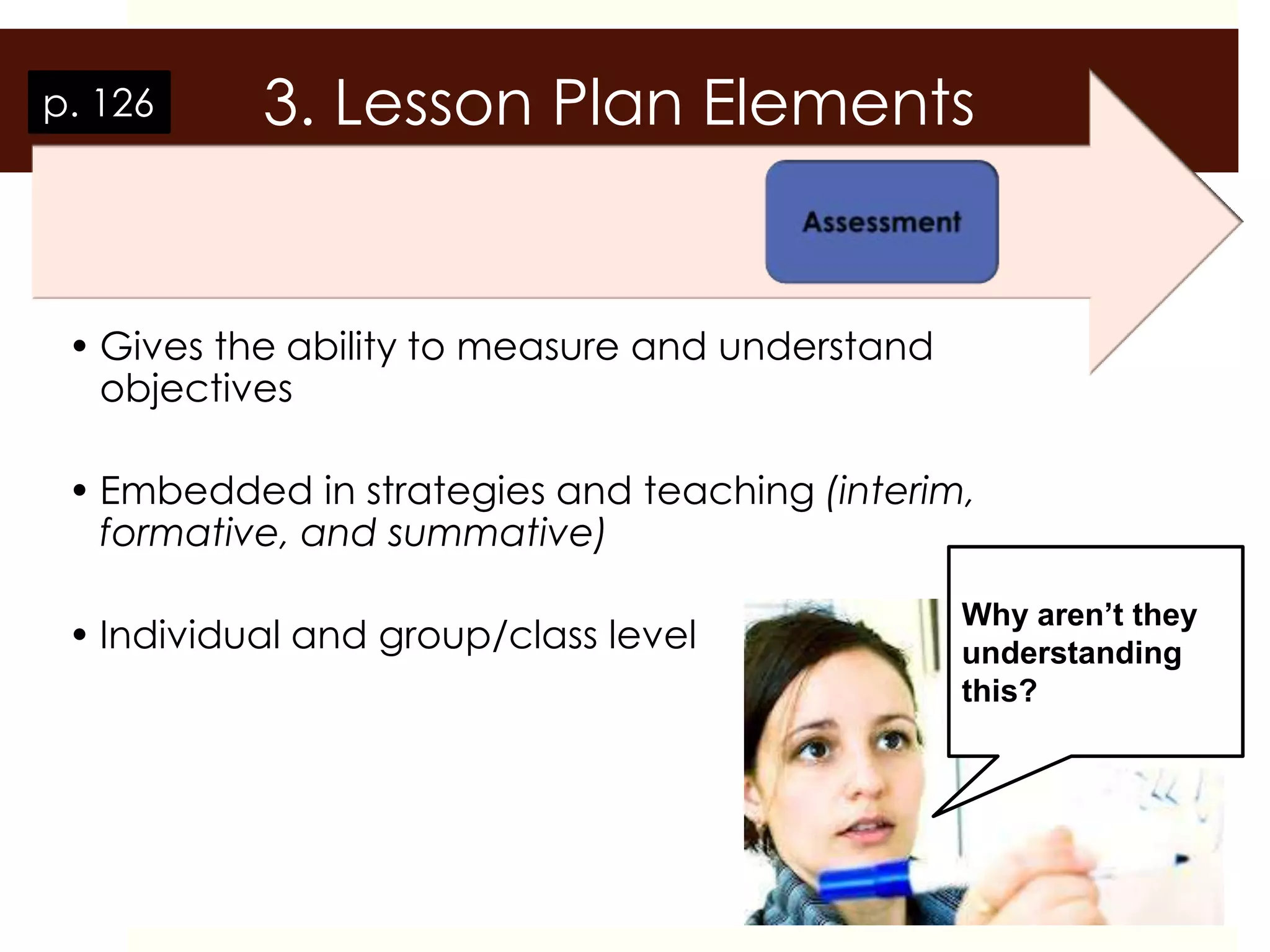
 • Gives the ability to measure and understand
   objectives

 • Embedded in strategies and teaching (interim,
   formative, and summative)

                                                 Why aren’t they
 • Individual and group/class level              understanding
                                                 this?
p. 127     3. Lesson Plan Elements


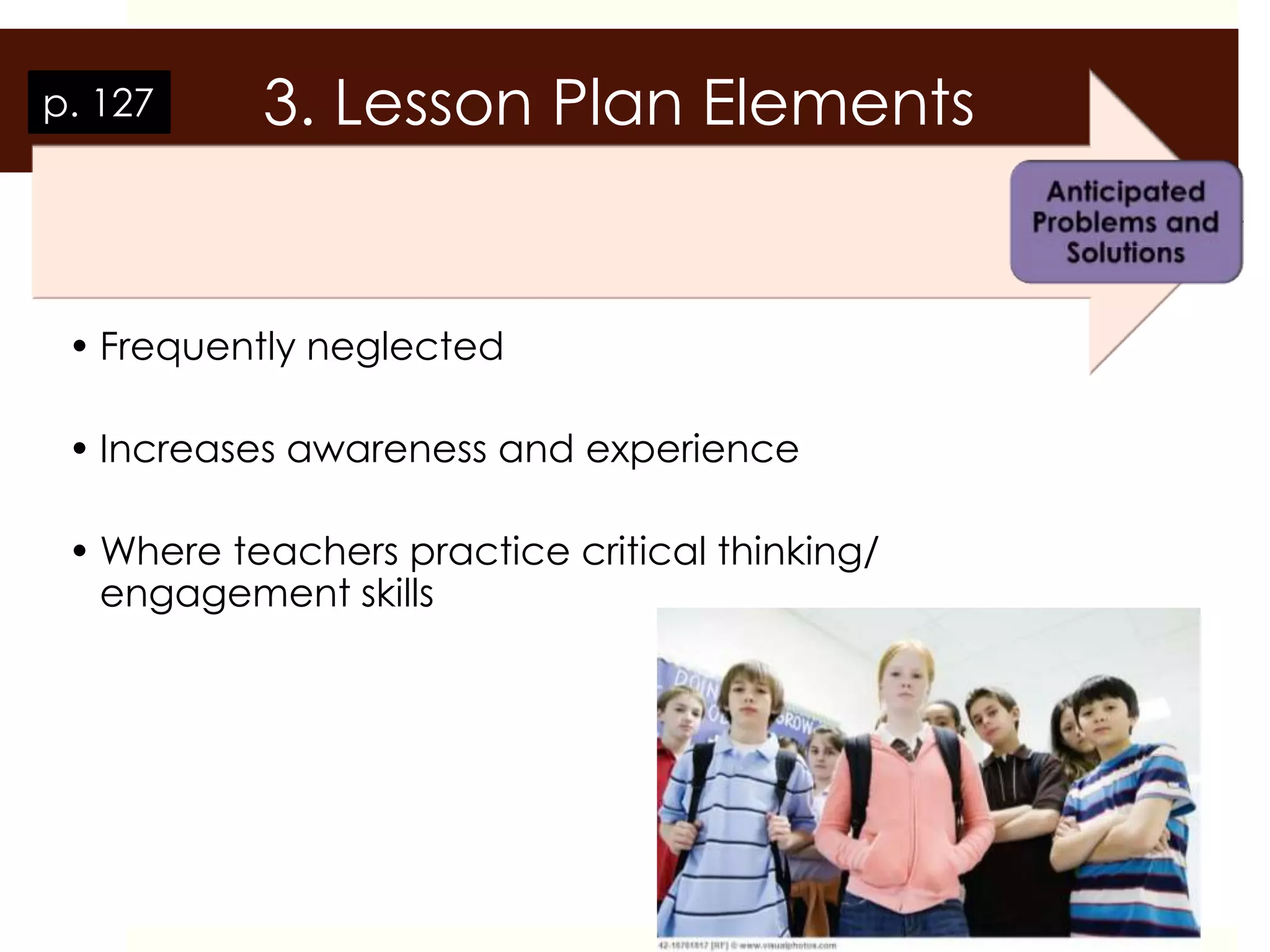
 • Frequently neglected

 • Increases awareness and experience

 • Where teachers practice critical thinking/
   engagement skills
4. Lesson Planning Activity
 Objective: Create a lesson plan and then assess another
 group’s lesson plan.
Instructions:
1. Your group will be given a worksheet packet and lesson material.
2. In your group, plan a lesson based on the material given to your group.
3. Use the information we discussed today and your lecture materials.
4. You will have 25 minutes to plan. After you're finished I will collect your plans.
5. Wait for more instructions.
4. Lesson Planning Activity
 Objective: Create a lesson plan and then assess another
 group’s lesson plan.
Instructions:
1. I will give your group another group’s lesson plan.
2. Use the “Lesson Planning Peer Assessment” form on page 1.
3. You can write any additional comments on that page or the lesson plan.
4. Please be constructive with your comments and assessment.
5. You have 10 minutes to assess.
Feedback and Questions

http://www.waygook.org/

http://www.eflclassroom.com


My email address: moonasard@gmail.com

PPP Lesson Planning

  • 1.
    Present, Practice, Produce UsingPPP Lesson Format to Create Effective Lessons Through Task Based Learning pp.118-131
  • 2.
    Objective/ Schedule Objective: Tohave participants create and assess a lesson plan. To prepare participants for Practicum 3. • Introductions • Group discussion activity • Lecture on lesson planning • Break • Lesson planning activity • Lesson plan feedback • Questions/ Closing
  • 3.
    Who am I? •Certified Teacher – U.S.A • 7.5yrs teaching experience  4yrs U.S.  3.5yrs South Korea • B.Sc. K-12 Music Education • MRes- Educational and Social Research • EPIK/ TaLK Teacher Trainer • Assistant Professor of English at Gimcheon University Daniel Moonasar
  • 4.
    Who are you? •Graduates (4yrs with degree)? • Undergraduates (2yrs and or no degree)? • Education majors? • Teaching experience? • Non internship? • 6 month contract? • 1 year contract? • Visited in South Korea before? • Lived in South Korea before?
  • 6.
    Group Discussion Activity Objective:To gather and discuss our thoughts on the role of lesson planning. Directions: 1. Make a group of 4-5 people. 2. Discuss and answer the question given to your group. 3. Pick 1 person to speak for your group. 4. When finished, we’ll share answers to the class.
  • 7.
    Group Discussion Activity G1.Why is lesson planning important? G2. How is lesson planning important for the teacher? For the learners? G3. What do you take into account when you design a lesson plan? G4. What constant components are there in your lesson plan? G5. Can lesson planning be a hindrance to teaching/ learning? Why? G6. What things are the most difficult when lesson planning? Why?
  • 8.
    Group Discussion Activity G1.Why is lesson planning important?  Gives teaching structure, framework, and an overall shape. I don’t need to lesson plan. I know what I am  Allows you to communicate more going to do. effectively to students, parents, and peers.  Gives time and structure to allow for development of teaching skills.  It suggests professionalism and genuine commitment.
  • 9.
    Group Discussion Activity G2.How is lesson planning important for the teacher? For the learners? • Don’t have to think on • Gives a structured lesson your feet. and allows for comprehensible input. • Don’t lose “face” in front of learners. • Builds confidence and respect for the teacher. • You know your procedures and sequence. • Gives the teacher’s work as a model to imitate.
  • 10.
    Group Discussion Activity G3.What do you take into account when you design a lesson plan? • who? Learners • level? Characteristics • previous knowledge? • multiple intelligences? • objectives • comprehensible input Learner outcomes • what did/ will they learn • micro/ macro sequencing • school’s/ department’s curriculum Practical Requirements • classroom/ materials • time • culture
  • 11.
    Group Discussion Activity G4.What constant components are there in your lesson plan?  title  objectives  materials  procedures  assessment  anticipated problems & solutions.
  • 12.
    Group Discussion Activity G5.Can lesson planning be a hindrance to teaching/ learning? Why? • create/ • practice • repetitive use templates • applying • concise theory to • essential application • comprehensible information language • assessment • practice/ • visual continuity style • professional and design development • creating a scedule
  • 13.
    Group Discussion Activity G6.What things are the most difficult when lesson planning? Why? My Lesson Difficulties
  • 14.
    Lecture Schedule 1. Skillsand Methodology 2. PPP Lesson Plan Format 3. Lesson Plan Elements 4. Lesson Planning Activity
  • 15.
    1. Bringing TogetherLanguage Skills and pp. 118-119 Methodology What are the 2 focuses in a language classroom? What are the 4 associated skills in a language classroom? Receptive Skills Productive Skills Reading Writing Listening Speaking
  • 16.
    1. Bringing TogetherLanguage Skills and pp. 121-122 Methodology • Expected in NSET (Native Speaking English Teacher) curriculum. • NSET emphasis on speaking. • Emphasis on exploring language skills through producing target language.
  • 17.
    1. Bringing TogetherLanguage Skills and pp. 122-123 Methodology • Receptive based. Allows for “correct or incorrect” engagement of language. • Teacher centered, component comprehension driven. Generally “safe” for students • Excellent for memorizing, introduction of core concepts, and eliciting information from students.
  • 18.
    1. Bringing TogetherLanguage Skills and pp. 119-120 Methodology  Lecture • The method in which you  Debate conduct your class.  Discussion  Student Centered • Consists of teaching and classroom strategies.  Active Learning  Small Groups • Helps in focusing and  Role Playing guiding your lesson/ classroom.  Jigsaw  Task Based Learning
  • 19.
    1. Bringing TogetherLanguage Skills and pp. 119-120 Methodology • Tasks in which learners generates authentic language. • The task is based on students using the language to achieve specific outcomes. • Task and the language are the instruments to complete the task. • The task is an activity that: • reflects real life or authentic tasks • has students focus on meaning • uses language freely • allows students to experiment or make mistakes
  • 21.
    1. Bringing TogetherLanguage Skills and pp. 119-120 Methodology •Questioning •Games with specific outcomes •Surveys •Interviews •Story building •Role plays •Ordering/ Sorting •Experimenting/ Building
  • 22.
    2. PPP Formatand it’s Reasoning pp. 120-122 • Easy 3 staged lesson plan. • Most accepted lesson plan format in South Korea and NSETs Present • Allows for receptive and productive language skills. Practice • Flexible for multi strategy approaches. Produce
  • 23.
    2. PPP Formatand it’s Reasoning pp. 120-122 • Share lessons with other professionals Present • Makes lessons understandable for 5-10 minutes observing peers, supervisors, & parents Practice 10-15 minutes • Communicates about in-class roles and lesson execution Produce 20-25 minutes
  • 24.
    2. PPP Formatand it’s Reasoning pp. 120-122 • Used to introduce new or target language. • Teacher can use: PPT songs flash cards drills picture cards games Present videos direct questions
  • 25.
    2. PPP Formatand it’s Reasoning pp. 120-122 • Teacher centered vs. student centered • Don’t linger for comprehension • Goal is to present comprehensible input not gain comprehension. Present
  • 26.
    2. PPP Formatand it’s Reasoning pp. 120-122 • Gives controlled practice through controlled activities • Teacher can use: question and pre-written role answer plays choral response jigsaw activities read and repeat games worksheets direct questions Practice
  • 27.
    2. PPP Formatand it’s Reasoning pp. 120-122 • Goal is to give students boundaries to safely use the language • Clearly defined correct and incorrect answers • Give clear feedback • Time to assess Practice
  • 28.
    2. PPP Formatand it’s Reasoning pp. 120-122 • To freely as possible interact and explore the language • Teacher can use: group & pair work gathering information creating dialogue interviews creating role plays games creating stories presentations Produce
  • 29.
    2. PPP Formatand it’s Reasoning pp. 120-122 • Goal is to produce language, not necessarily on correctness • Can be somewhat hectic • Use classroom strategies for management • Classroom Management • Curriculum Development and Design • Assessment & Assignment • Content-based English Instruction • Task-based Learning Produce
  • 30.
    p. 123 3. Lesson Plan Elements
  • 31.
    p.123 Table 1.4 3. Lesson Plan Elements
  • 32.
    p. 124 3. Lesson Plan Elements Keep the lesson on track Give learners concrete goals to work towards Fair assessment Gauge students progress Working towards expectations
  • 33.
    p. 124 3. Lesson Plan Elements When writing clear objectives they need to: have a measurable and observable outcome be concise in structure and length follow a consistent format be able to be read by an outside observer
  • 34.
    Pg. 125 Table 1.5 3. Lesson Plan Elements Avoid using ambiguous or passive verbs and phrases that are not measurable or observable.
  • 35.
    p. 124 3. Lesson Plan Elements “Students will be able to…” Examples of well-written objectives: Students will be able to identify the primary colors. Students will be able to locate proper nouns from a list of nouns. Students will be able to predict what comes next in the story presented. Students will be able to collect like shaped objects from a basket.
  • 36.
    Pg. 126 Table 1.6 3. Lesson Plan Elements • concise, repetitive in form • visually easy to understand
  • 37.
    p. 126 3. Lesson Plan Elements • Gives the ability to measure and understand objectives • Embedded in strategies and teaching (interim, formative, and summative) Why aren’t they • Individual and group/class level understanding this?
  • 38.
    p. 127 3. Lesson Plan Elements • Frequently neglected • Increases awareness and experience • Where teachers practice critical thinking/ engagement skills
  • 39.
    4. Lesson PlanningActivity Objective: Create a lesson plan and then assess another group’s lesson plan. Instructions: 1. Your group will be given a worksheet packet and lesson material. 2. In your group, plan a lesson based on the material given to your group. 3. Use the information we discussed today and your lecture materials. 4. You will have 25 minutes to plan. After you're finished I will collect your plans. 5. Wait for more instructions.
  • 40.
    4. Lesson PlanningActivity Objective: Create a lesson plan and then assess another group’s lesson plan. Instructions: 1. I will give your group another group’s lesson plan. 2. Use the “Lesson Planning Peer Assessment” form on page 1. 3. You can write any additional comments on that page or the lesson plan. 4. Please be constructive with your comments and assessment. 5. You have 10 minutes to assess.
  • 41.

Editor's Notes

  • #2 a skill at doing a specified thing, typically one acquired through practice.