Discussion Workshop
Applying PDCA A3 Thinking and
Problem Solving
John S. Kiff
Lean Summit 2012
Introduction
• Purpose:
– Is: to share experiences of the use of a common problem-
solving process in organizations
– Is not: to teach A3 Thinking
• Process:
– Presentation of (anonymised) survey results. “Indicative!”
– Discussion of experiences of using PDCA, A3 Thinking
• People:
– 41 delegates to this workshop
– 15 of these contributed to the survey
– 37 other Summit delegates contributed
52 responses in
total
Extent to which there is a process
Q1. Would you say that there is a
Common Problem-Solving Process in your organization?
28%
43%
23%
0%
5%
10%
15%
20%
25%
30%
35%
40%
45%
50%
No Yes, to some extent Yes, definitely
Source: LEA Survey of 53 delegates to Lean Summit, November 2012
A significant
proportion have
no common
problem-solving
process
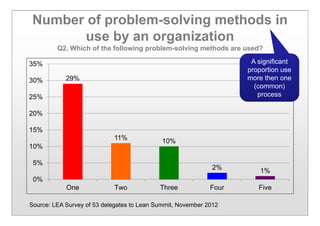
Number of problem-solving methods in
use by an organization
Q2. Which of the following problem-solving methods are used?
29%
11% 10%
2% 1%
0%
5%
10%
15%
20%
25%
30%
35%
One Two Three Four Five
Source: LEA Survey of 53 delegates to Lean Summit, November 2012
A significant
proportion use
more then one
(common)
process
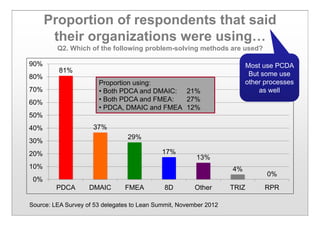
Proportion of respondents that said
their organizations were using…
Q2. Which of the following problem-solving methods are used?
81%
37%
29%
17%
13%
4%
0%
0%
10%
20%
30%
40%
50%
60%
70%
80%
90%
PDCA DMAIC FMEA 8D Other TRIZ RPR
Source: LEA Survey of 53 delegates to Lean Summit, November 2012
Proportion using:
• Both PDCA and DMAIC: 21%
• Both PDCA and FMEA: 27%
• PDCA, DMAIC and FMEA 12%
Most use PCDA
But some use
other processes
as well
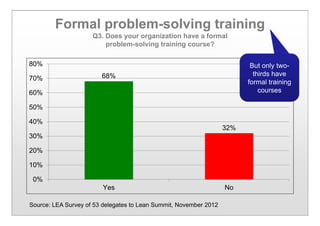
Formal problem-solving training
Q3. Does your organization have a formal
problem-solving training course?
68%
32%
0%
10%
20%
30%
40%
50%
60%
70%
80%
Yes No
Source: LEA Survey of 53 delegates to Lean Summit, November 2012
But only two-
thirds have
formal training
courses
Proportion of people trained
Q4. What proportion of the people in your organization has been TRAINED in a
Common Problem-Solving Process??
66%
13%
8% 8% 6%
0%
10%
20%
30%
40%
50%
60%
70%
<20% 20-40% 40-60% 60-80% 80-100%
Source: LEA Survey of 53 delegates to Lean Summit, November 2012
…and in most
organizations,
most people
have NOT
been trained!
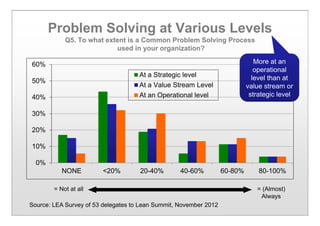
Problem Solving at Various Levels
Q5. To what extent is a Common Problem Solving Process
used in your organization?
0%
10%
20%
30%
40%
50%
60%
NONE <20% 20-40% 40-60% 60-80% 80-100%
At a Strategic level
At a Value Stream Level
At an Operational level
Source: LEA Survey of 53 delegates to Lean Summit, November 2012
= Not at all = (Almost)
Always
More at an
operational
level than at
value stream or
strategic level
Use of A3s at Various Levels
Q6. To what extent are A3s REGULARLY used
in your organization for problem solving??
0%
10%
20%
30%
40%
50%
60%
NONE <20% 20-40% 40-60% 60-80% 80-100%
At a Strategic level
At a Value Stream Level
At an Operational level
Source: LEA Survey of 53 delegates to Lean Summit, November 2012
= Not at all = (Almost)
Always
A3s
significantly
less used than
problem-
solving
process…
…but some use
at a strategic
level
Why are A3s not more widely used?
Q7. What do you think the causes are that prevent
wider use of A3 in your organization?
• Primary reason: lack of knowledge (60% cited)
– In some cases no awareness of the tool at all
• Combined with: lack of leadership (8% cited)
• Or: ‘perceived to be too time consuming’ (3%)
• Other reasons:
– No common problem-solving process anyway
– No culture of problem solving – jump to solutions
Why are A3s not more widely used?
Q7. What do you think the causes are that prevent
wider use of A3 in your organization –
• Verbatim quotes:
Natural tendency is to jump to solution,
we need to change the mindset that it’s
worth while slowing down to think deeper,
get to root cause and then address the
root causes
NO FACTS TO ANSWER THIS!
Historical culture of jumping to
the perceived solution
Some people don't feel as
comfortable as others.
Some people think A3s take
"too much time" to create
and they are already busy.
Mental blocks e.g. that if we
are supposed to use A3 as
the tool, it will take very long
time, and we don't have that
time to solve the problem
Why are A3s not more widely used?
Q7. What do you think the causes are that prevent
wider use of A3 in your organization –
Lack of training and
understanding.
No clear expectation from
Senior Management.
Perceived as too time
consuming
(again lack of training)
Poor management training.
Top down hierarchical (i.e. senior opinions)
and non-evidence based (no data) 'dictats'
and poor performance management
measures that drive the wrong solutions
and behaviours
High turnover of management staff, so less
than 2 years in post.
Constant drive to achieve results in a short
time scale so theirs is a culture of
'massaging the data' and kicking the can
down the road for
the next manager to deal with.
We write plenty, but more are
charters and mission
statements rather than
'usable' A3's
• Verbatim quotes:
Why are A3s not more widely used?
8. What do you think the causes are that prevent more effective (‘better’)
use of A3s in your organization?
• Primary reason: lack of knowledge (38%)
– a) Awareness and b) understanding - of the tool itself
– Of the value of, and purpose of, A3s
• Again combined with lack of leadership (25%)
– Setting an example and/or demanding the use of A3s
– “Traditional thinking predominates”
• Again: perceived to be too time consuming
Why are A3s not more widely used?
8. What do you think the causes are that prevent more effective (‘better’)
use of A3s in your organization?
• Verbatim quotes:
Lack of knowledge & training.
For those that are trained and
should do so: - lack of
leadership.
Lack of awareness, lack of training,
lack of understanding of the
benefits.
Lack of history or working with
'rigorous' methods.
Individualism.
Lack of training in A3.
Since it is not demanded to use it, it
is also difficult to achieve good
skills from using it.
Lack of clarity and sponsor
alignment over the 'true' problem
and best route / 'cost' of
implementing the solution.
Why are A3s not more widely used?
8. What do you think the causes are that prevent more effective (‘better’)
use of A3s in your organization?
• Verbatim quotes:
Seen as a tool rather
than a systematic
process for management
thinking and
development.
See it as a template not
the means to challenge
deeper thinking
Easier to get a decision from a more
traditional method where managers
'know' what to expect.
No clear expectations from management
and
management are not properly trained in
the use of A3 to challenge and coach the
organisation
Why are A3s not more widely used?
8. What do you think the causes are that prevent more effective (‘better’)
use of A3s in your organization?
• Verbatim quotes:
As above (too
time consuming)
plus seen by
many as a very
'Japanese'
approach. People
are conditioned to
PowerPoint etc.
Read Chris Argyris work
Double Loop Learning in Organizations.
Because we don't have senior managers at the top of
the organisation who use A3,
there is no peer to peer (or top down) challenge or
demonstration of 'Think Slow' problem solving.
Anyone challenging or demonstrating upwards and
revealing the paucity of our managers' problem solving
capability is likely to be seen as a threat and the person
and their 'better process' will be rejected from the
organisation.
Learning respectful challenge is the most difficult skill.
Thus is the way of the world.
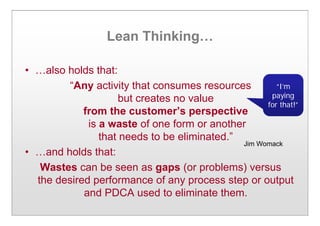
Lean Thinking…
• …also holds that:
“Any activity that consumes resources
but creates no value
from the customer’s perspective
is a waste of one form or another
that needs to be eliminated.”
• …and holds that:
Wastes can be seen as gaps (or problems) versus
the desired performance of any process step or output
and PDCA used to eliminate them.
Jim Womack
“I’m
paying
for that!”
The proven method for solving problems
and maintaining / improving solutions
• Main Lean tool for
structured problem-
solving by people
at ALL levels using
PDCA Grasp the
Situation
At the ‘gemba’
(workplace) facts!
“Go See!”
Check Do
PlanAct
1. Clarify, break down and
define the problem
2. Grasp the situation:
measure and map to
get proof / evidence
3. Define the desired
outcome (gap) QCDP
4. Analyse the problem
(5W 1H) and causes
5. Develop possible
countermeasures
“Hypothesis”
6. Give the ideas for
change a try-out
“Experiment”
7. Evaluate results
“What was learned?”
“Study & Reflect”
8. Incorporate the learning into
the process.
Standardise and stabilise the
improvement and/or go around
the improvement cycle again
“Standardise and/or
Adjust”
Go
See!
Don’t
jump to solutions
18
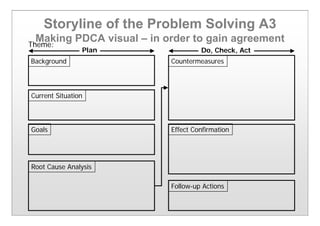
Storyline of the Problem Solving A3
Making PDCA visual – in order to gain agreement
Plan Do, Check, Act
Background
Current Situation
Goals
Root Cause Analysis
Countermeasures
Effect Confirmation
Follow-up Actions
Theme:
Storyline of the Problem Solving A3
- early to mid-stage
Plan Do, Check, Act
Background
Current Situation
Goals
Analysis
Possible Countermeasures
Theme:
Analysis contd.
Defining the
Problem.
The hardest part!
“Go slow in order to go fast”
(Jeffrey Liker)
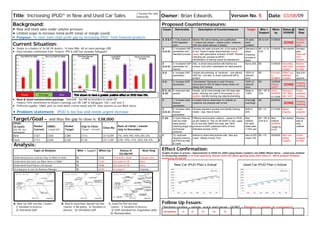
Title: Increasing IPUD* in New and Used Car Sales
Current Situation:
 Dealer vs a basket of 16 UK VX dealers, 14 have BMs, All on same package (VB)
 Data includes commission from Finance, PPP & GAP but excludes Safeguard
 New & Used remuneration package: £50/unit - but NB no incentive to retain GP
Finance:10% commission on Dealer’s earnings excl VB. GAP & Safeguard: £50 / unit over 5
 Preferred supplier: GMAC poor on Used albeit criteria eased July 09. Slow systems so use Black Horse
Owner: Brian Edwards Version No. 5 Date: 03/08/09
Background:
 New and Used sales under volume pressure
 Limited scope to increase metal profit (new) or margin (used).
 Purpose: To close Sales Dept profit gap by increasing IPUD* from financial products
Proposed Countermeasures:
Topic of Analysis Who + Support When by: Status @
03/08/09
Next Step
Understand process used by Tony vs others in team BE 12/06 Persistence, detail Evaluate more
Understand why team use Black Horse vs GMAC BE 12/06 Now paid on VB None
Understand Used Finance rate spread BE 15/06 Now paid on VB None
Develop pros & cons for Business Manager BE 30/08 In progress Ongoing
Follow Up Issues:
Checking routine – simple, quick and visual - HOW? – Phoning a sample of customers?
Effect Confirmation:
Graphs of plan vs actual – improvement in IPUD for 2009 using Dealer numbers not GMAC/Black Horse – need easy method
of measuring monthly or at least quarterly. Discuss with SJH about getting easily from Close It. SM to propose Pinnacle
method by 04/08/09
Analysis:
 Problem statement: IPUD is too low and needs urgent increase
Cause Deliverable Description of Countermeasure Target Who +
Support
When
by
Status @
03/08/09
Next
Step
A, B & C 1. Fully trained &
FSA regulated
team
Mentor F&I online training and qualification.
10 exams per person – needs a plan / cadence
(NB new starter allowed 2 weeks)
All sales
team
qualified
BE & SJH 31/08/09
DONE
Checks+1
2month
tests
A
(i) & (ii)
2. Increased GAP
penetration and
standard process
Develop std sales process (inc JI) for selling GAP
to incl. Close-It based deal presenter (nearly
ready) with assumptive inclusion of GAP. Routine
checking std. process by BE/IC.
Identification of training needs by salesperson
Standard in
place
Checking
process in
place
BE + IC &
SJH
31/08/09 Not started Develop
plan.
Date with
SJH
needed
A
(i) & (ii)
3. Increased GAP
penetration for
Katrina
Alex to share best practice with Katrina but
involve Tony when understand his ‘best practice’
Kat to 20% BE 31/09/09 Kat selling
GAP, Alex
S’guard
Monitor
progress
for both
A (i) 4. Increase GAP
penetration
Double documenting at handover – one without
GAP etc., one with, to show cost/month diff to
protect
100% of
relevant
docs
BE Put back
to
30/09/09
GMAC sys
teething
troubles
Spk SJH
re
payouts
A (i) 5. Increase GAP
penetration
‘Unprotected’ Stamped on each Finance
Document (or IDD for Black Horse) where not
taking GAP already
100% of
relevant
docs
BE 12/06/09
(Actual
14/07)
DONE
Ongoing
checking
B (i), (ii)
& (iii)
6. Improved rate
spread
Decide, set & communicate new HQ base rate
policy. Develop std. work JI for process & new
starters. Identify training esp.objectionhandling
Raise to
1.00%
BE + BF &
SJH
JIs by
30/09/09
31/12/09
Paying on
VB + New
rate 14/07
Check
expected
increase
C. 7. Increase Used
finance
penetration
Increase finance awareness on website so
customer can propose self on-line
finance@
hutchings.
BE 05/06/09
DONE
Ongoing
checking
C
(i) & (ii)
8. Increase Used
finance
penetration
Develop standard process and identify training
needs – esp. Alex & Gavin
Both to
30%
BE + IC 31/12/09 Begun,
ongoing
Check
progress
C (iii) 9. Each (New as
well as) Used
sales person
reaching target on
all financial
products
Different remuneration method – based on IPUD –
as per Dealer B. Pay on VB ASAP to max. oppty.
to do bus with GMAC but must sell 100%
products to100% customers100% of time
Standard process VITAL
New
method.
All Used
sales team
> XX% pen
BE + BF &
SJH & IC
New
method
30/09/09
Target by
31/12
Not started Develop
plan &
new
method
C 10. Improved
S/guard revenue
(& IPUD) by Alex
& Lewis
Katrina to share best practice with Alex and
Lewis. Maybe involve Tony
Alex to15%
Lewis 15%
BE + IC 30/09/09 Alex now
selling
S’guard
Check
progress
for both
(*Income Per Unit
Delivered)
A. New car GAP too low: Causes:
i) Variation in process
ii) Untrained staff
B. New & Used Rate Spread too low:
Causes: i) No policy, ii) Variation in
process iii) Untrained staff
C. Used Fin Pen too low:
Causes: i) Variation in process
ii) Staff untrained inc negotiation skills,
iii) Remuneration
Dealer Average Max
Target/Goal – and thus the gap to close is: £38,000:
IPUD
(£/unit)
(inc VB, excl
Safeguard)
Dealer
Current
GMAC:
“a good job”
Dealer
Target
Gap to Close
(Target – Current)
Close By:
Rate of Climb / month
July to December:
New £167 £350 £280 £113 31/12/09 7%-10%-9%-10%-8%-5%
Used £112 £250 £230 £118 31/12/09 14%-19%-11%-10%-5%-9%
Circulation: JH BF. SH SM NC
Summary: A3 Planning / Thinking (PDCA)
Background
(why are we talking
about this?)
Current
Situation
(what’s happening
now?)
Target/Goal
(where, quantitatively,
in QDCP terms do we
want to get to?)
(Root Cause) Analysis
(showing the working out)
Early analysis informs the
Current Situation
Countermeasures
(with timing plan – who
is going to do what by
when)
Effect
Confirmation
(Did the
countermeasures
work?)
Follow-up Issues
(what still needs
sorting)
Team members
Plan Do, Check, Act
22
Title (summary of problem) Project Owner / Sponsor
Discussion Workshop
Applying PDCA A3 Thinking and
Problem Solving
John S. Kiff
Lean Summit 2012

Applying PDCA, A3 Thinking & Problem Solving

  • 1.
    Discussion Workshop Applying PDCAA3 Thinking and Problem Solving John S. Kiff Lean Summit 2012
  • 2.
    Introduction • Purpose: – Is:to share experiences of the use of a common problem- solving process in organizations – Is not: to teach A3 Thinking • Process: – Presentation of (anonymised) survey results. “Indicative!” – Discussion of experiences of using PDCA, A3 Thinking • People: – 41 delegates to this workshop – 15 of these contributed to the survey – 37 other Summit delegates contributed 52 responses in total
  • 3.
    Extent to whichthere is a process Q1. Would you say that there is a Common Problem-Solving Process in your organization? 28% 43% 23% 0% 5% 10% 15% 20% 25% 30% 35% 40% 45% 50% No Yes, to some extent Yes, definitely Source: LEA Survey of 53 delegates to Lean Summit, November 2012 A significant proportion have no common problem-solving process
  • 4.
    Number of problem-solvingmethods in use by an organization Q2. Which of the following problem-solving methods are used? 29% 11% 10% 2% 1% 0% 5% 10% 15% 20% 25% 30% 35% One Two Three Four Five Source: LEA Survey of 53 delegates to Lean Summit, November 2012 A significant proportion use more then one (common) process
  • 5.
    Proportion of respondentsthat said their organizations were using… Q2. Which of the following problem-solving methods are used? 81% 37% 29% 17% 13% 4% 0% 0% 10% 20% 30% 40% 50% 60% 70% 80% 90% PDCA DMAIC FMEA 8D Other TRIZ RPR Source: LEA Survey of 53 delegates to Lean Summit, November 2012 Proportion using: • Both PDCA and DMAIC: 21% • Both PDCA and FMEA: 27% • PDCA, DMAIC and FMEA 12% Most use PCDA But some use other processes as well
  • 6.
    Formal problem-solving training Q3.Does your organization have a formal problem-solving training course? 68% 32% 0% 10% 20% 30% 40% 50% 60% 70% 80% Yes No Source: LEA Survey of 53 delegates to Lean Summit, November 2012 But only two- thirds have formal training courses
  • 7.
    Proportion of peopletrained Q4. What proportion of the people in your organization has been TRAINED in a Common Problem-Solving Process?? 66% 13% 8% 8% 6% 0% 10% 20% 30% 40% 50% 60% 70% <20% 20-40% 40-60% 60-80% 80-100% Source: LEA Survey of 53 delegates to Lean Summit, November 2012 …and in most organizations, most people have NOT been trained!
  • 8.
    Problem Solving atVarious Levels Q5. To what extent is a Common Problem Solving Process used in your organization? 0% 10% 20% 30% 40% 50% 60% NONE <20% 20-40% 40-60% 60-80% 80-100% At a Strategic level At a Value Stream Level At an Operational level Source: LEA Survey of 53 delegates to Lean Summit, November 2012 = Not at all = (Almost) Always More at an operational level than at value stream or strategic level
  • 9.
    Use of A3sat Various Levels Q6. To what extent are A3s REGULARLY used in your organization for problem solving?? 0% 10% 20% 30% 40% 50% 60% NONE <20% 20-40% 40-60% 60-80% 80-100% At a Strategic level At a Value Stream Level At an Operational level Source: LEA Survey of 53 delegates to Lean Summit, November 2012 = Not at all = (Almost) Always A3s significantly less used than problem- solving process… …but some use at a strategic level
  • 10.
    Why are A3snot more widely used? Q7. What do you think the causes are that prevent wider use of A3 in your organization? • Primary reason: lack of knowledge (60% cited) – In some cases no awareness of the tool at all • Combined with: lack of leadership (8% cited) • Or: ‘perceived to be too time consuming’ (3%) • Other reasons: – No common problem-solving process anyway – No culture of problem solving – jump to solutions
  • 11.
    Why are A3snot more widely used? Q7. What do you think the causes are that prevent wider use of A3 in your organization – • Verbatim quotes: Natural tendency is to jump to solution, we need to change the mindset that it’s worth while slowing down to think deeper, get to root cause and then address the root causes NO FACTS TO ANSWER THIS! Historical culture of jumping to the perceived solution Some people don't feel as comfortable as others. Some people think A3s take "too much time" to create and they are already busy. Mental blocks e.g. that if we are supposed to use A3 as the tool, it will take very long time, and we don't have that time to solve the problem
  • 12.
    Why are A3snot more widely used? Q7. What do you think the causes are that prevent wider use of A3 in your organization – Lack of training and understanding. No clear expectation from Senior Management. Perceived as too time consuming (again lack of training) Poor management training. Top down hierarchical (i.e. senior opinions) and non-evidence based (no data) 'dictats' and poor performance management measures that drive the wrong solutions and behaviours High turnover of management staff, so less than 2 years in post. Constant drive to achieve results in a short time scale so theirs is a culture of 'massaging the data' and kicking the can down the road for the next manager to deal with. We write plenty, but more are charters and mission statements rather than 'usable' A3's • Verbatim quotes:
  • 13.
    Why are A3snot more widely used? 8. What do you think the causes are that prevent more effective (‘better’) use of A3s in your organization? • Primary reason: lack of knowledge (38%) – a) Awareness and b) understanding - of the tool itself – Of the value of, and purpose of, A3s • Again combined with lack of leadership (25%) – Setting an example and/or demanding the use of A3s – “Traditional thinking predominates” • Again: perceived to be too time consuming
  • 14.
    Why are A3snot more widely used? 8. What do you think the causes are that prevent more effective (‘better’) use of A3s in your organization? • Verbatim quotes: Lack of knowledge & training. For those that are trained and should do so: - lack of leadership. Lack of awareness, lack of training, lack of understanding of the benefits. Lack of history or working with 'rigorous' methods. Individualism. Lack of training in A3. Since it is not demanded to use it, it is also difficult to achieve good skills from using it. Lack of clarity and sponsor alignment over the 'true' problem and best route / 'cost' of implementing the solution.
  • 15.
    Why are A3snot more widely used? 8. What do you think the causes are that prevent more effective (‘better’) use of A3s in your organization? • Verbatim quotes: Seen as a tool rather than a systematic process for management thinking and development. See it as a template not the means to challenge deeper thinking Easier to get a decision from a more traditional method where managers 'know' what to expect. No clear expectations from management and management are not properly trained in the use of A3 to challenge and coach the organisation
  • 16.
    Why are A3snot more widely used? 8. What do you think the causes are that prevent more effective (‘better’) use of A3s in your organization? • Verbatim quotes: As above (too time consuming) plus seen by many as a very 'Japanese' approach. People are conditioned to PowerPoint etc. Read Chris Argyris work Double Loop Learning in Organizations. Because we don't have senior managers at the top of the organisation who use A3, there is no peer to peer (or top down) challenge or demonstration of 'Think Slow' problem solving. Anyone challenging or demonstrating upwards and revealing the paucity of our managers' problem solving capability is likely to be seen as a threat and the person and their 'better process' will be rejected from the organisation. Learning respectful challenge is the most difficult skill. Thus is the way of the world.
  • 17.
    Lean Thinking… • …alsoholds that: “Any activity that consumes resources but creates no value from the customer’s perspective is a waste of one form or another that needs to be eliminated.” • …and holds that: Wastes can be seen as gaps (or problems) versus the desired performance of any process step or output and PDCA used to eliminate them. Jim Womack “I’m paying for that!”
  • 18.
    The proven methodfor solving problems and maintaining / improving solutions • Main Lean tool for structured problem- solving by people at ALL levels using PDCA Grasp the Situation At the ‘gemba’ (workplace) facts! “Go See!” Check Do PlanAct 1. Clarify, break down and define the problem 2. Grasp the situation: measure and map to get proof / evidence 3. Define the desired outcome (gap) QCDP 4. Analyse the problem (5W 1H) and causes 5. Develop possible countermeasures “Hypothesis” 6. Give the ideas for change a try-out “Experiment” 7. Evaluate results “What was learned?” “Study & Reflect” 8. Incorporate the learning into the process. Standardise and stabilise the improvement and/or go around the improvement cycle again “Standardise and/or Adjust” Go See! Don’t jump to solutions 18
  • 19.
    Storyline of theProblem Solving A3 Making PDCA visual – in order to gain agreement Plan Do, Check, Act Background Current Situation Goals Root Cause Analysis Countermeasures Effect Confirmation Follow-up Actions Theme:
  • 20.
    Storyline of theProblem Solving A3 - early to mid-stage Plan Do, Check, Act Background Current Situation Goals Analysis Possible Countermeasures Theme: Analysis contd. Defining the Problem. The hardest part! “Go slow in order to go fast” (Jeffrey Liker)
  • 21.
    Title: Increasing IPUD*in New and Used Car Sales Current Situation:  Dealer vs a basket of 16 UK VX dealers, 14 have BMs, All on same package (VB)  Data includes commission from Finance, PPP & GAP but excludes Safeguard  New & Used remuneration package: £50/unit - but NB no incentive to retain GP Finance:10% commission on Dealer’s earnings excl VB. GAP & Safeguard: £50 / unit over 5  Preferred supplier: GMAC poor on Used albeit criteria eased July 09. Slow systems so use Black Horse Owner: Brian Edwards Version No. 5 Date: 03/08/09 Background:  New and Used sales under volume pressure  Limited scope to increase metal profit (new) or margin (used).  Purpose: To close Sales Dept profit gap by increasing IPUD* from financial products Proposed Countermeasures: Topic of Analysis Who + Support When by: Status @ 03/08/09 Next Step Understand process used by Tony vs others in team BE 12/06 Persistence, detail Evaluate more Understand why team use Black Horse vs GMAC BE 12/06 Now paid on VB None Understand Used Finance rate spread BE 15/06 Now paid on VB None Develop pros & cons for Business Manager BE 30/08 In progress Ongoing Follow Up Issues: Checking routine – simple, quick and visual - HOW? – Phoning a sample of customers? Effect Confirmation: Graphs of plan vs actual – improvement in IPUD for 2009 using Dealer numbers not GMAC/Black Horse – need easy method of measuring monthly or at least quarterly. Discuss with SJH about getting easily from Close It. SM to propose Pinnacle method by 04/08/09 Analysis:  Problem statement: IPUD is too low and needs urgent increase Cause Deliverable Description of Countermeasure Target Who + Support When by Status @ 03/08/09 Next Step A, B & C 1. Fully trained & FSA regulated team Mentor F&I online training and qualification. 10 exams per person – needs a plan / cadence (NB new starter allowed 2 weeks) All sales team qualified BE & SJH 31/08/09 DONE Checks+1 2month tests A (i) & (ii) 2. Increased GAP penetration and standard process Develop std sales process (inc JI) for selling GAP to incl. Close-It based deal presenter (nearly ready) with assumptive inclusion of GAP. Routine checking std. process by BE/IC. Identification of training needs by salesperson Standard in place Checking process in place BE + IC & SJH 31/08/09 Not started Develop plan. Date with SJH needed A (i) & (ii) 3. Increased GAP penetration for Katrina Alex to share best practice with Katrina but involve Tony when understand his ‘best practice’ Kat to 20% BE 31/09/09 Kat selling GAP, Alex S’guard Monitor progress for both A (i) 4. Increase GAP penetration Double documenting at handover – one without GAP etc., one with, to show cost/month diff to protect 100% of relevant docs BE Put back to 30/09/09 GMAC sys teething troubles Spk SJH re payouts A (i) 5. Increase GAP penetration ‘Unprotected’ Stamped on each Finance Document (or IDD for Black Horse) where not taking GAP already 100% of relevant docs BE 12/06/09 (Actual 14/07) DONE Ongoing checking B (i), (ii) & (iii) 6. Improved rate spread Decide, set & communicate new HQ base rate policy. Develop std. work JI for process & new starters. Identify training esp.objectionhandling Raise to 1.00% BE + BF & SJH JIs by 30/09/09 31/12/09 Paying on VB + New rate 14/07 Check expected increase C. 7. Increase Used finance penetration Increase finance awareness on website so customer can propose self on-line finance@ hutchings. BE 05/06/09 DONE Ongoing checking C (i) & (ii) 8. Increase Used finance penetration Develop standard process and identify training needs – esp. Alex & Gavin Both to 30% BE + IC 31/12/09 Begun, ongoing Check progress C (iii) 9. Each (New as well as) Used sales person reaching target on all financial products Different remuneration method – based on IPUD – as per Dealer B. Pay on VB ASAP to max. oppty. to do bus with GMAC but must sell 100% products to100% customers100% of time Standard process VITAL New method. All Used sales team > XX% pen BE + BF & SJH & IC New method 30/09/09 Target by 31/12 Not started Develop plan & new method C 10. Improved S/guard revenue (& IPUD) by Alex & Lewis Katrina to share best practice with Alex and Lewis. Maybe involve Tony Alex to15% Lewis 15% BE + IC 30/09/09 Alex now selling S’guard Check progress for both (*Income Per Unit Delivered) A. New car GAP too low: Causes: i) Variation in process ii) Untrained staff B. New & Used Rate Spread too low: Causes: i) No policy, ii) Variation in process iii) Untrained staff C. Used Fin Pen too low: Causes: i) Variation in process ii) Staff untrained inc negotiation skills, iii) Remuneration Dealer Average Max Target/Goal – and thus the gap to close is: £38,000: IPUD (£/unit) (inc VB, excl Safeguard) Dealer Current GMAC: “a good job” Dealer Target Gap to Close (Target – Current) Close By: Rate of Climb / month July to December: New £167 £350 £280 £113 31/12/09 7%-10%-9%-10%-8%-5% Used £112 £250 £230 £118 31/12/09 14%-19%-11%-10%-5%-9% Circulation: JH BF. SH SM NC
  • 22.
    Summary: A3 Planning/ Thinking (PDCA) Background (why are we talking about this?) Current Situation (what’s happening now?) Target/Goal (where, quantitatively, in QDCP terms do we want to get to?) (Root Cause) Analysis (showing the working out) Early analysis informs the Current Situation Countermeasures (with timing plan – who is going to do what by when) Effect Confirmation (Did the countermeasures work?) Follow-up Issues (what still needs sorting) Team members Plan Do, Check, Act 22 Title (summary of problem) Project Owner / Sponsor
  • 23.
    Discussion Workshop Applying PDCAA3 Thinking and Problem Solving John S. Kiff Lean Summit 2012