Cardiac axis
Background
• The spread of the cardiac impulse gives rise to
the main deflections of the ECG.
• The total electrical activity at any one moment
of time can be summated and represented by
a single electrical force.
• This force has magnitude and direction and is
termed the instantaneous vector.
• All the vectors occurring in the ventricles
during the production of the QRS can be
averaged.
• The direction of the resulting vector of
electrical spread is called the MEAN QRS AXIS.
• It is customary to measure this only in the
frontal plane.
• It is based on the orientation of the limb
leads, I, II , III, aVR, aVL & aVF.
• The limb lead with the tallest R wave will be
the closest to the QRS axis.
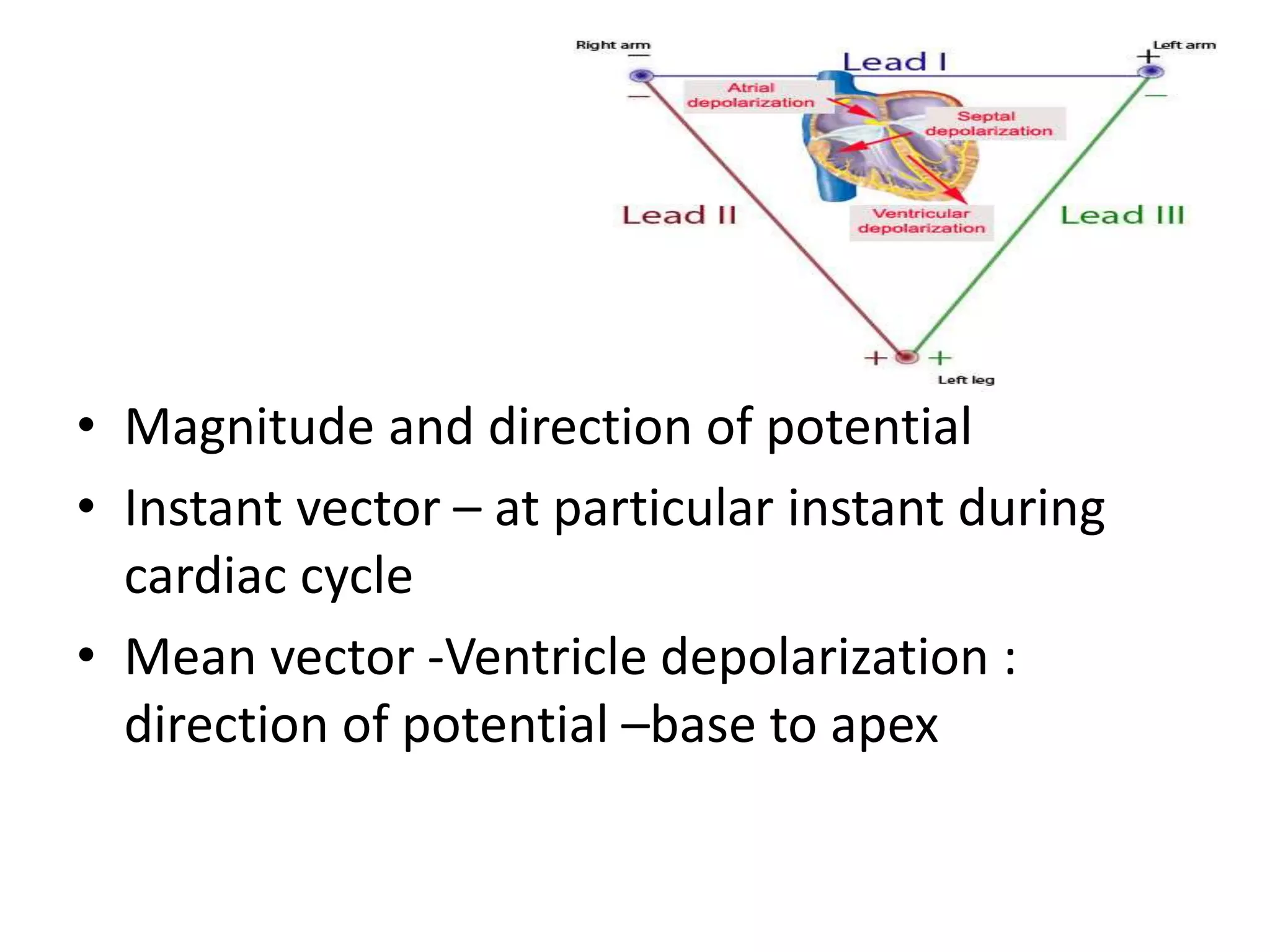
• Magnitude and direction of potential
• Instant vector – at particular instant during
cardiac cycle
• Mean vector -Ventricle depolarization :
direction of potential –base to apex
• Triaxial reference system
• Hexa-axial reference system
• Calculating mean axis from Std Lead ECG
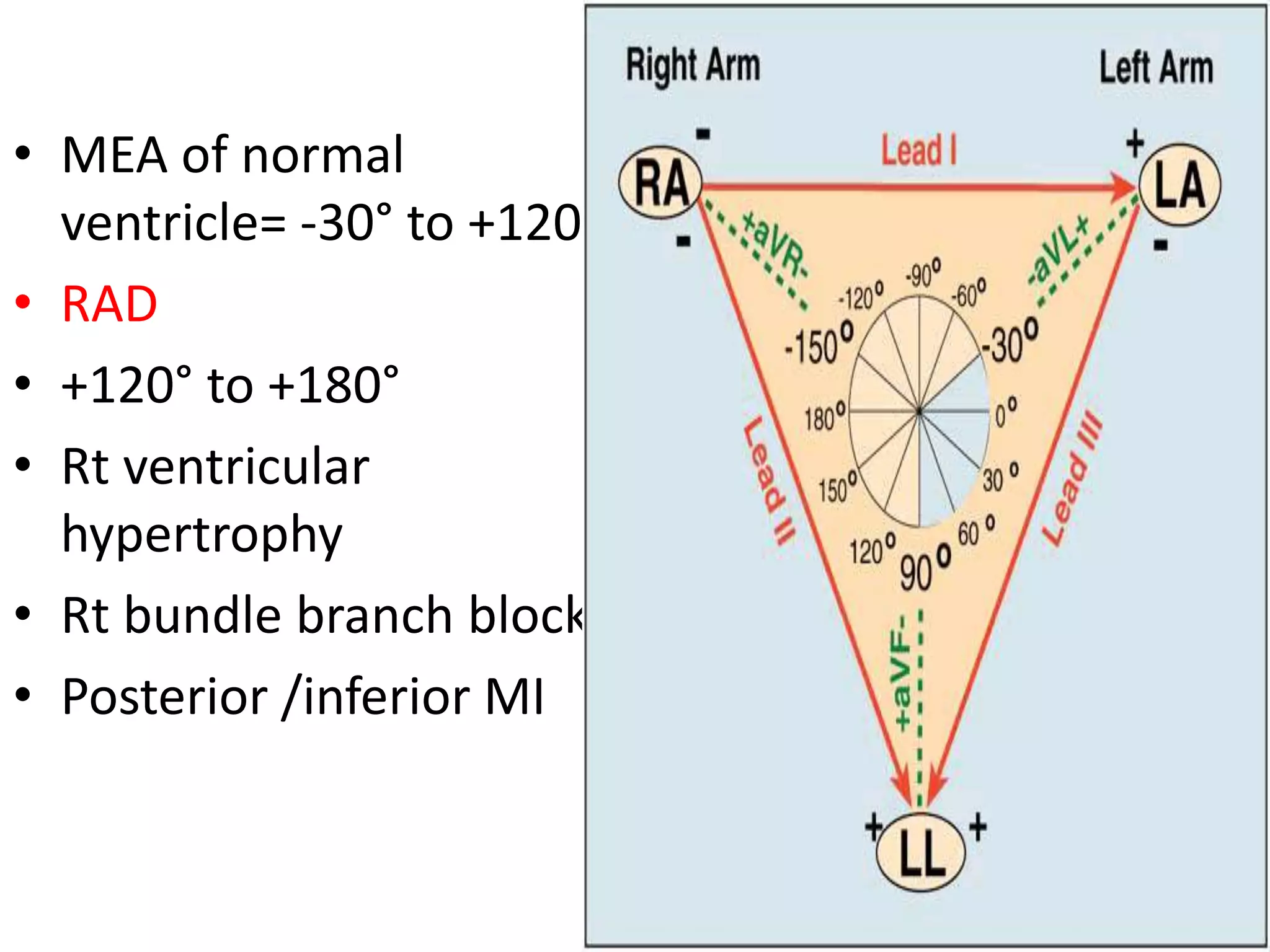
• MEA of normal
ventricle= -30° to +120°
• RAD
• +120° to +180°
• Rt ventricular
hypertrophy
• Rt bundle branch block
• Posterior /inferior MI
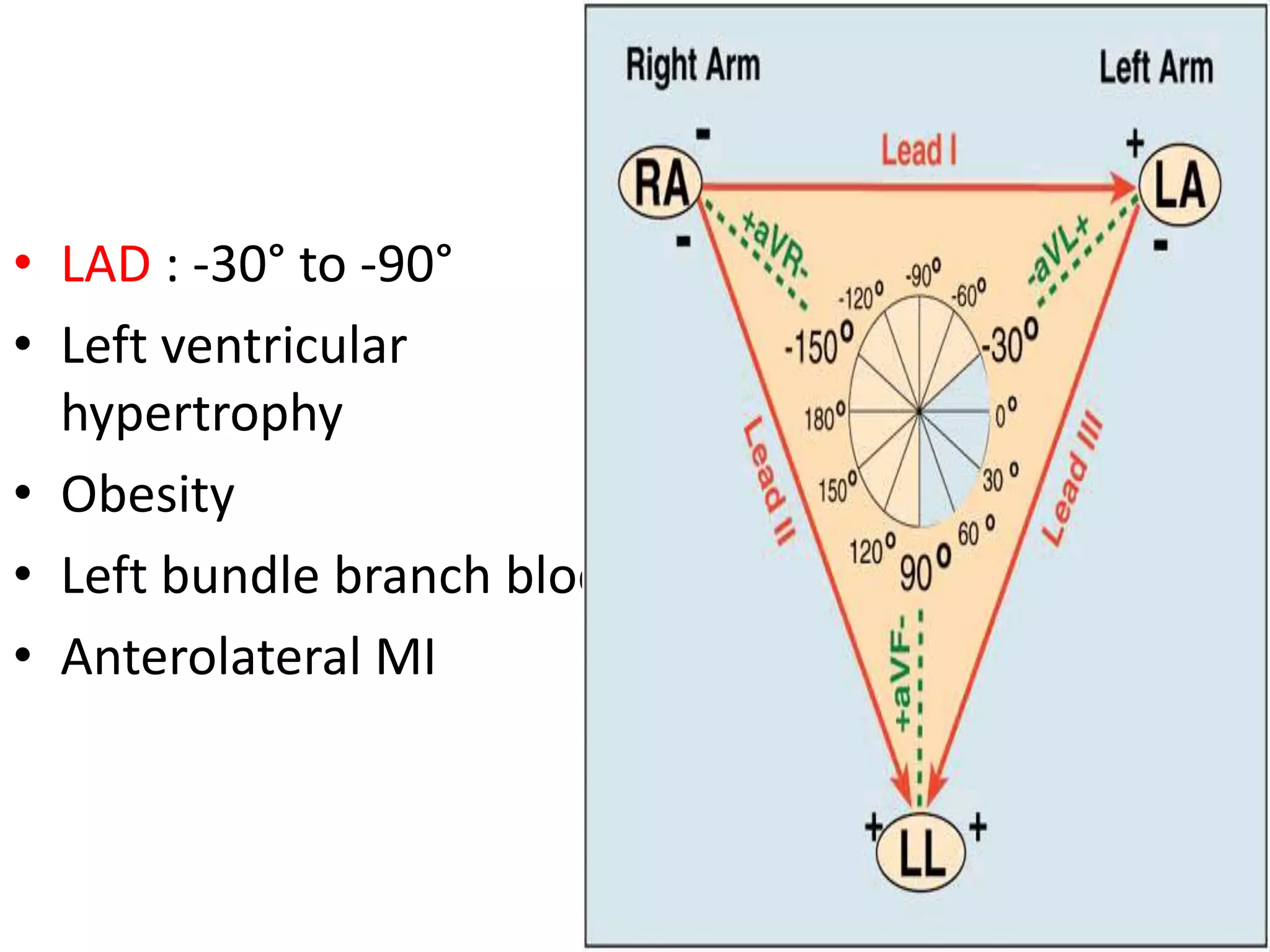
• LAD : -30° to -90°
• Left ventricular
hypertrophy
• Obesity
• Left bundle branch block
• Anterolateral MI
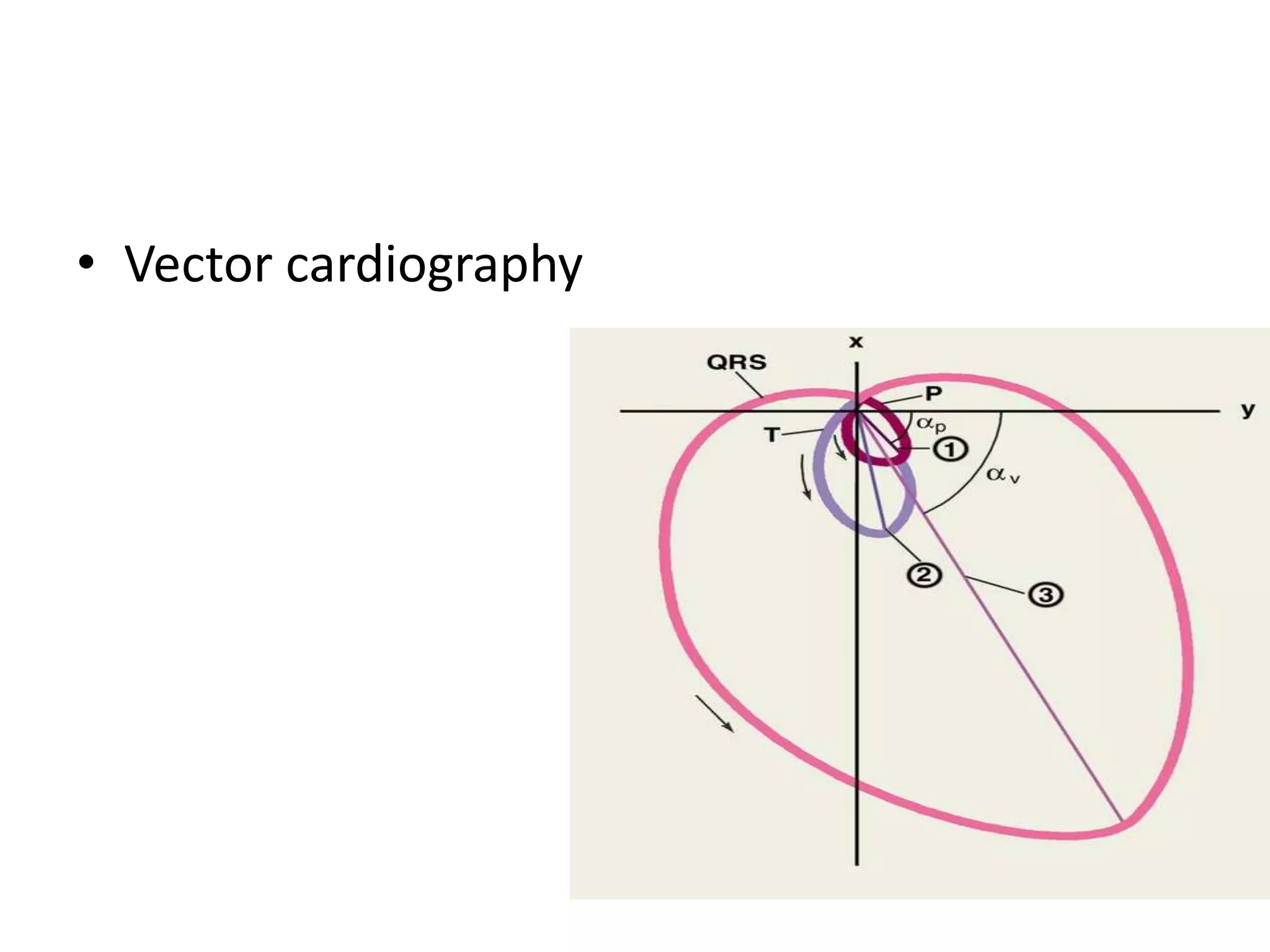
• Vector cardiography
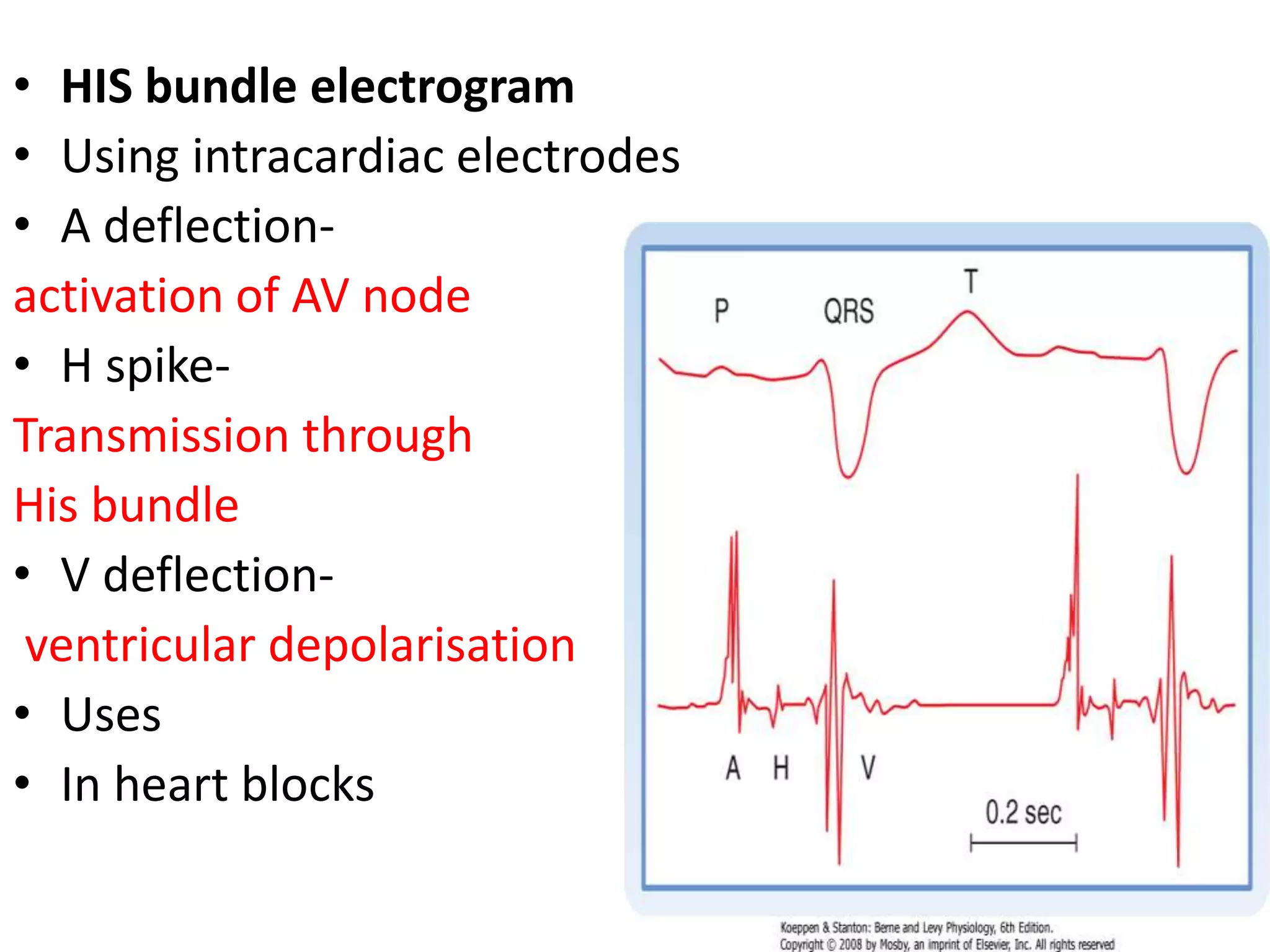
• HIS bundle electrogram
• Using intracardiac electrodes
• A deflection-
activation of AV node
• H spike-
Transmission through
His bundle
• V deflection-
ventricular depolarisation
• Uses
• In heart blocks
• PA interval
• First appearance of atrial depolarization to A
wave
• 27msec
• AH interval -92msec
• HV interval – 43msec
• Cardiac arrhthymias
• Distruption of normal rhthym
• Sinus rhthym – SA node –pacemaker, P wave
followed by QRS complex, P-R & Q-T interval –
normal.
• Sinus arrhthymia
• Normal sinus rhthym except varied RR interval
• Phases of respiration
• Children
• Endurance athelets
• Sinus tachycardia
• Fever
• Hyperthyroidism
Sinus bradycardiac
Endurance athelets
Sick sinus syndrome
Marked bradycardia with dizziness & syncope
• Conduction blocks
• SA nodal block
• AV nodal block
• Bundle branch block
• SA nodal block
• Elderly pt recovering from coronary artery
occlusion
• AV node becomes pacemaker –AV nodal
rhthym/ junctional rhythm
• Inverted P wave , normal QRS , slow HR
• AV nodal block
• First degree
• Second degree
• Complete
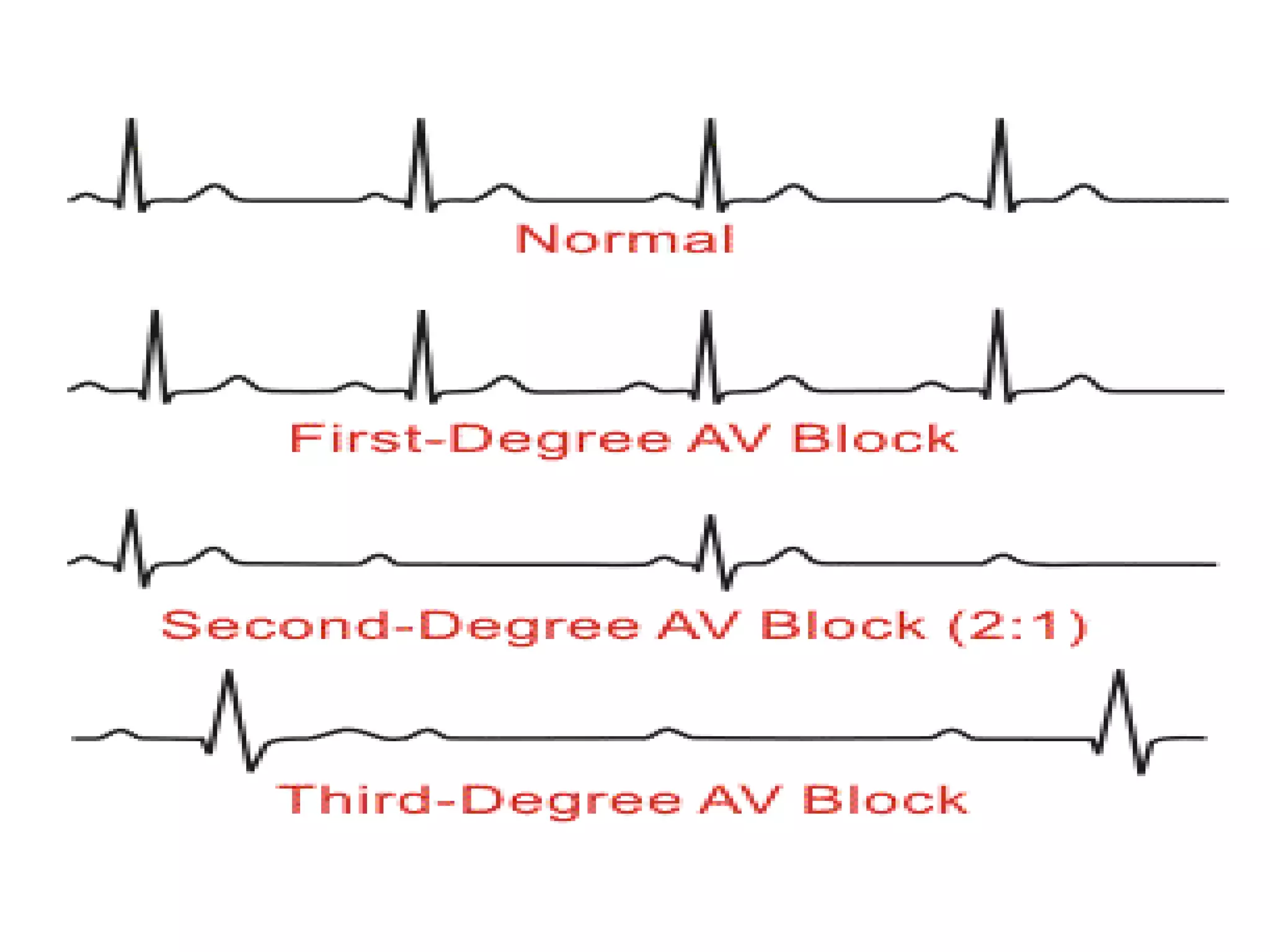
• First degree
• Slowing of conduction at AV node
• Second degree
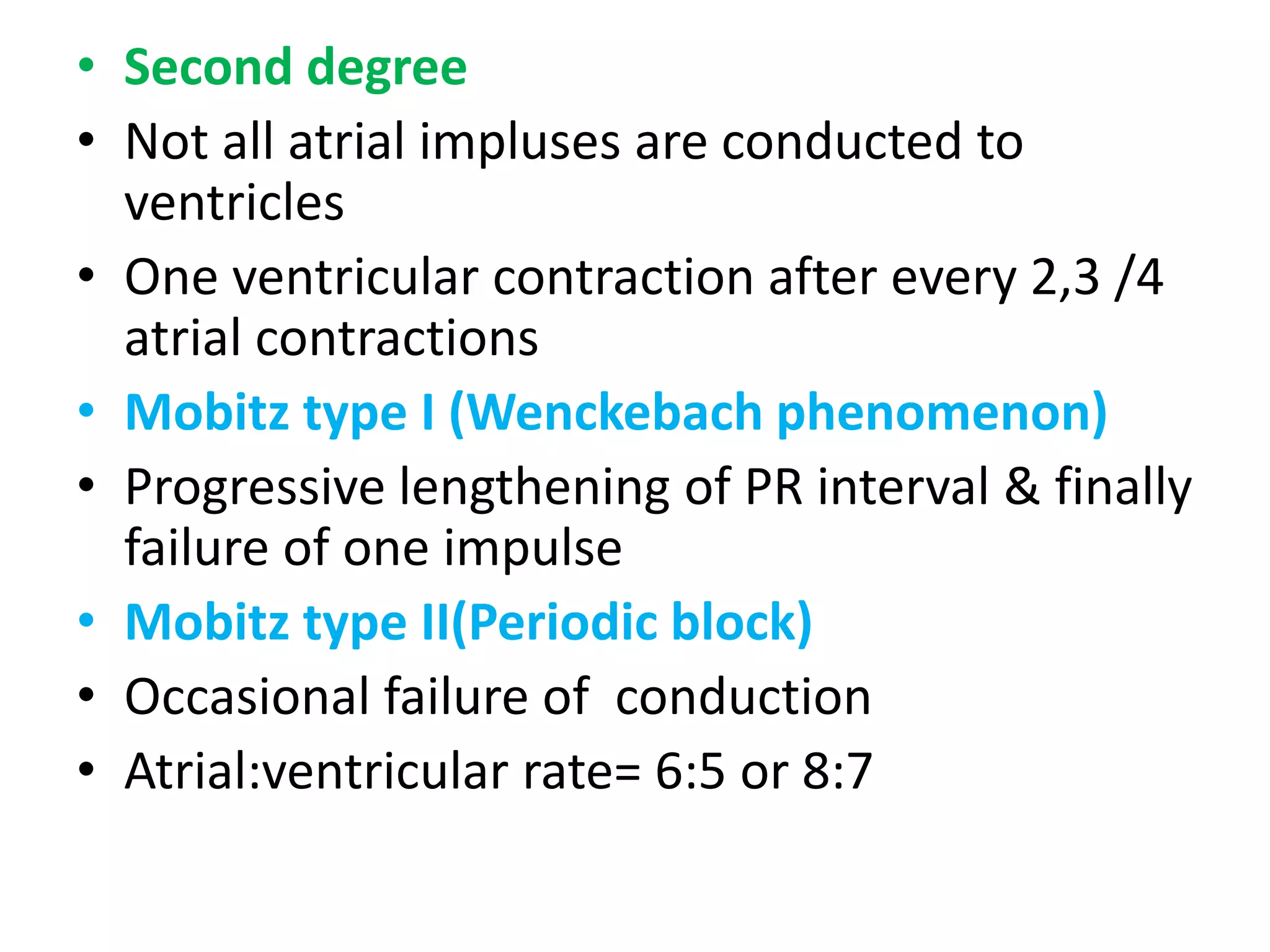
• Not all atrial impluses are conducted to
ventricles
• One ventricular contraction after every 2,3 /4
atrial contractions
• Mobitz type I (Wenckebach phenomenon)
• Progressive lengthening of PR interval & finally
failure of one impulse
• Mobitz type II(Periodic block)
• Occasional failure of conduction
• Atrial:ventricular rate= 6:5 or 8:7
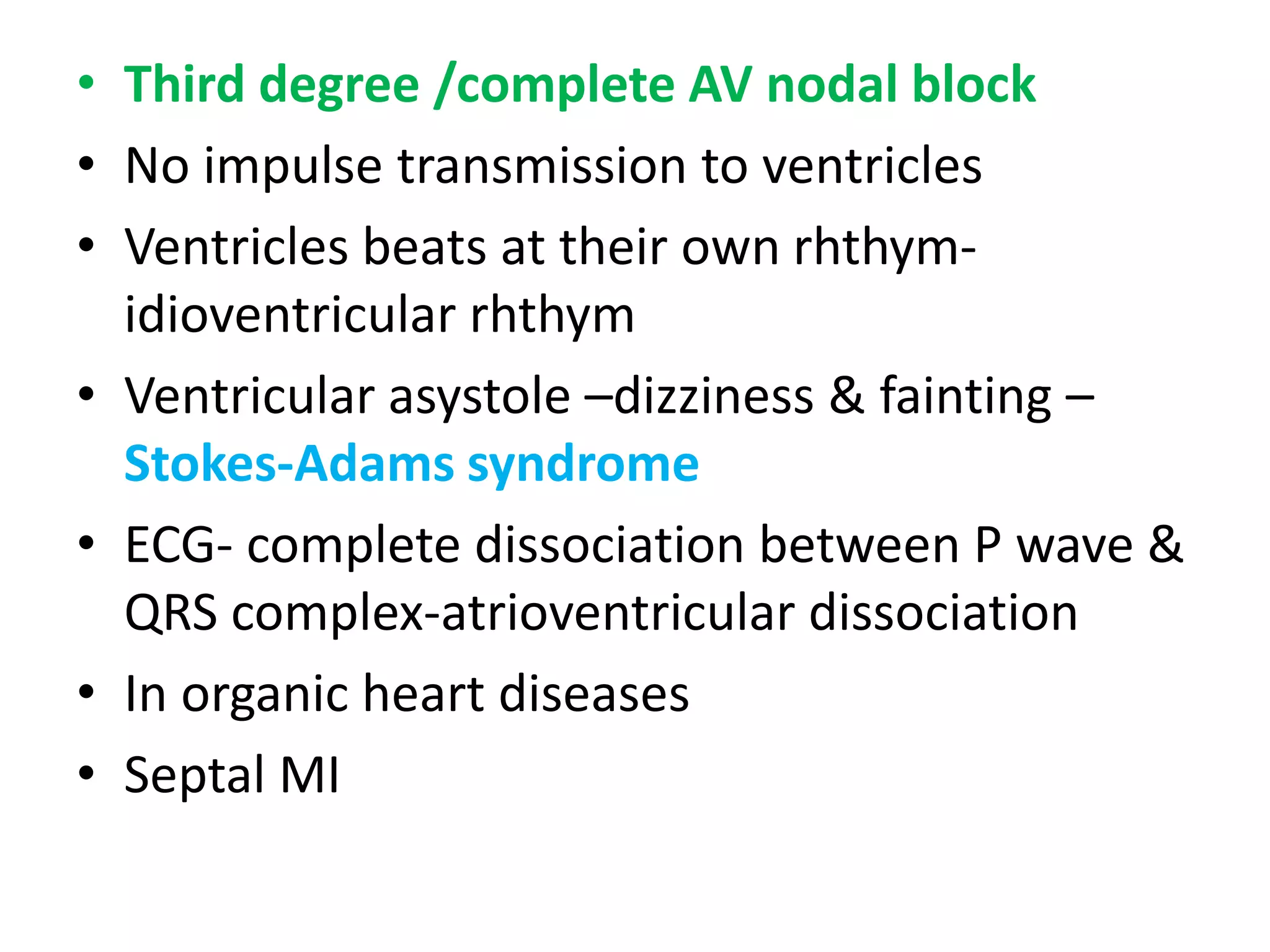
• Third degree /complete AV nodal block
• No impulse transmission to ventricles
• Ventricles beats at their own rhthym-
idioventricular rhthym
• Ventricular asystole –dizziness & fainting –
Stokes-Adams syndrome
• ECG- complete dissociation between P wave &
QRS complex-atrioventricular dissociation
• In organic heart diseases
• Septal MI
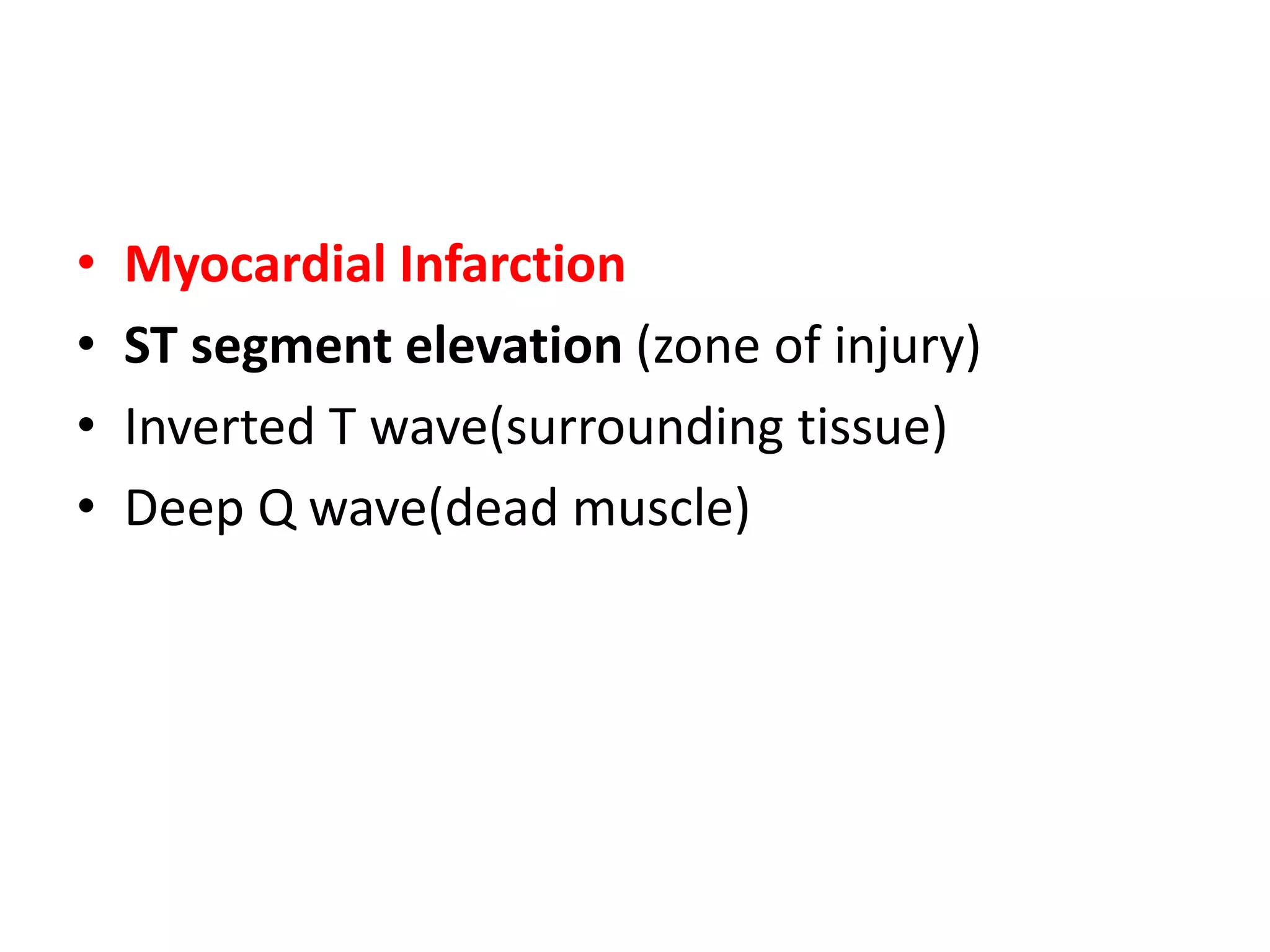
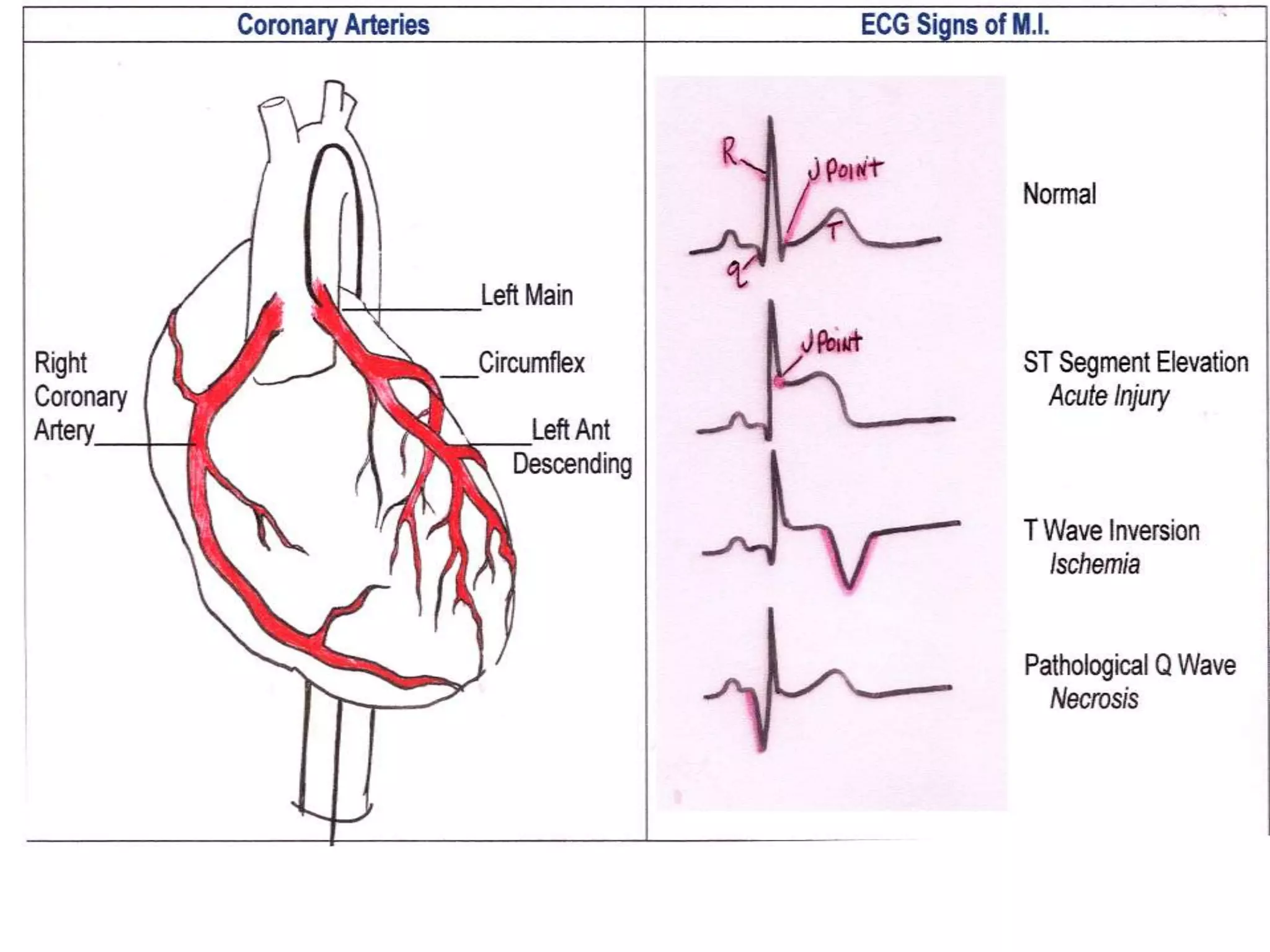
• Myocardial Infarction
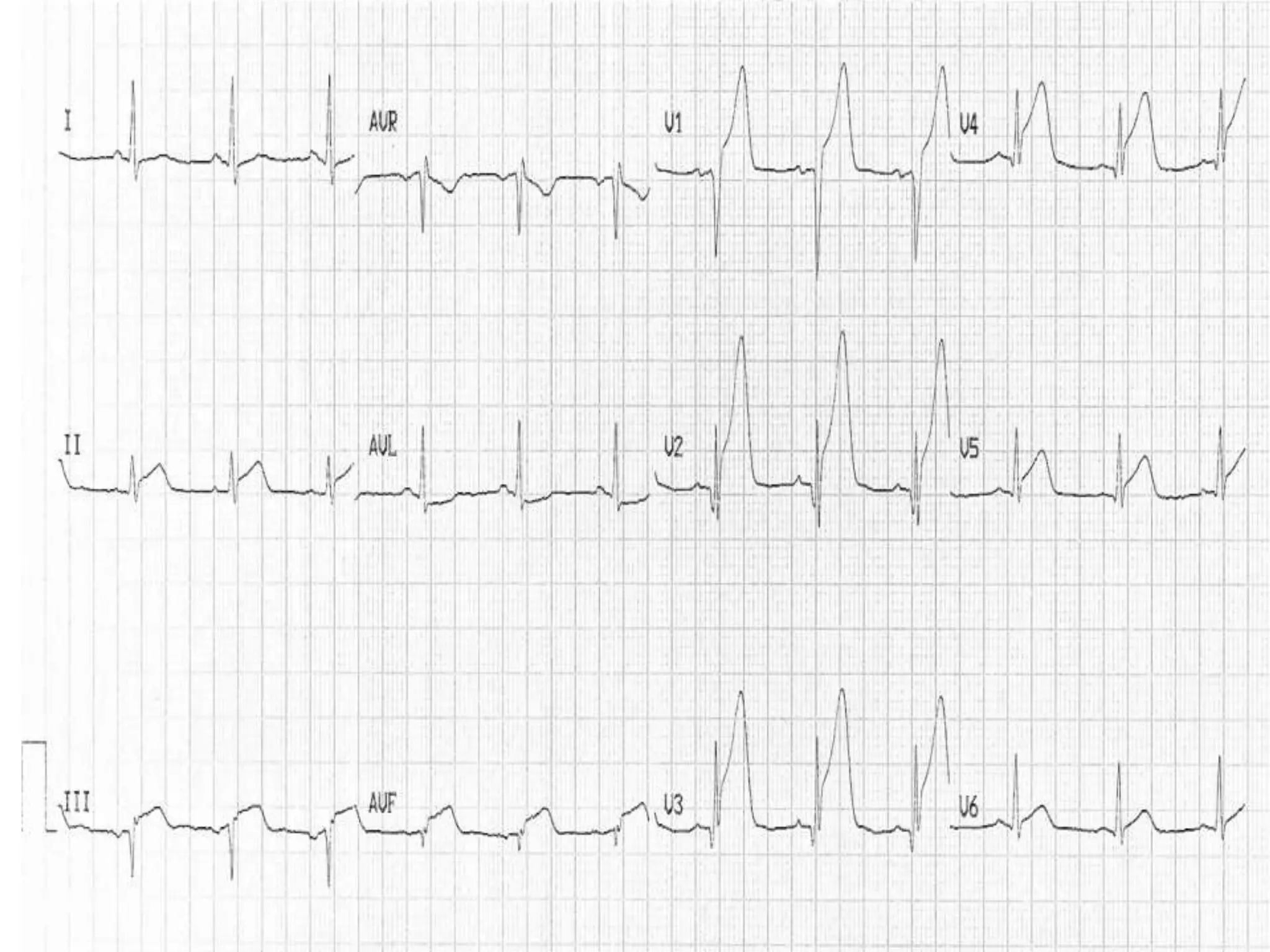
• ST segment elevation (zone of injury)
• Inverted T wave(surrounding tissue)
• Deep Q wave(dead muscle)
• Within mins to hrs ST seg elevation with Tall T
wave
• After 2days T waves-inverted
• After a week deep Q wave
• ST seg and T waves starts become normal
Infarction. When myocardial injury persists, MI is
the result.
• During the earliest stage of MI, known as the
hyperacute phase, the T waves become tall
and narrow. This configuration is referred to as
hyperacute or peaked T waves.
• Within a few hours, these hyperacute T waves
invert.
• Next, the ST segments elevate, a pattern that
usually lasts from several hours to several
days.
• In addition to the ST segment elevations in the
leads of the ECG facing the injured heart, the
leads facing away from the injured area may
show ST segment depression.
• This finding is known as reciprocal ST segment
changes.
• Reciprocal changes are most likely to be seen at
the onset of infarction, but their presence on the
ECG does not last long.
• Reciprocal ST segment depressions may simply be
a mirror image of the ST segment elevations.
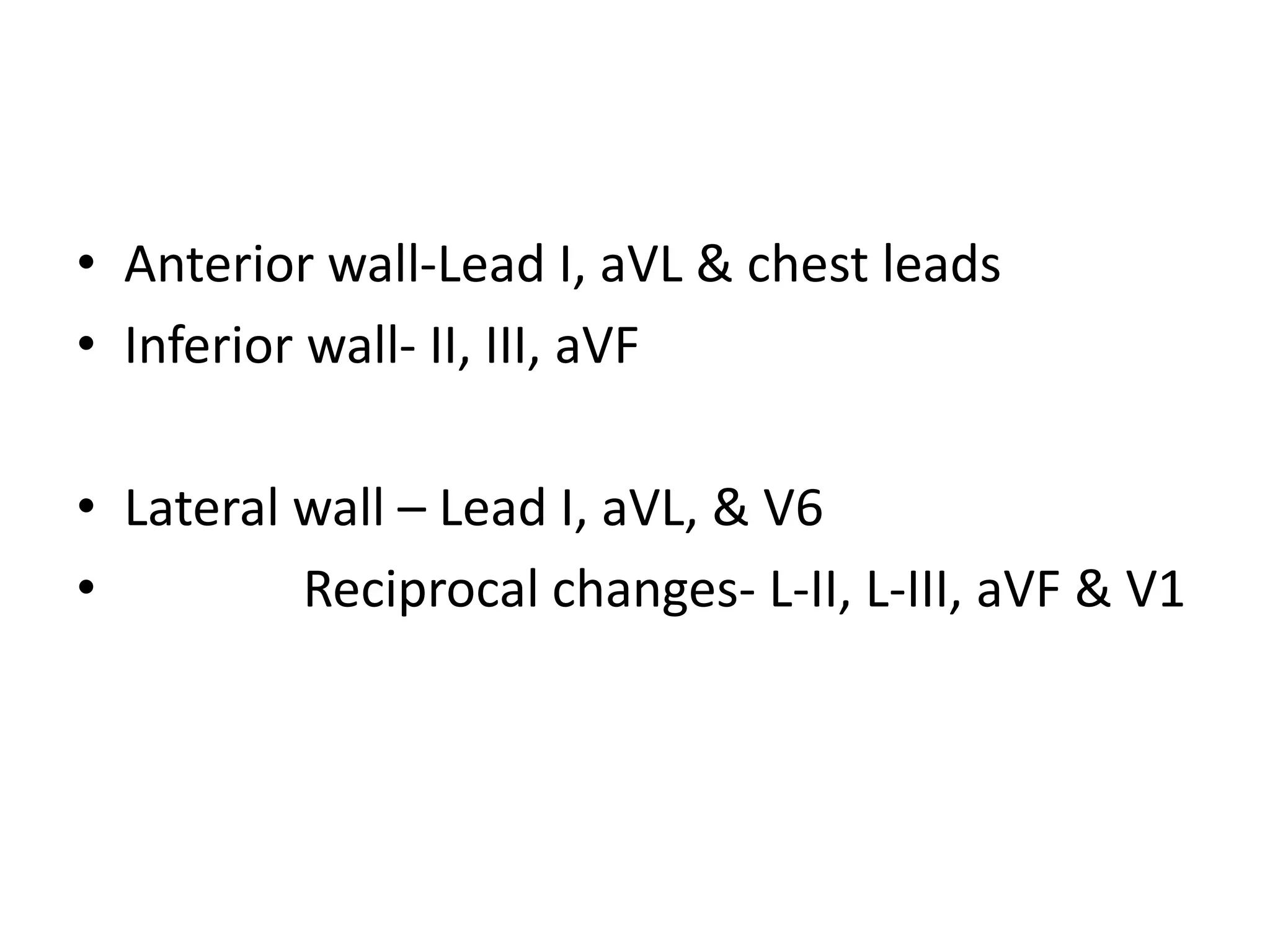
• Anterior wall-Lead I, aVL & chest leads
• Inferior wall- II, III, aVF
• Lateral wall – Lead I, aVL, & V6
• Reciprocal changes- L-II, L-III, aVF & V1
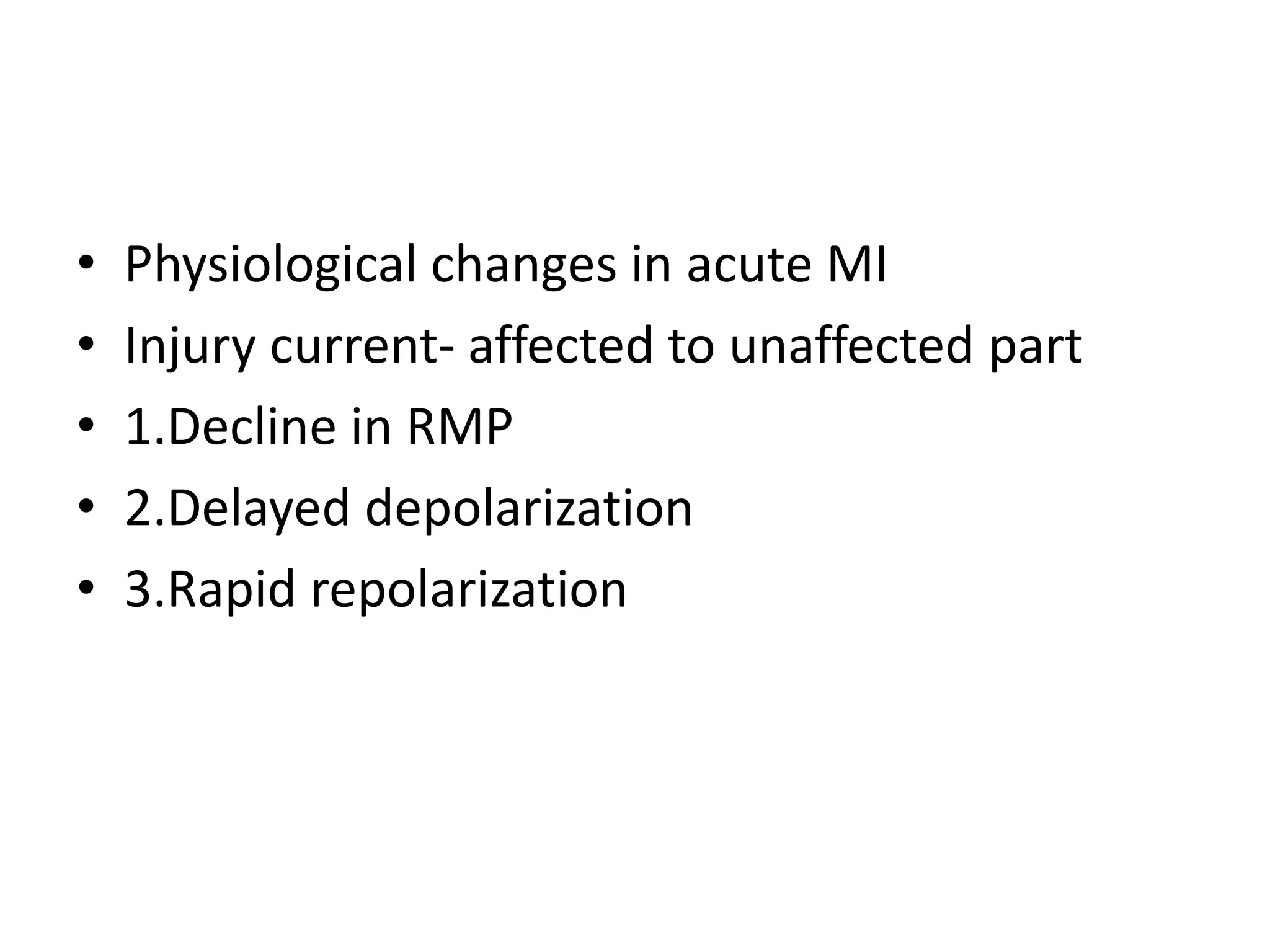
• Physiological changes in acute MI
• Injury current- affected to unaffected part
• 1.Decline in RMP
• 2.Delayed depolarization
• 3.Rapid repolarization
• Decline in RMP
• Ischaemic necrosis- K efflux & Na influx
• Inside of cell- less negative
• Extracellular current flows into the infarct
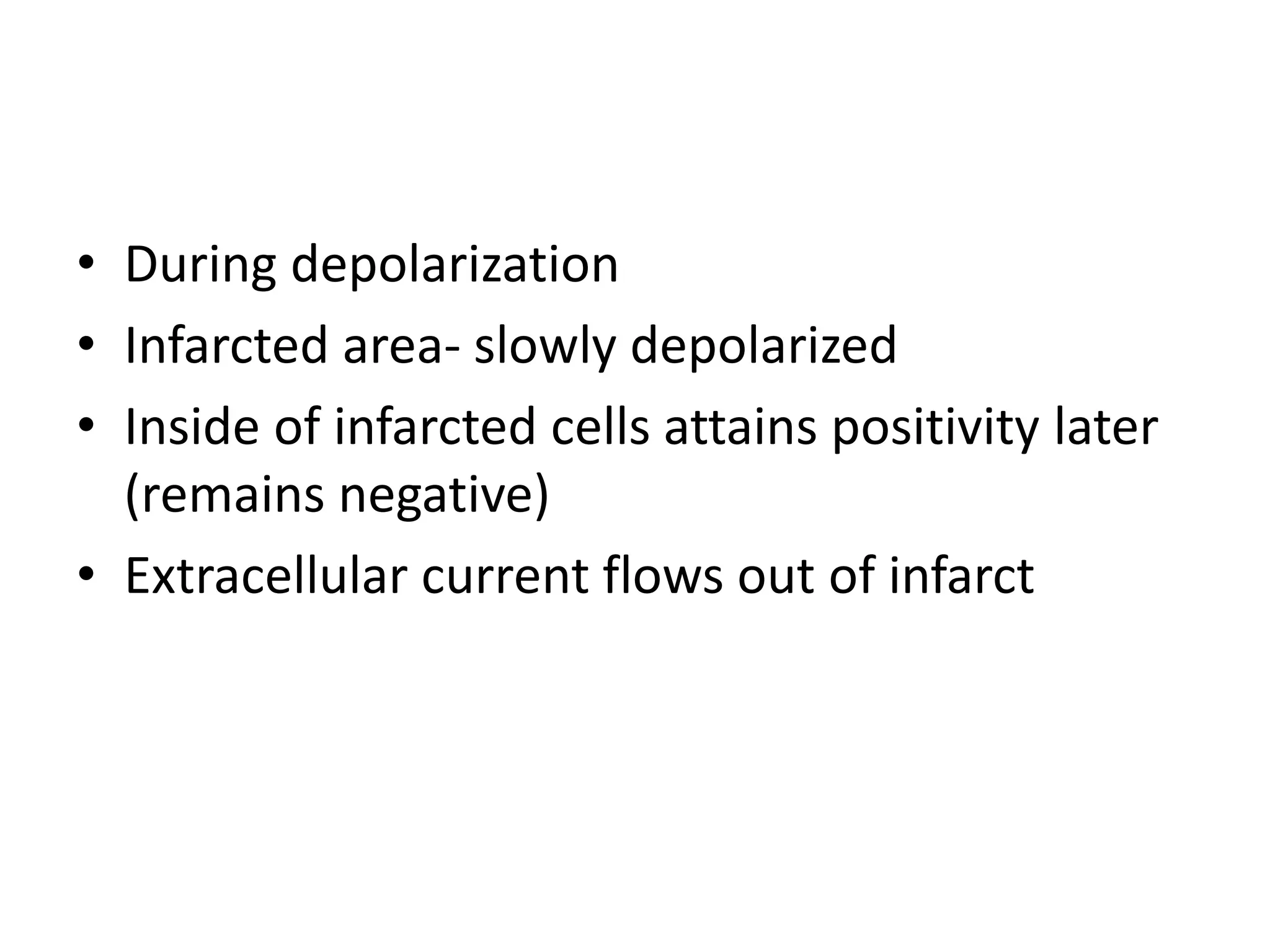
• During depolarization
• Infarcted area- slowly depolarized
• Inside of infarcted cells attains positivity later
(remains negative)
• Extracellular current flows out of infarct
• During repolarization
• Infarct cell-Rapid repolarization due to
opening of K channels (K efflux)
• Inside becomes negative
• Therefore there is
• Resultant extracellular current flow out of
infarct during depolarization & repolarization
• Flow of current towards recording electrode
over infarcted area causes increased positivity
between S and T wave- ST seg elevation.
• Anterior wall- anterior des left co A
• Inferior wall-posterior des rt co A
• posterior wall- Left circumflexleft co A

Cardiac vector and axis

  • 1.
  • 2.
    Background • The spreadof the cardiac impulse gives rise to the main deflections of the ECG. • The total electrical activity at any one moment of time can be summated and represented by a single electrical force. • This force has magnitude and direction and is termed the instantaneous vector.
  • 3.
    • All thevectors occurring in the ventricles during the production of the QRS can be averaged. • The direction of the resulting vector of electrical spread is called the MEAN QRS AXIS.
  • 4.
    • It iscustomary to measure this only in the frontal plane. • It is based on the orientation of the limb leads, I, II , III, aVR, aVL & aVF. • The limb lead with the tallest R wave will be the closest to the QRS axis.
  • 5.
    • Magnitude anddirection of potential • Instant vector – at particular instant during cardiac cycle • Mean vector -Ventricle depolarization : direction of potential –base to apex
  • 6.
    • Triaxial referencesystem • Hexa-axial reference system
  • 7.
    • Calculating meanaxis from Std Lead ECG
  • 8.
    • MEA ofnormal ventricle= -30° to +120° • RAD • +120° to +180° • Rt ventricular hypertrophy • Rt bundle branch block • Posterior /inferior MI
  • 9.
    • LAD :-30° to -90° • Left ventricular hypertrophy • Obesity • Left bundle branch block • Anterolateral MI
  • 10.
  • 11.
    • HIS bundleelectrogram • Using intracardiac electrodes • A deflection- activation of AV node • H spike- Transmission through His bundle • V deflection- ventricular depolarisation • Uses • In heart blocks
  • 12.
    • PA interval •First appearance of atrial depolarization to A wave • 27msec • AH interval -92msec • HV interval – 43msec
  • 13.
    • Cardiac arrhthymias •Distruption of normal rhthym • Sinus rhthym – SA node –pacemaker, P wave followed by QRS complex, P-R & Q-T interval – normal. • Sinus arrhthymia • Normal sinus rhthym except varied RR interval • Phases of respiration • Children • Endurance athelets
  • 14.
    • Sinus tachycardia •Fever • Hyperthyroidism Sinus bradycardiac Endurance athelets Sick sinus syndrome Marked bradycardia with dizziness & syncope
  • 15.
    • Conduction blocks •SA nodal block • AV nodal block • Bundle branch block
  • 16.
    • SA nodalblock • Elderly pt recovering from coronary artery occlusion • AV node becomes pacemaker –AV nodal rhthym/ junctional rhythm • Inverted P wave , normal QRS , slow HR
  • 17.
    • AV nodalblock • First degree • Second degree • Complete • First degree • Slowing of conduction at AV node
  • 18.
    • Second degree •Not all atrial impluses are conducted to ventricles • One ventricular contraction after every 2,3 /4 atrial contractions • Mobitz type I (Wenckebach phenomenon) • Progressive lengthening of PR interval & finally failure of one impulse • Mobitz type II(Periodic block) • Occasional failure of conduction • Atrial:ventricular rate= 6:5 or 8:7
  • 19.
    • Third degree/complete AV nodal block • No impulse transmission to ventricles • Ventricles beats at their own rhthym- idioventricular rhthym • Ventricular asystole –dizziness & fainting – Stokes-Adams syndrome • ECG- complete dissociation between P wave & QRS complex-atrioventricular dissociation • In organic heart diseases • Septal MI
  • 21.
    • Myocardial Infarction •ST segment elevation (zone of injury) • Inverted T wave(surrounding tissue) • Deep Q wave(dead muscle)
  • 23.
    • Within minsto hrs ST seg elevation with Tall T wave • After 2days T waves-inverted • After a week deep Q wave • ST seg and T waves starts become normal
  • 24.
    Infarction. When myocardialinjury persists, MI is the result. • During the earliest stage of MI, known as the hyperacute phase, the T waves become tall and narrow. This configuration is referred to as hyperacute or peaked T waves. • Within a few hours, these hyperacute T waves invert. • Next, the ST segments elevate, a pattern that usually lasts from several hours to several days.
  • 25.
    • In additionto the ST segment elevations in the leads of the ECG facing the injured heart, the leads facing away from the injured area may show ST segment depression. • This finding is known as reciprocal ST segment changes. • Reciprocal changes are most likely to be seen at the onset of infarction, but their presence on the ECG does not last long. • Reciprocal ST segment depressions may simply be a mirror image of the ST segment elevations.
  • 26.
    • Anterior wall-LeadI, aVL & chest leads • Inferior wall- II, III, aVF • Lateral wall – Lead I, aVL, & V6 • Reciprocal changes- L-II, L-III, aVF & V1
  • 28.
    • Physiological changesin acute MI • Injury current- affected to unaffected part • 1.Decline in RMP • 2.Delayed depolarization • 3.Rapid repolarization
  • 29.
    • Decline inRMP • Ischaemic necrosis- K efflux & Na influx • Inside of cell- less negative • Extracellular current flows into the infarct
  • 30.
    • During depolarization •Infarcted area- slowly depolarized • Inside of infarcted cells attains positivity later (remains negative) • Extracellular current flows out of infarct
  • 31.
    • During repolarization •Infarct cell-Rapid repolarization due to opening of K channels (K efflux) • Inside becomes negative
  • 32.
    • Therefore thereis • Resultant extracellular current flow out of infarct during depolarization & repolarization • Flow of current towards recording electrode over infarcted area causes increased positivity between S and T wave- ST seg elevation.
  • 34.
    • Anterior wall-anterior des left co A • Inferior wall-posterior des rt co A • posterior wall- Left circumflexleft co A