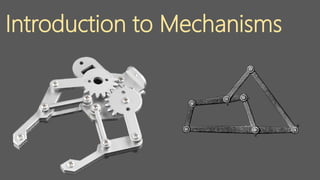
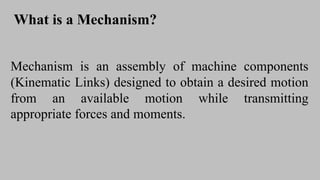


Introduction to Mechanisms
What is a Mechanism?
Mechanism is an assembly of machine components
(Kinematic Links) designed to obtain a desired motion
from an available motion while transmitting
appropriate forces and moments.
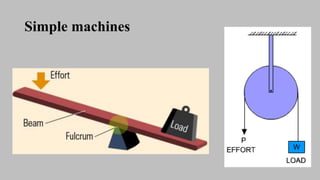
Simple machines
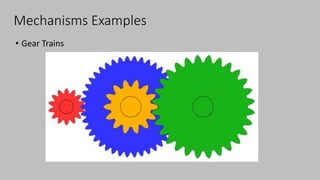
Mechanisms Examples
• Gear Trains
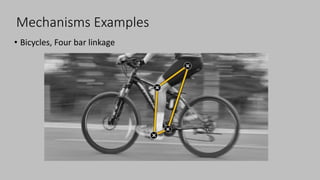
Mechanisms Examples
• Bicycles, Four bar linkage
Mechanisms Examples
• Sawing Machine
Lock Stitch Mechanism
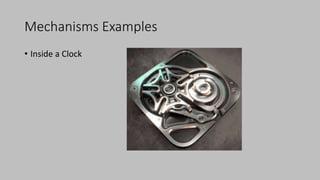
Mechanisms Examples
• Inside a Clock
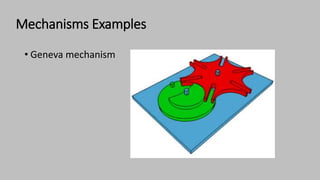
Mechanisms Examples
• Geneva mechanism
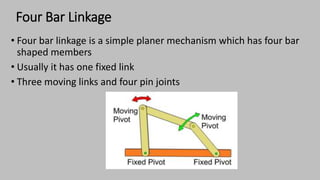
Four Bar Linkage
• Four bar linkage is a simple planer mechanism which has four bar
shaped members
• Usually it has one fixed link
• Three moving links and four pin joints
Four Bar Linkage
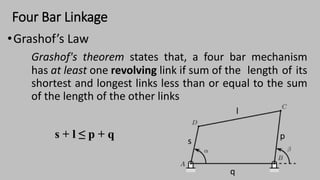
•Grashof’s Law
Grashof's theorem states that, a four bar mechanism
has at least one revolving link if sum of the length of its
shortest and longest links less than or equal to the sum
of the length of the other links
s + l ≤ p + q
Four Bar Linkage
• Under the Grashof’s Law condition there are three
modes of motions can be identified as follows:
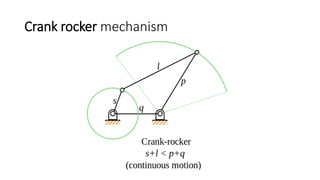
1. Crank rocker mechanism – When the shortest link is the input link
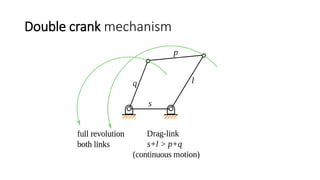
2. Double crank mechanism – When the shortest link is the fixed link
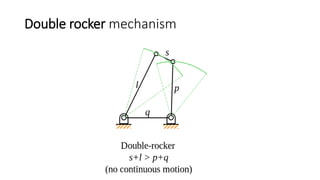
3. Double rocker mechanism – When the shortest link is the coupler link
Crank rocker mechanism
Double crank mechanism
Double rocker mechanism
Four Bar Linkage
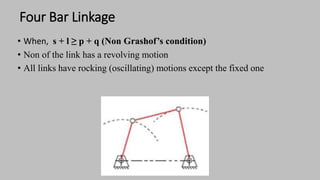
• When, s + l ≥ p + q (Non Grashof’s condition)
• Non of the link has a revolving motion
• All links have rocking (oscillating) motions except the fixed one
Four Bar Linkage (special cases )
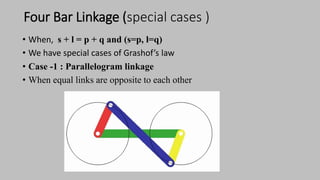
• When, s + l = p + q and (s=p, l=q)
• We have special cases of Grashof’s law
• Case -1 : Parallelogram linkage
• When equal links are opposite to each other
Four Bar Linkage (special cases )
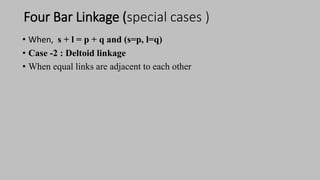
• When, s + l = p + q and (s=p, l=q)
• Case -2 : Deltoid linkage
• When equal links are adjacent to each other
Linkage mechanisms - Presentation

Linkage mechanisms - Presentation