PARTICIPATORY
  PLANNING


                ANKIT KUAMR
                2110200076
INTRODUCTION
                              (Involving participation of people.)

Participatory planning is part of the
decentralization(Decentralization is the transfer of power
and authority from the central/state government to the local level
government)processand it aims to identify the
critical problems and solve these problems
by different methods.
    .Participatoryplanningis
     part of the decentralisation process and it aims to identify the critical problems,
Purpose Of Participatory Planning

1. Identification of the felt needs of the
   people.
2. The empowerment of local
   disadvantaged groups.
3. Integration of local knowledge
   systems into project design.
4. Political commitment and support.
5. Two‐way learning process between
   the project and local people.
Salient Features
The planning process should produce two sets of results.
1.   In the short term, the tools of participatory planning should
generate a two‐way learning process, which will shape project
to local needs,
2. In the long term, this learning process should lead to local
empowerment and effective support at the institutional level.
METHODS OF PLANNING
Rapid Rural Appraisal methods(RRA):
• RRA can be defined as a
  qualitative survey
  methodology using a
  multi‐discipline team to
  formulate problems for
  research and development.
• It involves external experts
  teaming up with local
  community in a process of
  knowledge sharing.
Participatory Rural Appraisal (PRA)


PRA is a label given to a growing family of
participatory approaches and methods that
emphasize local knowledge and enable local
people to make their own appraisal, analysis, and
plans.
This tool is efficient in terms of both time and
money. PRA work together enough information to
make the necessary recommendations and
decisions.
Participatory Rural Appraisal (PRA)
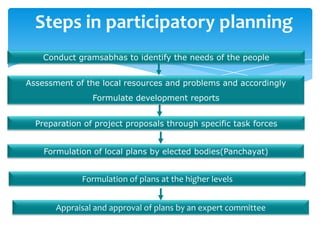
Steps in participatory planning
    Conduct gramsabhas to identify the needs of the people


Assessment of the local resources and problems and accordingly
                Formulate development reports


  Preparation of project proposals through specific task forces


    Formulation of local plans by elected bodies(Panchayat)


             Formulation of plans at the higher levels


       Appraisal and approval of plans by an expert committee
Risks involved and key success factors

  The major risk in participatory planning is that any
  failure in the implementation of a project results in
  disinterest among the community which in turn shuts
  down any possibility of further participatory planning
  process with the community.
  the participatory planning process should try to focus
  on those issues which can be solved with the
  available resources and gain the confidence of the
  community.
  the key factor for successful participatory planning is
  to build a relationship of mutual trust and then start
  the planning process.
THANK YOU

Participatory planning

  • 1.
    PARTICIPATORY PLANNING ANKIT KUAMR 2110200076
  • 2.
    INTRODUCTION (Involving participation of people.) Participatory planning is part of the decentralization(Decentralization is the transfer of power and authority from the central/state government to the local level government)processand it aims to identify the critical problems and solve these problems by different methods. .Participatoryplanningis part of the decentralisation process and it aims to identify the critical problems,
  • 3.
    Purpose Of ParticipatoryPlanning 1. Identification of the felt needs of the people. 2. The empowerment of local disadvantaged groups. 3. Integration of local knowledge systems into project design. 4. Political commitment and support. 5. Two‐way learning process between the project and local people.
  • 4.
    Salient Features The planningprocess should produce two sets of results. 1. In the short term, the tools of participatory planning should generate a two‐way learning process, which will shape project to local needs, 2. In the long term, this learning process should lead to local empowerment and effective support at the institutional level.
  • 5.
    METHODS OF PLANNING RapidRural Appraisal methods(RRA): • RRA can be defined as a qualitative survey methodology using a multi‐discipline team to formulate problems for research and development. • It involves external experts teaming up with local community in a process of knowledge sharing.
  • 6.
    Participatory Rural Appraisal(PRA) PRA is a label given to a growing family of participatory approaches and methods that emphasize local knowledge and enable local people to make their own appraisal, analysis, and plans. This tool is efficient in terms of both time and money. PRA work together enough information to make the necessary recommendations and decisions.
  • 7.
  • 9.
    Steps in participatoryplanning Conduct gramsabhas to identify the needs of the people Assessment of the local resources and problems and accordingly Formulate development reports Preparation of project proposals through specific task forces Formulation of local plans by elected bodies(Panchayat) Formulation of plans at the higher levels Appraisal and approval of plans by an expert committee
  • 10.
    Risks involved andkey success factors The major risk in participatory planning is that any failure in the implementation of a project results in disinterest among the community which in turn shuts down any possibility of further participatory planning process with the community. the participatory planning process should try to focus on those issues which can be solved with the available resources and gain the confidence of the community. the key factor for successful participatory planning is to build a relationship of mutual trust and then start the planning process.
  • 11.

Editor's Notes

  • #2 Opening – Academic ManagerToday is about quality of a plan that will lead to increased student achievement. Schools may not necessarily come away with a finalized product, but they will have a solid framework and outline of where they need to go.
  • #3 Participatory planning ispart of the decentralisation process and it aims to identify the critical problems,joint priorities, elaboration and adoption of a socio‐economic developmentstrategies.
  • #4 Presenter: DebIntroduce Academic Managers, Instruction Unit, AARSI Division Support Team, and any other departments in attendance for today.Housekeeping items: bathrooms, silence cell phones, complete evaluation, lunch, and professionalism for our students
  • #5 Presenter: Deb – setting the purpose to today and making adjustments to the school improvement plan to positively impact our students. Think about how we are going to make this a living, breathing, document.Connect Action Planning & Monitoring to school improvement process of continuous cycle. Please state we have moved from the evaluation phase and into in the planning phase. In the fall, schools will move into the implementation phase.
  • #6 Presenter: Academic ManagerThe school district has revised and aligned the District Improvement Plan with Dwight Jones’ vision from A Look Ahead. Our expectation is for schools to closely align their school improvement plan with the district’s plan. We will give you specific expectations as we move throughout the day to accomplish this task. Today is not about compliance and finishing the plan, but it is more about creating a quality plan that has been well thought out, based upon multiple data sources, and will lead the school toward improved student performance. Schools are going through a transformation and considering all possibilities to increase student achievement – think of today as a brainstorming session to custom design your plan to fit the needs of all students in your building. The only compliance piece will be to align your goals and measurable objectives with the district.
  • #7 Presenter: AARSI – Deb and Wayne will lead this slide. Remind participants to remain professional.Norms are the same and don’t forget to use the response cards to receive assistance at your table – review what each response card is/does.We are all learning and we may need to adjust today’s schedule to fit your needs.
  • #9 Presenter: AARSI – Handout pg. 5On Day 1 was focused on Data Analysis with schools organizing data, reviewing current performance, and writing performance trends. Day 2 was more about prioritizing performance concerns and identifying root causes. Now on Day 3, schools are going to identify solutions, set performance targets, identify measurable objectives, set action steps, and identify implementation evidence. Even though you have received the 3-day training, keep in mind this process is cyclical and you will be evaluating, planning, and implementing on a regular basis. You need to continuously review multiple sources of data, determine performance trends, prioritize the school’s concerns, and dig deep to determine the root cause BEFORE writing the goals, measurable objectives, and action steps.Questions – how do you create a plan that will implement the needed changes and how are we going to monitor what we say we are going to do and how will we evaluate what we have implemented to see if it is working or not? An area where we have fallen short in the past is monitoring, so to counteract that issue, we are going to give you time to calendar out the next steps and monitoring to determine how we will come back together to monitor and share out with the staff.
  • #10 Presenter: AARSI – Handout pg. 5On Day 1 was focused on Data Analysis with schools organizing data, reviewing current performance, and writing performance trends. Day 2 was more about prioritizing performance concerns and identifying root causes. Now on Day 3, schools are going to identify solutions, set performance targets, identify measurable objectives, set action steps, and identify implementation evidence. Even though you have received the 3-day training, keep in mind this process is cyclical and you will be evaluating, planning, and implementing on a regular basis. You need to continuously review multiple sources of data, determine performance trends, prioritize the school’s concerns, and dig deep to determine the root cause BEFORE writing the goals, measurable objectives, and action steps.Questions – how do you create a plan that will implement the needed changes and how are we going to monitor what we say we are going to do and how will we evaluate what we have implemented to see if it is working or not? An area where we have fallen short in the past is monitoring, so to counteract that issue, we are going to give you time to calendar out the next steps and monitoring to determine how we will come back together to monitor and share out with the staff.
  • #11 Presenter: AARSI – Handout pg. 6Review what schools should have completed.To help you begin the process today, we are going back to review your homework of root cause.
  • #12 Presenter: AARSI – Handout pg. 6Review what schools should have completed.To help you begin the process today, we are going back to review your homework of root cause.