ENTITY RELATIONSHIP DIAGRAM
(ERD)
Chapter 4
ICT 2073
Prepared By: Siti Hajar Ismail
OBJECTIVES
 Define terms related to entity relationship modeling,
including entity, entity instance, attribute,
relationship and cardinality, and primary key.
 Describe the entity modeling process.
 Discuss how to draw an entity relationship diagram.
 Describe how to recognize entities, attributes,
relationships, and cardinalities.
DATABASE MODEL
A database can be modeled as:
 a collection of entities,
 relationship among entities.
Database systems are often modeled using an Entity
Relationship (ER) diagram as the "blueprint" from which the
actual data is stored
ENTITY RELATIONSHIP DIAGRAM (ERD)
 ER model allows us to sketch database designs
 ERD is a graphical tool for modeling data.
 ERD is widely used in database design
 ERD is a graphical representation of the logical structure of a
database
 ERD is a model that identifies the concepts or entities that
exist in a system and the relationships between those
entities
PURPOSES OF ERD
 better understanding of the information to be contained
in the database
 documentation tool.
 to communicate the logical structure of the database to
users
COMPONENTS OF AN ERD
An ERD typically consists of four different graphical
components:
1. Entity
2. Relationship
3. Cardinality
4. Attribute
CLASSIFICATION OF RELATIONSHIP
 Optional Relationship
 An Employee may or may not be assigned to a
Department
 A Patient may or may not be assigned to a Bed
 Mandatory Relationship
 Every Course must be taught by at least one Teacher
 Every mother have at least a Child
 For a binary relationship set the mapping cardinality must
be one of the following types:
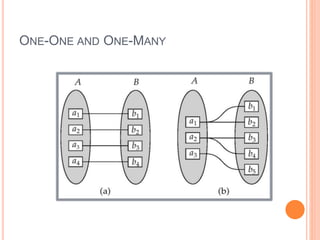
 One to one
A Manager Head one Department and vice versa
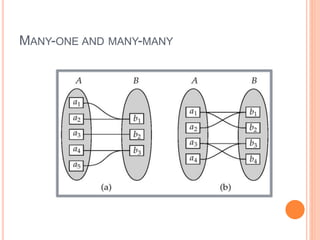
 One to many ( or many to one)
An Employee Works in one Department or One
Department has many Employees
 Many to many
A Teacher Teaches many Students and A student is
taught by many Teachers
9
ONE-ONE AND ONE-MANY
10
MANY-ONE AND MANY-MANY
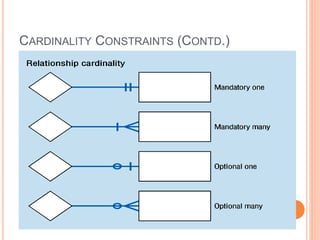
CARDINALITY CONSTRAINTS (CONTD.)
CARDINALITY CONSTRAINTS EXAMPLE
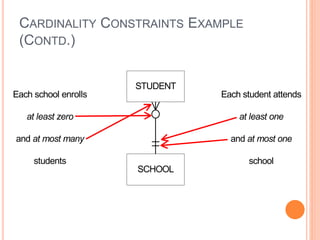
 In our model, we wish to indicate that each school may enroll
many students, or may not enroll any students at all.
 We also wish to indicate that each student attends exactly one
school. The following diagram indicates this optionality and
cardinality:
CARDINALITY CONSTRAINTS EXAMPLE
(CONTD.)
SCHOOL
STUDENT
Each school enrolls
at least zero
and at most many
students
Each student attends
at least one
and at most one
school
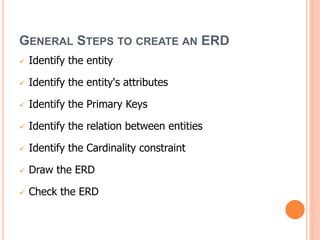
GENERAL STEPS TO CREATE AN ERD
 Identify the entity
 Identify the entity's attributes
 Identify the Primary Keys
 Identify the relation between entities
 Identify the Cardinality constraint
 Draw the ERD
 Check the ERD
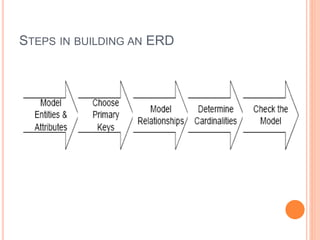
STEPS IN BUILDING AN ERD
A SIMPLE EXAMPLE
A company has several departments. Each department has a
supervisor and at least one employee. Employees must be
assigned to at least one, but possibly more departments. At
least one employee is assigned to a project, but an employee
may be on vacation and not assigned to any projects.
1. IDENTIFY ENTITIES
 A company has several departments. Each department has a
supervisor and at least one employee. Employees must be
assigned to at least one, but possibly more departments. At
least one employee is assigned to a project, but an employee
may be on vacation and not assigned to any projects.
 A true entity should have more than one instance
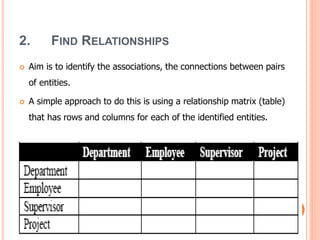
2. FIND RELATIONSHIPS
 Aim is to identify the associations, the connections between pairs
of entities.
 A simple approach to do this is using a relationship matrix (table)
that has rows and columns for each of the identified entities.
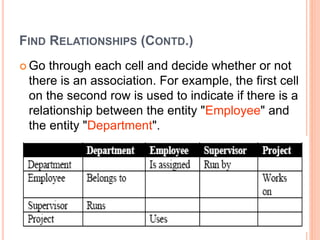
FIND RELATIONSHIPS (CONTD.)
 Go through each cell and decide whether or not
there is an association. For example, the first cell
on the second row is used to indicate if there is a
relationship between the entity "Employee" and
the entity "Department".
3. IDENTIFIED RELATIONSHIPS
Names placed in the cells are meant to capture/describe
the relationships. So you can use them like this
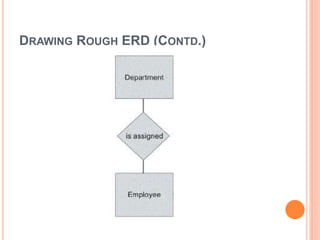
 A Department is assigned an employee
 A Department is run by a supervisor
 An employee belongs to a department
 An employee works on a project
 A supervisor runs a department
 A project uses an employee
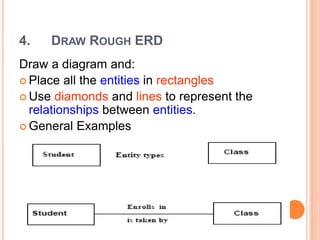
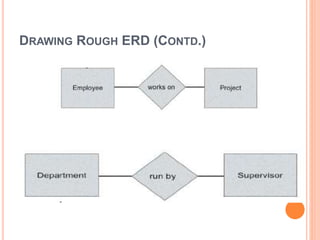
4. DRAW ROUGH ERD
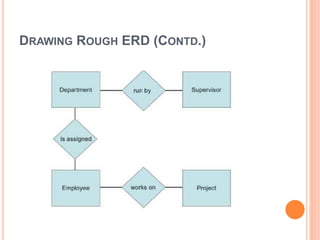
Draw a diagram and:
 Place all the entities in rectangles
 Use diamonds and lines to represent the
relationships between entities.
 General Examples
DRAWING ROUGH ERD (CONTD.)
5. FILL IN CARDINALITY
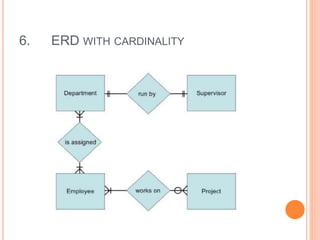
 Supervisor
 Each department has one supervisor.
 Department
 Each supervisor has one department.
 Each employee can belong to one or more departments
 Employee
 Each department must have one or more employees
 Each project must have one or more employees
 Project
 Each employee can have 0 or more projects.
FILL IN CARDINALITY (CONTD.)
The cardinality of a relationship can only have
the following values
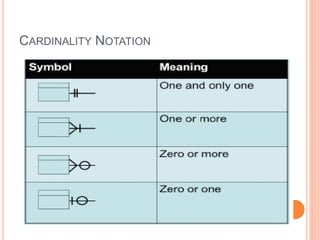
 One and only one
 One or more
 Zero or more
 Zero or one
CARDINALITY NOTATION
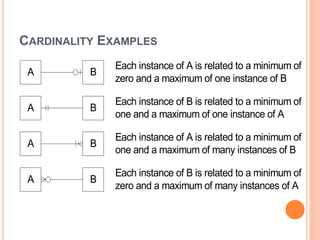
CARDINALITY EXAMPLES
A
A
A
A
B
B
B
B
Each instance of A is related to a minimum of
zero and a maximum of one instance of B
Each instance of B is related to a minimum of
one and a maximum of one instance of A
Each instance of A is related to a minimum of
one and a maximum of many instances of B
Each instance of B is related to a minimum of
zero and a maximum of many instances of A
6. ERD WITH CARDINALITY
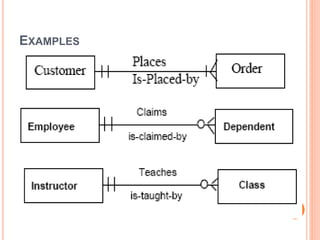
EXAMPLES
ERD FOR COURSE ENROLLMENT
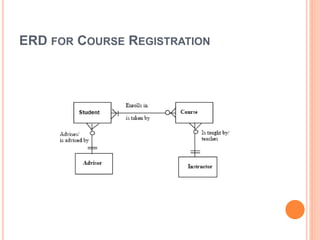
ERD FOR COURSE REGISTRATION
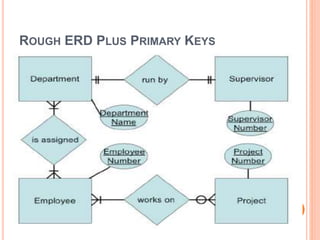
ROUGH ERD PLUS PRIMARY KEYS
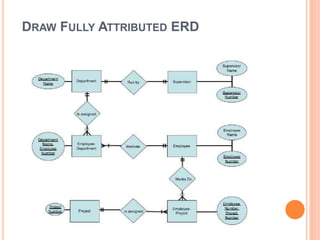
7. IDENTIFY ATTRIBUTES
 Identify and name all the attributes essential to the system we are
studying without trying to match them to particular entities.
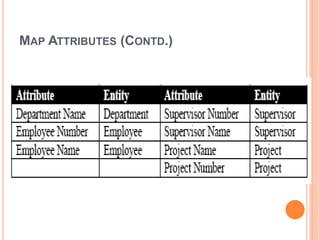
 The only attributes indicated are the names of the departments, projects,
supervisors and employees, as well as the supervisor and employee
NUMBER and a unique project number.
8. MAP ATTRIBUTES
 For each attribute we need to match it with exactly
one entity. Often it seems like an attribute should go
with more than one entity (e.g. Name).
MAP ATTRIBUTES (CONTD.)
DRAW FULLY ATTRIBUTED ERD
38
WEAK ENTITY SET
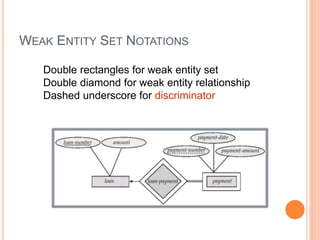
 Some entity sets in real world naturally depend on
some other entity set
 They can be uniquely identified only if combined with
another entity set
 Example:
 section1, section2, … become unique only if you put
them into a context, e.g. csce4350
39
WEAK ENTITY SET NOTATIONS
Double rectangles for weak entity set
Double diamond for weak entity relationship
Dashed underscore for discriminator
LEARNING OUTCOME
 Define terms related to entity relationship
modeling, including entity, entity instance, attribute,
relationship and cardinality, and primary key.
 Explain the entity modeling process.
 Draw an entity relationship diagram.

Entity Relationship Diagram

  • 1.
    ENTITY RELATIONSHIP DIAGRAM (ERD) Chapter4 ICT 2073 Prepared By: Siti Hajar Ismail
  • 2.
    OBJECTIVES  Define termsrelated to entity relationship modeling, including entity, entity instance, attribute, relationship and cardinality, and primary key.  Describe the entity modeling process.  Discuss how to draw an entity relationship diagram.  Describe how to recognize entities, attributes, relationships, and cardinalities.
  • 3.
    DATABASE MODEL A databasecan be modeled as:  a collection of entities,  relationship among entities. Database systems are often modeled using an Entity Relationship (ER) diagram as the "blueprint" from which the actual data is stored
  • 4.
    ENTITY RELATIONSHIP DIAGRAM(ERD)  ER model allows us to sketch database designs  ERD is a graphical tool for modeling data.  ERD is widely used in database design  ERD is a graphical representation of the logical structure of a database  ERD is a model that identifies the concepts or entities that exist in a system and the relationships between those entities
  • 5.
    PURPOSES OF ERD better understanding of the information to be contained in the database  documentation tool.  to communicate the logical structure of the database to users
  • 6.
    COMPONENTS OF ANERD An ERD typically consists of four different graphical components: 1. Entity 2. Relationship 3. Cardinality 4. Attribute
  • 7.
    CLASSIFICATION OF RELATIONSHIP Optional Relationship  An Employee may or may not be assigned to a Department  A Patient may or may not be assigned to a Bed  Mandatory Relationship  Every Course must be taught by at least one Teacher  Every mother have at least a Child
  • 8.
     For abinary relationship set the mapping cardinality must be one of the following types:  One to one A Manager Head one Department and vice versa  One to many ( or many to one) An Employee Works in one Department or One Department has many Employees  Many to many A Teacher Teaches many Students and A student is taught by many Teachers
  • 9.
  • 10.
  • 11.
  • 12.
    CARDINALITY CONSTRAINTS EXAMPLE In our model, we wish to indicate that each school may enroll many students, or may not enroll any students at all.  We also wish to indicate that each student attends exactly one school. The following diagram indicates this optionality and cardinality:
  • 13.
    CARDINALITY CONSTRAINTS EXAMPLE (CONTD.) SCHOOL STUDENT Eachschool enrolls at least zero and at most many students Each student attends at least one and at most one school
  • 14.
    GENERAL STEPS TOCREATE AN ERD  Identify the entity  Identify the entity's attributes  Identify the Primary Keys  Identify the relation between entities  Identify the Cardinality constraint  Draw the ERD  Check the ERD
  • 15.
  • 16.
    A SIMPLE EXAMPLE Acompany has several departments. Each department has a supervisor and at least one employee. Employees must be assigned to at least one, but possibly more departments. At least one employee is assigned to a project, but an employee may be on vacation and not assigned to any projects.
  • 17.
    1. IDENTIFY ENTITIES A company has several departments. Each department has a supervisor and at least one employee. Employees must be assigned to at least one, but possibly more departments. At least one employee is assigned to a project, but an employee may be on vacation and not assigned to any projects.  A true entity should have more than one instance
  • 18.
    2. FIND RELATIONSHIPS Aim is to identify the associations, the connections between pairs of entities.  A simple approach to do this is using a relationship matrix (table) that has rows and columns for each of the identified entities.
  • 19.
    FIND RELATIONSHIPS (CONTD.) Go through each cell and decide whether or not there is an association. For example, the first cell on the second row is used to indicate if there is a relationship between the entity "Employee" and the entity "Department".
  • 20.
    3. IDENTIFIED RELATIONSHIPS Namesplaced in the cells are meant to capture/describe the relationships. So you can use them like this  A Department is assigned an employee  A Department is run by a supervisor  An employee belongs to a department  An employee works on a project  A supervisor runs a department  A project uses an employee

  • 21.
    4. DRAW ROUGHERD Draw a diagram and:  Place all the entities in rectangles  Use diamonds and lines to represent the relationships between entities.  General Examples
  • 22.
  • 23.
  • 24.
  • 25.
    5. FILL INCARDINALITY  Supervisor  Each department has one supervisor.  Department  Each supervisor has one department.  Each employee can belong to one or more departments  Employee  Each department must have one or more employees  Each project must have one or more employees  Project  Each employee can have 0 or more projects.
  • 26.
    FILL IN CARDINALITY(CONTD.) The cardinality of a relationship can only have the following values  One and only one  One or more  Zero or more  Zero or one
  • 27.
  • 28.
    CARDINALITY EXAMPLES A A A A B B B B Each instanceof A is related to a minimum of zero and a maximum of one instance of B Each instance of B is related to a minimum of one and a maximum of one instance of A Each instance of A is related to a minimum of one and a maximum of many instances of B Each instance of B is related to a minimum of zero and a maximum of many instances of A
  • 29.
    6. ERD WITHCARDINALITY
  • 30.
  • 31.
    ERD FOR COURSEENROLLMENT
  • 32.
    ERD FOR COURSEREGISTRATION
  • 33.
    ROUGH ERD PLUSPRIMARY KEYS
  • 34.
    7. IDENTIFY ATTRIBUTES Identify and name all the attributes essential to the system we are studying without trying to match them to particular entities.  The only attributes indicated are the names of the departments, projects, supervisors and employees, as well as the supervisor and employee NUMBER and a unique project number.
  • 35.
    8. MAP ATTRIBUTES For each attribute we need to match it with exactly one entity. Often it seems like an attribute should go with more than one entity (e.g. Name).
  • 36.
  • 37.
  • 38.
    38 WEAK ENTITY SET Some entity sets in real world naturally depend on some other entity set  They can be uniquely identified only if combined with another entity set  Example:  section1, section2, … become unique only if you put them into a context, e.g. csce4350
  • 39.
    39 WEAK ENTITY SETNOTATIONS Double rectangles for weak entity set Double diamond for weak entity relationship Dashed underscore for discriminator
  • 40.
    LEARNING OUTCOME  Defineterms related to entity relationship modeling, including entity, entity instance, attribute, relationship and cardinality, and primary key.  Explain the entity modeling process.  Draw an entity relationship diagram.