COMMUNICATION ETHICS
Kit Laserna
COMMUNICATION ETHICS
What is Communication Ethics?
COMMUNICATION

 theact or process of communicating; fact of
 being communicated.

                             the imparting or
                              interchange of
                          thoughts, opinions, or
                              information by
                         speech, writing, or signs.
ETHICS
a   system of moral principles
 deals  with values relating to human
 conduct, with respect to the rightness and
 wrongness of certain actions and to the
 goodness and badness of the motives and
 ends of such actions.
COMMUNICATION ETHICS
 The principle governing communication, the
 right and wrong aspects of it, the moral-
 immoral       dimensions    relevant     to
 Interpersonal communication are called the
 ethics of Interpersonal communication.
COMMUNICATION ETHICS
    Maintaining the correct balance between
    the speaking and listening

    the legitimacy of fear and emotional
    appeal

   degree of criticism and praise
COMMUNICATION ETHICS
A     death or an overdose of either of the
    factors could result in unfavorable
    consequences.

    The principle of honesty on both sides
    should be completely applied because any
    amount of insincerity from either the listener
    or the speaker would not be prudent.
FUNDAMENTALS OF ETHICAL
COMMUNICATION

 responsiblethinking
 decision making

 development of relationships and
  communities
   Contexts
   Cultures
   Channels
   Media
UNETHICAL COMMUNICATION
 threatens the quality of all communication
 and consequently the well-being of
 individuals and the society.
PRINCIPLES OF
ETHICAL COMMUNICATION
 advocate
  truthfulness, accuracy, honesty, and
  reason as essential to the integrity of
  communication.
 endorse freedom of expression, diversity
  of perspective, and tolerance of dissent to
  achieve the informed and responsible
  decision making fundamental to a civil
  society.
 strive to understand and respect other
  communicators before evaluating and
  responding to their messages.
PRINCIPLES OF
ETHICAL COMMUNICATION

 promote access to communication resources and
  opportunities as necessary to fulfill human potential and
  contribute         to       the        well-being       of
  families, communities, and society.
 promote communication climates of caring and mutual
  understanding that respect the unique needs and
  characteristics of individual communicators.
 condemn communication that degrades individuals and
  humanity through distortion, intimidation, coercion, and
  violence, and through the expression of intolerance and
  hatred.
PRINCIPLES OF
ETHICAL COMMUNICATION

 Being    committed to the courageous
  expression of personal convictions in pursuit
  of fairness and justice.
 advocate sharing information, opinions, and
  feelings when facing significant choices
  while    also    respecting     privacy    and
  confidentiality.
 accept responsibility for the short- and long-
  term     consequences       for     our   own
  communication and expect the same of
  others.
INTERPERSONAL
COMMUNICATION
ETHICS
INTERPERSONAL COMMUNICATION
 Interpersonalcommunication refers to
 communication with another person.
 This kind of communication is
 subdivided into:
   dyadic communication
   public communication
   small-group communication.
FOUR PRINCIPLES OF
INTERPERSONAL
COMMUNICATION
Principles:
 Inescapable

 Irreversible

 Complicated

 Contextual
     Psychological context
     Relational context
     Situational context
     Environmental context
     Cultural context
FUNCTIONS OF
INTERPERSONAL
COMMUNICATION
 Gaining  Information
 Building a Context of Understanding
 Establishing Identity
 Interpersonal Needs
  Inclusion
  Control
  Affection
DISTANCE

 Provides   necessary space for each
  communicative partner to contribute to the
  relationship.
 Is interpersonal space that nourishes the
  very thing that keeps persons together
  interpersonally—relationship.
 Is an ethical responsibility, not a flaw or a
  limitation.
 The importance of distance keeps us from
  equating interpersonal communication with
  ever more closeness.
INTERPERSONAL RESPONSIBILITY
  Begins  with each person’s commitment to
   active care for the interpersonal
   relationship, owned by neither and nurtured
   with or without the support of the Other.
  Adheres to the insight of Emmanuel
   Levinas, abandoning the expectation of
   reciprocity for attentiveness to a call to
   responsibility with or without the approval of
   the other.
INTERPERSONAL RESPONSIBILITY
 Involves:
     Caring for an interpersonal relationship. As
      one seeks a path in life, interpersonal
      relationship responsibility invites a balance
      between distance and closeness in each
      relationship, which defines the quality of our
      interpersonal lives (Stewart, 2006).
       Sympathy
       Empathy
ETHICAL FRAMEWORKS
DEONTOLOGICAL ETHICS
 the most frequented basis of our decision
 making process, expressing a commitment
 to the most basic principles.
 It  is regarded as universal, always
 applicable whatever the circumstance is.

                       o We follow these rules
                       since we think of them as
                       duties.
UTILITARIAN ETHICS
                 focuses   on the results
                  and whether or not it
                  would benefit the
                  majority.
                 Utilitarianism focuses
                  on the consequences of
                  each action or decision.
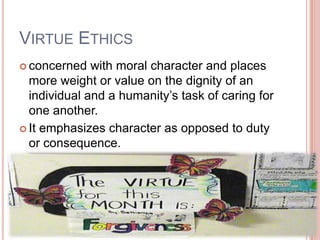
VIRTUE ETHICS
 concerned   with moral character and places
  more weight or value on the dignity of an
  individual and a humanity’s task of caring for
  one another.
 It emphasizes character as opposed to duty
  or consequence.
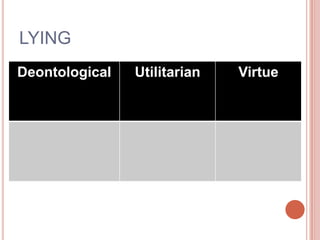
LYING
Deontological   Utilitarian   Virtue
SITUATIONAL OR CONTEXTUAL
ETHICS
 There    is no absolute approach to
  situations, each situation should be
  addressed as different from each other.
 Every problem should be evaluated in its
  particular context or situation.
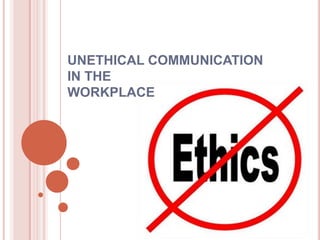
UNETHICAL COMMUNICATION
IN THE
WORKPLACE
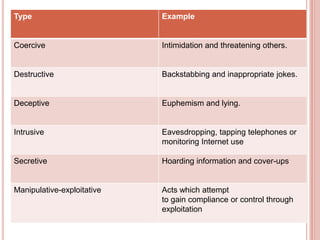
Type                        Example


Coercive                    Intimidation and threatening others.


Destructive                 Backstabbing and inappropriate jokes.


Deceptive                   Euphemism and lying.


Intrusive                   Eavesdropping, tapping telephones or
                            monitoring Internet use

Secretive                   Hoarding information and cover-ups


Manipulative-exploitative   Acts which attempt
                            to gain compliance or control through
                            exploitation
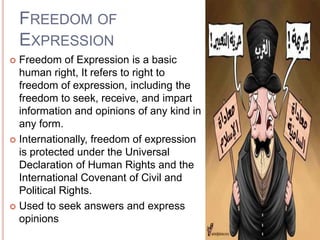
FREEDOM OF
    EXPRESSION
 Freedom of Expression is a basic
  human right, It refers to right to
  freedom of expression, including the
  freedom to seek, receive, and impart
  information and opinions of any kind in
  any form.
 Internationally, freedom of expression
  is protected under the Universal
  Declaration of Human Rights and the
  International Covenant of Civil and
  Political Rights.
 Used to seek answers and express
  opinions
ETHICAL FREEDOM OF
    EXPRESSION
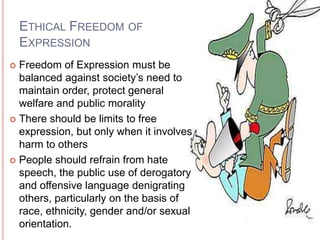
 Freedom of Expression must be
  balanced against society’s need to
  maintain order, protect general
  welfare and public morality
 There should be limits to free
  expression, but only when it involves
  harm to others
 People should refrain from hate
  speech, the public use of derogatory
  and offensive language denigrating
  others, particularly on the basis of
  race, ethnicity, gender and/or sexual
  orientation.
MASS COMMUNICATION
 Mass communication is used to
  describe the various means by which
  individuals and entities relay
  information through mass media to
  large segments of the population at the
  same time.
 It is the mass production of messages
  (message) or information that is
  intended to reach a large amount of
  people
 Uses mass media; such as
  newspapers, TV, radio, books etc.
MASS COMMUNICATION
ETHICS
       Ethics
        Truth
        Censorship
        Laws
        Privacy
        Appropriateness
        Sensitivity to other
         cultures
        Respect dignity, privacy,
         and well being of a
         person
ETHIC CODES
 Ethic Codes (or Ethical Codes) are moral
  guidelines that are used to help assist
  people in making decisions, to tell the
  difference between ‘right’ and ‘wrong’
  and to utilize this understanding to make
  ethical choices
 There are 3 levels;
     Code of ethics (social issues)
     Code of conduct (influence to behavior of
      employees)
     Code of practice (professional
      responsibility)
CORPORATE CODES OF ETHICS
   Honesty - Professional communicators are honest,
    accurate and candid in all communications. This
    practice encourages the free flow of important
    information in the interest of the public
CORPORATE CODES OF ETHICS
 Confidentiality
                - Protecting the confidences
 and privacy rights of employees and
 customers is the duty of professional
 communicators. Additionally, they must
 abide by legal requirements for disclosing
 information that affect the welfare of others

 Credit- Give due credit to those who you
 get ideas from.
CORPORATE CODES OF ETHICS
 Free Speech - Principles of free speech and
 free ideas should be encouraged.

 Courtesy - Sensitivity to cultural values and
 beliefs are crucial.
REFERENCES
   http://www.wordiq.com/definition/Interpersonal_communication
   http://www.pstcc.edu/facstaff/dking/interpr.htm
   http://www.abacon.com/commstudies/interpersonal/infunctions.html
   http://www.mpib-
    berlin.mpg.de/en/institut/dok/full/keller/moralobl/kell_moralobl.pdf
   http://www.blurtit.com/q697023.html
   https://teach.lanecc.edu/kenz/llc/userpages.html?thispage=68
   http://www.prismjournal.org/fileadmin/Praxis/Files/Fountaine.pdf
   http://www.uk.sagepub.com/upm-data/23227_Chapter_7.pdf
   http://www.ehow.com/facts_6726807_corporate-communication-
    code-ethics.html

Communication Ethics

  • 1.
  • 2.
    COMMUNICATION ETHICS What isCommunication Ethics?
  • 3.
    COMMUNICATION  theact orprocess of communicating; fact of being communicated. the imparting or interchange of thoughts, opinions, or information by speech, writing, or signs.
  • 4.
    ETHICS a system of moral principles  deals with values relating to human conduct, with respect to the rightness and wrongness of certain actions and to the goodness and badness of the motives and ends of such actions.
  • 5.
    COMMUNICATION ETHICS  Theprinciple governing communication, the right and wrong aspects of it, the moral- immoral dimensions relevant to Interpersonal communication are called the ethics of Interpersonal communication.
  • 6.
    COMMUNICATION ETHICS  Maintaining the correct balance between the speaking and listening  the legitimacy of fear and emotional appeal  degree of criticism and praise
  • 7.
    COMMUNICATION ETHICS A death or an overdose of either of the factors could result in unfavorable consequences.  The principle of honesty on both sides should be completely applied because any amount of insincerity from either the listener or the speaker would not be prudent.
  • 8.
    FUNDAMENTALS OF ETHICAL COMMUNICATION responsiblethinking  decision making  development of relationships and communities  Contexts  Cultures  Channels  Media
  • 9.
    UNETHICAL COMMUNICATION  threatensthe quality of all communication and consequently the well-being of individuals and the society.
  • 10.
    PRINCIPLES OF ETHICAL COMMUNICATION advocate truthfulness, accuracy, honesty, and reason as essential to the integrity of communication.  endorse freedom of expression, diversity of perspective, and tolerance of dissent to achieve the informed and responsible decision making fundamental to a civil society.  strive to understand and respect other communicators before evaluating and responding to their messages.
  • 11.
    PRINCIPLES OF ETHICAL COMMUNICATION promote access to communication resources and opportunities as necessary to fulfill human potential and contribute to the well-being of families, communities, and society.  promote communication climates of caring and mutual understanding that respect the unique needs and characteristics of individual communicators.  condemn communication that degrades individuals and humanity through distortion, intimidation, coercion, and violence, and through the expression of intolerance and hatred.
  • 12.
    PRINCIPLES OF ETHICAL COMMUNICATION Being committed to the courageous expression of personal convictions in pursuit of fairness and justice.  advocate sharing information, opinions, and feelings when facing significant choices while also respecting privacy and confidentiality.  accept responsibility for the short- and long- term consequences for our own communication and expect the same of others.
  • 13.
  • 14.
    INTERPERSONAL COMMUNICATION  Interpersonalcommunicationrefers to communication with another person. This kind of communication is subdivided into:  dyadic communication  public communication  small-group communication.
  • 15.
  • 16.
    Principles:  Inescapable  Irreversible Complicated  Contextual  Psychological context  Relational context  Situational context  Environmental context  Cultural context
  • 17.
  • 18.
     Gaining Information  Building a Context of Understanding  Establishing Identity  Interpersonal Needs  Inclusion  Control  Affection
  • 19.
    DISTANCE  Provides necessary space for each communicative partner to contribute to the relationship.  Is interpersonal space that nourishes the very thing that keeps persons together interpersonally—relationship.  Is an ethical responsibility, not a flaw or a limitation.  The importance of distance keeps us from equating interpersonal communication with ever more closeness.
  • 20.
    INTERPERSONAL RESPONSIBILITY Begins with each person’s commitment to active care for the interpersonal relationship, owned by neither and nurtured with or without the support of the Other.  Adheres to the insight of Emmanuel Levinas, abandoning the expectation of reciprocity for attentiveness to a call to responsibility with or without the approval of the other.
  • 21.
    INTERPERSONAL RESPONSIBILITY  Involves:  Caring for an interpersonal relationship. As one seeks a path in life, interpersonal relationship responsibility invites a balance between distance and closeness in each relationship, which defines the quality of our interpersonal lives (Stewart, 2006).  Sympathy  Empathy
  • 22.
  • 23.
    DEONTOLOGICAL ETHICS  themost frequented basis of our decision making process, expressing a commitment to the most basic principles.  It is regarded as universal, always applicable whatever the circumstance is. o We follow these rules since we think of them as duties.
  • 24.
    UTILITARIAN ETHICS  focuses on the results and whether or not it would benefit the majority.  Utilitarianism focuses on the consequences of each action or decision.
  • 25.
    VIRTUE ETHICS  concerned with moral character and places more weight or value on the dignity of an individual and a humanity’s task of caring for one another.  It emphasizes character as opposed to duty or consequence.
  • 26.
    LYING Deontological Utilitarian Virtue
  • 27.
    SITUATIONAL OR CONTEXTUAL ETHICS There is no absolute approach to situations, each situation should be addressed as different from each other.  Every problem should be evaluated in its particular context or situation.
  • 28.
  • 29.
    Type Example Coercive Intimidation and threatening others. Destructive Backstabbing and inappropriate jokes. Deceptive Euphemism and lying. Intrusive Eavesdropping, tapping telephones or monitoring Internet use Secretive Hoarding information and cover-ups Manipulative-exploitative Acts which attempt to gain compliance or control through exploitation
  • 30.
    FREEDOM OF EXPRESSION  Freedom of Expression is a basic human right, It refers to right to freedom of expression, including the freedom to seek, receive, and impart information and opinions of any kind in any form.  Internationally, freedom of expression is protected under the Universal Declaration of Human Rights and the International Covenant of Civil and Political Rights.  Used to seek answers and express opinions
  • 31.
    ETHICAL FREEDOM OF EXPRESSION  Freedom of Expression must be balanced against society’s need to maintain order, protect general welfare and public morality  There should be limits to free expression, but only when it involves harm to others  People should refrain from hate speech, the public use of derogatory and offensive language denigrating others, particularly on the basis of race, ethnicity, gender and/or sexual orientation.
  • 32.
    MASS COMMUNICATION  Masscommunication is used to describe the various means by which individuals and entities relay information through mass media to large segments of the population at the same time.  It is the mass production of messages (message) or information that is intended to reach a large amount of people  Uses mass media; such as newspapers, TV, radio, books etc.
  • 33.
    MASS COMMUNICATION ETHICS Ethics  Truth  Censorship  Laws  Privacy  Appropriateness  Sensitivity to other cultures  Respect dignity, privacy, and well being of a person
  • 34.
    ETHIC CODES  EthicCodes (or Ethical Codes) are moral guidelines that are used to help assist people in making decisions, to tell the difference between ‘right’ and ‘wrong’ and to utilize this understanding to make ethical choices  There are 3 levels;  Code of ethics (social issues)  Code of conduct (influence to behavior of employees)  Code of practice (professional responsibility)
  • 35.
    CORPORATE CODES OFETHICS  Honesty - Professional communicators are honest, accurate and candid in all communications. This practice encourages the free flow of important information in the interest of the public
  • 36.
    CORPORATE CODES OFETHICS  Confidentiality - Protecting the confidences and privacy rights of employees and customers is the duty of professional communicators. Additionally, they must abide by legal requirements for disclosing information that affect the welfare of others  Credit- Give due credit to those who you get ideas from.
  • 37.
    CORPORATE CODES OFETHICS  Free Speech - Principles of free speech and free ideas should be encouraged.  Courtesy - Sensitivity to cultural values and beliefs are crucial.
  • 38.
    REFERENCES  http://www.wordiq.com/definition/Interpersonal_communication  http://www.pstcc.edu/facstaff/dking/interpr.htm  http://www.abacon.com/commstudies/interpersonal/infunctions.html  http://www.mpib- berlin.mpg.de/en/institut/dok/full/keller/moralobl/kell_moralobl.pdf  http://www.blurtit.com/q697023.html  https://teach.lanecc.edu/kenz/llc/userpages.html?thispage=68  http://www.prismjournal.org/fileadmin/Praxis/Files/Fountaine.pdf  http://www.prismjournal.org/fileadmin/Praxis/Files/Fountaine.pdf  http://www.uk.sagepub.com/upm-data/23227_Chapter_7.pdf  http://www.ehow.com/facts_6726807_corporate-communication- code-ethics.html