Purposive Communication
How important is
communication in your
profession?
“The art of communication is the language of
leadership” James Humes
Effective communication can breach peace, spark
revolutions, and affect change in government.
The art of one's communication reflects the art of
one's thinking According to James Berlin (1982)
This is also true when it comes to all the language
skills essential in communication, whether this is in
writing, reading, listening, or speaking.
Communication Models
According to Denis Mcquail and Sven Windahl
(2013), "a model seeks to show the main
elements of any structure or process and the
relationship between these elements... it helps in
explaining by providing in a simplified way
information which would otherwise be
complicated or ambiguous."
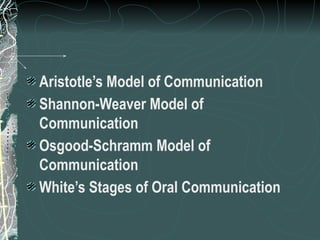
Aristotle’s Model of Communication
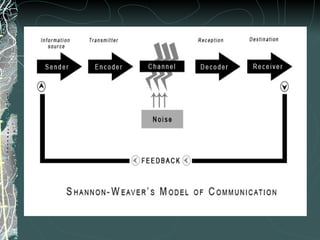
Shannon-Weaver Model of
Communication
Osgood-Schramm Model of
Communication
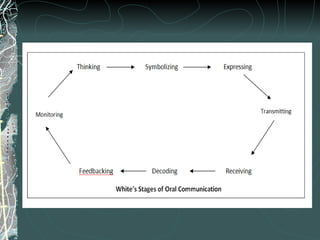
White’s Stages of Oral Communication
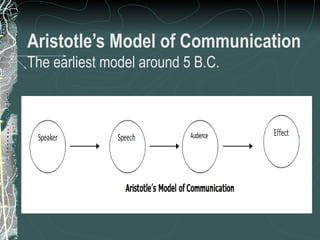
Aristotle’s Model of Communication
The earliest model around 5 B.C.
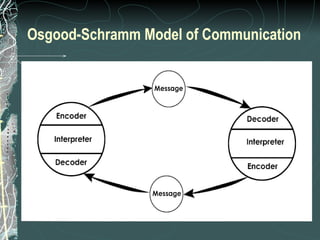
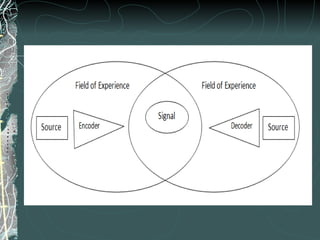
Osgood-Schramm Model of Communication
What is ethics?
Ethics is based on well-founded
standards of right and wrong that
prescribe what humans ought to do,
usually in terms of rights, obligations,
benefits to society, fairness, or specific
virtues.
Communication Ethics
Why is Ethics important
in Communication?
What is ethical communication?
a type of communication that is predicated upon
certain business values, such as being truthful,
concise, and responsible with one’s words and
the resulting actions.
"Ethical communication is fundamental to
responsible thinking decision-making, and the
development of relationships and communities
within and across contexts cultures channels,
and media.”
Four ethical Principles of Communication
they "advocate truthfulness, accuracy, honesty,
and reason as essential to the integrity of
communication" (NCA, 1999).
"freedom of expression diversity of perspective,
and tolerance of dissent to achieve the informed
and responsible decision-making fundamental to
a civil society" (NCA. 1999).
"condemn communication that degrades
individuals and humanity through distortion,
intimidation, coercion, and violence, and
through the expression of intolerance and
hatred" (1999).
"accept responsibility for the short and
long-term consequences of our own
communication and expect the same of
others."
What is Purposive Communication.........

What is Purposive Communication.........

  • 1.
  • 2.
    How important is communicationin your profession?
  • 3.
    “The art ofcommunication is the language of leadership” James Humes Effective communication can breach peace, spark revolutions, and affect change in government. The art of one's communication reflects the art of one's thinking According to James Berlin (1982) This is also true when it comes to all the language skills essential in communication, whether this is in writing, reading, listening, or speaking.
  • 4.
    Communication Models According toDenis Mcquail and Sven Windahl (2013), "a model seeks to show the main elements of any structure or process and the relationship between these elements... it helps in explaining by providing in a simplified way information which would otherwise be complicated or ambiguous."
  • 5.
    Aristotle’s Model ofCommunication Shannon-Weaver Model of Communication Osgood-Schramm Model of Communication White’s Stages of Oral Communication
  • 6.
    Aristotle’s Model ofCommunication The earliest model around 5 B.C.
  • 8.
  • 11.
    What is ethics? Ethicsis based on well-founded standards of right and wrong that prescribe what humans ought to do, usually in terms of rights, obligations, benefits to society, fairness, or specific virtues.
  • 12.
    Communication Ethics Why isEthics important in Communication?
  • 13.
    What is ethicalcommunication? a type of communication that is predicated upon certain business values, such as being truthful, concise, and responsible with one’s words and the resulting actions. "Ethical communication is fundamental to responsible thinking decision-making, and the development of relationships and communities within and across contexts cultures channels, and media.”
  • 14.
    Four ethical Principlesof Communication they "advocate truthfulness, accuracy, honesty, and reason as essential to the integrity of communication" (NCA, 1999). "freedom of expression diversity of perspective, and tolerance of dissent to achieve the informed and responsible decision-making fundamental to a civil society" (NCA. 1999).
  • 15.
    "condemn communication thatdegrades individuals and humanity through distortion, intimidation, coercion, and violence, and through the expression of intolerance and hatred" (1999). "accept responsibility for the short and long-term consequences of our own communication and expect the same of others."