Enols and Enolates
Dr. Firoz Khan
Assistant Professor
AIKTC, School of Pharmacy,
Panvel, Navi Mumbai, India.
https://scholar.google.co.in/citations?user=FkGHPWQAAAAJ&hl=en
Why Mixture of Compounds?
Because of Tautomerisation, dimedone has mixture of two
compounds i.e. Keto form of dimedone and enol form of
dimedone.
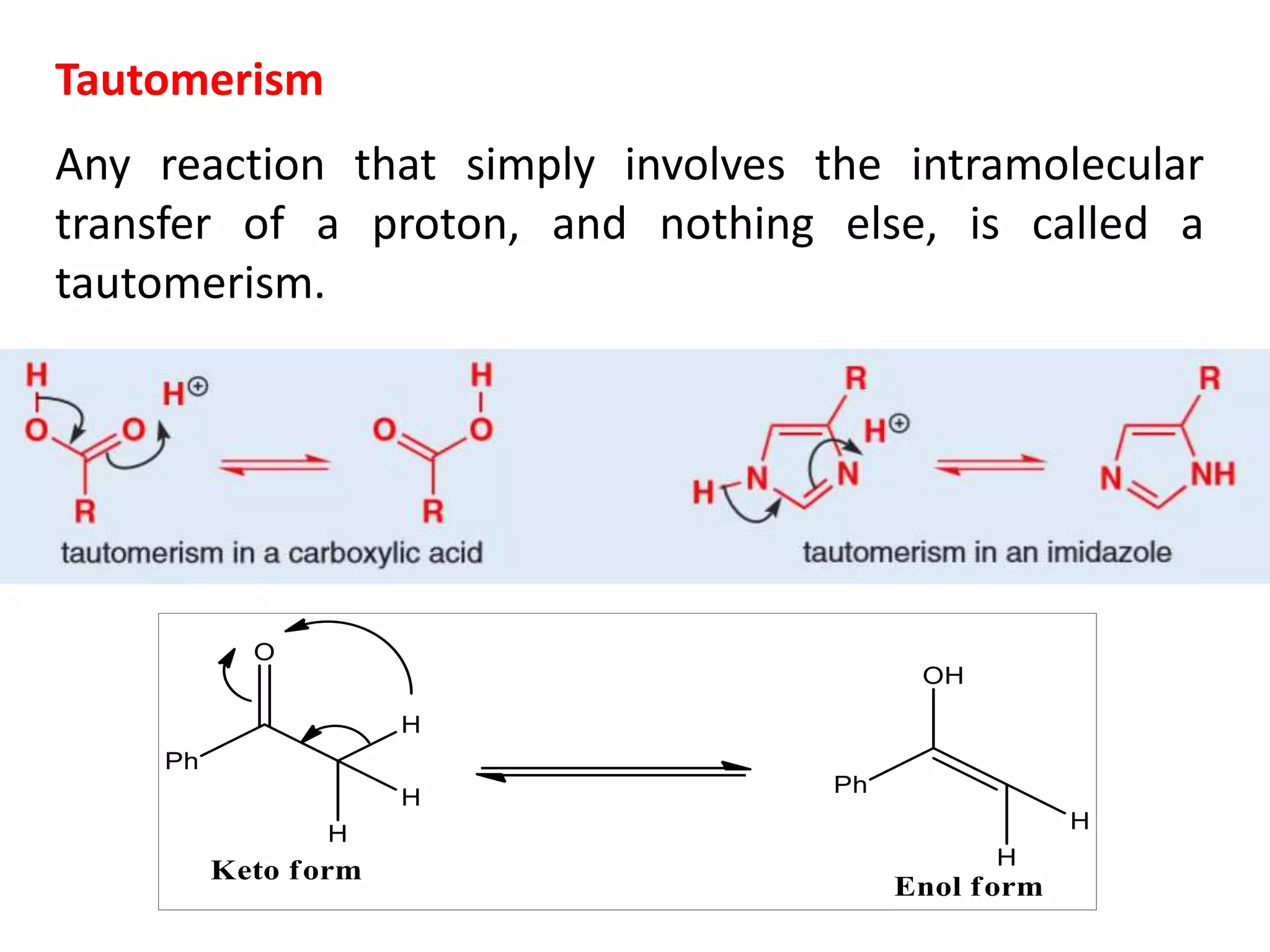
Tautomerism
Any reaction that simply involves the intramolecular
transfer of a proton, and nothing else, is called a
tautomerism.
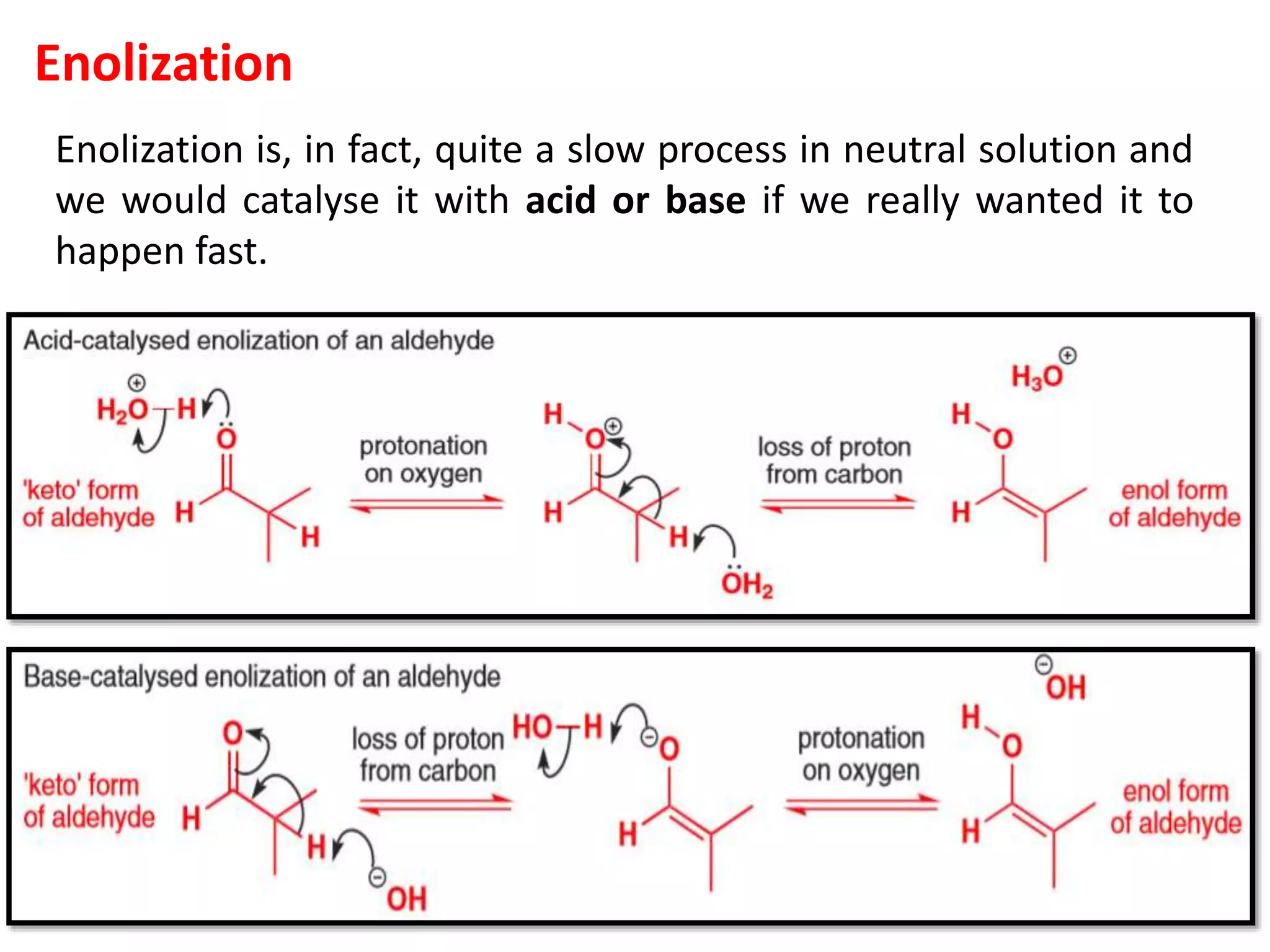
Enolization
Enolization is, in fact, quite a slow process in neutral solution and
we would catalyse it with acid or base if we really wanted it to
happen fast.
Enolate ion
During base-catalysed reaction of enol formation, the
intermediate anion formed is called the enolate ion.
It is the conjugate base of the enol and can be formed directly
from the carbonyl compound by the loss of a C–H proton or from
the enol by loss of the O–H proton.
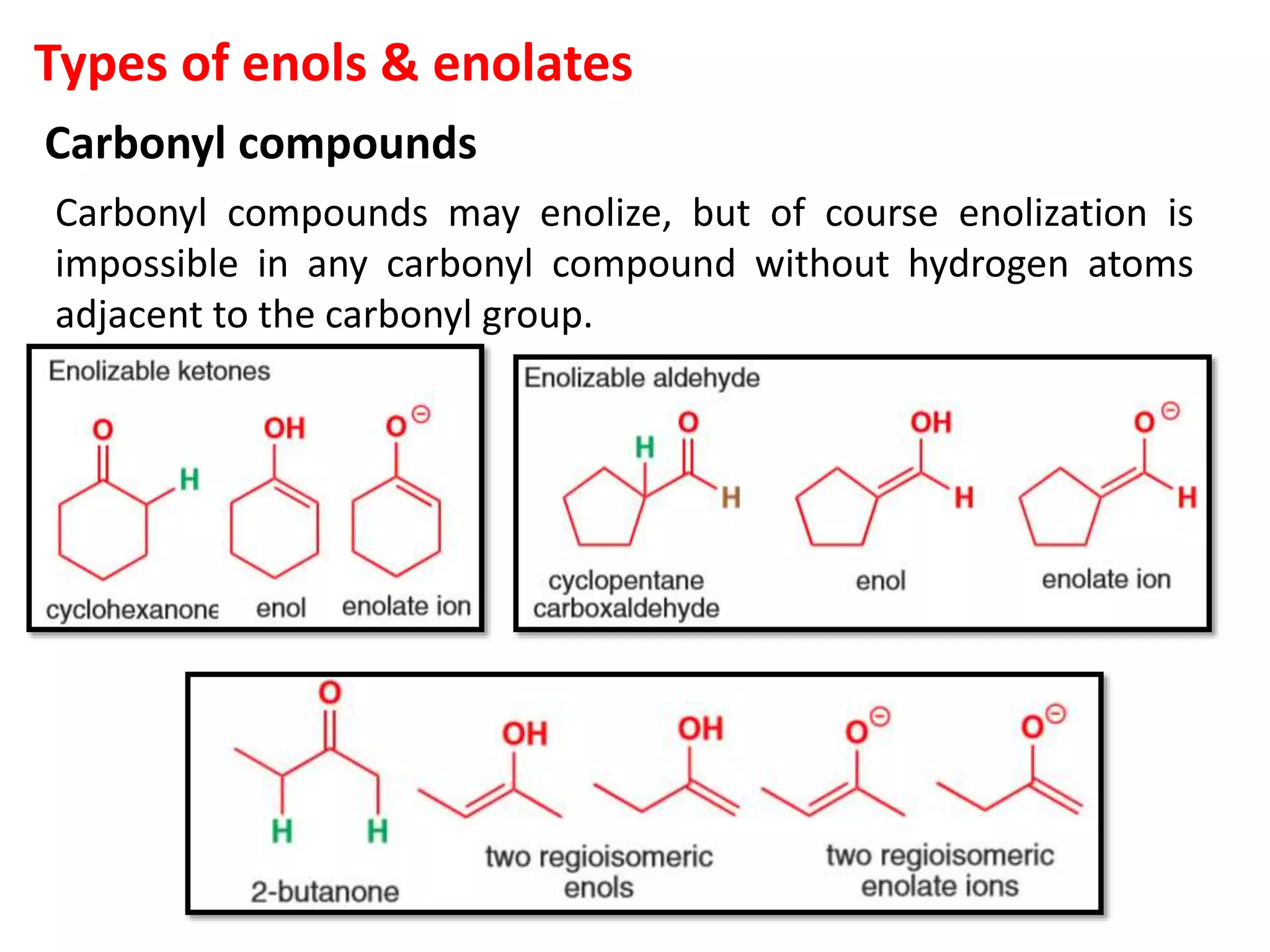
Types of enols & enolates
Carbonyl compounds
Carbonyl compounds may enolize, but of course enolization is
impossible in any carbonyl compound without hydrogen atoms
adjacent to the carbonyl group.
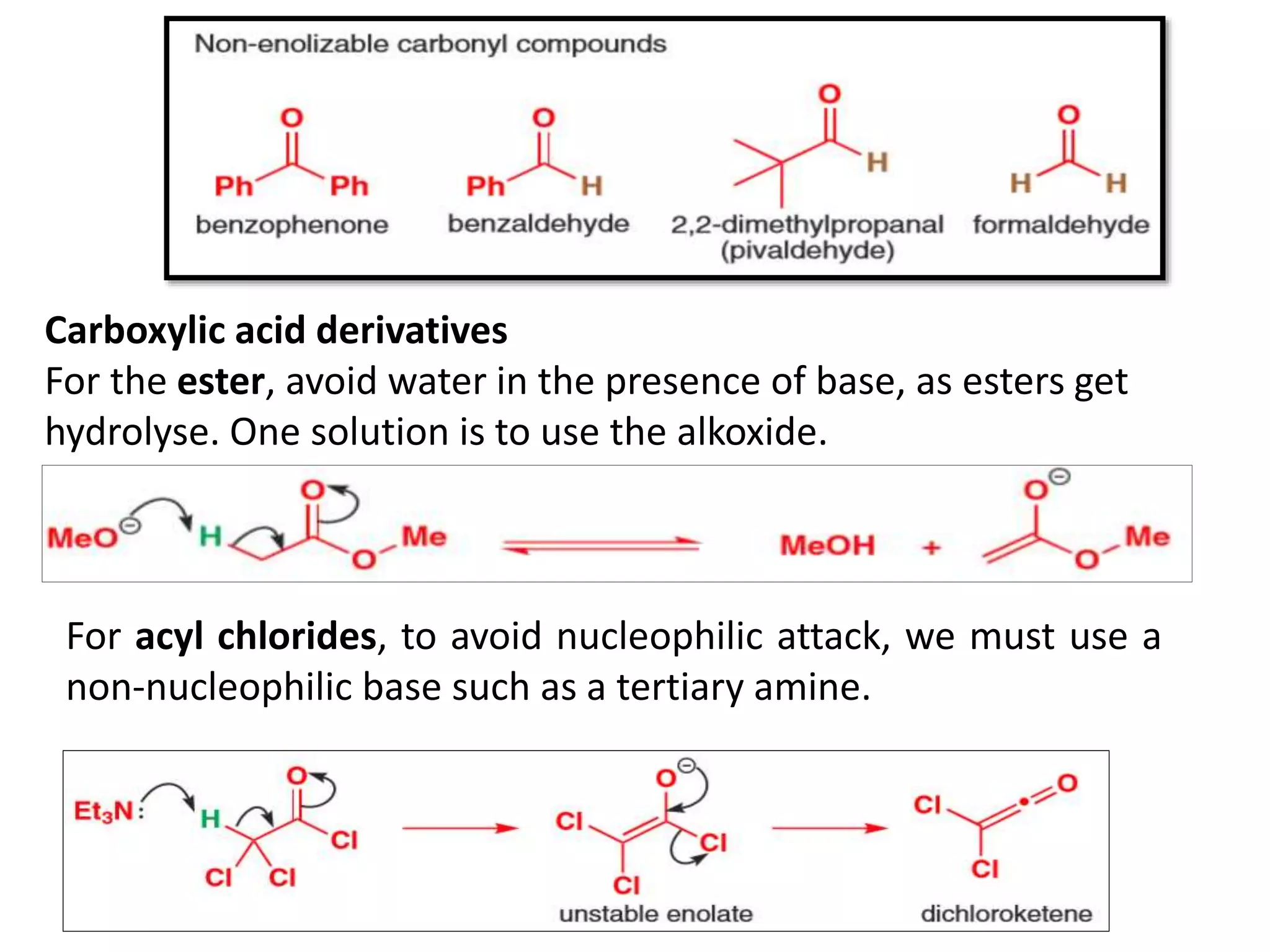
Carboxylic acid derivatives
For the ester, avoid water in the presence of base, as esters get
hydrolyse. One solution is to use the alkoxide.
For acyl chlorides, to avoid nucleophilic attack, we must use a
non-nucleophilic base such as a tertiary amine.
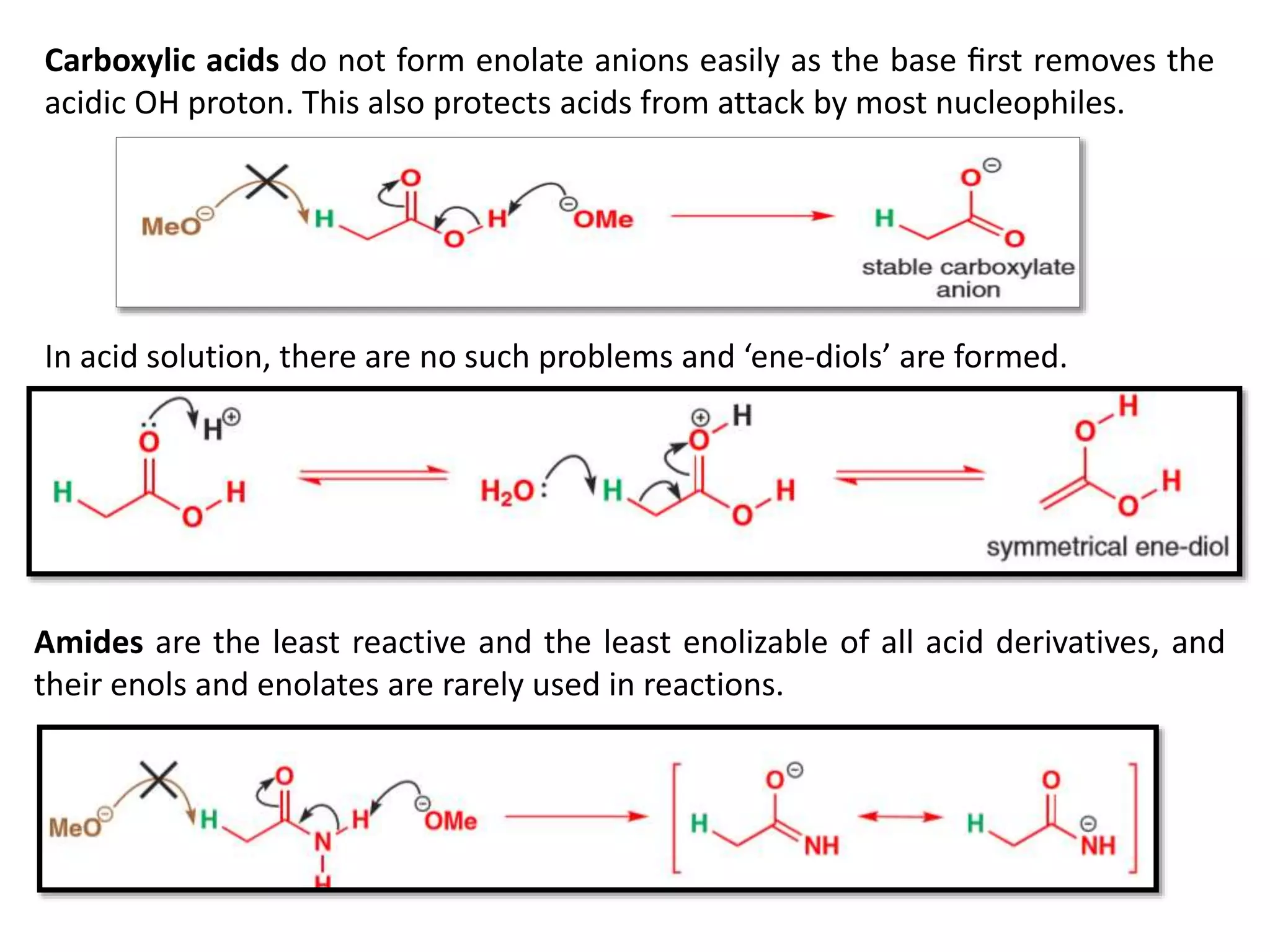
Carboxylic acids do not form enolate anions easily as the base first removes the
acidic OH proton. This also protects acids from attack by most nucleophiles.
In acid solution, there are no such problems and ‘ene-diols’ are formed.
Amides are the least reactive and the least enolizable of all acid derivatives, and
their enols and enolates are rarely used in reactions.
Stability of enols
Kinetically stable enols
The formation of enols is catalysed by acids and bases. The
reverse of this reaction—the formation of ketone from enol—must
therefore also be catalysed by the same acids and bases.
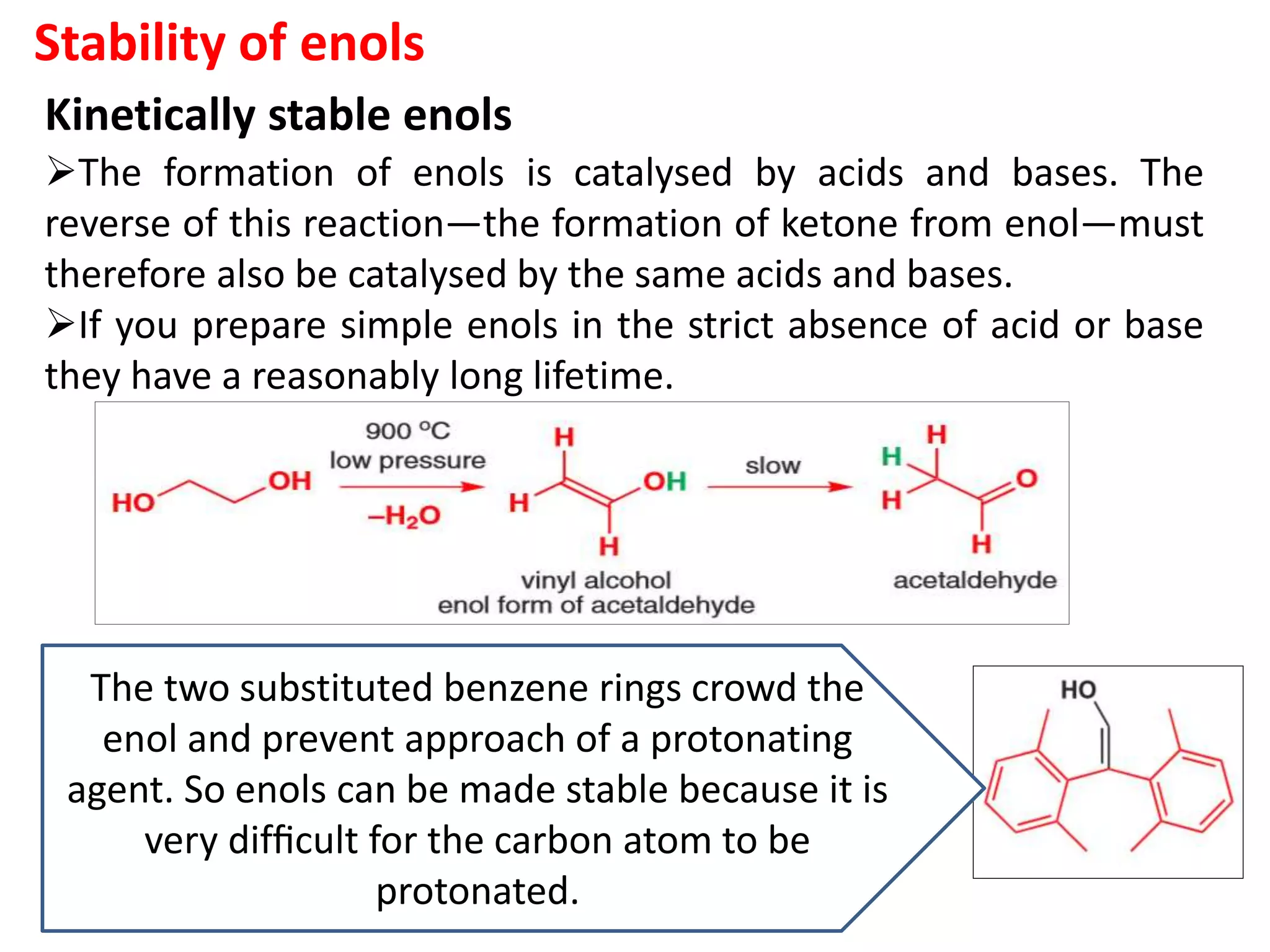
If you prepare simple enols in the strict absence of acid or base
they have a reasonably long lifetime.
The two substituted benzene rings crowd the
enol and prevent approach of a protonating
agent. So enols can be made stable because it is
very difficult for the carbon atom to be
protonated.
Thermodynamically stable enols
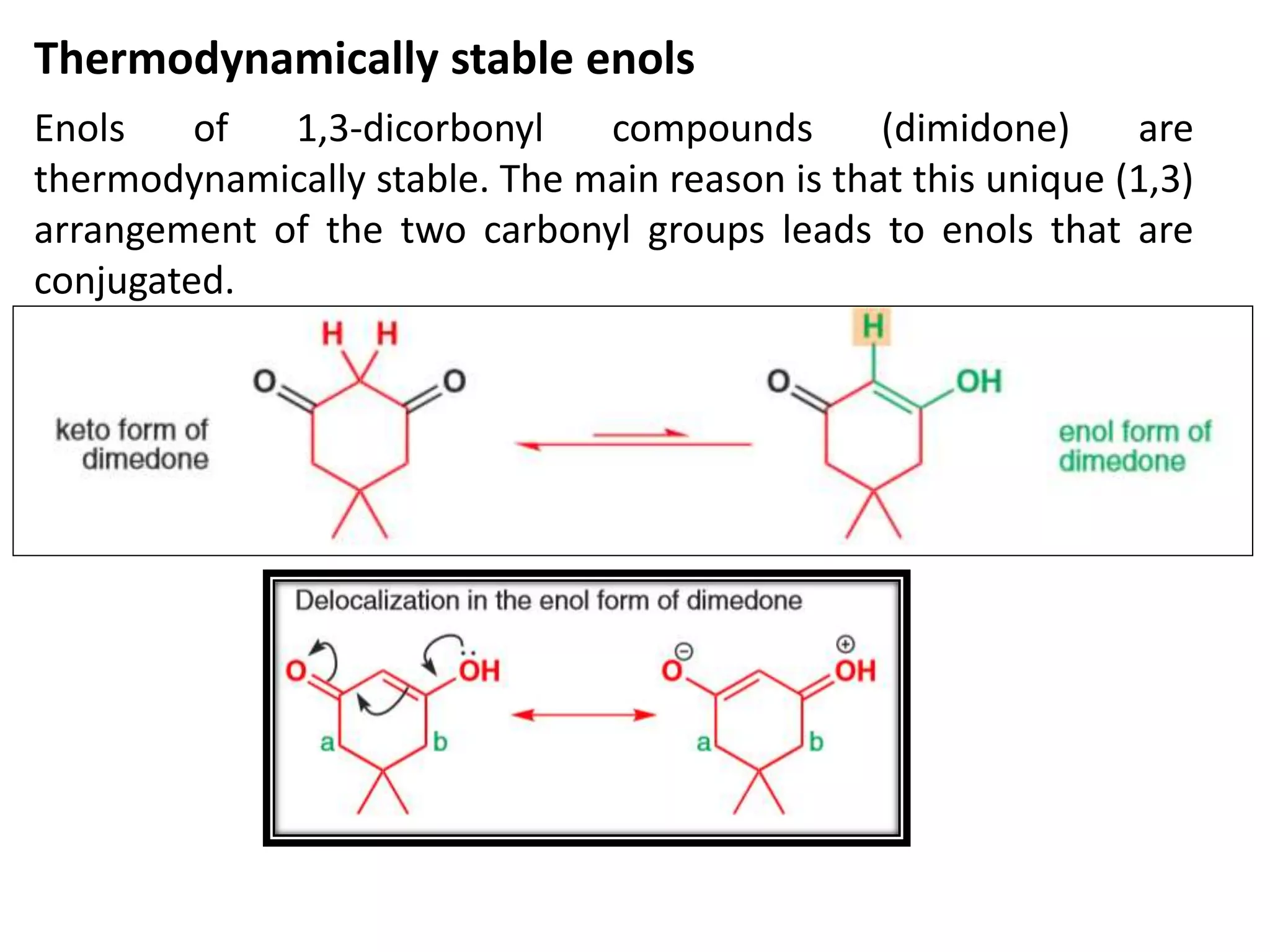
Enols of 1,3-dicorbonyl compounds (dimidone) are
thermodynamically stable. The main reason is that this unique (1,3)
arrangement of the two carbonyl groups leads to enols that are
conjugated.
In some examples there is an additional stabilizing factor,
intramolecular hydrogen bonding.
Acetylacetone (propane-2,4-dione) has a symmetrical enol
stabilized by conjugation. The enol form is also stabilized by a very
favourable intramolecular hydrogen bond in a six-membered ring.
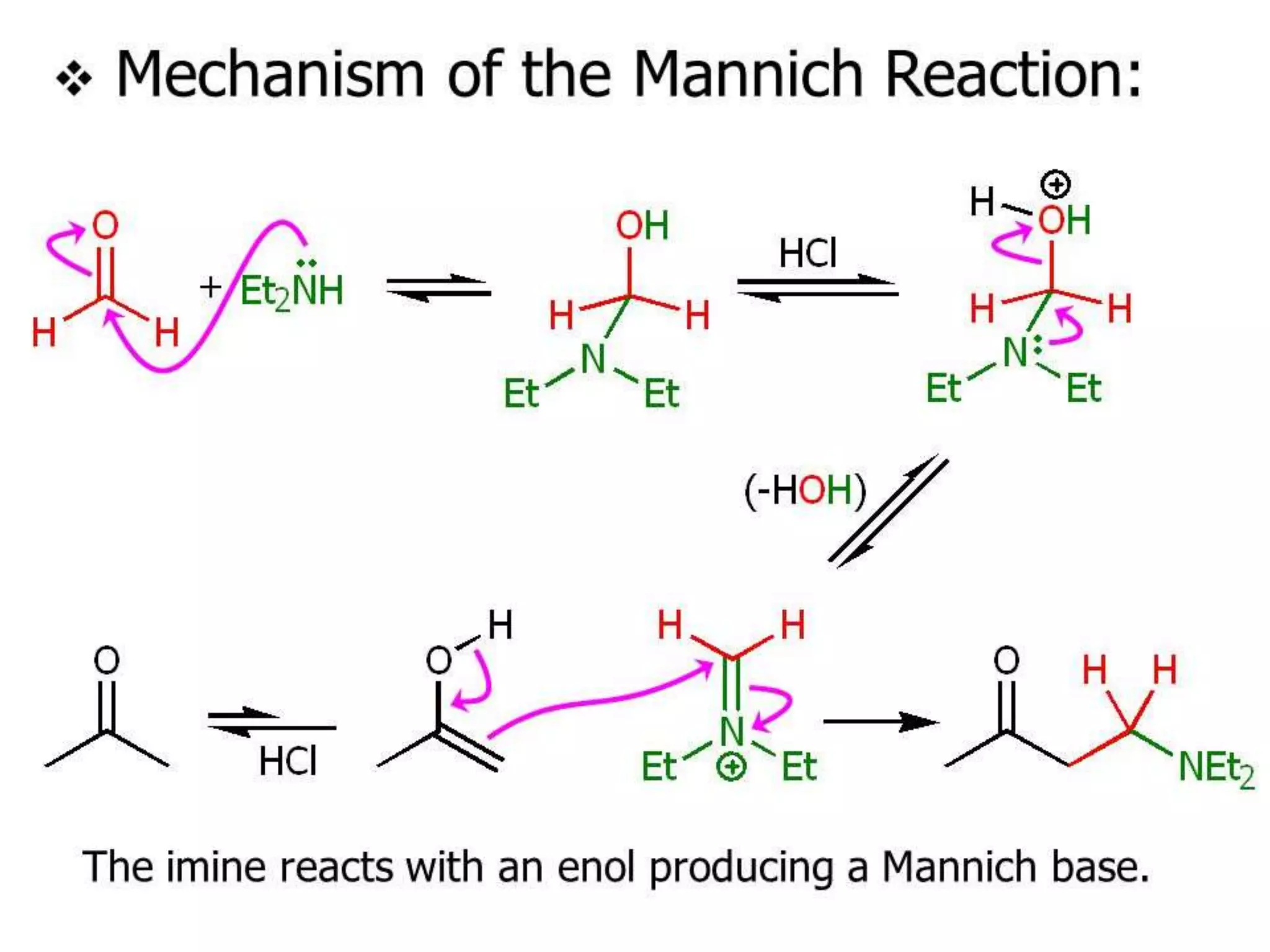
Mannich Reaction
Mannich reaction is an amino alkylation reaction, involving the
condensation of an enolizable carbonyl compound with a non-
enolizable aldehyde (like formaldehyde) and ammonia, or a
primary or a secondary amine to form a ß- amino carbonyl
compound, also known as Mannich Base.
General Reaction:
Example
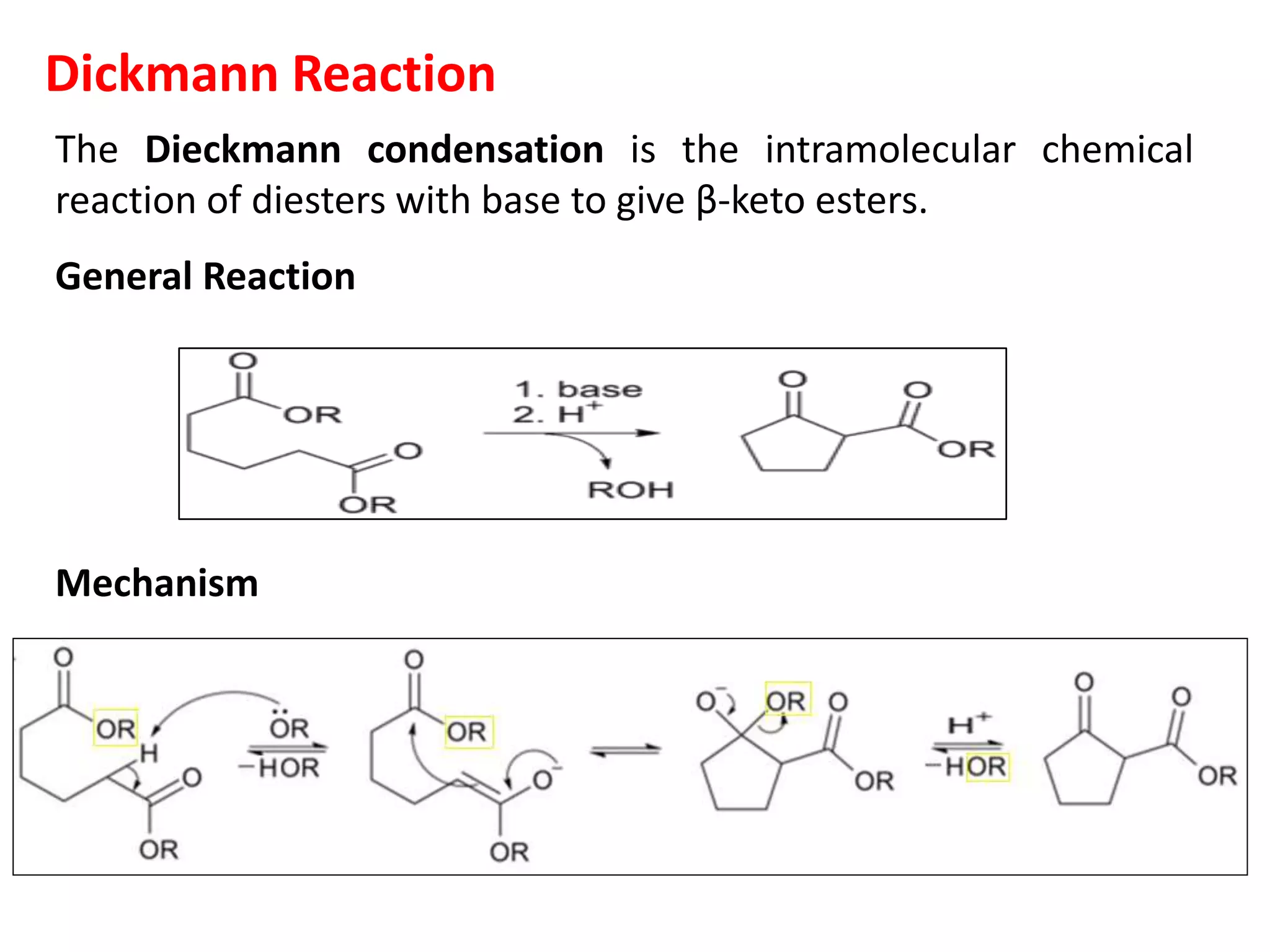
Dickmann Reaction
The Dieckmann condensation is the intramolecular chemical
reaction of diesters with base to give β-keto esters.
General Reaction
Mechanism
Examples
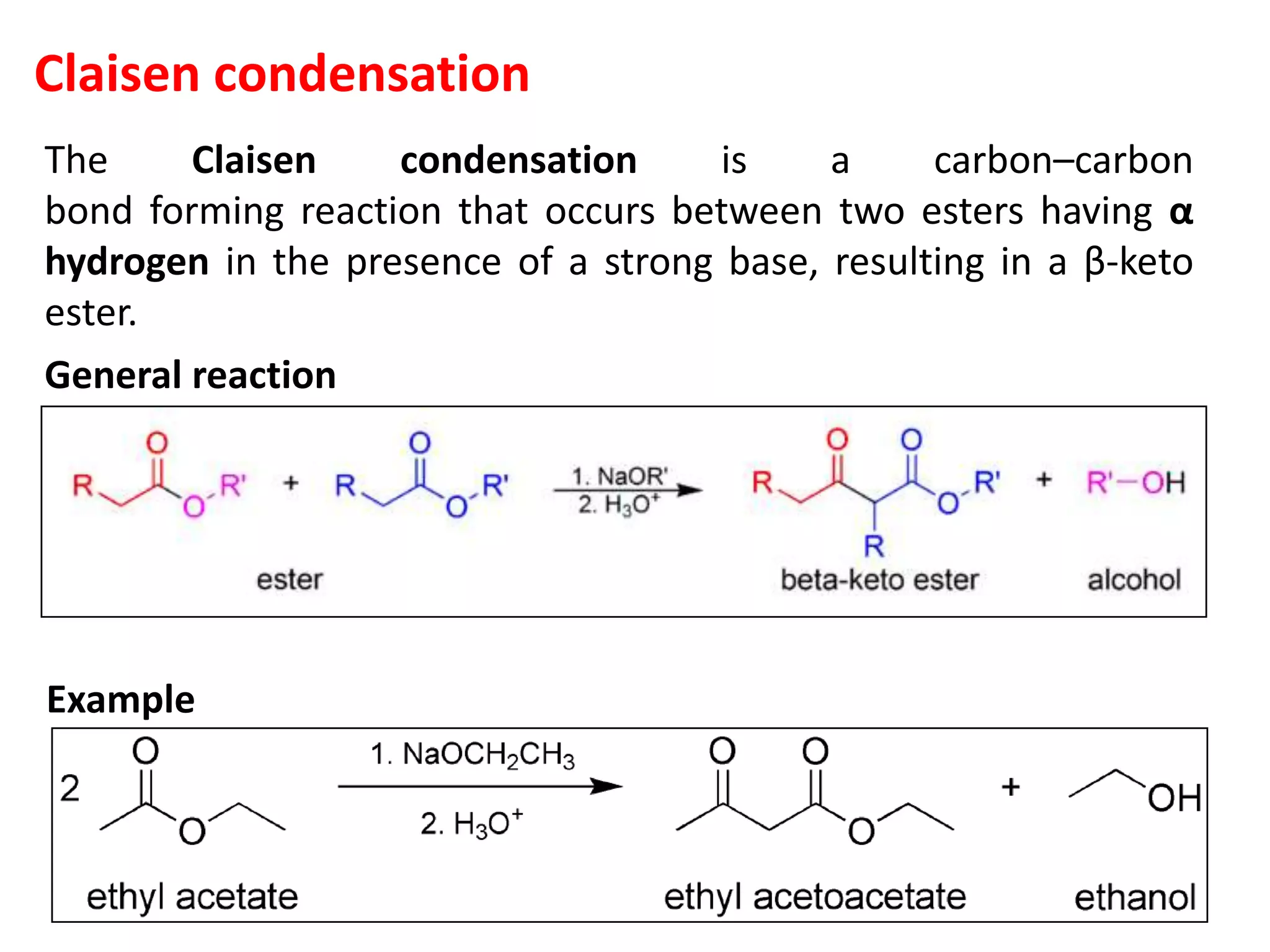
Claisen condensation
The Claisen condensation is a carbon–carbon
bond forming reaction that occurs between two esters having α
hydrogen in the presence of a strong base, resulting in a β-keto
ester.
General reaction
Example
Mechanism
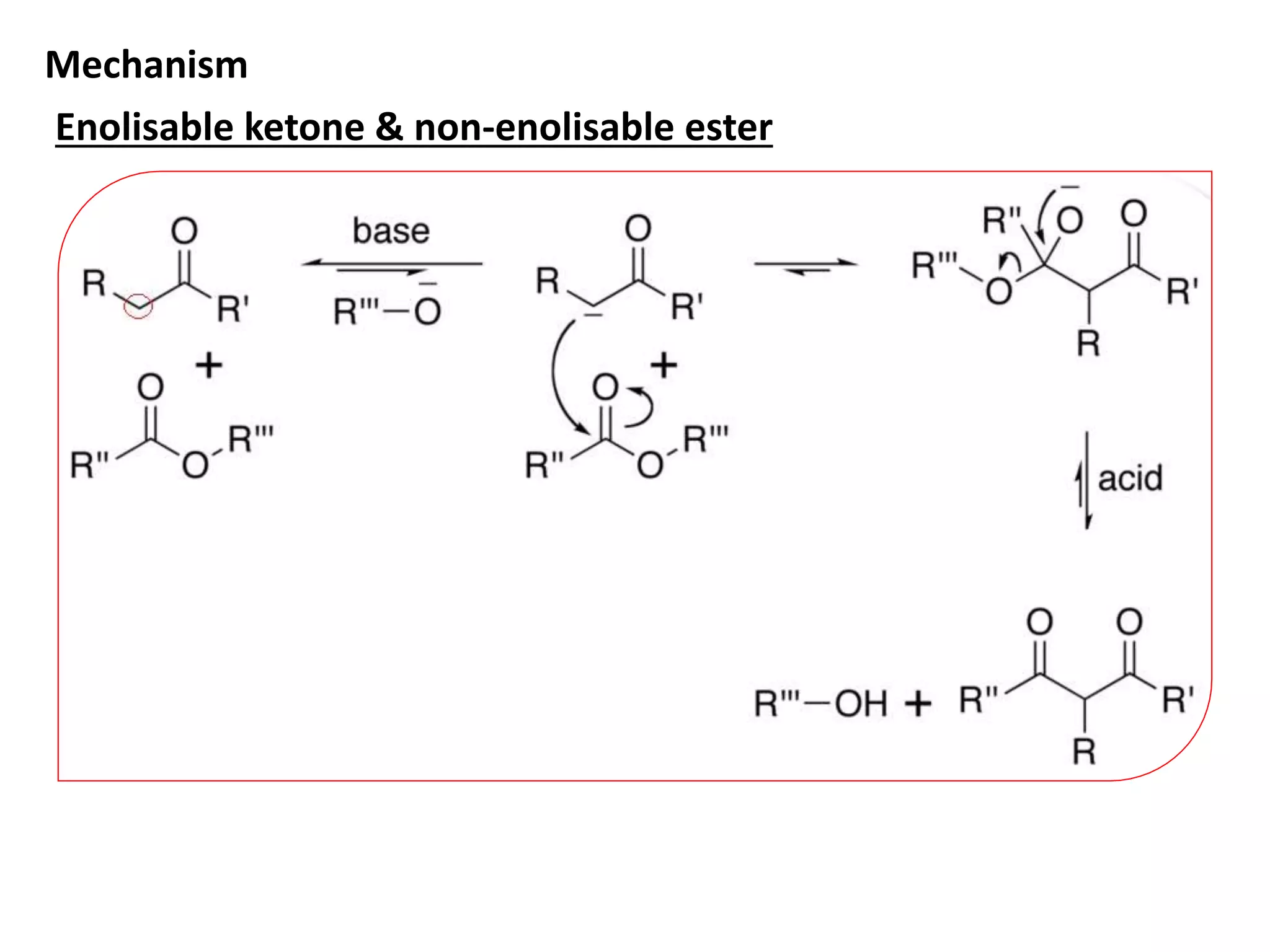
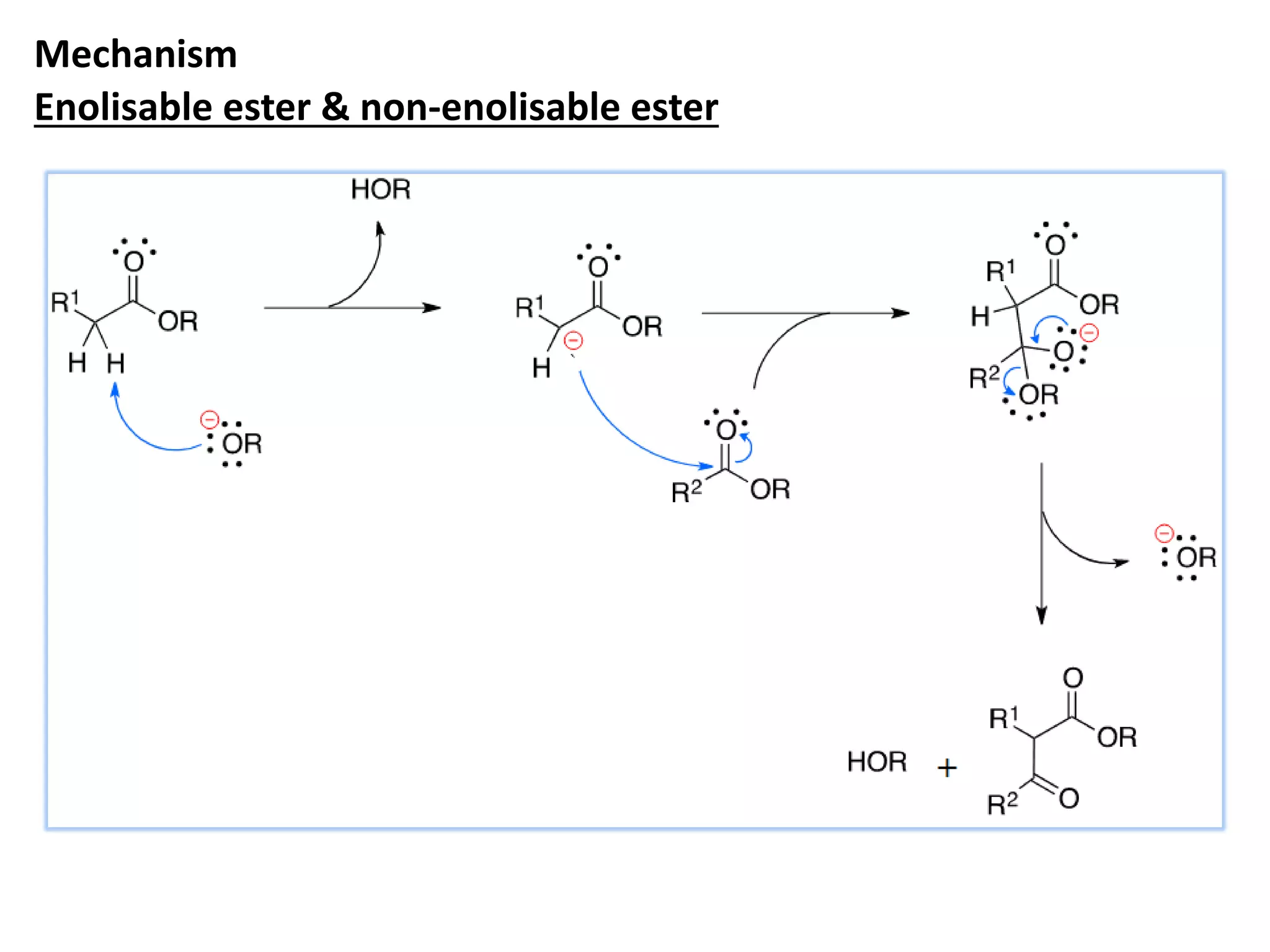
Crossed Claisen condensation
Claisen condensation, where one enolizable ester or ketone and
one non-enolizable ester are used called as Cossed Claisen
condensation.
Enolisable ketone & non-enolisable ester
Enolisable ester & non-enolisable ester
Example
Mechanism
Enolisable ketone & non-enolisable ester
Mechanism
Enolisable ester & non-enolisable ester
Aldol condensation
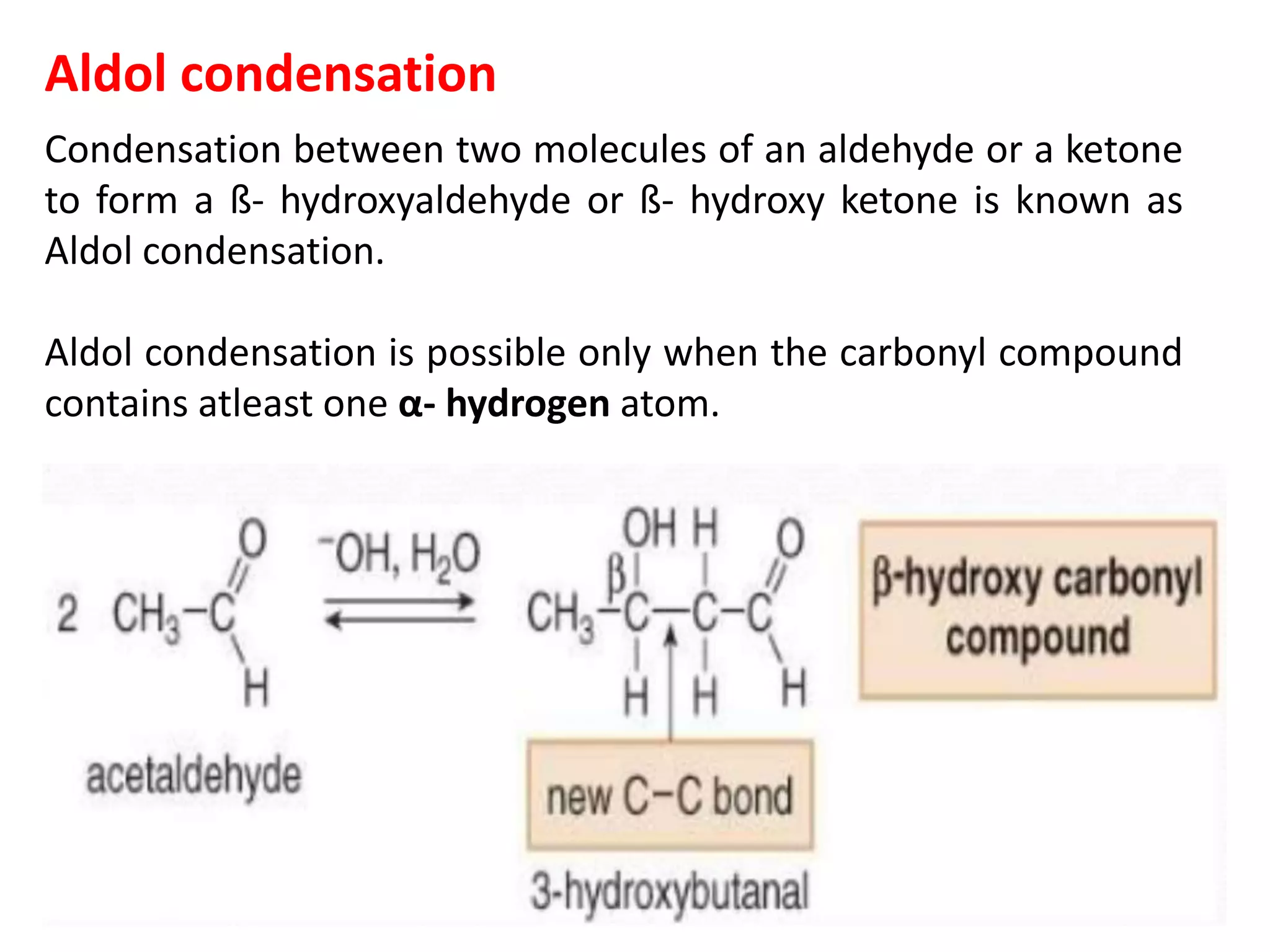
Condensation between two molecules of an aldehyde or a ketone
to form a ß- hydroxyaldehyde or ß- hydroxy ketone is known as
Aldol condensation.
Aldol condensation is possible only when the carbonyl compound
contains atleast one α- hydrogen atom.
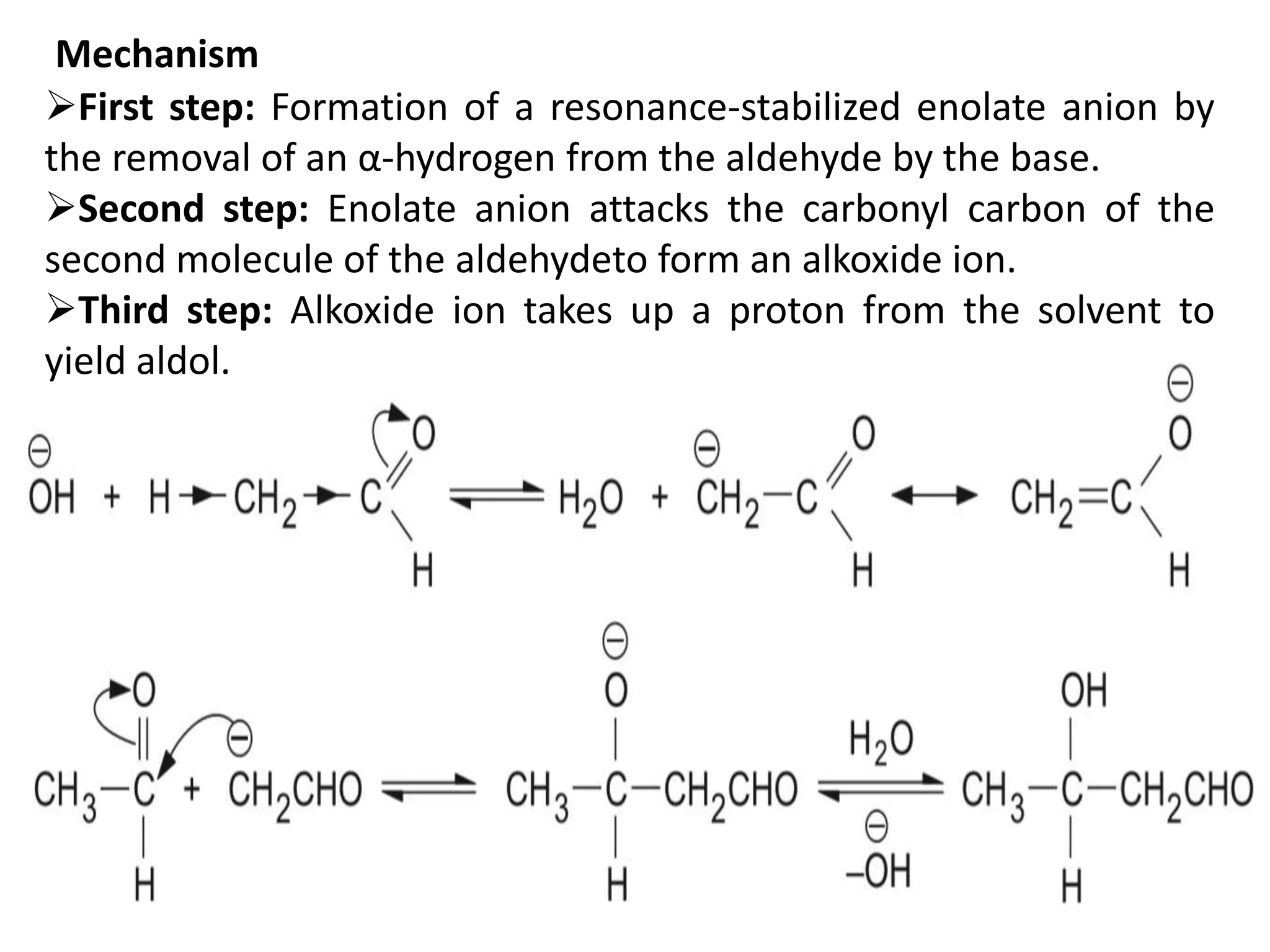
Mechanism
First step: Formation of a resonance-stabilized enolate anion by
the removal of an α-hydrogen from the aldehyde by the base.
Second step: Enolate anion attacks the carbonyl carbon of the
second molecule of the aldehydeto form an alkoxide ion.
Third step: Alkoxide ion takes up a proton from the solvent to
yield aldol.
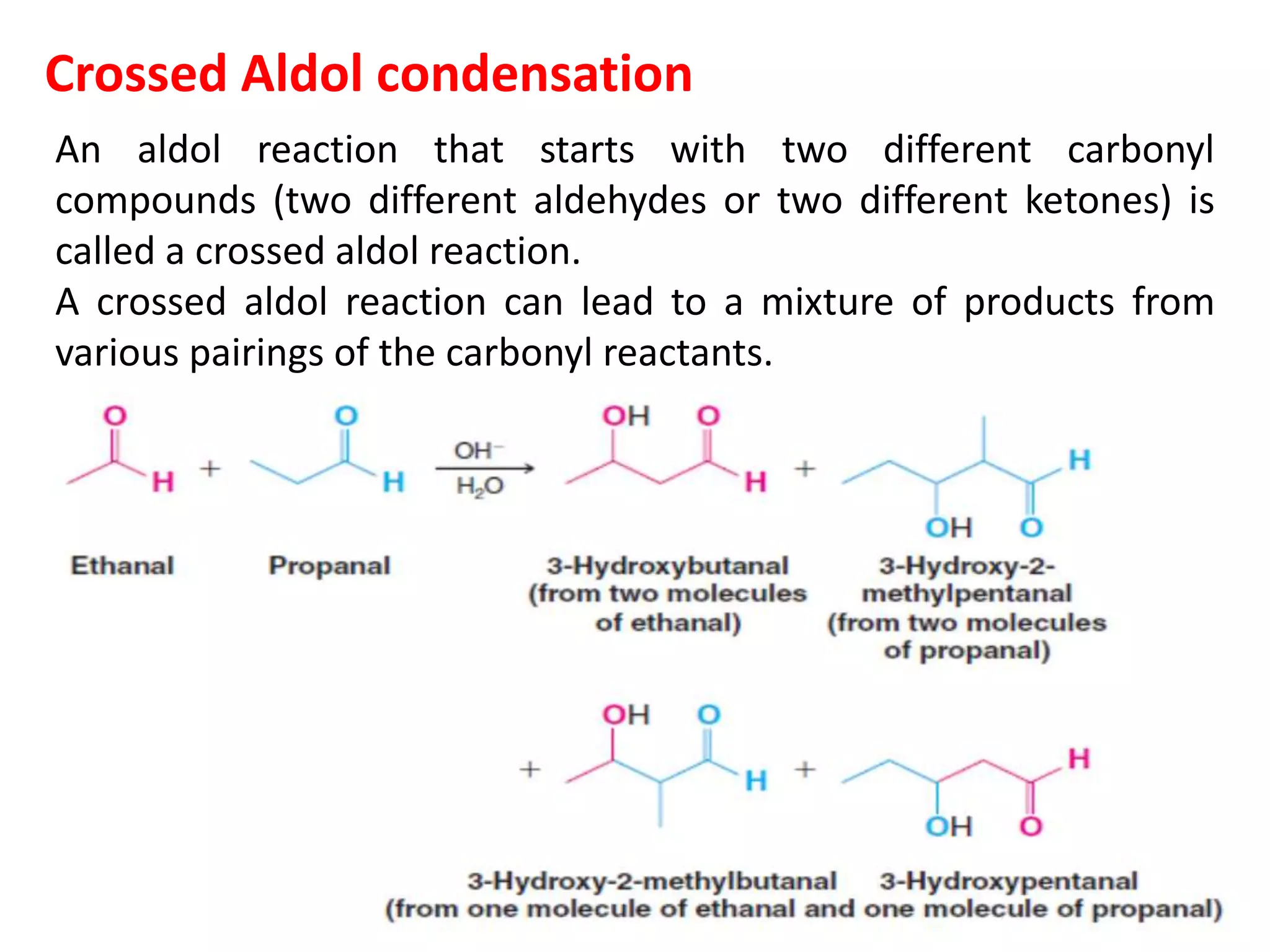
Crossed Aldol condensation
An aldol reaction that starts with two different carbonyl
compounds (two different aldehydes or two different ketones) is
called a crossed aldol reaction.
A crossed aldol reaction can lead to a mixture of products from
various pairings of the carbonyl reactants.
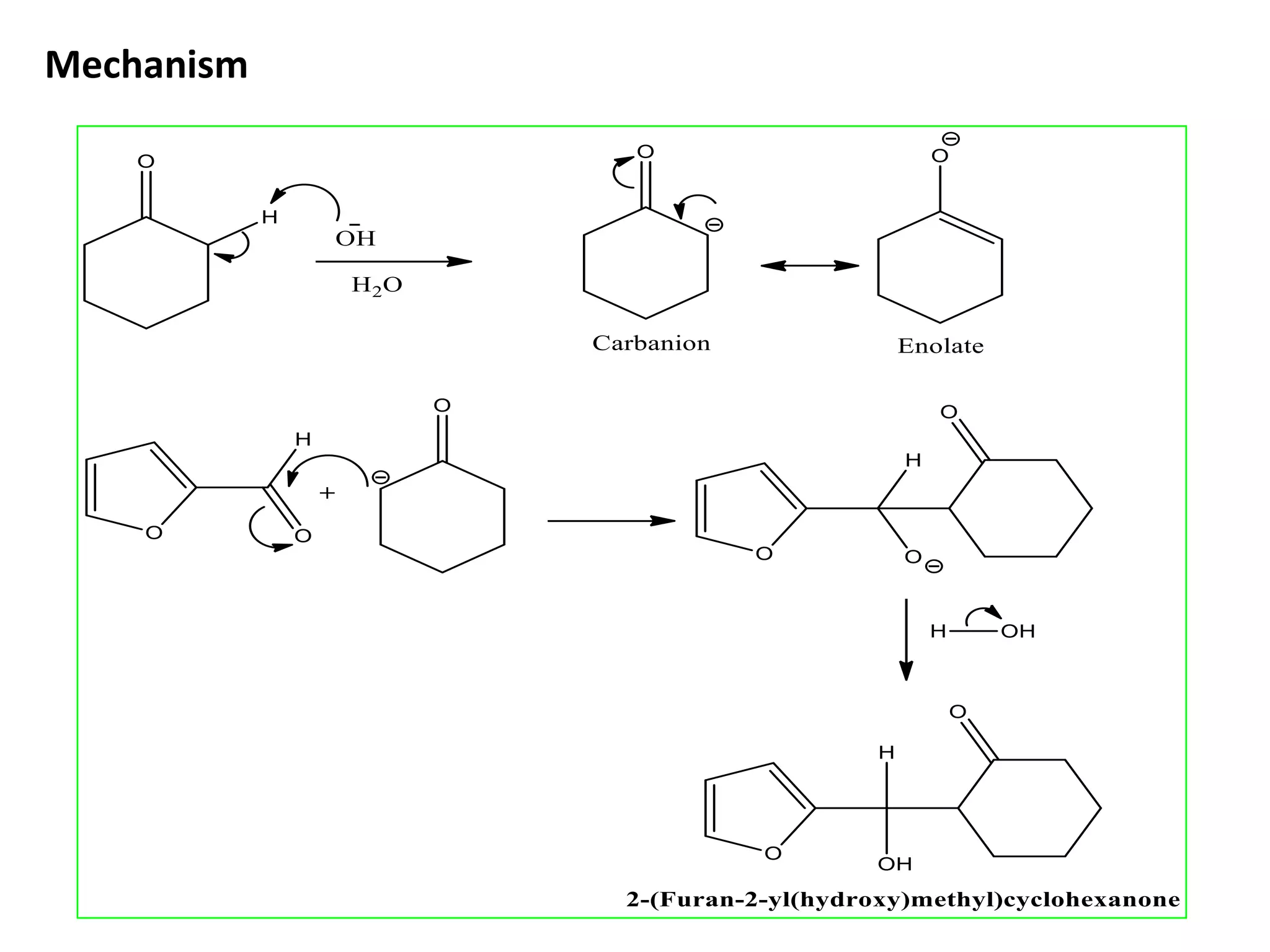
Mechanism
Mixed Aldol condensation
An aldol reaction that occurs between aldehyde and ketone is
called a mixed aldol reaction.
A mixed aldol reaction can lead to a mixture of products from
various pairings of the carbonyl reactants.
To overcome this problem, aldehyde with no α- hydrogen can be
used and ketone generally does not self condense approprially
because of steric hindrance.
Mechanism
Conjugate addition: 1,2 and 1,4- Michael Addition Reaction
Nucleophiles with α,ß- unsaturated carbonyl compounds can form
the conjugate addition (called 1,4-addition) and can also add
directly to the carbonyl group (called 1,2-addition).
The way that nucleophiles react depends on the conditions of the
reaction.
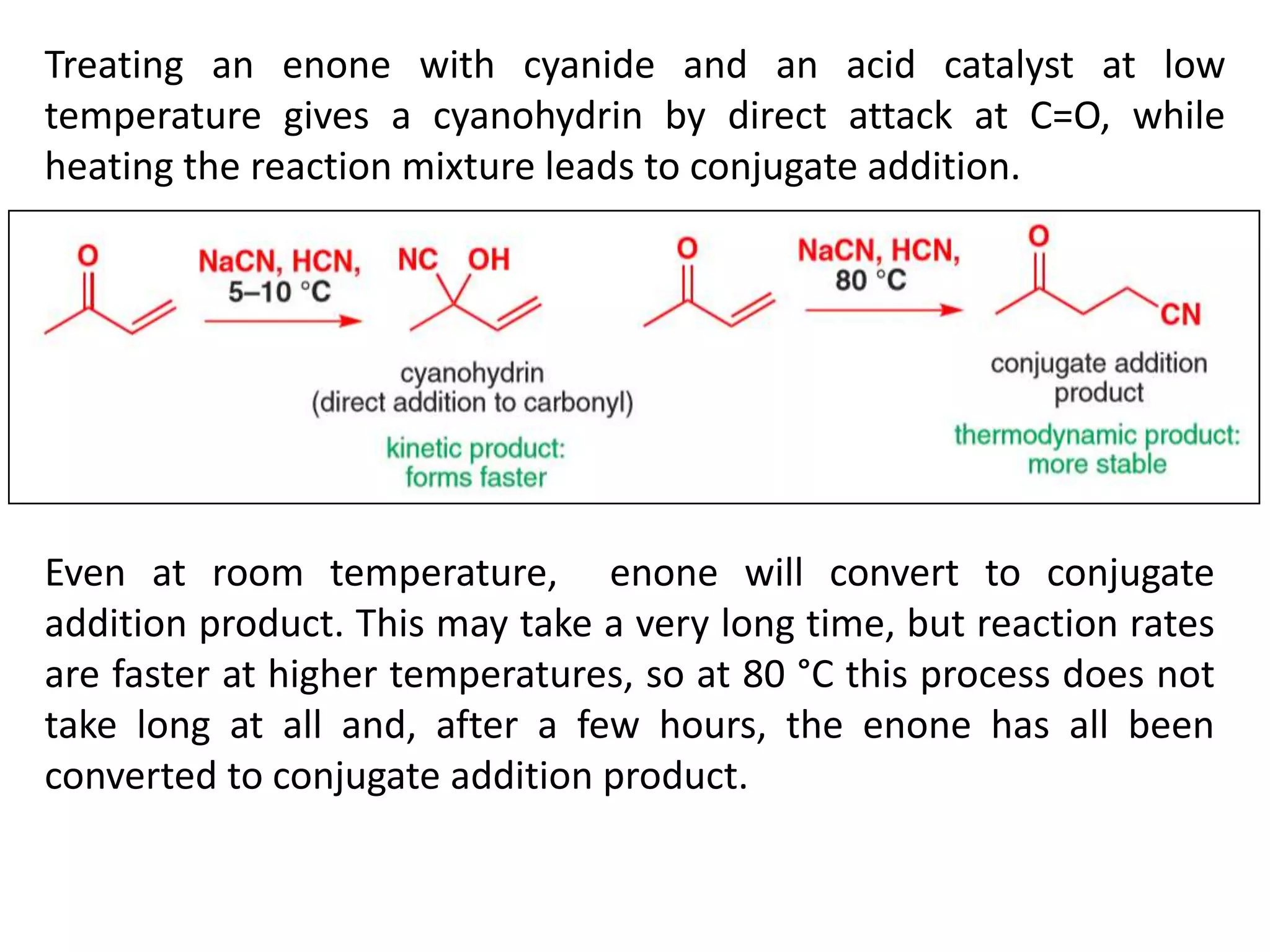
Treating an enone with cyanide and an acid catalyst at low
temperature gives a cyanohydrin by direct attack at C=O, while
heating the reaction mixture leads to conjugate addition.
Even at room temperature, enone will convert to conjugate
addition product. This may take a very long time, but reaction rates
are faster at higher temperatures, so at 80 °C this process does not
take long at all and, after a few hours, the enone has all been
converted to conjugate addition product.
Kinetic and thermodynamic control
• The product that forms faster is called the kinetic
product.
• The product that is the more stable is called the
thermodynamic product.
• Conditions that give rise to the kinetic product are
called kinetic control.
• Conditions that give rise to the thermodynamic
product are called thermodynamic control.
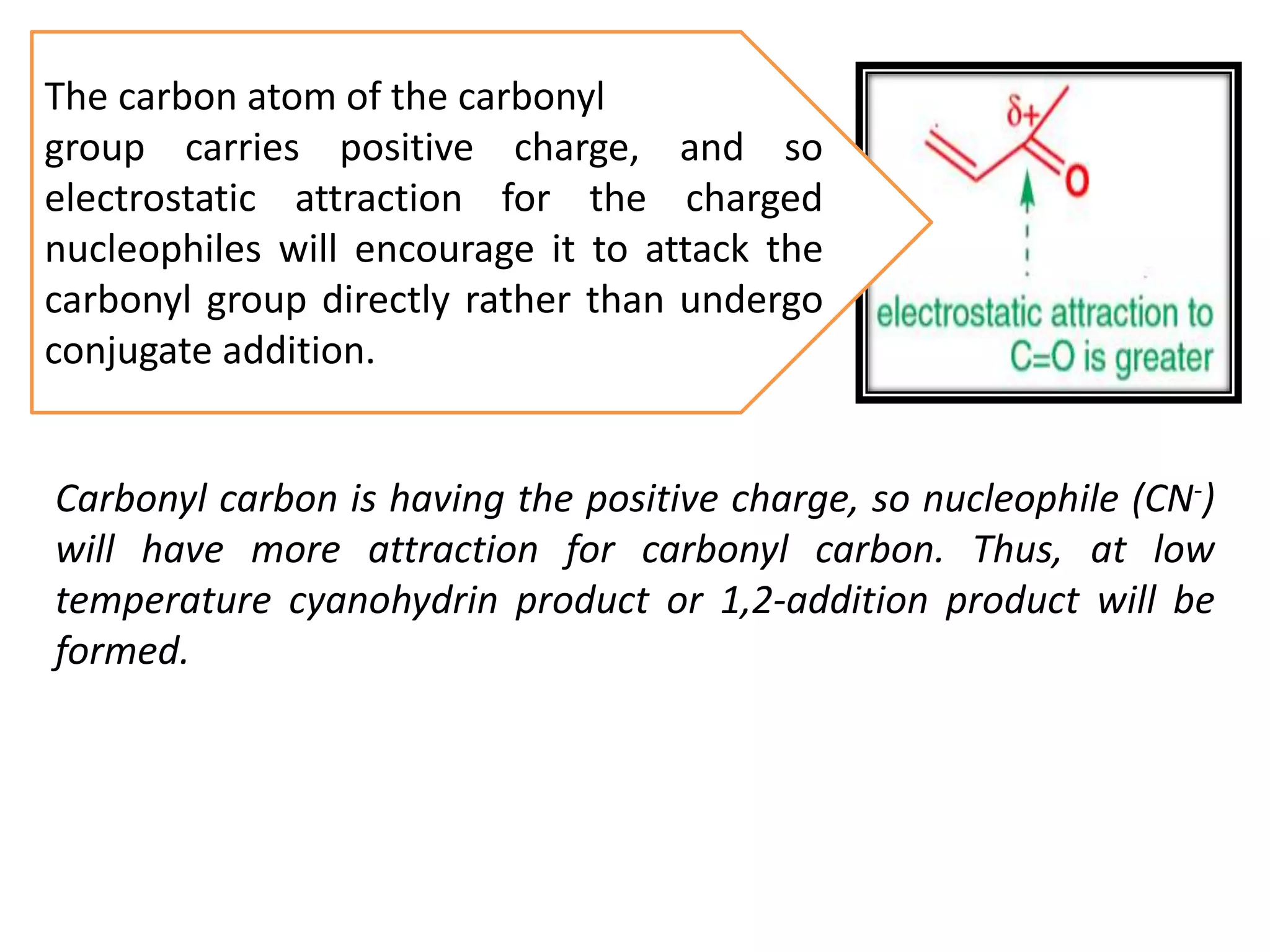
The carbon atom of the carbonyl
group carries positive charge, and so
electrostatic attraction for the charged
nucleophiles will encourage it to attack the
carbonyl group directly rather than undergo
conjugate addition.
Carbonyl carbon is having the positive charge, so nucleophile (CN-)
will have more attraction for carbonyl carbon. Thus, at low
temperature cyanohydrin product or 1,2-addition product will be
formed.
In the 1,4- addition
(conjugate addition) product, we gain a
C–C σ bond, losing a C=C π bond, but
keeping the C=O π bond.
With 1,2- addition (direct addition), we
still gain a C–C bond, but we lose the
C=O π bond and keep the C=C π bond.
C=O π bonds are stronger than C=C π bonds, so the conjugate
addition product is more stable.
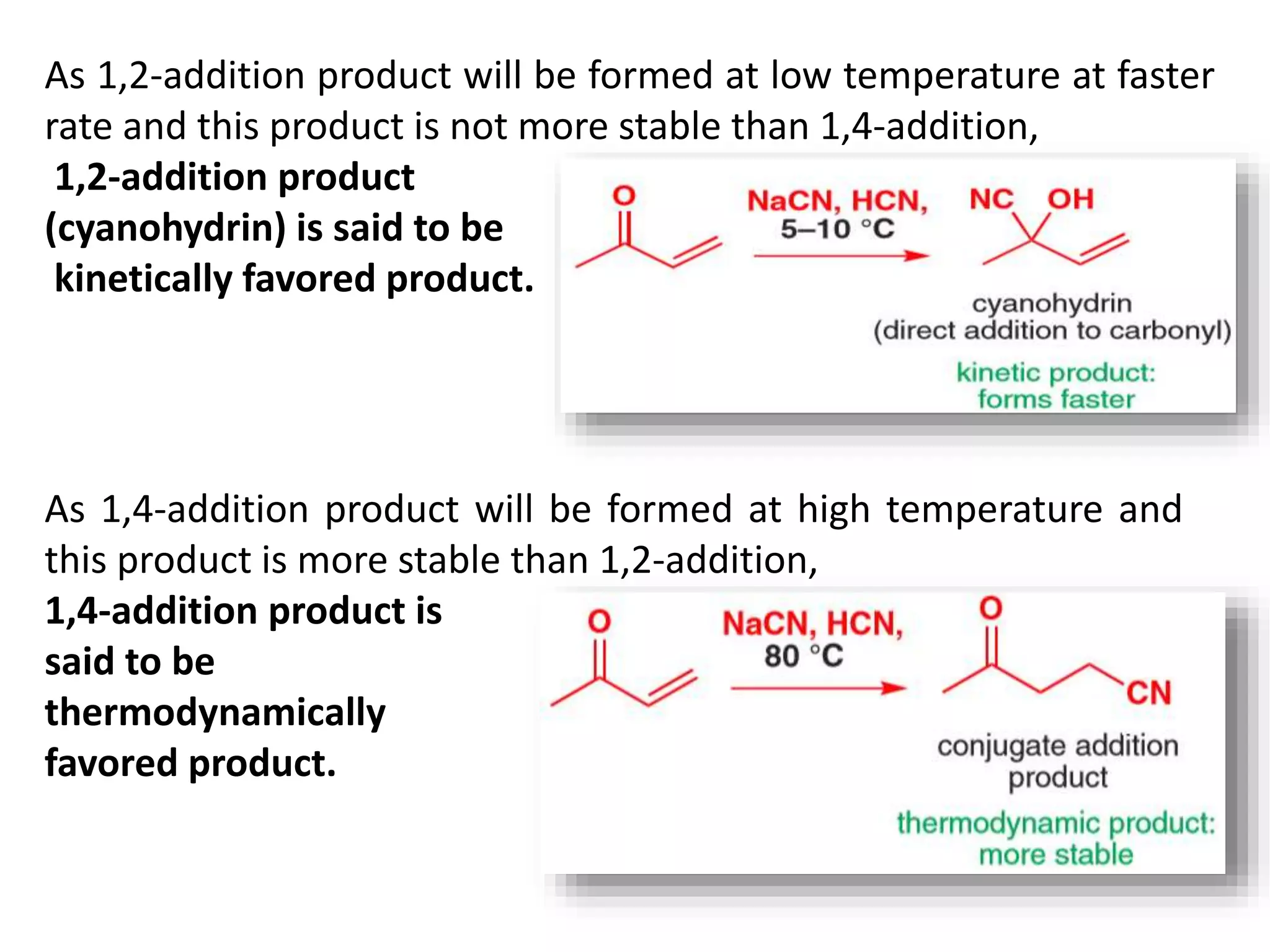
As 1,2-addition product will be formed at low temperature at faster
rate and this product is not more stable than 1,4-addition,
1,2-addition product
(cyanohydrin) is said to be
kinetically favored product.
As 1,4-addition product will be formed at high temperature and
this product is more stable than 1,2-addition,
1,4-addition product is
said to be
thermodynamically
favored product.

Enols & Enolates

  • 1.
    Enols and Enolates Dr.Firoz Khan Assistant Professor AIKTC, School of Pharmacy, Panvel, Navi Mumbai, India. https://scholar.google.co.in/citations?user=FkGHPWQAAAAJ&hl=en
  • 2.
    Why Mixture ofCompounds? Because of Tautomerisation, dimedone has mixture of two compounds i.e. Keto form of dimedone and enol form of dimedone.
  • 3.
    Tautomerism Any reaction thatsimply involves the intramolecular transfer of a proton, and nothing else, is called a tautomerism.
  • 4.
    Enolization Enolization is, infact, quite a slow process in neutral solution and we would catalyse it with acid or base if we really wanted it to happen fast.
  • 5.
    Enolate ion During base-catalysedreaction of enol formation, the intermediate anion formed is called the enolate ion. It is the conjugate base of the enol and can be formed directly from the carbonyl compound by the loss of a C–H proton or from the enol by loss of the O–H proton.
  • 6.
    Types of enols& enolates Carbonyl compounds Carbonyl compounds may enolize, but of course enolization is impossible in any carbonyl compound without hydrogen atoms adjacent to the carbonyl group.
  • 7.
    Carboxylic acid derivatives Forthe ester, avoid water in the presence of base, as esters get hydrolyse. One solution is to use the alkoxide. For acyl chlorides, to avoid nucleophilic attack, we must use a non-nucleophilic base such as a tertiary amine.
  • 8.
    Carboxylic acids donot form enolate anions easily as the base first removes the acidic OH proton. This also protects acids from attack by most nucleophiles. In acid solution, there are no such problems and ‘ene-diols’ are formed. Amides are the least reactive and the least enolizable of all acid derivatives, and their enols and enolates are rarely used in reactions.
  • 9.
    Stability of enols Kineticallystable enols The formation of enols is catalysed by acids and bases. The reverse of this reaction—the formation of ketone from enol—must therefore also be catalysed by the same acids and bases. If you prepare simple enols in the strict absence of acid or base they have a reasonably long lifetime. The two substituted benzene rings crowd the enol and prevent approach of a protonating agent. So enols can be made stable because it is very difficult for the carbon atom to be protonated.
  • 10.
    Thermodynamically stable enols Enolsof 1,3-dicorbonyl compounds (dimidone) are thermodynamically stable. The main reason is that this unique (1,3) arrangement of the two carbonyl groups leads to enols that are conjugated.
  • 11.
    In some examplesthere is an additional stabilizing factor, intramolecular hydrogen bonding. Acetylacetone (propane-2,4-dione) has a symmetrical enol stabilized by conjugation. The enol form is also stabilized by a very favourable intramolecular hydrogen bond in a six-membered ring.
  • 12.
    Mannich Reaction Mannich reactionis an amino alkylation reaction, involving the condensation of an enolizable carbonyl compound with a non- enolizable aldehyde (like formaldehyde) and ammonia, or a primary or a secondary amine to form a ß- amino carbonyl compound, also known as Mannich Base. General Reaction: Example
  • 14.
    Dickmann Reaction The Dieckmanncondensation is the intramolecular chemical reaction of diesters with base to give β-keto esters. General Reaction Mechanism
  • 15.
  • 16.
    Claisen condensation The Claisencondensation is a carbon–carbon bond forming reaction that occurs between two esters having α hydrogen in the presence of a strong base, resulting in a β-keto ester. General reaction Example
  • 17.
  • 18.
    Crossed Claisen condensation Claisencondensation, where one enolizable ester or ketone and one non-enolizable ester are used called as Cossed Claisen condensation. Enolisable ketone & non-enolisable ester Enolisable ester & non-enolisable ester Example
  • 19.
    Mechanism Enolisable ketone &non-enolisable ester
  • 20.
    Mechanism Enolisable ester &non-enolisable ester
  • 21.
    Aldol condensation Condensation betweentwo molecules of an aldehyde or a ketone to form a ß- hydroxyaldehyde or ß- hydroxy ketone is known as Aldol condensation. Aldol condensation is possible only when the carbonyl compound contains atleast one α- hydrogen atom.
  • 22.
    Mechanism First step: Formationof a resonance-stabilized enolate anion by the removal of an α-hydrogen from the aldehyde by the base. Second step: Enolate anion attacks the carbonyl carbon of the second molecule of the aldehydeto form an alkoxide ion. Third step: Alkoxide ion takes up a proton from the solvent to yield aldol.
  • 23.
    Crossed Aldol condensation Analdol reaction that starts with two different carbonyl compounds (two different aldehydes or two different ketones) is called a crossed aldol reaction. A crossed aldol reaction can lead to a mixture of products from various pairings of the carbonyl reactants.
  • 24.
  • 26.
    Mixed Aldol condensation Analdol reaction that occurs between aldehyde and ketone is called a mixed aldol reaction. A mixed aldol reaction can lead to a mixture of products from various pairings of the carbonyl reactants. To overcome this problem, aldehyde with no α- hydrogen can be used and ketone generally does not self condense approprially because of steric hindrance.
  • 27.
  • 28.
    Conjugate addition: 1,2and 1,4- Michael Addition Reaction Nucleophiles with α,ß- unsaturated carbonyl compounds can form the conjugate addition (called 1,4-addition) and can also add directly to the carbonyl group (called 1,2-addition). The way that nucleophiles react depends on the conditions of the reaction.
  • 29.
    Treating an enonewith cyanide and an acid catalyst at low temperature gives a cyanohydrin by direct attack at C=O, while heating the reaction mixture leads to conjugate addition. Even at room temperature, enone will convert to conjugate addition product. This may take a very long time, but reaction rates are faster at higher temperatures, so at 80 °C this process does not take long at all and, after a few hours, the enone has all been converted to conjugate addition product.
  • 30.
    Kinetic and thermodynamiccontrol • The product that forms faster is called the kinetic product. • The product that is the more stable is called the thermodynamic product. • Conditions that give rise to the kinetic product are called kinetic control. • Conditions that give rise to the thermodynamic product are called thermodynamic control.
  • 31.
    The carbon atomof the carbonyl group carries positive charge, and so electrostatic attraction for the charged nucleophiles will encourage it to attack the carbonyl group directly rather than undergo conjugate addition. Carbonyl carbon is having the positive charge, so nucleophile (CN-) will have more attraction for carbonyl carbon. Thus, at low temperature cyanohydrin product or 1,2-addition product will be formed.
  • 32.
    In the 1,4-addition (conjugate addition) product, we gain a C–C σ bond, losing a C=C π bond, but keeping the C=O π bond. With 1,2- addition (direct addition), we still gain a C–C bond, but we lose the C=O π bond and keep the C=C π bond. C=O π bonds are stronger than C=C π bonds, so the conjugate addition product is more stable.
  • 33.
    As 1,2-addition productwill be formed at low temperature at faster rate and this product is not more stable than 1,4-addition, 1,2-addition product (cyanohydrin) is said to be kinetically favored product. As 1,4-addition product will be formed at high temperature and this product is more stable than 1,2-addition, 1,4-addition product is said to be thermodynamically favored product.