Half-Life
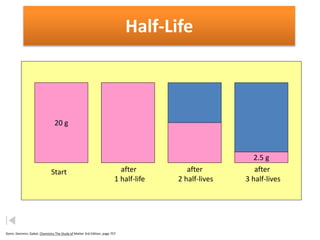
20 g
10 g
5 g
2.5 g
after
1 half-life
Start after
2 half-lives
after
3 half-lives
Dorin, Demmin, Gabel, Chemistry The Study of Matter 3rd Edition, page 757
Half-Life
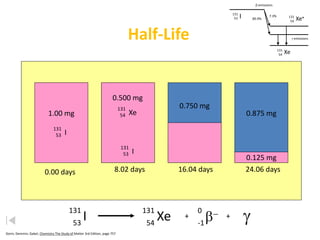
1.00 mg 0.875 mg
0.500 mg
0.250 mg
0.125 mg
8.02 days0.00 days 16.04 days 24.06 days
Half-Life
Dorin, Demmin, Gabel, Chemistry The Study of Matter 3rd Edition, page 757
131
53 I
131
53 I
0.500 mg
0.750 mg
b emissions
g emissions
89.9%
7.3%
131
53 I
131
54 Xe
131
54 Xe*
131
54 Xe
I
131
53
Xe
131
54
b-0
-1
+ g+
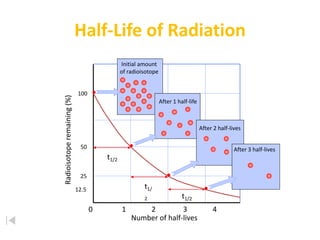
0 1 2 3 4
Number of half-lives
Radioisotoperemaining(%)
100
50
25
12.5
Half-Life of Radiation
Initial amount
of radioisotope
t1/2
t1/
2 t1/2
After 1 half-life
After 2 half-lives
After 3 half-lives
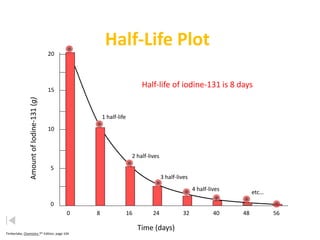
Half-Life Plot
Timberlake, Chemistry 7th Edition, page 104
AmountofIodine-131(g)
20
15
10
5
0
40 48 560 8
1 half-life
16
2 half-lives
24
3 half-lives
32
4 half-lives
etc…
Time (days)
Half-life of iodine-131 is 8 days
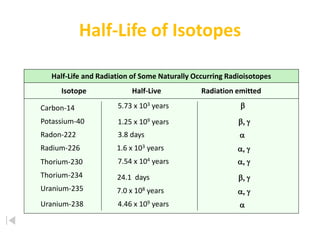
Half-Life of Isotopes
Isotope Half-Live Radiation emitted
Half-Life and Radiation of Some Naturally Occurring Radioisotopes
Carbon-14 5.73 x 10³ years b
Potassium-40 1.25 x 10⁹ years b, g
Thorium-234 24.1 days b, g
Radon-222 3.8 days a
Radium-226 1.6 x 10³ years a, g
Thorium-230 7.54 x 10⁴ years a, g
Uranium-235 7.0 x 10⁸ years a, g
Uranium-238 4.46 x 10⁹ years a
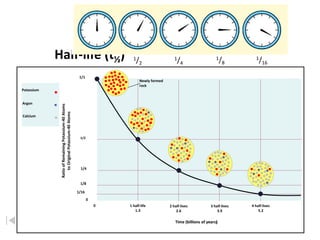
Half-life (t½)
– Time required for half the atoms of a
radioactive nuclide to decay.
– Shorter half-life = less stable.
1/2
1/4
1/8
1/16
1/1
1/2
1/4
1/8
1/16
0
RatioofRemainingPotassium-40Atoms
toOriginalPotassium-40Atoms
0 1 half-life
1.3
2 half-lives
2.6
3 half-lives
3.9
4 half-lives
5.2
Time (billions of years)
Newly formed
rock
Potassium
Argon
Calcium
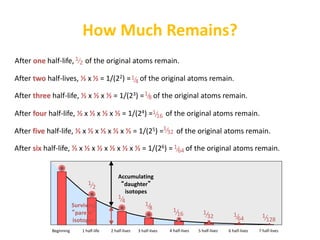
How Much Remains?
After one half-life, of the original atoms remain.
After two half-lives, ½ x ½ = 1/(22) = of the original atoms remain.
After three half-life, ½ x ½ x ½ = 1/(23) = of the original atoms remain.
After four half-life, ½ x ½ x ½ x ½ = 1/(24) = of the original atoms remain.
After five half-life, ½ x ½ x ½ x ½ x ½ = 1/(25) = of the original atoms remain.
After six half-life, ½ x ½ x ½ x ½ x ½ x ½ = 1/(26) = of the original atoms remain.
1
4
1
2
1
8
1
16
1
32
1
64
1 half-life 2 half-lives 3 half-lives
1
2
1
4
1
8 1
16 1
32 1
64 1
128
Accumulating
“daughter”
isotopes
4 half-lives 5 half-lives 6 half-lives 7 half-lives
Surviving
“parent”
isotopes
Beginning
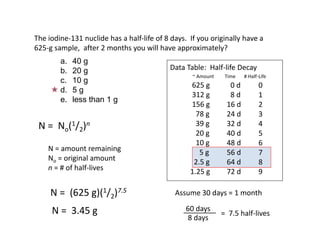
The iodine-131 nuclide has a half-life of 8 days. If you originally have a
625-g sample, after 2 months you will have approximately?
a. 40 g
b. 20 g
c. 10 g
d. 5 g
e. less than 1 g
625 g
312 g
156 g
78 g
39 g
20 g
10 g
5 g
2.5 g
1.25 g
0 d
8 d
16 d
24 d
32 d
40 d
48 d
56 d
64 d
72 d
0
1
2
3
4
5
6
7
8
9
Data Table: Half-life Decay
~ Amount Time # Half-Life
Assume 30 days = 1 month
60 days
8 days
= 7.5 half-lives
N = No(1/2)n
N = amount remaining
No = original amount
n = # of half-lives
N = (625 g)(1/2)7.5
N = 3.45 g
ln 2
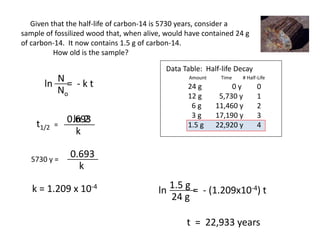
Given that the half-life of carbon-14 is 5730 years, consider a
sample of fossilized wood that, when alive, would have contained 24 g
of carbon-14. It now contains 1.5 g of carbon-14.
How old is the sample?
24 g
12 g
6 g
3 g
1.5 g
0 y
5,730 y
11,460 y
17,190 y
22,920 y
0
1
2
3
4
Data Table: Half-life Decay
Amount Time # Half-Life
ln = - k tN
No
t1/2 =
0.693
k
5730 y =
0.693
k
k = 1.209 x 10⁻⁴
ln = - (1.209x10⁻⁴) t1.5 g
24 g
t = 22,933 years
Half-Life Practice Calculations
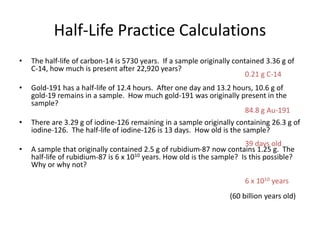
• The half-life of carbon-14 is 5730 years. If a sample originally contained 3.36 g of
C-14, how much is present after 22,920 years?
• Gold-191 has a half-life of 12.4 hours. After one day and 13.2 hours, 10.6 g of
gold-19 remains in a sample. How much gold-191 was originally present in the
sample?
• There are 3.29 g of iodine-126 remaining in a sample originally containing 26.3 g of
iodine-126. The half-life of iodine-126 is 13 days. How old is the sample?
• A sample that originally contained 2.5 g of rubidium-87 now contains 1.25 g. The
half-life of rubidium-87 is 6 x 10¹⁰ years. How old is the sample? Is this possible?
Why or why not?
0.21 g C-14
84.8 g Au-191
39 days old
6 x 10¹⁰ years
(60 billion years old)
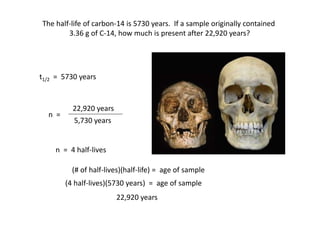
22,920 years
The half-life of carbon-14 is 5730 years. If a sample originally contained
3.36 g of C-14, how much is present after 22,920 years?
3.36 g
1.68 g
0.84 g
0.42 g
0.21 g
0 y
5,730 y
11,460 y
17,190 y
22,920 y
0
1
2
3
4
Data Table: Half-life Decay
Amount Time # Half-Lifet1/2 = 5730 years
n =
5,730 years
n = 4 half-lives
(4 half-lives)(5730 years) = age of sample
(# of half-lives)(half-life) = age of sample
22,920 years

Half life

  • 1.
  • 2.
    20 g 10 g 5g 2.5 g after 1 half-life Start after 2 half-lives after 3 half-lives Dorin, Demmin, Gabel, Chemistry The Study of Matter 3rd Edition, page 757 Half-Life
  • 3.
    1.00 mg 0.875mg 0.500 mg 0.250 mg 0.125 mg 8.02 days0.00 days 16.04 days 24.06 days Half-Life Dorin, Demmin, Gabel, Chemistry The Study of Matter 3rd Edition, page 757 131 53 I 131 53 I 0.500 mg 0.750 mg b emissions g emissions 89.9% 7.3% 131 53 I 131 54 Xe 131 54 Xe* 131 54 Xe I 131 53 Xe 131 54 b-0 -1 + g+
  • 4.
    0 1 23 4 Number of half-lives Radioisotoperemaining(%) 100 50 25 12.5 Half-Life of Radiation Initial amount of radioisotope t1/2 t1/ 2 t1/2 After 1 half-life After 2 half-lives After 3 half-lives
  • 5.
    Half-Life Plot Timberlake, Chemistry7th Edition, page 104 AmountofIodine-131(g) 20 15 10 5 0 40 48 560 8 1 half-life 16 2 half-lives 24 3 half-lives 32 4 half-lives etc… Time (days) Half-life of iodine-131 is 8 days
  • 6.
    Half-Life of Isotopes IsotopeHalf-Live Radiation emitted Half-Life and Radiation of Some Naturally Occurring Radioisotopes Carbon-14 5.73 x 10³ years b Potassium-40 1.25 x 10⁹ years b, g Thorium-234 24.1 days b, g Radon-222 3.8 days a Radium-226 1.6 x 10³ years a, g Thorium-230 7.54 x 10⁴ years a, g Uranium-235 7.0 x 10⁸ years a, g Uranium-238 4.46 x 10⁹ years a
  • 7.
    Half-life (t½) – Timerequired for half the atoms of a radioactive nuclide to decay. – Shorter half-life = less stable. 1/2 1/4 1/8 1/16 1/1 1/2 1/4 1/8 1/16 0 RatioofRemainingPotassium-40Atoms toOriginalPotassium-40Atoms 0 1 half-life 1.3 2 half-lives 2.6 3 half-lives 3.9 4 half-lives 5.2 Time (billions of years) Newly formed rock Potassium Argon Calcium
  • 8.
    How Much Remains? Afterone half-life, of the original atoms remain. After two half-lives, ½ x ½ = 1/(22) = of the original atoms remain. After three half-life, ½ x ½ x ½ = 1/(23) = of the original atoms remain. After four half-life, ½ x ½ x ½ x ½ = 1/(24) = of the original atoms remain. After five half-life, ½ x ½ x ½ x ½ x ½ = 1/(25) = of the original atoms remain. After six half-life, ½ x ½ x ½ x ½ x ½ x ½ = 1/(26) = of the original atoms remain. 1 4 1 2 1 8 1 16 1 32 1 64 1 half-life 2 half-lives 3 half-lives 1 2 1 4 1 8 1 16 1 32 1 64 1 128 Accumulating “daughter” isotopes 4 half-lives 5 half-lives 6 half-lives 7 half-lives Surviving “parent” isotopes Beginning
  • 9.
    The iodine-131 nuclidehas a half-life of 8 days. If you originally have a 625-g sample, after 2 months you will have approximately? a. 40 g b. 20 g c. 10 g d. 5 g e. less than 1 g 625 g 312 g 156 g 78 g 39 g 20 g 10 g 5 g 2.5 g 1.25 g 0 d 8 d 16 d 24 d 32 d 40 d 48 d 56 d 64 d 72 d 0 1 2 3 4 5 6 7 8 9 Data Table: Half-life Decay ~ Amount Time # Half-Life Assume 30 days = 1 month 60 days 8 days = 7.5 half-lives N = No(1/2)n N = amount remaining No = original amount n = # of half-lives N = (625 g)(1/2)7.5 N = 3.45 g
  • 10.
    ln 2 Given thatthe half-life of carbon-14 is 5730 years, consider a sample of fossilized wood that, when alive, would have contained 24 g of carbon-14. It now contains 1.5 g of carbon-14. How old is the sample? 24 g 12 g 6 g 3 g 1.5 g 0 y 5,730 y 11,460 y 17,190 y 22,920 y 0 1 2 3 4 Data Table: Half-life Decay Amount Time # Half-Life ln = - k tN No t1/2 = 0.693 k 5730 y = 0.693 k k = 1.209 x 10⁻⁴ ln = - (1.209x10⁻⁴) t1.5 g 24 g t = 22,933 years
  • 11.
    Half-Life Practice Calculations •The half-life of carbon-14 is 5730 years. If a sample originally contained 3.36 g of C-14, how much is present after 22,920 years? • Gold-191 has a half-life of 12.4 hours. After one day and 13.2 hours, 10.6 g of gold-19 remains in a sample. How much gold-191 was originally present in the sample? • There are 3.29 g of iodine-126 remaining in a sample originally containing 26.3 g of iodine-126. The half-life of iodine-126 is 13 days. How old is the sample? • A sample that originally contained 2.5 g of rubidium-87 now contains 1.25 g. The half-life of rubidium-87 is 6 x 10¹⁰ years. How old is the sample? Is this possible? Why or why not? 0.21 g C-14 84.8 g Au-191 39 days old 6 x 10¹⁰ years (60 billion years old)
  • 12.
    22,920 years The half-lifeof carbon-14 is 5730 years. If a sample originally contained 3.36 g of C-14, how much is present after 22,920 years? 3.36 g 1.68 g 0.84 g 0.42 g 0.21 g 0 y 5,730 y 11,460 y 17,190 y 22,920 y 0 1 2 3 4 Data Table: Half-life Decay Amount Time # Half-Lifet1/2 = 5730 years n = 5,730 years n = 4 half-lives (4 half-lives)(5730 years) = age of sample (# of half-lives)(half-life) = age of sample 22,920 years