July 2018
By Julian Kalac , P.Eng
Lean Six Sigma Master Black Belt
2
σMethodology that Focuses on Reducing
Process Variation, using data-driven,
measurement-based, statistical methods to Solve
problems, improve performance
σFocus: Surgical “inch-wide, mile-deep”
investigation and resolution
σApproach:
σData driven solves problems at the system and
root cause level
σImplement robust control plans for sustained
improvements
What is “Six Sigma”?
An Analytical Methodology that Focuses on Reducing
Process Variation
 DFSS is developed from Six Sigma
 It is methodology to improve product design reliability
 It achieves Six Sigma Level quality (3.4 PPM) by
design,
 DFSS can be used on new product design or to
improve existing product
 DFSS focusses on improving the manufacturing
process capability and roust performance
• Robust Design is often synonymous
to “Design for Six Sigma” or
“Reliability-based Optimization.)
• Reliability Analysis
Quantify the reliability (failure
probability, defects per million)
• Robust Design
Optimize the design such that it is
insensitive to unavoidable
uncertainties (e.g. material,loads,…)
• Reliability-based Optimization
Optimize the design such that
reliability is maximized or failure
probability (defects per million) is
minimized
Robust Design is
“Design for Six Sigma”
DFSS
Six Sigma = Optimize manufacturing processes such
that they automatically produce parts
conforming with six sigma quality
Design For Six Sigma = Optimize the design such that the parts
conform with six sigma quality, i.e. quality
and reliability are explicit optimization
goals
Design for Six Sigma:
• Achieve “Designed-In”
quality as opposed to
letting customers find
out about quality
problems
• Make informed decision
that are critical to
quality early in the
development process0.1
1
10
100
1000
Research Design Development
PrototypeTests
Production
Product Development Phases
Rel.CostofDesignChange
0%
20%
40%
60%
80%
100%
Design For Six Sigma Six Sigma
DegreeofFredomtoaffect
theProductLifetimeCosts
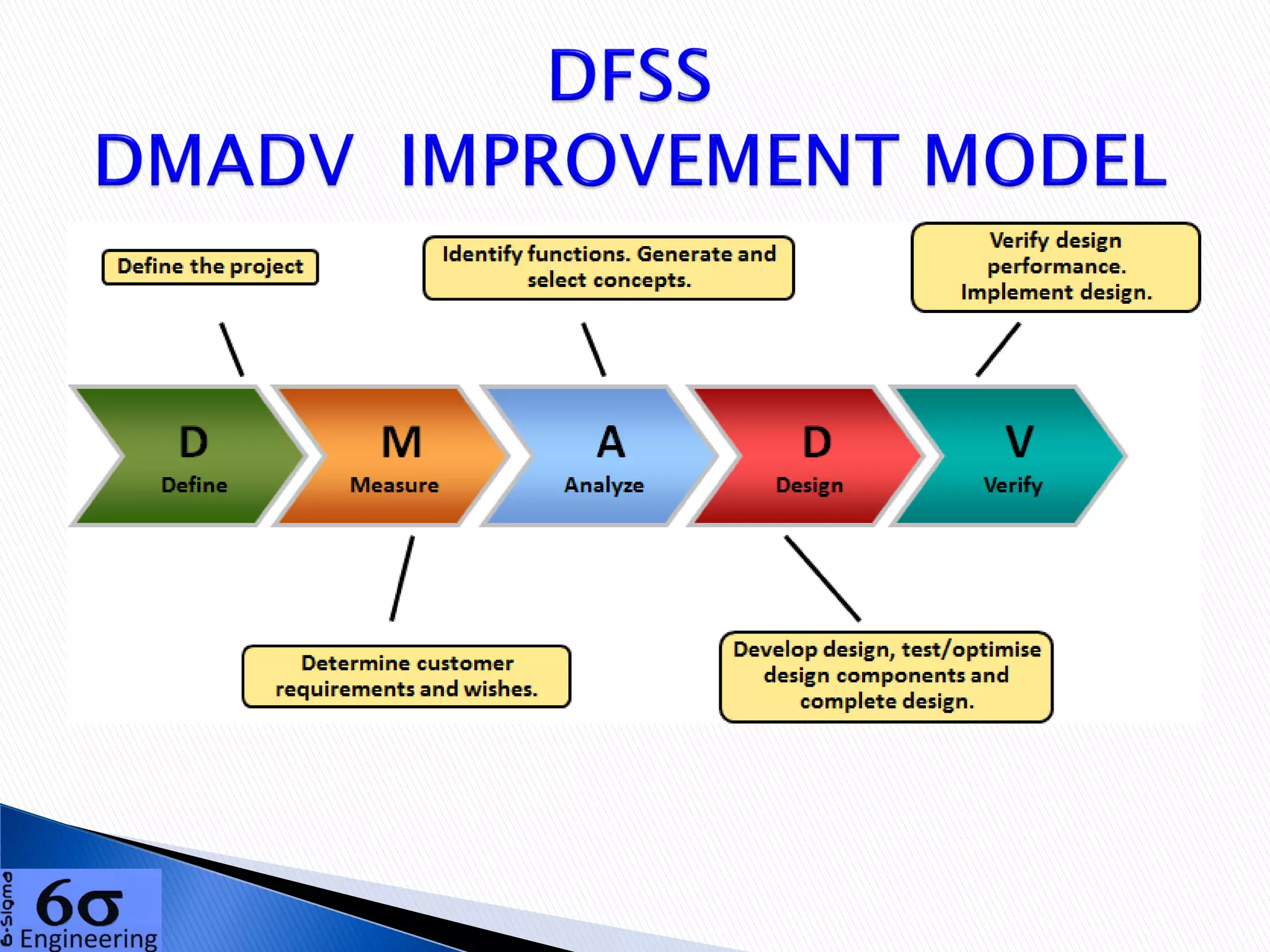
 Define - Voice Of Customers (VOC)
◦ Quality Function Deployment (QFD)
 Measure - Benchmarking
◦ Capability Performance
 Analyze-Process Simulation, Statistical Tolerance Stack Up
 Design- Failure Mode and Effects Analysis (FMEA)
◦ Design Of Experiences (DOE)
 Verify - Statistics Process Control (SPC)

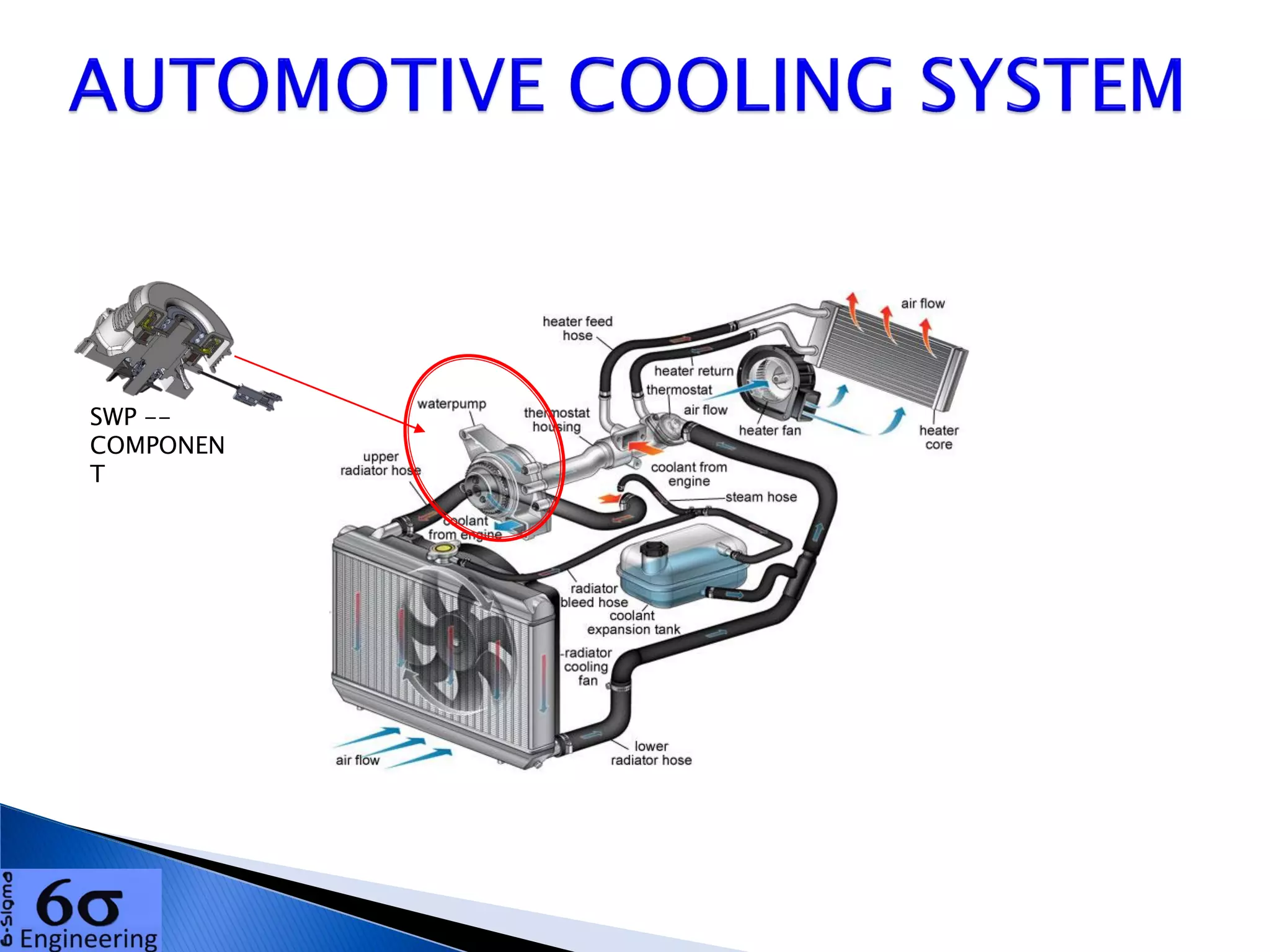
SWP --
COMPONEN
T
 This device allows the engine the ability to shut off
or limit flow by physically disconnecting the
impeller, thereby achieving fast engine warmup
and improved fuel economy and comfort.
 Conventional Water Pump (CWP) –
water pump is belt-driven by engine, with pump speed at a
fixed ratio to engine speed
 Switchable Water Pump (SWP) –
water pump output can be controlled based on the
engine cooling need
 Clutch mechanism to engage/disengage water pump
from the engine
 Can achieve zero-flow, full flow (equivalent of CWP), and
partial flow
 Significant speed up of engine warm-up
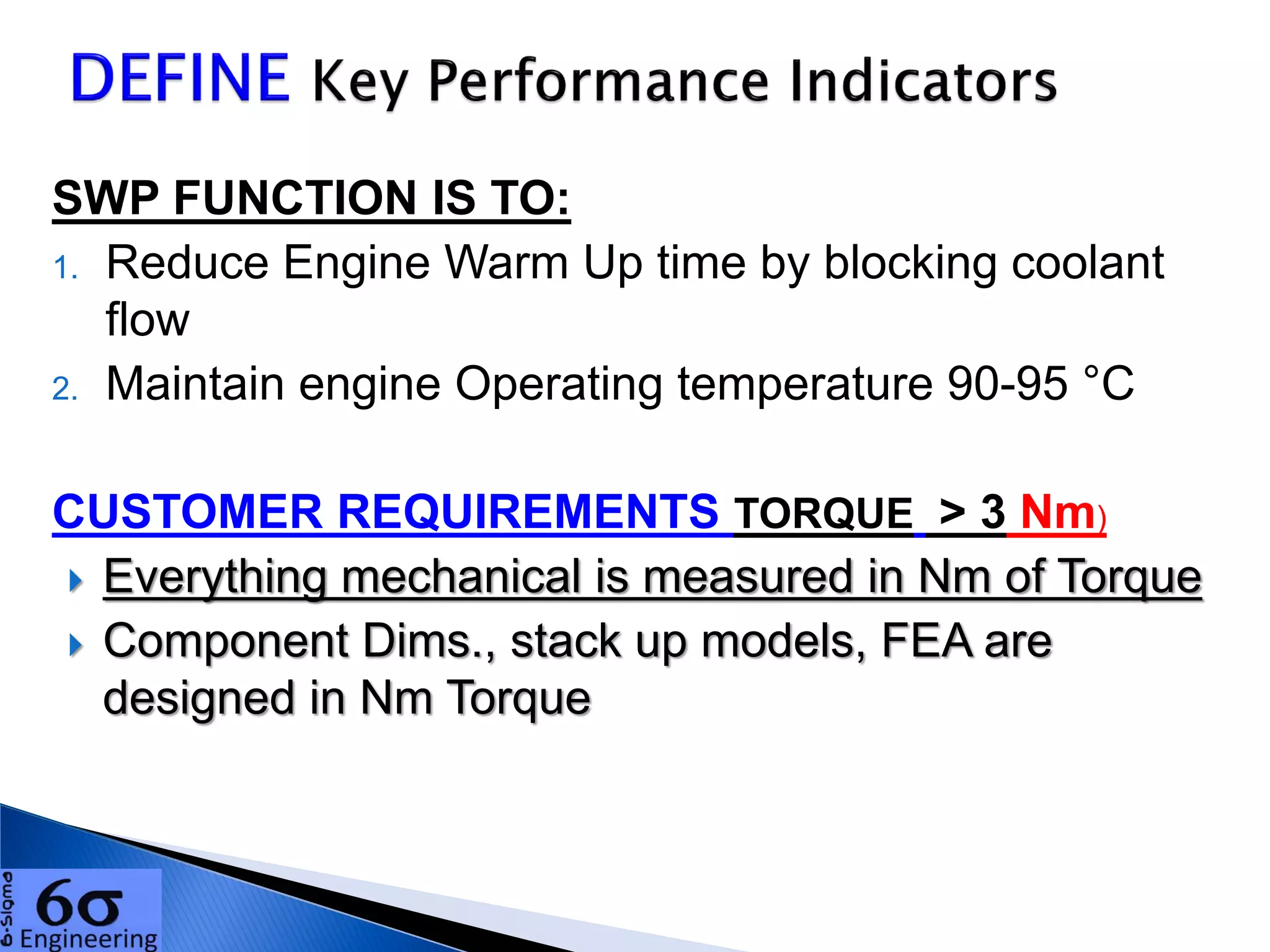
SWP FUNCTION IS TO:
1. Reduce Engine Warm Up time by blocking coolant
flow
2. Maintain engine Operating temperature 90-95 °C
CUSTOMER REQUIREMENTS TORQUE > 3 Nm)
 Everything mechanical is measured in Nm of Torque
 Component Dims., stack up models, FEA are
designed in Nm Torque
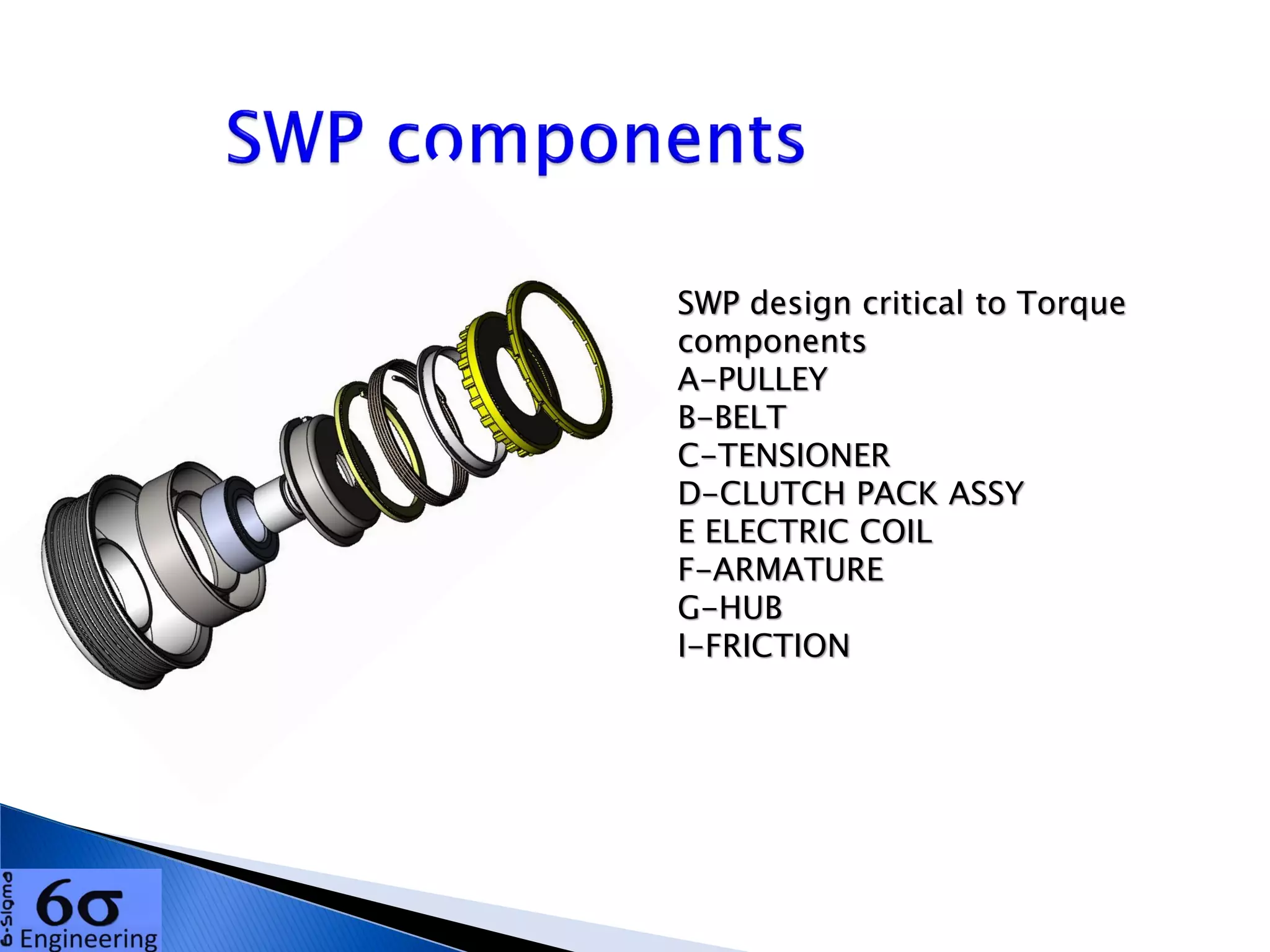
SWP design critical to Torque
components
A-PULLEY
B-BELT
C-TENSIONER
D-CLUTCH PACK ASSY
E ELECTRIC COIL
F-ARMATURE
G-HUB
I-FRICTION
 SWP was prototyped for VOLVO vehicles which
caused Volvo engines to over-heat
 SWP- failures were discovered by VOLVO during
prototype testing DFMEA was NOT done prior to
Volvo failures
 SWP 2 was launched in production for Chinese
vehicles without a doing a proper Design FMEA
 SWP-3 DFMEA was done after being launched in
production at the request of the Chinese customer
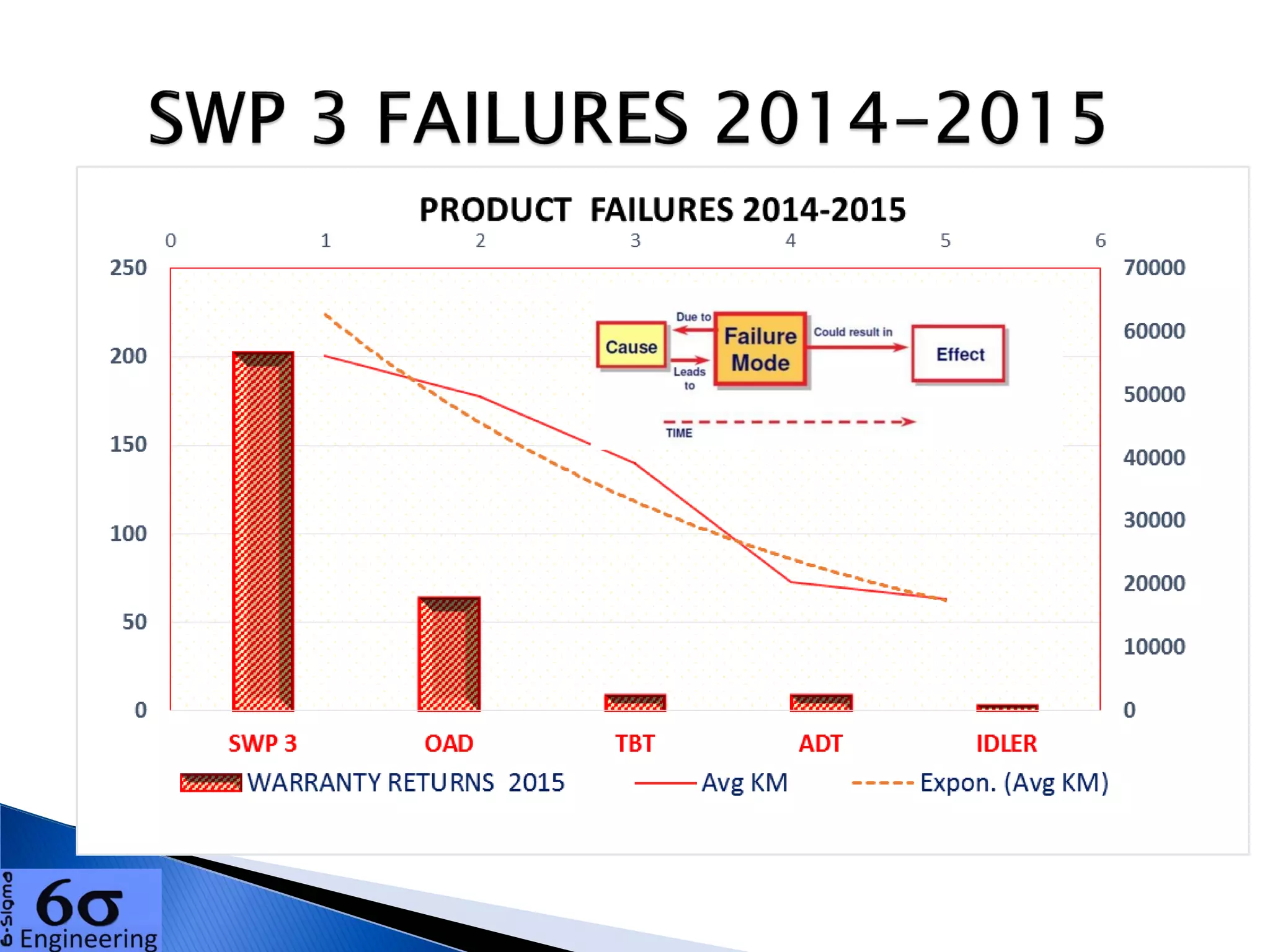
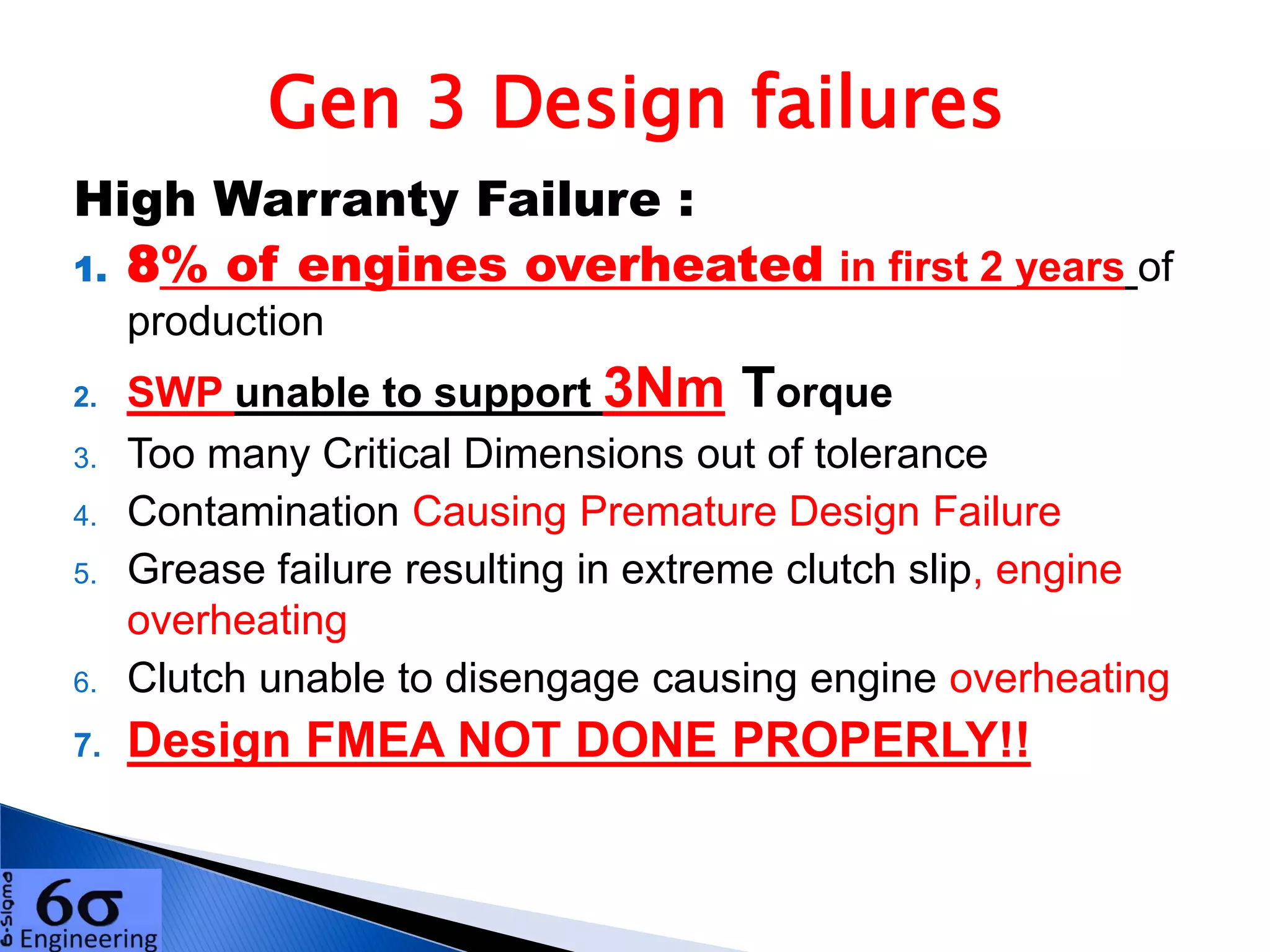
High Warranty Failure :
1. 8% of engines overheated in first 2 years of
production
2. SWP unable to support 3Nm Torque
3. Too many Critical Dimensions out of tolerance
4. Contamination Causing Premature Design Failure
5. Grease failure resulting in extreme clutch slip, engine
overheating
6. Clutch unable to disengage causing engine overheating
7. Design FMEA NOT DONE PROPERLY!!
Gen 3 Design failures
March 20, 2019
Page 19
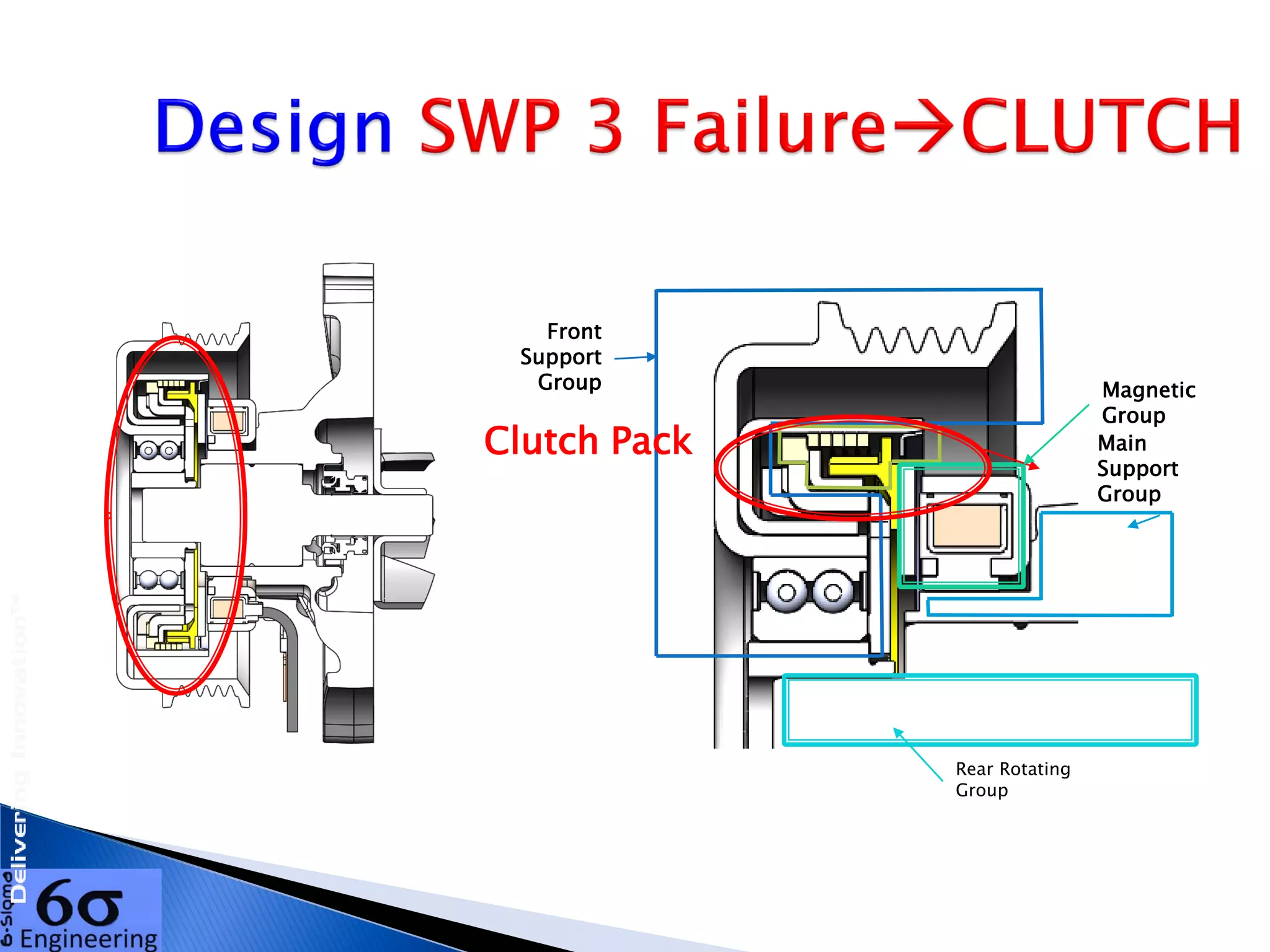
Front
Support
Group
Clutch Pack
Magnetic
Group
Main
Support
Group
Rear Rotating
Group
DATE CREATED: APRIL 26-2016 REVISION DATE:
Prevention BY DESIGN
Occurrence
Detection BY DESIGN
Detection
Action(s) Taken
Completion Date
Severity
Occurrence
8
100%
µ Coefficienct of friction is smaller
than 0.1
Minimum value of torque calculated at
lowest coefficient of friction of 0.1 is
larger then 3 Nm. 4
Perform 100% of the torque on line for a
minimum of 5 Nm
1 32
Specify on the assy drawing 100%
inspection of transmitted torque.
Implement measurement capability on
assy line.
Roman
Tracz,
MFE
8 4
8
MC
Hub ID larger than Ø79.05 mm.
Hub ID value is Ø79±0.5
Minimum value of torque calculated at
lowest coefficient of friction of 0.1 and
largest hub ID is larger than 3 Nm.
Single point failure value is 80.1 mm.
2
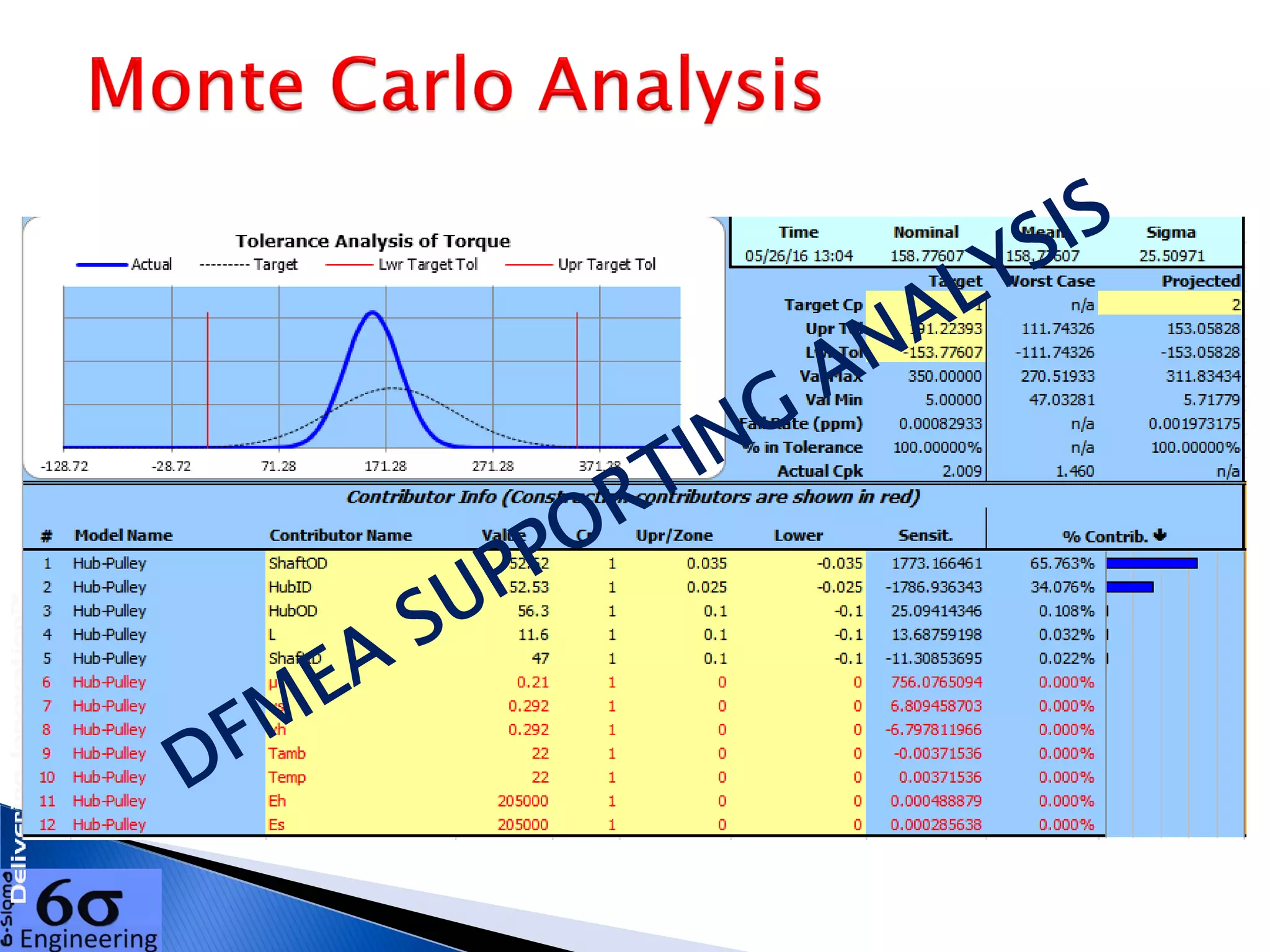
MC analysis shows that the maximum hub
ID is 79.07 mm but failure point is 80.1
mm. As a result probability of failure is
reduced to zero.
2 32
Specify on the part drawing Major
Characteristic.
Inspect dimension at each first off.
Roman
Tracz,
Suppli
er
8 2 1
8
MC
Clutch OD in free state is smaller than
Ø81.2 mm.
Clutch OD value Ø81.35±0.15
Minimum value of torque calculated at
lowest coefficient of friction of 0.1 and
smallest clutch OD of Ø81.2 is larger
than 3 Nm.
Single point failure value is 80.15 mm.
2
MC analysis shows that the minimum
clutch OD is 81.11 mm but failure point is
80.15 mm. As a result probability of failure
is reduced to zero.
2 32
Specify on the part drawing Major
Characteristic.
Inspect dimension at each first off.
Roman
Tracz,
Suppli
er
8 2 1
8
MC
Number of coils smaller than 4.967
Number of coils value is Ø5±0.033
Minimum value of torque calculated at
lowest coefficient of friction of 0.1 and
smallest clutch nr. of coils of 4.967 is
larger than 3 Nm.
Single point failure value is 4.55 coils.
1
MC analysis shows that the minimum
number of coils is 4.95 but failure point is
4.55 coils. As a result probability of failure
is reduced to zero.
1 8
Specify on the assy drawing Major
Characteristic.
Inspect dimension at each first off.
Roman
Tracz,
Suppli
er
8
MC
Armature to EM coil gap smaller than
0.3 mm.
Gap value is 0.4±0.1
Need to determine threshold where the
gap size causes a reduction in
transmitted torque. 10 TBD 10 800
Perform DOE and studies to optimize
the gap.
Refine stak-ups. TBD
8
MC
Staking between driver and bushing
holds less than 5 Nm due to insufficient
no. of teeth on the driver.
Stake holding torque spec 5 Nm MIN.
Analytical simulation difficult. Design
physical tests to determine the
minimum no. of teeth needed on the
driver.
10
Torque to break shall be higher than 5 Nm.
10 800
Design and perform torque tests.
Generate process drawing for the
staking process. Specify stake holding
torque value as a major characteristic.
Roman
Tracz,
MFE
8
Staking between driver and bushing
holds less than 5 Nm due to insufficient
staking step height on the bushing.
Stake holding torque spec 5 Nm MIN.
Analytical simulation difficult. Design
physical tests to determine the
minimum stake step height needed on
the bushing.
10
Torque to break shall be higher than 5 Nm.
10 800
Design and perform torque tests.
Generate process drawing for the
staking process
Roman
Tracz,
MFE
8
MC
Staking between driver and bushing
holds less than 5 Nm due to insufficient
hardness of the driver.
Stake holding torque spec 5 Nm MIN.
Hardness of the driver cannot be
enhanced due to the low carbon
content of the 1010 steel. Increase the
no. of teeth on the driver.
10
Torque to break shall be higher than 5 Nm.
10 800
Design and perform torque tests.
Generate process drawing for the
staking process. Specify stake holding
torque value as a major characteristic.
Roman
Tracz,
MFE
8
MC
Staking between retainer and driver
holds less than 1500 N due to
insufficient staking step height.
Stake axial holding force spec 1500 Nm.
Analytical simulation difficult. Design
physical tests to determine the
minimum stake step height needed on
the bushing.
10
Axial retention force shall be 1500 Nm.
10 400
Design and perform pushout tests.
Generate process drawing for the
staking process. Specify stake pushout
force value as a major characteristic.
Roman
Tracz,
MFE
6
Hub and clutch premature wear.
Nitride layer smaller than 0.01 mm
Nitride layer spec 0.01 to 0.02 mm
Investigate if distinctive color can be
applied to nitride layer.
5
Install color identifying sendor on assembly
line.
2 60
Add colour identification requirement on
drawing.
Install colour identifying sendor on
assembly line.
Roman
Tracz,
MFE
6
Hub and clutch premature wear.
Grease amount less than 1 gr.
Grease amount spec 1 gr MIN.
Investigate if distinctive colour can be
applied to nitride layer.
5
Install colour identifying sendor on
assembly line.
Weigh the clutch subassy before and after
aplying the grease.
2 60
Add colour identification requirement on
drawing.
Install colour identifying sendor on
assembly line.
Weigh the clutch subassy before and
after aplying the grease.
MFE
6
Grease and clutch premature wear.
Hub ID roughness larger than Rz6.3 NONE 10 NONE 10 600
Need more information about the
manufacturing process.
Clutch Pack ASSY
- Transmits torque
from pulley to
impeller as per
customer
specification
(example 3 Nm).
- Enables the
control of pump
states ON/OFF.
Clutch NOT ENGAGED
(impeller speed = 0 RPM)
Component
- Impeller rotates at lower speed
than the pulley
- Extra heat is generated in the
clutch
- Grease degrades at a faster rate
- Clutch ASSY fails prematurely
System
- Coolant flow has lower values
than minimum accepted.
- Engine overheats.
- Vehicle inoperable.
Clutch slips PARTIALLY
(Pulley Speed< impeller
speed < 0 RPM)
Component
- Impeller does not rotate
System
- No coolant flow.
- Engine overheats.
- Vehicle inoperable.
Reduced Clutch Durability
and Life Cycle
Component
- Impeller rotates at lower speed
than the pulley
- Extra heat is generated in the
clutch
- Grease degrades at a faster rate
- Clutch ASSY fails prematurely
System
- Coolant flow has lower values
than minimum accepted.
XXXXXXX
RPN
Litens SWP APQP TeamN/A
Developed by : John Danciu, Julian Kalac DESIGN TEAM: Roman Tracz, Garreth Graves, John Danciu
Potential
Failure
Mode
Key Date:
A c t i o n R e s u l t s
Responsibility
&TargetDate
Part Name,
Number,
Function /
Requirement
Original PFMEA Date:
XXXXXXXX
Recommended Action(s)
Revision Date:
Customer Part No.
Design Failure Mode and Effects Analysis (DFMEA)
Litens Automotive Partnership
LITENS AUTOMOTIVE GROUP
Customer:
Platform Design
Design Responsibility:
N/A N/A
N/A
Subsystem Assembly:
Accessory Drive SWP
Prepared By:Model Year/Vehicle:
XXXXXXX
C U R R E N T D E S I G N C O N T R O L S
Potential
Effect(s) of
Failure
Potential Cause(s) of
Failure
Severity
Classification
DRAFT VERSION
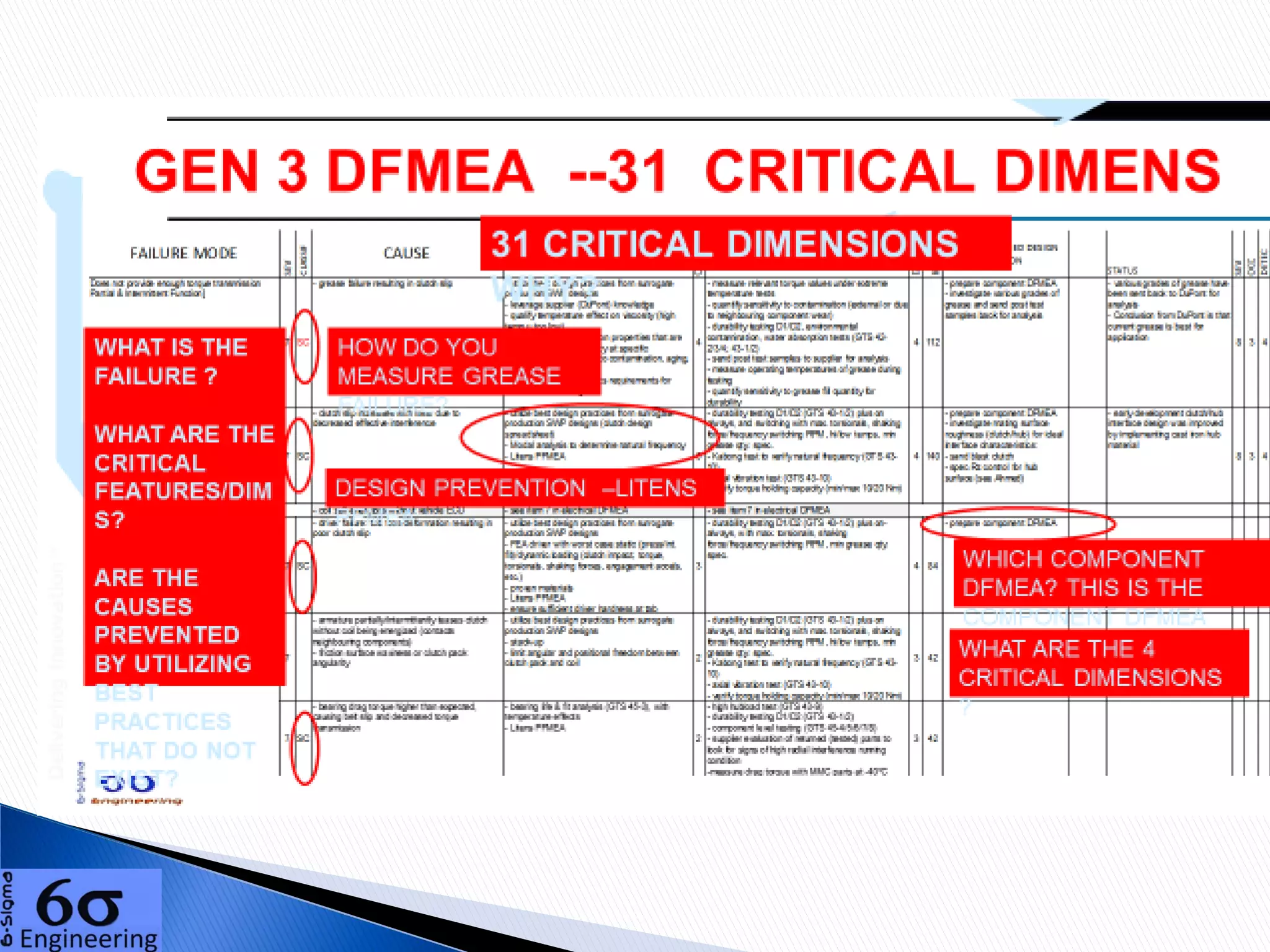
6 CRITICAL
DIMENSIONS
WHY?
Pa
ge
22March 20,
EM coil retention concept
EM coil overmold
Anti-Rotation
Features Molded &
Cast-in (matching
draft angles)
* Features are similar
to tensioner insert
bearings
Pa
ge
23
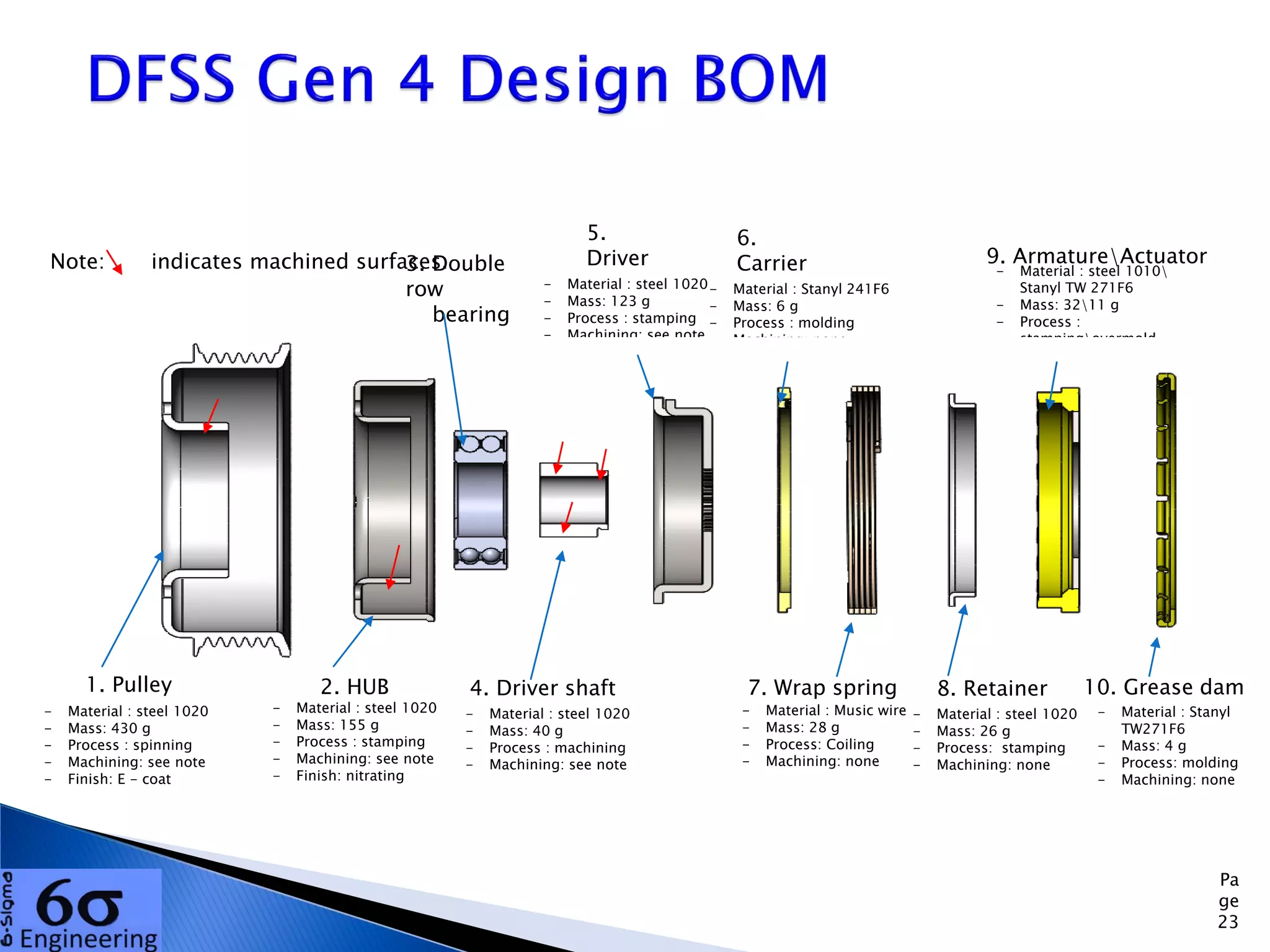
2. HUB
- Material : steel 1020
- Mass: 155 g
- Process : stamping
- Machining: see note
- Finish: nitrating
4. Driver shaft
- Material : steel 1020
- Mass: 40 g
- Process : machining
- Machining: see note
- Material : steel 1020
- Mass: 123 g
- Process : stamping
- Machining: see note
5.
Driver
- Material : Music wire
- Mass: 28 g
- Process: Coiling
- Machining: none
7. Wrap spring
- Material : steel 1010
Stanyl TW 271F6
- Mass: 3211 g
- Process :
stampingovermold
- Machining: none
9. ArmatureActuator
8. Retainer
- Material : steel 1020
- Mass: 26 g
- Process: stamping
- Machining: none
10. Grease dam
- Material : Stanyl
TW271F6
- Mass: 4 g
- Process: molding
- Machining: none
Note: indicates machined surfaces.3. Double
row
bearing
- Material : Stanyl 241F6
- Mass: 6 g
- Process : molding
- Machining: none
6.
Carrier
1. Pulley
- Material : steel 1020
- Mass: 430 g
- Process : spinning
- Machining: see note
- Finish: E - coat
Failure: SWP TORQUE < 3 Nm if:
1. µ Insufficient friction (Coefficient of friction) Coefficient
of friction =0.138+/-0.01mm---Single Point Failure # 1
2. Insufficient interference between clutch OD and Hub
ID. Min 1.5mm interference required to generate 3 Nm
Torque Single Point Failure # 2
3. Number of clutch coils turns < 4.73 ..Specification = Ø5.0
± 0.033 Single Point Failure # 3
4. Insufficient Armature to EM coil gap < 0.3 mm . Spec =
0.4 +/- 0.1
5. Insufficient Staking force (< 5 Nm) between driver and
bushing
6. Insufficient Lubrication < min 1g/part required
SINGLE POINT FAILURES IDENTIFIED
CRITICAL DIMENSIONS
Dimension Nominal Tolerance USL LSL Single Point
Failure
ϭ Torque P-failure Actual Cpk
Coefficienct Friction 0.138 0.01 0.148 0.128 0.116 0.00333 5.1 Nm 0.31 1.001
Hub ID 79 0.05 79.05 78.95 80.15 0.0083 5.1 Nm 0.0036 2.008
Clutch OD 81.35 0.15 81.5 81.2 80.15 0.0375 5.1 Nm 0.82 1.333
Clutch Coil Turns 5 0.03 5.03 4.97 4.2 0.0082 5.1 Nm 0.002 1.220
Nitride Coading 0.015 0.005 0.02 0.01 N/A 0.0083 5.1 Nm 0.201
Coil wire Width 1.6 0.025 1.625 1.575 ? 0.001 5.1 Nm 8.333
Coil wire Width 1.85 0.025 1.875 1.825 ? 0.0016 5.1 Nm 5.208
Page 27 March
20, 2019
Probability of SINGLE POINT FAILURE
Dimension
Coefficienct
Friction
Hub ID Clutch OD
Clutch Coil
Turns
X--Nominal 0.138 79 81.35 5
Tolerance 0.01 0.05 0.15 0.03
USL 0.148 79.05 81.5 5.03
LSL 0.128 78.95 81.2 4.97
Failure Point 0.116 80.15 80.15 4.54
(x-Nominal) 0.02 0.05 0.15 0.03
(x-Nominal) sq 0.00 0.00 0.02 0.00
ϭ 0.00 0.01 0.01 0.01
2Ϭ 0.01 0.02 0.02 0.02
e power 0.08 0.15 1.36 0.05
E-power x 1.08 1.16 3.88 1.06
1/2pi 0.16 0.16 0.16 0.16
Probability 0.17 0.19 0.62 0.17
Probability of
FAILURE =
17% 16.8%11.4%
Dimension Nominal Tolerance USL LSL Failure Point ϭ USL - LSL Z- % OUT SPEC
Coefficienct
Friction
0.138 0.01 0.148 0.128 0.116 0.003 0.01 3.333 0.0003%
Hub ID 79 0.05 79.05 78.95 80.15 0.0083 0.05 6.024 0.0002%
Clutch OD 81.35 0.15 81.5 81.2 80.15 0.0375 0.15 4.000 0.0250%
Clutch Coil
Turns
5 0.03 5.03 4.97 4.54 0.0082 0.03 3.659 0.0002%
Pa
ge
31
VERIFY Design
Design of Experiment
2ⁿ Full Factorial design
GEN 4
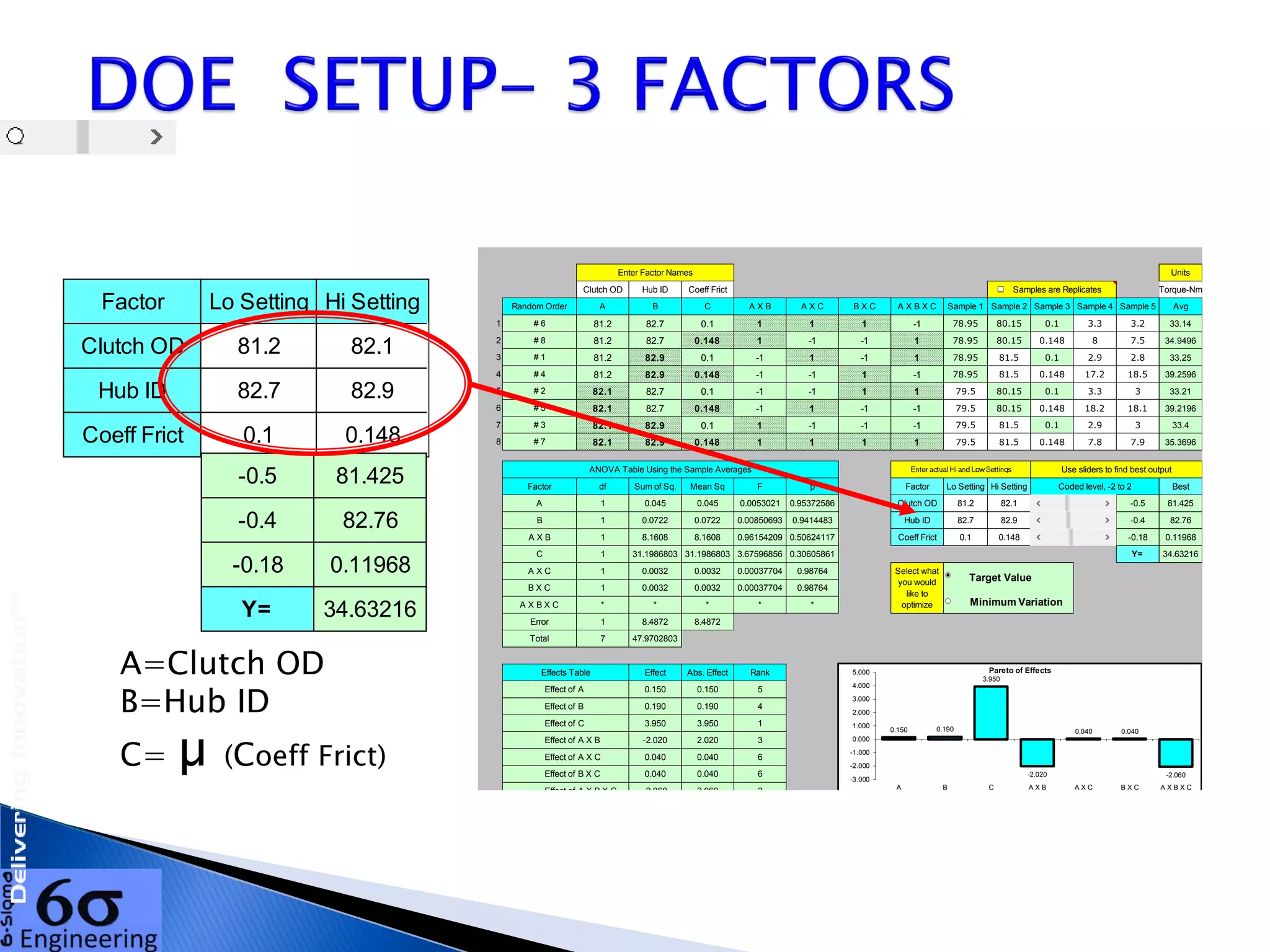
PURPOSE:
 To find what components significantly impact clutch
torque
METHOD:
 2ⁿ Factorial design
 3 Factors:
1. Coefficient Friction,
2. Clutch OD
3. Hub ID
 Using Torque Stack Up Model
March 20, 2019
Page 33
Units
Clutch OD Hub ID Coeff Frict Samples are Replicates Torque-Nm
Random Order A B C A X B A X C B X C A X B X C Sample 1 Sample 2 Sample 3 Sample 4 Sample 5 Avg
1 # 6 81.2 82.7 0.1 1 1 1 -1 78.95 80.15 0.1 3.3 3.2 33.14
2 # 8 81.2 82.7 0.148 1 -1 -1 1 78.95 80.15 0.148 8 7.5 34.9496
3 # 1 81.2 82.9 0.1 -1 1 -1 1 78.95 81.5 0.1 2.9 2.8 33.25
4 # 4 81.2 82.9 0.148 -1 -1 1 -1 78.95 81.5 0.148 17.2 18.5 39.2596
5 # 2 82.1 82.7 0.1 -1 -1 1 1 79.5 80.15 0.1 3.3 3 33.21
6 # 5 82.1 82.7 0.148 -1 1 -1 -1 79.5 80.15 0.148 18.2 18.1 39.2196
7 # 3 82.1 82.9 0.1 1 -1 -1 -1 79.5 81.5 0.1 2.9 3 33.4
8 # 7 82.1 82.9 0.148 1 1 1 1 79.5 81.5 0.148 7.8 7.9 35.3696
Factor df Sum of Sq. Mean Sq F p Factor Lo Setting Hi Setting Best
A 1 0.045 0.045 0.0053021 0.95372586 Clutch OD 81.2 82.1 150 -0.5 81.425
B 1 0.0722 0.0722 0.00850693 0.9414483 Hub ID 82.7 82.9 160 -0.4 82.76
A X B 1 8.1608 8.1608 0.96154209 0.50624117 Coeff Frict 0.1 0.148 182 -0.18 0.11968
C 1 31.1986803 31.1986803 3.67596856 0.30605861 Y= 34.63216
A X C 1 0.0032 0.0032 0.00037704 0.98764
B X C 1 0.0032 0.0032 0.00037704 0.98764
A X B X C * * * * *
Error 1 8.4872 8.4872
Total 7 47.9702803
Effect Abs. Effect Rank
Effect of A 0.150 0.150 5
Effect of B 0.190 0.190 4
Effect of C 3.950 3.950 1
Effect of A X B -2.020 2.020 3
Effect of A X C 0.040 0.040 6
Effect of B X C 0.040 0.040 6
Effect of A X B X C -2.060 2.060 2
A LO A HI B LO B HI C LO C HI
35.1498 35.2998 35.1298 35.3198 33.25 37.1996
B LO B HI C LO C HI C LO C HI
A LO 34.0448 36.2548 35.1498 33.195 37.1046 35.1398 33.175 37.0846
A HI 36.2148 34.3848 35.2998 33.305 37.2946 35.3098 33.325 37.3146
A LO B LO
A HI B HI
Enter Factor Names
Effects Table
Use sliders to find best output
Coded level, -2 to 2
ANOVA Table Using the Sample Averages
Select what
you would
like to
optimize Minimum Variation
Target Value
32
33
34
35
36
37
38
Main Effects A, B and C
0.150 0.190
3.950
-2.020
0.040 0.040
-2.060
-3.000
-2.000
-1.000
0.000
1.000
2.000
3.000
4.000
5.000
A B C A X B A X C B X C A X B X C
Pareto of Effects
Factor Lo Setting Hi Setting
Clutch OD 81.2 82.1
Hub ID 82.7 82.9
Coeff Frict 0.1 0.148
-0.5 81.425
-0.4 82.76
-0.18 0.11968
Y= 34.63216
A=Clutch OD
B=Hub ID
C= µ (Coeff Frict)
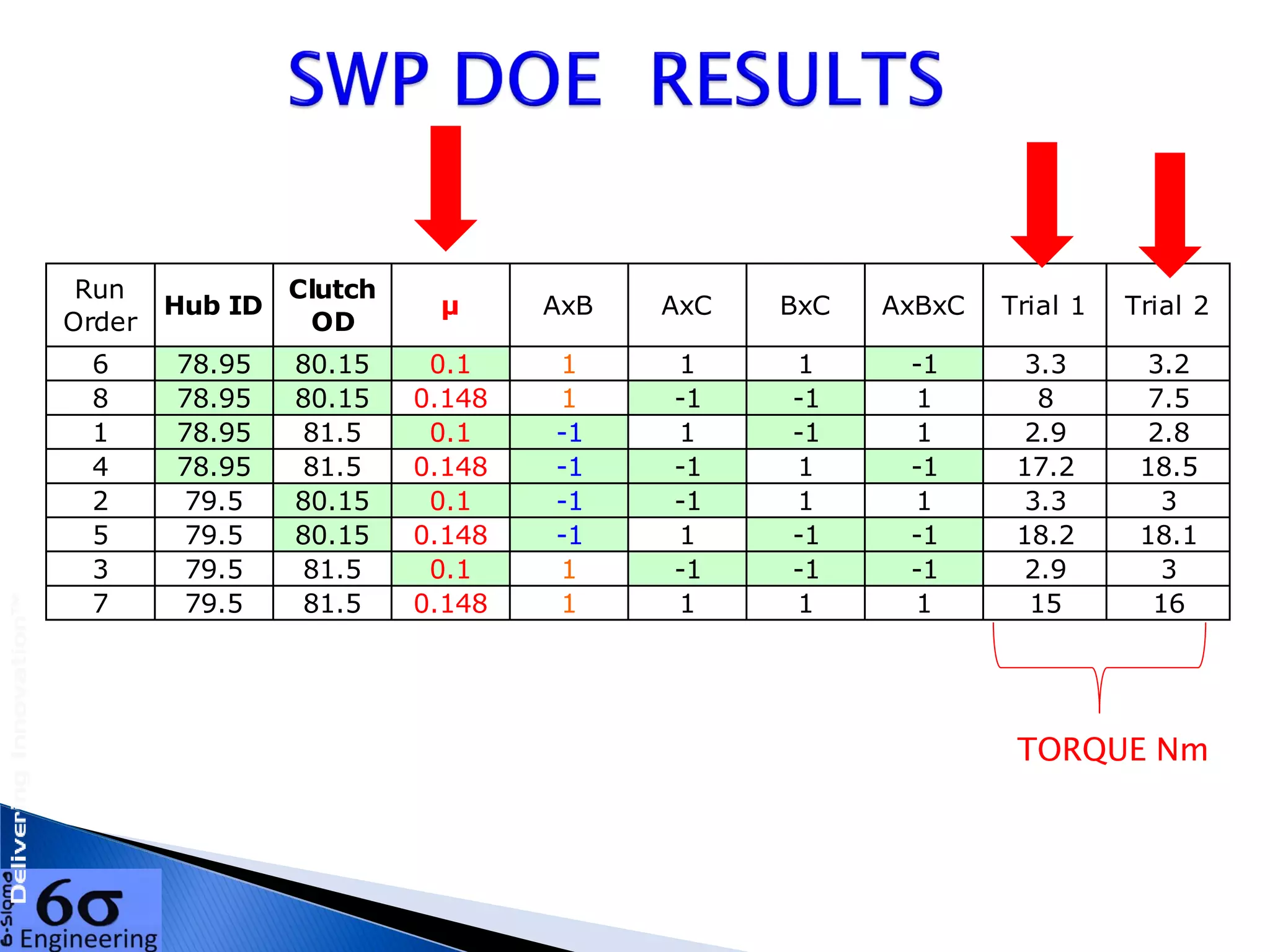
Run
Order
Hub ID
Clutch
OD
µ AxB AxC BxC AxBxC Trial 1 Trial 2
6 78.95 80.15 0.1 1 1 1 -1 3.3 3.2
8 78.95 80.15 0.148 1 -1 -1 1 8 7.5
1 78.95 81.5 0.1 -1 1 -1 1 2.9 2.8
4 78.95 81.5 0.148 -1 -1 1 -1 17.2 18.5
2 79.5 80.15 0.1 -1 -1 1 1 3.3 3
5 79.5 80.15 0.148 -1 1 -1 -1 18.2 18.1
3 79.5 81.5 0.1 1 -1 -1 -1 2.9 3
7 79.5 81.5 0.148 1 1 1 1 15 16
TORQUE Nm
March
20, 2019Pa
ge
35
0.150 0.190
3.950
-2.020
0.040 0.040
-2.060
-3.000
-2.000
-1.000
0.000
1.000
2.000
3.000
4.000
5.000
A B C A X B A X C B X C A X B X C
Pareto of Effects
Factor Lo Setting Hi Setting Best
Clutch OD 81.9 82.1 0 -2 81.8
Hub ID 82.7 82.9 100 -1 82.7
Coil Turns 4.5 5.03 260 0.6 4.924
Y= 9.14
Use sliders to find best output
Coded level, -2 to 2
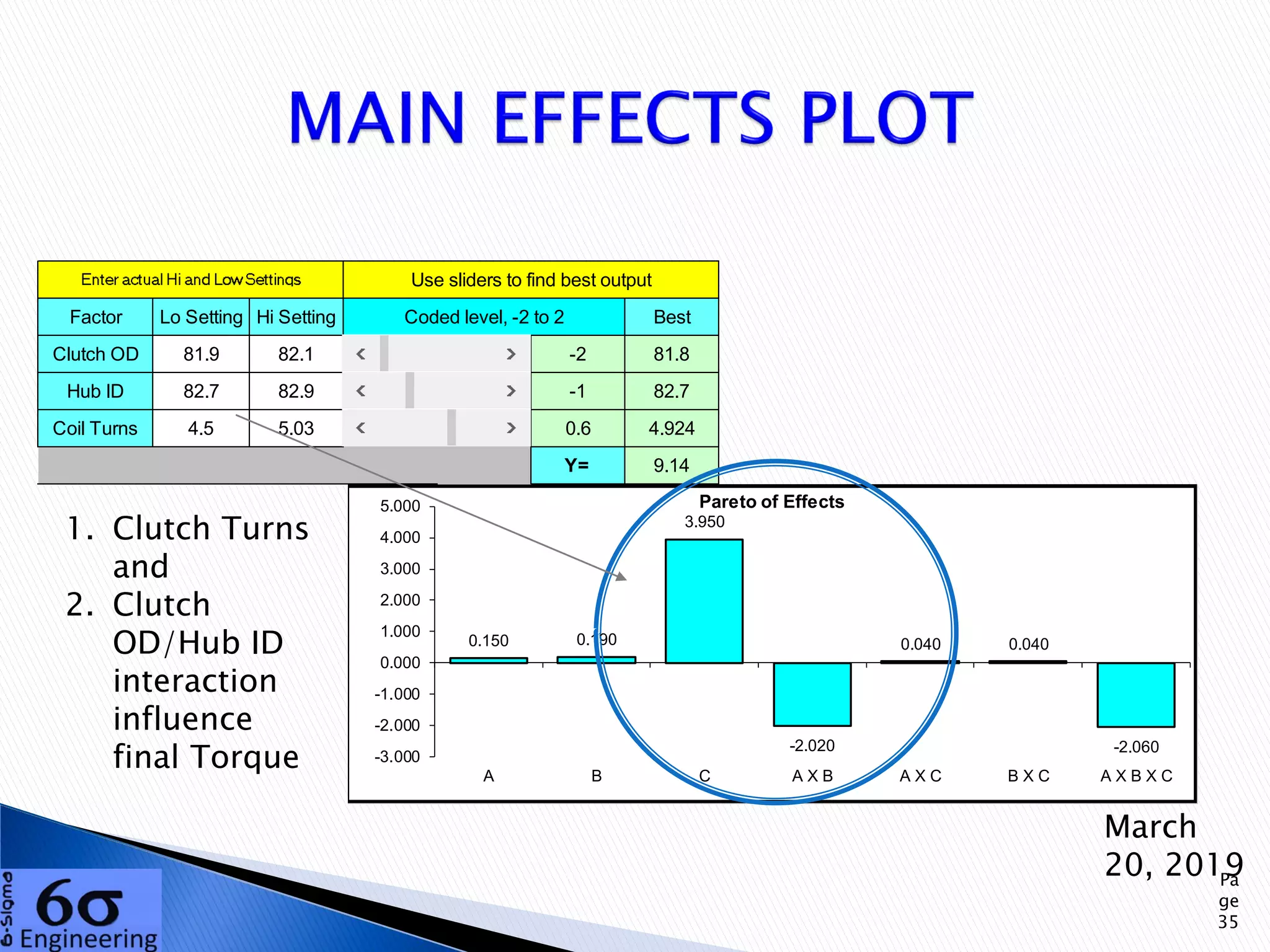
1. Clutch Turns
and
2. Clutch
OD/Hub ID
interaction
influence
final Torque
A LO A HI B LO B HI C LO C HI
35.1498 35.2998 35.1298 35.3198 33.25 37.1996
B LO B HI C LO C HI C LO C HI
A LO 34.0448 36.2548 35.1498 33.195 37.1046 35.1398 33.175 37.0846
A HI 36.2148 34.3848 35.2998 33.305 37.2946 35.3098 33.325 37.3146
A LO B LO
A HI B HI
1
Copyright 2010 Dean Christolear
31
32
33
34
35
36
37
38
A LO A HI B LO B HI C LO C HI
Main Effects A, B and C
32.5
33
33.5
34
34.5
35
35.5
36
36.5
A LO A HI
A X B Interaction
B LO
B HI
31
32
33
34
35
36
37
38
A LO A HI
A X C Interaction
C LO
C HI
31
32
33
34
35
36
37
38
B LO B HI
B X C Interaction
C LO
C HI
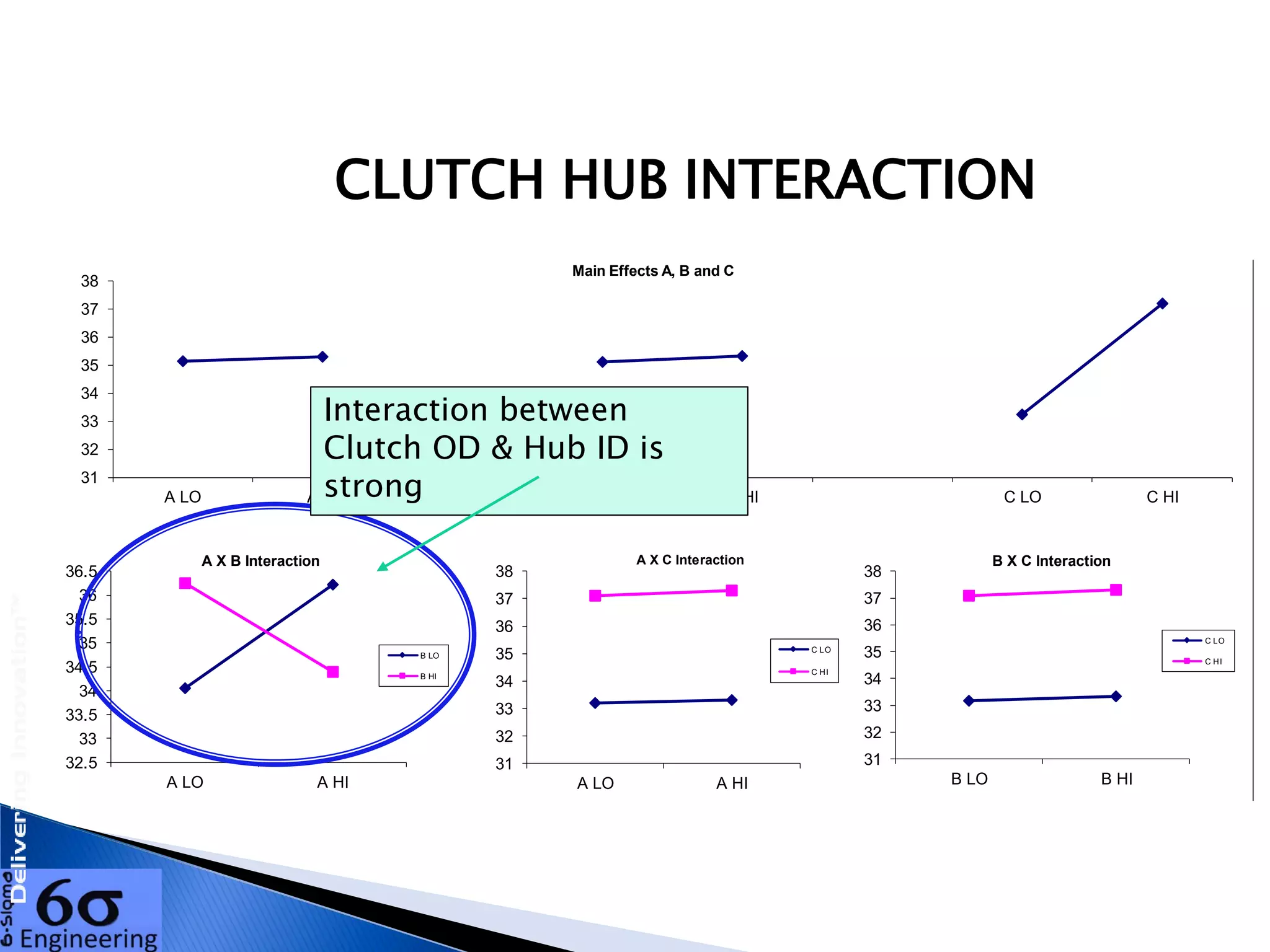
Interaction between
Clutch OD & Hub ID is
strong
CLUTCH HUB INTERACTION
Parameter Gen 4 Gen 3
Preset gap (mm) 0.5 0.4
Force at gap = 0.4 mm (metal to
metal) (N)* 27 38
Steel cost (1.10US$/kg) $ 0.077 $ 0.130
Copper cost (6.28US$/kg) $ 0.226 $ 0.446
Diode cost $ - $ 0.05
COST (steel, copper, resistor, diode) $ 0.303 $ 0.826
Cost saving/pc material only $ (0.52)
Design for Six Sigma in Automotive

Design for Six Sigma in Automotive

  • 1.
    July 2018 By JulianKalac , P.Eng Lean Six Sigma Master Black Belt
  • 2.
    2 σMethodology that Focuseson Reducing Process Variation, using data-driven, measurement-based, statistical methods to Solve problems, improve performance σFocus: Surgical “inch-wide, mile-deep” investigation and resolution σApproach: σData driven solves problems at the system and root cause level σImplement robust control plans for sustained improvements What is “Six Sigma”? An Analytical Methodology that Focuses on Reducing Process Variation
  • 4.
     DFSS isdeveloped from Six Sigma  It is methodology to improve product design reliability  It achieves Six Sigma Level quality (3.4 PPM) by design,  DFSS can be used on new product design or to improve existing product  DFSS focusses on improving the manufacturing process capability and roust performance
  • 5.
    • Robust Designis often synonymous to “Design for Six Sigma” or “Reliability-based Optimization.) • Reliability Analysis Quantify the reliability (failure probability, defects per million) • Robust Design Optimize the design such that it is insensitive to unavoidable uncertainties (e.g. material,loads,…) • Reliability-based Optimization Optimize the design such that reliability is maximized or failure probability (defects per million) is minimized Robust Design is “Design for Six Sigma” DFSS
  • 6.
    Six Sigma =Optimize manufacturing processes such that they automatically produce parts conforming with six sigma quality Design For Six Sigma = Optimize the design such that the parts conform with six sigma quality, i.e. quality and reliability are explicit optimization goals Design for Six Sigma: • Achieve “Designed-In” quality as opposed to letting customers find out about quality problems • Make informed decision that are critical to quality early in the development process0.1 1 10 100 1000 Research Design Development PrototypeTests Production Product Development Phases Rel.CostofDesignChange 0% 20% 40% 60% 80% 100% Design For Six Sigma Six Sigma DegreeofFredomtoaffect theProductLifetimeCosts
  • 9.
     Define -Voice Of Customers (VOC) ◦ Quality Function Deployment (QFD)  Measure - Benchmarking ◦ Capability Performance  Analyze-Process Simulation, Statistical Tolerance Stack Up  Design- Failure Mode and Effects Analysis (FMEA) ◦ Design Of Experiences (DOE)  Verify - Statistics Process Control (SPC) 
  • 11.
  • 12.
     This deviceallows the engine the ability to shut off or limit flow by physically disconnecting the impeller, thereby achieving fast engine warmup and improved fuel economy and comfort.
  • 13.
     Conventional WaterPump (CWP) – water pump is belt-driven by engine, with pump speed at a fixed ratio to engine speed  Switchable Water Pump (SWP) – water pump output can be controlled based on the engine cooling need  Clutch mechanism to engage/disengage water pump from the engine  Can achieve zero-flow, full flow (equivalent of CWP), and partial flow  Significant speed up of engine warm-up
  • 14.
    SWP FUNCTION ISTO: 1. Reduce Engine Warm Up time by blocking coolant flow 2. Maintain engine Operating temperature 90-95 °C CUSTOMER REQUIREMENTS TORQUE > 3 Nm)  Everything mechanical is measured in Nm of Torque  Component Dims., stack up models, FEA are designed in Nm Torque
  • 15.
    SWP design criticalto Torque components A-PULLEY B-BELT C-TENSIONER D-CLUTCH PACK ASSY E ELECTRIC COIL F-ARMATURE G-HUB I-FRICTION
  • 16.
     SWP wasprototyped for VOLVO vehicles which caused Volvo engines to over-heat  SWP- failures were discovered by VOLVO during prototype testing DFMEA was NOT done prior to Volvo failures  SWP 2 was launched in production for Chinese vehicles without a doing a proper Design FMEA  SWP-3 DFMEA was done after being launched in production at the request of the Chinese customer
  • 18.
    High Warranty Failure: 1. 8% of engines overheated in first 2 years of production 2. SWP unable to support 3Nm Torque 3. Too many Critical Dimensions out of tolerance 4. Contamination Causing Premature Design Failure 5. Grease failure resulting in extreme clutch slip, engine overheating 6. Clutch unable to disengage causing engine overheating 7. Design FMEA NOT DONE PROPERLY!! Gen 3 Design failures
  • 19.
    March 20, 2019 Page19 Front Support Group Clutch Pack Magnetic Group Main Support Group Rear Rotating Group
  • 21.
    DATE CREATED: APRIL26-2016 REVISION DATE: Prevention BY DESIGN Occurrence Detection BY DESIGN Detection Action(s) Taken Completion Date Severity Occurrence 8 100% µ Coefficienct of friction is smaller than 0.1 Minimum value of torque calculated at lowest coefficient of friction of 0.1 is larger then 3 Nm. 4 Perform 100% of the torque on line for a minimum of 5 Nm 1 32 Specify on the assy drawing 100% inspection of transmitted torque. Implement measurement capability on assy line. Roman Tracz, MFE 8 4 8 MC Hub ID larger than Ø79.05 mm. Hub ID value is Ø79±0.5 Minimum value of torque calculated at lowest coefficient of friction of 0.1 and largest hub ID is larger than 3 Nm. Single point failure value is 80.1 mm. 2 MC analysis shows that the maximum hub ID is 79.07 mm but failure point is 80.1 mm. As a result probability of failure is reduced to zero. 2 32 Specify on the part drawing Major Characteristic. Inspect dimension at each first off. Roman Tracz, Suppli er 8 2 1 8 MC Clutch OD in free state is smaller than Ø81.2 mm. Clutch OD value Ø81.35±0.15 Minimum value of torque calculated at lowest coefficient of friction of 0.1 and smallest clutch OD of Ø81.2 is larger than 3 Nm. Single point failure value is 80.15 mm. 2 MC analysis shows that the minimum clutch OD is 81.11 mm but failure point is 80.15 mm. As a result probability of failure is reduced to zero. 2 32 Specify on the part drawing Major Characteristic. Inspect dimension at each first off. Roman Tracz, Suppli er 8 2 1 8 MC Number of coils smaller than 4.967 Number of coils value is Ø5±0.033 Minimum value of torque calculated at lowest coefficient of friction of 0.1 and smallest clutch nr. of coils of 4.967 is larger than 3 Nm. Single point failure value is 4.55 coils. 1 MC analysis shows that the minimum number of coils is 4.95 but failure point is 4.55 coils. As a result probability of failure is reduced to zero. 1 8 Specify on the assy drawing Major Characteristic. Inspect dimension at each first off. Roman Tracz, Suppli er 8 MC Armature to EM coil gap smaller than 0.3 mm. Gap value is 0.4±0.1 Need to determine threshold where the gap size causes a reduction in transmitted torque. 10 TBD 10 800 Perform DOE and studies to optimize the gap. Refine stak-ups. TBD 8 MC Staking between driver and bushing holds less than 5 Nm due to insufficient no. of teeth on the driver. Stake holding torque spec 5 Nm MIN. Analytical simulation difficult. Design physical tests to determine the minimum no. of teeth needed on the driver. 10 Torque to break shall be higher than 5 Nm. 10 800 Design and perform torque tests. Generate process drawing for the staking process. Specify stake holding torque value as a major characteristic. Roman Tracz, MFE 8 Staking between driver and bushing holds less than 5 Nm due to insufficient staking step height on the bushing. Stake holding torque spec 5 Nm MIN. Analytical simulation difficult. Design physical tests to determine the minimum stake step height needed on the bushing. 10 Torque to break shall be higher than 5 Nm. 10 800 Design and perform torque tests. Generate process drawing for the staking process Roman Tracz, MFE 8 MC Staking between driver and bushing holds less than 5 Nm due to insufficient hardness of the driver. Stake holding torque spec 5 Nm MIN. Hardness of the driver cannot be enhanced due to the low carbon content of the 1010 steel. Increase the no. of teeth on the driver. 10 Torque to break shall be higher than 5 Nm. 10 800 Design and perform torque tests. Generate process drawing for the staking process. Specify stake holding torque value as a major characteristic. Roman Tracz, MFE 8 MC Staking between retainer and driver holds less than 1500 N due to insufficient staking step height. Stake axial holding force spec 1500 Nm. Analytical simulation difficult. Design physical tests to determine the minimum stake step height needed on the bushing. 10 Axial retention force shall be 1500 Nm. 10 400 Design and perform pushout tests. Generate process drawing for the staking process. Specify stake pushout force value as a major characteristic. Roman Tracz, MFE 6 Hub and clutch premature wear. Nitride layer smaller than 0.01 mm Nitride layer spec 0.01 to 0.02 mm Investigate if distinctive color can be applied to nitride layer. 5 Install color identifying sendor on assembly line. 2 60 Add colour identification requirement on drawing. Install colour identifying sendor on assembly line. Roman Tracz, MFE 6 Hub and clutch premature wear. Grease amount less than 1 gr. Grease amount spec 1 gr MIN. Investigate if distinctive colour can be applied to nitride layer. 5 Install colour identifying sendor on assembly line. Weigh the clutch subassy before and after aplying the grease. 2 60 Add colour identification requirement on drawing. Install colour identifying sendor on assembly line. Weigh the clutch subassy before and after aplying the grease. MFE 6 Grease and clutch premature wear. Hub ID roughness larger than Rz6.3 NONE 10 NONE 10 600 Need more information about the manufacturing process. Clutch Pack ASSY - Transmits torque from pulley to impeller as per customer specification (example 3 Nm). - Enables the control of pump states ON/OFF. Clutch NOT ENGAGED (impeller speed = 0 RPM) Component - Impeller rotates at lower speed than the pulley - Extra heat is generated in the clutch - Grease degrades at a faster rate - Clutch ASSY fails prematurely System - Coolant flow has lower values than minimum accepted. - Engine overheats. - Vehicle inoperable. Clutch slips PARTIALLY (Pulley Speed< impeller speed < 0 RPM) Component - Impeller does not rotate System - No coolant flow. - Engine overheats. - Vehicle inoperable. Reduced Clutch Durability and Life Cycle Component - Impeller rotates at lower speed than the pulley - Extra heat is generated in the clutch - Grease degrades at a faster rate - Clutch ASSY fails prematurely System - Coolant flow has lower values than minimum accepted. XXXXXXX RPN Litens SWP APQP TeamN/A Developed by : John Danciu, Julian Kalac DESIGN TEAM: Roman Tracz, Garreth Graves, John Danciu Potential Failure Mode Key Date: A c t i o n R e s u l t s Responsibility &TargetDate Part Name, Number, Function / Requirement Original PFMEA Date: XXXXXXXX Recommended Action(s) Revision Date: Customer Part No. Design Failure Mode and Effects Analysis (DFMEA) Litens Automotive Partnership LITENS AUTOMOTIVE GROUP Customer: Platform Design Design Responsibility: N/A N/A N/A Subsystem Assembly: Accessory Drive SWP Prepared By:Model Year/Vehicle: XXXXXXX C U R R E N T D E S I G N C O N T R O L S Potential Effect(s) of Failure Potential Cause(s) of Failure Severity Classification DRAFT VERSION 6 CRITICAL DIMENSIONS WHY?
  • 22.
    Pa ge 22March 20, EM coilretention concept EM coil overmold Anti-Rotation Features Molded & Cast-in (matching draft angles) * Features are similar to tensioner insert bearings
  • 23.
    Pa ge 23 2. HUB - Material: steel 1020 - Mass: 155 g - Process : stamping - Machining: see note - Finish: nitrating 4. Driver shaft - Material : steel 1020 - Mass: 40 g - Process : machining - Machining: see note - Material : steel 1020 - Mass: 123 g - Process : stamping - Machining: see note 5. Driver - Material : Music wire - Mass: 28 g - Process: Coiling - Machining: none 7. Wrap spring - Material : steel 1010 Stanyl TW 271F6 - Mass: 3211 g - Process : stampingovermold - Machining: none 9. ArmatureActuator 8. Retainer - Material : steel 1020 - Mass: 26 g - Process: stamping - Machining: none 10. Grease dam - Material : Stanyl TW271F6 - Mass: 4 g - Process: molding - Machining: none Note: indicates machined surfaces.3. Double row bearing - Material : Stanyl 241F6 - Mass: 6 g - Process : molding - Machining: none 6. Carrier 1. Pulley - Material : steel 1020 - Mass: 430 g - Process : spinning - Machining: see note - Finish: E - coat
  • 24.
    Failure: SWP TORQUE< 3 Nm if: 1. µ Insufficient friction (Coefficient of friction) Coefficient of friction =0.138+/-0.01mm---Single Point Failure # 1 2. Insufficient interference between clutch OD and Hub ID. Min 1.5mm interference required to generate 3 Nm Torque Single Point Failure # 2 3. Number of clutch coils turns < 4.73 ..Specification = Ø5.0 ± 0.033 Single Point Failure # 3 4. Insufficient Armature to EM coil gap < 0.3 mm . Spec = 0.4 +/- 0.1 5. Insufficient Staking force (< 5 Nm) between driver and bushing 6. Insufficient Lubrication < min 1g/part required SINGLE POINT FAILURES IDENTIFIED
  • 26.
    CRITICAL DIMENSIONS Dimension NominalTolerance USL LSL Single Point Failure ϭ Torque P-failure Actual Cpk Coefficienct Friction 0.138 0.01 0.148 0.128 0.116 0.00333 5.1 Nm 0.31 1.001 Hub ID 79 0.05 79.05 78.95 80.15 0.0083 5.1 Nm 0.0036 2.008 Clutch OD 81.35 0.15 81.5 81.2 80.15 0.0375 5.1 Nm 0.82 1.333 Clutch Coil Turns 5 0.03 5.03 4.97 4.2 0.0082 5.1 Nm 0.002 1.220 Nitride Coading 0.015 0.005 0.02 0.01 N/A 0.0083 5.1 Nm 0.201 Coil wire Width 1.6 0.025 1.625 1.575 ? 0.001 5.1 Nm 8.333 Coil wire Width 1.85 0.025 1.875 1.825 ? 0.0016 5.1 Nm 5.208
  • 27.
    Page 27 March 20,2019 Probability of SINGLE POINT FAILURE Dimension Coefficienct Friction Hub ID Clutch OD Clutch Coil Turns X--Nominal 0.138 79 81.35 5 Tolerance 0.01 0.05 0.15 0.03 USL 0.148 79.05 81.5 5.03 LSL 0.128 78.95 81.2 4.97 Failure Point 0.116 80.15 80.15 4.54 (x-Nominal) 0.02 0.05 0.15 0.03 (x-Nominal) sq 0.00 0.00 0.02 0.00 ϭ 0.00 0.01 0.01 0.01 2Ϭ 0.01 0.02 0.02 0.02 e power 0.08 0.15 1.36 0.05 E-power x 1.08 1.16 3.88 1.06 1/2pi 0.16 0.16 0.16 0.16 Probability 0.17 0.19 0.62 0.17 Probability of FAILURE = 17% 16.8%11.4%
  • 28.
    Dimension Nominal ToleranceUSL LSL Failure Point ϭ USL - LSL Z- % OUT SPEC Coefficienct Friction 0.138 0.01 0.148 0.128 0.116 0.003 0.01 3.333 0.0003% Hub ID 79 0.05 79.05 78.95 80.15 0.0083 0.05 6.024 0.0002% Clutch OD 81.35 0.15 81.5 81.2 80.15 0.0375 0.15 4.000 0.0250% Clutch Coil Turns 5 0.03 5.03 4.97 4.54 0.0082 0.03 3.659 0.0002%
  • 31.
    Pa ge 31 VERIFY Design Design ofExperiment 2ⁿ Full Factorial design GEN 4
  • 32.
    PURPOSE:  To findwhat components significantly impact clutch torque METHOD:  2ⁿ Factorial design  3 Factors: 1. Coefficient Friction, 2. Clutch OD 3. Hub ID  Using Torque Stack Up Model
  • 33.
    March 20, 2019 Page33 Units Clutch OD Hub ID Coeff Frict Samples are Replicates Torque-Nm Random Order A B C A X B A X C B X C A X B X C Sample 1 Sample 2 Sample 3 Sample 4 Sample 5 Avg 1 # 6 81.2 82.7 0.1 1 1 1 -1 78.95 80.15 0.1 3.3 3.2 33.14 2 # 8 81.2 82.7 0.148 1 -1 -1 1 78.95 80.15 0.148 8 7.5 34.9496 3 # 1 81.2 82.9 0.1 -1 1 -1 1 78.95 81.5 0.1 2.9 2.8 33.25 4 # 4 81.2 82.9 0.148 -1 -1 1 -1 78.95 81.5 0.148 17.2 18.5 39.2596 5 # 2 82.1 82.7 0.1 -1 -1 1 1 79.5 80.15 0.1 3.3 3 33.21 6 # 5 82.1 82.7 0.148 -1 1 -1 -1 79.5 80.15 0.148 18.2 18.1 39.2196 7 # 3 82.1 82.9 0.1 1 -1 -1 -1 79.5 81.5 0.1 2.9 3 33.4 8 # 7 82.1 82.9 0.148 1 1 1 1 79.5 81.5 0.148 7.8 7.9 35.3696 Factor df Sum of Sq. Mean Sq F p Factor Lo Setting Hi Setting Best A 1 0.045 0.045 0.0053021 0.95372586 Clutch OD 81.2 82.1 150 -0.5 81.425 B 1 0.0722 0.0722 0.00850693 0.9414483 Hub ID 82.7 82.9 160 -0.4 82.76 A X B 1 8.1608 8.1608 0.96154209 0.50624117 Coeff Frict 0.1 0.148 182 -0.18 0.11968 C 1 31.1986803 31.1986803 3.67596856 0.30605861 Y= 34.63216 A X C 1 0.0032 0.0032 0.00037704 0.98764 B X C 1 0.0032 0.0032 0.00037704 0.98764 A X B X C * * * * * Error 1 8.4872 8.4872 Total 7 47.9702803 Effect Abs. Effect Rank Effect of A 0.150 0.150 5 Effect of B 0.190 0.190 4 Effect of C 3.950 3.950 1 Effect of A X B -2.020 2.020 3 Effect of A X C 0.040 0.040 6 Effect of B X C 0.040 0.040 6 Effect of A X B X C -2.060 2.060 2 A LO A HI B LO B HI C LO C HI 35.1498 35.2998 35.1298 35.3198 33.25 37.1996 B LO B HI C LO C HI C LO C HI A LO 34.0448 36.2548 35.1498 33.195 37.1046 35.1398 33.175 37.0846 A HI 36.2148 34.3848 35.2998 33.305 37.2946 35.3098 33.325 37.3146 A LO B LO A HI B HI Enter Factor Names Effects Table Use sliders to find best output Coded level, -2 to 2 ANOVA Table Using the Sample Averages Select what you would like to optimize Minimum Variation Target Value 32 33 34 35 36 37 38 Main Effects A, B and C 0.150 0.190 3.950 -2.020 0.040 0.040 -2.060 -3.000 -2.000 -1.000 0.000 1.000 2.000 3.000 4.000 5.000 A B C A X B A X C B X C A X B X C Pareto of Effects Factor Lo Setting Hi Setting Clutch OD 81.2 82.1 Hub ID 82.7 82.9 Coeff Frict 0.1 0.148 -0.5 81.425 -0.4 82.76 -0.18 0.11968 Y= 34.63216 A=Clutch OD B=Hub ID C= µ (Coeff Frict)
  • 34.
    Run Order Hub ID Clutch OD µ AxBAxC BxC AxBxC Trial 1 Trial 2 6 78.95 80.15 0.1 1 1 1 -1 3.3 3.2 8 78.95 80.15 0.148 1 -1 -1 1 8 7.5 1 78.95 81.5 0.1 -1 1 -1 1 2.9 2.8 4 78.95 81.5 0.148 -1 -1 1 -1 17.2 18.5 2 79.5 80.15 0.1 -1 -1 1 1 3.3 3 5 79.5 80.15 0.148 -1 1 -1 -1 18.2 18.1 3 79.5 81.5 0.1 1 -1 -1 -1 2.9 3 7 79.5 81.5 0.148 1 1 1 1 15 16 TORQUE Nm
  • 35.
    March 20, 2019Pa ge 35 0.150 0.190 3.950 -2.020 0.0400.040 -2.060 -3.000 -2.000 -1.000 0.000 1.000 2.000 3.000 4.000 5.000 A B C A X B A X C B X C A X B X C Pareto of Effects Factor Lo Setting Hi Setting Best Clutch OD 81.9 82.1 0 -2 81.8 Hub ID 82.7 82.9 100 -1 82.7 Coil Turns 4.5 5.03 260 0.6 4.924 Y= 9.14 Use sliders to find best output Coded level, -2 to 2 1. Clutch Turns and 2. Clutch OD/Hub ID interaction influence final Torque
  • 36.
    A LO AHI B LO B HI C LO C HI 35.1498 35.2998 35.1298 35.3198 33.25 37.1996 B LO B HI C LO C HI C LO C HI A LO 34.0448 36.2548 35.1498 33.195 37.1046 35.1398 33.175 37.0846 A HI 36.2148 34.3848 35.2998 33.305 37.2946 35.3098 33.325 37.3146 A LO B LO A HI B HI 1 Copyright 2010 Dean Christolear 31 32 33 34 35 36 37 38 A LO A HI B LO B HI C LO C HI Main Effects A, B and C 32.5 33 33.5 34 34.5 35 35.5 36 36.5 A LO A HI A X B Interaction B LO B HI 31 32 33 34 35 36 37 38 A LO A HI A X C Interaction C LO C HI 31 32 33 34 35 36 37 38 B LO B HI B X C Interaction C LO C HI Interaction between Clutch OD & Hub ID is strong CLUTCH HUB INTERACTION
  • 39.
    Parameter Gen 4Gen 3 Preset gap (mm) 0.5 0.4 Force at gap = 0.4 mm (metal to metal) (N)* 27 38 Steel cost (1.10US$/kg) $ 0.077 $ 0.130 Copper cost (6.28US$/kg) $ 0.226 $ 0.446 Diode cost $ - $ 0.05 COST (steel, copper, resistor, diode) $ 0.303 $ 0.826 Cost saving/pc material only $ (0.52)