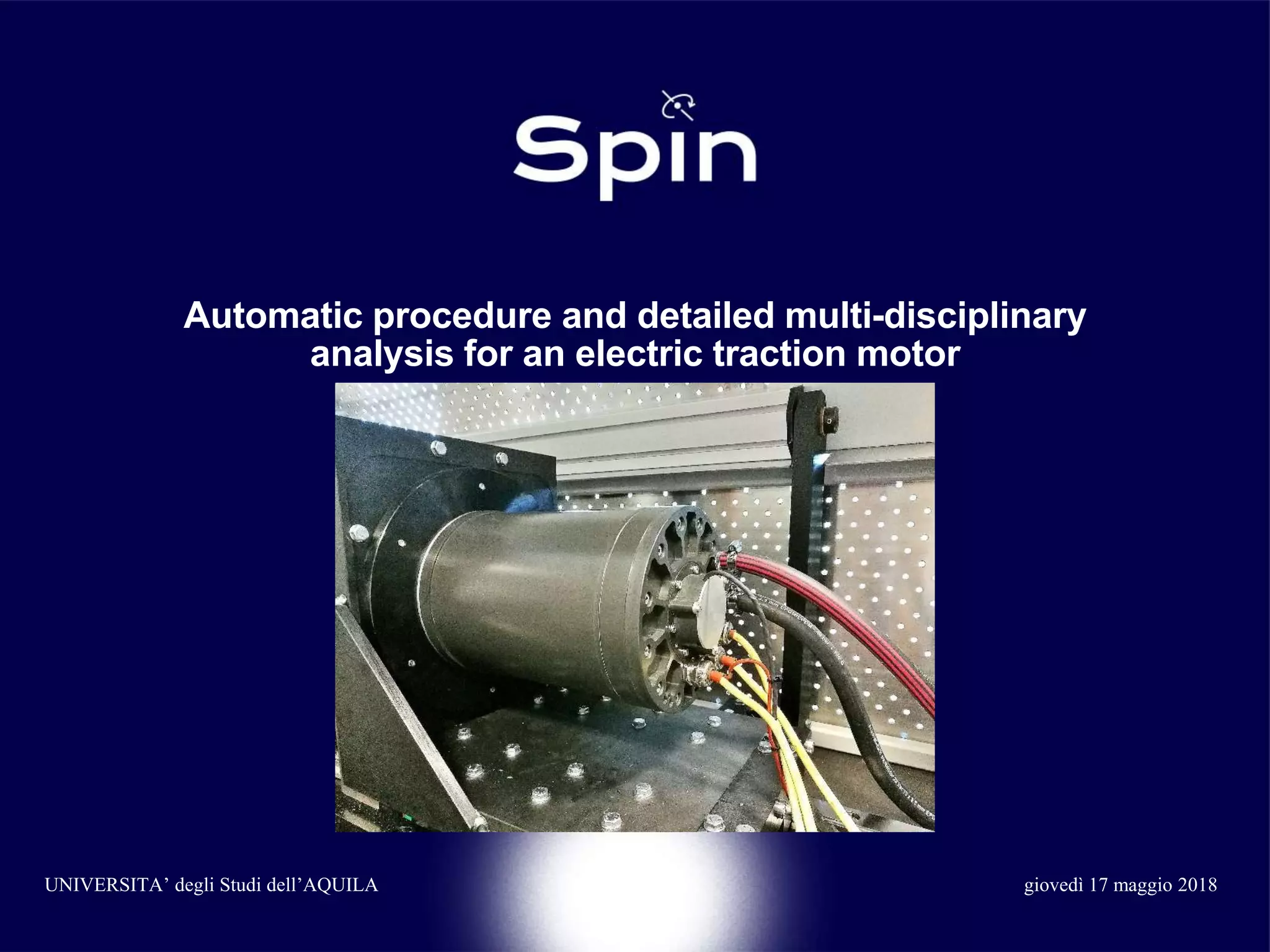
Automatic procedure and detailed multi-disciplinary
analysis for an electric traction motor
UNIVERSITA’ degli Studi dell’AQUILA giovedì 17 maggio 2018
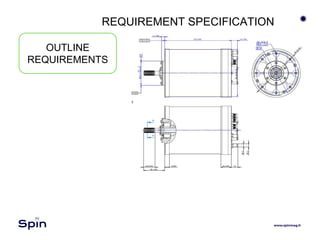
OUTLINE
REQUIREMENTS
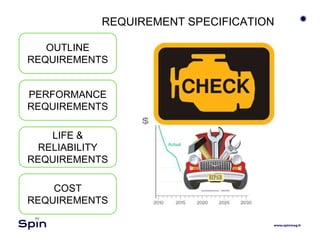
REQUIREMENT SPECIFICATION
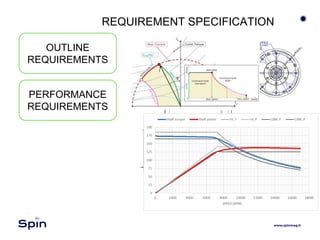
OUTLINE
REQUIREMENTS
PERFORMANCE
REQUIREMENTS
REQUIREMENT SPECIFICATION
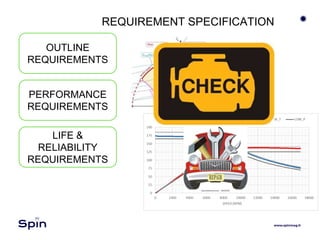
OUTLINE
REQUIREMENTS
PERFORMANCE
REQUIREMENTS
LIFE &
RELIABILITY
REQUIREMENTS
REQUIREMENT SPECIFICATION
OUTLINE
REQUIREMENTS
PERFORMANCE
REQUIREMENTS
LIFE &
RELIABILITY
REQUIREMENTS
COST
REQUIREMENTS
REQUIREMENT SPECIFICATION
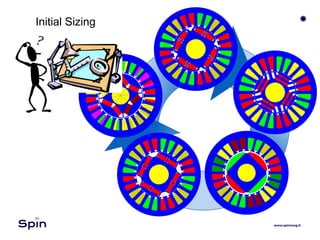
Initial Sizing
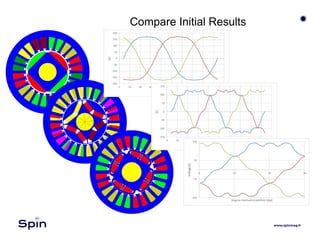
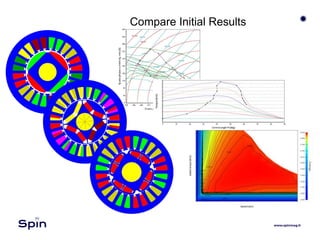
Compare Initial Results
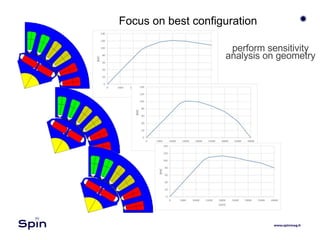
Focus on best configuration
perform sensitivity
analysis on geometry
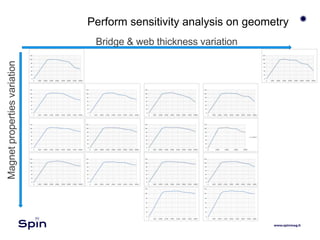
Perform sensitivity analysis on geometry
Bridge & web thickness variation
Magnetpropertiesvariation
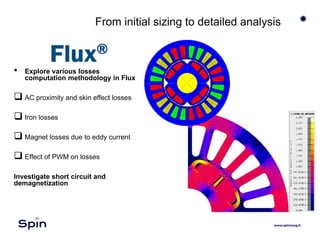
From initial sizing to detailed analysis
• Explore various losses
computation methodology in Flux
 AC proximity and skin effect losses
 Iron losses
 Magnet losses due to eddy current
 Effect of PWM on losses
Investigate short circuit and
demagnetization
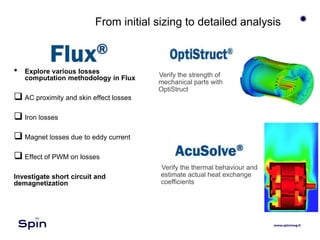
From initial sizing to detailed analysis
• Explore various losses
computation methodology in Flux
 AC proximity and skin effect losses
 Iron losses
 Magnet losses due to eddy current
 Effect of PWM on losses
Investigate short circuit and
demagnetization
Verify the strength of
mechanical parts with
OptiStruct
Verify the thermal behaviour and
estimate actual heat exchange
coefficients
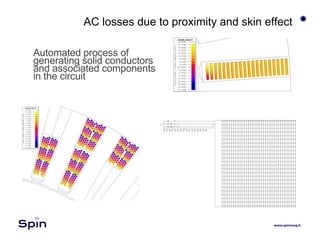
AC losses due to proximity and skin effect
Automated process of
generating solid conductors
and associated components
in the circuit
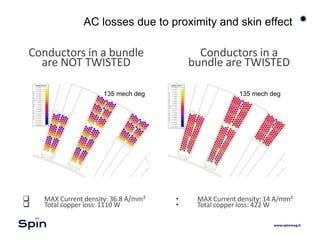
AC losses due to proximity and skin effect
135 mech deg 135 mech deg
Conductors in a bundle
are NOT TWISTED
Conductors in a
bundle are TWISTED
 MAX Current density: 36.8 A/mm²
 Total copper loss: 1110 W
• MAX Current density: 14 A/mm²
• Total copper loss: 422 W
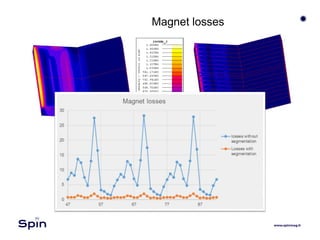
Magnet losses
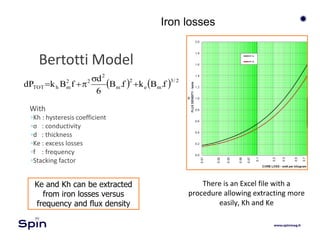
Iron losses
    2/3
me
2
m
2
22
mhTOT f.Bkf.B
6
d
fBkdP 


Bertotti Model
With
◦Kh : hysteresis coefficient
◦σ : conductivity
◦d : thickness
◦Ke : excess losses
◦f : frequency
◦Stacking factor
Ke and Kh can be extracted
from iron losses versus
frequency and flux density
There is an Excel file with a
procedure allowing extracting more
easily, Kh and Ke
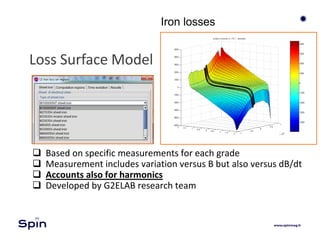
Iron losses
Loss Surface Model
 Based on specific measurements for each grade
 Measurement includes variation versus B but also versus dB/dt
 Accounts also for harmonics
 Developed by G2ELAB research team
Impact of PWM on losses
S1 without PWM
[rpm] ElMag torque [N∙m]
ElMag power
[kW]
Rotor iron losses
[W]
Stator teeth iron losses
[W]
Stator yoke iron losses
[W]
Iron losses
[W]
17000 59.37 105.70 546.42 3772.24 781.63 5100.29
S1 with PWM (switching frequency 10 kHz)
[rpm] ElMag torque [N∙m]
ElMag power
[kW]
Rotor iron losses
[W]
Stator teeth iron losses
[W]
Stator yoke iron losses
[W]
Iron losses
[W]
17000 59.58 106.07 495.82 3692.43 969.85 5158.09
S1 with PWM (switching frequency 20 kHz)
[rpm] ElMag torque [N∙m]
ElMag power
[kW]
Rotor iron losses
[W]
Stator teeth iron losses
[W]
Stator yoke iron losses
[W]
Iron losses
[W]
17000 59.34 105.63 806.06 4262.78 1015.00 6083.84
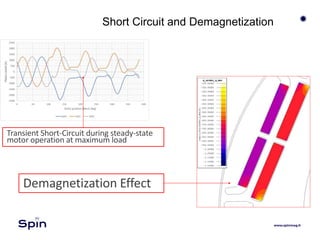
Short Circuit and Demagnetization
Transient Short-Circuit during steady-state
motor operation at maximum load
Demagnetization Effect
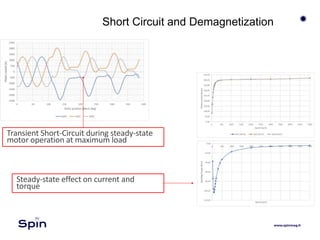
Short Circuit and Demagnetization
Transient Short-Circuit during steady-state
motor operation at maximum load
Steady-state effect on current and
torque
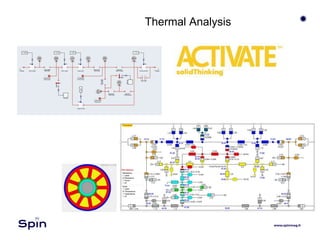
Thermal Analysis
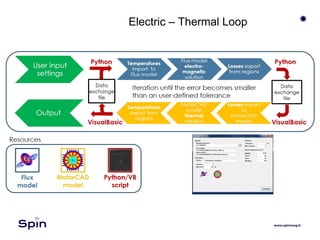
Electric – Thermal Loop
Advanced Thermal Analysis
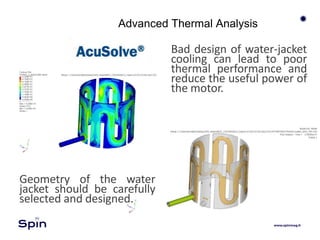
Geometry of the water
jacket should be carefully
selected and designed.
Bad design of water-jacket
cooling can lead to poor
thermal performance and
reduce the useful power of
the motor.
Advanced Thermal Analysis
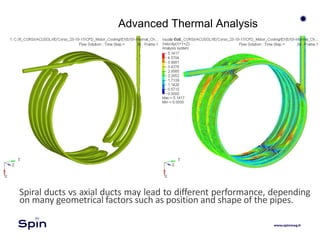
Spiral ducts vs axial ducts may lead to different performance, depending
on many geometrical factors such as position and shape of the pipes.
Advanced Thermal Analysis
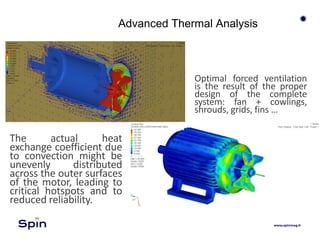
The actual heat
exchange coefficient due
to convection might be
unevenly distributed
across the outer surfaces
of the motor, leading to
critical hotspots and to
reduced reliability.
Optimal forced ventilation
is the result of the proper
design of the complete
system: fan + cowlings,
shrouds, grids, fins …
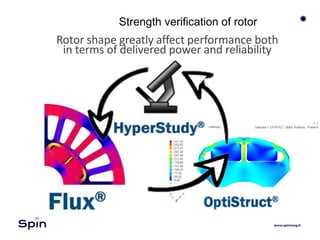
Strength verification of rotor
Rotor shape greatly affect performance both
in terms of delivered power and reliability
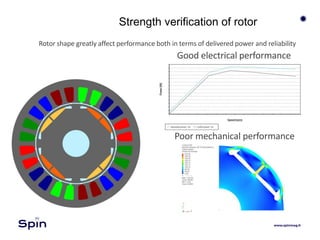
Strength verification of rotor
Rotor shape greatly affect performance both in terms of delivered power and reliability
Good electrical performance
Poor mechanical performance
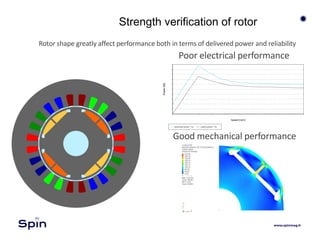
Strength verification of rotor
Rotor shape greatly affect performance both in terms of delivered power and reliability
Poor electrical performance
Good mechanical performance
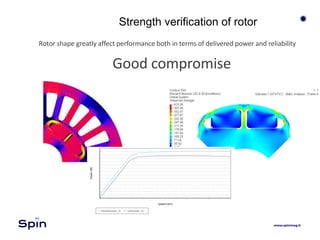
Strength verification of rotor
Good compromise
Rotor shape greatly affect performance both in terms of delivered power and reliability
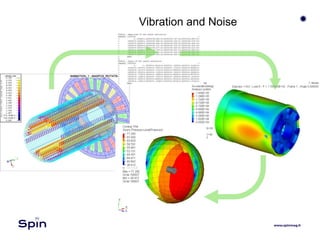
Vibration and Noise
Vibration and Noise
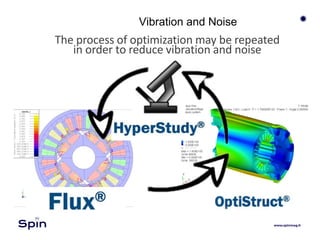
The process of optimization may be repeated
in order to reduce vibration and noise
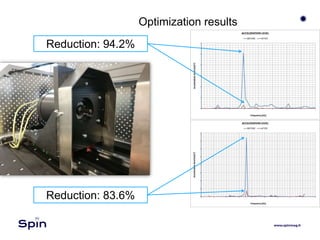
Optimization results
Reduction: 94.2%
Reduction: 83.6%
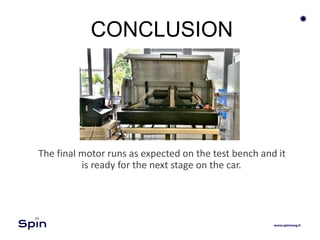
CONCLUSION
The final motor runs as expected on the test bench and it
is ready for the next stage on the car.
Spin Seminario L'Aquila

Spin Seminario L'Aquila

  • 1.
    Automatic procedure anddetailed multi-disciplinary analysis for an electric traction motor UNIVERSITA’ degli Studi dell’AQUILA giovedì 17 maggio 2018
  • 2.
  • 3.
  • 4.
  • 5.
  • 6.
  • 7.
  • 8.
  • 9.
    Focus on bestconfiguration perform sensitivity analysis on geometry
  • 10.
    Perform sensitivity analysison geometry Bridge & web thickness variation Magnetpropertiesvariation
  • 11.
    From initial sizingto detailed analysis • Explore various losses computation methodology in Flux  AC proximity and skin effect losses  Iron losses  Magnet losses due to eddy current  Effect of PWM on losses Investigate short circuit and demagnetization
  • 12.
    From initial sizingto detailed analysis • Explore various losses computation methodology in Flux  AC proximity and skin effect losses  Iron losses  Magnet losses due to eddy current  Effect of PWM on losses Investigate short circuit and demagnetization Verify the strength of mechanical parts with OptiStruct Verify the thermal behaviour and estimate actual heat exchange coefficients
  • 13.
    AC losses dueto proximity and skin effect Automated process of generating solid conductors and associated components in the circuit
  • 14.
    AC losses dueto proximity and skin effect 135 mech deg 135 mech deg Conductors in a bundle are NOT TWISTED Conductors in a bundle are TWISTED  MAX Current density: 36.8 A/mm²  Total copper loss: 1110 W • MAX Current density: 14 A/mm² • Total copper loss: 422 W
  • 15.
  • 16.
    Iron losses    2/3 me 2 m 2 22 mhTOT f.Bkf.B 6 d fBkdP    Bertotti Model With ◦Kh : hysteresis coefficient ◦σ : conductivity ◦d : thickness ◦Ke : excess losses ◦f : frequency ◦Stacking factor Ke and Kh can be extracted from iron losses versus frequency and flux density There is an Excel file with a procedure allowing extracting more easily, Kh and Ke
  • 17.
    Iron losses Loss SurfaceModel  Based on specific measurements for each grade  Measurement includes variation versus B but also versus dB/dt  Accounts also for harmonics  Developed by G2ELAB research team
  • 18.
    Impact of PWMon losses S1 without PWM [rpm] ElMag torque [N∙m] ElMag power [kW] Rotor iron losses [W] Stator teeth iron losses [W] Stator yoke iron losses [W] Iron losses [W] 17000 59.37 105.70 546.42 3772.24 781.63 5100.29 S1 with PWM (switching frequency 10 kHz) [rpm] ElMag torque [N∙m] ElMag power [kW] Rotor iron losses [W] Stator teeth iron losses [W] Stator yoke iron losses [W] Iron losses [W] 17000 59.58 106.07 495.82 3692.43 969.85 5158.09 S1 with PWM (switching frequency 20 kHz) [rpm] ElMag torque [N∙m] ElMag power [kW] Rotor iron losses [W] Stator teeth iron losses [W] Stator yoke iron losses [W] Iron losses [W] 17000 59.34 105.63 806.06 4262.78 1015.00 6083.84
  • 19.
    Short Circuit andDemagnetization Transient Short-Circuit during steady-state motor operation at maximum load Demagnetization Effect
  • 20.
    Short Circuit andDemagnetization Transient Short-Circuit during steady-state motor operation at maximum load Steady-state effect on current and torque
  • 21.
  • 22.
  • 23.
    Advanced Thermal Analysis Geometryof the water jacket should be carefully selected and designed. Bad design of water-jacket cooling can lead to poor thermal performance and reduce the useful power of the motor.
  • 24.
    Advanced Thermal Analysis Spiralducts vs axial ducts may lead to different performance, depending on many geometrical factors such as position and shape of the pipes.
  • 25.
    Advanced Thermal Analysis Theactual heat exchange coefficient due to convection might be unevenly distributed across the outer surfaces of the motor, leading to critical hotspots and to reduced reliability. Optimal forced ventilation is the result of the proper design of the complete system: fan + cowlings, shrouds, grids, fins …
  • 26.
    Strength verification ofrotor Rotor shape greatly affect performance both in terms of delivered power and reliability
  • 27.
    Strength verification ofrotor Rotor shape greatly affect performance both in terms of delivered power and reliability Good electrical performance Poor mechanical performance
  • 28.
    Strength verification ofrotor Rotor shape greatly affect performance both in terms of delivered power and reliability Poor electrical performance Good mechanical performance
  • 29.
    Strength verification ofrotor Good compromise Rotor shape greatly affect performance both in terms of delivered power and reliability
  • 30.
  • 31.
    Vibration and Noise Theprocess of optimization may be repeated in order to reduce vibration and noise
  • 32.
  • 33.
    CONCLUSION The final motorruns as expected on the test bench and it is ready for the next stage on the car.

Editor's Notes

  • #14 In order to get closer look into current density distribution across all conductors. Evaluation of unbalanced losses due to the position of the conductors in the slot. Explore the effect of twisting conductors.