INTRODUCTION
IATF 16949:2016 is the global technical specification and
quality management standard for the automotive industry
based on ISO 9001:2015. It is designed to be used in
conjunction with ISO 9001:2015, and contains
supplemental requirements specific to the automotive
industry rather than being a stand-alone QMS.
SCOPE
• The scope defines what areas to audit and also helps estimate audit time.
• For your scope, the organization needs to clearly state what products and services fall under
the QMS. Any area that is excluded from the scope needs to be clearly justified. For example,
if your organization does not design or develop any of its products or services then you
would want to state the exclusion of this section of the IATF 16949 in your scope.
• If your organization has more than one facility, you will want to list any locations that are
within or excluded from the scope of the QMS.
• When determining the scope, it is advised to consider external and internal issues,
requirements of relevant interested parties, and the products and services of your
organization.
Normative Referances
• One of the biggest differences between ISO/TS 16949:2009 and IATF
16949:2016, is that IATF 16949 is to be implemented as a supplement to and
in conjunction with ISO 9001:2015. This means that when you want to be
certified in IATF 16949, organizations must comply with ISO 9001, with
additional supplementary requirements. The new structure of ISO 9001:2015
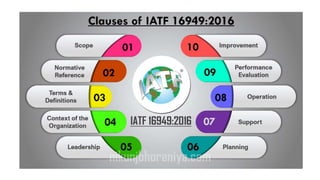
of which IATF 16949 is based off of, has ten clauses. Clauses 4-10 are
requirements.
• To make it easier for organizations to understand the unique requirements of
IATF 16949 from ISO 9001, all supplementary requirements for the
Automotive Industry (IATF 16949) will be in italics. The main reason is to
help organizations that use more than one standard, and make it easier to
maintain.
• The core concepts include management, customer, requirements, policy,
procedure, planning, performance, objective, control, monitoring,
measurement, auditing, decision making, corrective action, and
nonconformity. Many of the requirements around these concepts have not
changed.
Terms & Definitions
• Accessory part
• APQP
• After market part
• Authorization
• Challenge (master) part
• Control plan
• Customer requirements
• CSR
• Design for assembly (DFA)
• Design for manufacturing (DFM)
• Design for manufacturing & assembly (DFMA)
• Design for Six sigma (DFSS)
• Design responsible organization
• Error profing
• Escalation process
• Fault tree analysis (FTA)
• Laboratory
• Laboratory scope
• Manufacturing
• Manufacturing feasibility
• Manufacturing services
• Multi-disciplinary approach
• No trouble found (NTF)
• Out sourced process
• Periodic overhaul
• Predictive maintenance
• Premium freight
• Preventive maintenance
• Product
• Product safety
• Product shutdown
• Reaction plan
• Remote location
• Service part
• Site
• Special charectoristic
• Special status
• Support function
• TPM
• Trade -off curves
• Trade -off process
4. Context of the organization
4.1 Understanding the organization & its context
4.2 Understanding the needs & expectations of interested parties
4.3 Determining the scope of QMS
4.3.1 Determining the scope of QMS supplimental
4.3.2 CSR
4.4 QMS & its process
4.4.1.1 Conformance of products
4.4.1.2 Product safety
5. Leadership
5.1 Leadership & commitment
5.1.1 General
5.1.1.1 Corporate responsibility
5.1.1.2 Process effectiveness & efficiency
5.1.1.3 Process owners
5.1.2 Customer focus
5.2 Policy
5.2.1 Establishing the quality policy
5.2.2 Communicating the quality policy
5.3 Organizational roles, responsibilities & authorities
5.3.1 Organizational roles, responsibilities & authorities - supplimental
5.3.2 Responsibility & authority for product requirements & corrective actions
6.1 Actions to address risks & oppertunities
6.1.2.1 Risk analysis
6.1.2.2 Preventive action
6.1.2.3 Contigency plans
6.2 Quality objectives & planning to achieve them
6.3 Planning changes
6. Planning
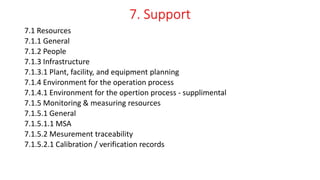
7. Support
7.1 Resources
7.1.1 General
7.1.2 People
7.1.3 Infrastructure
7.1.3.1 Plant, facility, and equipment planning
7.1.4 Environment for the operation process
7.1.4.1 Environment for the opertion process - supplimental
7.1.5 Monitoring & measuring resources
7.1.5.1 General
7.1.5.1.1 MSA
7.1.5.2 Mesurement traceability
7.1.5.2.1 Calibration / verification records
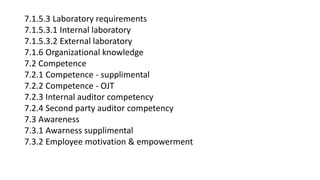
7.1.5.3 Laboratory requirements
7.1.5.3.1 Internal laboratory
7.1.5.3.2 External laboratory
7.1.6 Organizational knowledge
7.2 Competence
7.2.1 Competence - supplimental
7.2.2 Competence - OJT
7.2.3 Internal auditor competency
7.2.4 Second party auditor competency
7.3 Awareness
7.3.1 Awarness supplimental
7.3.2 Employee motivation & empowerment
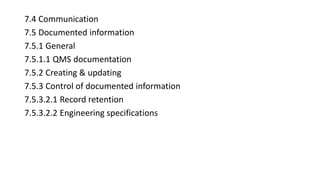
7.4 Communication
7.5 Documented information
7.5.1 General
7.5.1.1 QMS documentation
7.5.2 Creating & updating
7.5.3 Control of documented information
7.5.3.2.1 Record retention
7.5.3.2.2 Engineering specifications
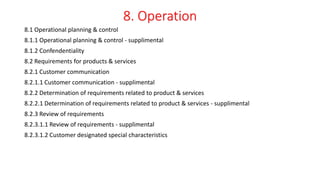
8. Operation
8.1 Operational planning & control
8.1.1 Operational planning & control - supplimental
8.1.2 Confendentiality
8.2 Requirements for products & services
8.2.1 Customer communication
8.2.1.1 Customer communication - supplimental
8.2.2 Determination of requirements related to product & services
8.2.2.1 Determination of requirements related to product & services - supplimental
8.2.3 Review of requirements
8.2.3.1.1 Review of requirements - supplimental
8.2.3.1.2 Customer designated special characteristics
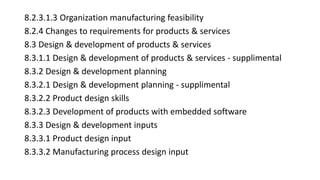
8.2.3.1.3 Organization manufacturing feasibility
8.2.4 Changes to requirements for products & services
8.3 Design & development of products & services
8.3.1.1 Design & development of products & services - supplimental
8.3.2 Design & development planning
8.3.2.1 Design & development planning - supplimental
8.3.2.2 Product design skills
8.3.2.3 Development of products with embedded software
8.3.3 Design & development inputs
8.3.3.1 Product design input
8.3.3.2 Manufacturing process design input
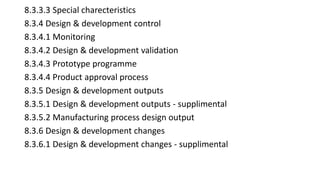
8.3.3.3 Special charecteristics
8.3.4 Design & development control
8.3.4.1 Monitoring
8.3.4.2 Design & development validation
8.3.4.3 Prototype programme
8.3.4.4 Product approval process
8.3.5 Design & development outputs
8.3.5.1 Design & development outputs - supplimental
8.3.5.2 Manufacturing process design output
8.3.6 Design & development changes
8.3.6.1 Design & development changes - supplimental
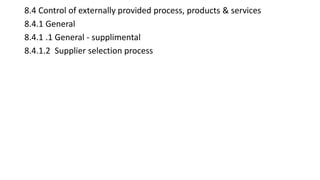
8.4 Control of externally provided process, products & services
8.4.1 General
8.4.1 .1 General - supplimental
8.4.1.2 Supplier selection process

IATF 16949 CLAUSES TRAINING MATERIAL BRIEF

  • 2.
    INTRODUCTION IATF 16949:2016 isthe global technical specification and quality management standard for the automotive industry based on ISO 9001:2015. It is designed to be used in conjunction with ISO 9001:2015, and contains supplemental requirements specific to the automotive industry rather than being a stand-alone QMS.
  • 5.
    SCOPE • The scopedefines what areas to audit and also helps estimate audit time. • For your scope, the organization needs to clearly state what products and services fall under the QMS. Any area that is excluded from the scope needs to be clearly justified. For example, if your organization does not design or develop any of its products or services then you would want to state the exclusion of this section of the IATF 16949 in your scope. • If your organization has more than one facility, you will want to list any locations that are within or excluded from the scope of the QMS. • When determining the scope, it is advised to consider external and internal issues, requirements of relevant interested parties, and the products and services of your organization.
  • 6.
    Normative Referances • Oneof the biggest differences between ISO/TS 16949:2009 and IATF 16949:2016, is that IATF 16949 is to be implemented as a supplement to and in conjunction with ISO 9001:2015. This means that when you want to be certified in IATF 16949, organizations must comply with ISO 9001, with additional supplementary requirements. The new structure of ISO 9001:2015 of which IATF 16949 is based off of, has ten clauses. Clauses 4-10 are requirements. • To make it easier for organizations to understand the unique requirements of IATF 16949 from ISO 9001, all supplementary requirements for the Automotive Industry (IATF 16949) will be in italics. The main reason is to help organizations that use more than one standard, and make it easier to maintain. • The core concepts include management, customer, requirements, policy, procedure, planning, performance, objective, control, monitoring, measurement, auditing, decision making, corrective action, and nonconformity. Many of the requirements around these concepts have not changed.
  • 7.
    Terms & Definitions •Accessory part • APQP • After market part • Authorization • Challenge (master) part • Control plan • Customer requirements • CSR • Design for assembly (DFA) • Design for manufacturing (DFM) • Design for manufacturing & assembly (DFMA) • Design for Six sigma (DFSS) • Design responsible organization
  • 8.
    • Error profing •Escalation process • Fault tree analysis (FTA) • Laboratory • Laboratory scope • Manufacturing • Manufacturing feasibility • Manufacturing services • Multi-disciplinary approach • No trouble found (NTF) • Out sourced process • Periodic overhaul
  • 9.
    • Predictive maintenance •Premium freight • Preventive maintenance • Product • Product safety • Product shutdown • Reaction plan • Remote location • Service part • Site • Special charectoristic • Special status • Support function • TPM • Trade -off curves • Trade -off process
  • 10.
    4. Context ofthe organization 4.1 Understanding the organization & its context 4.2 Understanding the needs & expectations of interested parties 4.3 Determining the scope of QMS 4.3.1 Determining the scope of QMS supplimental 4.3.2 CSR 4.4 QMS & its process 4.4.1.1 Conformance of products 4.4.1.2 Product safety
  • 11.
    5. Leadership 5.1 Leadership& commitment 5.1.1 General 5.1.1.1 Corporate responsibility 5.1.1.2 Process effectiveness & efficiency 5.1.1.3 Process owners 5.1.2 Customer focus 5.2 Policy 5.2.1 Establishing the quality policy 5.2.2 Communicating the quality policy 5.3 Organizational roles, responsibilities & authorities 5.3.1 Organizational roles, responsibilities & authorities - supplimental 5.3.2 Responsibility & authority for product requirements & corrective actions
  • 12.
    6.1 Actions toaddress risks & oppertunities 6.1.2.1 Risk analysis 6.1.2.2 Preventive action 6.1.2.3 Contigency plans 6.2 Quality objectives & planning to achieve them 6.3 Planning changes 6. Planning
  • 13.
    7. Support 7.1 Resources 7.1.1General 7.1.2 People 7.1.3 Infrastructure 7.1.3.1 Plant, facility, and equipment planning 7.1.4 Environment for the operation process 7.1.4.1 Environment for the opertion process - supplimental 7.1.5 Monitoring & measuring resources 7.1.5.1 General 7.1.5.1.1 MSA 7.1.5.2 Mesurement traceability 7.1.5.2.1 Calibration / verification records
  • 14.
    7.1.5.3 Laboratory requirements 7.1.5.3.1Internal laboratory 7.1.5.3.2 External laboratory 7.1.6 Organizational knowledge 7.2 Competence 7.2.1 Competence - supplimental 7.2.2 Competence - OJT 7.2.3 Internal auditor competency 7.2.4 Second party auditor competency 7.3 Awareness 7.3.1 Awarness supplimental 7.3.2 Employee motivation & empowerment
  • 15.
    7.4 Communication 7.5 Documentedinformation 7.5.1 General 7.5.1.1 QMS documentation 7.5.2 Creating & updating 7.5.3 Control of documented information 7.5.3.2.1 Record retention 7.5.3.2.2 Engineering specifications
  • 16.
    8. Operation 8.1 Operationalplanning & control 8.1.1 Operational planning & control - supplimental 8.1.2 Confendentiality 8.2 Requirements for products & services 8.2.1 Customer communication 8.2.1.1 Customer communication - supplimental 8.2.2 Determination of requirements related to product & services 8.2.2.1 Determination of requirements related to product & services - supplimental 8.2.3 Review of requirements 8.2.3.1.1 Review of requirements - supplimental 8.2.3.1.2 Customer designated special characteristics
  • 17.
    8.2.3.1.3 Organization manufacturingfeasibility 8.2.4 Changes to requirements for products & services 8.3 Design & development of products & services 8.3.1.1 Design & development of products & services - supplimental 8.3.2 Design & development planning 8.3.2.1 Design & development planning - supplimental 8.3.2.2 Product design skills 8.3.2.3 Development of products with embedded software 8.3.3 Design & development inputs 8.3.3.1 Product design input 8.3.3.2 Manufacturing process design input
  • 18.
    8.3.3.3 Special charecteristics 8.3.4Design & development control 8.3.4.1 Monitoring 8.3.4.2 Design & development validation 8.3.4.3 Prototype programme 8.3.4.4 Product approval process 8.3.5 Design & development outputs 8.3.5.1 Design & development outputs - supplimental 8.3.5.2 Manufacturing process design output 8.3.6 Design & development changes 8.3.6.1 Design & development changes - supplimental
  • 19.
    8.4 Control ofexternally provided process, products & services 8.4.1 General 8.4.1 .1 General - supplimental 8.4.1.2 Supplier selection process